Category: Instructional Design

  • From Myths to Principles: Part 8 Ethical Labyrinths, Interpreting Research

    From Myths to Principles: Part 8 Ethical Labyrinths, Interpreting Research

    Ethics, as a set of rules of practice, is something that instructional designers deal with on a daily basis in the form of assuring learner privacy, coursework security, instructor authorship and institutional ownership (Moore, 2021). These topics are recognizable within instructional designers’ professional work lives. However, many instructional design models like ADDIE, Backwards Design, and ASSURE do not include any acknowledgment of possible ethical concerns (Warren et al., 2023). As such, instructional designers might not recognize some ethical decisions which are a critical part of their professional job (Moore, 2021). Within immersive environments, the stakes are higher as learners are primed to experience environments far beyond a classroom or home.

    A scoping review of relevant research topics for immersive environments that covered access, content production, and deployment does not mention ethics (Gaspar et al., 2018). However, research on ethics in immersive educational environments is beginning to appear (Moore, 2021; Glaser & Moore, 2023; Zallio & Clarkson, 2022). Zallio, Huang, Osaki, Hong, Chang, Liu, and Ohashi (2024) completed a review of ethical issues in VR and AR technologies and found 15 different and broad ethical concerns including the dichotomy between the virtual and the real world (for example, abuse in immersive experiences), concerns related to user safety (for example, sensory overload) and the ethical concerns of people who surround immersive headset users (for example, caregivers). This series will look at some areas where instructional designers can exert influence even after the decision to incorporate immersive experiences has been made.

    Interpreting research

    Relying on what the research portrays on the surface does not fully illuminate what is happening within the immersive experiences. Research results were at the core of the myths illuminated earlier in this series. What might be a kernel of truth could be turned into a claim that immersive experiences will revolutionize education.

    Instructional designers can conduct literature reviews and quickly review research paper abstracts for studies that are similar to the situation being considered. R. C. Clark and Mayer (2016) summarized how to examine research claims for e-learning, but these questions equally apply to sorting for immersive experience research.

    1. “Are the methods, content, learners, and context like yours?


    2. Does the experimental group outscore the control at a significance

      level of p < .05?


    3. Does the effect size favor the experimental group at a 0.5 level or

      higher? (p. 63)


    Despite experimental results that tout learning success in immersive experiences, those results might not apply to another situation due to different variables, effect size, and other appropriate measures. Readers of research need to become adept at identifying effect sizes, immersion times, and the presence of comparison groups. In summary, “as a consumer of experimental research, you need to be picky” (R. C. Clark & Mayer, 2016, p. 56)

    Disney's Inside Out character Disgust, posing with a nonchalant look

    Disgust embodies ‘you need to be picky’

    When reviewing research, the reader may sleuth for two primary problems that might appear in immersive experience studies: the presence of novelty effect and the bane of media comparisons.


    Novelty effect


    This series defines novelty effect as the phenomena when learners are exposed to something new during instruction and the new treatment causes increased motivation, excitement, and effort. There is usually a corresponding learning gain from the increased attention (Lodico et al., 2010). R. E. Clark and Craig (1992) succinctly refer to the novelty effect as the “attitude advantage” (p. 9). Novelty effect can be suspected within a research design when the learners are exposed to a media with which they are not familiar and the learners’ time within the experience is limited. The presence of the novelty effect is generally a negative threat to external validity of a study; the study results cannot necessarily be generalized to be true for other populations.

    Certainly, an educator might be buoyed up by the illusory increase from incorporating immersive experiences. Just as motivation increases, however, it can also decrease. When the newness of the technology wears off, the learning gains tend to equilibrate to be comparable with other media choices (Clark & Craig, 1992).

    It is valid to ponder how long the novelty effect can be expected to last with immersive experience. The answer is it depends. Novelty effect is unique to each learner. Some learners might personally use immersive headsets outside of learning environments and the novelty of the experience will end sooner for them. At the time of this series’s writing, headsets and immersive learning environments are not ubiquitous, so the novelty effect can be expected for some time into the future.


    Decorative image comparing two cars that appear to be the same model; one care is very run down and dirty, the other car is new looking and stylish.

    Media comparison studies

    Much research about immersive experiences for learning has focused on the hardware and the learners’ reaction to it in the form of
    comparison studies (Glaser & Moore, 2023; Stefan et al., 2023). Studies often measure learning gains and do not give balanced
    consideration of the constraints of time, money, space, and connectivity that might have been present (McGivney, 2023). Indeed, media comparison studies are a debatable topic in instructional design. We must look at the root of the problem

    With the arrival of personal computers into education in the early 1980s, a debate arose of what causes the ideal conditions of learning: the media (which at this time was the personal computer) or the method (which is the approach taken to conduct the learning). R. E. Clark’s initial salvo in 1983, drawing on what was then already decades of empirical research, asserted that,


    There are no learning benefits to be gained from employing any
    specific medium to deliver instruction. Research showing performance
    or time-saving gains from one or another medium are shown to be
    vulnerable to compelling rival hypotheses concerning the uncontrolled
    effects of instructional method and novelty. (p. 445)

    With this, R. E. Clark called the media emperor naked. He pointed at two possible causes of learning gains seen in media comparison studies: the novelty effect (which was covered in the last section) and uncontrolled instructional methods. This latter item is when two different media experiences are pitted against each other to determine which is better. The problem is that use of different media often requires correspondingly different instructional methods. Thus, if something is taught differently, any differences cannot be the result of the media’s impact alone. The learning accomplished between the two media can be very different.

    An example of a poor media comparison would be when learners in an immersive experience are compared to learners in paper and pencil-based learning. The results of a comparison like this should be discounted due to the varying cognitive impact that the different instructional methods have on the learner (Parong & Mayer, 2021). In another example, a control group was exposed to the standard training and an experimental group was exposed to VR training in addition to and after the standard training (Seymour, et al., 2002). The VR group scored higher. The extra training time with the content could have caused higher scores, not the media. The two media conditions of one with and one without immersive experiences were not comparable. 

    Honebein and Reigeluth (2020) refer to media comparison studies as “a good guys versus bad guys competition” (p. 6). The comparison scenario has been repeated between many media. But R. E. Clark doubled down on this claim against media comparison studies in 1994 by making the “replaceability challenge” wherein he asked “whether there are other media or another set of media attributes that would yield similar learning gains” (p. 21). The research record since 1994 has supported R. E. Clark’s stance, now referred to at times as the no significant difference phenomena with media.

    Honebein and Reigeluth (2020) contended that the entire research-to-prove approach, striving to prove which media is better, needs to be replaced with a research-to-improve approach acknowledging the complexity and systemic components for each individual situation. Instructional designers can draw from this research-to-improve idea by advocating for the specific affordances that immersive experiences media might bring that stand separate from learning gains. More discussion of those affordances will be mentioned within the future directions section of this series.

    You do plan to have some learning theory in your learning experience, right?

    Missing design theories and models

    The design work for immersive experiences in education is complex. To design for the highest possible chance of learning, there should be instructional models or beacons for developers and designers to follow. Immersive experiences, as replications of real world experiences, could reasonably utilize any major learning theory. Radianti et al. (2020) reported that in their review of immersive virtual reality applications, 68% of studies did not mention a learning theory. Most papers focused on XR usability and did not connect theory with use. Checa and Bustillo (2023) asserted that constructivism, behaviorism, cognitivism, and connectivism can be foundations for a wide variety of immersive pedagogical approaches. Similarly, Marougkas et al. (2023) found that constructivism was the most commonly cited learning theory in VR studies. However, the specific affordances of presence and embodiment in the metaverse point to simulations and experiential learning as the most appropriate design theories (Reigeluth & Carr-Chellman, 2009; Johnson-Glenberg, 2018; Checa & Bustillo, 2023; Marougkas et al., 2023).


    Similarly, Castelhano et al. (2023) conducted a systematic literature review for instructional design models and found that no current model combines the best of what we know about pedagogy from two-dimensional learning with the affordances of three-dimensional technologies. For example, traditional pedagogical research has shown the importance of having clear learning objectives, a consideration of the audience, planned and structured learning, and alignment of assessment choices. All of these are standard instructional design expectations. By contrast, immersive experience research identifies the importance of segmenting training to avoid overload in intensely stimulating and surrounding environments. Also, the research stresses the equal importance of both advance briefings (on-boarding) to prepare learners for what they will experience and post-briefings (off-boarding) to allow the learners to process and engage in generative activities (Dede, 2021). Thus, researchers seem to be not putting the best of what are separate knowledge pools together.


    Similar gaps in theory-driven designs were found by Kim et al. (2023) and McGowin, Fiore, and Oden (2023). The emergent use of immersive experiences technology has precipitated haphazard designs lacking guidance:

    In these early days, trial and error plays an outsized role in design. Education researchers borrow heavily from the entertainment designers, who focus on engagement, and not necessarily on retention of content. The dearth of studies highlights the urgency for a set of guidelines for designing content that allows users to make appropriate choices in a spherical space. (Johnson-Glenberg, 2018, p. 7)


    Indeed, “theoretical frameworks devised to inform design, research, and practice in the field are rare” (Southgate, 2020).


    Problematic data


    Even after the learning event is done, assessing the results has been problematic. In a systematic review of computer-aided technologies in safety training, Gao et al. (2019) found that evidence supporting the effectiveness of the training is poor. Narciso et al. (2021) observed that the most common form of assessment used in published research of immersive experiences for learning was questionnaires. This contradicts the advice recommended by experts who point out that assessments should be tied closely to future performance (Ziker, et al., 2020). According to Stefan et al. (2023), only one-third of published studies contained some form of evaluation at all. Of those, Kirkpatrick’s Level 1, learner reaction, measurements were found 66% of the time. Some research studies do not seem to go further than asking the learners if they liked the immersive experience (Kavanagh at al., 2017; Stefan, et al., 2023). While liking an experience is pleasant, it is known that what learners like or prefer to engage in for their learning often has no positive correlation to their actuallearning (Thalheimer, 2018; Ruiz-Martin et al., 2024).


    Further problems appear once research is published. Lanier et al. (2019) noted that the median sample size in published studies was 25 participants. This number might not represent a large enough data pool to detect anything but large effects. If the impact effect of immersive experiences is supposed to be moderate, pools of 25 participants would only statistically detect the impact in about 50% of the experiments (Lanier et al., 2019, p. 14). This means that even if the inclusion of immersive experiences do positively impact learning, most published research studies cannot detect it because the sample sizes are too small. Despite researchers and educational influencers using the word significant to describe future anticipated impacts of immersive experiences, there is room for doubt that statistical thresholds are being met. 


    Decorative image with text: Immersive experiences, as replications of real world experiences, could reasonably utilize any major learning theory

    In the next part of these series, I’ll cover the ethical problems inside of the biased content creation process – both in terms of XR content and research publishing.

    References

    Castelhano, M., Morgado, L., & Pedrosa, D. (2023, November 1). Instructional design models for immersive virtual reality: a systematic literature review. http://hdl.handle.net/10400.2/15232

    Checa, D., & Bustillo, A. (2023). Virtual reality for learning. Current Topics in Behavioral Neurosciences, 289–307. https://doi.org/10.1007/7854_2022_404

    Clark, R. E. (1983). Reconsidering Research on Learning from Media. Review of Educational Research,
    53(4), 445–459. https://doi.org/10.3102/00346543053004445

    Clark, R. E. (1994). Media will never influence learning. Educational Technology Research and Development,
    42(2), 21–29. https://doi.org/10.1007/bf02299088

    Clark, R. E., & Craig, T. G. (1992). Research and Theory on Multi-Media Learning Effects. In Springer
    eBooks
    (pp. 19–30). https://doi.org/10.1007/978-3-642-77705-9_2

    Clark, R. C., & Mayer, R. E. (2016). E-Learning and the science of instruction: Proven Guidelines for Consumers and
    Designers of Multimedia Learning
    . John Wiley & Sons.

    Dede, C. (2021, May 17). Looking back: Insights from a century of cumulative research in immersive learning. [Video]. YouTube. https://www.youtube.com/live/l3tw6O8Hn-s?si=Ey6l-Na4t7YPYLu3

    Gao, Y., Gonzalez, V. A., & Yiu, T. W. (2019.). The effectiveness of traditional tools and computer-aided technologies for health and safety training in the construction sector: a Systematic review. Computers & Education, 138,101–115. https://doi.org/10.1016/j.compedu.2019.05.003

    Gaspar, H., Morgado, L., Mamede, H. S., Manjón, B., & Gütl, C. (2018). Identifying immersive environments’ most relevant research topics: an instrument to query researchers and practitioners. iLRN 2018 Montana. Workshop, Long and Short Paper, and Poster Proceedings From the Fourth Immersive Learning Research Network Conference, 48–71. https://doi.org/10.3217/978-3-85125-609-3-10

    Glaser, N., & Moore, S. (2023). Redefining immersive technology research: Beyond media comparisons to holistic learning approaches. Digital Psychology, 4(1S), 4–8. https://doi.org/10.24989/dp.v4i1s.2272


    Honebein, P.C. & Reigeluth, C.M. (2020). The instructional theory framework appears lost. Isn’t it time we find it again? RED
    Revista Educación a Distancia, 20(64). http://dx.doi.org/10.6018/red.405871

    Johnson-Glenberg, M. C. (2018). Immersive VR and education: embodied design principles that include gesture and hand controls. Frontiers in Robotics and AI, 5. https://doi.org/10.3389/frobt.2018.00081


    Kavanagh, S., Luxton-Reilly, A., Wuensche, B., & Plimmer, B. (2017). A systematic review of Virtual Reality in education. Themes in science and technology education, 10(2), 85-119. http://earthlab.uoi.gr/theste

    Kim, T., Planey, J., & Lindgren, R. (2023). Theory-driven design in metaverse virtual reality learning environments: Two illustrative cases. IEEE Transactions on Learning Technologies, 16(6), 1141–1153. https://doi.org/10.1109/tlt.2023.3307211

    Lanier, M., Waddell, T. F., Elson, M., Tamul, D. J., Ivory, J. D., & Przybylski, A. (2019). Virtual reality check: Statistical power, reported results, and the validity of research on the psychology of virtual reality and immersive environments. Computers in Human Behavior, 100, 70–78. https://doi.org/10.1016/j.chb.2019.06.015

    Lodico, M. G., Spaulding, D. T., & Voegtle, K. H. (2010). Methods in educational research: From Theory to Practice.
    John Wiley & Sons.


    Marougkas, A., Troussas, C., Krouska, A., & Sgouropoulou, C. (2023). Virtual reality in education: a review of learning theories,
    approaches and methodologies for the last decade. Electronics, 12(13), 2832. https://doi.org/10.3390/electronics12132832

    McGivney, E. (2023). Improving Technology- Enhanced Immersive Learning With Design-Based Implementation Research. Proceedings of the 17th International Conference of the Learning Sciences-ICLS
    2023
    . https://doi.org/10.22318/icls2023.213038


    McGowin, G., Fiore, S. M., & Oden, K. (2023). Towards a theory of learning in immersive virtual reality: designing learning affordances with embodied, enactive, embedded, and extended cognition. In Cherner, T. & Fegely, A. (Eds.), Bridging the XR technology-to-practice gap: methods and strategies for blending extended realities into classroom instruction, Association for the Advancement of Computing in Education (AACE). https://www.learntechlib.org/primary/p/222242/

    Moore, S. (2021). The design models we have are not the design models we need. Journal of Applied Instructional Design,
    10(4). https://doi.org/10.51869/104/smo


    Narciso, D., Melo, M., Rodrigues, S., Paulo Cunha, J., Vasconcelos-Raposo, J., & Bessa, M. (2021). A systematic review on the use of immersive virtual reality to train professionals. Multimedia Tools and Applications, 80, 13195-13214.
    https://doi.org/10.1007/s11042-020-10454-y

    Parong, J., & Mayer, R. E. (2018). Learning science in immersive virtual reality. Journal
    of Educational Psychology
    , 110(6), 785–797. https://doi.org/10.1037/edu0000241

    Radianti, J., Majchrzak, T. A., Fromm, J., & Wohlgenannt, I. (2020). A systematic review of immersive virtual reality applications
    for higher education: Design elements, lessons learned, and research agenda. Computers & education, 147, 103778.

    Reigeluth, C. M., & Carr-Chellman, A. A. (Eds.). (2009). Instructional-design theories and models, volume III: Building a
    common knowledge base. (Vol. 3)
    . Routledge.


    Ruiz-Martín, H., Blanco, F., & Ferrero, M. (2024). Which learning techniques supported by cognitive research do students use
    at secondary school? Prevalence and associations with students’ beliefs and achievement. Cognitive Research: Principles and Implications, 9(1), 44.


    Seymour, N. E., Gallagher, A. G., Roman, S. A., O’brien, M. K., Bansal, V. K., Andersen, D. K., & Satava, R. M. (2002). Virtual reality training improves operating room performance: results of a randomized, double-blinded study. Annals of surgery, 236(4),
    458.


    Southgate, E. (2020, June). Conceptualising embodiment through virtual reality for education. In 2020 6th international conference of the immersive learning research network (iLRN) (pp. 38-45). IEEE.

    Stefan, H., Mortimer, M. & Horan, B. Evaluating the effectiveness of virtual reality for safety-relevant training: a systematic review. Virtual Reality 27, 2839–2869 (2023). https://doi.org/10.1007/s10055-023-00843-7


    Thalheimer, W. (2018). The learning-transfer evaluation model: Sending messages to enable learning effectiveness. In Design
    Thinking Conference and the Learning Technologies Conference. London
    . https://www.worklearning.com/wp-content/uploads/2018/02/Thalheimer-The-Learning-Transfer-Evaluation-Model-Report-for-LTEM-v11.pdf


    Warren, S., Beck, D., & McGuffin, K. (2023). In support of ethical instructional design. S. Moore y L. Dousay (Eds.). Applied
    ethics for instructional design and technology
    , 15-37.


    Zallio, M., & Clarkson, P. J. (2022). Designing the metaverse: A study on inclusion, diversity, equity, accessibility and safety for
    digital immersive environments. Telematics and Informatics, 75, 101909.


    Zallio, M., Huang, T., Osaki, Y., Hong, S., Chang, X., Liu, W., & Ohashi, T. (2024). The ethics of immersion: A scoping review of VR and AR technologies. Accessibility, Assistive Technology and Digital Environments, 121(121).


    Ziker, C., Ydo, E., Zapata-Rivera, D., Hillier, M., & Casale, M. (2020, June). Special session—Challenges and opportunities for
    assessment in XR. In 2020 6th International Conference of the Immersive Learning Research Network (iLRN) (pp. 421-423). IEEE.

  • Does ChatGPT Enhance Student Learning?

    Does ChatGPT Enhance Student Learning?

    Not in 2026, it doesn’t.

    ChatGPT enhances academic performance.

    ChatGPT boosts affective motivational states.

    ChatGPT improves higher-order thinking propensities.

    ChatGPT reduces mental effort.

    Source: Does ChatGPT Enhance Student Learning? A Meta-analysis (Deng, et al., 2025).

    All of these statements, however, are ‘bent’ and are not necessarily true. Why? Watch the video below.

    TL:DR

    • It’s too early to conduct an AI meta-analysis.
    • Effect size is actually 0.25, with no statistical significance.
    • Authors did not include papers that show ChatGPT caused harm.

    Thus:

    • Not all research is created equally.
    • Not all data are created equal.
    • Knowledge takes time.
    • Lying with data is super easy.

    I’m sharing this because many folks disregard reading research papers altogether and will only hear the headline. Others will only read abstracts. Others will not recognize that the published paper’s research was essentially bad.


    Sources matter.

    Legitimate sources matter.

    Research methodology matters.


    It’s a tough world to navigate, instructional designers.

    Let’s be careful out there. 👮♂️

  • What Happened to The Learning Hack Podcast

    What Happened to The Learning Hack Podcast

    Serious question. What happened to The Learning Hack Podcast?

    I used to be such a fan! Of course, I was a fan of the Great Minds on Learning episodes when Donald Clark went over theory and research. But I just watched an episode and I had to bail around 49 minutes or so because it was so boring.

    And this episode had Margaret Korosec and I’ve worked (to my delight) with Margaret so I was really looking forward to listening/watching.

    Instead I found some rather boring, not-staying-on-track, and oh-by-the-way-did-you-bring-any-content stuff.  It’s interesting b/c even the host John mentions that he’s received some flack for his podcasts and I wasn’t thinking much of it.  For sure, even if he lets a live conversation wonder, he does not reign it in much in editing. But after the aforementioned 49 minutes, I was grasping for 

    some

    kind 

    of 

    point.

    Even my friend Margaret…what had she said simply beyond proposing words as questions?  

    • Teachers should learn from students when it comes to using AI in schools
    • What are the ethics involved in AI in schools? 
    • What is working and not working with AI in schools? 

    All questions. No answers. If I paid to go to this conference, for sure I’d have wanted to hear some answers to those questions. I’m in no mood for conscience pricking, thank-you-very-much. I’m an American and right now I’m getting much of that.

    The high point that I can remember is that John asked Donald and Margaret who they follow (influencer-types) in either the instructional design, learning and development, or AI in education space and they named some names. Nice, but I could have gotten that all for free off of their own respective social media feeds.

    Now let me go for the real point.

    I don’t remember The Learning Hack Podcast interspersed with SO MANY ADS. 

    Ads:

    0:33 – 1:12 Learning Technologies Conference
    1:13 – 1:51 Synthesia with a discount link  (and intros in this podcast were done by “Mariana, An AI Avatar from Synthesia”..what happened to the dear lady?)

    26:27 – 26:47  The Podcast Learning Festival 2026

    I’m guessing the ads went on but I bailed.

    And I’m sorry to say, ads for things like ‘using AI to create your learning materials’— makes me shudder– because I used to come to this Podcast for good content but now I’m going to have to wonder how much John edits in or out just to be favorable to his sponsors. 

    I get it. Perhaps the man’s gotta make a buck. But there are other choices.
     

    • If you can no longer produce your podcast, stop producing it.
    • If you must have sponsors, try to get one that might not be a conflict of interest. 🎤💧
  • From Myths to Principles Part 4 Myth: Learners learn faster

    From Myths to Principles Part 4 Myth: Learners learn faster


    From Myths to Principles: Navigating Instructional Design in Immersive Environments
    Part 4 Myth: Learners learn faster

    Credit: Burst and Canva


    Dispelling Myths


    With some background established on boom and bust cycles in the hype for immersive experiences (Parts 1, 2, and 3), we need to dismiss the rather rampant myths about learning within immersive experiences. In the hype, learning advantages have been overstated and over simplified. Web pages post outrageous claims (and I’ll show you!). Keynote presentations banty incredible promises (yup, it was recorded). This series addresses the four primary myths about learning within immersive experiences: that is, that it is faster, greater, active, and induces empathy.

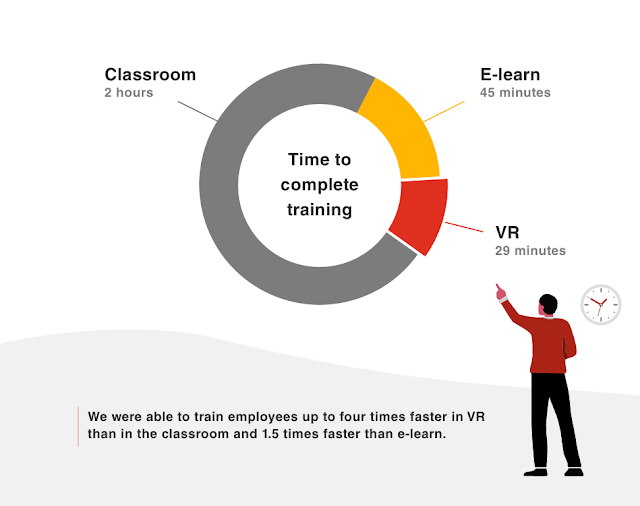
    In this Part 4, I’ll address the “learners learn faster in immersive experiences” myth. For those of you that follow my writing, you’ll know that this is Round 3 of me taking on this myth. My argument has not changed; remember this article series is an update, but not every point needs updating. However, I continue to communicate about this because the “VR learning is faster” myth continues to circulate– mostly in the reference to “4 times faster” and the PwC report. So, TLDR, the VR experience was designed to be 29 minutes long. That’s it. No longer. The classroom equivalent in content experience was designed to be 2 hours long. That’s it. 29 minutes is ¼ of 120 minutes. Someone inverted ¼ to 4x (which is factually true) and PwC who appears to have had a cozy contract with Oculus/Meta at the time, went out to trumpet the ‘four times’ from the rooftops. But students do NOT learn faster. They experienced a learning event that was designed to be faster. Had the learners spent 120 minutes in the headset, someone would have probably greedily snatched the headset off their heads and told them that they overstayed their welcome (and wondered what they were doing for the extra 91 minutes).


    Myth: Learners learn faster in immersive experiences


    The first myth asserts that learners learn faster with immersive experiences. Particularly, the phrase “four times faster” has taken root in the publications and in public discourse. A google search on the phrase “VR is 4 times faster” returns a plethora of results repeating the myth.

    4x in the wild. And it’s not hard to catch, yo.

    The source of this phrase is suggested to be one non-peer reviewed industry report by PricewaterhouseCoopers. Within the report, VR-based learning was “4x faster than classroom training on average” (Eckert & Mower, 2020, p. 8). The results of this report were then repeated in academic literature.

    Pie graph showing classroom training took 2 hours, e-learning training took 45 minutes, and VR training took 29 minutes. Text: We were able to train employees up to four times faster in VR than in the classroom and 1.5 times faster than e-learn.
    Do not make pie graphs that do not add up to one whole thing.


    Referring to the same report, D. Clark (an educational researcher not known for getting data wrong, but he did) wrote enthusiastically that “VR was x4 faster than classroom and x1.5 faster than e-learning” (2021, p. 190). Claims that learning is completed faster attempt to represent immersive experiences as a more efficient learning method, i.e., less time to learn equals learning faster.

    Tracking down how many academic papers have cited the PwC report is difficult. I’ve seen numbers as little as 4 citations and much higher numbers if I start flexing my search. Part of the problem is that folks have not cited the report (even though it calls itself a study) correctly. Some credit PwC, a few find the Eckert and Mower authors, but in general the hand wave approach to referring to the 4x data is very prevalent.


    The cause of this supposed faster learning was attributed to how a VR headset isolates the learner’s perception, so that the learner is focused on the learning task at hand. In other words, less distraction equals more focus. In the PricewaterhouseCoopers report, Likens seemed to hypothesize that, “A lot of courses that normally take an hour could be completed in 20 minutes through VR because people are so immersed in scenarios, there are fewer distractions and the learning is very concentrated” (Zielinski, 2021, para. 10).

    To be clear, in the PwC case, classroom learning which covered the same content was designed to take two hours to complete. The immersive experience was designed to take 29 minutes. Given that 29 minutes is approximately one-quarter of two hours, PwC inverted the time ratio and touted the line that the immersive learning was four times faster. The problem is that it is not true that learning in the immersive experience was faster. The VR-based learning took less time because it was designed to be a 29-minute one-on-one learning experience designed for a shorter total time duration. When compared to classroom learning, it is already known that one-on-one personalized learning is generally faster; it moves at the speed of the learner, not at the speed of the class. Perhaps, this is how myths begin. A kernel of truth gets extended to something with no context. Lack of context is a noted and rising problem in educational research (Williamson, 2024).

    Learning faster can be confused with greater efficiency. Efficiency could have a wide range of meanings beyond just taking less time. It could also mean wiser use of resources or less teaching burden on the instructor. Another example of the loose wordplay is on an industry webpage that displayed that VR training was 50% faster than a traditional in-person medical simulation. Not stated in the distilled summary of that study is that learners scored worse in the VR training than the traditional in-person medical simulation (Katz et al., 2020).


    If faster equals worse performance, this might not be the efficiency that educators are looking for.

    The myth that learning happens faster continues when educators fail to acknowledge that a different instructional method was being used. When supporting using virtual reality for chemistry studies, Muhsinah Morris, a chemistry professor and metaverse program director at Morehouse said “You can’t see molecules, but in my virtual reality classroom where I taught advanced inorganic chemistry, you can. You can actually build three-dimensional representations of molecules … The learning tends to happen faster. They go on to the real situation faster.” (D’Agostino, 2022, para. 5).

    Side point: Learning Chemistry in Three Dimensions


    Since this is my publishing space, I am going to spend some time on Mushinah Morris’ instructional and learning point here. Again, I was involved in the online teaching of chemistry for 14 years and my research speciality was science in VR, so I’ve got thoughts. If you would like to see her talk on video on this, she’s here in this video published by VictoryXR.

    She is correct that molecules cannot currently be seen in everyday life. It makes chemistry, as a field, a more abstract or conceptual field along with physics when compared to the “you can see it before you” fields of biology or earth science. Teaching that something unseen exists and engages in reactions has always been the uphill battle of chemistry teachers. So she’s describing an accurate problem.

    There is a tiny fly in the ointment, however, in that not many students at the college level fall into a chemistry course completely unfamiliar with chemistry at all. So learners in college chemistry probably were exposed to atoms in some other prior learning experience, be it high school, a museum, or a summer-camp like situation. So do her students need to learn atoms from the very beginning? I somewhat doubt that. 


    HCHE Advanced Inorganic Chemistry


    To massively further complicate her argument, she names and shows her chemistry course “Advanced Inorganic Chemistry”. That’s HCHE 421 at Morehouse University, which in 2021 had a prerequisite:

    HCHE 322 Elementary Physical Chemistry, which itself has 3 prerequisites:

    CHE 321/321L, Elementary Physical Chemistry and Lab (which has 4 prereqs: CHE 232, PHY 154, and MTH 161 and 162)

    PHY 253 Electricity & Magnetism, which has 2 prerequisites: PHY 154 (C or better) and MTH 162

    MTH 271 Introduction to Linear Algebra, which has 1 prerequisite: MTH 161

    You see where I’m going here. It’s highly doubtful that students arriving in an advanced chemistry class after what is years at college, whose content focus is actually math (that’s what inorganic focuses on) and not spatial abilities (which arguably organic chemistry DOES focus on) have a substantial problem with visualizing atoms and molecules to the point where it is disturbing their learning performance. And therefore VR could make a difference. No. Not buying it. 

    Covered in the mentioned course’s lab. That’s math, yo.

    Nonetheless, I’ve known very smart and exposed people have trouble visualizing atoms. So it IS remotely possible and let’s pretend she is articulating only the beginning of the trouble of understanding for a lay crowd…not the only problem. Said another way, she’s speaking about VR’s affordances overall, maybe not specifically for her students in her aforementioned class. For example, some chemical reactions are easy to understand (like cooking) and some are difficult to understand (like how hair coloring works or cell electrical potentials).

    It is interesting that she said “The learning tends to happen faster.” It’s a couched statement, for sure, with the word “tends”. In science that cannot be pinned down. So she gave herself an out. But what was she describing? At this point, we have to think about the instruction of chemistry.

    How To Show Atoms and Molecules

    Within the history of chemistry itself is the continuing saga of how will atoms be depicted? As in, how do you draw them? How are they really? And how does a teacher relay that ‘realness’ to the learners– and why? 


    So we’ve had our:


    Atoms are indivisible tiny units, folks. Thank you to the Greeks! There are no pictures from that time.


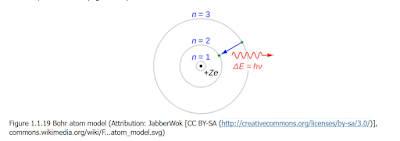
    We’ve had Bohr’s heliocentric-like model folks wherein the atom looks like a solar system or set of concentric rings. To be fair, the heliocentric model really does help explain things like electron energy levels.

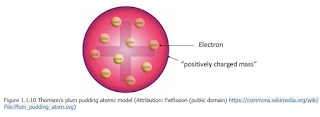
    We’ve had our Thomson plum pudding folks– which never translated from its culture. Which is probably a shame. I like plums.


    We’ve had our ‘cloud model’ folks – which are like the postmodern philosophers of chemistry. Truth for me, truth for you, we all get a truth, which isn’t true. But they told us that electrons cannot be pinned down and measured, they could be anywhere at any time but when we set about measuring them, that’s when they run away from us. Yes, I’m nodding to Heisenberg here. And wave/particle theory.

    Cloud model of what an atom looks like.


    After the heliocentric model, however, depictions of atoms needed to be displayed as three-dimensional, not just as two-dimensional on flat paper. By far, I’ve only selected some of the atomic model theories here. If you want to know more, study chemistry! It’s not hard.

    But, now, going against Mushinah Morris’ arguments now, educators HAVE been working on that educational problem for years (with success, mind you).


    First of all, delightful molecular (and atom) kits exist with physical manipulatives. Yeah, they look like tinker toys. I love them. They are good for at least 30 minutes of instruction, maybe more. They are usually plastic (boo, although there is nothing stopping them from being made of wood) and the kits would have to be purchased, stored, and de-germed from time to time. So they have their minor downsides.


    Second of all, 2D screens can show 3D objects…that’s entirely possible.


    Third, programming VR to follow mathematical principles – like, voila, chemistry DOES!– is actually not that hard. The first uses of VR in education that I know of were in the “physical”—that is mathematical sciences, physics and chemistry. Let’s face it. A computer understands 9.8 meters per second per second MUCH easier than a person does. (<- that’s one gravitational force).

    And get this, purchasing a simulation to teach atoms is so drop-dead cheap that it’s actually free by now. I have recommended those simulations for courses before and seen learning scores do quite well, thank you. 

    Looks pretty 3D to me


    I seriously bet that if I had been able to place that counter proposal before her administrators, I’d win the budget proposal. Ha! Bonus points that I could prove that my students would score equally to her VR students on the final exam.

    So in all, did she make a good point here? I’d say no but that’s because I recognize the instructional problem and I realize that the problem can be solved in a much cheaper and equally as efficient way. Also, she showed no data that “the learners learned faster”.

    Side point to the side point: Mushinah Morris on YouTube is highly associated with VictoryXR, the vendor that she is using when referring to her VR-for-education accomplishments. Close association with XR vendors makes for suspicious conclusions. I’m not picking on Mushinah Morris unfairly. She’s gone on the record multiple times for her claims. I could easily pick (and will in the future) other education influencers that are selling the VR-for-education snake oil.

    Back to my article

    Further, there is at least one study (so far!) that refutes this focusing-causes-faster-learning claim. Makransky, Terkildsen, et al. (2019) found that immersive metaverse environments could be sensory overload for learners and therefore decrease the learner’s focus. On the whole, claims for increased speed can often be attributed to more efficient instructional methods. Immersive experiences can allow for the utilization of comparatively faster instructional methods.

    The author finds this myth, that immersive experiences cause learners to learn faster, false.  (more…)

  • From Myths to Principles Part 3 The Case Against Virtual Campuses

    From Myths to Principles Part 3 The Case Against Virtual Campuses


    From Myths to Principles: Navigating Instructional Design in Immersive Environments
    Part 3 The Case Against Virtual Campuses

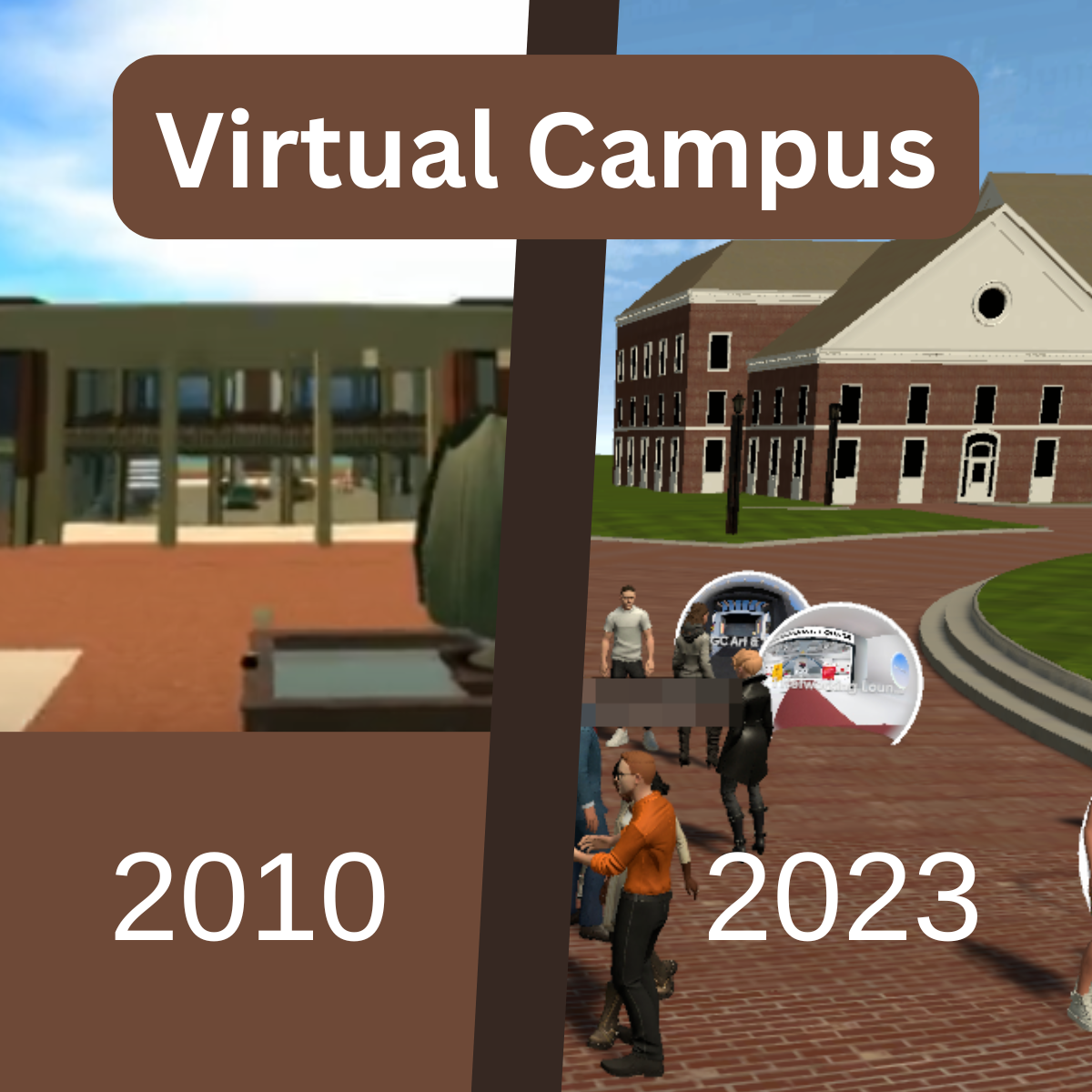
    Virtual Campuses: 2010 and 2023. Not much has changed; they still don’t work.


    I write this title with a tinge of irony. I’ve owned virtual campuses. I’ve worked on virtual campuses. If asked to work on a virtual campus again, I’d likely say yes.  So what’s my beef with virtual campuses?

    I feel that a sober-eyed look at virtual campuses* is necessary.

    Following the philosophy of ““those who cannot remember the past are condemned to repeat it” (Santayana), here is Part 3 of my series: From Myths to Principles; Navigating Instructional Design in Immersive Environments.

    The rise and fall of the metaversity

    In Part 2 of this series,I examined two examples from the history of immersive learning. First, I showed the parallels when companies like Meta and Linden Lab dominate a single platform for immersive learning designs. The lesson is that what is allowed one day can quickly become disallowed the next day. Second, I pointed out the inappropriate boasting and poor course design used in the “first course in virtual reality” by Stanford University. In these recent cases (Meta and Stanford University) there was a remarkable lack of awareness of the history of immersive learning. Said another way, mistakes of the past were repeated.

    In another example of history repeating itself, ten colleges and universities adopted digital twin campuses in June 2022 using the ENGAGE platform with monetary support and donated VR headsets from Meta (Koenig, 2022). These metaversity locations recreated (or created!) campus buildings to allow learners to gather on the virtual campus. 

    Eight years prior, Second Life (SL) campus buildings were “designed to mimic real-world architectural equivalents” but had become “abandoned ghost towns” (Wecker, 2014). 

    The early Second Life virtual campus creations were often the result of student projects. Confusingly, the professors who designed and assigned these projects touted the work of creating faithful campus recreations as creative and thus, at the highest level of Bloom’s cognitive learning objectives. I’m inserting a heavy eye roll here because that’s really stretching the justification of working in virtual reality to an extreme point.  Plus, I have to point out: what does next year’s class build if this year’s class made the campus?  My point is that simply building campus buildings (so that you can have a virtual campus!) is a project idea that runs out of steam. Things got really interesting right after the SL virtual campuses were launched.  Everyone involved noticed that the spaces were not being utilized. 

    Students were asked why they weren’t visiting the virtual campus. 

    The answer was simple.

    No one was there.

    You see, you could have the most amazing design with all of the bells and whistles (really!), but if people were not there, then people found that there was no compelling reason to return. Admissions folks had no compelling reason to be in the virtual admissions building, same for financial aid teams. Even library teams today in virtual reality struggle to staff spaces with the same spread as IRL (in real life) libraries.

    During a recent tour of the University of Maryland Global Campus metaversity campus, the audio connection failed. The host did not offer any tech support. The experience showcased empty buildings during what was a busy time of the academic semester. To be fair, I understand the implications of FERPA which might have predicted that students were in classroom spaces separate from public spaces. However, it is logical that on any campus, students could still be found  in public space buildings like the networking lounge. These accurate campus recreations rarely spur more than a passing interest to learners. 


    The ten colleges and universities in this project are now facing the end of the project and the initial funding is ending. Steven Van Hook commented that, “Administrators may speak of their twin campuses in glittering terms on the record –then off the record talk about their regrets and what else they could have bought for the hundreds of thousands of dollars” (VWBPE, 2024). According to Temple University’s Kathy Hirsh Pasek, “A year ago, a lot of companies were going full steam ahead. Today’s that’s not true; they’ve rerouted a lot of their funds for AI and Twitter alternatives” (Coffey, 2023, para. 37) Institutions made the decision to adopt immersive experiences but do not appear to know how to make wise decisions when generous funding stops and societal attention moves on.

    The key problems

    Therefore, throughout these first three parts of this series, there are several challenges apparent. Instructional designers and administrators must wade through the myriad of claims derived from dubious research studies. It feels like chicanery to figure out which statements about immersive experiences for learning are authentic and do point the way to future positive outcomes and which statements are in doubt. The first issue is with interpreting research wisely. Every research study has inherent flaws; no one study can definitively provide answers to all of education’s questions. This situation is made worse when the research is translated into social media and seems to tout incredible claims (Lanier et al., 2019).

    Therefore, the conundrum has been illuminated. The myths that appear to come from a research basis must be dispelled. Next, the very basis of the published research record is at risk of bias and problems. This series will inform on what characteristics to look for in published research.  Finally, if one were to step around the research interpretation problems, what is the system for building and using immersive experiences for its best advantage? This series will attempt to answer these questions. This series then forms the navigator role for instructional designers and administrators figuring out how to chart a route to a successful implementation.

    Post Script

    *virtual campuses

    I’m using the term virtual campuses to specifically refer to real work recreations of campus spaces like quads and lecture halls. I am not referring to simulations (for example in science courses) or spaces specifically designed for social use (for example, dance halls).

    Virtual campuses were designed as early as 1999 as text-based educational MUVEs (multi user virtual environments). This example classroom shows “the room’s description, list of contents, who  is in the room, the exits, and links to applications” (Maher, et al., 1999).

    Technically, ‘Nobody else is here’ might have been foresight.

    The metaversity concept is not to be confused with metauniversities, which are global collaborating universities (Costanza, et al., 2021). It appears as though the metaversity term became popular in 2021 and the company ENGAGE is not the only entity to claim it.

    Coffey, L. (2023, July 11). “Metaversities” face virtual learning’s financial reality. Inside Higher Ed | Higher Education News, Events and Jobs. https://www.insidehighered.com/news/tech-innovation/teaching-learning/2023/07/11/metaversities-face-virtual-learnings-financial

    Costanza, R., Kubiszewski, I., Kompas, T., & Sutton, P. C. (2021). A global metauniversity to lead by design to a sustainable well-being future. Frontiers in Sustainability, 2, 653721.

    Koenig, R. (2022, June 6). With Money From Facebook, 10 Colleges Turn Their Campuses into ‘Metaversities.’ EdSurge. https://www.edsurge.com/news/2022-06-01-with-money-from-facebook-10-colleges-turn-their-campuses-into-metaversities

    Lanier, M., Waddell, T. F., Elson, M., Tamul, D. J., Ivory, J. D., & Przybylski, A. (2019). Virtual reality check: Statistical power, reported results, and the validity of research on the psychology of virtual reality and immersive environments. Computers in Human Behavior, 100, 70–78. https://doi.org/10.1016/j.chb.2019.06.015

    Maher, M. L., Skow, B., & Cicognani, A. (1999). Designing the virtual campus. Design Studies, 20(4), 319-342.

    Wecker, M. (2014, April 22). What ever happened to Second Life? Chronicle Vitae. https://chroniclevitae.com/news/456-what-ever-happened-to-second-life

    #VirtualCampus #edtech #VirtualUniversity

    This article is simultaneously posted to LinkedIn and to my blog. My copyrights are retained. This article cannot be used to train AI.


    (more…)

  • From Myths to Principles Part 2 The Immersive Environment Delusion

    From Myths to Principles Part 2 The Immersive Environment Delusion

    From Myths to Principles: Navigating Instructional Design in Immersive Environments

    Part 2: The Immersive Environment Delusion

    Decorative scifi retrofuturism image of a person morphing with a computer.
    Image: Me and Copilot working on this using the article title, The Computer Delusion but making it personal, jazzy, and teal.


    In Part 1, we introduced this new series, From Myths to Principles: Navigating Instructional Design in Immersive Environments. This is an update from my 2022 series.

    In this Part 2, we’re going to go through some backstory showing the educators in Second Life was the first wave of hype for using immersive environments and we’ll look at one recent example from Stanford University with their “Virtual People” course.

    Here we go!

    History repeats itself

    The history of educational technology is a rhyme that repeats. Initial pitches have created optimism that the next big thing in technology will revolutionize education. Oppenheimer (1997) in a really well written article illustrated part of the history of educational technology by citing four examples:
    1. Edison’s 1922 prediction that the motion picture will revolutionize education.
    2. Levenson’s claim that radios will become common in every classroom.
    3. Skinner asserted that learners with teaching machines could learn twice as much.
    4. Clinton campaigned that computers are a bridge to the twenty-first century. (para. 1)

    The motion picture, the radio receiver, programmed instruction, and computers in the classroom have all failed to significantly impact learner performance. The past 102 years have not been kind to hyped educational technology predictions.


    I can hear you through the nether.
    There are some saying “But the metaverse is different!”
    Sit down. 👈😠
    I’ll deal with you soon enough.


    Cuban (1986) further suggested that this educational technology adoption cycle follows a predictable pattern. First, the earliest research will be produced by the technology producers themselves. Second, problems arise with adoption. Learner performance does not improve over the long term. The final stage in the cycle is blame-finding with reasons ranging from not enough money, educator resistance, and educational systems resistant to change. The methods and reasoning for incorporating the technology are rarely addressed in the historical or market record. The reader of this series might recognize these statements already being made about immersive experiences. As such, hype cycles for immersive experiences are already underway.
     
    This last point deserves emphasis. Here are the steps again:

    1. Tech producers make the first “research”.
    2. Tech adopted, but learner performance does not improve long term.
    3. Blame-finding ensues.

    I wanted to emphasize these points because they are going to appear in the research record that I will present.

    Boom and bust cycles


    Immersive experiences have already weathered several boom and bust cycles. One cycle began between 2003 and 2009. The desktop-based virtual reality program called Second Life, created by Linden Lab, attracted over 100 universities (Brown & Sugar, 2009) and thousands of dollars of investment (Wecker, 2014).

    In a sudden decision, Linden Lab eliminated its 50% discount for educational institutions (Harrison, 2010). What resulted was an educator exodus and fracture in the faith of immersive experiences for education. When referring to the shutdown of Woodbury University’s virtual campus for breach of conduct, Jordan Bellino, a senior learner at the institution, described the hazard when one major company dominates use:

    The incident suggests the dangers of online meeting spaces’ being run by companies, which get to decide who participates and who doesn’t. “It took years and thousands of dollars to make that virtual campus happen,” he said, “and it all vanished in a matter of an hour because Linden Lab pushed a button.” (Young, 2010, para. 12)

    Major technology companies can single-handedly dictate use of immersive environments. This would be a valuable lesson lost before the next boom cycle began in 2018.

    First course in virtual reality 


    After the launch of the consumer-oriented Quest headsets and the mandate for remote learning due to the COVID pandemic in 2020, interest in immersive environments surged. In June of 2021, Stanford opened their Virtual People course to 263 learners (Bailenson, 2021). 


    Source: https://news.stanford.edu/stories/2021/11/new-class-among-first-taught-entirely-virtual-reality

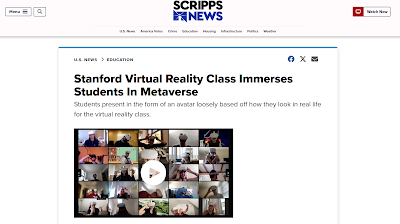
    Source: https://www.scrippsnews.com/us-news/education/stanford-virtual-reality-class-puts-students-in-metaverse

    The course was touted to be the first class in the world to be held inside of virtual reality (Hadhazy, 2021) which seemed to cast aside the nearly two-decade deep body of research on courses held as immersive experiences. The prestige of the course was further hyped when one of the course professors boasted:

    I can now stand up in front of all my students and there’s, you know, two hundred in the class, and I can say you will actually have a better chance of getting a job in the Valley because of taking this class because as of about a year ago, the most sought-after job in the Valley went from a data scientist to a VR engineer. (Bellini, 2024, para 12)

    The VR-based learning resulted in greater presence, enjoyment, motivation, and transfer (Han & Bailenson, 2024). However, within the course, all was not well. Video clips from the class showed learners struggling to control their avatars (Bailenson, 2021) and attending class just to stand around in circles (Bellini, 2021).


    (In case video does not display, it’s here: https://youtu.be/gOLI_OIV3nc?si=jv2LF-d4Dz8sIZsf)


    In spite of the boasting, published reports illuminated problems with onboarding learners to the VR headset experience, unexpected software updates, and sudden platform shutdowns (Han & Bailenson, 2024). 

    The instructional design was described as learning by doing, but the syllabus showed a majority of outside-of-virtual-world writing and quiz items. Within the immersive environment, there were required weekly discussion sessions (Han et al., 2022) and one project where learners could import 3D (three-dimensional) objects to make a unique VR environment. My translation? That’s not much doing, actually, as it relates to being a “virtual person”. 
     
    Much to the professors’ astonishment, one group of learners made a mock fake moon landing production set (Brown et al., 2023). For the course instructors, this suddenly raised the specter that immersive experiences can create false depictions or fake memories, a topic that will be revisited in the ethical labyrinths section of this series.


    In Part 3, I’ll share another example of boom and bust from the immersive environments-for-education market.

    Post-publication edit:


    They say there is no editor like the “Publish” button and that makes me laugh because you DO spot errors after something has been published.  But in this case, it’s not an error that I want to address, I want to add more depth and context to this post. Since it’s my blog, I can.  This work was previously planned to be a book chapter and as such, I held my tongue on some of my more pointed criticism and images. But here, I can lay out things more directly.

    Directly I am pointing to the Communication 166/266:Virtual People course as a poor design from an instructional designers point of view.  I have studied the syllabus and read several articles and watched videos produced about the course.  You can read the syllabus.


    What I can’t find is how many credits the course was. Just guessing from the workload in the syllabus, I’d guess 2 credits.  Could be 3 but it also could be 1. I severely doubt it’s 4.

    Where do I get the platform to critique this course?

    1. I have 14 years full time experience teaching online. Until ~2034, there are very few that can match me with that kind of full time teaching experience.  Now Bailenson’s class was arguably not “online” by definition (it happened in June 2021 or so and that would be post-shutdown), but it appears to have happened entirely remotely with the exception of picking up the headsets.  So I can claim some expertise about what SHOULD happen with digital-based instruction.
    2. My doctorate is in Instructional Design specifically *for Online Learning*. So I’ve spent my time focusing on that.
    3. My research focus was and is learning in immersive environments (hence this article series).
    4. Uniquely, I ALSO taught a course using the Meta Quest 2s which had a similar “survey” type of design. So what Bailenson did by visiting topics each week briefly is NOT part of my critique.

    Three things are my main concerns here:
    1. Video clips show a ridiculous amount of on-boarding malarkey.  Said another way, bringing learners into a 3D environment, not acclimating them to this and then bringing in various models and just letting the users play is nice for an introduction. It does NOT make a course and certainly it does not argue for a widespread use of the technology.

    I’m sure that in one version of the video, I could hear learners over and over again gathered in small groups supposedly “doing” something in VR only to hear “can anyone hear me?” as a COMMON statement.  Take my word for it; a class filled from beginning to end with learners not being able to hear or be heard does not count for much learning.

    My point: there isn’t evidence that anything other than some “visits” to VR happened.  And yet, over and over, this flagship course (my phrase) has learners that can’t walk, wave, or follow instructions and (I guess) hear instructions. After week one, the learners *should* be on-boarded, all practiced up and ready to do harder things. ‘Just walk over here for a group photo’ should not feel like an instructionally-impossible task– and the videos sure do make it look like it was. 

    (I had to giggle because in that “all class” photo, there is one avatar in 2D (not in a headset, because they don’t have hands and their movement is all 2D-type) and they are the only one that looks “logical” in their behaviors.)

    2. Bailenson really shows his excitement (in the somewhat unprofessional video) but also the “un-put-togetherness” of this experience with the quote I provided:

    I
    can now stand up in front of all my students and there’s, you know, two
    hundred in the class, and I can say you will actually have a better
    chance of getting a job in the Valley because of taking this class
    because as of about a year ago, the most sought-after job in the Valley
    went from a data scientist to a VR engineer. (Bellini, 2024, para 12)


    I find it VERY hard to believe that this one course at the 100 and 200 level will lead for a number like 200 new VR engineer’s getting jobs in “the Valley”.  Insert hard eyeroll here. 🙄  It looks extra bravado-y when he phrases it as “I can now stand up” as if he’s really planning to do this or HAS done it.  It’s a brag.  No humble about it.  Last I checked, the Valley wants to hire computer scientists, who should be in calculus class at the same time as this headset romp. Fact check: The Valley has been laying off VR teams.  So how’s that ‘better chance of getting a job’ brag going for ya?

    3. The learn-by-doing quote gets under my skin as an instructional designer. Learn WHAT by doing WHAT, in this case? His students had to use pre-existing 3D models included in the ENGAGE platform (OK, fine– but note that I didn’t see ANY examples of models beyond ones we’ve already seen in ENGAGE advertising) to build a scene that was basically their final project. 

    (Again, disclosure: my students final project was a video mock-up of an immersive experience that they would design, if they could. The course taught no programming skills.) 

    So OK, it’s fine that learners can’t program after 1 course. Totally understood. But then the learners put together a final project scene that sounds like Bailenson’s team spit out their coffee over…J. Brown source described the team experience as, “jarring” and wanted to coin a new phrase, “mis-experience.”  What the phrase? Garbage in, garbage out?  You don’t design a compelling course and the results surprise you?  Sigh.

    It appears that they took the “made lemonade from lemons” approach. Note that I haven’t mentioned ANYTHING about comparative learning outcomes related to this heralded course. Because there isn’t any data on that. Not like there should be, but the research is remarkably silent on that.

    Also fact check on this: the Meta Quest 2 headsets are officially OUT of support and sale from Meta. So they are, as of this writing, outdated.  I wonder how it’s going over there at Stanford. Do they just ring up Mark and ask for 266 more headsets in the Meta Quest 3 type now?

    I haven’t mentioned much, (actually I left it OUT), how much ENGAGE got free advertising from this mess.  That’s because they are really the main characters in the NEXT episode.

    References

    Bailenson, J. M. (2021). Stanford “Virtual People” class in the metaverse. [Video.] YouTube. https://youtu.be/gOLI_OIV3nc?si=if6DbOX43GESWTBd

    Bellini, J. (2021, December 7). Stanford virtual reality class immerses students in metaverse. Scripps News. https://www.scrippsnews.com/us-news/education/stanford-virtual-reality-class-puts-students-in-metaverse

    Brown, A., & Sugar, W. (2010). Second life in education: The case of commercial online virtual reality applied to teaching and learning. Themes in Science and Technology education, 2(1-2), 107-115.

    Brown, J., Bailenson, J., & Hancock, J. (2023). Misinformation in virtual reality. Journal of Online Trust and Safety, 1(5).

    Cuban, L. (2001). Oversold and underused: Computers in the classroom. Cambridge, MA: Harvard University.

    Hadhazy, A. (2021, November 5). Stanford course allows students to learn about virtual reality while fully immersed in VR environments. Stanford Report. https://news.stanford.edu/stories/2021/11/new-class-among-first-taught-entirely-virtual-reality

    Han, E., & Bailenson, J. N. (2024). Lessons for/in virtual classrooms: designing a model for classrooms inside virtual reality. Communication Education, 73(2), 234-243.

    Harrison, D. (2010, November 3). Linden Lab to end Second Life educational discounts. THE Journal. https://thejournal.com/Articles/2010/11/03/Linden-Lab-To-End-Second-Life-Educational-Discounts.aspx?Page=1

    Oppenheimer, T. (1997, July). The computer delusion. The Atlantic. https://www.theatlantic.com/magazine/archive/1997/07/the-computer-delusion/376899/

    Wecker, M. (2014, April 22). What ever happened to Second Life? Chronicle Vitae. https://chroniclevitae.com/news/456-what-ever-happened-to-second-lifeYoung, J. (2010, April 21). Woodbury U. banned from Second Life, again. Chronicle of Higher Education. Wired Campus. https://www.chronicle.com/blogs/wiredcampus/woodbury-u-banned-from-second-life-again

    (more…)

  • From Myths To Principles: Navigating Instructional Design in Immersive Environments Part 1 Introduction

    From Myths To Principles: Navigating Instructional Design in Immersive Environments Part 1 Introduction

    From Myths to Principles: Navigating Instructional Design in Immersive Environments

    Part 1 Introduction

    Decorative image with text: From Myths To Principles: Navigating Instructional Design in Immersive Environments with image of cloaked traveler on a mountian looking towards a break in gray clouds towards some buildings.

    This article begins a new series where I intend to continue to bust myths related to learning in immersive environments while also advocating for research-based decisions related to instructional design.

    Now if that sounded like gobbly-gook, this might not be the series for you. But, for anyone with an interest in virtual worlds, the metaverse, or even a simple 2D simulation and the uses of these for education, this is the RIGHT place for you.
     
    This is an updated version of my original 8-part Instructional Design in the Metaverse series. (Did you miss that? Here’s my 3 minute explainer video.) I estimate that I have at least 15 parts right now to start this series and new research comes in every day. However, this being my blog, I intend to spill a little more tea here than I do in other places.

    Buckle up buttercups
    !


    (more…)

  • Happy Twelvetide! 12 of My Most Favorite XR for Education Examples

    Happy Twelvetide! 12 of My Most Favorite XR for Education Examples


    Happy Twelvetide or the name you might recognize, The 12 Days of Christmas!
    For
    you, I’ve arranged 12 of my most favorite XR-for-education examples.
    These are virtual sites, simulations, companies, or concepts.

    But what’s a good story without some twists?
    – Some of these no longer exist. Let that twist your noodle. 😕
    – Some are concepts.
    – These were originally posted to LinkedIn as separate posts. This blog posts represents all 12 in one place (so buckle up, this will be long).

    Day 1 Heritage Key

    Happy Twelvetide! Number 1 on my 12 favorite
    XR-for-education list is Heritage Key by Rezzable. It was in Second Life
    and then Open Sim ~2008-2010, but no longer exists. Visitors could
    visit recreations of Stonehenge or the Valley of the Kings.

    My fav parts?

    Users **participated** in the building of Stonehenge. (THINK: NPCs
    giving instructions to quests in games.) Did you know that there were
    different versions of Stonehenge over thousands of years, including a
    wooden one?


    Time travel – The Stonehenge location (if I’m remembering it correctly)
    had “time travel” for visitors to go to Stonehenge in different times
    by directing users BACK to an underground Visitors Center where
    (unbeknownst to the visitors) the overhead scene would change and go
    forward ~500 years or something. Nice time travel technique!


    Avatar clothing. Each location offered avatars garb to wear appropriate
    to the builds (all of them, at once). I remember the choices where:
    Druid-theme, Thebes-theme, or Indiana Jones-theme. All a super fun way
    for users to keep playing along with “we are participating with” these
    locations. THINK: DRESS FOR THE JOB YOU WANT.

    Will
    someone resurrect this concept fully, please? It was so cool despite
    being from more than 10 years ago. And it outperforms a lot of XR for
    education even today.

    YouTube video from Heritage Key: https://www.youtube.com/watch?v=_SqTwaa0HVg

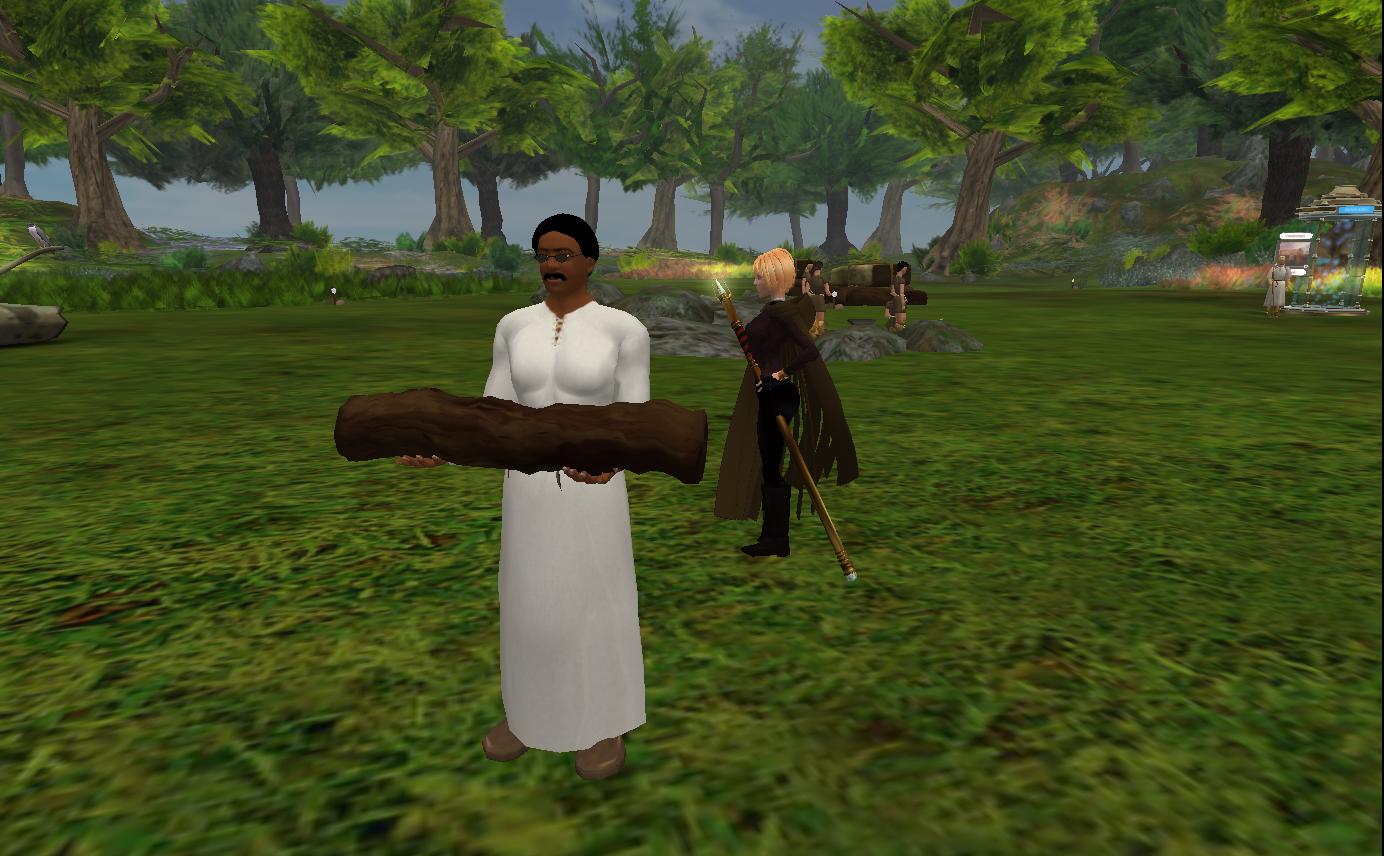
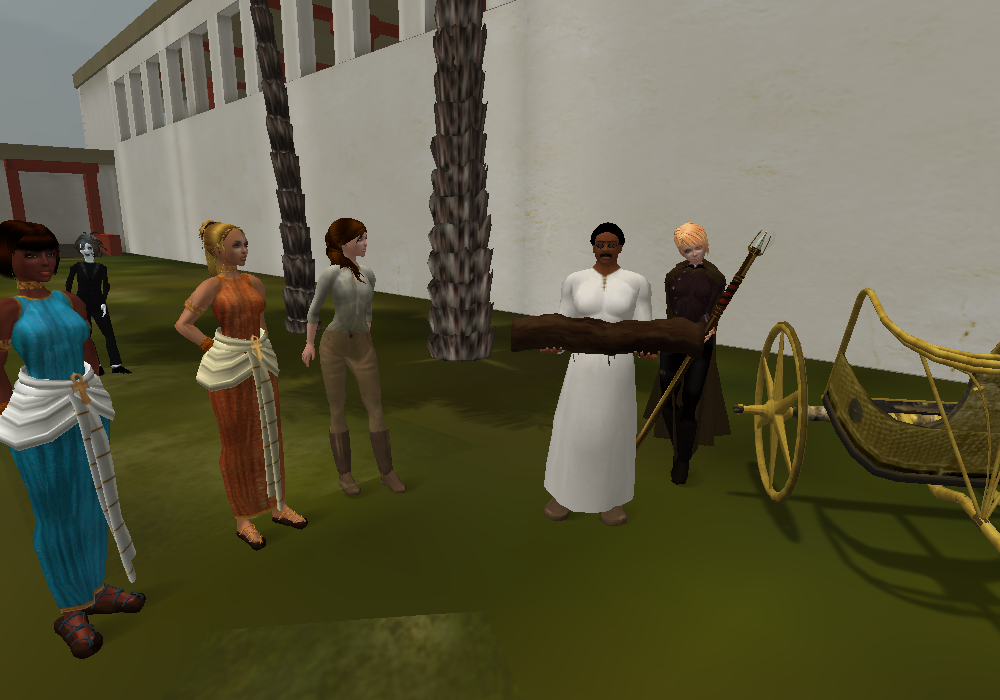
    IMAGE 1: Capture from Heritage Key of a clearing in a woods scene of a male avatar
    carrying a log to assist in the building of Stonehenge. A further
    female Indiana-Jone type character (that was me) is seen just behind.
    Circa 2010.


    IMAGE 2: Capture from
    Heritage Key tour that I believe Virtual Worlds Education Roundtable
    took back in 2010. Image shows a scene in Thebes between palaces and
    temples. Avatars are dressed in Egyptian, Druid, or Indiana Jones-like
    apparel.

    #VR #XR #vreducation #SecondLife #OpenSim #HeritageKey #Avatar #Stonghenge #ValleyOfTheKings #Participation #Best #Favorite #InstructionalDesign #Design #edtech

    Day 2 NASA goes to Mars


    Happy Twelvetide! Number 2 on my 12 favorite XR-for-education list is NASA goes to Mars!

    My fav parts?
    – Users had first person experiences walking around a Martian base in 2008.


    This kind of build checks every one of my ‘saves time, money, danger’
    boxes and as such, represents a great investment in XR. Experiences like
    this should be replicated.

    Yes, this
    is another defunct XR location, however there are still space clubs in
    Second Life and other platforms have picked up the gauntlet to recreate
    Mars, the Moon, and beyond.

    Is NASA
    done with virtual reality? Far from it. She’s just grown with the times.
    One of my favorite XR-for-education things that NASA has done recently
    is the First Woman graphic novel (comic book) demonstrating the
    diversity of thought that it will take to get successfully back to the
    moon. It’s XR-enabled and I’m happy to report that RT (the waving robot)
    has visited my living room.


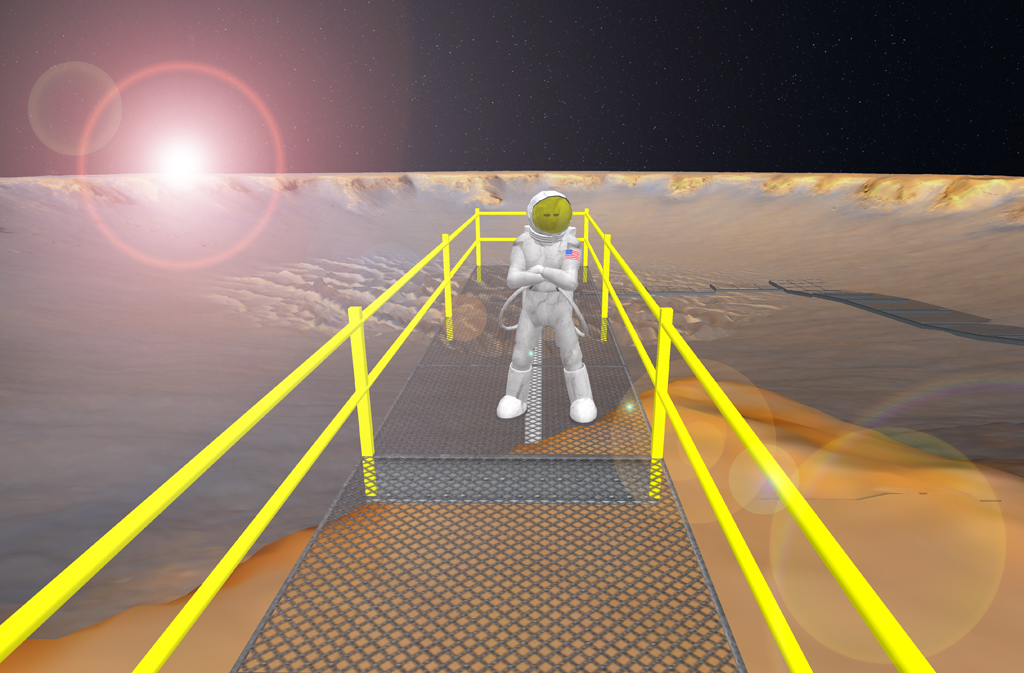
    IMAGE 1: Capture from NASA CoLab recreation of
    the Victoria Crater on Mars. Capture credit: Eric Hackathorn, NOAA,
    February 22 2008. Source: https://lnkd.in/gWFu7aKn Image is in the public domain.


    IMAGE
    2: Capture from NASA website about First Woman. Comic book style scene
    from the angle of moon boots shows a nearby moon rover with a robot
    waving in the back seat.


    IMAGE 3: Capture of cover of the First Woman, NASA’s Promise To Humanity, Issue Number 1 Dream to Reality graphic novel.

    #XR #VR #NASA #CommanderCallie #RT #VictoriaCrater #SecondLife #CoLab #SpaceEducation #edtech #InstructionalDesign

    Day 3 Dinosaur Track Lab


    Happy Day 3 of the 12 Days of Christmas! Today’s favorite XR-for-education example is for the curious InstructionalDesigners out there, wondering “how do you design instruction in VirtualReality?”

    I
    suggest this example from the Grand Cache Tourism and Interpretive
    Centre, that I saw demonstrated by Mike McCready of Lethbridge College,
    Alberta. This is the  best example of instructions given in a VR
    experience that I’ve seen!

    I
    should disclose my judging bias– I have taken many science labs in my
    time and a good set of lab instructions is a good set of instructions.
    Full stop. So these are good instructions. Direct, to the point, and
    helpful for completing the task at hand. Not too much detail in the
    objects presented to the learners and completing the lab *should* be
    within the physical capabilities of VR controllers (grabbing, placing,
    brushing, etc). Modification of target sizes could be done for Accessibility.
    I’m guessing that the VR artist and developer, Benjamin Blackwell,
    transposed real life lab instructions. I could be wrong, maybe someone
    wrote these instructions for the VR experience. But hey, either way, it
    works!

    The
    backstory of this VR experience isn’t bad either as it DOES tick
    Heather’s boxes of saving time, money, and danger. The real world
    dinosaur footprints are up on a sheer rock face at an angle in a
    preservation area. Getting there takes time, doing a dinosaur imprint
    IRL costs money (for supplies), and the location itself is dangerous to
    learners (and to environmental & historical damage). (Source: https://lnkd.in/gcWjFBXb)

    There’s
    a chance I would suggest adding an element that increases the stress
    level for learners (what??) but that’s just to add a narrative to the
    experience. I would throw in an approaching thunderstorm that the
    learners have to boogie and get out of the site ASAP.  But hey, I like
    narratives with my educational XR.

    I do not endorse any Lethbridge College program.


    IMAGE: Capture showing entry instructions for VR controllers.


    IMAGE
    3: Capture of prep table for taking a plaster cast of a dinosaur
    imprint. Equipment on the table includes a bag to carry the supplies up
    to the footprint location.


    IMAGE 4:
    Capture showing that learners have to use a spray (I think it was an
    adhesive) to position the frame in place to hold the plaster.


    IMAGE 5: Capture of the user grabbing the wooden frame to place over the footprint.


    IMAGE 6: Capture from a Lethbridge College site showing the angled sheer rock face with the dinosaur footprints.

    #InstructionalDesign #VR #XR #InstructionsMatter #ScienceLaboratory #Dinosaur #PlasterCast #VirtualInstruction #edtech

    Day 4 VR for Distraction/Pain Management

    Happy Day 4 of Twelvetide, where I’m sharing 12
    of my XR-for-education favorites! Today’s example is a concept– XR for
    distraction/pain management.


    I’ll admit
    that this example is tangentially associated with education. But two of
    the three examples I’m sharing are targeted for children. So in a way,
    VR is part of helping the children learn to live healthier lives!

    1.
    VR Vaccines – using VR to distract children during vaccine
    administration. Combine this with the “Buzzy” concept and I think the
    entire fear of needles (for anyone) could be eliminated! https://lnkd.in/gQsn39W9

    2.
    VR in a MRI – LOVE this but it’s still experimental. My favorite part
    of this design is that the clicks and whir sounds are incorporated INTO
    the VR experience. (Learning what the “sounds” mean is part of fear of
    flying courses so I think this could be incorporated into future virtual
    reality fear of flying experiences too.) https://lnkd.in/gZ6xnPEz

    3.
    VR for pain management. There are several companies working on this and
    kudos to ALL OF THEM! But I’ll shine a light on my friend Heather Bucalos, RN
    and her advocacy of using it for hospital patients (https://lnkd.in/g8s7q4_y ). It looks like Beth Savoldelli
    has a new initiative coming up in 2024, the XR Impact Network. Best wishes to all!


    IMAGE
    2: Capture from inside VR Vaccines where the user is about to have a
    special stone placed on their arm at the same timing as a vaccination.
    The user is presented with a story about how the stone “protects” them.


    IMAGE
    3: VR use during an MRI. Experimental but includes the typical sounds
    of an MRI and particularly helpful for children to stay still and calm
    during the procedure.

    InstructionalDesign VR XR PainManagement Distraction Pediatric CancerTreatment edtech #XRImpactNetwork

     
    Day 5 National Geographic Explore VR
     
    Clip from inside of National Geographic Explore VR with a pelican flying past.


    For Day 5 of Twelvetide, where I’m sharing 12 of
    my XR-for-education favorites, I list National Geographic Explore VR,
    whose name, perhaps in a clever move, puts the “VR” in the right
    place…last.  It just HAPPENS to occur inside the media of VR, but the
    star of the show IS the Nat Geo content.

    My favs of this?

    This puts the explore in Explore VR. Basically if you want to use VR to go places, this is your golden ticket.

    Plus,
    there is an impressive story line (I’m referring ONLY to the Antarctica
    experience here): going from a ship, via kayak, to an ice shelf,
    climbing it, and then waiting out an Antarctic storm in a camp. 
    (Playthrough video here: https://lnkd.in/ggMtNxy8 )

    When I taught an Introduction to XR (Design) course using the Quest 2s (https://lnkd.in/gYi9RWCU),
    I placed Nat Geo as the very first experience in the course after the
    Oculus First Steps primer. I also framed it within the design element of
    Function. That is, does the experience take advantage of VR
    affordances? If not, could it be done some other way just as well?  In
    the case of exploring, there is a long history of high quality National
    Geographic TV shows. Could doing something in VR measure up?

    In
    this case, the learner has to paddle their kayak, choose and take their
    own photos (they are on a mission from Nat Geo, of course, to get
    photographs), and climb an ice shelf. Either way, it’s arm work!

    So
    the user is not simply a viewer as would be for a TV show. There are a
    few folks right here that would like to pipe up and state that the
    movement *causes* learning or as I saw it phrased the other day:

    “It
    feels more like an earned learned experience than something you
    passively learned about or were informed about,” Bill Briggs, Deloitte
    CTO, told VentureBeat. “The retention and recall is just higher. Your
    brain is storing it in a different place.”

    That’s a bunch of horse hockey.

    Your
    brain is storing it in a different place? Oh, like that prepper
    pantry?  Experiences ARE experiences. Full stop. The brain encodes them
    exactly the same, whether they are in VR or IRL. What this person was
    doing was a backhand slap at traditional instruction (code word:
    passive), which (according to them) has been dreadful for ages.  On
    behalf of all teachers…thanks? (not really, grr)

    But
    I digress. Back to enjoying Nat Geo because they did a good job. It’s a
    good starter experience if you can afford it for your learners. It’s
    listed at US$9.99 in the Meta Quest store.


    IMAGE: Capture from inside of Explore VR looking down to see some whales in a small bay dotted with icebergs.


    IMAGE: Capture from the Meta Quest store of the purchase page from National Geographic Explore VR. 

     
    InstructionalDesign VR XR NationalGeographic Explore Antarctica Kayak Penguin Whale IceClimb Photography
     

    Day 6 VR for Conflict-Related Sexual Violence

    Trigger warning: today’s entry refers to sexual violence.

    I went to an entrepreneurial conference last year to speak on the topic of the metaverse. I know my ad hoc speaking style (which I enjoy but I lose my train of thought), so in advance I scribbled up a list of truly GREAT applications of virtual reality so that I could glance at it.  Today’s entry made that list. 

    A VR for conflict-related sexual violence (CRSV) pilot study includes everything from seeing a courtroom in advance, seeing visual assurances of identity protection, reenactments, and post trauma healing and comfort. I see it is still in the experimental stage but the results are about to come in.

    https://lnkd.in/gG7knz4y

    In September 2019, I was sexually attacked. I had to describe the event to the State Police three times. A friend rushed to me, took one look at me, and said that I was in shock. The shock goes on for a long time. I can only imagine what circumstances are like when sexual attacks occur as part of conflict or war.  Therefore, I wish this pilot Godspeed. 

    Good on yer to the sponsors: The Royal College of Art, Immersonal, Frontier Tech Hub, UK International Development, and the Office of the Prosecutor of the International Criminal Court.

    #VR #XR #BestUseCase #CRSV #SexualViolence #Crime #VictimProtections #RoyalCollegeOfArt #TechHub #UK #InternationalCriminalCourt


    Day 7 Tsunami Simulation from NOAA


    Day 7 from my 12 Days of Christmas favorite VR-for-education examples is a multi-step process. We have to time travel back. I’m going to stop our time machine at 14 years ago, the year 2010. NOAA had built their 2nd iteration of a tsunami simulation on their Second Life island, Meteora, that my old friend and colleague AJ Kelton captured in video here: https://lnkd.in/dCNDXnAH. (To see an even OLDER version of the same simulation, see video here https://lnkd.in/d2csDTyA) On the timeline, 2004 the Indian Ocean earthquake and tsunami was just 6 years prior when an estimated 227,000 people died (https://lnkd.in/du6sTWGt)

    OK, Heather, this looks chunky and old. What’s the deal?

    The point is that NOAA only built 5 experiences in VR– and a tsunami remained one of them (https://lnkd.in/dGD62bv6). I’m going to go out on a limb and state that NOAA thought it was *important* that humanity learn what tsunamis are and why you just can’t “outrun them”.

    Why was XR a good choice for this particular natural hazard?

    Because in XR, the viewer can stand still and let the tsunami wash over them and get a hint at it’s height, power, and devastation. (Hat tip to the movie, The Impossible for their depiction here https://lnkd.in/dSx-PHnv). READ: Avatar height actually means something here.

    Time machine forward to 2011, March 11 and the Great East Japan Earthquake. (https://lnkd.in/djjVKSsP ) For the first time, humanity would see in real terms the devastation of a tsunami.

    Fast forward one more time to 2016 and simulations advanced to this stage (see video clip below). By now, humanity had begun to take tsunamis MUCH more seriously with early warning buoys, escape routes, and *hopefully* people evacuating the coast when it could happen. 

    Do you see the connection between SEEING what a tsunami could do and future safety? Humans have a habit of clinging to “seeing is believing.”

    It is areas like this that hit my 3-item (time, money, danger) checklist hard and for the good: XR for reducing danger.

    In a sad twist, I’m late getting this posted on January 3 and another earthquake and tsunami occurred in Japan on the day I should have posted this, January 1, 2024. Thankfully, it appears that warnings went up fast and folks did evacuate. (Edit: I’ve now heard that at least 200+ people have died.)

    In summary, we can’t look at this Day 7 example outside of its historical context. More emphasis on the real dangers of tsunamis can save lives.

    #VR #XR #InstructionalDesign #Tsunami #Earthquake #Preparedness #NaturalDisaster #Awareness #EscapeRoute #Practice

    Day 8 Apart Gallery

    Day 8 of my Twelvetide favorite examples of XR-for-education is a true favorite. If you’ve never been in the metaverse, I’ll take you here first: the Apart Gallery.

    1. Surf to https://apartposters.com/

    2. Click on Virtual Gallery.

    3. Click on Join Room.

    4. Click Accept to agree to your avatar. (Yup, you can change it here if you want or you can change it later, either way. Because metaverse!)

    5. Turning on mics is optional so you can skip that if you want. Click on Enter Room.

    See? 5 Clicks.  And if you’ve been in before, it’s actually 4 clicks b/c  your browser will remember you.

    This is WebXR, the spatial web, or the immersive web. Names are not yet nailed down because it’s still relatively new.  You entered the metaverse with your browser. That doesn’t sound like much, but to gamers, it’s a big deal.

    Gamers are used to:

    – Large downloads

    – Required log-ins

    – Running extra programs for sound or dialog.

    – Turning off other programs to preserve memory and increase speed.

    – All kinds of special doohickeys.

    In this example, hosted by Mozilla Hubs, you don’t need to do any of that. You are free as a bird!  (Movement is with your W,A,S,D keys and your mouse).

    This *particular* example is on my list of favorites because of this ease of entry.  It’s the comfortable on-ramp into the metaverse. 🚗

    But there is one OTHER reason why I take newbies to the Apart Gallery. It’s an art gallery and it’s a time capsule of a sliver of American time. The original gallery artwork was produced between February and April 2020. Think back to what we were doing then:

    – Social distancing

    – Stay home

    – Wash your hands

    We were NOT talking about immunizations, unnecessary lock downs, and vulnerable populations. We didn’t even know COVID could be airborne. The artwork reflects the public health propaganda of those months. I use that word NEUTRALLY, not in a negative way. (I’m FOR public health!!)  The word propaganda to me means “relaying an idea that you want someone to agree with”. Another word might be “rhetoric”.  It’s fascinating to look back on what we were telling each other might work.  Truly, we have our own stories now, just like the haunting stories from the 1918 flu.

    The great folks at Paradowski Creative have since expanded the build so if you have time, wander around a bit. Not every version of the coming metaverse will be Second Life 2.0 ( 😏 ).

    #VR #XR #InstructionalDesign #ImmersiveWeb #SpatialWeb #WebXR #ApartGallery #ApartPosters #Propaganda #SocialDistancing #WashYourHands #StayHome #Immunizations #Art #VirtualReality


    Day 9  The Naturalist’s Workshop

    Today’s entry in my 12 Days of Christmas favorite XR-for-education examples is an odd one. For all those independent projects, developers, and small teams slogging away on tiny VR experiences and wondering…does anyone notice this?

    My answer is YES.

    I received exposure to the Naturalist’s Workshop (from North Carolina State University and the North Carolina Museum of Natural Sciences https://lnkd.in/duyS4xaW ) via a colleague. While I’m sure it’s great for learning some basic tree identification (yes!) I liked it for the basic design and how I could use THIS design to teach some elements of basic spatial design to others.  How do you situate a learner in a virtual space? How close is everything? How far away? Does the learner have to walk?

    I didn’t use this experience with any instructions. It was just headset on, app on, and go. So I didn’t even know it had a name or purpose. I was plopped in a small clearing in a forest on a slightly elevated concrete-looking platform with a desk and some stuff.

    I did some basic spatial awareness practice. I looked at my hands. I looked at my feet. I looked to the front, to the left, to the right, behind me, below me, and above me (oh! Nice opening the tree canopy). I looked at my stomach (missing. huh.) So users have no avatars. But they don’t need them to identify trees, do they? Even though the area is closed in, it did NOT feel claustrophobic at all…because trees just fade off into the distance. The color theme is a bright spring green. The platform had a low knee-level wall and 2 gaps for going out into the forest (cough, expansion plans please!)

    I bent down and looked under the desk and then discovered that the desk drawers do open! Hey there is stuff inside! So I started to pick those things up and when I placed them on the desk, something happened. Sometimes, I was temporarily transported to a 360 degree photo with one tree dominant in my view.  Oh! I had placed an object FROM the tree (a leaf or a seed) into a place and could learn more about it!  Level 1 tree identification unlocked.

    You can get this app via SideQuest.

    It’s paced at 5-15 minutes. I assume the 5 minute-rs would know what they are doing.  I’d say it’s nicely at the 20 minute mark if you want to fool around.

    It’s little projects like this (and the Dinosaur Track cast from Day 3) that are actually moving us forward in the XR for learning market.  It doesn’t escape me that both were built in partnership between a university and a museum.  Are you writing this down? You should be.

    #VR #XR #InstructionalDesign #NaturalistsWorkshop #VirtualReality #VirtualNature #TreeIdentification #NorthCarolina

    Day 10 Sandboxes


    Happy Day 10 of the 12 Days of Christmas! You’re
    probably getting tired of this by now, aren’t you?  But we are almost to
    the end!

    For today, my favorite
    example of XR-for-education is back to a concept– NOT a specific
    platform, app, or game. The concept is sandboxes.

    No,
    these are not virtual boxes on the ground filled with sand. These are
    locations in virtual reality where users are endowed as creators. 
    Virtual reality needs these spaces.  I’m reminded of the name of one of
    my favorite Facebook groups, I Require Art. I feel like that name needs a
    second clause “like I need air.”  Virtual reality needs places where
    users of any kind can experiment.

    I’m
    going to name 2 platforms because they meet this standard: Upon entry,
    users are endowed as creators. Of course, it often matters where you are
    standing.  You can’t just create anywhere and everywhere. You must have
    wisdom about this.

    When I first
    described Second Life to my best educational psychology friend and said
    “All users are endowed as creators”, he quipped back “Oh, you all can
    have God complexes!” God, I loved working with that guy. He both kept me
    grounded and pointed to the stars.

    But,
    yes, users can have God complexes. Or to put it more finely, users can
    explore their desires to create, to shape their world, to build, to
    paint, to sculpt, to cook, or do all kinds of creative things that
    humans have been doing for millennia.

    I
    used to have a tiny patch of ground in Second Life, thanks to a grant
    to educators via Montclair State University in New Jersey.  I could
    build whatever I wanted (that was free b/c I was cheap).  I set up a
    free pavilion, campfire, and space-pod office where-in I placed a
    Tiffany lamp and tiny velociraptor, as one would do.  It wasn’t much,
    but it was my space.

    I found that this location (https://lnkd.in/ek8h-22F) does
    a good job of explaining a virtual sandbox. I don’t know them, but they
    show the connection between space available, what you can do (rules),
    and technical specifications (prim/polygon or memory sizes).


    In
    the world of WebXR, Hubs allows for users to be creators from their
    first moment. As long as the space you are inside of standing allows it,
    you can bring in your own .glb files or surf over to Sketchfab.

    What’s my fav?

    Humans
    are creators. We bring order to chaos.  The freedom to create is
    important and yes, I think it is as important as air is to breathing.
    None of our other human endeavors would have value if we didn’t have art
    to express meaning.  Onward artists, onward!


    Post
    script: You might not know that most XR platforms do not endow users as
    creators.  There could be costs, permissions, or it is simply not
    available.  That’s why this feature is remarkable.

    (I actually do NOT know the platform Sandbox VR and this post does not constitute an endorsement.)

    #VR #XR #InstructionalDesign #Sandboxes #CreativeSpaces #CreativePlay #Expression #Art #Freedom #BringOrderToChaos

    Day 11 Action


    Day 11 of the 12 Days of Christmas of my favorite XR-for-education examples! Today is another “concept”– it is action.  I have some colleagues in the XR industry that believe that movement in XR is the best possible affordance of XR. I have disagreed with them.

    See one example where a researcher hypothesized that movement in XR would cause more learning and then (gasp!) found that it made no difference: Johnson‐Glenberg, M. C., Bartolomea, H., & Kalina, E. (2021). Platform is not destiny: Embodied learning effects comparing 2D desktop to 3D virtual reality STEM experiences. Journal of Computer Assisted Learning, 37(5), 1263-1284.

    But today I’m splitting that action hair super fine. 

    I’m actually FOR movement in XR when it facilitates learning.  Said another way: when all other media choices would not allow for equivalent movement in a situation (or if movement in XR is a brand new thing under the sun), movement, then, in XR is, yes, helpful.  I would not say it is the end-all be-all of XR-for-learning but it can help (facilitate) learning. I’m hinting at neuroscience and body memory.

    For example, using XR before approaching a large, moving, and dangerous piece of equipment like a windmill to learn maintenance. YES. This is a good use of movement in XR because it makes something happen that no other form of media would easily do (not a drone or first person GoPro video). If it would be dangerous to approach with zero training, XR can provide action practice use of the equipment in a safe way.

    Want some sources to support that?

    Here you go:

    Students at the University of East London practice using PCR equipment in XR before using it in real life. https://lnkd.in/eKhkRWks

    Potential workers in windmill maintenance get exposed to the work conditions in XR to decide if they really want to pursue this career

    https://lnkd.in/eqbzqceX

    And the now somewhat buried Lowe’s Home Improvement Store use of VR to teach skills like bathroom tiling to customers https://lnkd.in/emJF7KRr

    Other versions of “action” include programs like Tiltbrush or possibly GravitySketch that allow users to move and create from inside of XR, not on the outside and bring art of object creations into XR like is the current method with programs like Unity, Unreal, and Blender.

    The key to remember here is: compare the XR experience to its closest cognitively competitor experience. (READ: if the experience is processed in the brain the same way). If XR is faster or cheaper or safer than that competitor choice, XR is the way to go.

    Video clip from Simulwind. Capture shows the user selecting and placing the correct size wrench to open an equipment panel.

    #XR #VR #InstructionalDesign #Action #BodyMemory #Safety #Movement #Art #Skills

    Day 12 Emergency Services


    Last but far from least, my 12th favorite XR-for-education example has, as far as I discern right now, the strongest connection between USE and LEARNING. (Translation: a safe bet!)

    It’s XR for the emergency and military services– fire, medical, police, and military. As the daughter of a fire instructor, this use just makes me smile. I’m sure my Dad would have LOVED this.  He loved teaching and learning via fire simulations– there was no time his skills shone brighter than helping trainee firefighters learn things like fire behavior, untapped rural water sources, and fire site safety. I’m sure I got my “adult educator” genes from him.

    By now, I don’t have to tell you how XR for training uses here ticks every box of saving time, saving money, and reducing danger.

    But I’ll spend this last moment on the list hinting – indeed – to the intriguing research connection here. What is it about emergency situations that makes XR work so well?  I don’t know!  The emotional hype? The practice-so-many-times-until-you-can-do-it-in-your-sleep-ness? The visual SEEING of emergency situations– and living thereafter?

    So much cool depth to explore here, but in the meantime, using XR for these uses has my endorsement.  May we never need these services, but I’m glad that our service people are getting well trained in the meantime.

    Ending my 12 Days of Christmas on Epiphany (whew!) I wish you the gifts of peace, happiness, and good health in the New Year!

    #XR #VR #InstructionalDesign #EmergencyServices #Police #Fire #EMS #Medical #Military #SaveTime #SaveMoney #ReduceDanger


  • Instructional Design in the Metaverse: Behind The Scenes

    Instructional Design in the Metaverse: Behind The Scenes


    Decorative image of a future metaverse city in blue and green tones.

    We should officially start our BTS story with the fact that this writing is a rejected academic book chapter.

    😢

    Rejected Book Chapter

    Yeah. No shame, however, tossed towards the editors.  Their decision gets to be their decision.

    I was unnerved that the editors were entirely China-based. I’m not saying one way or the other on that. Just that I’m aware that when political winds change, something that seemed like an OK idea at one point could become a very bad idea later.

    It was a bit of a strange call for chapters in the first place, putting
    ALL of the approval at the END of the writing process. I went through a
    review and a rewrite only to be informed after 8 months that my writing
    didn’t seem to fit what the editors were looking for.

    The only tip I’ll give about WHICH book it was was that I wrote a long section on myths and that aligned with the book’s title. 

    But…in the spirit of how the President of Stanford was brought down by
    what was originally a blog…I figured I’d go for it with
    self-publishing. Charging for a book? Right now, definitely not my
    style. Plus, I didn’t want to wait another 8 months for another academic
    publication process.  I told some of my ID friends that I would “juice
    it up” for LinkedIn and I did! The original chapter had NO images (strict publisher) and I
    whooped it up on LinkedIn with all kinds of visual “borrows” to help
    laymen deal with the academic language.

    Key Points

    1. Continuing to bang my drum on the 3 characteristics that make XR builds successful: reducing time, money, and/or danger.
    2. A focus on plot as the driving theme of an educational XR experience.
    3. A focus on purpose at every step in the process.

    And
    these 3 items are not new for me to say. I’ve been trying to get them
    into the academy since 2013 with my dissertation, or maybe a little
    earlier in a few mucky conference papers.

    Misinformation

    In my opinion, I pissed off some of both the XR research and XR industry stakeholders. And I got two rebuttals. The most attention and chuckling came from me doing a TLDR on the myth section and just coming out and saying

    Virtual Reality Causes Faster Learning – Myth

    That was surprising– mostly because I don’t expect to turn any aircraft carriers with that language. Did I? Time will tell.

    Indeed, support for and any engagement with the articles dropped off over time. It was as though literally if one posted ANYTHING with the word Metaverse it in, a whole crowd of whoopdeedooers would drop by, hit the clap button, wish you well and…disappear.  I mean I felt I wrote some uplifting, helpful, and cheap (for the price) advice in the latter articles and there…crickets.

    Coda

    There is too much XR-for-education misinformation going on out there for me to remain quiet on some of this shit.

    Just this morning, I woke up to find fresh serving in my LinkedIn feed.  It’s like I want to take a break from writing but the crap keeps flowing in the door.

    Screen capture of "report" text: The numbers show that virtual reality in the workplace can improve communication, togetherness, output satisfaction, and the experience of working together in virtual workshops.


    In one sentence, nearly every good research rule is broken:

    The numbers show that virtual reality in the workplace can improve communication, togetherness, output satisfaction, and the experience of working together in virtual workshops.

    “The numbers show” – that’s an appeal to research results.  What they mean is THEIR numbers from THEIR study which was not really structured as research at all. It was structured as a rah-rah-sis-boom-bah don’t-we-love-the-newest-shiniest-thing data collection exercise.

    “Improve communication” – how? how measured?

    Improve [implied] togetherness – how measured?

    Improve [implied] output satisfaction – that is a “like” study, which means nothing to productivity. Tricky there….using “output” to make you think these might be widgets. Nope.

    Improve [implied] the experience of working together in virtual workshops.  You know what ALSO improves the experience of working together in virtual workshops? Free food.

    All that implication was a bit of a grammatical somersault but alas, it is what it is. 

    Hopefully if you understood my point, you’d see that these “numbers” refer to novelty effect.  Pretty much on the nail head.  People had fun because it was new. It won’t always be new, so be careful. 

    AI

    Because I wrote and published this article series in 2023, a valid question must be asked: 

    Did I use AI at all in the writing of this?
    Answer: Yes. And I’ll tell you exactly where.

    When I was proofreading myself (so long after finishing writing), I wanted to check on a somewhat novel phrase that I was using (coining?) just to make sure that my intended meaning matched what others might think it means.

    I asked Bing to clarify the difference between these 2 phrases:

    • Non-cognitively comparable methods
    • Non-comparable cognitive methods

    Sure enough, Bing helped clarify that the ‘non-‘ in front is the item negated. That is:
    Non-cognitively comparable means that something is comparable but the DIFFERENCE is in the cognition. That’s exactly what I meant; the brain burden is different.  This occurs when studies try to compare textbook learning to VR learning. It’s non-cognitively comparable. Therefore, null results. It’s like dividing by zero.

    Non-comparable cognitive methods assumes that both methods are cognitive (yeah, duh) but that they are not comparable. No, that’s NOT what I meant. People try comparing like crazy, even if I don’t like.

    So I stuck with my original writing and phrase: non-cognitively comparable.

    And that’s the only AI I knowingly used. It’s possible that Google Scholar had some AI with reference writing?? But I don’t know that. That’s sort of pre-AI because really a reference is just an act of putting the right thing in the right place with the right formatting. It can be driven by code…not by some sort of intelligence.

    I did use Midjourney to make the artwork but that was completely separate from the writing (and was really fun and educational!)

    Conclusion

    In summary, in over 12,000 words, is there anything more I can say that I didn’t cover?

    Yes.

    I sincerely hope that my freely given advice is not lost on decision makers. I constantly write for someone with her hands on a multi-thousands or multi-millions of dollars budget  and she needs to KNOW WHAT TO DECIDE when she gets an XR or virtual reality for education proposal on her desk.

    I wrote all of this with NO tie to money whatsoever. I’m not employed. I do not work for a company that will sell you XR.  I’m not working as an instructional designer pushing XR choices on my bosses.  LinkedIn articles, unlike Medium articles, provide NO pay-per-click (although, to be fair Medium pays less than pennies per click..so comparing pennies to nothing is a bit of a low blow). I do not have a monetized YouTube account. I don’t have anything social media wise that makes me money.  I’m “employed” at my own Consulting business but that is just a front to make me “look” employed to LinkedIn. I’ve done no work for pay in 2023. Actually, during the writing and publication, I don’t own a car so I used the public bus and I utilized the provisions of a food pantry.  

    I have nothing at stake to sway a person one way or another. I’m simply calling out where the research points. I do hope it will be of value to someone.

    Here’s my LinkedIn video summary of the 8 articles. In under 3 minutes, you can get it all! The bad news? It will come at you VERY fast. 

  • Instructional Design in the Metaverse Part 8

    Instructional Design in the Metaverse Part 8

    Decorative image: Our metaverse explorer heads off into the golden sun.

    What fights won’t we fight? What is our secret weapon? And what lies ahead? It’s the final part of this series. 

    (more…)