


From Myths to Principles Part 9: Biased Creation Processes
In Part 8 of my Dispelling Myths, Navigating Ethical Labyrinths, and Applying Design Principles in the Metaverse series, I explored the first of the mysterious ethical labyrinths of instructional design for immersive environments, that is the most common problems that arise from research interpretation. The first commonly noted problem was the novelty effect– the immersive environment was a one-off or very new experience. Newer experiences cause higher performance scores with learners. The novelty effect, however, can wear off. Few studies push past the novelty. The second problem is that media comparison studies often pit very different instructional approaches against each other, creating a massively unfair cognitive comparison; in short, they compare different cognitive workloads. Unsurprisingly, the immersive environment is often set up to comparatively win. The third common problem is missing design theories and models. The fourth common problem was problematic data in terms of assessment, collection, and sample size.
Here in Part 9, I will explore a second ethical maze addressed in this series are challenges with creation processes, specifically with immersive experience content and the subsequent publishing of results.
Content creation
Because immersive experiences environments are entirely digitally created, behind the scenes are the content creators. Research has noted that immersive experiences and social media share the same landscape of influencing. Immersive experiences can influence through emotions by misleading, inducing, manipulating, personalizing, and distorting reality (Mhaidli & Schaub, 2021). Simultaneously, the immersive environment is suspected to possibly both foster positive feelings (Li et al., 2024) and to overwhelm the learner’s senses (Makransky & Petersen, 2021), both elements which might lower the learner’s resistance to influence.
Thus, the same technology touted with the potential to deeply impact learners can be used in campaigns to influence or prejudice learners. Procopiou (2021) proposed that the stimulating environment of immersive experiences could make learners “more vulnerable to the extremists’ and terrorists’ recruitment approaches, propaganda and radicalisation methods” (p. 31). Undoubtedly, the researchers in the Stanford VR class described having a “jarring experience” when realizing that their learners had depicted the Moon landing as fake (J. Brown et al., 2023, p. 1). Noting this concern, these authors further argued that the high development burden of making misleading immersive experiences should prevent them from being made under anything but the most purposeful of circumstances. Said another way, they felt that only bad actors would put forth the effort to make something elaborate and false. However, the declining cost of immersive experience development and immersive experience’s primary use as social (meetings, events) hints that it does not require flawless builds to influence. This suggests that the perceived development obstacle will not remain for long.

On the other hand, there are examples of immersive experiences being used to counter real world narratives perpetrated by bad actors. In 2015 and 2017, violent extremists destroyed parts of the ancient city of Palmyra (Barnard & Saad, 2015; Unitar, 2017.) Virtual reconstructions began immediately (Denker, 2016). There has been some comment that the digitization by European and American institutions constituted a form of colonization of Syrian heritage (Samad, 2020).
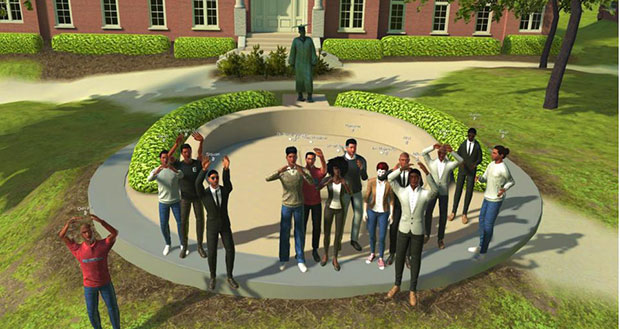
In some cases, immersive experiences technology fails to be representative of its intended users. When Morehouse University adopted immersive experiences, there were concerns that black learners and faculty avatars were poor representations. D’Agostino (2022) quoted Muhsinah Morris, a chemistry professor at the institution, who pinpointed the problem, “Representation matters because of the memories that you create…You are still a person behind that avatar” (para. 33). Millron (2023) referred to these problems as “inelegant and downright crude attempts at representation” (para. 4).
Technological companies have been under scrutiny for a retinue of privacy invasion problems. But there are also concerns that these companies’ main purpose is profit, not education and what that could lead to. Nir Eisikovits, philosophy professor and founding director of the Applied Ethics Center at the University of Massachusetts at Boston contented that there is a future possible overlap of privacy invasion and immersive experiences’ learner data, when he stated, “If you can monetize how much time I spend on a YouTube video or if you can monetize your Google search, imagine how you could monetize your biometric responses to stimuli that you viewed in virtual reality” D’Agostino (2022, para. 24).
The dominance of a few players in the shrinking immersive experiences technology market is also cause for concern. Developers have had to work within constraints to get published on the the Meta Quest 2 VR headset (Lang, 2024; Armstrong, 2023). Platforms and companies like Microsoft’s AltspaceVR and Magic Leap that did seem poised to continue in the immersive experiences market have abandoned their efforts. When major companies dominate the content creation market, they can choke out smaller, independent, and open-source options. Issues with lack of competition and fair choice are detrimental to the success of immersive experiences in education.
References
Armstrong, M. (2023, February 28). Meta leads the way in VR headsets. Statista Daily Data. https://www.statista.com/chart/29398/vr-headset-kpis/
Barnard, A. & Saad, H. (2015, August 31). Palmyra Temple was destroyed by ISIS, U.N. confirms. The New York Times.
https://www.nytimes.com/2015/09/01/world/middleeast/isis-militants-severely-damage-temple-of-baal-in-palmyra.html
Brown, J., Bailenson, J., & Hancock, J.* (2023). Misinformation in virtual reality. Journal of Online Trust and Safety
1(5).https://doi.org/10.54501/jots.v1i5.120
D’Agostino, S. (2022, August 3). College in the metaverse is here. Is higher ed ready?
Inside Higher Ed | Higher Education News, Events and Jobs
https://www.insidehighered.com/news/2022/08/03/college-metaverse-here-higher-ed-ready
Denker, A. (2016, October). Virtual Palmyra: 3d reconstruction of the lost reality of “the bride of the desert”. In 8th
International Congress on Archaeology, Computer Graphics, Cultural
Heritage and Innovation, 318–320.
https://doi.org/10.4995/arqueologica8.2015.3540
Lang, B. (2024, April 25). Quest Developers react to Meta Horizon OS & Partner Headset news.
Road to VR. https://www.roadtovr.com/quest-developers-react-to-meta-horizon-os-partner-headset-news/
Li, L., Hu, Y., Yang, X., Wu, M., Tao, P., Chen, M., & Yang, C. (2024). Enhancing pre-service teachers’ classroom management competency in a large class context: the role of fully immersive virtual reality. Humanities and Social Sciences Communications 11(1). https://doi.org/10.1057/s41599-024-03538-9
Makransky, G., & Petersen, G. B. (2021). The Cognitive Affective Model of Immersive Learning (CAMIL): a Theoretical Research-Based Model of Learning in Immersive Virtual Reality. Educational Psychology Review
33(3), 937–958. https://doi.org/10.1007/s10648-020-09586-2
Mhaidli, A. H., & Schaub, F. (2021). Identifying manipulative advertising techniques in XR through scenario construction. Proceedings of the 2021 CHI Conference on Human Factors in Computing Systems. https://doi.org/10.1145/3411764.3445253
Millron, M. (2023, September 14). The power and peril of virtual reality in HE. Times Higher Education
https://www.timeshighereducation.com/campus/power-and-peril-virtual-reality-he
Procopiou, A. (2022, December). Ready player bad: the future rise of extremism and terrorism in the Metaverse. In 2022 IEEE 2nd International Conference on Intelligent Reality (ICIR) (pp. 31-34). IEEE.
Samad, B. A. (2020). Civilizational memory: the transformation of Palmyra as a cultural patrimony of the west. Bowlin Green State University.
Unitar. (2017, January 20). Cultural treasures in ancient city of Palmyra destroyed.
https://www.unitar.org/about/news-stories/news/cultural-treasures-ancient-city-palmyra-destroyed
Post script:
*In looking for images for this blog post, I came across this news 👀 about Jeff Hancock: Stanford Professor Allegedly Includes Fake AI Citations in Filing on Deepfake Bill