Category: Instructional Design

  • Instructional Design Interview Nightmares

    Instructional Design Interview Nightmares


    Photo of communal office space with desks and chairs with a windowed room further into the background.


    Photo by Jose Losada on Unsplash

    I was walked to a windowed room that had a view out to the gently rolling green treed slopes of the campus. The ivy on the brick buildings was dying down in the November chill. Three panelists sat opposite me, with their backs to the view and the interview began.

    I was interviewing for an educational technologist-type position at an Ivy League university. Even though I had a relative that worked there, our last names were different and I had done the application and interview prep entirely on my own. I didn’t want to get this position through any nepotism.

    As per usual in the course of human events, you can prepare for one set of circumstances (standing on my own, separate from my relative in the hiring process) and then you experience another set of circumstances.

    Sidebar: I remember when I took care of a cohort of student teachers-to-be and one of them was in Tennessee (READ BIBLE BELT) and was a youth pastor becoming a Biology teacher. He shared with our cohort group that he was frightened about teaching evolution to kids that he was simultaneously counseling as a youth pastor. Then the first day of student teaching arrived.

    It went OK, according to the student teacher.

    But it was what happened at the end of the day that threw him.

    The football coach came to his classroom after all the kids had left. The coach put his arm around the student teacher and said to him that he ‘would pass every one of the football players in his classes’.

    We all sat stunned for a moment and then started sputtering “That’s not right!” and “He can’t do that!” and “That’s intimidation!”

    The student teacher immediately reported the conversation to HIS teacher lead and we were informed that the situation was “taken care of.”

    Whew. We laughed. We prepared for an evolution-creation debate and instead received football intimidation. See the detail of Tennessee meant something.

    It’s classic that a teacher prepares for a big lesson. And then something breaks.

    Surviving events like this is what makes you a good teacher. Experience. Not lessons.

    (more…)

  • XR Accessibility & Instructional Design

    XR Accessibility & Instructional Design


    Photo of ramp going up gradually in a building bathed in light blue colors.

    The topic has come up again. I guess I should start being happy that it’s coming up again and again. The topic is accessibility versus XR as instructional designers see it. The throw-down response of some instructional designers is “XR is not accessible” and they discard it as real learning option for the future.

    Capture of social media post with text: I have had, and continue to have concerns about the accessibility of IR & VR in education.

    So I gathered 7 examples (current as of August 2022) of organizations and people working FOR accessibility and I posted them. I’m re-sharing them here. 

    This is quick in – out, giving IDs examples they can quote that XR is gaining ground on accessibility.

    I hold to my premise: 

    In general, people care and they want MORE people to enjoy XR versus less.

    Sound

    Just this week, the FrameVR platform (a good example of WebXR) announced live captioning along with translations. https://twitter.com/gabriel…/status/1561793880835575808… 
     

    Technology

    WebXR in general is good for smartphone access which can help with
    internet access and speed accessibility problems too. 
     
    I recently
    attended a conference session with examples of how low access continents
    like Africa are racing ahead with WebXR. https://youtu.be/le1WHqtiBzM?t=7164)

    Sight & Mobility

    Organizations like EqualEntry produces video interviews with designers and testers. I would recommend these 2: VR for the blind https://youtu.be/CjILBKqOZ3g and VR for the physically disabled: https://youtu.be/lwmAFHAj6EI
     

    Cognitive (& All)

    XRAccess is another organization that is heavily working on standards https://xraccess.org/
    – these will show up for IDs as *defaults* when we work with platforms
    in the future (READ: default closed captioning, default bubble spaces,
    default no flying, etc.)

    I’m gearing up to talk more about Virtuleap, VR for cognitive exercise & monitoring, on my social media channels. https://virtuleap.com/

    Vision

    There are even efforts to use VR to combat the negative effects of VR (READ: vertigo.) https://youtu.be/E6jFqqy0wes
     
    But
    if you explore nothing else from an ID perspective the first 1:30 of
    this video shows that accessibility is gaining ground…https://youtu.be/rvsZ1ssyom8

    This article is not meant to be exhausting and lord knows I love the
    research teams out there working on these topics. Hey neurodiversity & medical XR research teams, I see you!! They are doing SO
    MUCH.

    Don’t count XR out when it comes to accessibility. Not by a long shot.

    Organizations to watch

    EqualEntry

    Virtuleap

    XRAccess

    FrameVR

    Mozilla Hubs

    #Accessibility #XR #WebXR #EqualEntry #Virtuleap #XRAccess #FrameVR #MozillaHubs #Vision #Sound #Mobility #Cognitive #VirtualReality #AR #MR

    Simultaneously posted to LinkedIn: https://www.linkedin.com/pulse/xr-accessibility-instructional-designers-dodds-ph-d-

  • The Salem Witches of ID OR Cancel culture has arrived in Instructional Design

    The Salem Witches of ID OR Cancel culture has arrived in Instructional Design


    Photograph of Salem-like harvest table with autumn colors

    Photo by Erica Marsland Huynh on Unsplash

    What do the Salem witch trials and woke cancel culture have in common?

    Both established rogue thoughts as truth.

    I’m sorry to report that over the past few months, cancel culture has arrived in Instructional Design.

    Personally, I’ve seen “Andragogy” and “Brain-Based Learning” attacked and discarded on public LinkedIn posts, threads, and some blog posts. I’ll be collecting them here below as I find them. However, if there get to be too many (and already collecting these was depressing and exhausting.  In one case there were 30 replies and that was not even to me!) I’ll stop collecting.

     It is as if a newer ID hears of brain-based learning, says to
    themselves “huh, where else is learning supposed to happen?” and then
    calls brain-based learning stupid because of the name.

    I’ve
    tried to point out that what’s happening is that less educated
    Instructional Designers are approaching these concepts as words only or
    with very little in-depth research and are tossing out the concept
    entirely.

    In
    the case of Andragogy, I tried defending it. It’s an established
    section of education with a depth of history of more than 50 years (in
    popular Education studies, longer in lexicon). Attacking it, to me, is
    the equivalent of attacking Black History.  Why would you do this? It
    makes no sense.  The arguments against andragogy always seem to equate little children with adults. 

    For example:

    • According to andragogy, adults want to know why.
    • My child asks why. 
    • When doing so, my child behaves as an adult.
    • My child is not an adult.
    • Therefore, andragogy does not exist. 

    Rinse & repeat with a lot of cognitive elements (my child can do this, my child can do that…)  Always exceptions. Piaget gets dragged into this (he does below). Perhaps then begin the “Well, if one part of false, then all parts are false” arguments…which themselves are logical fallacies. Duh.

    It’s tough out there. Note in this first example, the author is the post is ALSO the author of the article hosting place called The Learning Scientists— which is a point that I make; that the OP is putting on a aura of authority that is, perhaps, inappropriately authoritative to the audience. Said another way, readers might not understand that the writing, all inclusive here, was opinion.

    Andragogy

    (more…)

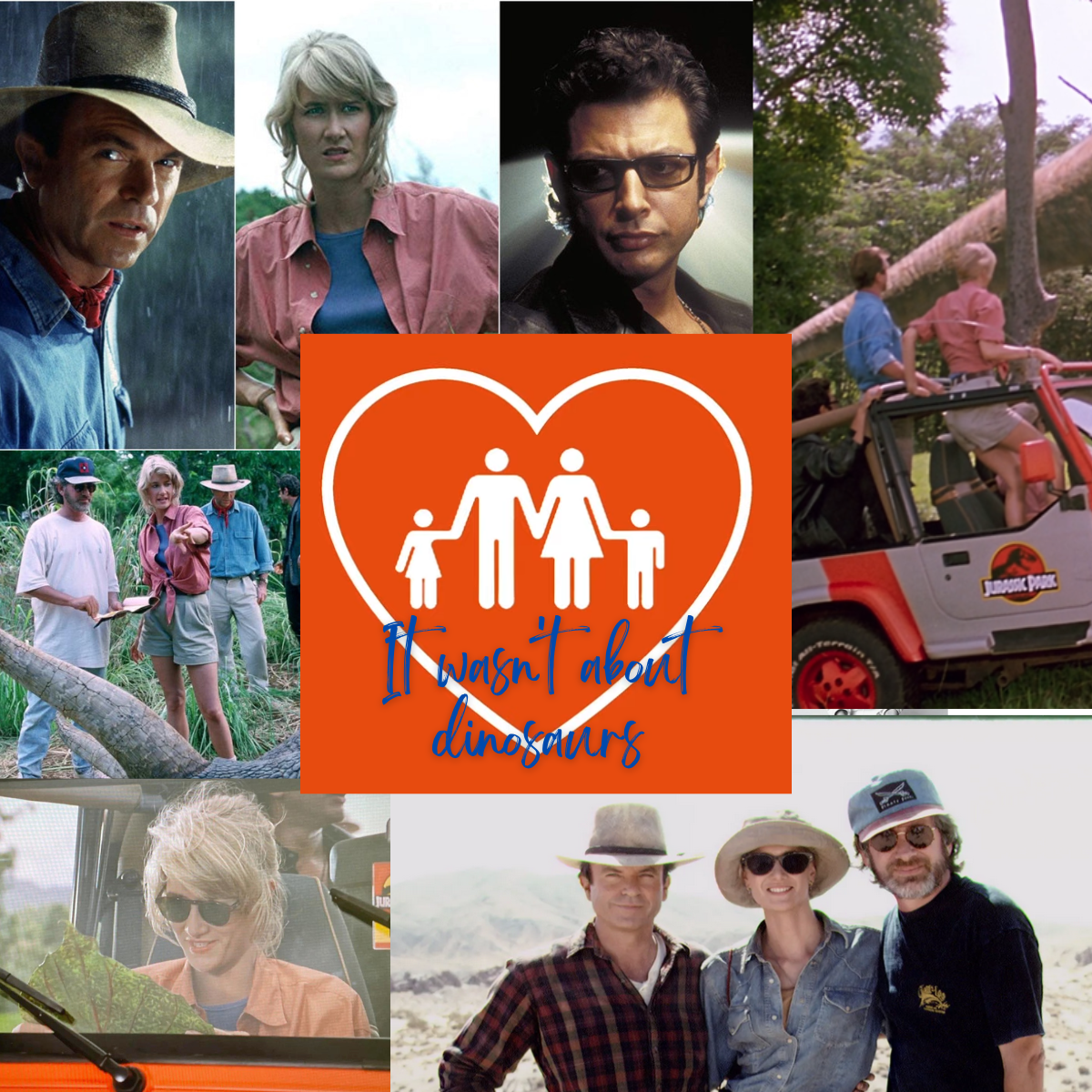
  • Dr. Ellie Sattler, Jurassic Park, and Narrative Plot. Or It Wasn’t About Dinosaurs.

    Dr. Ellie Sattler, Jurassic Park, and Narrative Plot. Or It Wasn’t About Dinosaurs.


    It’s a rare moment when I can bring 3 themes into 1 post:
    leadership, XR, and design. Also, I’m going to be personal. Believe it
    or not, I’m not really personal on LinkedIn. Enthusiastic, yes. Personal, hardly.

    Over the weekend, I wrote a gushing sentence to a friend that I
    realized I’d never written down before: I became a Biology major in
    college because of Dr. Ellie Sattler.

    A mentor of mine once said writing is thinking. Writing that
    sentence lead me to do a lot of thinking and reading about her character
    and on the impact of the Jurassic Park (JP) movie.  I’m not alone as a
    woman in deciding to go further in STEM because of the Dr. Ellie Sattler
    character.  So huzzah all the Paleobotanists out there!

    We have to time travel to talk about JP. In 1993, we’ve just BARELY
    broken out of the 1980s. For the first time in STEM history, scientific
    breakthroughs are being accomplished by teams instead of white men.  Think: AIDS breakthroughs & the Human Genome Project. Teams means women included. Prior to this point, women were the “also rans” in science.  Sisters. Mentioned on the side. Or worse, they had their research stolen.
    Strong women depicted in media? Disney’s top film of the 80s was The
    Little Mermaid and Aladdin was just released in 1992. Strong women, not
    so much. Video tapes existed; the Internet did not. If you wanted to see
    a movie, you bought a movie theater ticket.

    We arrive when the music was rises in cool, dark, air conditioned theaters.  And then you see this: 

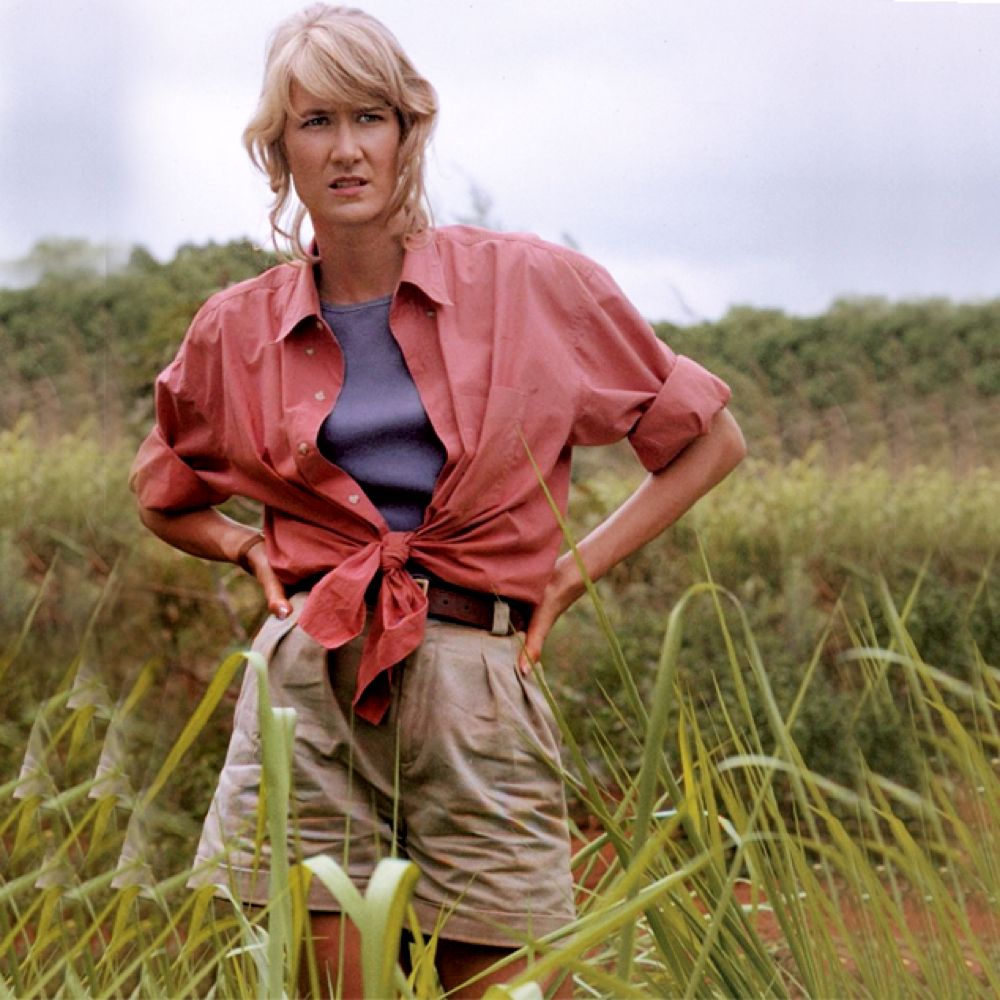
    "Screen capture from Jurassic Park of Dr. Ellie Sattler looking pensive. Remarkably, this depiction of a woman scientist was also not sexualized nor concerned about sex in any way."


    Caption: A character who does not care what you think because she’s solving a problem.

    A character who lays out this line while she holds a stare on the richest daddy around:

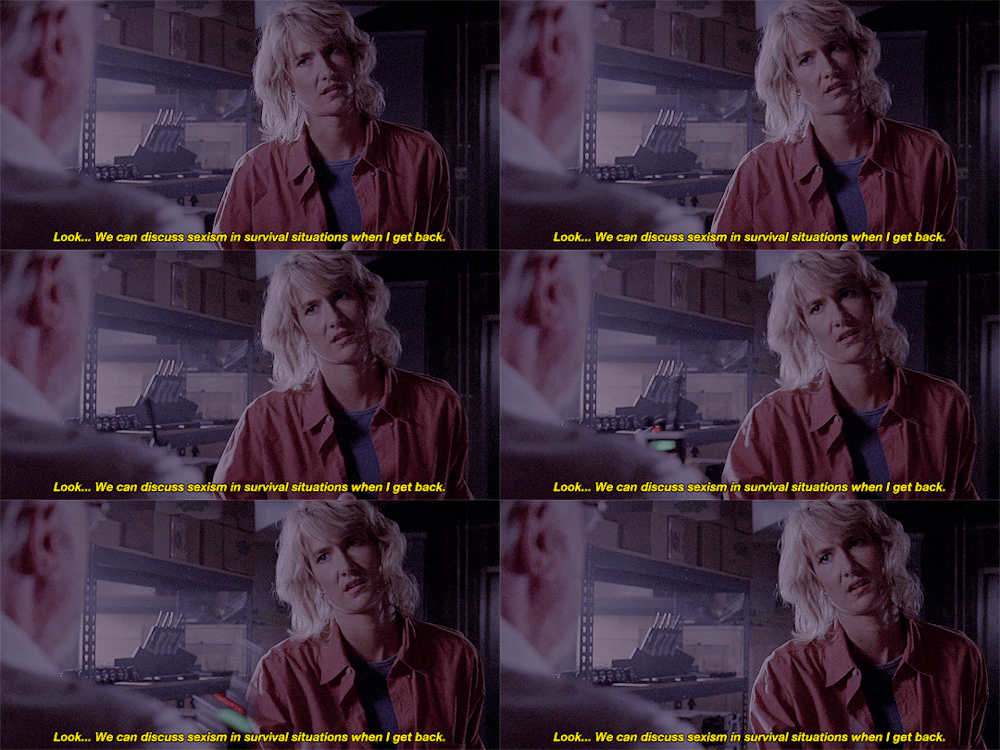
    “Look…we can discuss sexism in survival situations when I get back” 

    "Gif from Jurassic Park. Dr. Ellie Sattler responds to John Hammond's weak sexist protest that he should be resetting the electrical circuit. She says "Look...We can discuss sexism in survival situations when I get back" while looking at him straight in the eye and placing a walkie talkie in his hand."


    I took that to mean that women are better in survival situations (not equal, as others took it.) and my life was shaped for the better.

    I bought a $5 ticket 3 times over the course of that 1993 summer. Now that’s saying something.
    To this day, it’s the only movie I’ve bought multiple theater seats
    for. But realize, I have older brothers that saw Star Wars, what, a
    bazillion times?

    Jurassic Park became the first movie to gross US$1billion.

    Reading some commentaries and watching some videos over the past few
    days, I picked up some tidbits below. Some I agree with, some not.

    1. To this day, the scene of the T-Rex crossing the paddock fence
    HAS NOT YET BEEN BEAT in movie history & you don’t need to try. 
    True disclosure: the raptor jumping up to the ceiling shot? I still
    can’t *barely* watch that. I wince too hard.

    2. There’s been some 2022 commentary on the age difference between
    the Dr. Ellie Sattler (Laura Dern) and Dr. Alan Grant (Sam Neill)
    characters.  It’s been confusing and I’ve decided to weigh in.

    In the book, Dr. Ellie Sattler was written as a grad student (Age
    23, no advanced degree) but also no relationship. It was apparently
    Laura Dern’s own idea to give the character a full doctoral degree and
    in the movie the character holds her own against dinosaurs. In real
    life, I’m disappointed to say, Laura treats Sam Neill patronizingly
    and actually “left the party” of JP with Jeff Goldblum, which I find to
    be a big mistake. (I said this article would be personal, yo.)


    "Screenshot of ending helicopter scene from Jurassic Park. Dr. Alan Grant holds Lex and Tim in his arms while looking at Dr. Ellie Sattler."

    Caption: The look of faithfulness.

    Don’t be like this guy and not see the sexual tension in JP: https://youtu.be/jSPxu3WprSs 
    As far as the age difference? The problem came in when, in the book,
    the “relationship” was not there but in the movie it was. Laura was in her late 20s playing early 20s. Sam (then early 40s)
    continues to feel the (physical) burden of the age difference. If you
    need help to see what was happening, Deshi Basara has collected these gifs. Notice in gifs 2, 3, and 7 how his body immediately reacts to hers when she touches him. This is chemistry, folks.

    I had to wade into all that because the point was that regardless of
    an age difference (which, arguably could be *less* than 23 years),
    there was a *quality difference* between Dr. Ian Malcolm and Dr. Alan
    Grant.

    I will concede this one point (I disagreed with so much here
    that I couldn’t read more than 2 pages of this commentary) that Ellie
    holds her ground just fine (and doesn’t move despite Alan’s come here
    gesture) with a metamessage at the Raptor pit: 

    "Screenshot from a commentary that points out a gesture from Alan to Ellie at the Raptor pit. He says come here. She does not move. It is clear, she holds her own space."

     Vogue got an interview with Laura Dern
    where she points out that the Dr. Ellie Sattler character went on to be
    an activist and whistleblower. Interesting!! I’ll just leave that right there.

    "Photo from Getty Images of Sam Neill, Laura Dern, and Steven Speilberg on the set of Jurassic Park."

    But most I really enjoyed watching these video analyses of the plot of Jurassic Park here and especially by Mike Hill here and why the movie worked when all subsequent versions of JP have not worked. The key was that Steven Spielberg worked in narrative plot. He carried a story all the way through that was human, basic, and emotional. Dinosaurs just happened to be there.

    "Graphic image of a human family inside a heart surrounded by dinosaurs. Image from Mike Hill's YouTube video speech about Narrative Plot in Jurassic Park."


    But that shows up in my VR/XR consulting work to this day.

    The famous quote about rushing into things by the Choatician character Dr. Ian Malcolm:

    Ian Malcolm: Don’t you see the danger, John, uh,
    inherent in what you’re doing here? Genetic power’s the most awesome
    force this planet’s ever seen, but you wield it like a kid who’s found
    his dad’s gun.

    Donald Gennaro: It’s hardly appropriate to start hurling accusations–

    Ian Malcolm: If I may, if I may. Uh, I’ll tell you
    the problem with the scientific power that you’re, that you’re using
    here. It didn’t require any discipline to attain it. You know, you read
    what others had done, and you, and you took the next step. You didn’t
    earn the knowledge for yourselves, so you don’t take any
    responsibility… for it. You stood on the shoulders of geniuses, uh, to
    accomplish something as fast as you could, and before you even knew it,
    you had, you’ve patented it, and packaged it, and slapped it on a
    plastic lunch box, and now (bangs the table) you’re selling it, you
    wanna sell it, well.

    John Hammond: I don’t think you’re giving us our due credit. Our scientists have done things which nobody has ever done before.

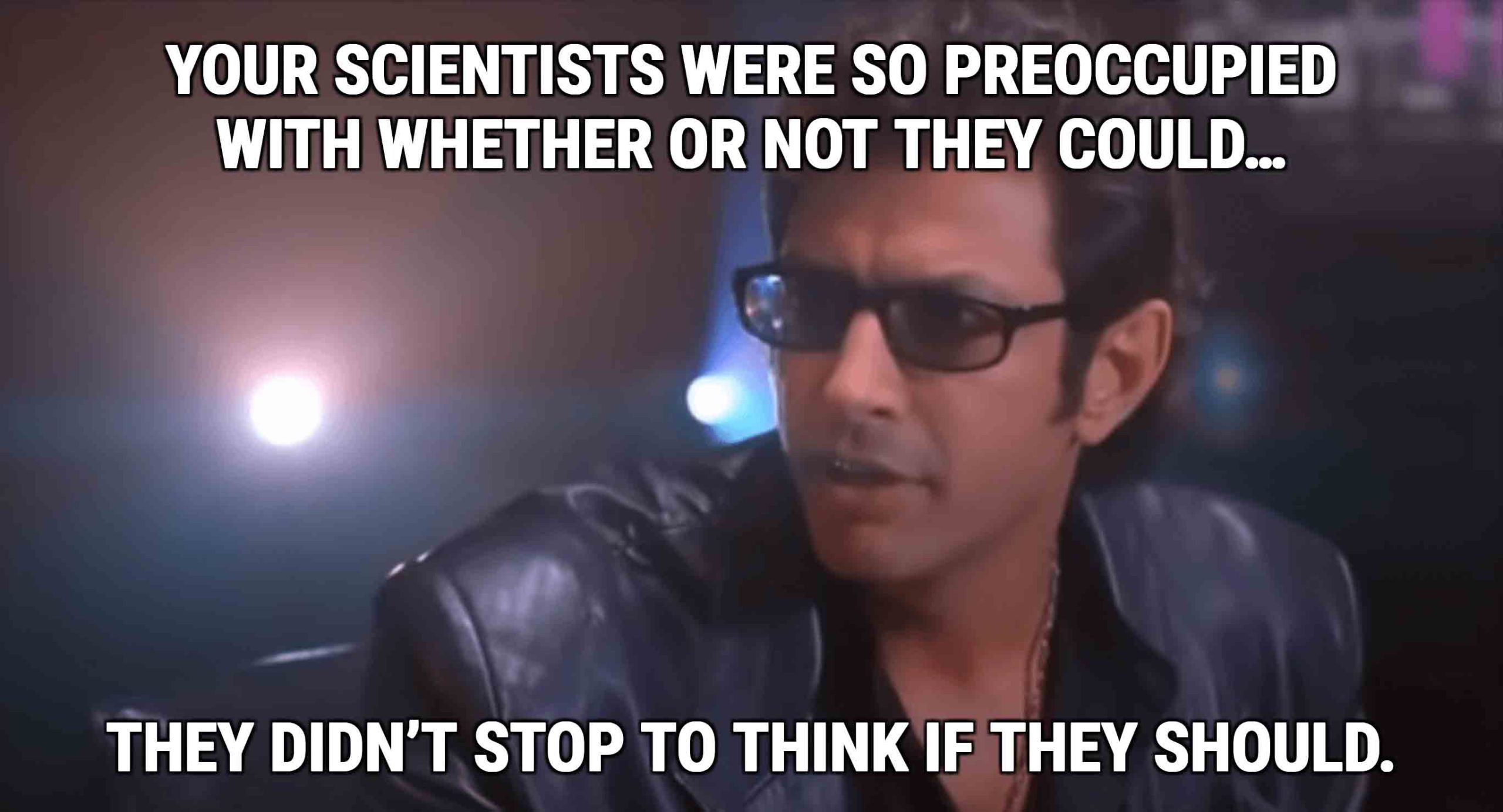
    Ian Malcolm: Yeah, yeah, but your scientists were so preoccupied over whether or not they could, they didn’t stop to think if they should.

    "Meme from Jurassic Park scene: Ian Malcolm: Yeah, yeah, but your scientists were so preoccupied over whether or not they could, they didn't stop to think if they should."


    I fight this battle every day.

    Industry and indeed some in academia want to use XR liberally in
    education. Yet, the power of XR is still unknown. Our early research is
    pointing to one thing that seems firm:

    The mind believes what the eye sees.

    That means that the XR experiences we put our children into will be real for them.

    What power are we wielding in the classroom? Everywhere?

    There are those that say “XR is the Empathy Machine! We can create empathy, soft skills in the workplace!” 

    Oh yeah?

    The most recent research I saw (from 2018) says that empathy coming from XR is a 50/50 gambit. That does not mean that it causes empathy for whatever you want half the time.

    It means it causes empathy half of the time and causes the opposite of empathy the other half of the time!  

    So, would you like your employees to don a headset to be more
    empathetic towards race, age, body size? Oh really? How would you like
    results that say that half of the time, those employees are going to
    take off the headsets and quietly say to themselves “Thank God I’m not
    black” 50% of the time? That’s one hell of a bet you are willing to take
    with XR.

    XR is dangerous.

    People say “Look at how you can look all around you! 360 degrees! A
    sphere! Isn’t this cool? Isn’t this new? Just think how this will reach new learners!”

    I can take a learner into a new real physical space (for example on a field trip) and have them be overwhelmed. We’re all on the spectrum, remember? Was that cool? Were they reached
    in a new way when they cried? Would you like for me to even mention
    harassment events in VR that have already happened? We haven’t yet
    arrived into market saturation of haptic bodysuits, but it’s coming.

    XR is dangerous.

    I’d rather have a low, slow, plodding walk into an XR for education
    experience than every bell and whistle thrown at them the first day. The
    line “spared no expense” gives me chills.

    XR is dangerous and if we aren’t careful, we will damage learners
    along the way. Jurassic Park should not have been built or opened. Dr.
    Alan Grant refused to give his endorsement. That was the lesson of the
    movie.

    • I’m proud that I don’t endorse some forms of XR (Dr. Alan Grant)
    • I’m proud that I throw water on some XR ideas (Dr. Ian Malcolm)
    • I’m proud that I tackle problems that no one else can survive. (Dr. Ellie Sattler)

    But the parallel lesson of JP was “Build for story. Because the dinosaurs are not real.

    When I encourage XR design, I build for narrative plot. 

    I build for emotions, 

    because those are real.


    "Graphic image of a family inside of a heart. Image credit to Mike Hill."

    #XR #Design #JurassicPark #NarrativePlot #InstructionalDesign #DrEllieSattler #DrAlanGrant #DrIanMalcolm #Dinosaurs #VR #VirtualReality #EmpathyMachine #Leadership #WomenInMedia #FemTech #Sexism #BestMovieSceneEver #Whistleblower #Scientist #PreoccupiedWithCould #SparedNoExpense #Emotion #DesignForXR 

    Article originally posted same day to LinkedIn here: https://www.linkedin.com/pulse/dr-ellie-sattler-jurassic-park-narrative-plot-wasnt-dodds-ph-d-


  • Your first attempt at designing XR for accessibility will suck. Keep Going. GAAD 2022

    Your first attempt at designing XR for accessibility will suck. Keep Going. GAAD 2022


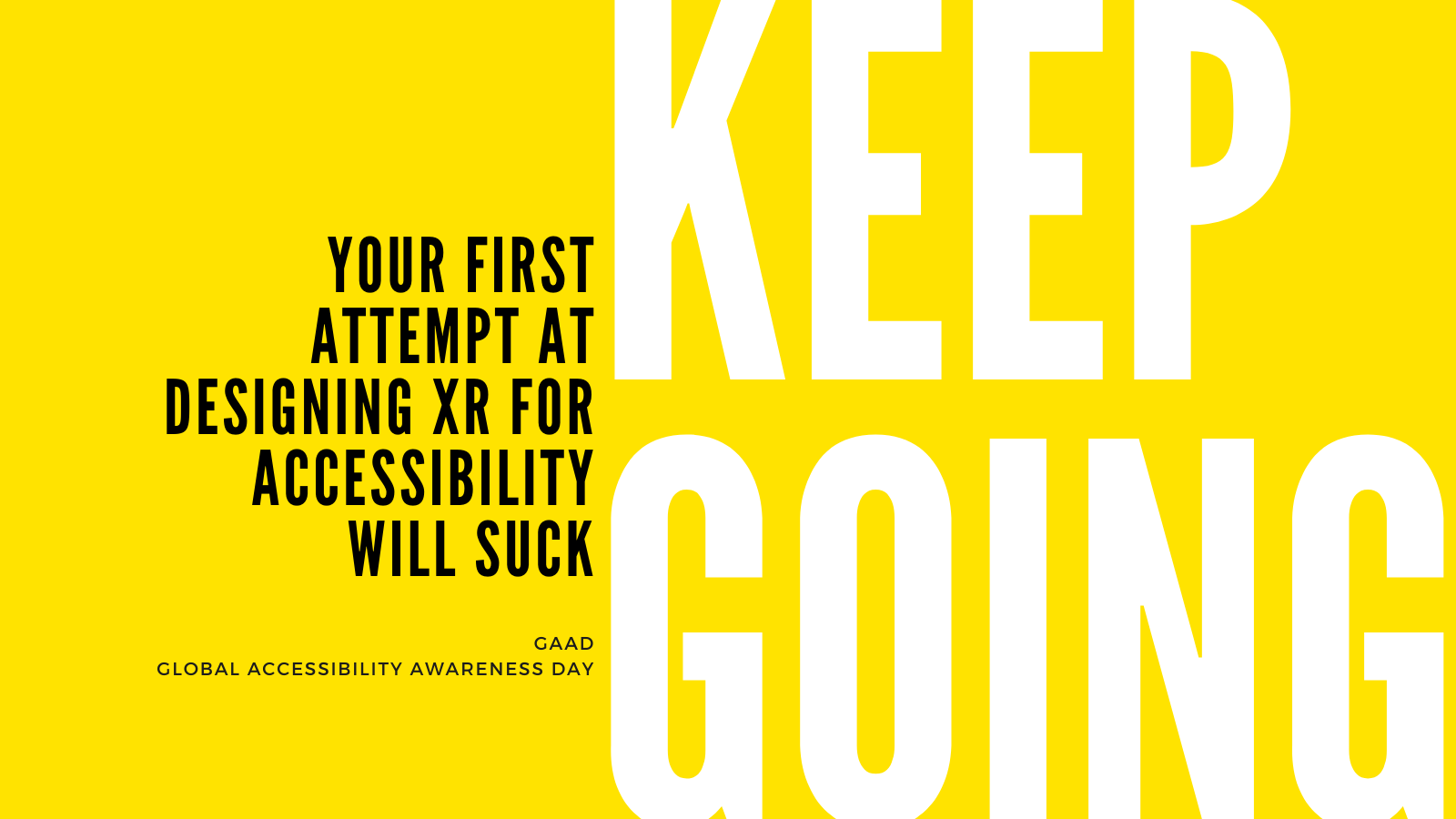
    Image with text: Your first attempt at designing XR for accessibility will suck. Keep going. GAAD. Global Accessibility Awareness Day. Image made by Heather Dodds in Canva.

    Replica of my GAAD LinkedIn post

    Looking for tips on how to design #XR
    for accessibility? You could follow me, but I’m just learning this
    stuff myself. Search. Learn. Ask. Network. Try. Then try again. Cry
    some. Then try 1 MORE DAMN TIME. Because XR can be for everyone.

    Curious? Good. I’m putting some links here. They are all click worthy.

    Vision

    In 2021 I heard, “I don’t know why the blind
    would want to access VR”
    . I’m so over that. I’m SOOO over that comment.
    👿 Let’s make one thing clear: if you make a human “sub-human” in
    front of me, there will be angry eyes. Start here: https://equalentry.com/virtual-reality-development-for-blind/ and then here: https://equalentry.com/how-can-a-blind-person-use-virtual-reality/ and for a video, see here (seriously, WATCH the very beginning): https://youtu.be/rvsZ1ssyom8


    Sound


    XR for the Deaf: I read everything my link Meryl puts out. I would encourage you to follow her: https://www.linkedin.com/in/meryl/ She publishes on topics beyond deaf accessibility.

    I just found this golden tidbit TODAY for #gaad2022
    , check it out! Audio descriptions in games – something of particular
    interest to my Instructional Designer friends as we are always keeping
    an eye on conflicting text, sound, and narration. This is something to
    learn about here! https://youtu.be/W2B3jBu0ZqY


    Mobility

    I absolutely LOVE this product and want more of it: https://www.walkinvrdriver.com/ Need to watch a video instead of read? Sure! https://youtu.be/lwmAFHAj6EI 


    Also: https://specialeffectdevkit.info/

  • The first step into the Metaverse isn’t the hardest. It’s the nth step that you do for the nth time.

    The first step into the Metaverse isn’t the hardest. It’s the nth step that you do for the nth time.


    Photo of architecture in Iran

    Response post to: The Forgotten Stage of Human Progress


    I’m knee deep in an XR implementation project. It’s going forward by
    inches; each step aches with how small it is. If I measured it, it feels
    like it would barely tick one mark on a stick. However, like a gardener
    that makes one small snip here, one pull of a weed there, there is no
    overnight transformation. But still– in the messy work of
    IMPLEMENTATION, I’m making a garden that turns heads and makes people
    think “I want to be there.”

    Seriously, here is the garden:


    Today is one of those days where it feels like we are going 2 steps backwards with no step forward. When you hear it mentioned quietly, but over and over and over, that one of the biggest implementation problems we have in XR for education is “sound” — WE ARE NOT KIDDING.

    We have more problems with sound that with any other aspect of an experience. It is the TOP problem source.

    Virbela had this problem in buckets. My hosts cringed every time I estimated that 20% of incoming users had sound problems. 20%!  If YouTube had a 20% failure rate that they presented to users, they would far, far out of business by now.

    I watched this video dated November 5, 2021 put out by Stanford University touting the first course taught in XR with Jeremy Bailenson where he claims it will be “an incredible journey for about half of this class”


    Here is the video promo text: 

     “263 students, all with their own VR headsets, across 20 weeks and two courses, spent over 200,000 shared minutes together in the Metaverse. They engaged in large group field trips, small group discussions, performed live music and skits, and worked both alone and together to build their own virtual worlds.”

    First: posed shot OR photoshopped image. Notice: no Zoom markings at all. It’s not “live”, people are not moving.


    For someone like me with enough live event logistics and tech support experience, watching this video shows me that I suspected the course was riddled with sound problems.  

    The background music starts at 0:18, so “hearing” the students will be hard.

    Watch for how much students were cordoned off into small groups (that’s not just a teaching method, that’s to put them soundwise AWAY from each other and minimize disruption) and then just listen to what you CAN hear of the sound provided in the video, you will get snippets and what you will hear will be blurbs of users acting more awkward and users waiting around on another user.

    The “you made it” comment is somewhat telling. It is HARD to get users into XR. Admittedly, it might easier if you are at Stanford and everyone has an Oculus Quest 2 (Meta Quest). (smirk)

    Privilege much?

    At 1:14 there is a LOT of talk over and by 1:18 the video has been sped up to just overwhelm with ADDING models or processing to VR on the ENGAGE platform.

    I’m not trying to douse flames of innovation here. But I’m trying to point out that implementation, as the Atlantic article points out, is a much messier, day-by-day process than the glitz and glamour of a moment.

    The video shows THIS as what appears to be a class highlight moment.


    The sound is a man speaking saying “Nice work everyone!”

    Just let that sink in while looking at that image.

    2021. Stanford University. That is one of our very best learning instituations, folks.

    Ironically, all of the avatars with awkward arms ARE the users actually using headsets. That one avatar in the middle in the gray shirt with this hands at his sides? He is the one user in 2D, not a headset.

    Snicker now, because he is the only one looking normal in this bunch.

    Implementation is HARD!

  • Reducing Cognitive Load and Slide Layouts

    Reducing Cognitive Load and Slide Layouts


    I had an interesting short conversation with a colleague on Facebook in January. I went back and screen captured it to show what we wrote and here, I’m going to further explain my thoughts about his question and my answers.

    His question:

    Hi
    everyone! Just joined as I’m looking for some insights into this slide
    design issue: how do you make use of slide layouts in developing
    training slide decks? One slide layout would be repetitive and boring
    but too many slide layouts would appear inconsistent. The training
    program has 8 modules, each module has between 8-12 slides. I currently
    have 6 slide layouts to work with. The type of content in each module
    can be repetitive (why this topic, a quote, bold statement, activities,
    topic idea with bullet points, etc). Different slide layouts could be
    applied to each content (e.g. photo on the right, photo on the left,
    photo in the background, etc). Hope you’re following the context setting
    🙂
    Do you use any slide layout organization method? E.g. Layout 1 for
    Module title (that’s a given), Layout 2 for a quote, Layout 3 for the
    first slide with a photo in the module, Layout 4 for the second slide
    with a photo in the module, etc. Then repeat for the next module. Or do
    you just use some random slide layouts in each training module. The
    graphic designers I’m using don’t seem to be using any coherent slide
    layout organization, so when I’m adding slides, it’s always a puzzle for
    me to determine which slide layout might best (as if there’s some
    overall training slide design principles out there…) I’ve done my
    research and also have a great book on building PowerPoint templates but
    I can’t find any thoughts, ideas, suggestions on the matter. Happy to
    clarify more, if needed! Thanks!

    My responses:


    From the laughter and heart emoticon, we were having a good time with each other.  But I want to go deeper into this topic. Because Mark* mentioned being interested in cognitive overload in some of the responses he had already received, I wanted to go that route to see how much he was willing to figure that out –was he willing to figure out that ANY simultaneous spoken words and text increases cognitive load (Dual Channel Processing Theory)…therefore eliminating that reduces cognitive load problems and can increase the “pleasantness” of a presentation.

    So when he presented that so much content was already present in a prototype manner of 64-96 slides , I was first testing to see if he was willing to pull some of that content OUT and place the text in another format (a handout).

    I also was intrigued that he was truly asking about slide formats which, is quite a ridiculous question actually. To me, I would advise to stick with whatever format is the most obvious– HOWEVER I’m going to talk you out of all formats so don’t put too much energy into this.

    Example Google Slide layouts: Title slide, Main Point, Big Number, Blank, etc.

    PowerPoint Slide layout examples: Title Slide, Two Content, Content with Caption, Blank, etc.


    My first response:

    Is
    there any particular reason why you can’t package the “8 modules with
    8-12 slides” into one PDF text-only handout and present only images?

     His reply:

    Yeah,
    I’ve looked into design like this. They can be punchy. I’d have to see
    from a training deck perspective how this would look like (e.g. a full
    deck), most of what I’ve seen are decks create for business purposes,
    presentations and pitches. The full slide deck has about 80 slides, so
    that’d be lots of images!

    Oo! He misunderstood because it seems he thought that by taking content out, it would be replaced with images. No, that’s not what I meant. I meant reducing the number of total slides AND reducing what was on the slide. 

    This is moving content that should be speaker notes to speaker notes (duh) and what should be a text handout for the audience to one of those freebies and focusing the visual presentation on looking at and listening to the presenter.

    But I was willing to tease one more step with this designer.  So I did one more push to see if he’d get my idea of REDUCE THE SLIDES.

    My second reply:

    Groovy. Time to next level the next level. Present from one slide. Go.

    His final reply:

    I’ll go a step beyond, present with candlelights because power is off and it would be quite costly to send everyone home 😁 it only lasted 2 hours, thankfully lol.

    He’s laughing here. I don’t think he got that I was pushing to present with no images and no slides and all text pushed to another source. He MIGHT have thought that I meant presenting from one big image (Yikes! like one big Prezi!) but I hope not. But we did end laughing because I think he got that sometimes the power does go off and you do talk in the dark (boy, does that prove that you know what you’re talking about or not.)

    I haven’t gone further here but I’m going towards Robin Williams‘ Principles for effective presentation design in The Non-Designer’s Presentation Book, which does explain well that most presentations (like the one Mark describes) have probably used the slides like speaker notes and that’s a no-no.  

    Hint: Would you like to see a presentation of just images that is compelling and works?  Try the first 1 minute 26 seconds at the beginning of The Da Vinci Code.  (Set aside how you feel about the content).  A good speaker/presenter/teacher might NOT need words on the slide.

    OK, there are times for words on the slide. I’ll write about it someday.

    *Mark is not his real name. 🙂

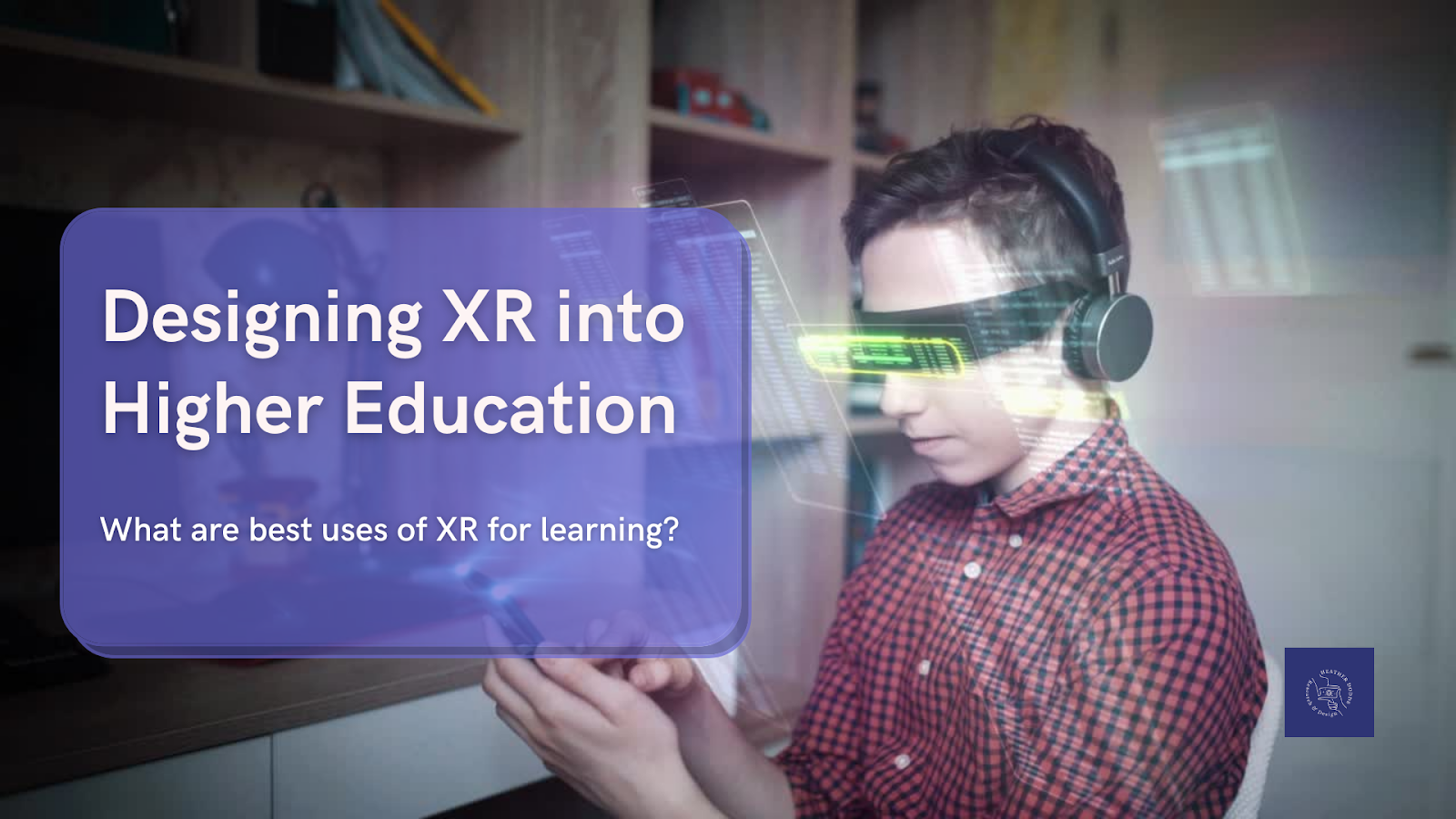
  • Designing XR into Higher Education

    Designing XR into Higher Education


    With the dramatic shift to online learning with the arrival of the
    COVID-19 pandemic, faculty, staff, and students within higher education
    worldwide have made the sudden but necessary initial steps to
    incorporate technology into the learning environment in ways never
    imagined. However, forward-thinking administrators are wondering, “what
    comes next?” Immersive learning and XR answer this call. 

    Created with care in Canva. 


    Sources: 

    Definitions come from my own writing here: 

    Ziker C., Truman B., Dodds H. (2021) Cross Reality (XR): Challenges and
    Opportunities Across the Spectrum. In: Ryoo J., Winkelmann K. (eds)
    Innovative Learning Environments in STEM Higher Education.
    SpringerBriefs in Statistics. Springer, Cham. https://doi.org/10.1007/978-3-030-58948-6_4 

    Dodds, H. (2021). Immersive Learning Environments: Designing XR into
    Higher Education. In J. E. Stefaniak, S. Conklin, B. Oyarzun, &
    R. M. Reese (Eds.), A Practitioner’s Guide to Instructional Design in
    Higher Education. EdTech Books. https://edtechbooks.org/id_highered/immersive_learning_e

    Slide 6: 

    Mordor Intelligence. (2021). Extended Reality (XR) Market –
    Growth, Trends, COVID-19 Impact, and Forecasts (2021 – 2026) https://www.mordorintelligence.com/industry-reports/extended-reality-xr-market 

    Slide 8 does not have one source but over 20 years research (including
    my dissertation study) with technology-facilitated immersive learning
    has yet to show a significant improvement other any other learning
    media. This aligns with this important article in the history of
    instructional design: Clark, R. E. (1994). Media will never influence
    learning. Educational technology research and development, 42(2), 21-29. 

    Slides 9, 10, 11 “XR reduces Time, Money, Danger” (similarly expressed
    in my dissertation). There are parallel comments made by Jeremy
    Bailenson documented here as his “DICE” advice. https://stanfordvr.com/video/2019/transformative-experiences-vr-for-good/
    It should be noted that the DICE advice are the 4 occasions for which
    to NOT use VR (against) where my 3 are 3 occasions TO use VR (for). 

    The combination of 4 different models is my own published creation:
    ADDIE (traditional ID model), Design Thinking (from UX), 3DLED (from
    Karl Kapp), and narrative plot (loosely credited to Pixar). They are
    displayed here to show the remarkable similarity of steps/pathway across
    each model, thus supporting the validity of the proposed path.

  • What Does the Space Age Teach Us about Instructional Design?

    What Does the Space Age Teach Us about Instructional Design?


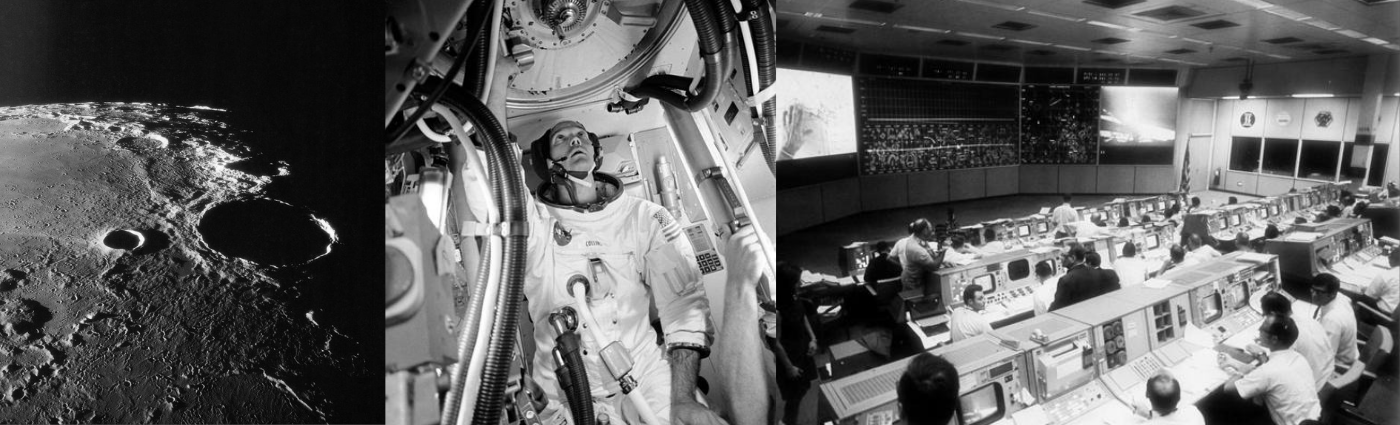
    Source: NASA

    The 50th Anniversary of the Apollo 11 Mission to the Moon is upon us. As a science lover, I’ve been soaking up all of the ceremonies
    as well as the updates of future space missions ahead including
    Artemis. Space science has been inside of science learning standards for
    years. Several themes have emerged that intersect with instructional
    design and I want to mark the 50th Anniversary of the Mission to the
    Moon by noting these lessons.

    First, a little history.

    The
    urgency within modern STEM education within the U.S. traces it’s
    history directly back to geopolitical sources. With both Sputnik in
    low-space orbit and a man in “space” already, the Russians were ahead
    during the Cold War and fears were rampant that enemies could be
    anywhere on the planet because they could look down or drop down from
    above. Since the dawn of the Space Age, there has been a call to
    increase the number of working scientists in the United States in order
    to achieve and maintain supremacy of near-Earth space. Interestingly,
    this call for more mathematicians and scientists goes on today, even
    though the U.S. is undeniably one of the top three countries in the
    world with viable dominance in space. Therefore, lesson one is: Never
    underestimate the power of geopolitical influence in guiding overall
    learning and education. If you thought science and space could float
    off together un-tethered to any human notions of greed, you are very
    wrong. (Reference: the entire movie Interstellar.)

    Coincidentally,
    the field of Instructional Design tends to trace its history to nearly
    the same time period, starting in the 1950s Post-World War II America,
    with ID edging out the space race by less than 10 years. ID was born to
    the idea of planning and putting edges and method to the art and science of learning. How nice that ID was considered both an art and a science! That’s a theme coming up.

    Next lesson: It’s all about teamwork.

    This one is the biggest lesson for me. There were two types of people directly involved in the Moon Missions:

    First, Ground Control.
    Notice the name. Ground Control. Not Ground
    We-Think-We-Have-A-Good-Idea, Can-We-Run-It-Past-You. Not
    I-Have-10,000-Twitter-Followers-So- Obviously-I’m-Thinking-Clearly.
    Ground Control. They called the shots. The people on the ground had
    access to:

    • The most amount of data. (Crossover with AI here)
    • The most amount of experts.
    • Prototypes and the ability to change technology setups on the fly. Hint: Cross-over with UX technology here.

    I
    look at the footage of the control rooms, practice areas, and hear from
    the astronauts themselves and I see one theme over and over: Checklists.
    Controls. Contingency plans. And training until it is automatic. And
    this is a great lesson for instructional design. When designing
    learning, make sure every step is documented. Make checklists. Keep
    checklists. Update them. You will need to know about every fuse, knob,
    switch, and procedure that your learners will need to engage. In Space
    travel, there is no “hand waving” approach. That means that there are no
    shortcuts or middle parts that are so ubiquitous that they are not
    documented. You can’t skip launch to get to orbit. You can’t skip orbit
    to get to the Moon. Checklists make me happy. Every step is important.
    This is learning science.

    Second, Test Pilots.
    As we reflect on history, we’ll have to just weigh the balance as to why
    the test pilots were only white males. Grr. But alas, the specific
    personality characteristics of test pilots is the point here. Test
    pilots need to know as much as they can. They need to be trained to the
    point of automatic responses (just the same as police, fire, and
    medical personnel on Earth). And then the most important point: they need to be able to improvise and take the leap from the known to the unknown. Another name for this characteristic is bravery. This is the art.

    If I may insert an analogy here, we had our Spock on the ground and sent our Jim Kirk to space. We need both.

    Instructional
    designers need to have a little of both within them. They should know
    everything about everything within the instruction they are working on.
    (I’m not saying that they should be SME’s on the content. We have
    SMEs, it’s the SME’s job to be the Subject Matter Expert.) But
    instructional designers should know the learning inside and out.

    Instructional designers should have a test pilot streak; the ability to say “I wonder what this will do” and be willing to try.

    As I’ve written about before, most of the bad rap that online education has comes from badly done online education. We have to experiment to do better. Strap on a parachute and get up there and try something new.

    Next lesson: It’s worth it to “shoot for the moon.”

    There
    is a quaint phrase out there that says “Shoot for the moon. If you
    miss, you’ll land in the stars.” Beside the annoyance you give
    scientists over the concept of accuracy, the point is to try because
    other things besides your main goal are achievable; to reach out. It is
    good when the instruction you designed reaches its goal. It is an
    absolute delight when the instruction you designed reaches another unplanned
    but desired for goal. But you don’t get that second goal until you try
    for the first. It is this degree of bravery that helped us get where we
    are. To this day, we have advanced in many areas of Earth habitation,
    not just space exploration, with the Moon Missions. We need more bravery
    in instruction to go forward.

    Final lesson: After 50 years, we’ve only just started.

    NASA
    has plans and I entirely support their explorations both in space and
    on Earth. (Indeed, without Earth, where are we going to keep our stuff?)
    The blue marble in space idea reminds us that we are all in this
    together. Within instructional design, brain-based learning is getting
    some great traction and I support this as it erases differences of
    gender and race to look at the neurological underpinnings of learning.
    As I’ve noted
    before, I’m researching the future of transmedia, cross-reality, and
    virtual reality as it relates to instructional design and we are only
    just beginning to know what it can do.

    Our Moon shot is still ahead, instructional designers.

    Come along for the launch. I’ll save you a seat.


    #Apollo11
    #Moonshot #space #NASA #spaceexploration #50thAnniversary #Transmedia
    #virtual reality #virtualworlds #crossreality #mixedreality
    #augmentedreality #design #instructionaldesign
    #everythingilearnedfromStarTrek #Spock #JimKirk #GroundControl
    #TestPilots #brainbasedlearning #neuroscience #teamwork #artandscience
    #science #heatherpolicy #heatherlovesscience #5DayChallenge


    This post originally appeared on LinkedIn on July 16, 2019

    https://www.linkedin.com/pulse/what-does-space-age-teach-us-instructional-design-heather-dodds  This post was updated on April 3, 2026 with a better font and removal of missing images.

  • Instructional Design Resources for XR

    Instructional Design Resources for XR


    Digital Library Federation

    #DLFteach Toolkit Volume 2: Lesson Plans on Immersive Pedagogy

    https://dlfteach.pubpub.org/dlfteach-toolkit-2


    PEAT

    Inclusive Resources for XR

    https://www.peatworks.org/futureofwork/xr/inclusiveworkplacexr/

    Microsoft

    How to approach inclusive design (a mindset): https://lnkd.in/dwcj_8-Z


    XRA Developers Guide

    12 pages. Easy read. General
    ideas related to ability and UX/UI. However, NOT necessarily advice
    about best uses of XR with reference to design (I’m referring to
    mission/purpose/value…not images, colors, themes.)

    https://xra.org/research/xra-developers-guide-accessibility-and-inclusive-design/