Author: H

  • Leadership should be simple and confident

    Leadership should be simple and confident


    Photos of motorcycle rider leaning confidently against motorcycle, arms crossed.

    “For a large organization to be effective, it must be
    simple. For a large organization to be simple, its people must have
    self-confidence and intellectual self-assurance. Insecure managers
    create complexity. Frightened, nervous managers use thick, convoluted
    planning books and busy slides filled with everything they’ve known
    since childhood.

    Real leaders don’t need clutter. 

    People must have the
    self-confidence to be clear, precise, to be sure that every person in
    their organization—highest to lowest—understands what the business is
    trying to achieve. But it’s not easy. 

    You can’t believe how hard it is
    for people to be simple, how much they fear being simple. They worry
    that if they’re simple, people will think they’re simpleminded. 

    In
    reality, of course, it’s just the reverse. 

    Clear, tough-minded people
    are the most simple.” ~ Jack Welch


  • Lisa, you missed this

    Lisa, you missed this


    Photo of sunlight bursting through clouds on to a green landscape.

    Photo by Ales Krivec on Unsplash

    When I worked for an online university, I was hired in a group that considered ourselves an unofficial “class”, as in, a group of similar aged/characteristic employees that were all hired by one boss.We were Phil’s hires. 

    That’s Phil’s boy! ~Hercules movie, Disney


    Lisa and I had a further set of similarities; we were single, we were from the Northeast, had dogs, and felt like we were the “B” kids compared to the “A” kids of the rest of this class. It seemed that everyone else in this same class was the best at something. One day she even asked about it in a small team meeting, saying something like “How did I/we [referring to her and me] get here?”  To which, I remember Phil giving a lovely answer about hiring people that he thought had a touch of excellence. With that, I remembered that Phil was particularly taken with my New York State university experience and probably had seen my honor society, Phi Theta Kappa. Oh, nice touch!

    Through the years Lisa and I worked together, I got to know that she was a high quality math teacher. Surviving in that job required it but also she thrived. But after a few years, she did leave and took a job teaching in California (not online), I think in San Francisco. In doing so, she missed the great firings of 2010 which did decimate what was left of the original class. We were scattered or demoted as Phil had left by then himself (I think?).

    I kept in touch with Lisa via Facebook. Her mom got sick, brain cancer I think. Lisa took her into her home and took care of her, even putting in a garden for her mom to sit in. But her mom died. It looked like Lisa took it OK. Her mom was cremated and had her ashes scattered in the Pacific. After that Lisa’s life did look like it started to shatter a little.

    Before I knew it, she announced she was moving back to New Hampshire. That struck me as odd since I had thought that her position and life in California was pretty good. She said something about having a teaching job there. So I didn’t pay more attention. New Hampshire does have its attractions.  Be it far from me to blame someone for exchanging earthquakes for no income tax.

    But in general her life got so much quieter.

    It was right about this time of year. I remember that now.  I remembered that this morning.

    At 4:12 this morning, a robin was singing outside. Happy to sing. As I listened, he sung without compunction or care. He sung because God created him to sing when it is barely light outside. He sings for hope.

    At 6:30, I opened my curtains to find the sun bursting through the clouds. It was such a surprise. I had only briefly checked the weather forecast which was calling for storms and sun. So to get a burst of sun just at that moment was like another message from God that said “I’ve got this all under control”.

    Then I walked my dogs outside and as the wetness of the air hit me, one thought just rushed to my mind.

    Lisa, you missed this.

    About this time of year, Lisa committed suicide.

    She waited for the school year to be over. There aren’t more details available because, sadly, she left behind only one blood brother who seemed so grief stricken, he could not communicate what happened. But he said she had planned it and left a note.

    She had picked a time AFTER the school year was done because she was a math teacher and didn’t want to hurt her students more than it was going to. She missed her mother and she thought that suicide would bring her back to her mother.

    At the time of Lisa’s death, I did reach out to Lisa’s family and I made sure that everyone in the “class” knew.

    But this morning, I have different words now. Grief and mourning has turned to anger. It’s no longer time for me to be sorry Lisa has died. Now I’m angry.

    I’m angry because Lisa was wrong.

    Suicide is wrong. Suicide is throwing one’s life away, throwing away a gift from God. As long as you are alive, God wants you to do something.

    Think about that robin. Did I need to do anything to receive hearing his song? No, I only had to hear it. 

    Did I need to do anything to open my curtains at just the right time that the sunlight streamed into my eyes through a break in the clouds? No, I only had to see it. 

    Did I need to do anything to feel that God’s love & forgiveness is for me? No, I only had to exist and be aware enough to conceive of it. It doesn’t take hearing necessarily. It doesn’t take sight necessarily.

    It doesn’t take a job. It doesn’t take having a mother. It doesn’t take __[fill in the blank]__

    Lifeline Center calls are free and confidential. 1-800-273-8255 — Starting on July 16, 2022, just dial 988.

    Suicide is not the answer.


  • Your first attempt at designing XR for accessibility will suck. Keep Going. GAAD 2022

    Your first attempt at designing XR for accessibility will suck. Keep Going. GAAD 2022


    Image with text: Your first attempt at designing XR for accessibility will suck. Keep going. GAAD. Global Accessibility Awareness Day. Image made by Heather Dodds in Canva.

    Replica of my GAAD LinkedIn post

    Looking for tips on how to design #XR
    for accessibility? You could follow me, but I’m just learning this
    stuff myself. Search. Learn. Ask. Network. Try. Then try again. Cry
    some. Then try 1 MORE DAMN TIME. Because XR can be for everyone.

    Curious? Good. I’m putting some links here. They are all click worthy.

    Vision

    In 2021 I heard, “I don’t know why the blind
    would want to access VR”
    . I’m so over that. I’m SOOO over that comment.
    👿 Let’s make one thing clear: if you make a human “sub-human” in
    front of me, there will be angry eyes. Start here: https://equalentry.com/virtual-reality-development-for-blind/ and then here: https://equalentry.com/how-can-a-blind-person-use-virtual-reality/ and for a video, see here (seriously, WATCH the very beginning): https://youtu.be/rvsZ1ssyom8


    Sound


    XR for the Deaf: I read everything my link Meryl puts out. I would encourage you to follow her: https://www.linkedin.com/in/meryl/ She publishes on topics beyond deaf accessibility.

    I just found this golden tidbit TODAY for #gaad2022
    , check it out! Audio descriptions in games – something of particular
    interest to my Instructional Designer friends as we are always keeping
    an eye on conflicting text, sound, and narration. This is something to
    learn about here! https://youtu.be/W2B3jBu0ZqY


    Mobility

    I absolutely LOVE this product and want more of it: https://www.walkinvrdriver.com/ Need to watch a video instead of read? Sure! https://youtu.be/lwmAFHAj6EI 


    Also: https://specialeffectdevkit.info/

  • Tenure should be abolished because tenure is slavery

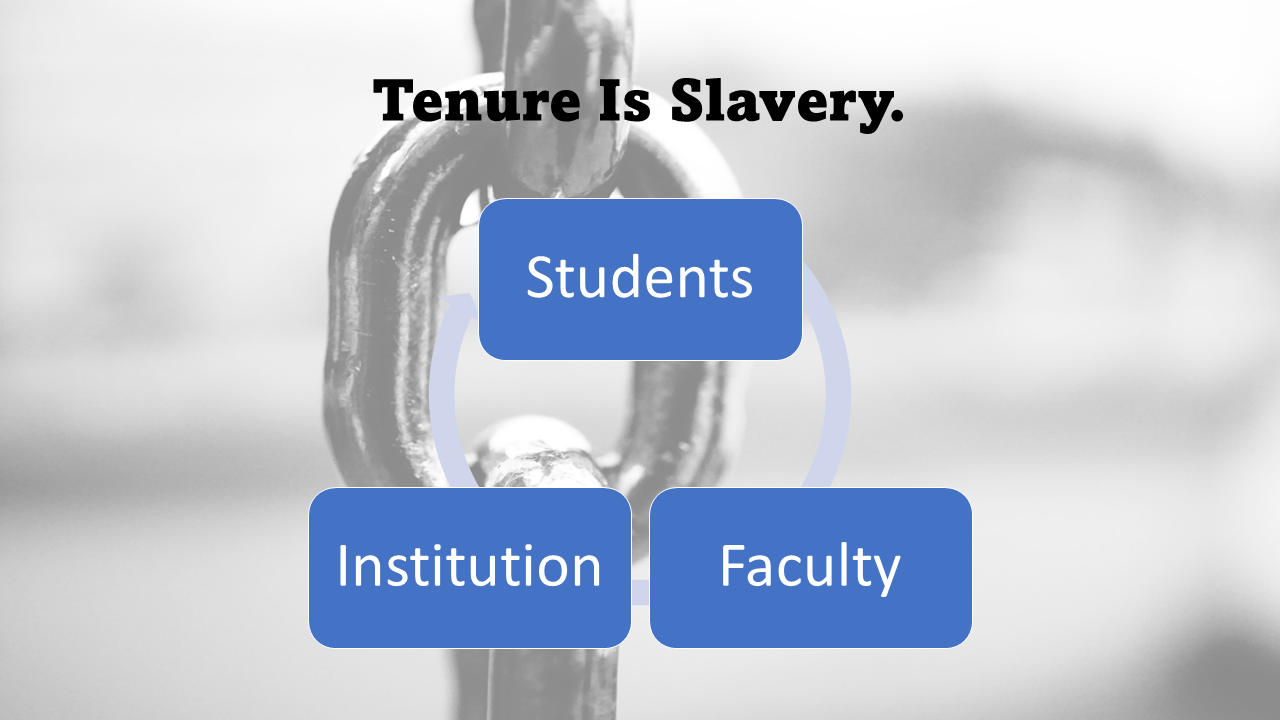
    Tenure should be abolished because tenure is slavery


    Tenure is one of our current day forms of slavery. Response post to: https://www.insidehighered.com/digital-learning/blogs/online-trending-now/communicating-realities-higher-ed-2022?fbclid=IwAR3B_Sp0QFDigHRGAfPDG852F3DGX5uMWwgae6FIg3iS-0Z5dYo44KsVNu4

    It’s is not direct slave-is-slave, master-is-master slavery. It is, as is some forms of education now, disaggregated. The parts of slavery now are possessed or embodied within different entities, but it is still slavery if one defines slavery as a lack of freedom combined with a lifetime of benefit.

    Here me out.

    1. Students pay the price–their tuition literally becomes the forever paycheck that will output last in this process. As long as students keep joining the institution–and really, ask any university how important “Enrollment” is to them– the input into the system keeps happening.  This is the input of “lifeblood” for lack of a better analogy.  Without students, a university dies. In this model, the debt that students carry becomes the disaggregated “lack” or deficit.

    2. Faculty pay the entry price to attain the status of “tenure”.  (Note: I can point out that paying this price is one-time technically.) They will go through the YEARS of hoops it takes to get this status. Now, I will not pretend to know what this is. I’ve simply turned my head and hands away from this entirely. I worked at institutions that did not offer it OR I did not work in roles that had tenure in the career path. (Sabbatical is a completely different idea, BTW.) But I’ve heard the horrors stories. I can’t even LINK to one article because a Google search of just “Chronicle of Higher Education gave up pursuing tenure” pulls up 8 articles in just the past 5 years and that’s just the surface!

    But I know we’re talking years of:

    • Attending faculty meetings but being on time AND contributing more than one’s fair share
    • Publishing and its attendant research
    • Excellent teaching record
    • Carrying the load of freshman courses that would make one cry daily
    • Simultaneously carry strong academic conversations while respecting other tenured profs
    • Attend non-academic events for the university to look like you have ‘team spirit’ (READ: Football)
    • Don’t forget to buy a house in the university neighborhood.

    Side point: I won’t get deep into the scandalous price that adjuncts are paid for what is known as often EQUIVALENT or HARDER work with many less benefits and pay. It’s very true that adjuncts could be paid a fraction (the article says 1/4) of what a full time faculty member is paid for the same work.  THE SAME. How is that EVEN legal?

    3. Then there is the “forever” part. The faculty member, once they get tenure, supposedly has a ‘forever paycheck’ and now a benefit of this lauded extra thing called “Academic Freedom” (which…actually….checking the paperwork was a right awarded to all faculty (including adjuncts) from the date of hire…but no one noticed that) but still… FREEDOM.

    And yet, that forever is only contingent on the university being open.  Which brings us back to #1. Students. A university is only open if it has students.

    Post-pandemic. Students are realizing they have a much broader choice. I hope they embrace that and walk with their dollars. Universities will shut down, profs will lose tenure, and hopefully that concept will pass from memory. Bye bye slavery.

  • The first step into the Metaverse isn’t the hardest. It’s the nth step that you do for the nth time.

    The first step into the Metaverse isn’t the hardest. It’s the nth step that you do for the nth time.


    Photo of architecture in Iran

    Response post to: The Forgotten Stage of Human Progress


    I’m knee deep in an XR implementation project. It’s going forward by
    inches; each step aches with how small it is. If I measured it, it feels
    like it would barely tick one mark on a stick. However, like a gardener
    that makes one small snip here, one pull of a weed there, there is no
    overnight transformation. But still– in the messy work of
    IMPLEMENTATION, I’m making a garden that turns heads and makes people
    think “I want to be there.”

    Seriously, here is the garden:


    Today is one of those days where it feels like we are going 2 steps backwards with no step forward. When you hear it mentioned quietly, but over and over and over, that one of the biggest implementation problems we have in XR for education is “sound” — WE ARE NOT KIDDING.

    We have more problems with sound that with any other aspect of an experience. It is the TOP problem source.

    Virbela had this problem in buckets. My hosts cringed every time I estimated that 20% of incoming users had sound problems. 20%!  If YouTube had a 20% failure rate that they presented to users, they would far, far out of business by now.

    I watched this video dated November 5, 2021 put out by Stanford University touting the first course taught in XR with Jeremy Bailenson where he claims it will be “an incredible journey for about half of this class”


    Here is the video promo text: 

     “263 students, all with their own VR headsets, across 20 weeks and two courses, spent over 200,000 shared minutes together in the Metaverse. They engaged in large group field trips, small group discussions, performed live music and skits, and worked both alone and together to build their own virtual worlds.”

    First: posed shot OR photoshopped image. Notice: no Zoom markings at all. It’s not “live”, people are not moving.


    For someone like me with enough live event logistics and tech support experience, watching this video shows me that I suspected the course was riddled with sound problems.  

    The background music starts at 0:18, so “hearing” the students will be hard.

    Watch for how much students were cordoned off into small groups (that’s not just a teaching method, that’s to put them soundwise AWAY from each other and minimize disruption) and then just listen to what you CAN hear of the sound provided in the video, you will get snippets and what you will hear will be blurbs of users acting more awkward and users waiting around on another user.

    The “you made it” comment is somewhat telling. It is HARD to get users into XR. Admittedly, it might easier if you are at Stanford and everyone has an Oculus Quest 2 (Meta Quest). (smirk)

    Privilege much?

    At 1:14 there is a LOT of talk over and by 1:18 the video has been sped up to just overwhelm with ADDING models or processing to VR on the ENGAGE platform.

    I’m not trying to douse flames of innovation here. But I’m trying to point out that implementation, as the Atlantic article points out, is a much messier, day-by-day process than the glitz and glamour of a moment.

    The video shows THIS as what appears to be a class highlight moment.


    The sound is a man speaking saying “Nice work everyone!”

    Just let that sink in while looking at that image.

    2021. Stanford University. That is one of our very best learning instituations, folks.

    Ironically, all of the avatars with awkward arms ARE the users actually using headsets. That one avatar in the middle in the gray shirt with this hands at his sides? He is the one user in 2D, not a headset.

    Snicker now, because he is the only one looking normal in this bunch.

    Implementation is HARD!

  • Passive Aggressive Behavior in Online Meetings

    Passive Aggressive Behavior in Online Meetings


    Photo of aligator floating on surface of water with text: passive aggressive in online meetings

    To assist those continuing to adjust to full time remote work, I share one story from my archives about a passive aggressive employee that used online meetings to derail projects and get his own way. To be clear, I considered this employee a friend and in-person, they never pulled the passive aggressive behavior I’m describing.This was unique to group phone calls or web conferencing.

    So this story is about the passive aggressive behavior and the day I’d had enough and decided to prank him back. It is NOT a “do as I do” story.

    This person’s go-to passive aggressive technique in online meetings was to wait until near the end of a discussion on a topic and then quietly in a voice that purposely trailed off, say something like:

    • I only wanted to add that…
    • There is the extra point that…
    • I wanted to point out that…

    The key to this technique was to start out VERY quiet and get QUIETER. So the voice has to truly “trail off”. It has to sound as if the person either stopped having the will to talk or the line itself faded away or some sense of “I’ve given up hope” has to come through the auditory line. That is key. One cannot be bold and pull this off. Think Eeyore but 20x more and quieter.

    I had observed this employee do this behavior for years. In this story, I’d like to point out– he didn’t work for me; he was not on my team. So on the day I decided to take him on for this, I was truly poking the bear, I wasn’t actually ‘taking the mick’ out on a team member of my own, which I would not do.  But I knew this person loved to get his own flavor or mission added to projects or to hard steer projects into his own ‘my way is best’ direction. Here is how he’d try to use this technique on a work project:

    1. He’d use this trailing off voice line.

    2. Immediately the person running the meeting would say “Oh, I’m sorry, what did you say?”

    3. He would repeat it a little louder but not much. The point was to draw attention to himself and he had to draw you in. Until he knew he had you, he kept pulling you closer and closer by keeping his voice quiet. Folks would literally lean IN on their cameras.

    4. Even if you as the project leader felt like his idea had not merit whatsoever, because he would present it in this “humble servant who can barely speak above the quietest mumble mode.” Socially, the proper response he was banking on would be something like “Oh, you have a point there, I didn’t think of that” or “We might be able to consider that” because he was being so meek and mild.

    5. THAT was the foot in the door he needed because YOU just acknowledged HIS idea as valid in front of the entire team (this technique was always done before a crowd). In case of any backsliding or NON-implementing of his idea now, he would constantly remind you that you had approved (notice the wording change) of his idea and you’d failed (as a leader) to put it into play. Said another way, he had you. He had his way. All from a mumble.

    *The foil to his technique, by the way, was to simply listen, lean back in your chair, consider and then deny it forthrightly.

    *Another technique (that I was bold enough to use) was to stop him right as he started mumbling and override his talking with your own and say something like “I realize you are trying to interject but we don’t have time for more comments. Moving on to the next agenda item.”


    (more…)

  • Reducing Cognitive Load and Slide Layouts

    Reducing Cognitive Load and Slide Layouts


    I had an interesting short conversation with a colleague on Facebook in January. I went back and screen captured it to show what we wrote and here, I’m going to further explain my thoughts about his question and my answers.

    His question:

    Hi
    everyone! Just joined as I’m looking for some insights into this slide
    design issue: how do you make use of slide layouts in developing
    training slide decks? One slide layout would be repetitive and boring
    but too many slide layouts would appear inconsistent. The training
    program has 8 modules, each module has between 8-12 slides. I currently
    have 6 slide layouts to work with. The type of content in each module
    can be repetitive (why this topic, a quote, bold statement, activities,
    topic idea with bullet points, etc). Different slide layouts could be
    applied to each content (e.g. photo on the right, photo on the left,
    photo in the background, etc). Hope you’re following the context setting
    🙂
    Do you use any slide layout organization method? E.g. Layout 1 for
    Module title (that’s a given), Layout 2 for a quote, Layout 3 for the
    first slide with a photo in the module, Layout 4 for the second slide
    with a photo in the module, etc. Then repeat for the next module. Or do
    you just use some random slide layouts in each training module. The
    graphic designers I’m using don’t seem to be using any coherent slide
    layout organization, so when I’m adding slides, it’s always a puzzle for
    me to determine which slide layout might best (as if there’s some
    overall training slide design principles out there…) I’ve done my
    research and also have a great book on building PowerPoint templates but
    I can’t find any thoughts, ideas, suggestions on the matter. Happy to
    clarify more, if needed! Thanks!

    My responses:


    From the laughter and heart emoticon, we were having a good time with each other.  But I want to go deeper into this topic. Because Mark* mentioned being interested in cognitive overload in some of the responses he had already received, I wanted to go that route to see how much he was willing to figure that out –was he willing to figure out that ANY simultaneous spoken words and text increases cognitive load (Dual Channel Processing Theory)…therefore eliminating that reduces cognitive load problems and can increase the “pleasantness” of a presentation.

    So when he presented that so much content was already present in a prototype manner of 64-96 slides , I was first testing to see if he was willing to pull some of that content OUT and place the text in another format (a handout).

    I also was intrigued that he was truly asking about slide formats which, is quite a ridiculous question actually. To me, I would advise to stick with whatever format is the most obvious– HOWEVER I’m going to talk you out of all formats so don’t put too much energy into this.

    Example Google Slide layouts: Title slide, Main Point, Big Number, Blank, etc.

    PowerPoint Slide layout examples: Title Slide, Two Content, Content with Caption, Blank, etc.


    My first response:

    Is
    there any particular reason why you can’t package the “8 modules with
    8-12 slides” into one PDF text-only handout and present only images?

     His reply:

    Yeah,
    I’ve looked into design like this. They can be punchy. I’d have to see
    from a training deck perspective how this would look like (e.g. a full
    deck), most of what I’ve seen are decks create for business purposes,
    presentations and pitches. The full slide deck has about 80 slides, so
    that’d be lots of images!

    Oo! He misunderstood because it seems he thought that by taking content out, it would be replaced with images. No, that’s not what I meant. I meant reducing the number of total slides AND reducing what was on the slide. 

    This is moving content that should be speaker notes to speaker notes (duh) and what should be a text handout for the audience to one of those freebies and focusing the visual presentation on looking at and listening to the presenter.

    But I was willing to tease one more step with this designer.  So I did one more push to see if he’d get my idea of REDUCE THE SLIDES.

    My second reply:

    Groovy. Time to next level the next level. Present from one slide. Go.

    His final reply:

    I’ll go a step beyond, present with candlelights because power is off and it would be quite costly to send everyone home 😁 it only lasted 2 hours, thankfully lol.

    He’s laughing here. I don’t think he got that I was pushing to present with no images and no slides and all text pushed to another source. He MIGHT have thought that I meant presenting from one big image (Yikes! like one big Prezi!) but I hope not. But we did end laughing because I think he got that sometimes the power does go off and you do talk in the dark (boy, does that prove that you know what you’re talking about or not.)

    I haven’t gone further here but I’m going towards Robin Williams‘ Principles for effective presentation design in The Non-Designer’s Presentation Book, which does explain well that most presentations (like the one Mark describes) have probably used the slides like speaker notes and that’s a no-no.  

    Hint: Would you like to see a presentation of just images that is compelling and works?  Try the first 1 minute 26 seconds at the beginning of The Da Vinci Code.  (Set aside how you feel about the content).  A good speaker/presenter/teacher might NOT need words on the slide.

    OK, there are times for words on the slide. I’ll write about it someday.

    *Mark is not his real name. 🙂

  • Do not worry about the numbers

    Do not worry about the numbers

    For many years, I worked at an institution that prided itself in its competency-based model, which then drove data-based decision making. It’s easy to draw the A to B on this one. Faculty were held responsible for the completion data of their students: how many students completed the course within 6 months. The data was direct and succinct. But my leadership policy was to not hold my faculty responsible for this data. I would de-emphasize this when the topic came up.

    Actually, nearly every year, I was known for saying this:

    There was a reporter once that asked Mother Teresa, “We always seem to have the problem of poverty. We never escape it. What can we do about it?” She replied “Turn to the person closest to you, and love them.”

    Photo of Mother Teresa.

    Of course, this is a story, based on her lifetime of interviews, actions, and what she shared of her beliefs. But I find the story rings true so I don’t blush in sharing it.

    And I would encourage my faculty in this way…

    “Don’t worry about what your completion rates are. Students will be students.

    But the email at the top of your Inbox–that is the person closest to you. Help them. When your phone rings, and it is a student struggling and they can’t understand how to be successful, that is the person closest to you. Help them. When it is your turn on a Help Line and a call is routed to you, take the call. Help them. Help them like they are the only student you’ve ever met. This is how you approach numbers. If you do this with each student that appears in front of you, I’ll provide cover from every other force at this university. I’ll provide resources, time off, and respect for your work.”

    And none of my faculty were ever fired or let go for their performance numbers.

    Indeed in the 14 years I was at that university, the Satisfactory Academic Performance rate (SAP) never moved from 72%. Students always completed, on average across the entire university, about ¾ of their work each term.

    And I’ll share this tidbit with you–just to show you that it’s all fine to boast but…was there really any danger?

    Yes. Every year I was a leader, I only met half of my goals. 50%. Every year I submitted my own performance evaluation, I’d laugh and feel like I was tossing my own “oh well” paper into an inbox of some class I just would not master. That 72% held firm. We weren’t going to move it and I wasn’t going to make my faculty die on a battlefield that we were not going to win. It was an infinite game and I played to keep my faculty going (to stay employed) so that they would keep helping students, so that students would keep being successful. Yeah, not every student, we could not save them all. But we did not fall on our swords so that performance numbers would go up. The courses were hard and we were teaching math and science to non-majors. Said another way, our student could not have cared less for the material. Just passing was their goal and I respected that.

    (Another leadership rule, after EVERYONE IS A LEADER and GROW UP MORE LEADERS is PICK YOUR BATTLES. Don’t fight all of them. This one—the numbers, the data—wasn’t worth fighting. So I refused.)

    Want to learn more? I suggest you research The Infinite Game, by Simon Sinek, research the phrase “deficit thinking” (and if you like, the short rabbit trail of “growth mindset”) and of course, there is much more about this in the Holy Bible, if you care to venture in. Oh, and do the math on what I just wrote; I was doing this years before the 2018 video I just referenced. I was doing the Infinite Game play before it was called that. In my book, it’s just called leadership.

    Photo of siloette of women looking right before a colorful sunset.

     Photo by Ahmet Sali on Unsplash

  • I’ve Quit With Zero-Day Notice 3 Times Now. Sorry, Not Sorry.

    I’ve Quit With Zero-Day Notice 3 Times Now. Sorry, Not Sorry.


     Photo of a beautiful spot in Ukraine by Maksym Tymchyk on Unsplash


    Zero day notice. Same day notice. Resigning and walking. Notifying your boss that you quit on the day you quit.

    I’ve given zero-day notice 3 times. This blog is about why I found it to be the right choice those 3 times. I’ve been told I write long articles too (yes, I know!) so I’ll keep this moving along.

    Time #1

    I was working for an institution that was famous for quick & sudden firings, Western Governors University. On June 2, 2010, they fired 14 employees, one every 15 minutes, between 9 – 12:30. No severance. Their famous line was “Your position has been eliminated.” 

    The Famous 14 Firings - Image from Up in the Air Movie- Decorative
    WGU was fire happy like this

    The institution was an At-Will institution in an At-Will State. I define that as employment can be terminated for any reason without notice.

    Screen capture of At Will policy from with an example Human Resource Employee Handbook.


    The At-Will clause applies to both the employer and the employee. Notice that? The employee is employed at the employee’s will. Folks often miss that.

    I was being retaliated against for being a whistleblower. I was in a horse race; they would fire me or I would quit. I was not sure which would happen first.

    I consulted with two Human Resource experts over my zero-day plans. Both of them advised that given the institution’s reputation for firing and the at-will status, it would be acceptable to give zero-day notice in this instance. One even said that I’d be a champion for those that were previously fired because they might have wished to walk out on their own terms.

    I calculated my departure day ~3 months in advance. 

    The unanswered instant message


    The day arrived. At 9 in the morning, I sent my boss an instant message. “Hey, it’s important that I meet with you today. Can we find some time?”

    No response. 9-10 goes by. 10-11 goes by. 

    This is just like her. Ignoring me was her management style. 

    Her schedule showed a “Leadership” meeting from 11 – 1 (ironic! 😂). I wait and continue to complete my work.

    By 12:54 I really cannot wait much longer. I intend to give verbal notice but I can’t get to her to deliver it.

    So I click send on an email written to her and Human Resources simultaneously. 

    Three minutes goes by.

    Then my instant messenger goes off. “Oh Heather!”

    My boss begs for a phone meeting. I put her off until 3:30 p.m. Guess who’s too busy now? 😏 


    I communicated the status of my projects by email. Because this institution runs on the Amazon 1:8 leadership model, I had 8 or less direct reports and I did not have much on my plate.

    Once our phone call happened, it was a stilted meeting. I can feel that she wants me to state an reason for leaving suddenly (i.e. “I’ve been diagnosed with cancer, so I’m starting the treatments tomorrow”). That might absolve her of her guilt.

    But I don’t give her a reason. I know I don’t have to. My employment was at my will.

    I shut down the work laptop for last time at 6 p.m. 

    I never looked back.

    Photo of woman walking away in an underground hallway.

    (more…)