
A History of XR Cross Reality Part 2 of 6
 |
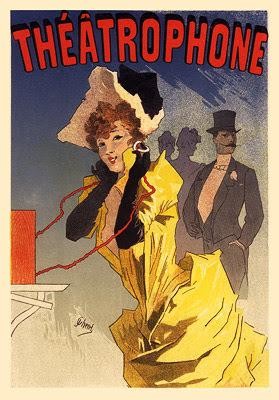
| Jules Chéret, Public domain, via Wikimedia Commons |
As a reminder, we are using science fiction as our time
machine vehicle to examine how good we are at predicting the future and
our intention is to predict the future of cross realities (XR).
1881 – 1909
1881
– The invention of the theater phone (theatrophone) allowed users to
listen to the live opera from a location up to 1 mile away from the
theater. So you do not have to be there to be there.
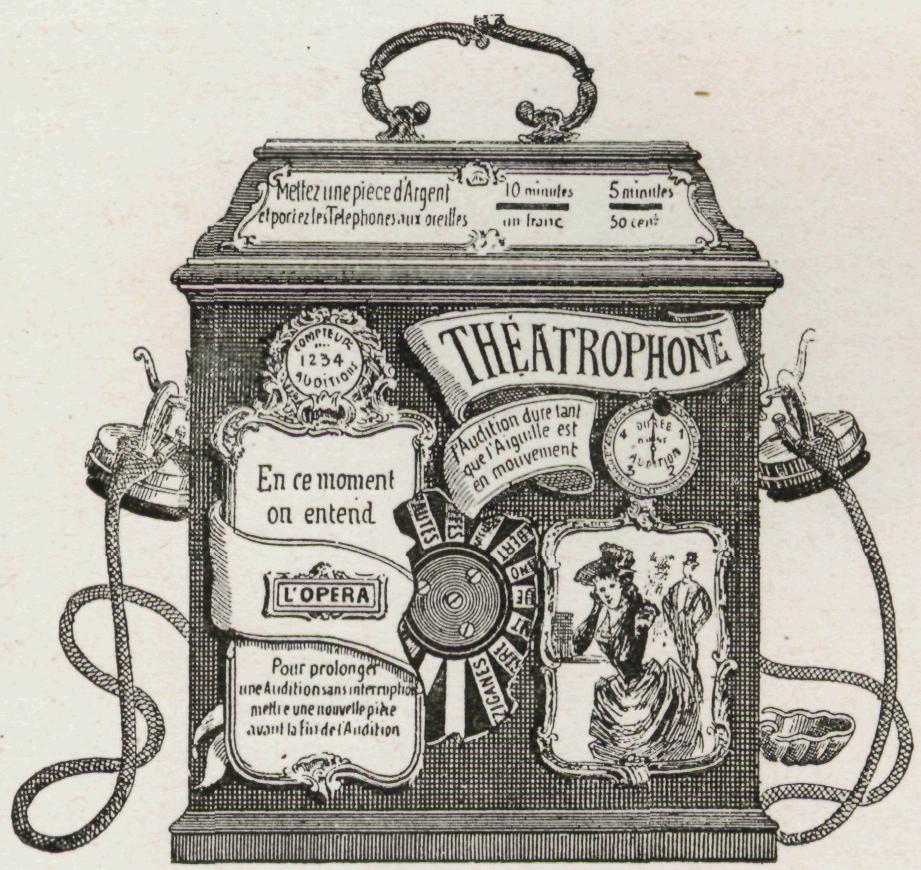 |
| Münzbetriebenes Empfangsgerät des de:Theatrophons. Circa 1892. Work is considered to be in the public domain in the US. |
1882 Paleo futuristic image showing opera attendees in the future year 2000.
In case you are checking your watch, that’s 2 decades ago as of this
writing. Did I miss fish cars? Lizard cars? Actually, never mind. I
don’t think you’d find me going to the opera regardless of the kind of
car.
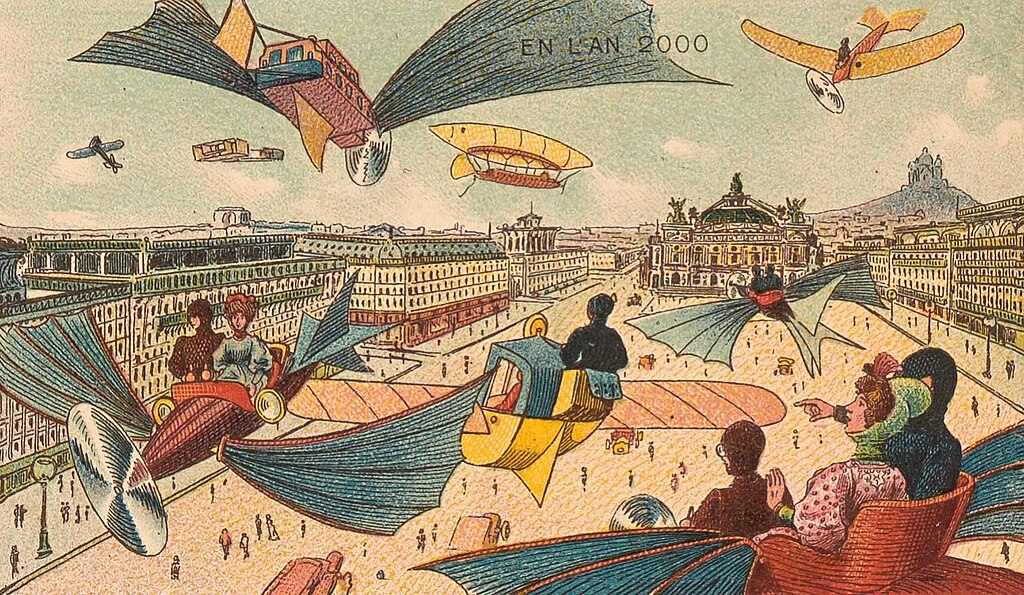 |
| Villemard, Public domain, via Wikimedia Commons |
1895
H.G. Wells published The Time Machine as a dystopian future view. Wells
was living in rural England and was seeing the industrial revolution
expand. He saw large factory cities swallow up young workers for long
hours in dark conditions and producing to satisfy an seemingly
insatiable consumer. He looked forward and saw a future where humanity
would become split into two groups that would almost would never interact.
_-_front_cover.jpg) |
| Author Herbert George WellsPublisher William Heinemann, Public domain, via Wikimedia Commons |
On
the surface was a Greek god-like existence of Eloi. They all looked
alike. (Shivers.) This group would be the consumers. They would benefit
from this world order but simultaneously be oblivious to the price for
their existence. They would be a small group, the 1%.
The
underground dwellers, the Morlocks, would run all of the machinery. They
would be the producers, and the generations of being underground would
allow for adaptations of evolution including large eyes, intolerance of
sunlight, and flesh-eating.
E.M. Forster read The Time Machine and rejected this future that H.G. Well foresaw.
However,
before we get to Forster’s publication, we visit one other futurist. In
1901, Frank Baum (of The Wizard of Oz) published The Master Key which
contains the first known reference in writing to what we would recognize
today as augmented reality:
 |
| William Wallace Denslow, Public domain, via Wikimedia Commons |
“On
the other hand,” continued the Demon, “some people with fierce
countenances are kindly by nature, and many who appear to be evil are in
reality honorable and trustworthy. Therefore, that you may judge all
your fellow-creatures truly, and know upon whom to depend, I give you
the Character Marker. It consists of this pair of spectacles. While you
wear them every one you meet will be marked upon the forehead with a
letter indicating his or her character. The good will bear the letter
‘G,’ the evil the letter ‘E.’ The wise will be marked with a ‘W’ and the
foolish with an ‘F.’ The kind will show a ‘K’ upon their foreheads and
the cruel a letter ‘C.’ Thus you may determine by a single look the true
natures of all those you encounter.”
“And are these,
also, electrical in their construction?” asked the boy, as he took the
spectacles… All character sends out certain electrical vibrations, which
these spectacles concentrate in their lenses and exhibit to the gaze of
their wearer, as I have explained.”
“It’s a fine idea,” said the boy; “who discovered it?”
“It is a fact that has always existed, but is now utilized for the first time.” [A wonderful Wizard of Oz-like sense of humor. Making fun of the fantastical, but obvious.]
In December 1909, E.M. Forster publishes The Machine Stops. If
you have a chance to read it, I encourage that. It is a remarkable
story. If you substitute “the Internet” for “the Machine,” the story is
eerily accurate in some predictions of humanity. There is also very
interesting economy where humanity values the exchange of ideas above all other concepts (cough, Instagram, Twitter/X, Mastadon, Bluesky, etc.).
Short summary:
In
the future, everyone lives underground in these large columns of cells
because the surface is inhabitable. Each person lives in a cell that is
of a small defined space, one person per cell. The collections of people
are like bee hives. Everything a person needs to live is brought to
them in their cell by the Machine. Food, air, water, and once a day the
cell (and the person) are washed clean. The humans never meet or touch
in any way. They listen to concerts, speeches, and read books.
The
plot of the story unfolds with a son that yearns to escape to the
surface world; he believes it might be inhabitable and as such, holds
new promise for humanity. At first, he tells his mother about his desire
to leave via the Machine (a progenitor to Skype?) but the Machine,
intercepting the message, always fuzzes out when people express
unhappiness with the current order of things (cough, Facebook experiment).
Thus, the mother does not understand her son’s intent. She tries to
dismiss her worries. The son becomes insistent and travels to visit his
mother in person. When they meet, the mother is bothered by human touch.
He insists that he’s been on an exploratory climb and that he knows
other youth that are going to leave too. She will not leave the hive,
she cannot understand why anyone would leave the Machine. He leaves and
finds a livable world on the surface. The Machine, without humans to
service it, eventually breaks down and everyone remaining underground
dies; not because they are unable to leave, but because they lack the fortitude to do so.
Forster’s future vision does not have cannibalism but it highlights an amazing weakness; that the more humans depend on machines, the less human we will essentially become. Forster seems to argue that the human connection to the natural world is our salvation; a lesson not lost in 2019.
You’ve
finished a great deal of time travel but this was the slowest feeling
part of our journey. We’ll start speeding up in Part 3 which will
publish on November 29, 2019.
#Reality
#CrossReality #MixedReality #VirtualReality #AugmentedReality
#VirtualWorlds #Design #Transmedia #XR #VR #AR #ARVRinEdu #EdTech
#Innovation #Change #HGWells #EMForster #TheMachineStops #TheTimeMachine
#TheMasterKey #FrankBaum #TheaterPhone
Originally posted in November 2019. Updated on February 24, 2026 with changed font and re-added images.