From Myths to Principles: Part 8 Ethical Labyrinths, Interpreting Research
Immersive experiences, as replications of real world experiences, could reasonably utilize any major learning theory.

XR, Instructional Design, and remote team leadership



.png)


What fights won’t we fight? What is our secret weapon? And what lies ahead? It’s the final part of this series.




Credit: Me and Midjourney
My first article in this series garnered so much attention! But many folks tried to pass me Mirjam Neelen & Paul A. Kirschner’s Truth or Truthiness? Analysing a VR Study Using Gorard’s Sieve article on the PwC report entitled “The effectiveness of virtual reality soft skills training in the enterprise: a study” and all of its associated webpages like this one. I was like, I know! Mirjam & Paul wrote their article 2020 and I wrote about it in 2021. What’s cool is that separately, we both came to the same conclusions. That’s a good sign for our conclusions!
Short version: we both cast strong doubt on any conclusions.
Still, I realize the world does not revolve around me (sigh!). Some folks might have missed my long stream-of-consciousnesses article about the PwC report. I decided that the second article in this series should be an abbreviated and updated critique. Bear in mind that to reach the LinkedIn audience, I have to leave much nuance by the side of the road. If you have questions, just ask!
As Mario says “Here we go!”
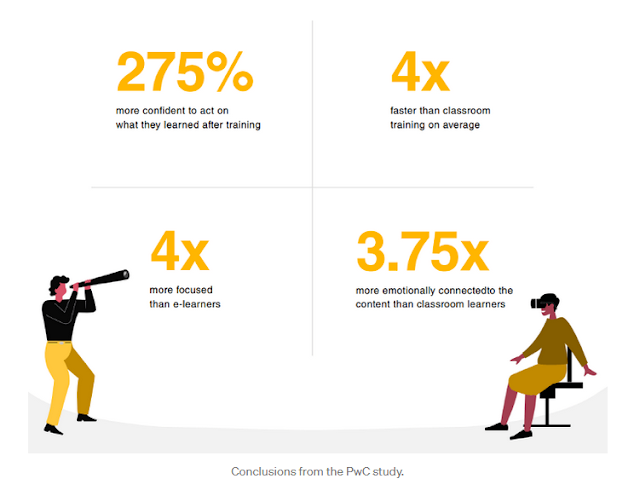
This infographic summarizes the dominant conclusions:


What do these Google results have in common?
They are all companies that sell some sort of VR product or service.
Because I was curious, I checked out that vrowl dot io link (“Virtual Reality training is not effective”) just to see if it was presenting an alternate opinion. It’s a strawman argument; it puts up “not really real” protests against VR for learning and then explains them away. I’m telling ya, Beware the VR Strawman.
Eckert, D., & Mower, A. (2020). The effectiveness of virtual reality soft skills training in the enterprise: a study. https://www.pwc.com/us/en/services/consulting/technology/emerging-technology/assets/pwc-understanding-the-effectiveness-of-soft-skills-training-in-the-enterprise-a-study.pdf
Let’s ask Google Scholar what it thinks. It’s coming up with 11 cites. That’s not much at all. But as I showed above, the money shot is on the Internet, not in academic articles.
Truly, the 4x faster learning quote is the runaway train of this report.


I love to dwell in both theory and research. Both are fascinating to me.
But how do I balance theory and research when they conflict with each other?
I share an example and I know this is stormy waters ahead for some readers because I’m going to create waves.

Photo by Ant Rozetsky on Unsplash
First, the theory; Andragogy or Adult Learning Theory credited to Malcolm Knowles and to smaller degrees to other theorists. Before I go any further, I have to acknowledge that in 2022, there is a STRONG movement to discredit Knowles and Adult Learning Theory. More than I can count, it’s currently cool to disrespect this around instructional design. It’s quite ugly.
Examples:


I find this trend really disturbing and an example of cancel culture. Realistically, I find that IDs that put no mental effort into truly studying Andragogy dismiss it out of hand as unreal based on their surface understanding. Said another way, they believe that they know what Andragogy is and then they say it does not exist. BTW, LinkedIn comments have become hot when I’ve described that THE MOST COMMON COMPLAINT against andragogy is that “children occasionally display these adult traits too, so, therefore, adult learning as an exclusive or separate thing does not exist.” Heads-up: Classic logical fallacy of composition.
Once in a while someone will ask “What is an adult anyway?” which I find to be at least a cognizant thought and then explain “Yes, defining an adult is the first exercise in an Adult Learning Theory class.” Duh. It’s actually really hard to define an adult because there are so many different standards.
In summary, using a logical fallacy of composition argument is already weak.
Additionally, I find that Andragogy is well-respected, research-supported part of education around for over 30 years. What’s next to pick apart? Gender studies?!? 2022 does seem to be the Year to Attack Women. What about Black Cultural studies? How about studies about any particular group?? Or should I be saying “Any particular group that isn’t White Mainstream?” See? That’s where cancel culture gets you eventually; no one is good enough. I reject all of this.
Rinse & repeat on Brain-Based Learning.

