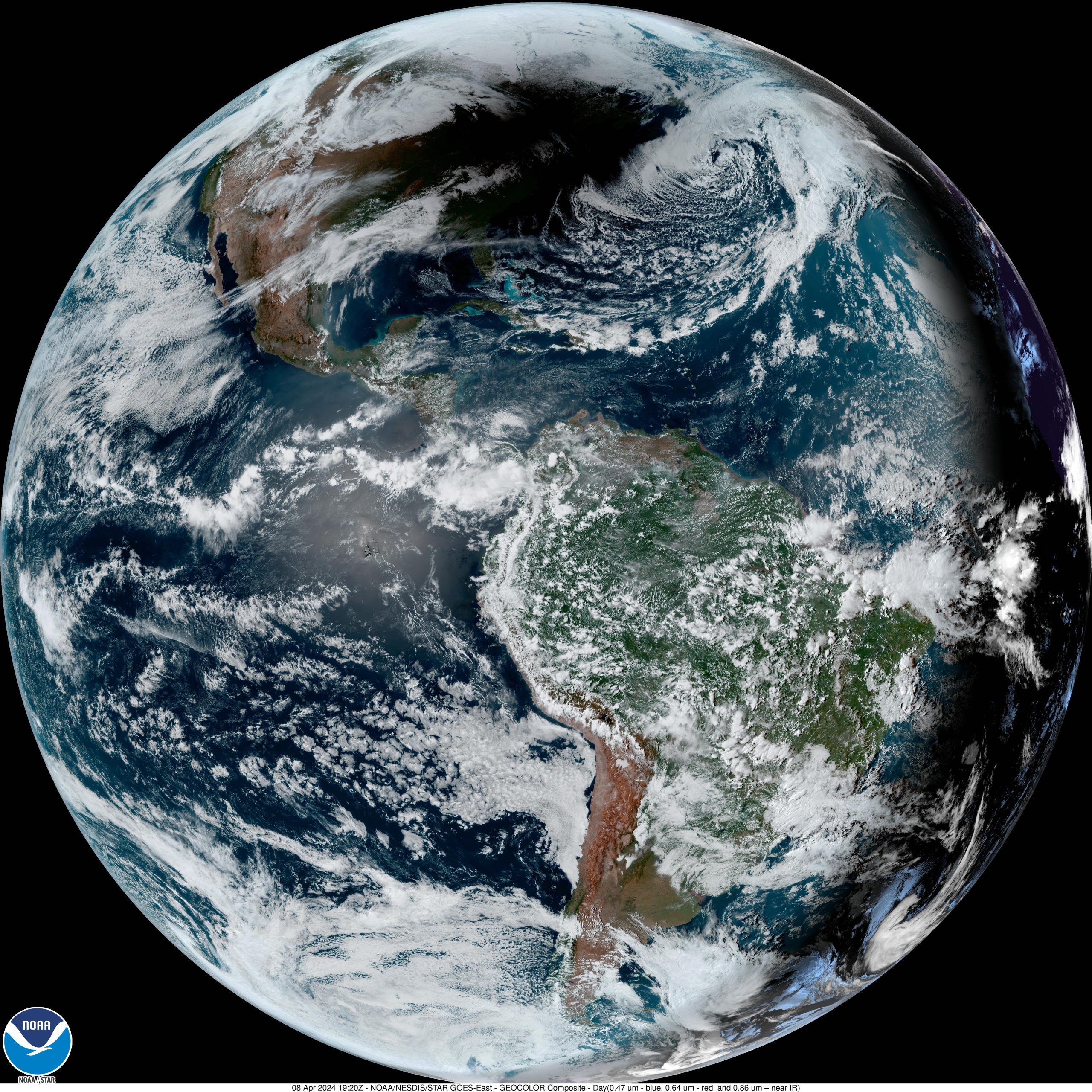
A total solar eclipse occurs on any given spot on the planet once every 375 years. I am honored and blessed that I was inside totality right from my front yard.

Preparations
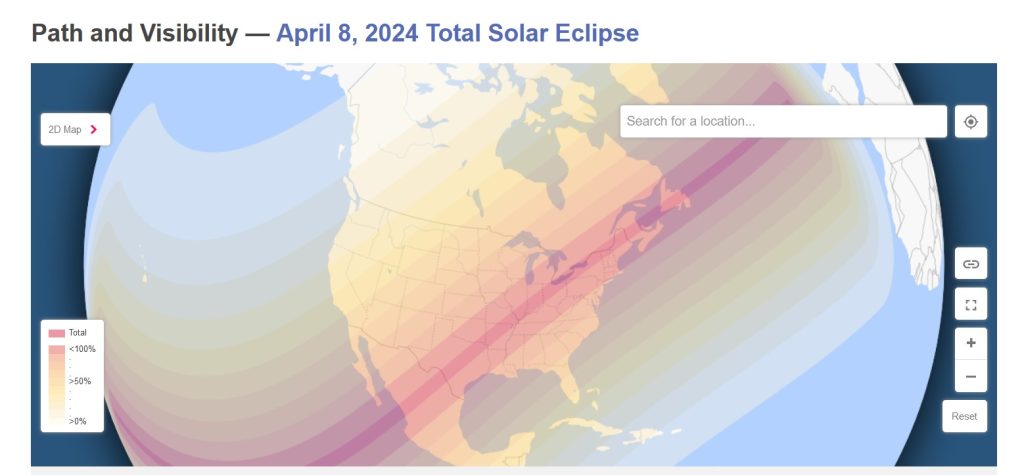
Preparations began with me realizing that the path for totality for this solar eclipse was going to come directly over my home. So I didn’t need to make any plans for travel.
I purchased the “VisiSolar Solar Eclipse Glasses Made in USA Pack of 1 CE ISO Certified NASA…” from Walmart.com for $7.99 on March 11, 2024. Later on the day of my online order, Heuvelton Free Library announced that they were giving away eclipse glasses for free. 😖 Bummer. Actually, I don’t have a final positive opinion about these flimsy glasses. I found the view to be less detailed than what I saw through welder’s glass. However, they WERE a bit easier to finagle over my smartphone camera lens for a photo.
Test photo the day before the eclipse:

Yup, the sun in out there.
We were forecast for ~2 minutes and 59 seconds of totality.
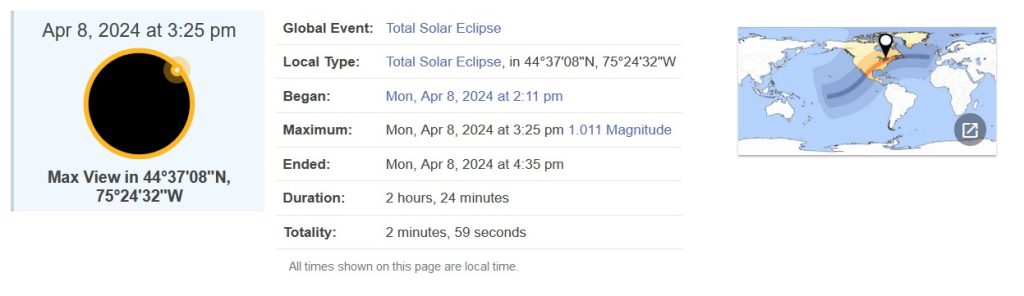
The following Detailed view of timing is from Time and Date.com and I did not review it in advance of this writing. It’s already interesting that some of my observations match up. The times look a little off, but I couldn’t get more exact on the location with Time and Date.
These predicted details were correct in that the moon moved from the lower right to the upper left in apparent view across the sun at my location. (Some video shots from astronomical equipment reverse up and down).


Fortunately, St. Lawrence County Chamber of Commerce put out a detailed timing list and I was able to note it for my location. This was VERY helpful and I scribbled it on a post-it that I kept in my pocket to remind me of official start and end times.

I had also heard that welder’s glass or a welder’s helmet would be OK for viewing the eclipse. As a blessing, Dad and more likely, my Grandpa left a welder’s mask in my barn workshop that I dusted off and tested beforehand. I thought that worked out very well, you can even see details of my house in the photos I took with it…although taking photos was a struggle to get it the camera inside the face mask.
One more prep that I did was to decide to do the NASA Globe Observer app eclipse temperature observations. So I purchased a special digital wired thermometer for that (it’s in the photos) but I found it to be a constant nuisance because the readings were different from each other (inside and outside) and that should not be happening when the entire unit is in the same air — outside! Grr. I thought the readings were consistently 0.4 degrees off, but that was not true as they did fluctuate. I brought out 3 more thermometers just to guess who was reading what temperature correctly. We were advised in the Globe Observer eclipse training to NOT depend or use a weather app for the temperature. I would verify that that was good advice as the weather app didn’t update, I think, anywhere near as dynamically as the temperature did change. At some points, I had more than 1 degree air temperature change inside of 5 minutes.
The Globe Observer app also collects cloud observations, mosquito habitat mapping, land cover, and tree observations. I took several cloud observations during the event. NASA should email me later to let me know if they can calibrate my “ground truthing” photos of the clouds with a GOES Satellite overhead. I also took one land cover measurement to show my thermometer, as per the eclipse suggested protocol.

I chose to stick with the Globe Observer app and temperature readings because I could do those even if we had cloud cover. I was tempted to try the SunSketcher app which was designed to try and capture Baily’s Bead photos. But the app wasn’t ready until late before the eclipse (just a few days before?) so I wasn’t logged in and ready like I was with NASA Globe Observer.
The National Weather Service in Burlington sent out a Tweet that high clouds were moving in but that thicker clouds around Buffalo might not make it into the North Country before totality.
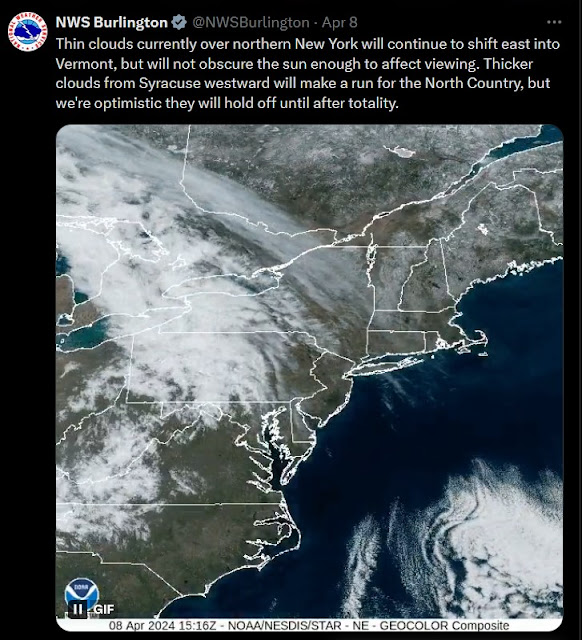
Everyone west of the Adirondacks and north of the Jefferson county line started to hold our breath. There was one reply tweet offered a helpful maneuver:

Partial Eclipse
After a hurried lunch, I set up my camping chair, telescope (hopeful that I could see the comet during the eclipse), binoculars (I am experienced at how to safely use binoculars during a solar event), water, notebook, pen, thermometers, and nervous chocolate (no shame). I realized at that point that the Globe Observer wanted one to start 2 hours before. It had actually jingled my phone and I ignored it. Oops. So I was a little late on that start time.
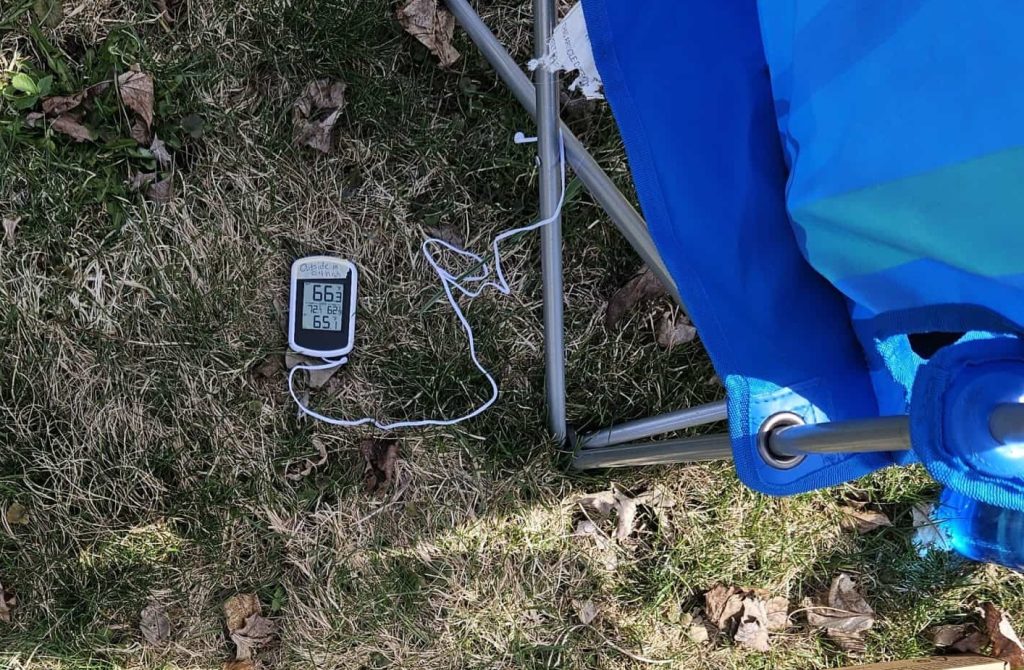
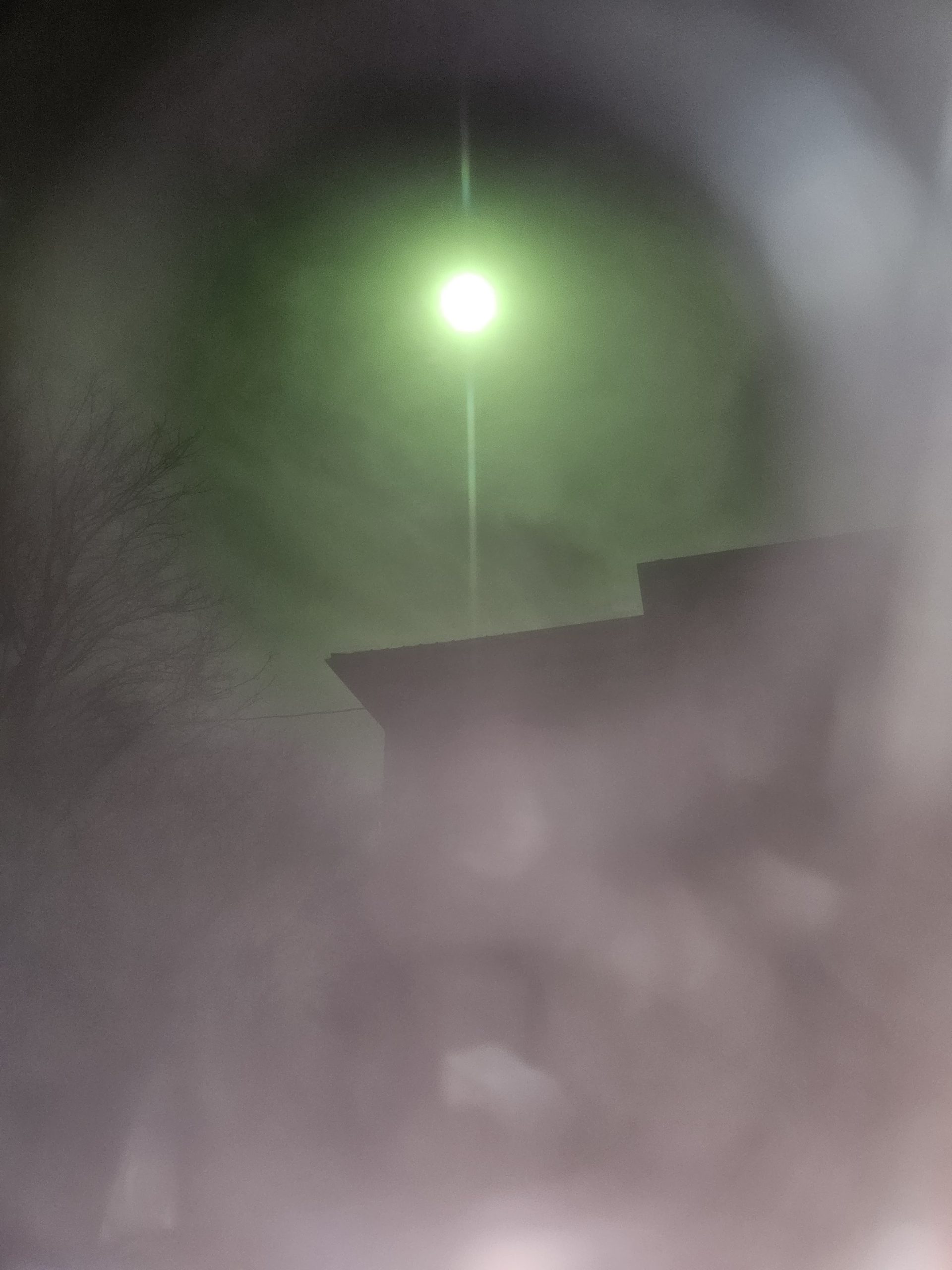
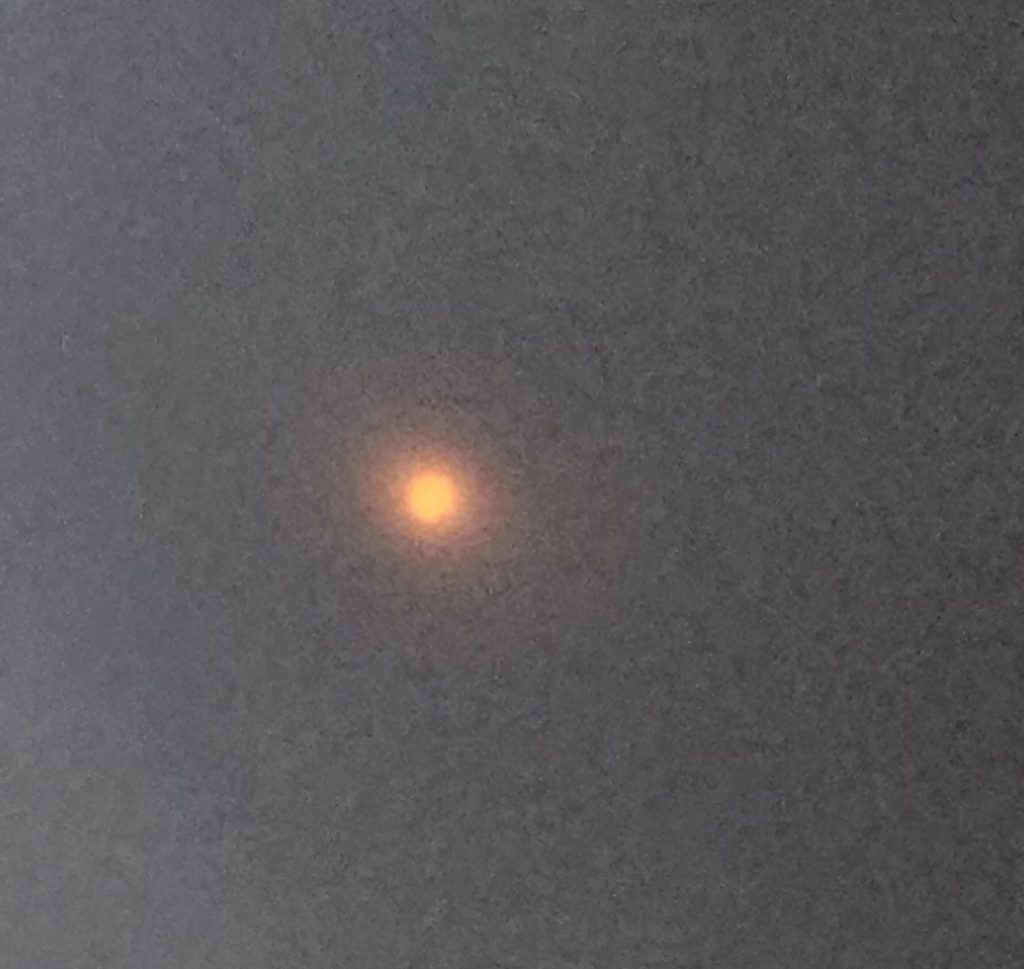
2:45 Clouds moving in, light breeze.⛅🍃
2:51 Cool enough to put on a long sleeve shirt.
2:53 ~50% of sun covered. Last temperature reading switched from “outside” to “inside” as it calibrates to 2 other thermometers. (The outside temperature only matched 1 other thermometer.)
2:55 Can’t barely see sun at all with cloud cover. Merlin 🐦 flying around.
2:59 Eclipse progresses.

3:02 1/4 of sun left, filtered light. Distinctly cooler and darker.
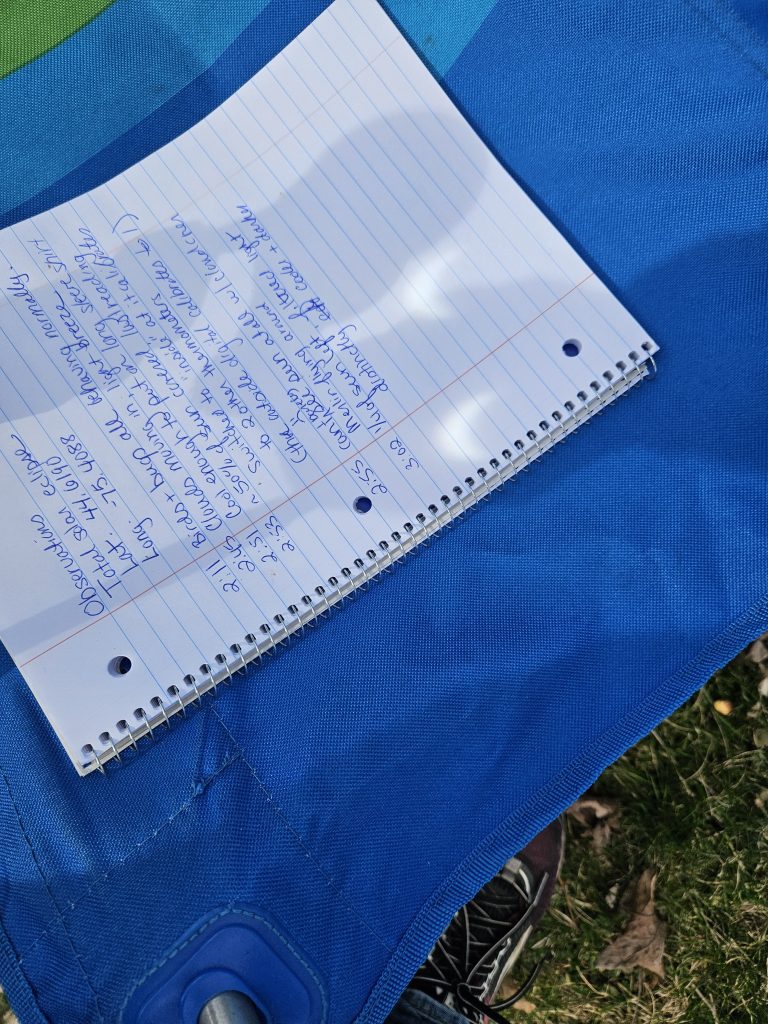
3:05 chatted with neighbor. I mentioned my nervousness over how dark it’s going to get. He said his outdoor light had already gone on and off once. He mentioned that it felt quieter.
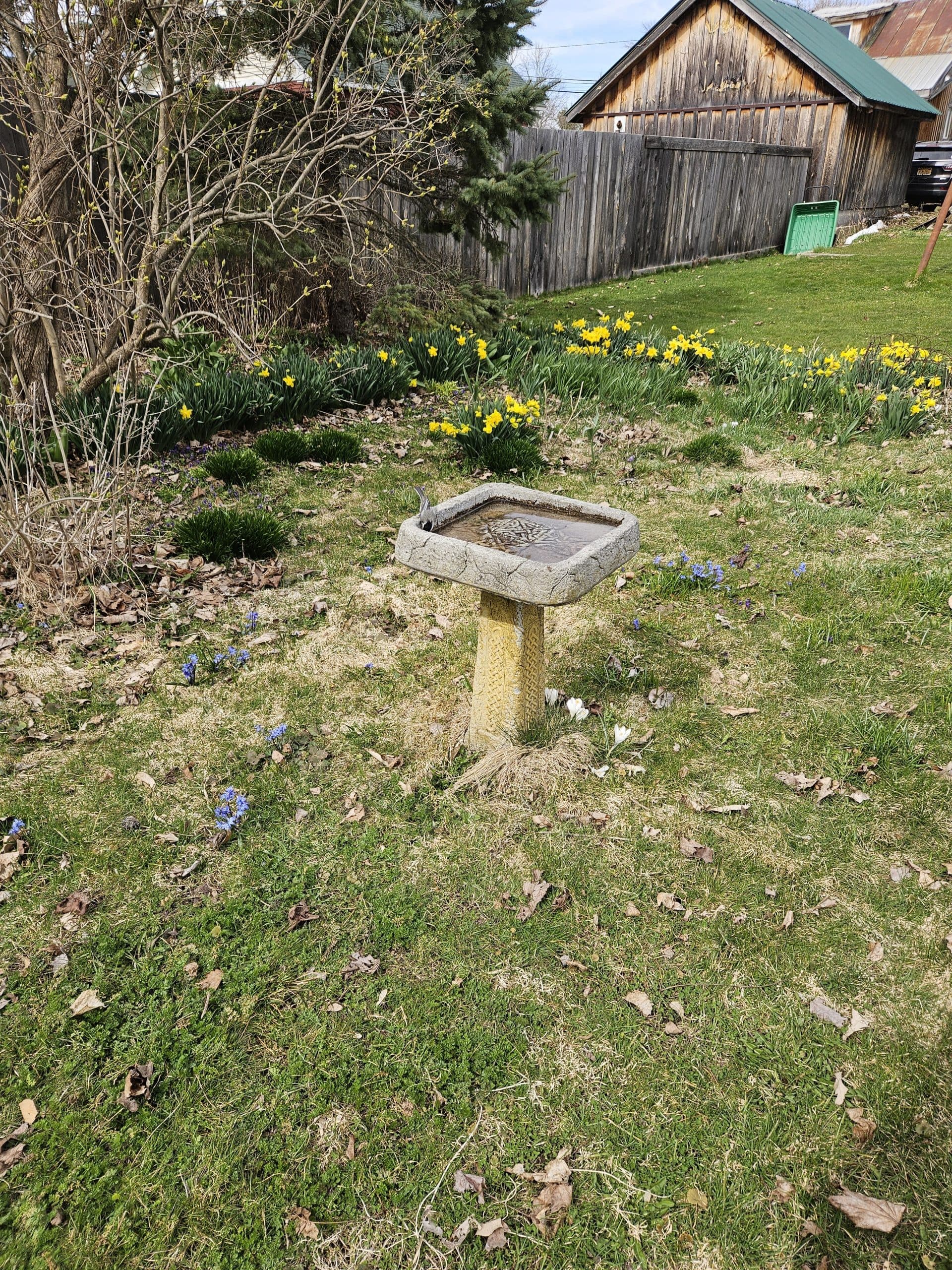
3:12 Bird activity: Chickadees and robins.
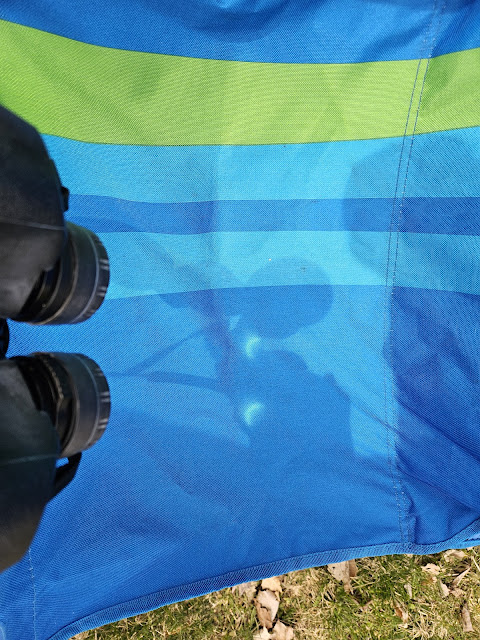

3:17 Feels darker – like wrong weird dark.
3:20 Clicking sound from the ground- like a temp drop. Mosquitos eating. Darker, heavy clouds but still can see a shadow.
3:22 Sky colored, reddish, gray.
Totality
The darkness approached fast. I took photos at what looked like a sudden storm bank.
3:23 I grabbed my camera as the darkness approached. I could hear my neighbors who were at most 4 houses west starting to whoop and holler. I had time to get these 7 next photos almost in serial fashion in one minute.


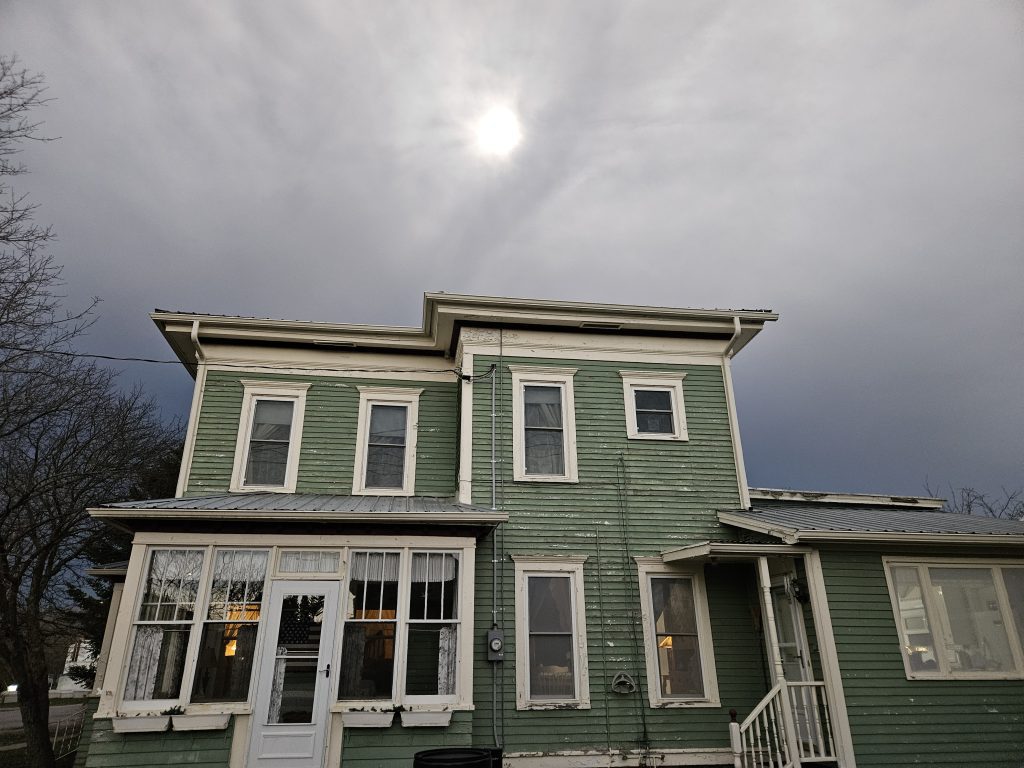
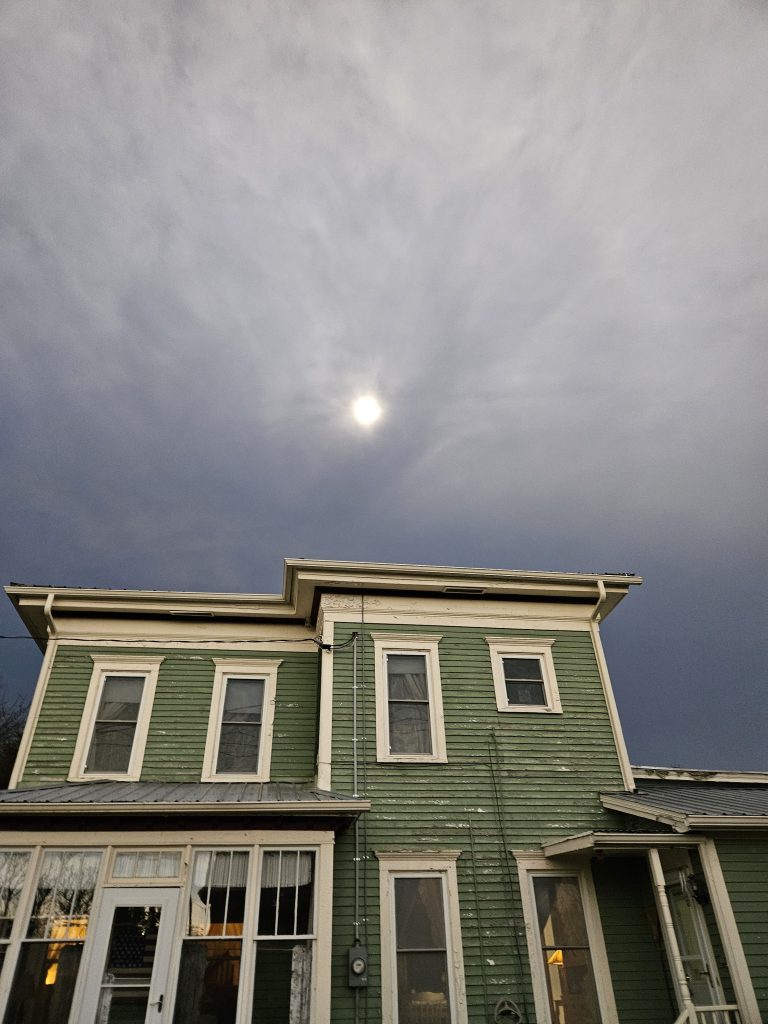
Distinctly scarier now. Folks are yelling.


Light dropped by the second.
Street light on!
3:24 Quick into darkness.

Could see. Not “thick” darkness.
Neighbor called out “We survived!” and laughed.


East north east


I don’t know why the photos improve but it probably was a combo of me slowing down and the street light shining more brightly (as it warms up).


One robin kept singing the whole time.
Could see the horizon of light around us.
Temp dipped ~10 degrees in total (Fact check: It was 12.1 degrees total). It read the 40s on one thermometer on the ground.
Neighbors were whopping it up, I took photos, the sun looked lovely as a ring in clouds!
Partial Eclipse Again
Right after, Blue Jays calling a lot. Also could hear: mourning doves, robins, starlings, dogs barking.
3:32 light feels back to normal, can see shadow, sliver of sun back
3:37 same light cracking sound from surface of the ground, not deep. No observed problems with birds.
3:38 Merlin flying again, seemed to call to its mate.
3:42 Still enough sun to see a shadow. Mosquitoes are bad– hovering! Have to move away.
3:49 50% of light of sun showing now. Lots of things already back to normal. Temp is rising significantly now.
Cheap glasses did not go through the clouds as well as the welder’s glass or more truthfully, the cheap glasses blocked more.
Didn’t move thermometer. Wore long underwear — glad I did if only against the mosquitos.
I didn’t expect that “feeling the shadow” would feel so small– you could see out of it to the horizon nearly the entire time.
3:55 60% of the sun back.
3:56 small airplane (prop plane), direction south, another small airplane direction SW

4:02 more sunshine, but cloud thickness has felt the same since the thicker clouds moved in.
4:04 Distinctly brighter now, 75% of sun back.
4:06 birds seem all normal– so unusual calling for the time of day. (I don’t know what I meant there)
4:07 another jet leaving
4:12 junco came nearby. Cloud over the sun is thicker with fingers over it, as viewed through the welder’s glass.
4:18 (drew picture)
4:20 Thick cloud moved in to cover sun.
4:27 another 2 small planes: 1st to the south and lower altitude, 2nd to the SW and higher altitude
Rich folk who flew in for the event?
A third! South.
4:30 A fourth.
4:32 Sunshine! Breaks in clouds!
4:36 Local forecast end of time of eclipse. Clouds observed with mottled pattern. (drew picture)
5:15 been raking and moving leaves from spring cleaning. No unusual worm data. 🙂
5:21 Sun coming out strong now. Fully sunny in a cloud break.
5:45 Stopped observations (this was more than 2 hours after totality). Very sunny now with Cirrus clouds.
Temps were up and down due the sun, clouds, and wonky thermometer that I fought most of the time.
Thermometer set up at the end, showing 62.3 in outdoor (air level) and 59.0 at indoor (ground level)

Thoughts
I’ll note one strange observation. I did hear a cracking or crackling sound lasting 2-3 seconds coming from the ground BEFORE (3:20pm ) and AFTER (3:37pm) the eclipse. Totality was timed for 3:25 for my location (but we were in diamond ring at 3:24). So ~5 minutes before and ~12 minutes after peak totality this sound happened. The list from Time and Dates predicts that “animals and nature affected by falling levels of light”. It was very faint and it sounded like the cracking sound a metal roof makes when heating up or cooling down. But the sound was coming from dry leaves on the ground, not from under the ground. It last long enough that I could turn my head around and hear it distinctly. I could not determine if it was just the decrease in light causing the leaves to cool and crackle (which is what I thought at the time) or if the slightest of breezes skirted the ground.
I was ever so thankful that my neighbor and his kids were outside in their yard through the event because I was nervous. Not “the apocalypse is going to happen” type of nervous. Don’t be ridiculous! I am a follower of Jesus so apocalypses are not outside of my understanding but God works in a much more sneak attack manner than a predictable eclipse. My type of nervousness was more like “how dark is it going to get? Deep dark? Plunge into never-ness dark?” I could not picture how we get from cloudy to dark.
In the end, it swept over–just like those plague scenes from Exodus movies.
Right as totality started and we “winked” into deep twilight (that’s how dark it was), my neighbor shouted “We survived!” with laughter. At that moment, I thought of all of the folks hiding underground in the first days of the Ukraine war, or of family members staying close to each other in Gaza and I thought “Yeah, we humans, we survive. We survive because we stick together.” I’ve often wondered that if I was one of those people stuck in those situations, if I’d have the guts to sing. I think I’d want to sing. Just to be defiant and to show hope. Just to show, even if it was with my last breath, that evil doesn’t have me. It was very emotional for me. I didn’t come down off the adrenaline until about 7 p.m. last evening.
However, to keep myself calm and focused (and admittedly, I probably looked like a proper dork 🤓 walking around with a notebook and pen), I did citizen science all through the event with our 90% but translucent cloud cover, with the NASA Globe Observer app, taking temperature readings (there was a 12.1 degree Fahrenheit drop, see below) and observing changes in nature (birds, insects, light, wind, etc.).
While no animals (besides humans 😜 ) behaved strangely DURING the eclipse, one robin sung all the way through (my spirit animal?) and it’s wasn’t a wrong or forelorn song. It was just his song– like what he would sing at daybreak. After the eclipse, several birds, robins, mourning doves, starlings, blue jays, and the local merlins, seemed to do a repeat “morning cacophony” like they were re-finding each other.
Here were my temp readings:

Seeing the comet was a bust but I’ll say I would NOT have had enough time even if I had my wits about me. I haven’t seen the comet and getting the telescope onto something takes 5 minutes in the best of times.
In sum
In conclusion, I reached first for the words glorious, biblical, and scary/creepy. I can understand how this event would have frightened people not knowing what it was because you didn’t get the feeling that something weird was happening until just 3-5 minutes before totality started.
The eclipse did have a feeling to it. It’s not pure science. It shook me. I spent some time contemplating these Bible verses:
- Clouds and darkness surround him; he rules with righteousness and justice. Psalm 92:7
- He tore the sky open and came down, with a dark cloud under his feet. 2 Samuel 22:10
- He tore the sky open and came down with a dark cloud under his feet. Psalm 18:9
- But the people continued to stand a long way off, and only Moses went near the dark cloud where God was. Exodus 20:21
I’ve been re-watching scenes from Gods and Kings by Christopher Nolan and I find that I’m liking that movie more each time — despite others’ objections (and my own). A good old fashioned epic, sweeping “you are about to get spanked, bad guy” movie hits the spot sometimes. The speed of this eclipse which was the speed of earth?, the moon? was breathtaking. It just reminds you how quickly something can happen. And this was just the dance of the sun and moon. There are bigger things in the universe.
It reminded me that God’s power supreme, awesome, and not to be messed with. These two celestial bodies, the sun and moon, obey HIS rules. That’s entirely why this prediction of when a total eclipse of the sun would happen…worked. 😏
Post Script
I had the chance to talk about my observations with a representative of the National Weather Service office in Burlington, Vermont. He immediately noticed that I had a 12°F temperature drop whereas most of the official Mesonet stations in my area recorded, at most, a 10.2°F temperature drop. I theorized that I had pretty significant cloud cover and was the most “west” of any of the official stations, thus my results simply could be my own unique results. To be clear, notice how the temperature did bounce right back up afterwards despite the cloud cover moving in throughout the event, which could have been considered a confounding variable. Thus, I still feel like my 12°F was legit.
Leave a Reply