Category: XR

  • Your first attempt at designing XR for accessibility will suck. Keep Going. GAAD 2022

    Your first attempt at designing XR for accessibility will suck. Keep Going. GAAD 2022


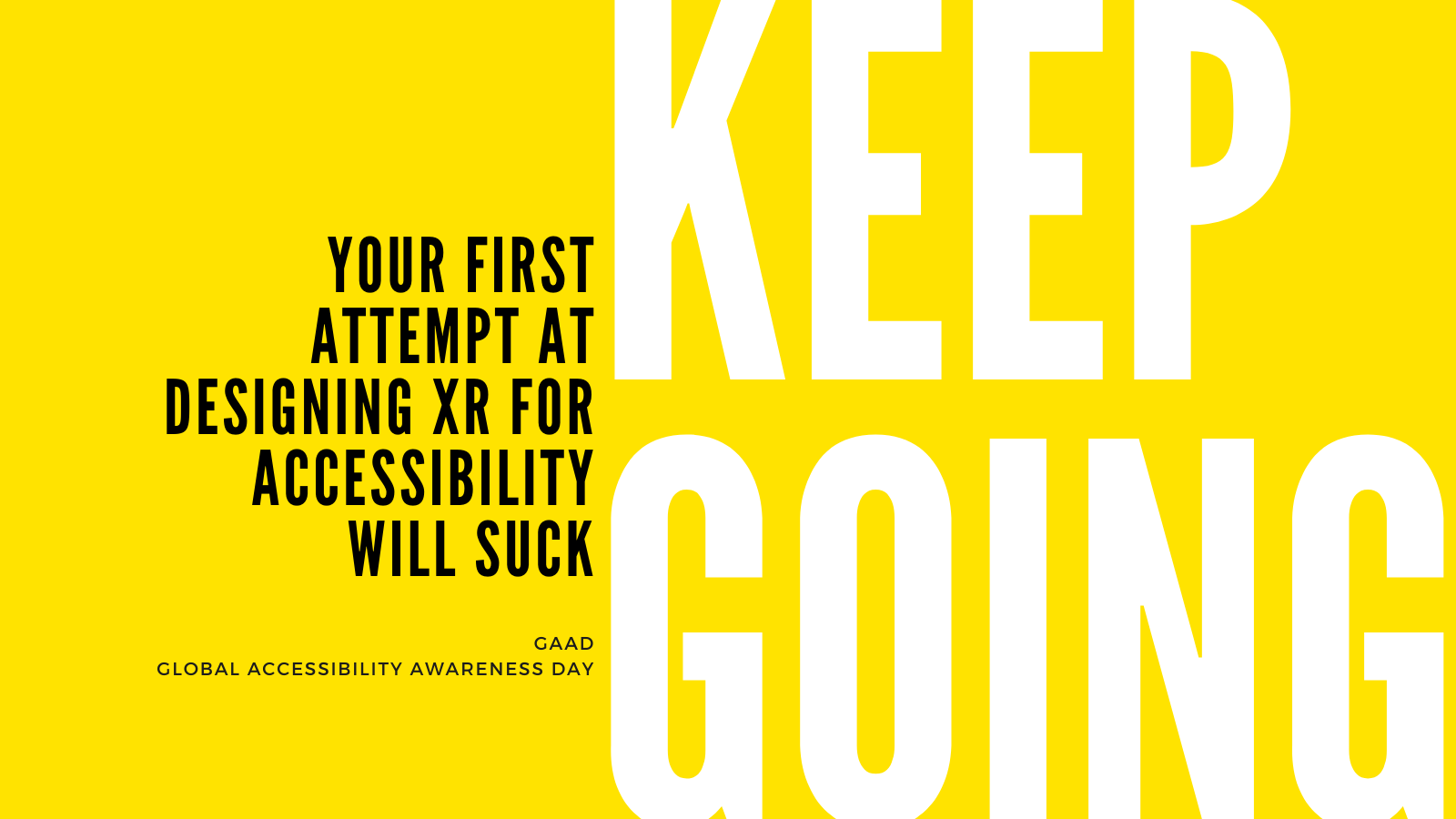
    Image with text: Your first attempt at designing XR for accessibility will suck. Keep going. GAAD. Global Accessibility Awareness Day. Image made by Heather Dodds in Canva.

    Replica of my GAAD LinkedIn post

    Looking for tips on how to design #XR
    for accessibility? You could follow me, but I’m just learning this
    stuff myself. Search. Learn. Ask. Network. Try. Then try again. Cry
    some. Then try 1 MORE DAMN TIME. Because XR can be for everyone.

    Curious? Good. I’m putting some links here. They are all click worthy.

    Vision

    In 2021 I heard, “I don’t know why the blind
    would want to access VR”
    . I’m so over that. I’m SOOO over that comment.
    👿 Let’s make one thing clear: if you make a human “sub-human” in
    front of me, there will be angry eyes. Start here: https://equalentry.com/virtual-reality-development-for-blind/ and then here: https://equalentry.com/how-can-a-blind-person-use-virtual-reality/ and for a video, see here (seriously, WATCH the very beginning): https://youtu.be/rvsZ1ssyom8


    Sound


    XR for the Deaf: I read everything my link Meryl puts out. I would encourage you to follow her: https://www.linkedin.com/in/meryl/ She publishes on topics beyond deaf accessibility.

    I just found this golden tidbit TODAY for #gaad2022
    , check it out! Audio descriptions in games – something of particular
    interest to my Instructional Designer friends as we are always keeping
    an eye on conflicting text, sound, and narration. This is something to
    learn about here! https://youtu.be/W2B3jBu0ZqY


    Mobility

    I absolutely LOVE this product and want more of it: https://www.walkinvrdriver.com/ Need to watch a video instead of read? Sure! https://youtu.be/lwmAFHAj6EI 


    Also: https://specialeffectdevkit.info/

  • The first step into the Metaverse isn’t the hardest. It’s the nth step that you do for the nth time.

    The first step into the Metaverse isn’t the hardest. It’s the nth step that you do for the nth time.


    Photo of architecture in Iran

    Response post to: The Forgotten Stage of Human Progress


    I’m knee deep in an XR implementation project. It’s going forward by
    inches; each step aches with how small it is. If I measured it, it feels
    like it would barely tick one mark on a stick. However, like a gardener
    that makes one small snip here, one pull of a weed there, there is no
    overnight transformation. But still– in the messy work of
    IMPLEMENTATION, I’m making a garden that turns heads and makes people
    think “I want to be there.”

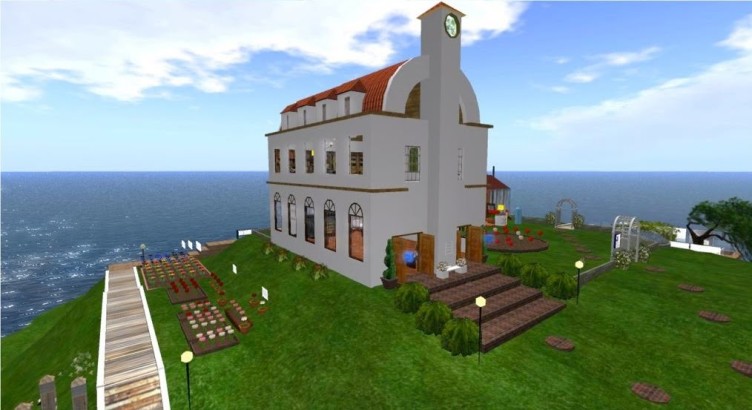
    Seriously, here is the garden:


    Today is one of those days where it feels like we are going 2 steps backwards with no step forward. When you hear it mentioned quietly, but over and over and over, that one of the biggest implementation problems we have in XR for education is “sound” — WE ARE NOT KIDDING.

    We have more problems with sound that with any other aspect of an experience. It is the TOP problem source.

    Virbela had this problem in buckets. My hosts cringed every time I estimated that 20% of incoming users had sound problems. 20%!  If YouTube had a 20% failure rate that they presented to users, they would far, far out of business by now.

    I watched this video dated November 5, 2021 put out by Stanford University touting the first course taught in XR with Jeremy Bailenson where he claims it will be “an incredible journey for about half of this class”


    Here is the video promo text: 

     “263 students, all with their own VR headsets, across 20 weeks and two courses, spent over 200,000 shared minutes together in the Metaverse. They engaged in large group field trips, small group discussions, performed live music and skits, and worked both alone and together to build their own virtual worlds.”

    First: posed shot OR photoshopped image. Notice: no Zoom markings at all. It’s not “live”, people are not moving.


    For someone like me with enough live event logistics and tech support experience, watching this video shows me that I suspected the course was riddled with sound problems.  

    The background music starts at 0:18, so “hearing” the students will be hard.

    Watch for how much students were cordoned off into small groups (that’s not just a teaching method, that’s to put them soundwise AWAY from each other and minimize disruption) and then just listen to what you CAN hear of the sound provided in the video, you will get snippets and what you will hear will be blurbs of users acting more awkward and users waiting around on another user.

    The “you made it” comment is somewhat telling. It is HARD to get users into XR. Admittedly, it might easier if you are at Stanford and everyone has an Oculus Quest 2 (Meta Quest). (smirk)

    Privilege much?

    At 1:14 there is a LOT of talk over and by 1:18 the video has been sped up to just overwhelm with ADDING models or processing to VR on the ENGAGE platform.

    I’m not trying to douse flames of innovation here. But I’m trying to point out that implementation, as the Atlantic article points out, is a much messier, day-by-day process than the glitz and glamour of a moment.

    The video shows THIS as what appears to be a class highlight moment.


    The sound is a man speaking saying “Nice work everyone!”

    Just let that sink in while looking at that image.

    2021. Stanford University. That is one of our very best learning instituations, folks.

    Ironically, all of the avatars with awkward arms ARE the users actually using headsets. That one avatar in the middle in the gray shirt with this hands at his sides? He is the one user in 2D, not a headset.

    Snicker now, because he is the only one looking normal in this bunch.

    Implementation is HARD!

  • The Failure of Technology-Centered Approaches To Multimedia Design

    The Failure of Technology-Centered Approaches To Multimedia Design


    Photo by Birmingham Museums Trust on Unsplash

    Within the same morning, I had scanned The Total Economic Impact™ Of Mixed Reality Using Microsoft HoloLens 2, A Forrester Total Economic Impact Study Commission by Microsoft, headlined by the Senior Mixed Reality Specialist at Microsoft.  I found the numbers inside dismal and took screen captures of the most egregious numbers so that I would not forget what jumped out as the most ludicrous (60% increase in efficiency in learning as an verbal report given in interviews by interviewees selected by Microsoft).


    I also had been invited to a group that will “build a community of practice around applications of learning experience design in XR modalities.”  But I had watched this community do a series in 2021 where they picked individual pieces of research and tried to derive principles for design in XR. I gave them feedback for the first 3 days. They kept hand-picking research and trying to establish large principles.

    Err, that’s ethically wrong.

    Plus, when I pointed out that some pieces of research– while fine as independent pieces of research, could not be applied broadly because of problems like cognitive load, comparative design, sample size, novelty effect etc. they would give me the hand wave response of “Oh yes, we saw that” but they never retracted or stepped back from the total theme and they had the ability to.

    So….

    I don’t see much hope there.

    Therefore, I was in a pit of despair. Everyone around me is in some sort of technology-haze thinking it will solve all of their problems. Come to think of it, much of the field of instructional design for the past 18 months has been soaking in a technology tools fantasy.  And yet, not a word about learning gains. Funny, that.

    (more…)

  • 2021 Bests and Worsts

    2021 Bests and Worsts


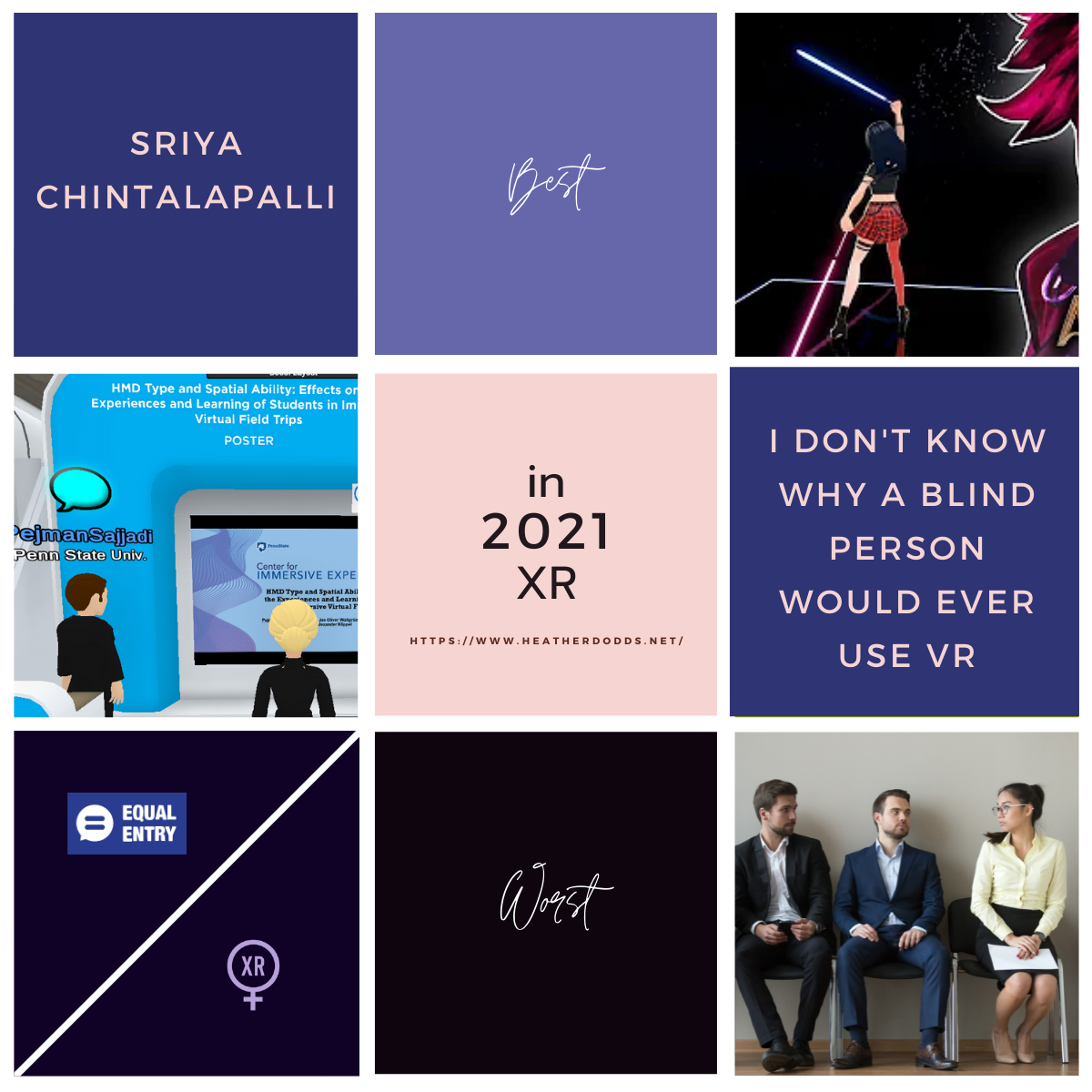
    I drew up my list of Best and Worst for 2021 and to make it balanced, it has 3 on each side. Here we go:

    Best

    1. Meeting Sriya Chintalapalli.

    I count meeting Sriya as a golden moment of 2021.  I actually haven’t had long chats with her. But I was given a small heads-up for a student XR conference that I was supporting that a speaker was coming that was going to be amazing. I think the ‘knock socks off‘ phrase might have been used. I was under FERPA regulations to know that she needed extra protection at the conference and I volunteered to give it. That means I stood on the virtual stage with her, playing the role of direct tech support but also crowd control if necessary.

    But what did happen meant something much more to me.

    Sriya gave her presentation. It was a great topic and very forward looking. Then, she took questions from the audience. Because the topic was on brain-computer interfaces (BCI), it didn’t take long before questions of invasion of privacy questions came from what were obviously professors in the audience.  

    I’ve seen these verbal examinations before. I’ve seen them break college seniors and Master’s Degree students. It’s just enough questioning to find where the student does not know the answer. That’s the push point. Several men in the audience were going right for her, directly and academically.

    Standing on stage with her, without her knowing it, I would have thrown up a shield if she needed it and blocked those men from getting to her/embarrass her/humiliate her by making some excuse that we’d run out of time, audio wasn’t working, etc.

    But, she held the stage. She held her ground. More than once she said “The data doesn’t say.”  

    Good line! Don’t let them pin you where you have not staked a claim.  She’d been trained well to enter an academic fight.

    When she was done, I let out my breath.

    Were those men plants in the audience? Not sure. Maybe. Either way, my hackles were real.

    And the lesson for me that day was: if I can do anything to help women like Sriya…even if it is only shouting “Make a path!“, I will.  It’s very hard to be a woman in the technological sciences. The road ahead will shape her in ways I’m sorry to contemplate. May she always find a woman like me standing by, ready to help.  

    Please follow her. Great things are ahead.

    2. A small unheralded research paper, HMD Type and Spatial Ability: Effects on the Experiences and Learning
    of Students in Immersive Virtual Field Trips.

    I was able to meet the first author, Pejman Sajjadi, at the IEEE VR conference in March/April 2021 in avatar form here. This small piece of research stayed in my mind all year as a great example of the piecemeal way that scientific research works its way slowly towards practitioners and teachers.
     

    The write up of this study is pay walled behind IEEE, I believe, and Pejman would be the first to point out the small sample size. Therefore, there was no fanfare and no social media on this paper. If you look at his research background, what you see is this paper is just one of several papers generated from one research event, so it’s pretty generic par-for-the-course research.
     
    Taking into account all those discount factors, this tiny study investigated something that teachers do really want to know:   
     
    Are expensive VR headsets worth it?
     
    The answer is no.
     
    There is much more to the no, of course, related to content, learning objectives, scalability, etc. But more so than ever in 2021, educators turned to VR as a more realistic mainstream learning choice. The price drop of the Oculus Quest 2 to $299 and further, the Facebook push for the work use of Workrooms to bring VR use directly into the workplace show that we are going to have to get more and more comfortable with VR headsets and quality will be a question.
     

     (Image source: https://about.fb.com/news/2021/08/introducing-horizon-workrooms-remote-collaboration-reimagined/)

    Quietly researched, small sample size, no social media presence.  
     
    But bit by bit, researchers are answering these questions. I hope teachers are listening to the work of Pejman.

    P. Sajjadi, J. Zhao, J. O. Wallgrün, P. C. La Femina and A. Klippel,
    “HMD Type and Spatial Ability: Effects on the Experiences and Learning
    of Students in Immersive Virtual Field Trips,” 2021 IEEE Conference on Virtual Reality and 3D User Interfaces Abstracts and Workshops (VRW), 2021, pp. 546-547, doi: 10.1109/VRW52623.2021.00155. https://ieeexplore.ieee.org/abstract/document/9419337


    3. Equal Entry and XR Women 

    It’s a tie! Both organizations work for similar goals: 
    • Equal Entry has a strong drive for accessibility and has a section of work dedicated just for VR, AR, and XR.
    • XR Women‘s mission is dedicated to getting women’s voices up on stage as part of the narrative about the ongoing and future directions of XR.  
    • Both organizations stay focused on their task and welcome listeners, newcomers, and allies.
    Both groups alike are working on accessibility into the coming metaverse for all.  I applaud their efforts.
    Now time for the worsts.  Is worsts a word?  You will notice a theme from the Bests that carries through.  Here it comes…

    Worst

    1. Not necessarily restricted to 2021 sadly, say the phrase “Women in XR” and you will likely get this image:

    Or this one.  That’s not even a woman on the right. #dehumanizing means you treat women like animals.

    Actually, as I prepped for this article, I went to find one screen capture of a woman in a short skirt playing Beat Saber so that I could use it as a example of a poor behavior.  I thought finding one image of a woman in a skirt would be hard. I had remembered seeing one.  
     
    Much to my shock and horror, it turns out….it was drop dead easy.  So easy, nearly EVERY image on YouTube for playing Beat Saber is of a young female scantily dressed.  Check it out:

    I counted ~9 images of women playing with either bare legs, bare midriffs, sports bras, etcs, for every 1 man.
    Think that’s a coincidence?  Oh no. It’s BY REQUEST.  Look video info at the bottom of this image I just posted above again.
     
     
    It says:
     
    “Song + Outfit per George T’s request! To request songs & outfits/costumes become a Patron at…”

    This woman is taking money to have herself videoed/green screened playing Beat Saber in a short skirt.  Don’t tell me that the Patron isn’t begging for that skirt to fly up at some point. I know what you can see through that black skirt by outline.  In these videos, women have not only lost body space control, they are selling it.

     
    It’s disgusting. And this is ALL OVER YouTube.  There’s a research project in there to count the views of Beat Saber videos without skirts versus those with.
    Remember that the Quest 2 was a major Christmas gift for 2021 and your daughters are now –January 2022– watching YouTube videos to learn how to get better at Beat Saber.  Is getting better at the game the only thing they are learning?
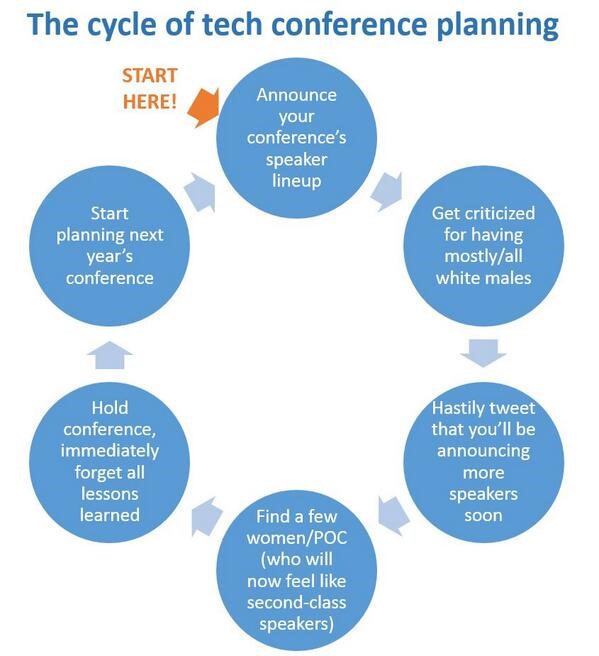
    Think that this is just about fun, though?  Really? Did you read what happened at late 2021 a technical conference ad?  Reminder: Major “Game” conference, no women speakers on the ad, and a sexbot prominently featured. This is what women in tech are facing when we “go to work.”

    Women have been getting groped at tech conferences during large standing-room only keynotes. It’s real that women feel less comfortable in HMDs because they give up body space control. 
     
    At any conference right now, by putting on a headset, women take a risk that men do not.

    2. Major immersive learning researcher responds to an accessibility question with “I don’t know why a blind person would ever use VR.”

    I was running tech support. I was on mute. I sputtered.  But the researcher’s mic was hot. The video caught that…I think. It’s out there.  
     
    But what does that matter if it’s on video or not, if the researcher truly thought that?
     
    I don’t even know what to do with that.
     
    Major. US. Immersive Learning Researcher.  
     
    😔
     
    By the way, for you, reader,  in answer to the question, contemplate this:

    Screenreader Experience of a Virtual Reality Conference by Rhea Althea Guntalili

    and  

    Virtual Reality in the Dark: VR Development for People Who Are Blind | Accessibility VR Meetup Recap by Aaron Gluck (YouTube link and transcript available at this link)

    3.  Microaggressions against women in the XR industry
     

    I left 3 organizations in 2021 and am no longer associated with them. It’s apparent now that I could not stand up for the rights of women and for accessibility in XR without being targeted myself.
     
    “A microaggression is a subtle behavior – verbal or non-verbal, conscious
    or unconscious – directed at a member of a marginalized group that has a
    derogatory, harmful effect. Chester Pierce, a psychiatrist at Harvard
    University, first introduced the term microaggression in the 1970s. ” https://www.thoughtco.com/microaggression-definition-examples-4171853
     

    The last organization I left questioned if I was a dues-paying member, so they used an institutional rule to execute an exclusionary move.

    We’ve heard about headset straps that do not adjust for varying hair styles. Women and people with disabilities that are not recruited into research studies so that research results are invalidated when applied to major populations, conferences that not only host but advertise manels with sexbots, and the list keeps going already 7 days in 2022…
    😔
     
  • I thought this story would end differently

    I thought this story would end differently

    I had stepped out of one meeting into another. It is rare that I have back to back meetings now.

    But I left a truly back-slapping ha-yucking good time with 2 of my fellow instructional designers who were presenting on future horizons in education. We were all having such a good time (she says just like Uncle Albert, who loves to laugh, from Mary Poppins). And I had stayed in that meeting 15 extra minutes over time and wiped tears of laughter from my eyes hurriedly to prepare for the next meeting where I thought I would turn on my camera.

    I had dropped into the next group meeting late before so I know it wasn’t a problem. I was an attendee, not a presenter. I scoped out the attendee list as I listened to the presentation. The topic was Native American use of XR in education. 20 attendees.  From the names, there appeared to be 3 total women. I was the only one on camera. I was the only one that spoke at the end the meeting as it wrapped (the speaker had to leave quickly and didn’t take direct questions but the attendees did a little talking amongst themselves). We did a few polite comments– which included me commenting on how intelligent the speaker’s wife was–that he had referred to in his presentation/she wasn’t there– and the session wrapped up.

    Later, I thought about the day and I thought about dropping my ID friends a note to explain the comparison of just how remarkable our friendship is…given that the following meeting was staid, and somewhat difficult to find a place for women (the 3 out of 20 thing.)

    But I just contemplated that thought and didn’t share it.  And then, the story changed.

    That second meeting runs on a 2 week rotation.  Before the next 2 weeks came up, I received an email in my inbox. I’m paraphrasing:

    “Are you having a problem paying the membership dues?”

    Oh, crap. I knew what this was. Exactly.

    Now I have to take this story backwards before I take it forwards again.

    Because we have to go back 2 1/2 years ago to when a certain educational organization advertised on LinkedIn that they were looking for new members. The topic of educational use of XR was very interesting to me so I submitted my interest.  The President of the group replied by email to me directly that I would be welcome to join. He directly sent me the meeting information at that time (I actually still have it at this very moment, ahem.) He also directed me to the page where the membership fees were posted.

    Now, here is where the story starts to turn.

    (more…)

  • 2 out of 4

    2 out of 4

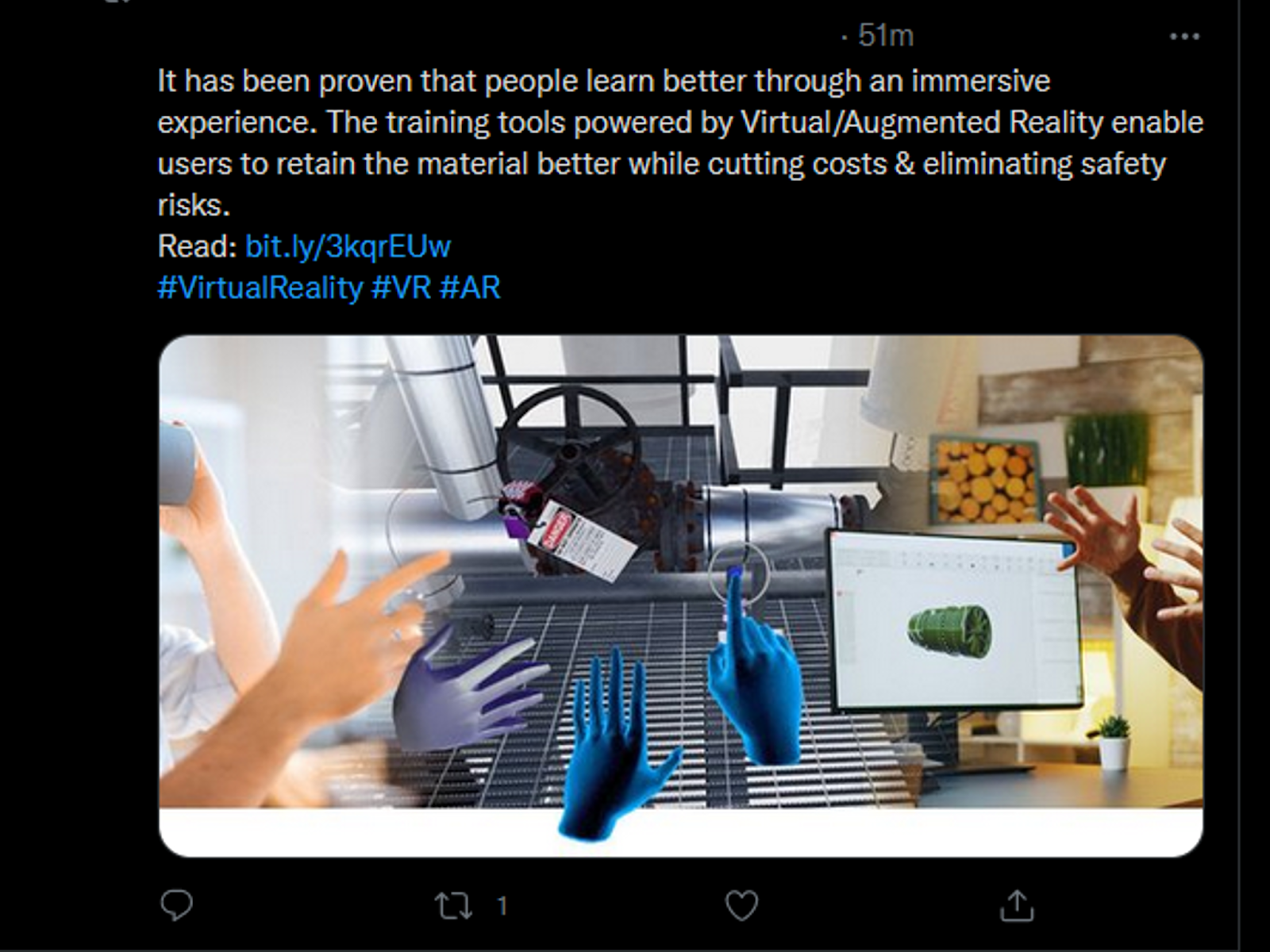
     Twitter post dated November 29, 2021.

    “It has been proven that people learn better through an immersive experience. The training tools powered by Virtual/Augmented Reality enable users to retain the material better while cutting costs & eliminating safety risks. Read [link].  #VirtualReality #VR #AR

    So there are 4 claims here:

    A. people learn better through an immersive experience

    B.  enable users to retain the material better 

    C. cutting costs

    D. eliminate safety risks.


    And here’s my vote on these claims: 

    A. people learn better through an immersive experience – No. 👎

    B.  enable users to retain the material better  – No, because ‘better’ is flaky. I’ll shoot at “retain” too. 👎

    C. cutting costs – Yes. 👍

    D. eliminate safety risks.- Yes. 👍


    The link provided goes to a business website that is selling developer services to make things in Unity.  On the front page, there are NO claims about learning that I can find at all.  So the “Read:” doesn’t seem to invite you to read more about facts supporting those claims. They are asking you to read all about how their business is cool.


    Overall. that’s a score of 50%.  Still, failing.


    Remember that I’ve pointed to how dangerous & misleading “hand waive” language is.  As soon as this started with “It has been proven that…” my hackles go up. 

    😦

  • A Tribute to Second Life. Yes, it’s still around.

    A Tribute to Second Life. Yes, it’s still around.


    I purposely start articles with “A” when I mean to not be definitive but exemplary. In this case, I would like to pick out a few of the early education influencers and memories that I knew from Second Life (SL) (and Heritage Key, 3rd Rock Grid, OpenSim, and other early virtual worlds).

    One of the observations that brings on this article (besides the true desire to give credit where credit is due) is that educators are starting to stream into the metaverse or cross reality (XR) – especially with the $299 Oculus headset cost and the pandemic forcing isolation – and I find that in education & XR development – there is a disturbing lack of knowledge of the foundation of virtual reality studies. That is, people that know about the role Second Life played in XR for learning research are not writing enough about it now so that what it did in the past is captured for the future.

    Remember the ‘we stand on the shoulders of giants’ thing?

    The giant is, in part, Second Life.

    I would suggest that what is lacking in this background research is the fact that the vocabulary (and somewhat, the meaning) of words has changed so even a well-meant Google Scholar search might not pick up valid research from 10+ years ago because search terms were simply different words.

    So, first – Search on virtual world (VW) as your primary term. Virtual world was a more dominant phrase than virtual reality. Other words to use: immersive, MUVE, multi-player online, persistent, HIVE (highly interactive virtual environments), online games, simulations, visualizations, online reenactments, distributed classrooms, and hypergrids. Indeed, find one good metastudy from ~2009 and you’ll probably hit the vocabulary jackpot. In researching this article, I found the term Sloodle which I had forgotten but that was an incorporation of SL into the Moodle course management system. You will find a great of research on identity, presence, and immersion with avatars (not so much with locations or “doing stuff” in VWs because object physics was/is very primitive and you can’t “do” too much there. There are pose balls, but really that’s a subject I’m not going to get into here). Bear in mind that headsets only existed in research so this was all what we would know in 2021 as 2D virtual reality or 2DVR (VR on flat screens, monitors, and tablets). Because there were few consumer headsets, there was no “us versus them” that you find now between 2D and Head Mounted Device-based (HMD) 3DVR.

    Next, I very well realize that in some circles, Second Life causes giggling, either in derision (see the hype cycle image below) or in acknowledgement that SL did primarily serve the adult content market more than the education market. Sorry, but someone needs to write the obvious. Just recently, when the metaverse conversation popped up with some SL users on Twitter, they were adamant that they would never move to a platform that didn’t allow “adult content.” Second Life was never a place that you wanted to wander into the dark alleys as an educator. At least, if you did, you would learn some stuff you’d rather not know. The sexualization of Second Life is still prominent. Just do a google image search on second life. NSFW. Second Life was always a place for college and university educators (READ: Over 18 years of age). 


    Gartners Hype Cycle for Social Virtual Worlds showing a start at 1987 and going to 2012.
    Source: http://www.muvedesign.com/the-virtual-worlds-hype-cycle-for-2009/


    Thus, educators tended to stick together. You heard about SL from another educator and you went in with them. I went in with a professional development group and had my first “meeting” in a hot tub at the Burning Life festival in SL in 2008.

    There were some GREAT educator groups and some of them are still going! I mention my favorites:

    1. Virtual Worlds Educators Roundtable (VWER) – my home base and it is still going! I volunteered on the organizing committee and hosted a “Reading Meeting” where we invited the author of an article in for a presentation and Q&A (I was able to talk with the Whyville Pox article researcher, which is still a GREAT study). At its heyday, VWER had 2 grids: 1 for meetings and we had a Quidditch pitch/outdoor ice skating rink and 1 for parcels for educators as a sandbox and I had a virtual office.
    2. Virtual Worlds Best Practices in Education (VWBPE) Conference – still going as of 2025!
    3. Real Life Educators in Second Life is an in-world group (READ: notification list) you can join. Users post different events to that group.
    4. ISTE  https://www.iste.org/…/explore-these-virtual-worlds
    5. VSTE: VA Soc. for Tech in Education https://vste.org/
    6. Second Life Community Convention (SLCC) – a larger group but education was a subset. Now defunct.
    7. The SLED group – an email list serv that had the first collection of educators as subscribers. Now defunct.

    Other groups still going but not necessarily education-focused nor restricted to Second Life:

    Virtual Ability http://blog.virtualability.org/2021/08/by-gentle-heron-you-can-teleport-to-any.html

    Non-profit Commons Community https://nonprofitcommons.avacon.org/

    OpenSimulator Community Conference https://blog.inf.ed.ac.uk/atate/2021/10/31/oscc21/

    Special shout out to independent journalists that still cover Second Life:

    Ryan Schultz https://ryanschultz.com/

    Daniel Voyager on Twitter @danielvoyager

    Great “places to visit” included NASA, NOAA locations. Rockcliffe University Consortium, Glascow University Online, California State University, Chico (defunct? I think?). Then there were one-off builds that were also great like the Edgar Allen Poe House and the walk-through heart and colon.

    During this same time, other virtual worlds were coming up and visiting them was fair game. My favorite was the short lived Heritage Key that needs to come back! That place was so cool and educational, you could visit Stonehenge over 5 different time periods and help build it
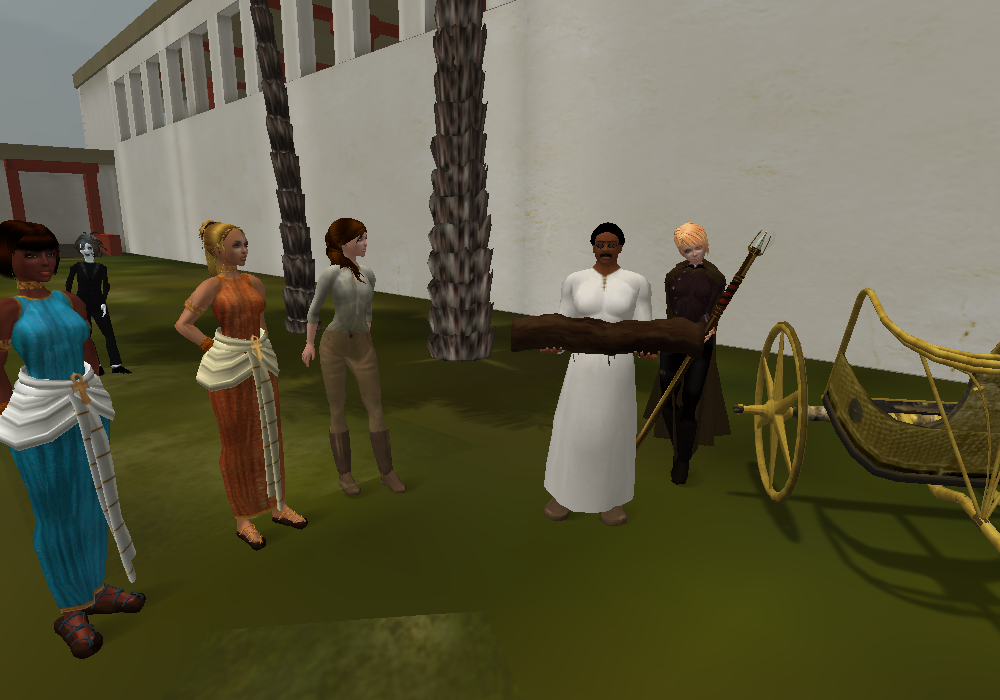
    You could travel to both Egypt and Stonehendge in Heritage Key.  Avatars received costumes and had roles to play at each site.
    What happens when 2 Egyptians, 2 Adventurers, 1 Druid and 1 Zombie all go to Ancient Thebes?

    So…what happened?

    There are many commentaries now. All of them have a piece of the truth. Probably the biggest factor was money. Hosting a grid literally cost money and universities had to pay for it. Over time, it just didn’t make sense to keep paying monthly for a place rarely visited.

    College and university builds represented a huge investment of time. You should have heard how much the word “Primmy” was used back then. Primmy is short for primitive which meant the building blocks of virtual realities which are primitive shapes (spheres, cubes, columns, pyramids, etc.) Some clever instructors had their students do the builds and then called that assessment (I’m not calling that wrong, I’m just saying…clever.)

    The locations, indeed, themselves brought on their own demise. Many builds became ghost towns because avatars would visit a “virtual campus” (OFTEN a replica of their real campus buildings (cough, mistake, cough) but walk inside the buildings that may or may not have had enough “prims” to put separate rooms inside those buildings, and so visitors found the building completely empty during off hours, wonder what the big deal was, and then leave.

    This was one positive result of those early days. Many educators realized that “replicating reality” should NOT be the goal because for now, you’ll never get there. The human eye is too good at discrimination. But what you do want to do is the phantasmagorical.

    Do the impossible. Virtual reality is very good at the impossible.

    Remember this was before VR was called Social VR, so the ‘social’ part was truly touch and go. In SL, you either found groups of people or you didn’t. Most positive SL stories going around right now will involve relationships and groups. Truly today, I only go into SL for events. I hardly ever go in to just explore. It’s not built for that. What was it built for? Well, it had some characteristics that were interesting and unique. (Alt opinion here.)

    Born creator

    First and foremost to me, every avatar is endowed as a creator. An educational psychologist I know immediately deemed this a “God complex” program. Indeed, every bell and whistle of creation (object creation and space manipulation) was available in the overwhelming UI. I’ve been a SL citizen for more than 10 years and still I don’t know what half of the UI choices are for. Even though I’ve done it a lot, I’m still not sure what rebaking does.

    Screen capture of the original Ruth avatar from Second Life.
    The original Second Life Ruth avatar


    The default avatar was “Ruth”. She made new users learn how to change appearances. Impressive abs though. She must have never eaten a potato chip.

    Avatar customization

    The avatar customization is in Second Life (still) is top notch.

    Seriously, OpenSim and Second Life have the best clothes’ animations! I once saw someone who wore a top hat to a Christmas party and the around the rim of the hat was a tiny puffing train! (If you are reading this and that was you, please reach out to me, I LOVED your hat!! I want a video of it!) But, I find Sandsar and sinespace is coming up fast on good clothes and avatars.

    You can get married and divorced in Second Life. There are also active furry communities. I’ve got no comment on all of that. I would just remind everyone that what is in a virtual world is what you bring with you. It is definitely not all innocent and it is definitely not all healthy.

    Even though you have creator controls, you cannot build just anywhere. Land is owned (permissioned) and you have to essentially pay to have land. Early objects were NOT copyright protected. So copying, stealing, and replicating was rampant. (Hat tip to Somnium Space, who addressed this problem from the very start by tying assets to NFTs.) I suspect a lot of artists hiked out of SL because their work didn’t stay under their control for long. For educators, there was an active “free sharing” market and I still wear my first set of “professional educators clothes” I picked up free from some place.

    Hat tip to the word rezzing. I still use it. When I arrive somewhere, I rez in. The spot is the rez in spot. The current term in 2021 is “spawn point”. Yuck. I think this term, rez, should NOT be lost. Rez means resolving, which is what your avatar would do when it was still “coming into” the VR space. It’s the ghostly cloud you see here:

    We would lost without our Path…finder

    But I’d like to get to the tribute part of this tribute article. I would like especially point out the impact that John “Pathfinder” Lester had in Second Life. Everyone who was on staff for Linden Labs officially had a Linden last named avatar. John was Pathfinder Linden and all educators knew he was the one to talk to about ideas and problems. He “led the development of the education and healthcare markets while evangelizing the innovative use of virtual worlds in research, art and immersive learning.” Truly John cared and helped. I remember the day I sat next to his avatar at a meeting. I was so, so, so thrilled. But I never figured out why his avatar looked like a boot to me. It must be the eyelets and the shoestring. Apparently this is a bit of British culture I don’t know…that’s a character?

    Early John:


    Pathfinder Linden


    Many of us observed in stunned silence as Linden Labs pared down staff infamously. I watched in foreshadowing because I knew that it was like to work for a company that would drop you easily. I followed John’s blog “Be Cunning and Full of Tricks” closely during that time and noticed how he rebuilt his professional life.

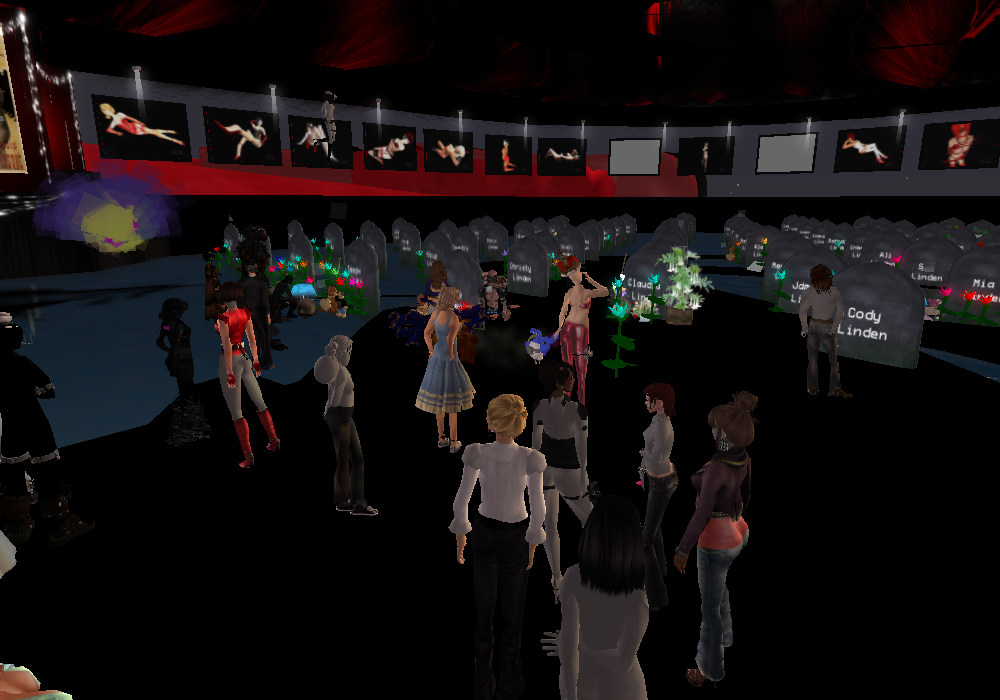
    The Linden Graveyard. This image specifically shows the named gravestones as many Linden Lab employees were let go over time. Note this space is NSFW.


    The Linden Graveyard. The fact that this place was made still haunts me. 

    John is doing well and every time I hear that he’s back near virtual worlds, I’m so pleased (and I’m still part of his fan club).

    My last call of affection goes to the VWER Planning Committee of 2012. I’m still in touch with Evelyn. 🙂

    • AJ Kelton, Montclair State University (SL: AJ Brooks)
    • Joe Essid, University of Richmond (SL: Ignatius Onomatopoeia)
    • Ann Steckel, California State University, Chico (SL: Olivia Hotshot)
    • Evelyn McElhinney, Glasgow Caledonian University (SL: Kali Pizarro)
    • Margaret Czart, University of Illinois at Chicago (SL: Margaret Michalski)
    • Charlotte Burch, retired middle school principal/Pres. Friends of Humboldt Bay NWR (SL: Mimi Muircastle)

    So in response to the question: Is Second Life still around? Yes.

    She has her children now, Sansar, sinespace, and High Fidelity.

    See you in world!

    #SecondLife #Metaverse #XR #VR #VirtualWorld #Avatar #Sansar #sinespace #HighFidelity #VWER #VWBPE #VirtualAbility #immersive #MUVE #multi-player online #persistent #HIVE #highlyinteractivevirtualenvironments #onlinegames #simulations #visualizations #onlinereenactments #distributedclassrooms #hypergrid #cyberspace


    This article was posted simultaneously to my LinkedIn account on 11/23/2021. https://www.linkedin.com/pulse/tribute-second-life-yes-its-still-around-heather-dodds
  • Next stop: Bad VR Implementation

    Next stop: Bad VR Implementation

    In my published writing of August 2021:

    “Especially with decreased technology prices and increased access to XR,
    campus administrators might want to buy the technology first and think
    about use second. Instructional designers are obligated to advise on the
    best use of the technology even if that advice is sought after the
    purchase.”

    Immersive Learning Environments: Designing XR into Higher Education. 

    It feels like the ink is still drying…and this pops up. An instruction designer asks how to best use VR headsets, after the boss has committed to buying some.

    That set off my “bedonkers” filter 😜, so I replied:

    After I posted the phrase “@ss backwards” that thread stopped for almost a day.  Then one more post has arrived talking about a suggested resource.

    But here we are folks.

    Bad Implementation is our next stop on this train.  Other stops on this train include:

    • Overspending
    • Results the same as other forms of learning
    • Bosses disappointed in results
    • Bosses reluctant to invest in the next big thing
    • VR learning becomes laughable but slowly adopted.

    Does all this seem familiar? If you are over 30 years old, it should be. It’s the e-learning adoption story.  Go further back and it is the Internet-in-all-schools adoption story. And DVD-adoption story. And TVs in classrooms…

    And film strips…

    And radio…

    And “moving pictures”

    And individual textbooks

    And chalkboards.

    Think I’m kidding? I wish I was.