
What fights won’t we fight? What is our secret weapon? And what lies ahead? It’s the final part of this series.
What fights won’t we fight? What is our secret weapon? And what lies ahead? It’s the final part of this series.

Welcome to Part 6! Are you alive? By my calculation, when this goes live, 3 intrepid souls have read all of Parts 1-5 before this. (Insert laughter with tears). Indeed, you may have found this in isolation of the other parts! That’s OK, I’m cool with modularization. Feel free to “go around the Horn” at some other point in the future and read Parts 1-5 later.
Oh! And, for those 3 travelers AND everyone else, I am making an explainer video of all of this content. But it comes with 2 caveats:
No references or quotes. Just ideas.
Because it moves with a preset piece of music, each idea will have a limited amount of screen time: 2.4 seconds, to be precise.
Finally, I’ll probably write a full BTS (Behind The Scenes) on this article series on my blog. For those of you that love BTS content, that one will be for you. Translation: these articles were NOT written to be sound-bite worthy. What I write in the BTS will be.
This is basically the second of two parts that were originally together: Part 5 is what is the SAME about designing between 2D and 3D and this is what is different.
Long story short?
Here is where the fun begins.

A learner could learn from a book how to enter a store and buy something. A learner could also learn from entering a real store and buying something. Both are ways to complete the learning, but the designs– that is, how to structure the learning from start to finish, will be different. The book is analogous to direct instruction. There are times when direct instruction will be the better approach. The real store is analogous to experiential learning. There are times when experiential learning will be the better approach. The approaches are different; there is no inherently better approach for all situations.
These elements in this section are not meant to imply that they exclusively belong to XR media. That is, many other forms of media contain these same elements. These items are listed here because they are often found within and indeed are combined in design solutions in XR.
Clark and Mayer observed that humans are sense makers and attempt to derive meaning from life experiences (2016). Learners engage in making meaningful connections when words and pictures align during experiences. Meaning is also deeply embedded in the storytelling approach, where it is often the journey that the protagonist goes through that remains memorable long after a story has ended. D. Clark argued, “learning experiences are exactly that, experiences designed to change us, specifically our long term memories” (2022, p. 7). Further, D. Clark advocated for a balanced use of storytelling, explaining that it can bring life to dry information, but should not be overused and wander into a “Disneyfication of learning as entertainment” (2022, p. 7). Lastly, D. Clark argued that stories for learning should be designed as “always beginnings, never ends-in-themselves” if the learning is to be applicable beyond the experience, into the “long tail of practice, transfer, and performance” (2022, p. 7).
Points for poetry, D. Clark!
“always beginnings, never ends-in-themselves”

Indeed, the storytelling approach in learning pulls the learner through the experience. To use storytelling, the learner should experience a flow through their experience, a beginning and middle of the story. The end could happen in XR or more substantially outside of XR into desired application. The learning experience should be planned and not haphazard. Learners should be guided on a planned route. XR storytelling can be first person or group experiences. Regardless, each learner is a protagonist; their decisions determine what they will experience. Recalling the constructivist learning theory foundation, what the learners experience becomes the learning experience that is being designed for. If learners are exposed to situations where they actively construct their knowledge, then the reality that the learners construct was constructed by them, not constructed by the media or by others. Further, learners do not arrive as empty vessels to be passively filled with information if they are the protagonists of their own learning event. Learners add, sort, emphasize, or suppress new experiences when compared to old experiences. Subsequently, a learner already experienced in real life (non-XR) is bringing those experiences into XR with them. In summary, learners arrive already ready to experience a story. Thus, narrative plot or a story arc is a good approach to XR instructional design.
Plot, narrative, or narrative plot are all descriptions of phases within storytelling. There are slight variances in names but the phases generally focus on the user’s (or in our case, the learner’s) experience (Lichaw, 2016).

These phases describe what is happening to the protagonist. In the case of XR, the learner is the star and they should be brought through these phases in an effective design plan. Table 1 compares a storytelling arc with the Pixar story arc, a story arc example of Cinderella, an XR story arc, and an XR narrative plot example.
.png)
Pixar story arc from Khan Academy. (2017). Pixar in a box: Introduction to storytelling [Video]. YouTube. https://youtu.be/1rMnzNZkIX0 Cinderella story arc derived from Kurt Vonnegut, as documented by Derek Sivers. (2009, September 1). https://sive.rs/drama
Introduction. The who, what, where, why, when of the experience is explained. The scene opens. This starts before the digital experience begins and lasts 30 seconds to a few minutes into the experience, depending on how much needs to be explained. This is the beginning of the exposition.
Set the scene. Provide guidance on the affordances within the experience, how to communicate, walk, navigate, where is help (e.g. where is a digital companion). The learner is invited to move, change appearance, and communicate.
Dilemma. Introduce the conflict or the scenario that the learner will participate in. The learner is presented with a challenge or problem. This is the inciting incident and rising action phases. This can be a great time to guide and practice small solutions to small problems.
Crisis. The learner must act and initiate some sort of change. It is action-oriented, and the learner is on center stage.
Change or Denouement. The results of the change have an impact on consequences or the environment. Said another way, the change ripples through the experience to change it for the learner. The results are non-trivial and not haphazard.
Resolution or End. The mission is complete, and the world has changed around the learner. The learner is living out the consequences of their decision.
Some research has shown that most of the instructional emphasis does not need to be within the XR experience itself. Dede (2021), when reflecting on what he now believes after over five decades of immersive learning research, said:
“I used to believe that if you had resources, you should spend 95% of the resources on the immersive experience and then you just do a little thinking about what kind of induction you use before people go into immersion and what kind of post experience debriefing you do. I’ve come to believe now that the induction and debriefing is where the learning takes place predominantly, and so designing those is very important.”
This indicates the importance of the on-boarding and the follow up experiences. The story of an experience begins before something is activated and ends long after.
The main point of keeping a narrative plot mindset in ID XR design is to keep the learner at the center of the experience. Every step of the narrative plot approach focuses on what the protagonist- that is, the learner- experiences: dilemmas, crisis, change, etc. This approach, then, keeps the ID focused on the learner’s experience, not the technology. For example, let’s say a platform can recreate the school environment down to the desks and chairs. An ID might reason, ‘This a great place to hold a class! I can assign classes to virtual rooms and the instructor can use web-sharing boards.’

Don’t try this in VR
That approach puts the technology first and does not consider the learner. It also recreates the problems of regular in-person classrooms and throws in a few more virtual problems as well (i.e., poor internet connections might have avatars distractedly appearing and disappearing). Rather, a learner-centric approach might ask “What is the main experience or emotion that the instructor wants the learners to have in this lesson?” As Mayer stated, “How can we adapt multimedia technology to aid human cognition?” (2020, p. 15). This might cause the ID to look at the entire XR event differently and not recommend a virtual classroom. There is more on emotion in design in Section 5.2.
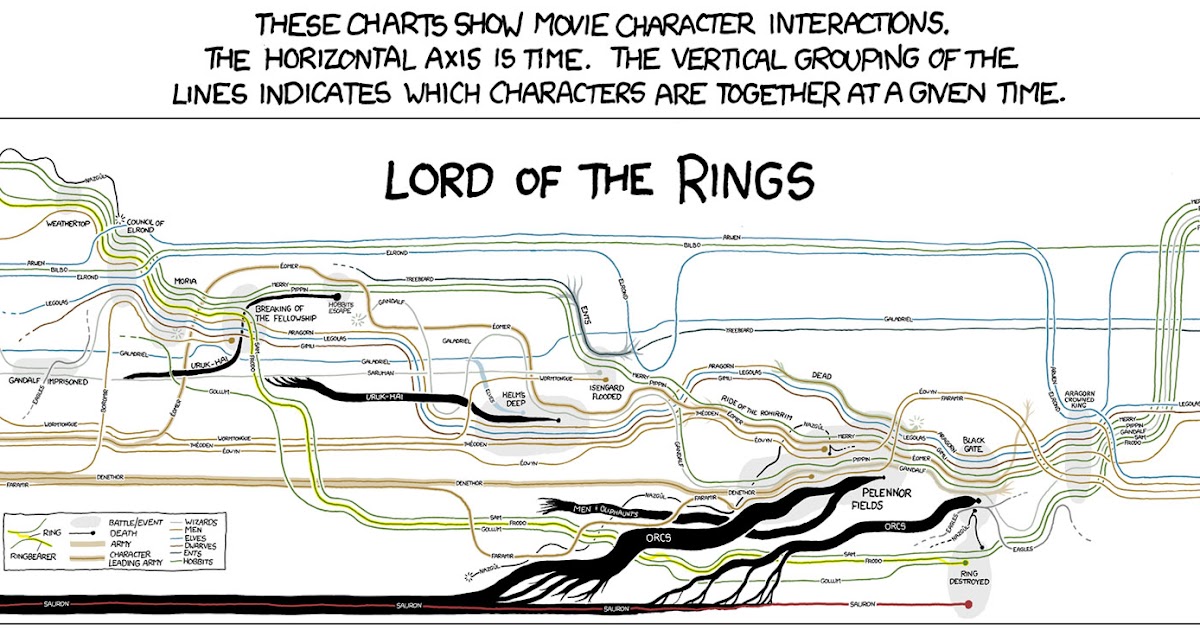
Credit: https://fbvisualisation.blogspot.com/2014/04/narrative-charts-tell-tale.html
For the ID, the added visual depth and sound possibilities beyond 2D must be designed. However, more to design means more risk. With XR, the added ability to put information anywhere has more risk of overwhelming the learner than helping the learner. Indeed, D. Clark (2022) agrees that Mayer’s Principles lean towards less is more.
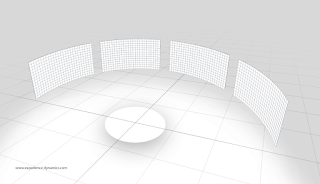
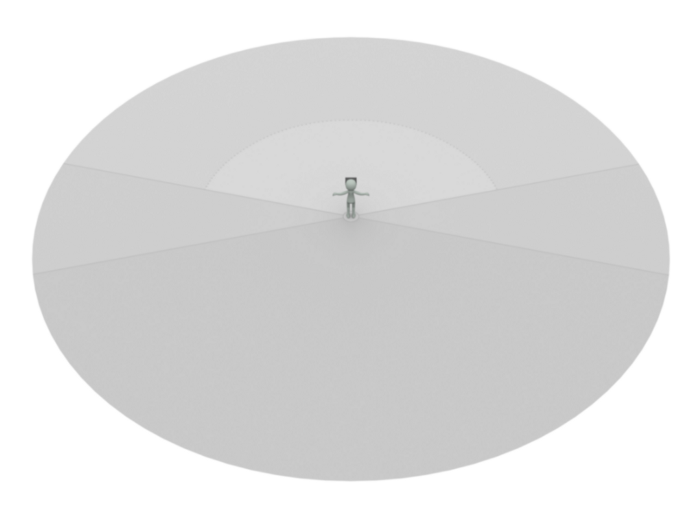
Alger (2015) noted these basic principles for visual range called the Comfortable Content Zone: 77 degrees of viewing range side to side and a range of 0.5 to 20 meters in depth. There are Periphery Zones to the sides and above, but the learner should be only prompted to use those.

Credit: Alger, 2015
This reflects real life. If one was working at a workstation, critical information would be within easy viewing and reach. Other information could be available in what Alger calls the Curiosity Zone – behind and below the learner, but learners should be prompted, as in real life, by sound, light, or foreknowledge, to engage with that non-obvious space (2015).
Alger (2015) further proposes that the visual hierarchy matches the importance of information. To find information in 3D, we look at the center ahead first, then left and right, then below, then above, then finally at our own bodies. Everything above eye level is for things beyond the learner’s control like weather, time, or authority notifications. Everything at or below eye level is within the learner’s control.
.gif)
These user interface principles skew towards conservatism in detail; less is better. IDs should design minimal spaces, with prompts, and within easy arm reach. IDs can create storyboards with isomorphic qualities that both curve around the learner and contain planning space for the foreground, mid-ground, and background visuals.


Immersive sound is a rising field within XR design. Poor sound can ruin an XR experience. Experiences can have spatial sound where the loudness drops off over virtual distance or flat sound where the loudness is the same throughout the entire space. As much as possible, it is good accessible practice that all senses should have learner controls: brightness, sound, movement, and intensity.
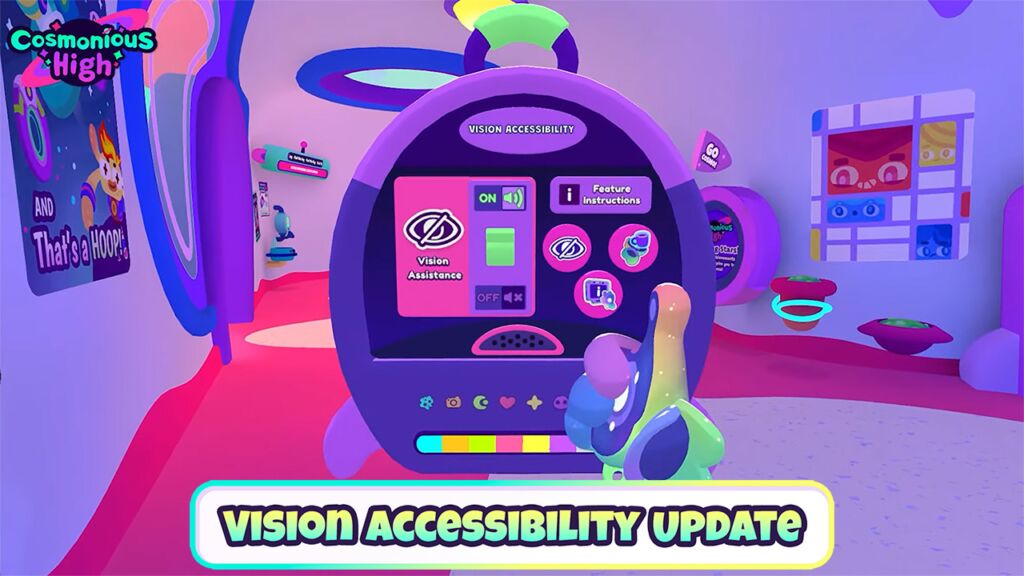
Many platforms and experiences already contain volume controls for separate parts of the experience (e.g., voice chat, environment, or notifications all have separate volume controls). Learners should be trained on these controls at on-boarding.

Generally, for information that is necessary for the learning event:
If the information is in speech, provide text equivalents (e.g., transcript).
If the information is in sound (environmental sounds or notifications), it should have equivalent visual and/or text indicators.
If the information is in text only, provide sound equivalents.
Interactions in XR could be reaching, grabbing, and moving. Good experimental research exists from organizations like IEEE VR or ACM IUI on 3D user interface recommendations. Alger’s (2015) design advice showed a seated avatar seated work will be more comfortable than standing in XR.

Credit: Alger, 2015
Almost every new XR user has walked their avatar into a wall. It happens.

You stay in that corner until you can act like a good avatar, Peter!
Given that the wall isn’t real, mistakes like this are forgiven quickly. IDs can ask learners to move.
(And Peter knew I took his picture at this moment above.)
Movement in XR is an advantage of the metaverse. While research does not indicate that movement causes learning, it can greatly assist in the storytelling aspect of bringing a learner through an experience by requesting that the avatar move through the story in virtual space time.
Movement is relative in this media. Frame of reference can be manipulated. The avatar can move, or the avatar can stay in one place and the scenes can move or change around them. There are a LOT of choices for movement in XR. From gaming research, it looks like most of the possibilities are aiming to reduce vestibular mismatch.
In this area, movement-based engagement can be an area of exploration in designs. For example, asking learners to move to one side of the room or another is an interesting way to run a poll. XR movement often includes dancing and flying. Future research should explore the use of controllers or hand detection for learning.
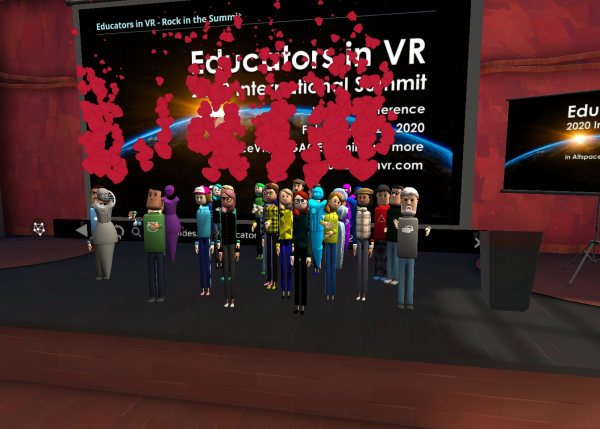
Many social XR platforms have incorporated emojis and they can be used for their apparent reasons: love, happy, sad, clapping, or raised hand. Within designs, learners can use them differently, that is for feedback, poll indicators, or silent ‘I need help’ indicators. Learners have been known to redefine emojis to mean whatever makes sense to them during a learning event.
Part 7 will cover designing and building XR experiences for learning. See you there!

.png)
It keeps on happening
If I were you, by now, I’d be asking, “Heather, why are you doing this? Why are you stirring the pot? You claim to be pro-XR for education but you are reviving research from long ago just to pick on it. It’s old news.”
[To protect identity, I am PURPOSELY going to change some things by asking AI to rename and reword some of these statements.]
Heather steps up the microphone and says “Within the past 3 weeks…
Title proper: VISIONARIUM :
Abbreviated key-title: Visionarium
Other variant title: iJEDIE
Other variant title: International journal of emerging and disruptive innovation in education
Original alphabet of title: Basic roman
Subject: Dewey : 371
Subject: Education, teaching, training of special groups of persons. Special schools
Corporate contributor: Lindenwood University.
Publisher: [St. Charles Missouri]: Lindenwood University, 2023-
Dates of publication: 2022- 9999
Description: Began with: Volume 1, issue 1 (2023)
Frequency: Three times a year
Type of resource: Journal
Language: English
Country: United States
Note: Volume 1, issue 1 (2023) (digitalcommons.lindenwood.edu viewed Aug. 8, 2023).
Note: Volume 1, issue 1 (2023); title from cover image (digitalcommons.lindenwood.edu viewed Aug. 8, 2023).
Medium: Online
Indexed by: ROAD
Journal summary:
The journal provides a diverse, interdisciplinary forum for the
publication of original peer-reviewed scholarship, data, and research
addressing intersections of education and technology. Education in all
domains increasingly incorporates emerging technologies and their novel
use in learning environments, such as current pedagogical explorations
of gamification, mobile and adaptive learning, digital humanities,
machine learning, blockchain, Artificial Intelligence (AI), and
Immersive Realities, to support innovative teaching methods and engaging
learning experiences. With the rise of new educational platforms and
metaverses, iJEDIE focuses on emerging trends in research to bridge the
artificial divide between scholarship and innovative pedagogical
applications. Submissions to iJEDIE will include, but are not limited
to, the following themes of interest:
I’m sorry, could you hit me over the head with the word application one more time?
Published by Lindenwood University -a NOT regionally accredited
institution, however, their Teacher education program (which this would
appear to be under the auspices of) is CAEP accredited. Unfortunately,
it’s not a strong tie to claim that a particular university or
institution’s reputation applies to the people within. It’s very
possible (and I’ve seen it!) but it’s a weak link, IMO, as great
researchers can be within poor institutions and vice versa.
Interesting how the journal description looks like the panel it was derived from…
“April 21, 2023, the Senior Editorial Board and organizing committee of the
International Journal of Emerging and Disruptive Innovation in Education (iJEDIE)
hosted a panel of speakers on Emerging Technologies and the Future of
Education. The session invited researchers and practitioners from a wide
range of fields, including Education Technology, Digital Humanities,
Extended Reality (XR), Artificial Intelligence and Machine Learning, and
more. Speakers will discuss their recent research into how emerging
technologies may be used to disrupt, enhance, and/or revolutionize
traditional approaches to education for the benefit of both teachers and
learners.
I italicized and/or bolded the similar wording between the panel and the journal.
I don’t know about you, but I’m getting a very strong “applications” vibe here. Notice how application is contrasted to research. Hmm…can you say “chip on shoulder”?
This is a quote from volume 1:
“There is now clear evidence that virtual reality can greatly enhance academic performance and educational attainment for students in both academic and higher education institutions” (Rephrased via Microsoft AI).
This sentence came from the end of a literature review section, which in fact, did NOT make this particular statement CLEAR with EVIDENCE.
Hello? Editors? A good editor would catch a claim like that NOT being substantiated in writing. You do plan to have editors in your edited journal, right?

No need to wait to read articles that contain this like of non-editing! You can just read a special issue coming out next year that is dedicated to, ahem, utilization of XR. Membership in the parent organization is US$150/year.
JAID special issue, sponsorted by AECT ($150/year membership):
Journal of Applied Instructional Design (JAID)
Special Issue: Designing Extended Reality (XR) for Authentic Learning
Watch how the highlights are nearly all the same concept:
For this special issue, we are interested in presenting current research in applied
instructional design methods for utilizing VR, AR, MR, and other immersive
technologies to foster authentic learning experiences. We are inviting articles that will
provide readers with practical ideas, strategies, methods, and techniques on topics related
to designing, implementing, and evaluating instruction using XR for authentic learning
experiences. Furthermore, we seek contributions that provide evidence about the efficacy
of XR technologies, including the challenges encountered during their application in
authentic settings. The articles should inform the study and practice of immersive
learning in preschool, K-12, higher education, or work-based contexts. We invite
scholar-practitioner perspectives as a means of disseminating and developing new ideas
in instructional design. We aim to share expertise, success stories, and lessons learned
from failure.
Oh and do you think the PwC thing is old news?
5 days ago on LinkedIn:

and here is the luscious “4 times” quote! (If you’ve been reading along, you know this is the key phrase to look for.)

And there there was this comment, saying “That study is gold”

It’s a report. It’s not research. It’s marketing. Say it with me “MAR-KET-TING”
And the commenter is using it for their dissertation on “the potential impact of IVR learning platforms on teaching presence”?
The PwC report did not measure presence, in any of the academically accepted ways, nor any of the man-on-the street ways. The word presence is in the report zero times.
Falling into the trap of thinking that just because it is published means that it’s fact-checked is false.
Most of the volunteer reviewing jobs I’ve been on contain 2 reviewers and 1 editor. Rarely do I ever run into anyone else with an educational psychology research background that knows about research models that do not stand up to publishing scrutiny (methods like comparing non-comparable instructional methods or exposing learners to novelty effect). I know a source that ran a 91-93% acceptance rate on articles. Owch! That’s the “write your name at the top of the paper and you get an A” publication standard. Cringe!
A person’s biases show up in their writing and editing– this happens to me just the same— no stones being thrown in glass houses here.
But there has been an undercurrent that I’ve detected running for the past 3 years:
Most folks are generally skeptical about learning in VR. It looks like a game.
Pro-VR people realize that “published research” is a way of adding validity & gravitas to their pro-VR stance.
Pro-VR people have been slipping pro-VR pieces of research into low publication standards sources and getting their overblown and hype statements like “staff learn 4x faster” flown right under radars.
Pro-VR people sit back and say “The research proves it! Come and buy some VR for education!”
This all happened in the past 3 weeks. August…August of 2023. Can you see way this Seeking Integrity series must continue?
I just can’t face palm enough.

#VirtualReality #VR #XR #VRForLearning #Technology #Future #edtech #learning #education #InstructionalDesign #research #ComparisonResearch #Media #MediaForLearning #ImmersiveExperience #Design #ResearchIntegrity #publishing #review #editor #provr #journal #specialissue
This blog post was updated on April 11, 2026 with an improved font.

.png)
I’m starting a new article series today, calling out ‘bad research’ or research that is quoted badly in virtual reality for educational use. I thought I would start with a whopper – a really egregious example to start this series with a bang. Then I checked my notes and realized that this example is from LAST MONTH, June 2023. I’m not even going into the vault for this. I’m barely picking myself up off the ground from the shock wave.
So, like Mario says “Here we go!”
June 2023, LinkedIn Post:
“According to a study from the University of Maryland in 2018, learners remember an astounding 90% of what they experience in VR compared to merely 10% of what they read and 20% of what they hear.”

I believe this is the research referred to:
Krokos, E., Plaisant, C., & Varshney, A. (2019). Virtual memory palaces: immersion aids recall. Virtual reality, 23, 1-15. https://obj.umiacs.umd.edu/virtual_reality_study/10.1007-s10055-018-0346-3.pdf
Hey, I’ll give you the abstract because I know you don’t like to read long papers:
“Virtual reality displays, such as head-mounted displays (HMD), affords us a superior spatial awareness by leveraging our vestibular and proprioceptive senses, as compared to traditional desktop displays. Since classical times, people have used memory palaces as a spatial mnemonic to help remember information by organizing it spatially and associating it with sali�ent features in that environment. In this paper, we explore whether using virtual memory palaces in a head-mounted display with head-tracking (HMD condition) would allow a user to better recall information than when using a traditional desktop display with a mouse-based interaction (desktop condition). [OK skip to here because this is the interesting part:] We found that virtual memory palaces in HMD condition provide a superior memory recall ability compared to the desktop condition. We believe this is a frst step in using virtual environments for creating more memorable experiences that enhance productivity through better recall of large amounts of information organized using the idea of virtual memory palaces.”
Google Scholar tells me this study has been cited 461 times. That’s a low-medium citation number. Not bad, and remember that’s in ~3 years of time.
Believe it or not, I’m walking RIGHT PAST that 90%, 10%, and 20% because it has already be debunked here and here. Also, to be fair to the research paper, it never quotes those 10 and 20% numbers.
Research found 90.48% recall in the headset condition, with a 78.57% score from the desktop display control group. So that’s ~10% higher with the headset.
From Section 4.1 “Using a paired t test with Bonferroni–Holm correction, we calculated p = 0.0017 < 0.05 which shows that our result was statistically significant.”
Interesting. I’m not familiar with Bonferroni-Holm correction. Just looking at it, it appears to be a method of discarding some data. I wonder if NOT using it showed a not statistically significant difference between the 90 and 78. Their n was 40. Smaller group sizes means it can be harder to justify the data as fitting a normal bell curve.
Figure 5 shows the data and just looking at it, you can see that the numbers landed in similar scores. The boxes overlap, so whatever the effect of VR is, it’s not that substantial in this study. Students were learning, regardless.
But here comes the whopper. Check out this little detail in the Materials section:
“For this study, we used a traditional desktop with a 30 inch (76.2) cm—diagonal monitor and an Oculus DK2 HMD. The rendering for the desktop was configured to match that of the Oculus with a resolution of 1920 × 1080 pixels (across the two eyes) with a rendering field of view (FOV) of 100◦. In order to give the desktop display the same field of view as the HMD, the participants were positioned with their heads 10 inches (25.4 cm) away from the monitor.”
10 inches away
The “control group” sat 10 inches from their desktop monitor to use the desktop condition.
WHO DOES THAT?
You know, I was curious. I grabbed my ruler.

I’m currently sitting 24 inches from my monitor. I leaned in to feel what 10 inches is like.
At that point, it became no wonder to me that the control group scored about 10 points lower. It was maddening. Remember, the learners had to look all around themselves so completing learning at 10″ from the monitor would be…uh…weird?
This is a great example of not seeing the forest for the trees in VR in education design. In order to match the field of view, they forced learners to unusually use their desktop monitors.
The quote is from a keynote speaker at a research conference. I can’t believe anyone in the audience did not flag the play on the quote, the percentages, or the design setup of the U. of Maryland study. At the industry.
As Hill Street Blues would say, “Let’s be careful out there.”
What do you think?
#VirtualReality #VR #XR #VRForLearning #Technology #Future #edtech #learning #education #UserExperience #InstructionalDesign #research #ComparisonResearch #Media #MediaForLearning #BonferroniHolm #ImmersiveExperience #Desktop #Design #MemoryPalace #ResearchIntegrity
This article is co-published to my LinkedIn account here: https://www.linkedin.com/pulse/seeking-integrity-vr-educational-research-heather-dodds-ph-d-

Attribution-NonCommercial-ShareAlike
CC BY-NC-SA
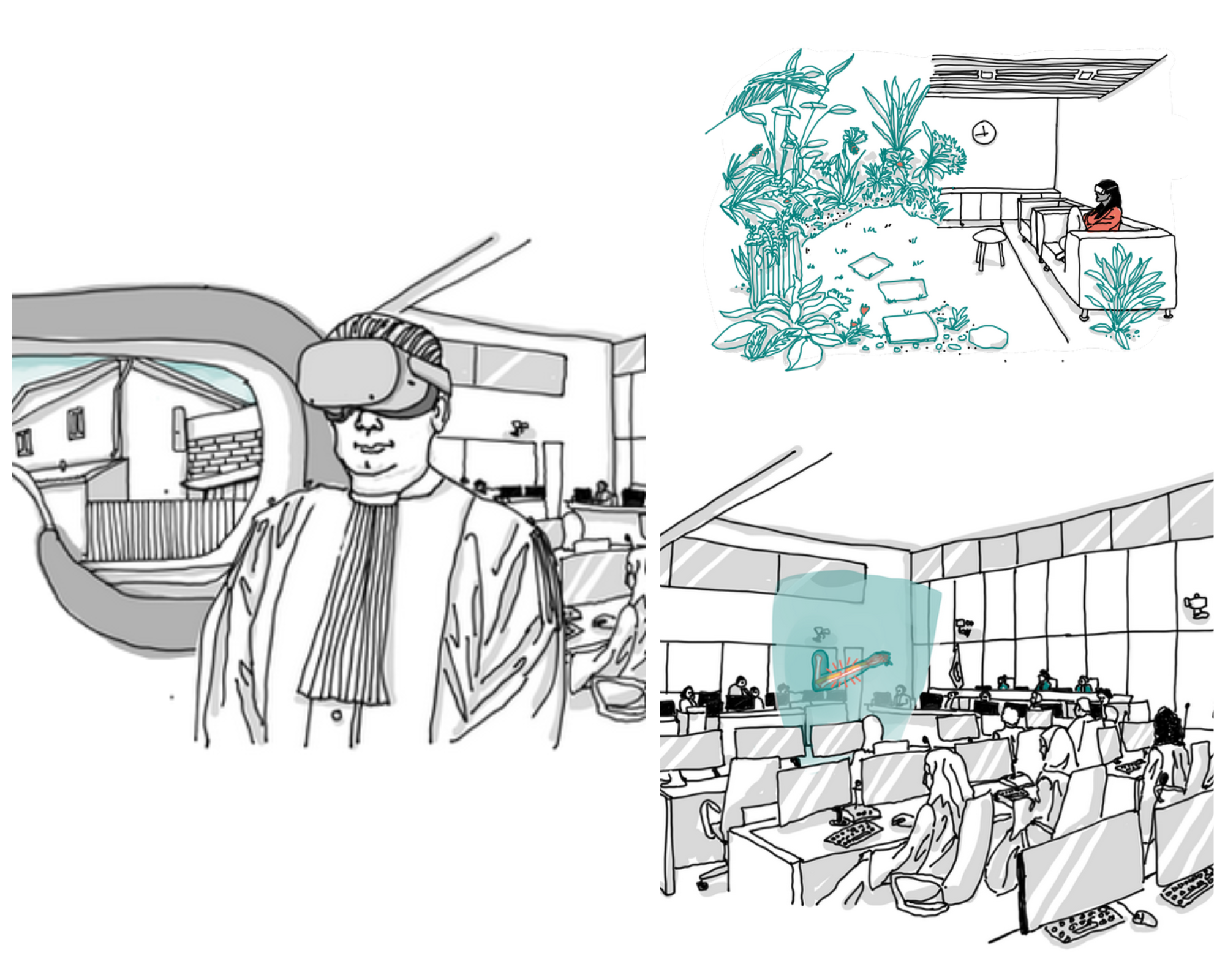

The Deputy Head of Conflict Related Sexual Violence (CSRV) Accountability within the UK Foreign, Commonwealth and Development Office (FCDO) is seeking to work with Office of the Prosecutor (OTP) of the International Crimes Court ICC to introduce AR/VR/XR into their conflict-related sexual violence program, centered on victim care.
They have 11 ideas where to incorporate XR:

Photo by Dan DeAlmeida on Unsplash
I’ve received some questions on my video and transcript posted here: https://heatheredodds.blogspot.com/2022/09/xr-will-not-cause-lasting-improvements.html
So I’ll add some clarifications:
1. There are weak points in my argument:
A. I argue that the learner is the still as-yet undiscovered cause of the flat lining of learning objective results media to media. I have NO data to back that up. That is a supposition by me. I suspect the data will have to come from brain studies.
B. My argument that learners in previous generations were NOT dumb is a bit of low…err…high?…blow. Certainly, there were dumb learners in the past.
However, I do not buy the modernist argument that when technology gets “better”, learning gets better. Nope. No. As I mentioned in the video, humans appear to have a learning speed limit. Said another way, the neural pathways of learning in a human brain are set. (Yup, I’m referring to brain-based learning theory here. You might know it as neuroscience.) Short of something like “Lawnmower Man” or a “Flowers for Algernon” royal technology/drug-induced fuck up, I don’t see humans getting smarter.
2. Let me be clear on my argument about results flat-lining and there being no “lasting improvement”. The “lasting improvement” that I’m mentioning are ONLY learning objectives. So said another way, if there was an exam covering X taught with media Y where students score Z right now….in 10 to 30 years, learners will still score Z even if XR is the media. I’m sticking to apples to apples comparisons. I’m NOT talking about other things like XR affordances, which would introduce apples to kiwi to melon comparisons….which are not comparisons and are not fair.
So I’m not talking about XR doing things like increasing access to resources due to manipulations of time, space, geography, physics, etc. Those things are affordances, the characteristics that belong or sort-of stick to a media form.
The conversation about affordances is fascinating and I’d love to have it! As a designer, knowing the positives and negatives about each media is my specialty! (See my XR platforms writing.) However, I’m also bound as designer to not force any decision about the “best” media upon a client. The clients decides what they will select, what they will pay for, what they will invest in long-term and thus the client accepts both the positive and negative consequences of their decision, their “opportunity cost”. So by default, I almost never like to say this is “the best” when it comes to an XR platform.
3. Timeline = I used smartphones as an example in the video but I’m really brief about it. But it is in somewhat recent memory that smartphones went from a new technology to everyone having one. How long did that take? Hmm… lemme check:
First arguable smartphone: 1992.
2022: as shown in the video there are enough smartphones in the US for every adult to have one. Translation = the US market is saturated. Smartphones are ubiquitous.
1992 to 2022. So that took 30 years.
I’m fine with adding in Moore’s Law here. So the adoption of XR until the point of it being ubiquitous and saturated– how long will that take?
Hmm… I’m guessing but I’m more comfortable saying closer the 10 years from 2022 than 5 years. That puts my guess at 2032.
Now now, you pro-XR folks out there! I heard your cry! 10 years!! Don’t be sad. Remember what is between HERE and THERE: a great big increase, an expansion, a bubble, GROWTH. It will be a good 10 years. (Imagine what the first 10 years was like for smartphone manufacturers Nokia and Apple, whoohoo!)

I’m late getting this post out. This accompanies a video. The initial hubbub about virtual offices from Meta Connect 2022 is over.
However, I like to live out the phrase: The early bird gets the worm but the second mouse gets cheese.
I like to stand back and watch the first wave, like a Twitter trending word, pass over. It’s really often people rejecting something without having tried it.
Then I watch for the next, slower wave of reactions. Those people that
really gave something a try and then have something to say about it.

It’s like watching a Gartner Hype cycle wash over.
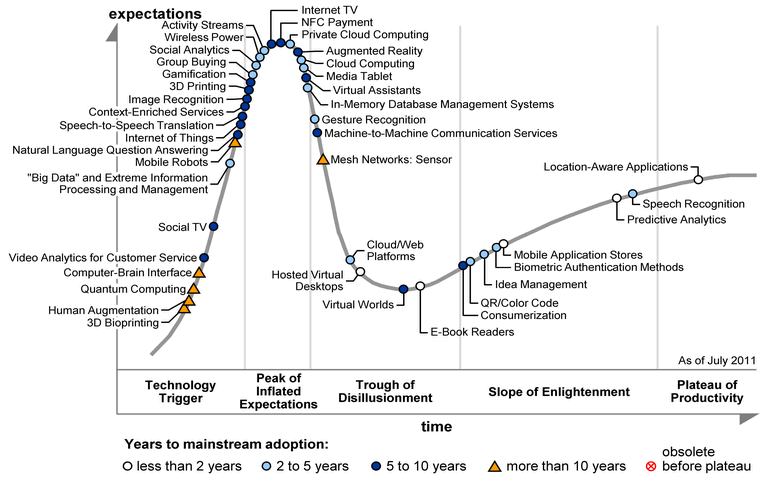
Source: https://www.wolfsheadonline.com/gartner-hype-cycle-virtual-worlds-in-the-trough-of-disillusionment/
I think that we are now going up the Slope of Enlightenment. It is not easy going and the Gartner Hype cycle has many problems.
This video is not about working in an XR office in game design or evaluation
or spending inordinate amounts of time in VR,
and it is not about working in a VR headset for a week.
It is about working remotely and having an XR office component to your life.
(Video credits to Meta Connect 2020, Shapes XR, and Immersed, Ben Fern at Variant )Professor Sylvia Pan crediting Brad Lynch)
In other words, adding XR to your life like you’ve added Zoom.
Yeah, I can hear you. You’ve added Zoom but you don’t like it. Join the crowd. I didn’t say work was something you liked either. Buckle up buttercup,
this post is not about what you will like. It’s about what you will normalize. If the Queen could get into Zoom, you can get into XR.
I’m going to dwell on “remote” for a moment because I like to draw analogies and I think the remote work phenomenon
is in such recent human memory that I can use it as a good example (and
indeed, just like XR, I’ve worked remotely for YEARS before others
warmed to it so I have a good view of the good and bad points of
adopting remote work.)
Before 2020, remote work had a poor reputation.
COVID changed that. Suddenly everyone had to work remote, if they could. And a new element was discovered: remote work does produce results. It’s not a cheat. It’s not worth less.

This stymied those so in love with working in the office. What? I can’t actually WATCH my workers work?
You
know, I’ll just sit over here and eat popcorn while you–in the
office–shot the shit for what adds up to HOURS EACH WEEK and you
claimed that was not only work, you claimed that got you ahead at work.
Yeah, that “if you talk with the boss at the water cooler, you get
ahead” thing. I’ve got news for you. If your boss promoted based on
that, your boss understands zero about diversity.
Many
feel so differently about remote work that it is no longer a negative
stigma attached to WANTING to work remote full time. That’s a huge,
huge change from even 2 years ago.

I
noted at a conference just 2 weeks ago that we don’t even use the word
“Skyping” anymore. It’s “Zooming”. Did you notice that? I’m going to
bring up Zoom again later. Pin that.

60% of workers now want remote options.

THIS scene showing a mix of avatars and Zoom caused quite a stir.
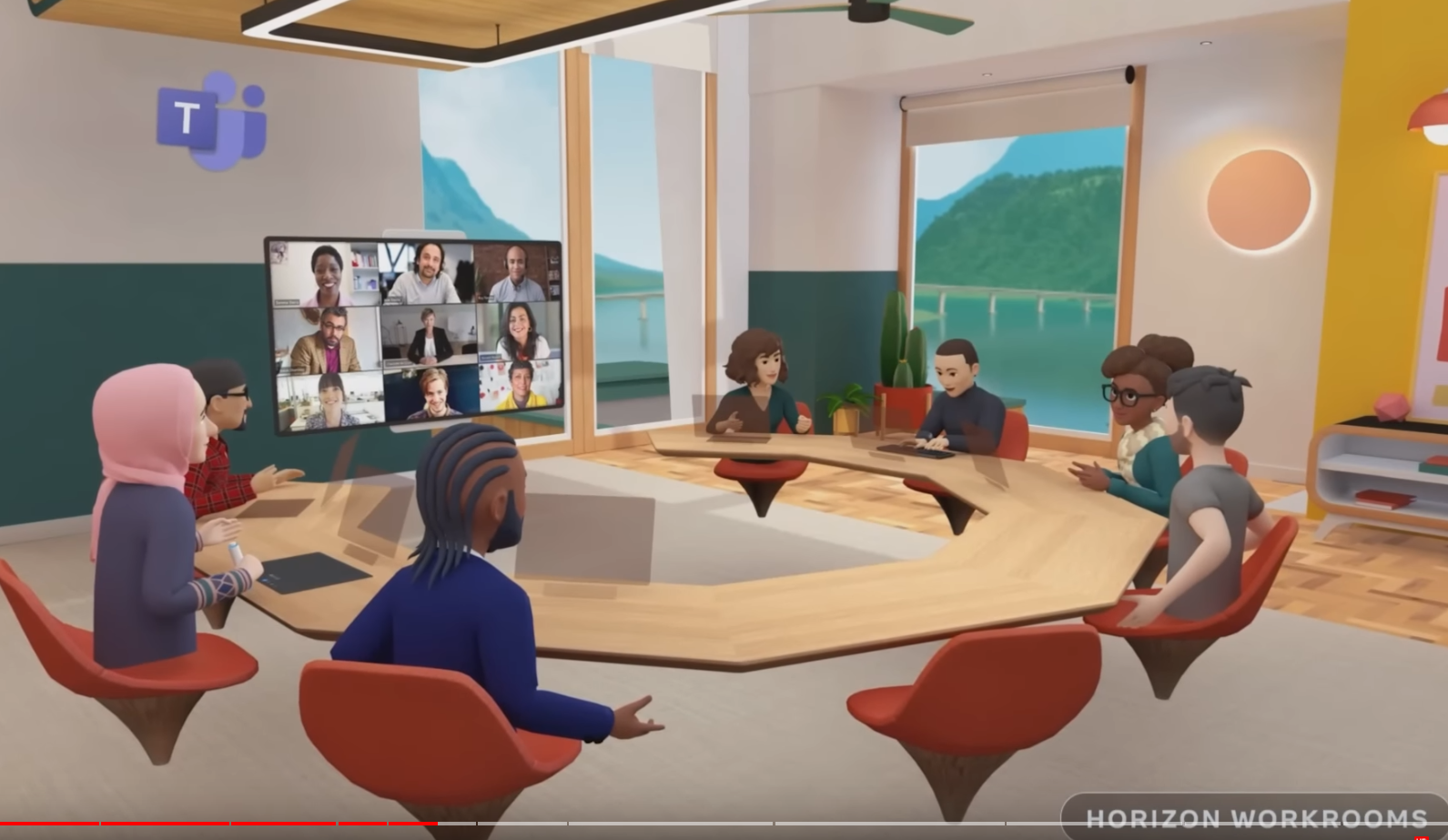
So Meta Connect 2022 raised the specter again of working in an XR-enabled office.
It isn’t just Meta talking about virtual offices in 2022 and new interfaces.
Apple’s forray is yet to come.
(I
am struggling to find the right keywords to describe ‘working in an XR
office’. Society please help and come up with something quippy.)
To get ready for a business conference where I was speaking
as an expert in the metaverse, I decided to study the enemy- those on
social that have disdain the coming metaverse.
People try to make
it all or nothing. They are eager to throw out the baby with the
bathwater. They say things like can’t wear the headset all day,
expensive, wrong bets from a company with a bad rep, etc. Only a few are
saying “maybe”
This AR Post article is has very
cool data. Spoiler alert: Boomers are not against XR.
I
predict that they will come around and come around to XR meetings SO
MUCH that they will be embarrassed someday to think that they didn’t want
it.
For real, as in, working every day in XR.
So I realized the time has come to share how I worked in XR. I bet it is NOT like what you are imagining
Here we go!

For 8 months last year, I was the Chief Operating Officer of an international research organization.
We hosted and rented XR real estate to educational organizations.
My job was to keep the organization moving forward and to put dreams into action.
“I’m a dreamer, I build worlds”- James Halliday, Ready Player One
I had a small office that could seat 6 avatars.

I had 3 Internet boards where I could display any image or web page.
I averaged 4 hours a day in-world.
For 2 hours I worked in my office and held 1:1 meetings.

The other 2 hours would be in larger meetings,

giving tours,

or checking on designs & creations.
It was all 2D XR so eye strain was less of a problem.
There
were times that I locked my VR office door and went heads down on
projects and could see other avatars outside my door.
Typing in world
is, right now, frustrating and I wouldn’t seriously attempt it (I’d go
for speech to text instead.) But my
stronger point is why would you improve on an interface that is already
working pretty well right now, which is a keyboard?
If you’d like to moan about it not being immersive enough, you belong in the finite game mindset.
You do not have to be seen on camera.
Work part of your day in XR and part out of XR.
Attend meetings in cool spaces. Need focus time away from others? Easy.
I regularly hosted global meetings.
Because you can move through spaces in XR, there is space to move closer to those you do want to talk about and further from the topics that you don’t care for.
How and what we work on is about the people we work with.
It is not about the technology; it is about the people.
I beg you, if you think the metaverse is even only 1% cool, you should be bringing in other people to discover it, yes! But that’s the point. It says that after all, how and what we work on is about the people we
work with. It’s not about the technology. Think about that for a
moment:
It’s about the people, not about the technology.
You should be fighting to bring everyone in. That’s fighting for accessibility.
The metaverse IS coming. You either will join or you won’t.
The metaverse is not just for the privileged if I have anything to say about it.
It will be part of all of our lives and the lives of our children. We have WAY more fun that you think. I would always end tours of our Virbela island with boat rides starting
at the beach (and to make it really fun, I would have my guest take the
driver’s seat and then I would not tell them how to drive.) Mind you,
I’d usually just spent 1 hour literally directing them verbally on every
action in VR so they knew they could trust me and that I wasn’t trying
to embarrass them with not giving them instructions.

I’m saying that the metaverse will be PART of your life, not your whole life.
The metaverse is just a new player in the infinite game. Your invitation is waiting.
Why don’t you come on in?
This post accompanies my XR will not cause lasting improvement in education video and contains a few more details. I wrote this blog post first, then made and remade the video and I’ve come back to finish the blog post with the final script and my notes.
XR will not cause lasting improvement in education.
That’s an interesting statement to start a video
when I’m known for being pro-XR.
That’s right, I am pro-XR in education.
But I have expectations that learners will not perform higher.
With respect: Rephrased
from the Cambridge Handbook of Multimedia, (2005, pp. 7-9) and Cuban’s
1986 book: Teachers and machines: The classroom use of technology since
1920 (pp. 9-26) and Mayer, R. (2020). Multimedia Learning (3rd ed.).
Cambridge: Cambridge University Press. doi:10.1017/9781316941355.
Generally, educators are on the lookout for what causes learning and we want to encourage more of it. We realize that content is hard to learn and we want as many learners as possible to successfully learn it. This is given– a belief in the general positive well-being of the learning process, the educators and not least, the learners. It IS important to say that because somewhere along the way, one of the counter arguments against that fact that we don’t find learning gains is “the technology was poorly implemented” or “the leaders don’t care for change” and I wanted to cut both of those excuses off right at the beginning. Nope! Educators IN GENERAL are implementing the technology well and leadership IN GENERAL is pro-change.
Next we need to visit the scientific experimental model as it is the basis for the experimental models used in education. That means that we observe an effect, some data, some phenomena, and we ask “What caused this?”
Remember, we are looking for cause and effect.
This is the scientific experimental model.
Controlled variables – things hold them constant so that they don’t change.
Independent variable – what we purposely change to test cause and effect.
Dependent variable – what we measure as the result.
There are other models to gain information from; naturalistic…meaning anything outside of a lab
Or cultural ways of knowing. This could be indigenous or religious knowledge.
Regardless, the Experimental Model is one of our strongest logic systems and it comes through more times than not at finding cause and effect.
We can isolate variables down to determining the cause (a deductive reasoning approach, a la Sherlock Holmes), or we can simply start with as few variables as possible to find the cause.
This is the same experimental model as it appears in educational research.
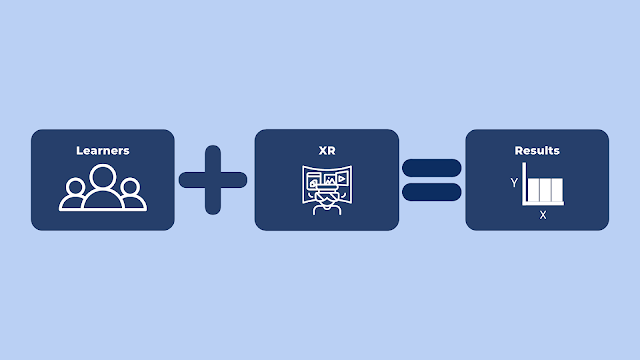
We have our learners, we add a technology, and we measure the results.
And it’s not like we just started this research.
For the purposes of this video, I’ll go back just over 100 years and use the word technology to mean anything powered by electricity.
For example, Radio
And here are the results: no lasting improvement.
Projectors – no lasting improvement
Television – no lasting improvement
Computers – no lasting improvement
Internet – no lasting improvement
and in the future, cloud-based learning by robots or whatever.
But in all seriousness, this video is about XR, extended reality, cross-reality, mixed reality or whatever you want to call it.
.png)
Now RIGHT HERE, some will become upset. They say:
But this is different!
This is learning in 3D!
No, you don’t understand, this is a computer stuck to your face!
We need to implement it correctly and THEN we’ll see the results!
I have a study right here that shows it better when putting VR up against a textbook or a human teacher!
OK for that last one, I toss that right out as non-comparable methods, but that’s a topic for another day.
So let’s look at the results, shall we?
No improvement.
Now for those that are hearing me right now having a really hard time taking this in, I understand that this is not fitting into your schema. What you are feeling is bias. You want the results to be a certain way, and even when the results are not turning out the way you want them to, you want to reject all of the previous results as not predicting what will happen next. Remember that bias, in research, is a bad thing. We don’t want it. So I need to ask you to check your bias and leave it behind.
I’ll give you an example that should be in the recent memory of XR enthusiasts. I’ll use 2022 words to explain a 2022 real world example.
How many studies do we hear of right now that show a spectacular increase in learning with a smartphone (mobile)?
How many times do we hear from learners that they love learning on their smartphone? “Oh it’s so cool!” “Oh it’s the best!” Oh I love that I can learn from a computer in my pocket! Oh, I love that I can learn on this tiny screen!”
~ Oh I love that I’m
being forced to do my workplace learning on my own device (that I paid
for, pay for the internet subscription for, and pay the insurance on, to
say nothing of being tracked by my workplace VIA my own phone!
What’s that?
No one says this?
You’re right.
Why?
Said another way, smartphones are ubiquitous. Actually if you listen closely, there is a STRONG amount of conversation about how learning on the smartphone is boring, forced, poorly designed and/or at least equivalent to learning in the classroom—thanks to COVID and 2020.
So learning on a smartphone is ubiquitous. The learning results have flat-lined.
I’ve made my case that history predicts that XR will also flat-line after it has become ubiquitous.
But….why?
We still didn’t answer that.
I have 2 reasons. One I’ll share, the other, not yet.
Let’s go back and look at that experiment model again.
We said that every technological improvement has proved to produce zero overall learning gains. Learners are simply NOT DOING BETTER.
We can slip in and out all of these technologies and we keep getting goose egg results, nothing. But…look closely at the model. What other variables are there?
We said that technology was a variable and our proposed independent variable– we are purposely changing it).
The results are the dependent variable – they are the output, the effect, or the result of what we are changing and frustratingly, they are NOT CHANGING.
So what else is there?
Look. One more variable is present…
The learners!
Matching my technology examples: 1920s learners
1940s learners
1960s learners
1980s learners
Learners from the year 2000
2010 learners
I mean, everyone knows that 1920s learners were dumb, right? I mean…
Oh, you mean the time when Einstein discovered his E = mc(squared) hypothesis? We were dumb?
1940s? The start of the discovery of the polio vaccine? Saving thousands if not millions of future lives?
We were dumb then?
1960s? Early computers being built? Remember…going to the moon?
1980s? Well no comment from me, I’m from there.
Many smart well-respected people that I acknowledge, say it is a mistake to assume that older generations were not, at least, as smart as us, and in some ways, we can find evidence that they excelled (for example, try learning entirely by oral tradition, no shared writing, READ: no books).
So we can’t say that those learners, educators, and leaders were dumb. They were trying to implement the latest, greatest technology in the best way and certainly there’s been plenty of time to try MANY iterations of the technology. For example, radio for adult learning, radio for kids,
radio for cows. Heh heh, just kidding about the cows, let’s leave them out of this.
~I included cows because there is some research already about there about putting VR headsets on cows and I’m totally befuddled by that. I’m like “Why? Just stop it.”
But the humans are there.
The humans are the same.
I’ll repeat that for emphasis.
The humans are the same.
So we have experiment after experiment; we change out the technology thinking THAT will cause changes in the learning. But the results come out the same.
Could it be the OTHER variable– the humans – causing the non-increase in learning?
I posit, yes it is.
Brain-based learning science (OK, use the word neuroscience if that makes you more comfortable) gives this as it’s prediction.
The humans are the cause of why the learning results are always turning out the same, flat-lining, goose egg in improvements. Humans seem to have a “speed limit” when it comes to learning. We all have it. We can’t break past it. (Why? that’s my second shhhhhhh reason.)
So that’s why I’m so confident that XR will not cause lasting improvements in education.
As long as we are using humans as our test subjects, the results will peg even.
To be clear, I’m all for the improvements in AFFORDANCES that VR will bring; for example, safely learning inside a VR volcano, or added safety information with XR glasses. But those will not cause an overall lasting improvement because eventually everyone should be able to learn inside of a VR volcano or with XR glasses at work. Eventually, VR will be ubiquitous and not…
not the domain of the rich kids.

The topic has come up again. I guess I should start being happy that it’s coming up again and again. The topic is accessibility versus XR as instructional designers see it. The throw-down response of some instructional designers is “XR is not accessible” and they discard it as real learning option for the future.

So I gathered 7 examples (current as of August 2022) of organizations and people working FOR accessibility and I posted them. I’m re-sharing them here.
This is quick in – out, giving IDs examples they can quote that XR is gaining ground on accessibility.
I hold to my premise:
In general, people care and they want MORE people to enjoy XR versus less.
I’m gearing up to talk more about Virtuleap, VR for cognitive exercise & monitoring, on my social media channels. https://virtuleap.com/
This article is not meant to be exhausting and lord knows I love the
research teams out there working on these topics. Hey neurodiversity & medical XR research teams, I see you!! They are doing SO
MUCH.
Don’t count XR out when it comes to accessibility. Not by a long shot.
#Accessibility #XR #WebXR #EqualEntry #Virtuleap #XRAccess #FrameVR #MozillaHubs #Vision #Sound #Mobility #Cognitive #VirtualReality #AR #MR
Simultaneously posted to LinkedIn: https://www.linkedin.com/pulse/xr-accessibility-instructional-designers-dodds-ph-d-

.png)
It’s a rare moment when I can bring 3 themes into 1 post:
leadership, XR, and design. Also, I’m going to be personal. Believe it
or not, I’m not really personal on LinkedIn. Enthusiastic, yes. Personal, hardly.
Over the weekend, I wrote a gushing sentence to a friend that I
realized I’d never written down before: I became a Biology major in
college because of Dr. Ellie Sattler.
A mentor of mine once said writing is thinking. Writing that
sentence lead me to do a lot of thinking and reading about her character
and on the impact of the Jurassic Park (JP) movie. I’m not alone as a
woman in deciding to go further in STEM because of the Dr. Ellie Sattler
character. So huzzah all the Paleobotanists out there!
We have to time travel to talk about JP. In 1993, we’ve just BARELY
broken out of the 1980s. For the first time in STEM history, scientific
breakthroughs are being accomplished by teams instead of white men. Think: AIDS breakthroughs & the Human Genome Project. Teams means women included. Prior to this point, women were the “also rans” in science. Sisters. Mentioned on the side. Or worse, they had their research stolen.
Strong women depicted in media? Disney’s top film of the 80s was The
Little Mermaid and Aladdin was just released in 1992. Strong women, not
so much. Video tapes existed; the Internet did not. If you wanted to see
a movie, you bought a movie theater ticket.
We arrive when the music was rises in cool, dark, air conditioned theaters. And then you see this:

Caption: A character who does not care what you think because she’s solving a problem.
A character who lays out this line while she holds a stare on the richest daddy around:
“Look…we can discuss sexism in survival situations when I get back”
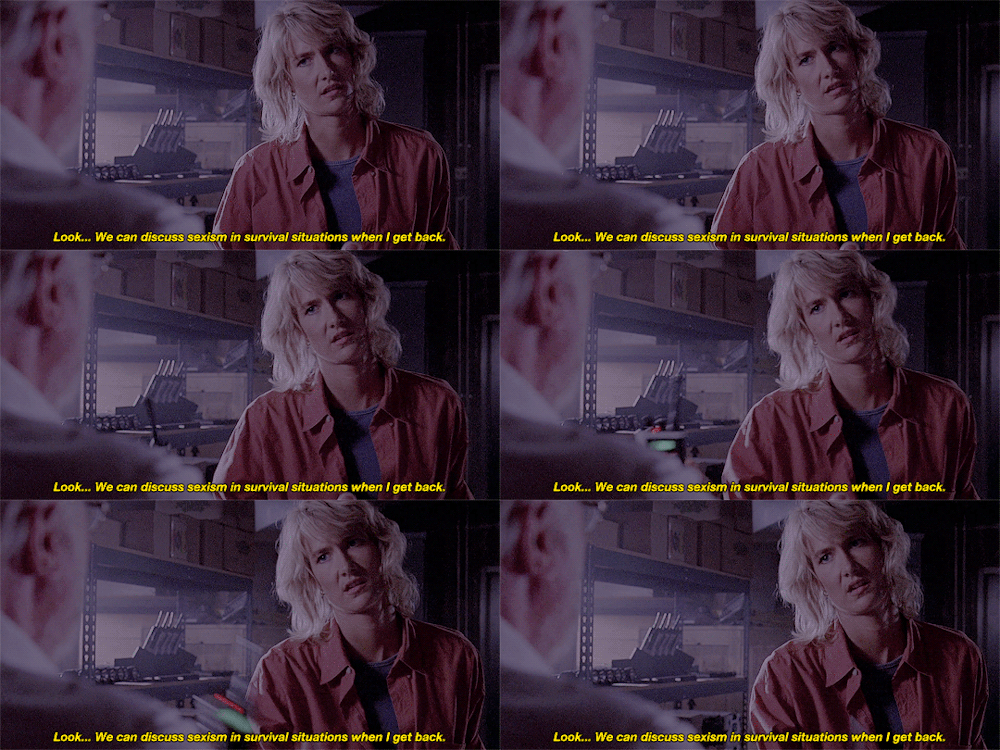
I took that to mean that women are better in survival situations (not equal, as others took it.) and my life was shaped for the better.
I bought a $5 ticket 3 times over the course of that 1993 summer. Now that’s saying something.
To this day, it’s the only movie I’ve bought multiple theater seats
for. But realize, I have older brothers that saw Star Wars, what, a
bazillion times?
Jurassic Park became the first movie to gross US$1billion.
Reading some commentaries and watching some videos over the past few
days, I picked up some tidbits below. Some I agree with, some not.
1. To this day, the scene of the T-Rex crossing the paddock fence
HAS NOT YET BEEN BEAT in movie history & you don’t need to try.
True disclosure: the raptor jumping up to the ceiling shot? I still
can’t *barely* watch that. I wince too hard.
2. There’s been some 2022 commentary on the age difference between
the Dr. Ellie Sattler (Laura Dern) and Dr. Alan Grant (Sam Neill)
characters. It’s been confusing and I’ve decided to weigh in.
In the book, Dr. Ellie Sattler was written as a grad student (Age
23, no advanced degree) but also no relationship. It was apparently
Laura Dern’s own idea to give the character a full doctoral degree and
in the movie the character holds her own against dinosaurs. In real
life, I’m disappointed to say, Laura treats Sam Neill patronizingly
and actually “left the party” of JP with Jeff Goldblum, which I find to
be a big mistake. (I said this article would be personal, yo.)

Caption: The look of faithfulness.
Don’t be like this guy and not see the sexual tension in JP: https://youtu.be/jSPxu3WprSs
As far as the age difference? The problem came in when, in the book,
the “relationship” was not there but in the movie it was. Laura was in her late 20s playing early 20s. Sam (then early 40s)
continues to feel the (physical) burden of the age difference. If you
need help to see what was happening, Deshi Basara has collected these gifs. Notice in gifs 2, 3, and 7 how his body immediately reacts to hers when she touches him. This is chemistry, folks.
I had to wade into all that because the point was that regardless of
an age difference (which, arguably could be *less* than 23 years),
there was a *quality difference* between Dr. Ian Malcolm and Dr. Alan
Grant.
I will concede this one point (I disagreed with so much here
that I couldn’t read more than 2 pages of this commentary) that Ellie
holds her ground just fine (and doesn’t move despite Alan’s come here
gesture) with a metamessage at the Raptor pit:

Vogue got an interview with Laura Dern
where she points out that the Dr. Ellie Sattler character went on to be
an activist and whistleblower. Interesting!! I’ll just leave that right there.

But most I really enjoyed watching these video analyses of the plot of Jurassic Park here and especially by Mike Hill here and why the movie worked when all subsequent versions of JP have not worked. The key was that Steven Spielberg worked in narrative plot. He carried a story all the way through that was human, basic, and emotional. Dinosaurs just happened to be there.
%20Spielberg's%20Subtext%20-%20Jurassic%20Park%20analysis%202.png)
But that shows up in my VR/XR consulting work to this day.
The famous quote about rushing into things by the Choatician character Dr. Ian Malcolm:
Ian Malcolm: Don’t you see the danger, John, uh,
inherent in what you’re doing here? Genetic power’s the most awesome
force this planet’s ever seen, but you wield it like a kid who’s found
his dad’s gun.
Donald Gennaro: It’s hardly appropriate to start hurling accusations–
Ian Malcolm: If I may, if I may. Uh, I’ll tell you
the problem with the scientific power that you’re, that you’re using
here. It didn’t require any discipline to attain it. You know, you read
what others had done, and you, and you took the next step. You didn’t
earn the knowledge for yourselves, so you don’t take any
responsibility… for it. You stood on the shoulders of geniuses, uh, to
accomplish something as fast as you could, and before you even knew it,
you had, you’ve patented it, and packaged it, and slapped it on a
plastic lunch box, and now (bangs the table) you’re selling it, you
wanna sell it, well.
John Hammond: I don’t think you’re giving us our due credit. Our scientists have done things which nobody has ever done before.
Ian Malcolm: Yeah, yeah, but your scientists were so preoccupied over whether or not they could, they didn’t stop to think if they should.
I fight this battle every day.
Industry and indeed some in academia want to use XR liberally in
education. Yet, the power of XR is still unknown. Our early research is
pointing to one thing that seems firm:
The mind believes what the eye sees.
That means that the XR experiences we put our children into will be real for them.
What power are we wielding in the classroom? Everywhere?
There are those that say “XR is the Empathy Machine! We can create empathy, soft skills in the workplace!”
Oh yeah?
The most recent research I saw (from 2018) says that empathy coming from XR is a 50/50 gambit. That does not mean that it causes empathy for whatever you want half the time.
It means it causes empathy half of the time and causes the opposite of empathy the other half of the time!
So, would you like your employees to don a headset to be more
empathetic towards race, age, body size? Oh really? How would you like
results that say that half of the time, those employees are going to
take off the headsets and quietly say to themselves “Thank God I’m not
black” 50% of the time? That’s one hell of a bet you are willing to take
with XR.
XR is dangerous.
People say “Look at how you can look all around you! 360 degrees! A
sphere! Isn’t this cool? Isn’t this new? Just think how this will reach new learners!”
I can take a learner into a new real physical space (for example on a field trip) and have them be overwhelmed. We’re all on the spectrum, remember? Was that cool? Were they reached
in a new way when they cried? Would you like for me to even mention
harassment events in VR that have already happened? We haven’t yet
arrived into market saturation of haptic bodysuits, but it’s coming.
XR is dangerous.
I’d rather have a low, slow, plodding walk into an XR for education
experience than every bell and whistle thrown at them the first day. The
line “spared no expense” gives me chills.
XR is dangerous and if we aren’t careful, we will damage learners
along the way. Jurassic Park should not have been built or opened. Dr.
Alan Grant refused to give his endorsement. That was the lesson of the
movie.
But the parallel lesson of JP was “Build for story. Because the dinosaurs are not real.”
When I encourage XR design, I build for narrative plot.
I build for emotions,
because those are real.
%20Spielberg's%20Subtext%20-%20Jurassic%20Park%20analysis%20-.png)
#XR #Design #JurassicPark #NarrativePlot #InstructionalDesign #DrEllieSattler #DrAlanGrant #DrIanMalcolm #Dinosaurs #VR #VirtualReality #EmpathyMachine #Leadership #WomenInMedia #FemTech #Sexism #BestMovieSceneEver #Whistleblower #Scientist #PreoccupiedWithCould #SparedNoExpense #Emotion #DesignForXR
Article originally posted same day to LinkedIn here: https://www.linkedin.com/pulse/dr-ellie-sattler-jurassic-park-narrative-plot-wasnt-dodds-ph-d-