
What Does the Space Age Teach Us about Instructional Design?
 |
| Source: NASA |
The 50th Anniversary of the Apollo 11 Mission to the Moon is upon us. As a science lover, I’ve been soaking up all of the ceremonies
as well as the updates of future space missions ahead including
Artemis. Space science has been inside of science learning standards for
years. Several themes have emerged that intersect with instructional
design and I want to mark the 50th Anniversary of the Mission to the
Moon by noting these lessons.
First, a little history.
The
urgency within modern STEM education within the U.S. traces it’s
history directly back to geopolitical sources. With both Sputnik in
low-space orbit and a man in “space” already, the Russians were ahead
during the Cold War and fears were rampant that enemies could be
anywhere on the planet because they could look down or drop down from
above. Since the dawn of the Space Age, there has been a call to
increase the number of working scientists in the United States in order
to achieve and maintain supremacy of near-Earth space. Interestingly,
this call for more mathematicians and scientists goes on today, even
though the U.S. is undeniably one of the top three countries in the
world with viable dominance in space. Therefore, lesson one is: Never
underestimate the power of geopolitical influence in guiding overall
learning and education. If you thought science and space could float
off together un-tethered to any human notions of greed, you are very
wrong. (Reference: the entire movie Interstellar.)
Coincidentally,
the field of Instructional Design tends to trace its history to nearly
the same time period, starting in the 1950s Post-World War II America,
with ID edging out the space race by less than 10 years. ID was born to
the idea of planning and putting edges and method to the art and science of learning. How nice that ID was considered both an art and a science! That’s a theme coming up.
Next lesson: It’s all about teamwork.
This one is the biggest lesson for me. There were two types of people directly involved in the Moon Missions:
First, Ground Control.
Notice the name. Ground Control. Not Ground
We-Think-We-Have-A-Good-Idea, Can-We-Run-It-Past-You. Not
I-Have-10,000-Twitter-Followers-So- Obviously-I’m-Thinking-Clearly.
Ground Control. They called the shots. The people on the ground had
access to:
- The most amount of data. (Crossover with AI here)
- The most amount of experts.
- Prototypes and the ability to change technology setups on the fly. Hint: Cross-over with UX technology here.
I
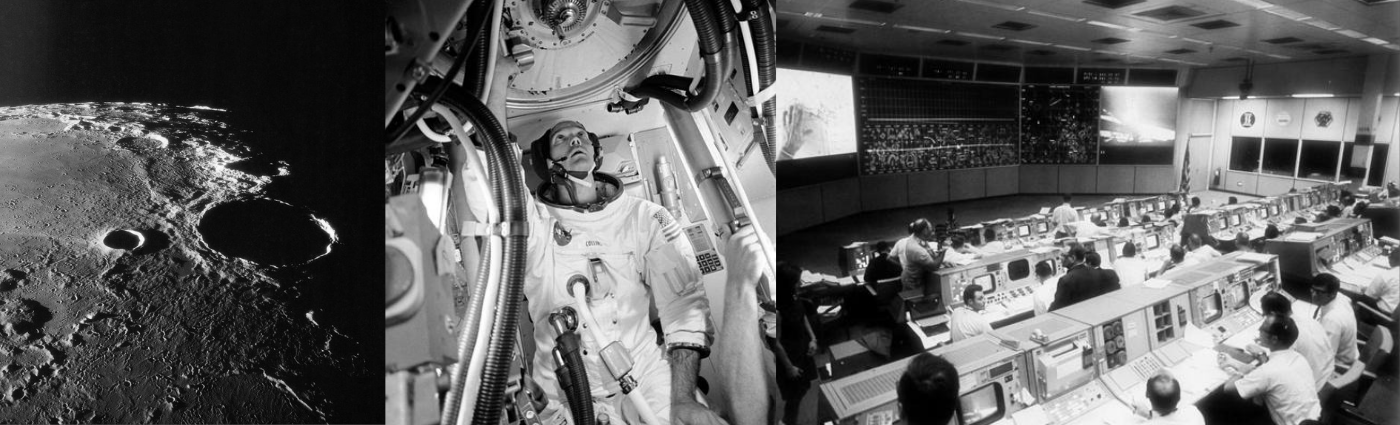
look at the footage of the control rooms, practice areas, and hear from
the astronauts themselves and I see one theme over and over: Checklists.
Controls. Contingency plans. And training until it is automatic. And
this is a great lesson for instructional design. When designing
learning, make sure every step is documented. Make checklists. Keep
checklists. Update them. You will need to know about every fuse, knob,
switch, and procedure that your learners will need to engage. In Space
travel, there is no “hand waving” approach. That means that there are no
shortcuts or middle parts that are so ubiquitous that they are not
documented. You can’t skip launch to get to orbit. You can’t skip orbit
to get to the Moon. Checklists make me happy. Every step is important.
This is learning science.
Second, Test Pilots.
As we reflect on history, we’ll have to just weigh the balance as to why
the test pilots were only white males. Grr. But alas, the specific
personality characteristics of test pilots is the point here. Test
pilots need to know as much as they can. They need to be trained to the
point of automatic responses (just the same as police, fire, and
medical personnel on Earth). And then the most important point: they need to be able to improvise and take the leap from the known to the unknown. Another name for this characteristic is bravery. This is the art.
If I may insert an analogy here, we had our Spock on the ground and sent our Jim Kirk to space. We need both.
Instructional
designers need to have a little of both within them. They should know
everything about everything within the instruction they are working on.
(I’m not saying that they should be SME’s on the content. We have
SMEs, it’s the SME’s job to be the Subject Matter Expert.) But
instructional designers should know the learning inside and out.
Instructional designers should have a test pilot streak; the ability to say “I wonder what this will do” and be willing to try.
As I’ve written about before, most of the bad rap that online education has comes from badly done online education. We have to experiment to do better. Strap on a parachute and get up there and try something new.
Next lesson: It’s worth it to “shoot for the moon.”
There
is a quaint phrase out there that says “Shoot for the moon. If you
miss, you’ll land in the stars.” Beside the annoyance you give
scientists over the concept of accuracy, the point is to try because
other things besides your main goal are achievable; to reach out. It is
good when the instruction you designed reaches its goal. It is an
absolute delight when the instruction you designed reaches another unplanned
but desired for goal. But you don’t get that second goal until you try
for the first. It is this degree of bravery that helped us get where we
are. To this day, we have advanced in many areas of Earth habitation,
not just space exploration, with the Moon Missions. We need more bravery
in instruction to go forward.
Final lesson: After 50 years, we’ve only just started.
NASA
has plans and I entirely support their explorations both in space and
on Earth. (Indeed, without Earth, where are we going to keep our stuff?)
The blue marble in space idea reminds us that we are all in this
together. Within instructional design, brain-based learning is getting
some great traction and I support this as it erases differences of
gender and race to look at the neurological underpinnings of learning.
As I’ve noted
before, I’m researching the future of transmedia, cross-reality, and
virtual reality as it relates to instructional design and we are only
just beginning to know what it can do.
Our Moon shot is still ahead, instructional designers.
Come along for the launch. I’ll save you a seat.
#Apollo11
#Moonshot #space #NASA #spaceexploration #50thAnniversary #Transmedia
#virtual reality #virtualworlds #crossreality #mixedreality
#augmentedreality #design #instructionaldesign
#everythingilearnedfromStarTrek #Spock #JimKirk #GroundControl
#TestPilots #brainbasedlearning #neuroscience #teamwork #artandscience
#science #heatherpolicy #heatherlovesscience #5DayChallenge
This post originally appeared on LinkedIn on July 16, 2019
https://www.linkedin.com/pulse/what-does-space-age-teach-us-instructional-design-heather-dodds This post was updated on April 3, 2026 with a better font and removal of missing images.