Seeking Integrity in VR Educational Research 3: It keeps on happening
It keeps on happening If I were you, by now, I’d be asking, “Heather, why are you doing this?…

XR, Instructional Design, and remote team leadership




Credit: Me and Midjourney
My first article in this series garnered so much attention! But many folks tried to pass me Mirjam Neelen & Paul A. Kirschner’s Truth or Truthiness? Analysing a VR Study Using Gorard’s Sieve article on the PwC report entitled “The effectiveness of virtual reality soft skills training in the enterprise: a study” and all of its associated webpages like this one. I was like, I know! Mirjam & Paul wrote their article 2020 and I wrote about it in 2021. What’s cool is that separately, we both came to the same conclusions. That’s a good sign for our conclusions!
Short version: we both cast strong doubt on any conclusions.
Still, I realize the world does not revolve around me (sigh!). Some folks might have missed my long stream-of-consciousnesses article about the PwC report. I decided that the second article in this series should be an abbreviated and updated critique. Bear in mind that to reach the LinkedIn audience, I have to leave much nuance by the side of the road. If you have questions, just ask!
As Mario says “Here we go!”
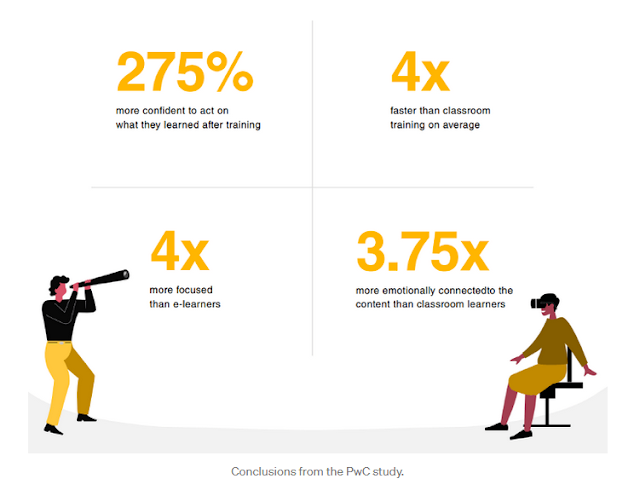
This infographic summarizes the dominant conclusions:


What do these Google results have in common?
They are all companies that sell some sort of VR product or service.
Because I was curious, I checked out that vrowl dot io link (“Virtual Reality training is not effective”) just to see if it was presenting an alternate opinion. It’s a strawman argument; it puts up “not really real” protests against VR for learning and then explains them away. I’m telling ya, Beware the VR Strawman.
Eckert, D., & Mower, A. (2020). The effectiveness of virtual reality soft skills training in the enterprise: a study. https://www.pwc.com/us/en/services/consulting/technology/emerging-technology/assets/pwc-understanding-the-effectiveness-of-soft-skills-training-in-the-enterprise-a-study.pdf
Let’s ask Google Scholar what it thinks. It’s coming up with 11 cites. That’s not much at all. But as I showed above, the money shot is on the Internet, not in academic articles.
Truly, the 4x faster learning quote is the runaway train of this report.