You gotta suit up for them all
Photo by Brandon Mowinkel on Unsplash Heather’s Book on Leadership*, Chapter: Leadership Lessons from Sports, page 297: “You win…

XR, Instructional Design, and remote team leadership




(Image: Crowds gathering outside New York Stock Exchange Source: https://commons.wikimedia.org/wiki/File:Crowds_gathering_outside_New_York_Stock_Exchange.jpg)
This report, The Total Economic Impact™ Of Mixed RealityUsing Microsoft HoloLens 2, dated (November 2021) came through my LinkedIn feed in this post:

What most caught my eye was the fourth bullet:
Mixed reality increased
training efficiency by 60%, saving $1,440 per trainee while improving
knowledge acquisition and retention.
I posted my response:
“With
respect, a company that sells a product that then claims the product
increases training efficiency with these kinds of numbers is to be
doubted.
In the case of the 60% increase, my eyes land on the
table on page 21 and the source of the 60% increase in task efficiency
data is “Interview data”, not quantified data. That means the
interviewees that Microsoft picked provided verbal estimates to the
interviewers. While the report takes great pains to describe how the
results were calculated– and I respect that– this is a “commissioned
report” (page 1)– that was paid for by the very company selling the
product.
Long term, results like these do not hold up.”
To which, an Associate Fellow at Lockheed Martin replied:
While the numbers seem outlandish they are very real based on our findings.
We
use mixed reality to build spacecraft and see well over these numbers
(~93% reduction) in touch labor. This was analyzed across 10
manufacturing sites and numerous spacecraft manufacturing programs.
Technicians consistently finish 8 hours worth of traditional work in 45 minutes, and other companies are seeing similar results.
For
training we see an 85% reduction in training time. Mixed reality also
offers greater comprehension than traditional methods.
While the numbers seem incredible, they have been validated with more than four years of shop floor implementation.
If you would like to chat details, just let me know. I would be happy to provide insight to our findings.
I did not reply further at the time to this post because I was not actually arguing time-based measurements. I was arguing improving knowledge acquisition and retention via task efficiency– admittedly their own squirrely wording. Said another way, claims that users learned more.
This blog post is, in part, my response.


Photo by Birmingham Museums Trust on Unsplash
Within the same morning, I had scanned The Total Economic Impact™ Of Mixed Reality Using Microsoft HoloLens 2, A Forrester Total Economic Impact Study Commission by Microsoft, headlined by the Senior Mixed Reality Specialist at Microsoft. I found the numbers inside dismal and took screen captures of the most egregious numbers so that I would not forget what jumped out as the most ludicrous (60% increase in efficiency in learning as an verbal report given in interviews by interviewees selected by Microsoft).

I also had been invited to a group that will “build a community of practice around applications of learning experience design in XR modalities.” But I had watched this community do a series in 2021 where they picked individual pieces of research and tried to derive principles for design in XR. I gave them feedback for the first 3 days. They kept hand-picking research and trying to establish large principles.
Err, that’s ethically wrong.
Plus, when I pointed out that some pieces of research– while fine as independent pieces of research, could not be applied broadly because of problems like cognitive load, comparative design, sample size, novelty effect etc. they would give me the hand wave response of “Oh yes, we saw that” but they never retracted or stepped back from the total theme and they had the ability to.
So….
I don’t see much hope there.
Therefore, I was in a pit of despair. Everyone around me is in some sort of technology-haze thinking it will solve all of their problems. Come to think of it, much of the field of instructional design for the past 18 months has been soaking in a technology tools fantasy. And yet, not a word about learning gains. Funny, that.


On January 6, 2022, Disney announced that it received a patent for what they called a Virtual World Simulator. Commentators on Twitter, Facebook, and blogs all began outputting opinions, most of them along the line of
“Is this Disney entering the metaverse?”
and
“Can Disney patent existing technology?”
Haters gonna hate.
Comment seen on Twitter:

Comments seen LinkedIn:

Matthew Wren on LinkedIn dug up the actual patent.
Both of us were reading it with an eye to “What makes this different or deserving of a patent?” To date, most commentators have their own ideas and this blog is represents my hypothesis.
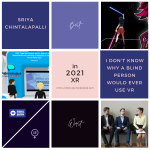

I drew up my list of Best and Worst for 2021 and to make it balanced, it has 3 on each side. Here we go:
I count meeting Sriya as a golden moment of 2021. I actually haven’t had long chats with her. But I was given a small heads-up for a student XR conference that I was supporting that a speaker was coming that was going to be amazing. I think the ‘knock socks off‘ phrase might have been used. I was under FERPA regulations to know that she needed extra protection at the conference and I volunteered to give it. That means I stood on the virtual stage with her, playing the role of direct tech support but also crowd control if necessary.
But what did happen meant something much more to me.
Sriya gave her presentation. It was a great topic and very forward looking. Then, she took questions from the audience. Because the topic was on brain-computer interfaces (BCI), it didn’t take long before questions of invasion of privacy questions came from what were obviously professors in the audience.
I’ve seen these verbal examinations before. I’ve seen them break college seniors and Master’s Degree students. It’s just enough questioning to find where the student does not know the answer. That’s the push point. Several men in the audience were going right for her, directly and academically.
Standing on stage with her, without her knowing it, I would have thrown up a shield if she needed it and blocked those men from getting to her/embarrass her/humiliate her by making some excuse that we’d run out of time, audio wasn’t working, etc.
But, she held the stage. She held her ground. More than once she said “The data doesn’t say.”
Good line! Don’t let them pin you where you have not staked a claim. She’d been trained well to enter an academic fight.
When she was done, I let out my breath.
Were those men plants in the audience? Not sure. Maybe. Either way, my hackles were real.
And the lesson for me that day was: if I can do anything to help women like Sriya…even if it is only shouting “Make a path!“, I will. It’s very hard to be a woman in the technological sciences. The road ahead will shape her in ways I’m sorry to contemplate. May she always find a woman like me standing by, ready to help.
Please follow her. Great things are ahead.


(Image source: https://about.fb.com/news/2021/08/introducing-horizon-workrooms-remote-collaboration-reimagined/)
P. Sajjadi, J. Zhao, J. O. Wallgrün, P. C. La Femina and A. Klippel,
“HMD Type and Spatial Ability: Effects on the Experiences and Learning
of Students in Immersive Virtual Field Trips,” 2021 IEEE Conference on Virtual Reality and 3D User Interfaces Abstracts and Workshops (VRW), 2021, pp. 546-547, doi: 10.1109/VRW52623.2021.00155. https://ieeexplore.ieee.org/abstract/document/9419337


This woman is taking money to have herself videoed/green screened playing Beat Saber in a short skirt. Don’t tell me that the Patron isn’t begging for that skirt to fly up at some point. I know what you can see through that black skirt by outline. In these videos, women have not only lost body space control, they are selling it.


Which groups tend to be targeted by microaggressions?
According to Derald Wing Sue, any group in society may become targeted, including women, people of different gender
identities, those with disabilities, religious minorities, among
others. For example, a forthright white woman might be labeled a bitch
just because she exercises assertiveness. https://www.psychologytoday.com/us/basics/microaggression
The last organization I left questioned if I was a dues-paying member, so they used an institutional rule to execute an exclusionary move.