Research Writing is Like Baked Alaska
When I help students understand the basic reasoning behind research writing, I often say “Research writing is like Baked…

XR, Instructional Design, and remote team leadership




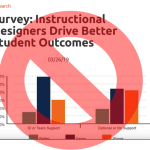

This article, Instructional Designers Drive Better Student Outcomes,
made the rounds in 2019 and now that it is time for end-of-year
reviews, it is popping up again. I need to make my objections to the
conclusions of this article known because if I was a CEO and handed this
article as justification for an Instructional Design (ID) department,
I’d toss the article back across the table.
Poor research is worse than no research.
Before
I articulate my objections and show you some tips on how to analyze
research papers, I would like to state my philosophical bias clearly: I
am, by degree & interest, an Instructional Designer. I believe that
Instructional Designers can create and improve instruction. There
is a plethora of bad instruction out there and I’m part of the group
that supports better instruction.
Please be clear on this point because
now that I’ve said that, I think the 2019 CHLOE 3 Report (hereafter referred to as the report, APA reference at bottom of this page) together with the Campus Technology article (hereafter referred to as the article) headline are garbage.
From the very first paragraph of the article, the claims seem compelling:
“When
faculty are compelled to work with instructional designers on
development of their online courses, students have better outcomes,
according to a recent survey from Quality Matters and Eduventures Research,
the research division of ACT/NRCCUA. In schools where instructional
design for online course development was absent or optional, 58 percent of
“chief online officers” (COOs) believed that students taking those
courses would perform at least as well if not better than those in
face-to-face classes; that jumped to 70 percent where instructional design was mandated.”
Mind
you, depicted directly above this paragraph is a graph which does not
show a 70% Y axis interval.
Hmm…70% in the text and no 70% on the graph? That’s your first sign that something might be wrong. These
numbers might be aggregated…as in…more than one category of
responses has been added together to get a bigger number. At this point,
that is not a research sin. But which numbers were added?
Better and same? Same and worse? What? I get the feeling that the graph
and this paragraph, even as they are snuggled together, might not go
together. It might mean that the writer is reaching for conclusions
(pushing the data) that the data doesn’t show. Hackles raised. I’ve got
to get my hands on the actual data.
I surfed off to find the 2019 CHLOE 3 Report.
In order to obtain access, I had to fill out a form.
Interestingly, on the form I was given the option to disclose that I, myself, am a COO. I gave that a moment of thought. Hmm…okay, so I am technically the COO of my own home office. But…does that mean I will be surveyed for the next CHLOE Report?? We’ll see.
(I *will* update this article.) Immediately, the problem here has me
asking, “Who exactly did they survey?” Just people that disclosed they
were COOs? And by what standard? Because they said so? Because they
clicked “I am the Chief Online Officer or equivalent?” Is it possible
that only progressive, forward-looking campus representatives even read
or know of the CHLOE survey? Maybe only the technologically jazziest
COOs reply to surveys? Or maybe COOs that have time to read their email
and are, perhaps, not the least bit jazzy?
Point of order: whether you are a COO or not, why do you need this information to give me access to your report? Casting my very best Spock raised eyebrow at you.
My
notes say I received this report on June 26, 2019 at 7:23 a.m. Eastern.
CHLOE does a breakdown of the respondents on pages 6-8. I can’t filter
out the “jazzy” factor but this report goes to great lengths to tell me
the demographics of these respondents. Wow. The stats person on the
other side of this was on full caffeine the day they ran this data.
I’m
searching for the data on the use of instructional designers. ID is on
pages 22-24. I’m looking for 70% (a good anchor number to scan for since
it was at the front of the article).
A search found 70% in two places in this PDF between pages 22 and 24.
What’s
this? This time the report snuggles the 70% directly up to the same
image from the article and yet, there is no 70% on this diagram either.
This
70% does not seem to be related to that headline. It’s just reporting
that among enterprise institutions, 70% of them grant faculty
autonomy/academic freedom as to why instructional design is absent or
optional. Not relevant for my writing.
But I want to get to the
heart of the data question: What did they measure? I scoured this
section (and the whole report really) and found this was the most
descriptive response:
“A higher proportion of COOs at institutions that require ID use in online course development judge their fully online students as performing comparably to or better than on-ground students than claimed by COOs from institutions that do not require ID support”
Bold
emphasis added by me. Thus, the survey respondents judged and claimed.
No problem with that as surveys can collect opinion results. But let’s
look at the headline again:
Instructional Designers Drive Better Student Outcomes
That’s not what the data shows is it? The survey did not measure student outcomes. It measured the perception (judge, claim) of student outcomes.
It collected subjective data. Is it possible that COOs love their ID
departments and don’t want anything to make them look bad so they
responded, “Of course my ID department helps, that’s why I have one!”
The
survey did not appear to ask for objective student outcome data at all.
*CHLOE 3 authors if you did ask that question, please clarify. Hint: If
I was a CEO, *that’s* the data I’d like handed to me.
At this point, my interest is really peaked.
 |
| CHLOE 3 Figure 15 |
I’m struggling to make the diagram match anything
in the written accompanying text.
Let’s use our graph reading skills and dive in.
First, the data appears to be split into 2 groups:
Option A:
Or
Option B: No sure which columns refer to online versus on-ground, but X axis seems to claim with or without ID support.
Since
the title takes up a great deal of real estate in a graph, it’s fair to
say that it should be the more dominant piece of data, so I’ll assume
Option A is the correct interpretation of the two groups. Bear in mind
at this point, that this graph is showing the (perceived) difference ID
makes in two different populations (online versus on-ground) and not
what difference ID makes versus non-ID. Remember the headline said Instructional Designers Drive Better Student Outcomes, no mention of online versus on-ground.
However, I’m willing to analyze this graph based on three separate
assumptions (ID versus non-ID, online versus on-ground, and mix those
groups up too) so let’s continue.
The Y axis is showing us
percents so really quickly, we should decide if this is a number that
*should* add up to 100% maximum or could the total percent go higher?
Some aggregates can go higher than 100% if a respondent can pick more
than one answer. Scanning these columns, it looks like if you added all
of the columns of a group together, we’d get 100%. OK. So these
respondents could not be part of more than one column. Each respondent
had to be part of a discrete, exclusive set.
Reading the colors, the turquoise columns are those COOs that felt that their student performance (interestingly, not student outcomes?
Watch that vocabulary crossfire boys!) was better with ID. So referring
to my philosophical bias, we like this group. Yay! But they seem to hit
the 15% and 19% mark. Ugh, those are not high numbers.
The dark
blue column is the COOs that felt that their student performance was the
same. Now I will make a leap here. I can be argued against this but I’m
going to take the stance that any set of data that indicates a result
of ‘same’ probably shouldn’t make headlines. Notice however, that these are the largest columns.
So in an alternative universe, the article could have been titled
Instructional Designers Seem To Make No Difference In Student Outcomes.
No column crossed the 60% threshold either.
The orange column is the COOs that felt that their student performance was worse with IDs.
OK, I gotta stop here for a moment.
Bwhahahahahahahaha!
I love it when a plan…
totally explodes.
As you can tell, I have disdain this group and wish it did not exist. However, the scientist in me loves the fact that I have to acknowledge that it is possible
that the presence of ID could totally muck up the works. Statistically,
it is possible that there are institutions filled with awesome
teachers, doing the best instruction, utilizing the best learning
science, and creating wonderful learning outcomes. Insert a mediocre (at
best) ID with a job task to, for example, input boilerplate language
into every syllabus, and it is possible that (perceived) student
outcomes take a hit. This data just makes me laugh. But I’m not laughing
that much because those columns are pulling 30% and 42%, both numbers
higher than my beloved turquoise. Owch. Pipe down.
OK.
Still, look at that headline again: Instructional Designers Drive Better Student Outcomes
Remember that I’m not nit-picking an insignificant detail here. This diagram is the prominent one showing in the article.
But does the data supported that headline? Even if I tried to pretend
it did…how does 15% and 19% surpass 59%, 45%, 30%, and 42%– all of
the columns that said that ID presence had no effect or a worse effect.
There are times when a low number can and should make a headline.
This…is not one of those times.
In conclusion, pulling
the article headline from this report was a pretty gross exaggeration of
the data. But CHLOE 3, you are not exempt either because I’m still
spinning on your 70%. This was the paragraph immediately preceding the graph:
“In
Figure 15, CHLOE 3 supplements these findings with evidence that a
higher proportion of COOs at institutions that require ID use in online
course development judge their fully online students as performing
comparably to or better than on-ground students than claimed by COOs
from institutions that do not require ID support (70% vs. 58%).
Conversely, 12% or more COOs from institutions that do not require the
use of ID expertise reported worse performance by online students than
COOs from schools mandating ID involvement.”
I take issue with: “a
higher proportion..that require ID use…in online…judge…as
performing comparably or better than on-ground that do not require ID
(70% vs. 58%).” This one sentence almost needs a flow diagram to unpack.
So they want to compare:
Online AND “better or same”, that’s left side turquoise plus blue, 15% plus 59% = 74%
against
Ground
AND “not require ID” (no other different specification in the sentence,
so we’ll go with a continuation of the first specification of “better
or same”), that’s right side turquoise plus blue, 19% plus 45% = 64%.
The
difference between those two groups (74% minus 64%) is 10%. They say
it’s 12% (the difference between 70 and 58, not the 12% in the following
sentence of their quote). I spent over an hour playing with the numbers
from the graph but I cannot easily show you the calculations on this
LinkedIn article. In summary, I’m more comfortable finding 58% from the
graph than 70%.
To be fair, it is very possible that these sets of
numbers, 70% and 58%, reside inside a set of data that the report
authors is not providing, despite starting the sentence with “In Figure
15.” Said another way, the data is real and valid, just not available to
my eyes. That is a completely fair possibility. Occam’s Razor actually
predicts that that has the highest probability of being true
because despite me playing with those percentages and trying to add them
up in different ways; it takes contortion to get 70 and 58. Thus, I am willing to go with their 70% and 58% because I have no other stronger evidence to work from.
Don’t
mistake what I am getting at here. I’m not saying that their 70 and 58
are false, fake, or poor. I’m saying if you’ve raised my interest, I’m
going to use all of my skills to second-guess your work. As my former
students know, I will fight hard if I align myself with your interests. But first you have to win me over.
I need to step back and look at these numbers again.
Reading
that sentence over again a few times, they are comparing apples to
oranges: Online courses with ID support perform better or the same than
on-ground courses with no ID. Um…that’s not a fair comparison, is it?
(I know, I’ll carry the Clark versus Kozma debate with me for a VERY
long time. Only IDs get that reference.) To be clear, the confounding variables in this comparison are that online courses are:
And just to muddy the water a little bit more, many campuses now use online learning management platforms as integral parts of on-ground courses.
Therefore, the effect of adding in a tool that provides a great deal
more advantages in terms of access to grades (feedback), course
strategic planning, and insertion of required but helpful boilerplate
language (i.e. here is where to find the Math Lab) ought to drive better
student outcomes regardless of where the classes took place.
This conclusion is like telling me that people who live in the light see
better than people who live in the dark. I’m going to toss that
research conclusion out and say “Tell me something I don’t know.”
Furthermore, 12% isn’t busting down any doors, especially when it contains within it the group that felt that ID’s impact was the same. That’s like asking me if I’d like some 14% hot coffee with my 56% lukewarm coffee. Urm. No?






Article: Is VR the Future of Employee Training Programs? Bank of America Thinks So
Published on October 28, 2021 – By Emma Ascott
Within the article, links to press release,
Bank of America is First in Industry to Launch Virtual Reality Training Program in Nearly 4,300 Financial Centers
by Bank of America (BoA) dated October 7, 2021 here: https://newsroom.bankofamerica.com/content/newsroom/press-releases/2021/10/bank-of-america-is-first-in-industry-to-launch-virtual-reality-t.html
I find 3 errors:
1. The bolded statements right at the top of the allwork article version allude to “executive summary” or “highlights”. But look at that middle one. Remember, when you do something to get your audience’s attention (97%!), you better deserve it. In this case, BoA really does not.
2. The general hand-wave effect of statements made throughout are signalling a weak foundation. I worry about this. Who sold what snake oil to which BoA leader for this entire project to proceed.
3. A lack of needs analysis might have happened, but claiming that a “lack of evidence” is evidence for something is shaky ground. Nonetheless, BoA leaves a few hints. (“We are constantly seeking ways to implement advanced technologies that
offer better solutions for our teammates and our clients. “)
Bonus points: the headset are rolling out at 4,300 locations but called “VR”—- which is funny because you could roll out VR at an infinite number of locations with zero headsets (cough WebXR)…but I guess that memo didn’t make it around.

Immediately one’s hackles are raised by bullet #2.
I mean. really. Here, I fixed it for you:

I must credit the “hand wave” phrase to my former colleague Gideon Weinstein when we used to do Master’s Degree Oral Defense Examinations together. He’d say “We don’t allow ‘hand wave’ explanations in math.” This means that you can’t get to a formula, for example, and instead of saying “we just solve it from here”. You MUST show your work and that includes showing every step of the solution. No hand waving as if it is so obvious that we don’t need to explain it.
So this article does an uncomfortable amount of hand waving. It’s tucked in with weak evidence statements which I also indicate.
👋 = hand wave evidence
😔 = weak evidence, could be improved with more specificity
Whether helping a client through a difficult moment or picking up on cues from a person who didn’t even realize they needed help understanding their accounts, the life-like 👋 simulations made possible by VR are highly effective👋 at helping employees 😔 build and retain 😔 new skills and 😔 better connect 😔 with clients in real life.
Currently, we offer five training modules but are slated to roll out a total of 20 different VR simulations that will help our teammates practice a wide range of skills such as 😔strengthening and deepening relationships😔 with clients and 😔 listening and responding with empathy. 😔
We began piloting the VR program in 2019 and 😔after seeing its success in driving employee engagement and knowledge retention, 😔 [notice that they *could* tell you more about this success but they do NOT. So there are no claims of “better” here. We could guess that the VR learning was “equal” to other forms of learning.] 👋 it became clear👋 this was a program we wanted to extend to more employees.
👋We know VR is a highly effective,👋 immersive learning technology that
helps teammates to be 😔 more engaged 😔, [“more engaged” is really questionable wording for VR, it often seems to mean “we cut off all vision except what we want you to see and we dominate the sounds with what we want you to hear, so you are forced to pay more attention to the training.” See more engaged from the PwC report for further explanation of how this is problematic.] 😔 better prepared 😔 [what is “better”?] 👍 and develop new skills more quickly. 👍 [yes, agreed, quickly is the right word here IF there are enough headsets] It’s an 👋 intuitive tool 👋 [would the 12 think so?] 👍 that allows teammates to practice client interactions on their own time and at their own speed in a realistic environment. 👍 [OK, that appears to be true!]
👋VR has shown early promise for replicating real-life scenarios
and giving our teammates meaningful practice and confidence. 👋Following a
successful pilot with 400 employees, 97% of the participants felt more
comfortable performing their tasks after going through the simulations.
By giving employees the tools to be more prepared and confident in their
roles, 😔 we can create a better overall experience for both our employees
and our clients.😔 [that’s a reaching statement, but this isn’t research, so…]
At Bank of America, we pride ourselves on being a great place to work,
and that includes providing best-in-class learning programs and
meaningful career growth opportunities. VR is one of the many ways we
are using world-class technology to increase skill development, support
internal mobility, and ensure all teammates have access to the resources
they need to grow in their current roles and build new skills. 👋VR has a
long list of benefits, 👋but there are many other learning formats and
advanced technologies that can be useful for training, depending on the
need.
At least twice, the article nearly word-for-word copies itself. Erp. I could be fussy, but that just seems suspect.
My designer buddies would recognize what a needs analysis or gap analysis is. It’s also the “A” section of the ADDIE design process. It means that training must solve a problem. If there is no problem, don’t design training. This article is not specific on what the problem was prior to the decision to use headsets. Admittedly, they are a business talking about a business decision so it is unlikely that they’ll say “our previous training was poor.”
The other flag that is noticeable is that BoA keeps justifying this decision along the lines of wanting to be first:
Bank of America became the first major financial services firm to launch virtual reality training for its employees.
In early October, Bank of America became the first financial services firm to launch virtual reality (VR) training in all of its nearly 4,300 financial centers nationwide.
Bank of America is the first financial services firm to launch virtual reality (VR) training in nearly 4,300 financial centers nationwide, making this the latest in our long-standing investment in the success of our people. Currently, we offer five training modules but are slated to roll out a total of 20 different VR simulations that will help our teammates practice a wide range of skills such as strengthening and deepening relationships with clients and listening and responding with empathy.
We are constantly seeking ways to implement advanced technologies that
offer better solutions for our teammates and our clients.
At Bank of America, we pride ourselves on being a great place to work,
and that includes providing best-in-class learning programs and
meaningful career growth opportunities. VR is one of the many ways we
are using world-class technology to increase skill development, support
internal mobility, and ensure all teammates have access to the resources
they need to grow in their current roles and build new skills. VR has a
long list of benefits, but there are many other learning formats and
advanced technologies that can be useful for training, depending on the
need.
As a business, they can use that language. But it weakens the use of this article as “evidence” and some will try to do that.
Thus, I wrote this piece and will pass it out whenever needed.
Remember, I’m for virtual reality for learning. And I do entirely predict that the learners here with BoA will be able to learn the soft skills presented to them. Yes.
But when it comes to pass there are no learning gains (aka, it is not BETTER than, say, e-learning) for 50,000 employees over 4,300 financial centers, which leader is going to be OK with the cost of ~12,000 headsets and the cost to develop that training?? This is a major investment on a leap here.

Over time, the cost to develop VR training and to own VR headsets will drop. Yes.
Over time, any apparent “learning objective gains” by VR will normalize (the novelty effect will wear off). Yes.
So can/should BoA continue with VR? Yes. Sure.
That’s not the problem.
It is thinking that XR is new, amazing, and solves world peace in the training realm.
That’s the problem.
Because it does not.
I’ll stay vigilant and call out bad uses of XR when I see them.