Seeking Integrity in VR Educational Research
Credit: Midjourney I’m starting a new article series today, calling out ‘bad research’ or research that is quoted badly…

XR, Instructional Design, and remote team leadership




This article, The College Essay Is Dead (December 6, 2022), circled around both my close instructional designer friends and our huge instructional designer Facebook group and it is garnering a lot of attention.
One overheard comment was that instructional designers will be out of job as AI can now write lesson plans aligned to learning objectives.
I’ll just sit over here eating popcorn if you think that instructional designers ONLY write lesson plans.

You can tell things get hot when I need to start writing my rebuttal before I’ve even finished reading the article! How very un-academic of me! Ha! That means that I’m writing from real life experience. Said another way, you will not find this in the manual.
One of my friends quipped that everything old is new again.
Said another way, here we go on an another design cycle.
Live long enough and the world will start to move in cycles, patterns. You see things new that you’ve seen before. It’s like the return of an old friend.
Some things you live long enough to see:
The introduction of a new technology – in this case – AI writing papers for learners – and you see the same reactions.


So the article’s title is about the college essay, but really this issue impacts nearly every form of online education because online education’s history draws directly from writing-based learning.
Current online education has plentiful examples from every possible degree and discipline where it is being offered, at least in part, online and the online parts have written assessments. (The few exceptions might be things like dance where video-taped dancers have to be evaluated or perhaps teaching and nursing certifications where a learner MUST touch or impact another person as part of the learning and assessment process.) But in many, many, many, MAAANNNYYY other subjects, they can be taught online. Hence, the writing component. It might be discussion posts, ‘essays’, papers, reports, analysis, etc.
So today’s schools and universities of 2022 are the children of ‘parent’ online schools that were successful BEFORE the COVID-19 pandemic, like:
Then the ‘grandparent’ generation is:
The ancestor generation is the exchange of written scrolls to disseminate and share knowledge and here we find monks with scrolls:
7th century Xuanzang, reported to have brought Buddhism to China (note his scrolls in the backpack and the little lantern to see by):

By Unknown author – https://colbase.nich.go.jp/collection_items/tnm/A-10600?locale=en, Public Domain, https://commons.wikimedia.org/w/index.php?curid=247641
Monks singing, obviously telling us with their upturned faces and raised hands that the written text is pretty high and mighty.

[Image from https://www.medievalists.net/2016/02/five-surprising-rules-for-medieval-monks/]
So let me get back to the patterns and design cycles.
As each new technology is introduced (into education, but that clause is irrelevant) there is a hubbub of negative comments about what it could me and what might happen.

Here is a great article on the transition from horses to cars for transportation.
There was the arrival of the Internet which was supposed to be the great equalizer. (snort!) Those quotes were said in 1996

and they are still being said in 2022!!

And I’ve already copied, word for word, the brief and brilliant words of Richard Mayer from the 2005 edition of the Cambridge Handbook of Multimedia Learning, a book I rank as *the most important book* to instructional design.
In summary, each new technological changes arrives with high promise and even with full incorporation, fails to change educational results.
So here we are, with learners that have at their fingertips AI that can write their school papers.
What do we do?
One solution that I’d like to talk a little more about is the verbal exam (oral exam always sounded like what happened at a dentist). Here’s the backstory.
At a university that I worked at, we ran on assessments. They were our bread-and-butter. There was no way to get course credit WITHOUT passing assessments.
Think double-comprehensive final exam;
When students passed a ‘double comprehensive final exam’, they would get credit for passing the course.
We had learners who would show up, not want to do the required studies, and would shortcut their studies with some flashcards on the Internet and fail their exam.
And fail it again.
And fail it again.
For 4th and further attempts, learners had to earn the approval of a faculty member to retake the exam.
It was incumbent upon us faculty to ascertain the readiness of the learner to retake the exam.
So by looking at our learning metrics, it was pretty easy to tell that learner had NOT engaged with the learning content. We’d explain the ‘study plan’ which was basically filling out a large workbook of questions that would help them get ready for the exam.
Now here’s where it would get interesting.
Learners would cheat on the workbook because cheating was working SO WELL for them up to this point. (sarcasm).
Very early on in the use of this workbook, I would do 2 behaviors:
1. I myself, as faculty, would google the actual first 2 modules of study questions in the workbook on the topics of the scientific method, basic machines, and physics. It was a scary day when Google actually had received the exact same question so many times that it form-filled. No, I don’t think that Google was only learning me & my questions.
I looked up and read the first 20 hits of answers to each question.
Shockingly, I’d find some scientifically WRONG answers on the Internet! (I remember watching a video about the inverse square law that was just garbage. I’d say that line in front of my students and they’d be like “oh tell us which ones are the right ones to watch!” and I’d be like “Sure! Pass this course. Then you’ll know!” Burn. 🔥)
Once I familiarized myself with what was on the Internet, I became very adept at picking up when my students were answering the questions truthfully (authentically) or had only copied and pasted.
Whenever I received a section filled out, I would read it through for accurate answers (of course) but also any answers that just seemed ‘to good to be true” or even better “weren’t at all covered in the course”.
I would simply (it is AMAZING how fast one could do this) cut and paste the answer into Google and huh-ho! (as Seinfeld would say) I’d find where they copied it from.
After that, there was a neat little rehearsed email.
“Dear Learner,
Thank you for sending this! Some of the answers to these study questions look like material available on the Internet. Of course, you didn’t copy these but the actual answers I’m looking for are in this linked video from 2:34 until 4:13.”
The usual response?
“I didn’t know there were course videos.”
Just picture me over here in a corner rocking as the course videos took HOURS of faculty time to produce. They were good. They were accurate. And they lead directly to passing the exam. And we plastered them everywhere. Students not knowing they existed? Good Grief! 🤦
Behavior 2: Scenario, learner has failed multiple times, had insisted that they completed the workbook, they cheated on the preassessment, and they feel as though their faculty member is being mean to them not letting them attempt the exam again. So this learner lands on my lap as I’m the department head. They are angry. They have a set phone appointment with me. They’ve be rehearsing how they are going to give me a piece of their mind and now I’m there.
They let it fly.
I’ve heard it all. I really have. My favorite, tho, was when one of my most kindest faculty was called a…get this…despot. Bravo for $5 word choice! You passed your SATs. But I don’t buy it.
I would listen until they ran out of gas, taking notes, listening for patterns (I didn’t read the book because I don’t have time, I didn’t watch the videos because I don’t have time, didn’t study because my job keeps me really busy, I didn’t prepare for the exam because I had a sick baby…yada yada yada.)
Once they had calmed down, I would say,
“I can give you approval right now if you will take a verbal exam of 6 questions with me. The result will tell me if you are ready to attempt the exam.”
“OK,” they’d say, “yes, sure!”
So I’d start.
I won’t write those questions here because those are my trade secrets, but they were 6 questions: 4 conceptual and 2 detailed.
Most learners failed by the 3rd question. At that point, we’d have a “Come To Jesus” moment, which means, come to the truth. “We need to talk about the fact that you are not ready to attempt the exam.”
And really, that was what that little exercise was all about. Only a couple of my faculty clued into that method.
It wasn’t WHAT the answer was that they gave me, it was HOW they attacked the question; how they got there. Were they ready to face questions that do not have memorized answers?
If a learner was able to engage in reasoning for a question, then I could see that they were ready to face 70 more questions on the exam that were going to make them do the same thing.
It was all about being ready to dance with a thought, not regurgitating it.
And indeed, if you are a Star Trek fan, you will have notice the dance between humans trumping technology and technology trumping humans, as played out between the Kirk and Spock characters.
Spock could be stopped by “How do you feel?” and a computer could be stopped by “Calculate Pi” I’m not suggesting that AI can be stopped by Pi. I’m suggesting that there are just concerns that humans need to handle more than AI does.
So I’m not having any large fits of problems with AI arriving so fast here in 2022.
It’s just another cycle beginning again. We’ll adjust. It’s fine if AI writes a crappy paper anyway. People who think that good writing is the beginning and end of knowledge really have bigger problems.
This post accompanies my XR will not cause lasting improvement in education video and contains a few more details. I wrote this blog post first, then made and remade the video and I’ve come back to finish the blog post with the final script and my notes.
XR will not cause lasting improvement in education.
That’s an interesting statement to start a video
when I’m known for being pro-XR.
That’s right, I am pro-XR in education.
But I have expectations that learners will not perform higher.
With respect: Rephrased
from the Cambridge Handbook of Multimedia, (2005, pp. 7-9) and Cuban’s
1986 book: Teachers and machines: The classroom use of technology since
1920 (pp. 9-26) and Mayer, R. (2020). Multimedia Learning (3rd ed.).
Cambridge: Cambridge University Press. doi:10.1017/9781316941355.
Generally, educators are on the lookout for what causes learning and we want to encourage more of it. We realize that content is hard to learn and we want as many learners as possible to successfully learn it. This is given– a belief in the general positive well-being of the learning process, the educators and not least, the learners. It IS important to say that because somewhere along the way, one of the counter arguments against that fact that we don’t find learning gains is “the technology was poorly implemented” or “the leaders don’t care for change” and I wanted to cut both of those excuses off right at the beginning. Nope! Educators IN GENERAL are implementing the technology well and leadership IN GENERAL is pro-change.
Next we need to visit the scientific experimental model as it is the basis for the experimental models used in education. That means that we observe an effect, some data, some phenomena, and we ask “What caused this?”
Remember, we are looking for cause and effect.
This is the scientific experimental model.
Controlled variables – things hold them constant so that they don’t change.
Independent variable – what we purposely change to test cause and effect.
Dependent variable – what we measure as the result.
There are other models to gain information from; naturalistic…meaning anything outside of a lab
Or cultural ways of knowing. This could be indigenous or religious knowledge.
Regardless, the Experimental Model is one of our strongest logic systems and it comes through more times than not at finding cause and effect.
We can isolate variables down to determining the cause (a deductive reasoning approach, a la Sherlock Holmes), or we can simply start with as few variables as possible to find the cause.
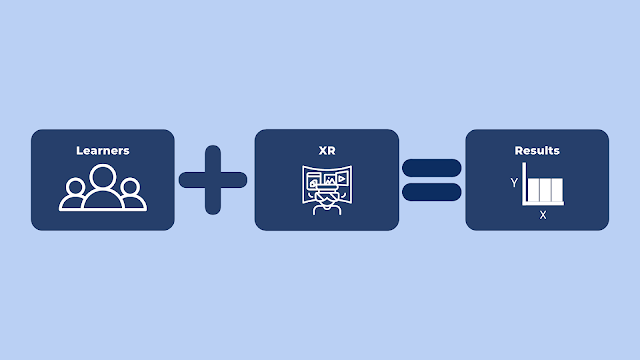
This is the same experimental model as it appears in educational research.
We have our learners, we add a technology, and we measure the results.
And it’s not like we just started this research.
For the purposes of this video, I’ll go back just over 100 years and use the word technology to mean anything powered by electricity.
For example, Radio
And here are the results: no lasting improvement.
Projectors – no lasting improvement
Television – no lasting improvement
Computers – no lasting improvement
Internet – no lasting improvement
and in the future, cloud-based learning by robots or whatever.
But in all seriousness, this video is about XR, extended reality, cross-reality, mixed reality or whatever you want to call it.
.png)
Now RIGHT HERE, some will become upset. They say:
But this is different!
This is learning in 3D!
No, you don’t understand, this is a computer stuck to your face!
We need to implement it correctly and THEN we’ll see the results!
I have a study right here that shows it better when putting VR up against a textbook or a human teacher!
OK for that last one, I toss that right out as non-comparable methods, but that’s a topic for another day.
So let’s look at the results, shall we?
No improvement.
Now for those that are hearing me right now having a really hard time taking this in, I understand that this is not fitting into your schema. What you are feeling is bias. You want the results to be a certain way, and even when the results are not turning out the way you want them to, you want to reject all of the previous results as not predicting what will happen next. Remember that bias, in research, is a bad thing. We don’t want it. So I need to ask you to check your bias and leave it behind.
I’ll give you an example that should be in the recent memory of XR enthusiasts. I’ll use 2022 words to explain a 2022 real world example.
How many studies do we hear of right now that show a spectacular increase in learning with a smartphone (mobile)?
How many times do we hear from learners that they love learning on their smartphone? “Oh it’s so cool!” “Oh it’s the best!” Oh I love that I can learn from a computer in my pocket! Oh, I love that I can learn on this tiny screen!”
~ Oh I love that I’m
being forced to do my workplace learning on my own device (that I paid
for, pay for the internet subscription for, and pay the insurance on, to
say nothing of being tracked by my workplace VIA my own phone!
What’s that?
No one says this?
You’re right.
Why?
Said another way, smartphones are ubiquitous. Actually if you listen closely, there is a STRONG amount of conversation about how learning on the smartphone is boring, forced, poorly designed and/or at least equivalent to learning in the classroom—thanks to COVID and 2020.
So learning on a smartphone is ubiquitous. The learning results have flat-lined.
I’ve made my case that history predicts that XR will also flat-line after it has become ubiquitous.
But….why?
We still didn’t answer that.
I have 2 reasons. One I’ll share, the other, not yet.
Let’s go back and look at that experiment model again.
We said that every technological improvement has proved to produce zero overall learning gains. Learners are simply NOT DOING BETTER.
We can slip in and out all of these technologies and we keep getting goose egg results, nothing. But…look closely at the model. What other variables are there?
We said that technology was a variable and our proposed independent variable– we are purposely changing it).
The results are the dependent variable – they are the output, the effect, or the result of what we are changing and frustratingly, they are NOT CHANGING.
So what else is there?
Look. One more variable is present…
The learners!
Matching my technology examples: 1920s learners
1940s learners
1960s learners
1980s learners
Learners from the year 2000
2010 learners
I mean, everyone knows that 1920s learners were dumb, right? I mean…
Oh, you mean the time when Einstein discovered his E = mc(squared) hypothesis? We were dumb?
1940s? The start of the discovery of the polio vaccine? Saving thousands if not millions of future lives?
We were dumb then?
1960s? Early computers being built? Remember…going to the moon?
1980s? Well no comment from me, I’m from there.
Many smart well-respected people that I acknowledge, say it is a mistake to assume that older generations were not, at least, as smart as us, and in some ways, we can find evidence that they excelled (for example, try learning entirely by oral tradition, no shared writing, READ: no books).
So we can’t say that those learners, educators, and leaders were dumb. They were trying to implement the latest, greatest technology in the best way and certainly there’s been plenty of time to try MANY iterations of the technology. For example, radio for adult learning, radio for kids,
radio for cows. Heh heh, just kidding about the cows, let’s leave them out of this.
~I included cows because there is some research already about there about putting VR headsets on cows and I’m totally befuddled by that. I’m like “Why? Just stop it.”
But the humans are there.
The humans are the same.
I’ll repeat that for emphasis.
The humans are the same.
So we have experiment after experiment; we change out the technology thinking THAT will cause changes in the learning. But the results come out the same.
Could it be the OTHER variable– the humans – causing the non-increase in learning?
I posit, yes it is.
Brain-based learning science (OK, use the word neuroscience if that makes you more comfortable) gives this as it’s prediction.
The humans are the cause of why the learning results are always turning out the same, flat-lining, goose egg in improvements. Humans seem to have a “speed limit” when it comes to learning. We all have it. We can’t break past it. (Why? that’s my second shhhhhhh reason.)
So that’s why I’m so confident that XR will not cause lasting improvements in education.
As long as we are using humans as our test subjects, the results will peg even.
To be clear, I’m all for the improvements in AFFORDANCES that VR will bring; for example, safely learning inside a VR volcano, or added safety information with XR glasses. But those will not cause an overall lasting improvement because eventually everyone should be able to learn inside of a VR volcano or with XR glasses at work. Eventually, VR will be ubiquitous and not…
not the domain of the rich kids.


Photo by Birmingham Museums Trust on Unsplash
Within the same morning, I had scanned The Total Economic Impact™ Of Mixed Reality Using Microsoft HoloLens 2, A Forrester Total Economic Impact Study Commission by Microsoft, headlined by the Senior Mixed Reality Specialist at Microsoft. I found the numbers inside dismal and took screen captures of the most egregious numbers so that I would not forget what jumped out as the most ludicrous (60% increase in efficiency in learning as an verbal report given in interviews by interviewees selected by Microsoft).

I also had been invited to a group that will “build a community of practice around applications of learning experience design in XR modalities.” But I had watched this community do a series in 2021 where they picked individual pieces of research and tried to derive principles for design in XR. I gave them feedback for the first 3 days. They kept hand-picking research and trying to establish large principles.
Err, that’s ethically wrong.
Plus, when I pointed out that some pieces of research– while fine as independent pieces of research, could not be applied broadly because of problems like cognitive load, comparative design, sample size, novelty effect etc. they would give me the hand wave response of “Oh yes, we saw that” but they never retracted or stepped back from the total theme and they had the ability to.
So….
I don’t see much hope there.
Therefore, I was in a pit of despair. Everyone around me is in some sort of technology-haze thinking it will solve all of their problems. Come to think of it, much of the field of instructional design for the past 18 months has been soaking in a technology tools fantasy. And yet, not a word about learning gains. Funny, that.