Instructional Design in the Metaverse Part 7 Design and Build
Heading out with purpose, emotion, and awareness of real world. At this point, we have all of the…

XR, Instructional Design, and remote team leadership


Welcome to Part 6! Are you alive? By my calculation, when this goes live, 3 intrepid souls have read all of Parts 1-5 before this. (Insert laughter with tears). Indeed, you may have found this in isolation of the other parts! That’s OK, I’m cool with modularization. Feel free to “go around the Horn” at some other point in the future and read Parts 1-5 later.
Oh! And, for those 3 travelers AND everyone else, I am making an explainer video of all of this content. But it comes with 2 caveats:
No references or quotes. Just ideas.
Because it moves with a preset piece of music, each idea will have a limited amount of screen time: 2.4 seconds, to be precise.
Finally, I’ll probably write a full BTS (Behind The Scenes) on this article series on my blog. For those of you that love BTS content, that one will be for you. Translation: these articles were NOT written to be sound-bite worthy. What I write in the BTS will be.
This is basically the second of two parts that were originally together: Part 5 is what is the SAME about designing between 2D and 3D and this is what is different.
Long story short?
Here is where the fun begins.

A learner could learn from a book how to enter a store and buy something. A learner could also learn from entering a real store and buying something. Both are ways to complete the learning, but the designs– that is, how to structure the learning from start to finish, will be different. The book is analogous to direct instruction. There are times when direct instruction will be the better approach. The real store is analogous to experiential learning. There are times when experiential learning will be the better approach. The approaches are different; there is no inherently better approach for all situations.
These elements in this section are not meant to imply that they exclusively belong to XR media. That is, many other forms of media contain these same elements. These items are listed here because they are often found within and indeed are combined in design solutions in XR.
Clark and Mayer observed that humans are sense makers and attempt to derive meaning from life experiences (2016). Learners engage in making meaningful connections when words and pictures align during experiences. Meaning is also deeply embedded in the storytelling approach, where it is often the journey that the protagonist goes through that remains memorable long after a story has ended. D. Clark argued, “learning experiences are exactly that, experiences designed to change us, specifically our long term memories” (2022, p. 7). Further, D. Clark advocated for a balanced use of storytelling, explaining that it can bring life to dry information, but should not be overused and wander into a “Disneyfication of learning as entertainment” (2022, p. 7). Lastly, D. Clark argued that stories for learning should be designed as “always beginnings, never ends-in-themselves” if the learning is to be applicable beyond the experience, into the “long tail of practice, transfer, and performance” (2022, p. 7).
Points for poetry, D. Clark!
“always beginnings, never ends-in-themselves”

Indeed, the storytelling approach in learning pulls the learner through the experience. To use storytelling, the learner should experience a flow through their experience, a beginning and middle of the story. The end could happen in XR or more substantially outside of XR into desired application. The learning experience should be planned and not haphazard. Learners should be guided on a planned route. XR storytelling can be first person or group experiences. Regardless, each learner is a protagonist; their decisions determine what they will experience. Recalling the constructivist learning theory foundation, what the learners experience becomes the learning experience that is being designed for. If learners are exposed to situations where they actively construct their knowledge, then the reality that the learners construct was constructed by them, not constructed by the media or by others. Further, learners do not arrive as empty vessels to be passively filled with information if they are the protagonists of their own learning event. Learners add, sort, emphasize, or suppress new experiences when compared to old experiences. Subsequently, a learner already experienced in real life (non-XR) is bringing those experiences into XR with them. In summary, learners arrive already ready to experience a story. Thus, narrative plot or a story arc is a good approach to XR instructional design.
Plot, narrative, or narrative plot are all descriptions of phases within storytelling. There are slight variances in names but the phases generally focus on the user’s (or in our case, the learner’s) experience (Lichaw, 2016).

These phases describe what is happening to the protagonist. In the case of XR, the learner is the star and they should be brought through these phases in an effective design plan. Table 1 compares a storytelling arc with the Pixar story arc, a story arc example of Cinderella, an XR story arc, and an XR narrative plot example.
.png)
Pixar story arc from Khan Academy. (2017). Pixar in a box: Introduction to storytelling [Video]. YouTube. https://youtu.be/1rMnzNZkIX0 Cinderella story arc derived from Kurt Vonnegut, as documented by Derek Sivers. (2009, September 1). https://sive.rs/drama
Introduction. The who, what, where, why, when of the experience is explained. The scene opens. This starts before the digital experience begins and lasts 30 seconds to a few minutes into the experience, depending on how much needs to be explained. This is the beginning of the exposition.
Set the scene. Provide guidance on the affordances within the experience, how to communicate, walk, navigate, where is help (e.g. where is a digital companion). The learner is invited to move, change appearance, and communicate.
Dilemma. Introduce the conflict or the scenario that the learner will participate in. The learner is presented with a challenge or problem. This is the inciting incident and rising action phases. This can be a great time to guide and practice small solutions to small problems.
Crisis. The learner must act and initiate some sort of change. It is action-oriented, and the learner is on center stage.
Change or Denouement. The results of the change have an impact on consequences or the environment. Said another way, the change ripples through the experience to change it for the learner. The results are non-trivial and not haphazard.
Resolution or End. The mission is complete, and the world has changed around the learner. The learner is living out the consequences of their decision.
Some research has shown that most of the instructional emphasis does not need to be within the XR experience itself. Dede (2021), when reflecting on what he now believes after over five decades of immersive learning research, said:
“I used to believe that if you had resources, you should spend 95% of the resources on the immersive experience and then you just do a little thinking about what kind of induction you use before people go into immersion and what kind of post experience debriefing you do. I’ve come to believe now that the induction and debriefing is where the learning takes place predominantly, and so designing those is very important.”
This indicates the importance of the on-boarding and the follow up experiences. The story of an experience begins before something is activated and ends long after.
The main point of keeping a narrative plot mindset in ID XR design is to keep the learner at the center of the experience. Every step of the narrative plot approach focuses on what the protagonist- that is, the learner- experiences: dilemmas, crisis, change, etc. This approach, then, keeps the ID focused on the learner’s experience, not the technology. For example, let’s say a platform can recreate the school environment down to the desks and chairs. An ID might reason, ‘This a great place to hold a class! I can assign classes to virtual rooms and the instructor can use web-sharing boards.’

Don’t try this in VR
That approach puts the technology first and does not consider the learner. It also recreates the problems of regular in-person classrooms and throws in a few more virtual problems as well (i.e., poor internet connections might have avatars distractedly appearing and disappearing). Rather, a learner-centric approach might ask “What is the main experience or emotion that the instructor wants the learners to have in this lesson?” As Mayer stated, “How can we adapt multimedia technology to aid human cognition?” (2020, p. 15). This might cause the ID to look at the entire XR event differently and not recommend a virtual classroom. There is more on emotion in design in Section 5.2.
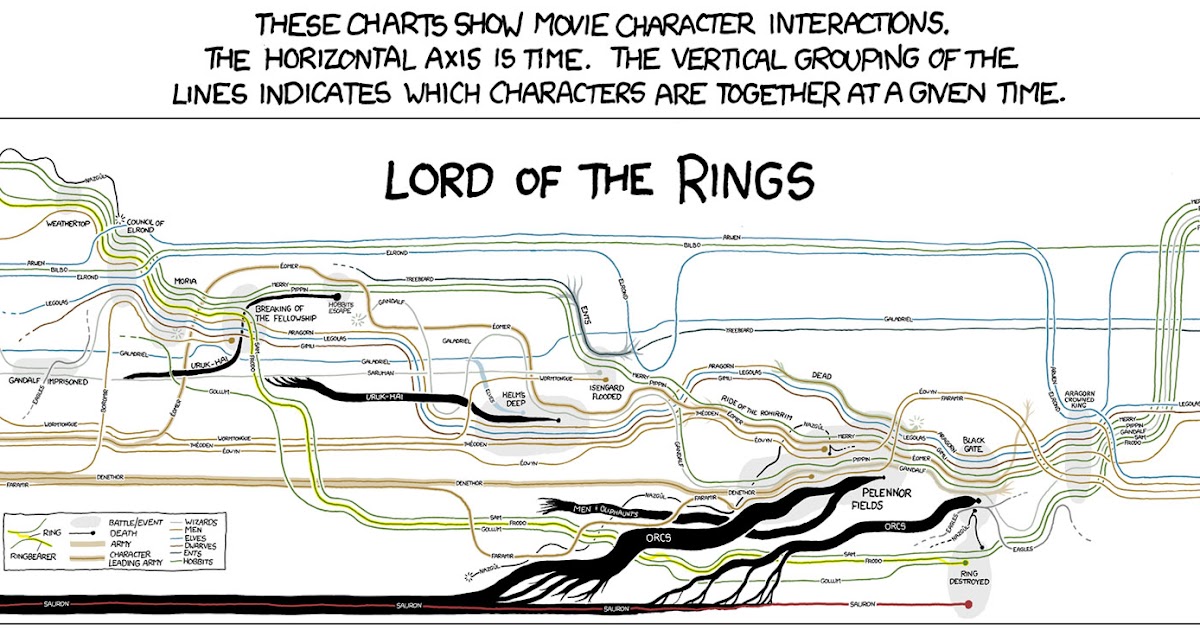
Credit: https://fbvisualisation.blogspot.com/2014/04/narrative-charts-tell-tale.html
For the ID, the added visual depth and sound possibilities beyond 2D must be designed. However, more to design means more risk. With XR, the added ability to put information anywhere has more risk of overwhelming the learner than helping the learner. Indeed, D. Clark (2022) agrees that Mayer’s Principles lean towards less is more.
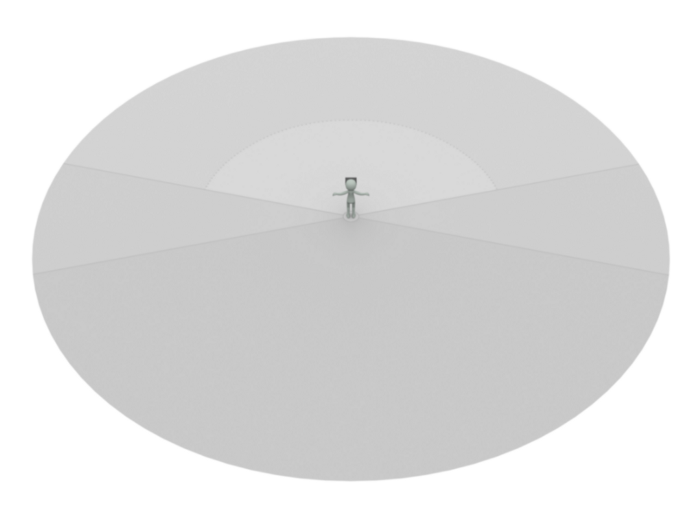
Alger (2015) noted these basic principles for visual range called the Comfortable Content Zone: 77 degrees of viewing range side to side and a range of 0.5 to 20 meters in depth. There are Periphery Zones to the sides and above, but the learner should be only prompted to use those.

Credit: Alger, 2015
This reflects real life. If one was working at a workstation, critical information would be within easy viewing and reach. Other information could be available in what Alger calls the Curiosity Zone – behind and below the learner, but learners should be prompted, as in real life, by sound, light, or foreknowledge, to engage with that non-obvious space (2015).
Alger (2015) further proposes that the visual hierarchy matches the importance of information. To find information in 3D, we look at the center ahead first, then left and right, then below, then above, then finally at our own bodies. Everything above eye level is for things beyond the learner’s control like weather, time, or authority notifications. Everything at or below eye level is within the learner’s control.
.gif)
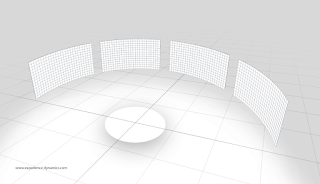
These user interface principles skew towards conservatism in detail; less is better. IDs should design minimal spaces, with prompts, and within easy arm reach. IDs can create storyboards with isomorphic qualities that both curve around the learner and contain planning space for the foreground, mid-ground, and background visuals.


Immersive sound is a rising field within XR design. Poor sound can ruin an XR experience. Experiences can have spatial sound where the loudness drops off over virtual distance or flat sound where the loudness is the same throughout the entire space. As much as possible, it is good accessible practice that all senses should have learner controls: brightness, sound, movement, and intensity.
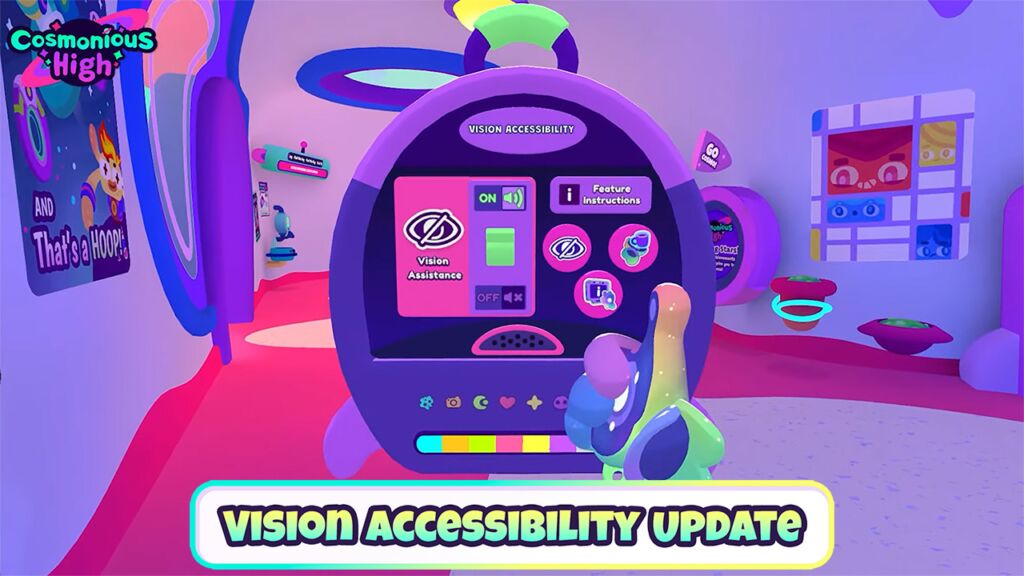
Many platforms and experiences already contain volume controls for separate parts of the experience (e.g., voice chat, environment, or notifications all have separate volume controls). Learners should be trained on these controls at on-boarding.

Generally, for information that is necessary for the learning event:
If the information is in speech, provide text equivalents (e.g., transcript).
If the information is in sound (environmental sounds or notifications), it should have equivalent visual and/or text indicators.
If the information is in text only, provide sound equivalents.
Interactions in XR could be reaching, grabbing, and moving. Good experimental research exists from organizations like IEEE VR or ACM IUI on 3D user interface recommendations. Alger’s (2015) design advice showed a seated avatar seated work will be more comfortable than standing in XR.

Credit: Alger, 2015
Almost every new XR user has walked their avatar into a wall. It happens.

You stay in that corner until you can act like a good avatar, Peter!
Given that the wall isn’t real, mistakes like this are forgiven quickly. IDs can ask learners to move.
(And Peter knew I took his picture at this moment above.)
Movement in XR is an advantage of the metaverse. While research does not indicate that movement causes learning, it can greatly assist in the storytelling aspect of bringing a learner through an experience by requesting that the avatar move through the story in virtual space time.
Movement is relative in this media. Frame of reference can be manipulated. The avatar can move, or the avatar can stay in one place and the scenes can move or change around them. There are a LOT of choices for movement in XR. From gaming research, it looks like most of the possibilities are aiming to reduce vestibular mismatch.
In this area, movement-based engagement can be an area of exploration in designs. For example, asking learners to move to one side of the room or another is an interesting way to run a poll. XR movement often includes dancing and flying. Future research should explore the use of controllers or hand detection for learning.
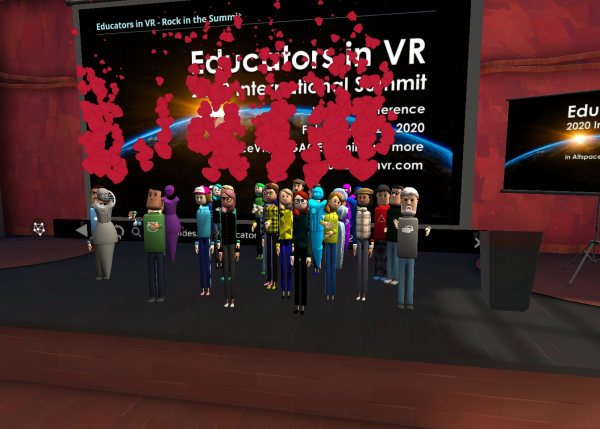
Many social XR platforms have incorporated emojis and they can be used for their apparent reasons: love, happy, sad, clapping, or raised hand. Within designs, learners can use them differently, that is for feedback, poll indicators, or silent ‘I need help’ indicators. Learners have been known to redefine emojis to mean whatever makes sense to them during a learning event.
Part 7 will cover designing and building XR experiences for learning. See you there!

Welcome to Part 4 of this series that proposes instructional design principles for the metaverse. Hopefully, you’ve read Parts 1 – 3 because we need to remember this:
Learning outcomes are expected to be equal to other media.
So what are the characteristics that predict success for an educational experience? Read on.
By the time IDs are often introduced to learning projects, the decision to incorporate XR technologies might already be made. Yet, IDs might be tasked with evaluating choices for off-the-shelf XR experiences or do-it-yourself (DIY) projects. Both choices have possibilities and limits and this part will point out what characteristics predict that an XR solution should work for a given implementation.
IDs should complete a thorough market analysis for off-the-shelf experiences. However, learning standards and ratings have not moved from early research to implementation (Dreimane, 2020). Thus, the experiences vary in quality with some being quite poor.

On the other hand, XR experiences not tagged as educational can be successfully used for learning with careful implementation.
In a DIY project, IDs could be asked to learn 3D programming, such as Unity or Unreal. Artificial intelligence (AI) is beginning to be used for 3D development and this could assist IDs. If IDs do engage primarily in programming and building assets, there is a risk that they will take their eyes off the goal of representing the learner. An ID should be constantly asking the question,“what is the learner experiencing?” and making sure that all decisions align to the planned purpose.
In general, the research up to this point indicates these three characteristics predict a successful XR educational experience:
it saves or manipulates time
it saves money
it reduces danger (Bailenson, 2018; Ziker, Truman, & Dodds, 2021).
While having one of these characteristics is good for continuing development, having two or all three characteristics can lead to very successful full implementation. For example, an XR experience for wind turbine maintenance training would currently save time, money, and danger.

Have all three regularly and you tend to be NASA. https://accessmars.withgoogle.com/

XR experiences can manipulate time for instruction. For instance, an experience could involve time travel, speeding up, slowing down, or pausing time.

[Editor Heather interjects: the River City Multi User Virtual Environment (MUVE) is a great example of time manipulation. Learners had to determine the cause of 3 diseases in a city on a river. This built pedagogically went where learners often struggle: determining cause in a multi-variable (READ: REAL WORLD, messy, wicked) system. The build could pause or speed up time–very helpful while waiting for bacteria to grow.
With time paused in the middle of a process, visual cues can add positively to the instruction (Clark & Mayer, 2016).

XR experiences can also reduce instructional time overall because the training can be delivered more efficiently to the learners. For example, workplace training that has been preloaded onto VR headsets can be shipped to remote workers, saving travel time.

IDs should be aware that with this characteristic, many 2D simulations can do the same time manipulation and savings for possibly lower costs.
XR experiences can save money over other forms of learning. For example, it would cost a lot of money to take your learners to the Moon in real life. In XR, space travel is much cheaper.

Those unfamiliar with development trends might comment that the metaverse is not currently cheaper than other media. As of this writing, costs are dropping [Editor Heather reminds you that 1 of the 2 things I actually liked about the PwC study was the calculation that if you make a build for more than 3,000 users, it will be cheaper overall to do in XR versus e-learning] with the arrival of artificial-intelligence (AI) developed resources.
Immersive web (WebXR) options allow approximately 20 learners to join one virtual space with a web browser, no additional equipment. Development prices do rise with more complexity.
One final note: the ‘time is money’ statement does hold true here. Often, an XR experience that saves time also saves money.
This characteristic, the metaverse reduces danger, also includes impossible activities. While Alger (2015) properly suggested that any content that was inherently 3D in the first place is ideal for XR development, XR is not limited to the real and actual. It can expand to the phantasmagorical and impossible. For instance, taking learners to look inside of an operating nuclear reactor would be dangerous in real life. This can be replicated in XR with no added danger for the learners.

IDs should remember that some environments in the metaverse can still represent psychological risk if not real danger. In the Proteus Effect, learners could change their behavior depending on what their avatar is experiencing (Praetorius, & Görlich, 2020). As a result, a learner’s avatar walking into fire might be a frightening experience even if it is physically safe. Examples of risks include claustrophobia, fear of heights, hostility, prejudices, and negative social pressures.
In all cases, IDs should keep the learner primarily in mind. If it scares a learner and it was not meant to, it should be removed from the design.

.png)
Credit: Midjourney and Me. Prompt: retrofuturistic city, monorails, glowing lights, nighttime, blue and green color scheme, mysterious –style raw –ar 16:9
This conceptual series proposes instructional design principles
for the metaverse. You’ve arrived at Part 2 where I cover theory,
application, and scope.
If you are a theory nerd like me, you’ll love this part. If not, hang on to your butts.
Metaverse educational experiences, as replications of known reality, can draw from every major learning theory already in existence because metaverse experiences are often copies of the real world. Checa and Bustillo
asserted that constructivism, behaviorism, cognitivism, and
connectivism can be foundations for a wide variety of XR pedagogical
approaches (2023). However, the specific affordances of presence and
embodiment in the metaverse indicate that existing approaches that
include simulations and experiential learning are applicable (Checa
& Bustillo, 2023; Johnson-Glenberg, 2018; Reigeluth, & Carr-Chellman, 2009). Specifically, cognitivism and constructivism theories are often cited for the metaverse.
On the other hand, there is new research calling for more
nuanced theories that reflect the social and learner-centered
environments in the metaverse, e.g. connectivism or complexity theory
(Checa & Bustillo, 2023; Schmidt & Glaser, 2021).
Cognitivism and constructivism will be expanded upon here as they
relate to research and application, beginning with cognitivism.
Cognitive learning theory historically reflects the strong
influence from the computer science discipline wherein XR applications
are understood as input/output platforms controlled by programming.
Learner experiences are transactional and computational. A learner is
faced with a choice, they take that choice, and the program reacts. As
such, the experiences appear to have a cause-and-effect flow with
computers and learners both mediating the processing. For instructional
designers specifically, a deeper understanding of the cognitive theory
of multimedia learning, where visuals and audio have been studied with
respect to learning, is required to apply the advice within Section 4 of
this series.
Theories begin with a set of assumptions based on observation. Mayer’s (2020) cognitive theory of multimedia design has three critical assumptions:
Based on those assumptions, the cognitive theory of multimedia design focuses on the human processing system.
 Mayer’s Cognitive Theory of Multimedia Design (2014 edition)
There are two input channels (eyes and ears) where words and
pictures enter sensory memory, then processing through working memory
where sounds and images may interchange and conflict, finally moving to
long term memory where information is integrated into prior knowledge.
Words can be sensed by both eyes and ears. Selecting which words to
focus on can cause conflict because the brain converts words to sounds
inside of processing. This increases cognitive workload if an external
voice is speaking while the learner’s internal voice is reading. This
theory is relevant in that immersive experiences can provide words,
voices, and graphics which, when simultaneously present
in working memory, can increase cognitive workload, making long-term
learning difficult. Because XR can provide an immersive environment of
words, text, and sound surrounding learners, the risk is high that
learners could be exposed to these cognitive conflicts. Section 4 will
explore these pitfalls and how to avoid them. I will look briefly at
constructivism next.
Constructivist learning theory postulates that learners
construct their knowledge through experience; learners do not arrive as
blank slates. With a wide variety of possibilities of the metaverse, IDs
can think that constructivism represents a constantly growing approach
to learning – learners could even create objects in 3D to construct
their knowledge. However, a closer examination of this theory is
required. In constructivism, new knowledge is connected to older
knowledge in a way similar to the act of construction, just as boards
are attached one upon another to build up a building. For IDs,
constructivist theory appears both while designing step-wise learning
experiences and in knowing that learners arrive in XR with preconceptions from prior experiences
(Checa & Bustillo, 2023). It is in these preconceptions that
learners will recognize and begin to process the experience. For
example, if a learner arrives in an office building XR environment, they
may begin to process the experience as work training. In this way, the
learner might not need to be prompted that work behaviors are expected.
It is important to note that both of these theories keep the learner, not the technology, primarily in mind
when thinking of how learning will occur. Drawing from the indicated
research, two further assumptions are held in this series and will be
treated as givens:
Understanding how theory informs daily practice and design
requires some finesse as rarely does an ID wake up and say, “I’m going
to design pure cognitivist lessons today.”
Instead, theory provides the guide when the ID is facing a decision where the better path is not apparent.
Theories offer “guidelines on motivations, learning processes
and learning outcomes for the learners” (Checa & Bustillo, 2023,
p.5). A theory can point to methods, approaches, and strategies. Indeed,
the mistake of not drawing upon a learning theory that is apparent in
earlier research should not be repeated (Beck, Morgado, & O’Shea, 2023; Checa & Bustillo, 2023; Fowler, 2015).
Overall, this series lands squarely within Pasteur’s Quadrant, contributing to both fundamental and practical applications (Shi & Evans, 2023).

Pasteur’s Quadrant: The type of research that quests for fundamental
understanding AND can be used every day, like pasteurization. This
article series lands in that sweet spot.
This series is fundamental because it draws primarily from the
cognitive theory of multimedia design and it examines research designs
and results. It is practical in that it provides many examples based on
the author’s XR design experiences. (You’ll see, it’s coming in a
future Part.) As Mayer suggested, this type of approach is “basic
research in applied situations” (2020, p. 22). Pasteur’s Quadrant lends
light on exploratory topics. In this case, I have some basic theory from
2D learning, but there is much more 3D nuance unknown. Progress in this
field will require that theory and applied research move forward hand
in hand.
Fortunately, being in Pasteur’s quadrant provides hints at
further unanswered puzzles beyond this series. For example, what is the
connection between the popular XR game emotional coinage of fear and
successful XR applications for the training of the emergency services:
fire, police, military, and medical personnel? The answer to that quest
will wait for another day. Before I begin an examination of research
myths (upcoming Part 3), I need to explain what can and cannot be
covered in a series of this breadth.
This series leaves many topics by the wayside: defining the
metaverse in education, qualifying and categorizing experiences,
affordances and constraints, and accessibility options. Doubtless, each
of those topics deserves a series of its own [note to self] but there is
no space to address them here. This series does provide insight into
four areas:
The specific research gap that this series addresses is the
missing connection between known design principles and practical
applications of ID in the metaverse. Makransky
commented on the lack of connection between the cognitive theory of
multimedia design and instructional design in virtual reality, stating
that “research that has investigated instructional design implications
in immersive learning environments is severely limited” (2023, p. 5).
Beck, Morgado, and O’Shea surveyed that “mostly papers discuss
opportunities and challenges or compare outcomes, rather than expose
details on educational practices or strategies” (2023, p. 2). Reigeluth
and Honebein suggested that research-to-prove should be replaced with
research-to-improve when a technology is in its early developmental
stage (2023). Such research should limit itself to suggesting “possible
ideas for actions and improvement” (Reigeluth & Honebein, 2023, p. 2). Finally, the emergent use of XR technology has precipitated haphazard designs lacking guidance:
“In these early days, trial and error plays an outsized role in
design. Education researchers borrow heavily from the entertainment
designers, who focus on engagement, and not necessarily on retention of
content. The dearth of studies highlights the urgency for a set of
guidelines for designing content that allows users to make appropriate
choices in a spherical space.” (Johnson-Glenberg, 2018, p. 7).
It is hoped that this series lends to two facets of instructional design. First, the thinking side of design, when a designer must choose one approach or another. This series strives to give the best advice. Second, the implementing
side of design where designers arrive directly into the metaverse to
see what their learners will experience. This series, then, points the
way.
Part 3 will approach research myths surrounding the metaverse in
education.
.png)


Credit: Me and Midjourney
My first article in this series garnered so much attention! But many folks tried to pass me Mirjam Neelen & Paul A. Kirschner’s Truth or Truthiness? Analysing a VR Study Using Gorard’s Sieve article on the PwC report entitled “The effectiveness of virtual reality soft skills training in the enterprise: a study” and all of its associated webpages like this one. I was like, I know! Mirjam & Paul wrote their article 2020 and I wrote about it in 2021. What’s cool is that separately, we both came to the same conclusions. That’s a good sign for our conclusions!
Short version: we both cast strong doubt on any conclusions.
Still, I realize the world does not revolve around me (sigh!). Some folks might have missed my long stream-of-consciousnesses article about the PwC report. I decided that the second article in this series should be an abbreviated and updated critique. Bear in mind that to reach the LinkedIn audience, I have to leave much nuance by the side of the road. If you have questions, just ask!
As Mario says “Here we go!”
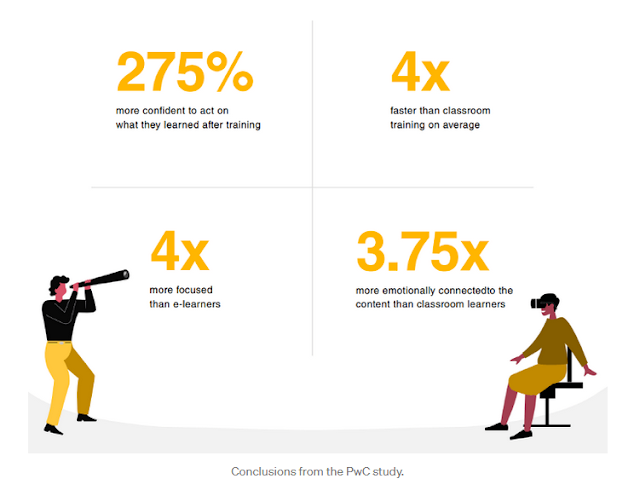
This infographic summarizes the dominant conclusions:


What do these Google results have in common?
They are all companies that sell some sort of VR product or service.
Because I was curious, I checked out that vrowl dot io link (“Virtual Reality training is not effective”) just to see if it was presenting an alternate opinion. It’s a strawman argument; it puts up “not really real” protests against VR for learning and then explains them away. I’m telling ya, Beware the VR Strawman.
Eckert, D., & Mower, A. (2020). The effectiveness of virtual reality soft skills training in the enterprise: a study. https://www.pwc.com/us/en/services/consulting/technology/emerging-technology/assets/pwc-understanding-the-effectiveness-of-soft-skills-training-in-the-enterprise-a-study.pdf
Let’s ask Google Scholar what it thinks. It’s coming up with 11 cites. That’s not much at all. But as I showed above, the money shot is on the Internet, not in academic articles.
Truly, the 4x faster learning quote is the runaway train of this report.