Tag: Research

  • From Myths to Principles: Part 8 Ethical Labyrinths, Interpreting Research

    From Myths to Principles: Part 8 Ethical Labyrinths, Interpreting Research

    Ethics, as a set of rules of practice, is something that instructional designers deal with on a daily basis in the form of assuring learner privacy, coursework security, instructor authorship and institutional ownership (Moore, 2021). These topics are recognizable within instructional designers’ professional work lives. However, many instructional design models like ADDIE, Backwards Design, and ASSURE do not include any acknowledgment of possible ethical concerns (Warren et al., 2023). As such, instructional designers might not recognize some ethical decisions which are a critical part of their professional job (Moore, 2021). Within immersive environments, the stakes are higher as learners are primed to experience environments far beyond a classroom or home.

    A scoping review of relevant research topics for immersive environments that covered access, content production, and deployment does not mention ethics (Gaspar et al., 2018). However, research on ethics in immersive educational environments is beginning to appear (Moore, 2021; Glaser & Moore, 2023; Zallio & Clarkson, 2022). Zallio, Huang, Osaki, Hong, Chang, Liu, and Ohashi (2024) completed a review of ethical issues in VR and AR technologies and found 15 different and broad ethical concerns including the dichotomy between the virtual and the real world (for example, abuse in immersive experiences), concerns related to user safety (for example, sensory overload) and the ethical concerns of people who surround immersive headset users (for example, caregivers). This series will look at some areas where instructional designers can exert influence even after the decision to incorporate immersive experiences has been made.

    Interpreting research

    Relying on what the research portrays on the surface does not fully illuminate what is happening within the immersive experiences. Research results were at the core of the myths illuminated earlier in this series. What might be a kernel of truth could be turned into a claim that immersive experiences will revolutionize education.

    Instructional designers can conduct literature reviews and quickly review research paper abstracts for studies that are similar to the situation being considered. R. C. Clark and Mayer (2016) summarized how to examine research claims for e-learning, but these questions equally apply to sorting for immersive experience research.

    1. “Are the methods, content, learners, and context like yours?


    2. Does the experimental group outscore the control at a significance

      level of p < .05?


    3. Does the effect size favor the experimental group at a 0.5 level or

      higher? (p. 63)


    Despite experimental results that tout learning success in immersive experiences, those results might not apply to another situation due to different variables, effect size, and other appropriate measures. Readers of research need to become adept at identifying effect sizes, immersion times, and the presence of comparison groups. In summary, “as a consumer of experimental research, you need to be picky” (R. C. Clark & Mayer, 2016, p. 56)

    Disney's Inside Out character Disgust, posing with a nonchalant look

    Disgust embodies ‘you need to be picky’

    When reviewing research, the reader may sleuth for two primary problems that might appear in immersive experience studies: the presence of novelty effect and the bane of media comparisons.


    Novelty effect


    This series defines novelty effect as the phenomena when learners are exposed to something new during instruction and the new treatment causes increased motivation, excitement, and effort. There is usually a corresponding learning gain from the increased attention (Lodico et al., 2010). R. E. Clark and Craig (1992) succinctly refer to the novelty effect as the “attitude advantage” (p. 9). Novelty effect can be suspected within a research design when the learners are exposed to a media with which they are not familiar and the learners’ time within the experience is limited. The presence of the novelty effect is generally a negative threat to external validity of a study; the study results cannot necessarily be generalized to be true for other populations.

    Certainly, an educator might be buoyed up by the illusory increase from incorporating immersive experiences. Just as motivation increases, however, it can also decrease. When the newness of the technology wears off, the learning gains tend to equilibrate to be comparable with other media choices (Clark & Craig, 1992).

    It is valid to ponder how long the novelty effect can be expected to last with immersive experience. The answer is it depends. Novelty effect is unique to each learner. Some learners might personally use immersive headsets outside of learning environments and the novelty of the experience will end sooner for them. At the time of this series’s writing, headsets and immersive learning environments are not ubiquitous, so the novelty effect can be expected for some time into the future.


    Decorative image comparing two cars that appear to be the same model; one care is very run down and dirty, the other car is new looking and stylish.

    Media comparison studies

    Much research about immersive experiences for learning has focused on the hardware and the learners’ reaction to it in the form of
    comparison studies (Glaser & Moore, 2023; Stefan et al., 2023). Studies often measure learning gains and do not give balanced
    consideration of the constraints of time, money, space, and connectivity that might have been present (McGivney, 2023). Indeed, media comparison studies are a debatable topic in instructional design. We must look at the root of the problem

    With the arrival of personal computers into education in the early 1980s, a debate arose of what causes the ideal conditions of learning: the media (which at this time was the personal computer) or the method (which is the approach taken to conduct the learning). R. E. Clark’s initial salvo in 1983, drawing on what was then already decades of empirical research, asserted that,


    There are no learning benefits to be gained from employing any
    specific medium to deliver instruction. Research showing performance
    or time-saving gains from one or another medium are shown to be
    vulnerable to compelling rival hypotheses concerning the uncontrolled
    effects of instructional method and novelty. (p. 445)

    With this, R. E. Clark called the media emperor naked. He pointed at two possible causes of learning gains seen in media comparison studies: the novelty effect (which was covered in the last section) and uncontrolled instructional methods. This latter item is when two different media experiences are pitted against each other to determine which is better. The problem is that use of different media often requires correspondingly different instructional methods. Thus, if something is taught differently, any differences cannot be the result of the media’s impact alone. The learning accomplished between the two media can be very different.

    An example of a poor media comparison would be when learners in an immersive experience are compared to learners in paper and pencil-based learning. The results of a comparison like this should be discounted due to the varying cognitive impact that the different instructional methods have on the learner (Parong & Mayer, 2021). In another example, a control group was exposed to the standard training and an experimental group was exposed to VR training in addition to and after the standard training (Seymour, et al., 2002). The VR group scored higher. The extra training time with the content could have caused higher scores, not the media. The two media conditions of one with and one without immersive experiences were not comparable. 

    Honebein and Reigeluth (2020) refer to media comparison studies as “a good guys versus bad guys competition” (p. 6). The comparison scenario has been repeated between many media. But R. E. Clark doubled down on this claim against media comparison studies in 1994 by making the “replaceability challenge” wherein he asked “whether there are other media or another set of media attributes that would yield similar learning gains” (p. 21). The research record since 1994 has supported R. E. Clark’s stance, now referred to at times as the no significant difference phenomena with media.

    Honebein and Reigeluth (2020) contended that the entire research-to-prove approach, striving to prove which media is better, needs to be replaced with a research-to-improve approach acknowledging the complexity and systemic components for each individual situation. Instructional designers can draw from this research-to-improve idea by advocating for the specific affordances that immersive experiences media might bring that stand separate from learning gains. More discussion of those affordances will be mentioned within the future directions section of this series.


    You do plan to have some learning theory in your learning experience, right?

    Missing design theories and models

    The design work for immersive experiences in education is complex. To design for the highest possible chance of learning, there should be instructional models or beacons for developers and designers to follow. Immersive experiences, as replications of real world experiences, could reasonably utilize any major learning theory. Radianti et al. (2020) reported that in their review of immersive virtual reality applications, 68% of studies did not mention a learning theory. Most papers focused on XR usability and did not connect theory with use. Checa and Bustillo (2023) asserted that constructivism, behaviorism, cognitivism, and connectivism can be foundations for a wide variety of immersive pedagogical approaches. Similarly, Marougkas et al. (2023) found that constructivism was the most commonly cited learning theory in VR studies. However, the specific affordances of presence and embodiment in the metaverse point to simulations and experiential learning as the most appropriate design theories (Reigeluth & Carr-Chellman, 2009; Johnson-Glenberg, 2018; Checa & Bustillo, 2023; Marougkas et al., 2023).


    Similarly, Castelhano et al. (2023) conducted a systematic literature review for instructional design models and found that no current model combines the best of what we know about pedagogy from two-dimensional learning with the affordances of three-dimensional technologies. For example, traditional pedagogical research has shown the importance of having clear learning objectives, a consideration of the audience, planned and structured learning, and alignment of assessment choices. All of these are standard instructional design expectations. By contrast, immersive experience research identifies the importance of segmenting training to avoid overload in intensely stimulating and surrounding environments. Also, the research stresses the equal importance of both advance briefings (on-boarding) to prepare learners for what they will experience and post-briefings (off-boarding) to allow the learners to process and engage in generative activities (Dede, 2021). Thus, researchers seem to be not putting the best of what are separate knowledge pools together.


    Similar gaps in theory-driven designs were found by Kim et al. (2023) and McGowin, Fiore, and Oden (2023). The emergent use of immersive experiences technology has precipitated haphazard designs lacking guidance:

    In these early days, trial and error plays an outsized role in design. Education researchers borrow heavily from the entertainment designers, who focus on engagement, and not necessarily on retention of content. The dearth of studies highlights the urgency for a set of guidelines for designing content that allows users to make appropriate choices in a spherical space. (Johnson-Glenberg, 2018, p. 7)


    Indeed, “theoretical frameworks devised to inform design, research, and practice in the field are rare” (Southgate, 2020).


    Problematic data


    Even after the learning event is done, assessing the results has been problematic. In a systematic review of computer-aided technologies in safety training, Gao et al. (2019) found that evidence supporting the effectiveness of the training is poor. Narciso et al. (2021) observed that the most common form of assessment used in published research of immersive experiences for learning was questionnaires. This contradicts the advice recommended by experts who point out that assessments should be tied closely to future performance (Ziker, et al., 2020). According to Stefan et al. (2023), only one-third of published studies contained some form of evaluation at all. Of those, Kirkpatrick’s Level 1, learner reaction, measurements were found 66% of the time. Some research studies do not seem to go further than asking the learners if they liked the immersive experience (Kavanagh at al., 2017; Stefan, et al., 2023). While liking an experience is pleasant, it is known that what learners like or prefer to engage in for their learning often has no positive correlation to their actuallearning (Thalheimer, 2018; Ruiz-Martin et al., 2024).


    Further problems appear once research is published. Lanier et al. (2019) noted that the median sample size in published studies was 25 participants. This number might not represent a large enough data pool to detect anything but large effects. If the impact effect of immersive experiences is supposed to be moderate, pools of 25 participants would only statistically detect the impact in about 50% of the experiments (Lanier et al., 2019, p. 14). This means that even if the inclusion of immersive experiences do positively impact learning, most published research studies cannot detect it because the sample sizes are too small. Despite researchers and educational influencers using the word significant to describe future anticipated impacts of immersive experiences, there is room for doubt that statistical thresholds are being met. 


    Decorative image with text: Immersive experiences, as replications of real world experiences, could reasonably utilize any major learning theory

    In the next part of these series, I’ll cover the ethical problems inside of the biased content creation process – both in terms of XR content and research publishing.

    References

    Castelhano, M., Morgado, L., & Pedrosa, D. (2023, November 1). Instructional design models for immersive virtual reality: a systematic literature review. http://hdl.handle.net/10400.2/15232

    Checa, D., & Bustillo, A. (2023). Virtual reality for learning. Current Topics in Behavioral Neurosciences, 289–307. https://doi.org/10.1007/7854_2022_404

    Clark, R. E. (1983). Reconsidering Research on Learning from Media. Review of Educational Research,
    53(4), 445–459. https://doi.org/10.3102/00346543053004445

    Clark, R. E. (1994). Media will never influence learning. Educational Technology Research and Development,
    42(2), 21–29. https://doi.org/10.1007/bf02299088

    Clark, R. E., & Craig, T. G. (1992). Research and Theory on Multi-Media Learning Effects. In Springer
    eBooks
    (pp. 19–30). https://doi.org/10.1007/978-3-642-77705-9_2

    Clark, R. C., & Mayer, R. E. (2016). E-Learning and the science of instruction: Proven Guidelines for Consumers and
    Designers of Multimedia Learning
    . John Wiley & Sons.

    Dede, C. (2021, May 17). Looking back: Insights from a century of cumulative research in immersive learning. [Video]. YouTube. https://www.youtube.com/live/l3tw6O8Hn-s?si=Ey6l-Na4t7YPYLu3

    Gao, Y., Gonzalez, V. A., & Yiu, T. W. (2019.). The effectiveness of traditional tools and computer-aided technologies for health and safety training in the construction sector: a Systematic review. Computers & Education, 138,101–115. https://doi.org/10.1016/j.compedu.2019.05.003

    Gaspar, H., Morgado, L., Mamede, H. S., Manjón, B., & Gütl, C. (2018). Identifying immersive environments’ most relevant research topics: an instrument to query researchers and practitioners. iLRN 2018 Montana. Workshop, Long and Short Paper, and Poster Proceedings From the Fourth Immersive Learning Research Network Conference, 48–71. https://doi.org/10.3217/978-3-85125-609-3-10

    Glaser, N., & Moore, S. (2023). Redefining immersive technology research: Beyond media comparisons to holistic learning approaches. Digital Psychology, 4(1S), 4–8. https://doi.org/10.24989/dp.v4i1s.2272


    Honebein, P.C. & Reigeluth, C.M. (2020). The instructional theory framework appears lost. Isn’t it time we find it again? RED
    Revista Educación a Distancia, 20(64). http://dx.doi.org/10.6018/red.405871

    Johnson-Glenberg, M. C. (2018). Immersive VR and education: embodied design principles that include gesture and hand controls. Frontiers in Robotics and AI, 5. https://doi.org/10.3389/frobt.2018.00081


    Kavanagh, S., Luxton-Reilly, A., Wuensche, B., & Plimmer, B. (2017). A systematic review of Virtual Reality in education. Themes in science and technology education, 10(2), 85-119. http://earthlab.uoi.gr/theste

    Kim, T., Planey, J., & Lindgren, R. (2023). Theory-driven design in metaverse virtual reality learning environments: Two illustrative cases. IEEE Transactions on Learning Technologies, 16(6), 1141–1153. https://doi.org/10.1109/tlt.2023.3307211

    Lanier, M., Waddell, T. F., Elson, M., Tamul, D. J., Ivory, J. D., & Przybylski, A. (2019). Virtual reality check: Statistical power, reported results, and the validity of research on the psychology of virtual reality and immersive environments. Computers in Human Behavior, 100, 70–78. https://doi.org/10.1016/j.chb.2019.06.015

    Lodico, M. G., Spaulding, D. T., & Voegtle, K. H. (2010). Methods in educational research: From Theory to Practice.
    John Wiley & Sons.


    Marougkas, A., Troussas, C., Krouska, A., & Sgouropoulou, C. (2023). Virtual reality in education: a review of learning theories,
    approaches and methodologies for the last decade. Electronics, 12(13), 2832. https://doi.org/10.3390/electronics12132832

    McGivney, E. (2023). Improving Technology- Enhanced Immersive Learning With Design-Based Implementation Research. Proceedings of the 17th International Conference of the Learning Sciences-ICLS
    2023
    . https://doi.org/10.22318/icls2023.213038


    McGowin, G., Fiore, S. M., & Oden, K. (2023). Towards a theory of learning in immersive virtual reality: designing learning affordances with embodied, enactive, embedded, and extended cognition. In Cherner, T. & Fegely, A. (Eds.), Bridging the XR technology-to-practice gap: methods and strategies for blending extended realities into classroom instruction, Association for the Advancement of Computing in Education (AACE). https://www.learntechlib.org/primary/p/222242/

    Moore, S. (2021). The design models we have are not the design models we need. Journal of Applied Instructional Design,
    10(4). https://doi.org/10.51869/104/smo


    Narciso, D., Melo, M., Rodrigues, S., Paulo Cunha, J., Vasconcelos-Raposo, J., & Bessa, M. (2021). A systematic review on the use of immersive virtual reality to train professionals. Multimedia Tools and Applications, 80, 13195-13214.
    https://doi.org/10.1007/s11042-020-10454-y

    Parong, J., & Mayer, R. E. (2018). Learning science in immersive virtual reality. Journal
    of Educational Psychology
    , 110(6), 785–797. https://doi.org/10.1037/edu0000241

    Radianti, J., Majchrzak, T. A., Fromm, J., & Wohlgenannt, I. (2020). A systematic review of immersive virtual reality applications
    for higher education: Design elements, lessons learned, and research agenda. Computers & education, 147, 103778.

    Reigeluth, C. M., & Carr-Chellman, A. A. (Eds.). (2009). Instructional-design theories and models, volume III: Building a
    common knowledge base. (Vol. 3)
    . Routledge.


    Ruiz-Martín, H., Blanco, F., & Ferrero, M. (2024). Which learning techniques supported by cognitive research do students use
    at secondary school? Prevalence and associations with students’ beliefs and achievement. Cognitive Research: Principles and Implications, 9(1), 44.


    Seymour, N. E., Gallagher, A. G., Roman, S. A., O’brien, M. K., Bansal, V. K., Andersen, D. K., & Satava, R. M. (2002). Virtual reality training improves operating room performance: results of a randomized, double-blinded study. Annals of surgery, 236(4),
    458.


    Southgate, E. (2020, June). Conceptualising embodiment through virtual reality for education. In 2020 6th international conference of the immersive learning research network (iLRN) (pp. 38-45). IEEE.

    Stefan, H., Mortimer, M. & Horan, B. Evaluating the effectiveness of virtual reality for safety-relevant training: a systematic review. Virtual Reality 27, 2839–2869 (2023). https://doi.org/10.1007/s10055-023-00843-7


    Thalheimer, W. (2018). The learning-transfer evaluation model: Sending messages to enable learning effectiveness. In Design
    Thinking Conference and the Learning Technologies Conference. London
    . https://www.worklearning.com/wp-content/uploads/2018/02/Thalheimer-The-Learning-Transfer-Evaluation-Model-Report-for-LTEM-v11.pdf


    Warren, S., Beck, D., & McGuffin, K. (2023). In support of ethical instructional design. S. Moore y L. Dousay (Eds.). Applied
    ethics for instructional design and technology
    , 15-37.


    Zallio, M., & Clarkson, P. J. (2022). Designing the metaverse: A study on inclusion, diversity, equity, accessibility and safety for
    digital immersive environments. Telematics and Informatics, 75, 101909.


    Zallio, M., Huang, T., Osaki, Y., Hong, S., Chang, X., Liu, W., & Ohashi, T. (2024). The ethics of immersion: A scoping review of VR and AR technologies. Accessibility, Assistive Technology and Digital Environments, 121(121).


    Ziker, C., Ydo, E., Zapata-Rivera, D., Hillier, M., & Casale, M. (2020, June). Special session—Challenges and opportunities for
    assessment in XR. In 2020 6th International Conference of the Immersive Learning Research Network (iLRN) (pp. 421-423). IEEE.

  • Does ChatGPT Enhance Student Learning?

    Does ChatGPT Enhance Student Learning?

    Not in 2026, it doesn’t.

    ChatGPT enhances academic performance.

    ChatGPT boosts affective motivational states.

    ChatGPT improves higher-order thinking propensities.

    ChatGPT reduces mental effort.

    Source: Does ChatGPT Enhance Student Learning? A Meta-analysis (Deng, et al., 2025).

    All of these statements, however, are ‘bent’ and are not necessarily true. Why? Watch the video below.

    TL:DR

    • It’s too early to conduct an AI meta-analysis.
    • Effect size is actually 0.25, with no statistical significance.
    • Authors did not include papers that show ChatGPT caused harm.

    Thus:

    • Not all research is created equally.
    • Not all data are created equal.
    • Knowledge takes time.
    • Lying with data is super easy.

    I’m sharing this because many folks disregard reading research papers altogether and will only hear the headline. Others will only read abstracts. Others will not recognize that the published paper’s research was essentially bad.


    Sources matter.

    Legitimate sources matter.

    Research methodology matters.


    It’s a tough world to navigate, instructional designers.

    Let’s be careful out there. 👮♂️

  • From Myths To Principles: Navigating Instructional Design in Immersive Environments Part 1 Introduction

    From Myths To Principles: Navigating Instructional Design in Immersive Environments Part 1 Introduction

    From Myths to Principles: Navigating Instructional Design in Immersive Environments

    Part 1 Introduction

    Decorative image with text: From Myths To Principles: Navigating Instructional Design in Immersive Environments with image of cloaked traveler on a mountian looking towards a break in gray clouds towards some buildings.

    This article begins a new series where I intend to continue to bust myths related to learning in immersive environments while also advocating for research-based decisions related to instructional design.

    Now if that sounded like gobbly-gook, this might not be the series for you. But, for anyone with an interest in virtual worlds, the metaverse, or even a simple 2D simulation and the uses of these for education, this is the RIGHT place for you.
     
    This is an updated version of my original 8-part Instructional Design in the Metaverse series. (Did you miss that? Here’s my 3 minute explainer video.) I estimate that I have at least 15 parts right now to start this series and new research comes in every day. However, this being my blog, I intend to spill a little more tea here than I do in other places.

    Buckle up buttercups
    !


    (more…)

  • Instructional Design in the Metaverse Part 8

    Instructional Design in the Metaverse Part 8

    Decorative image: Our metaverse explorer heads off into the golden sun.

    What fights won’t we fight? What is our secret weapon? And what lies ahead? It’s the final part of this series. 

    (more…)

  • Instructional Design in the Metaverse References

    Instructional Design in the Metaverse References


    As I post my Instructional Design in the Metaverse article series, I’m trying to add web links as directly as possible to the references, bearing in mind that most of my readers are like me and might not have institutional library access.

    However, I respect that some folks might want the whole formatted enchilada. So here you go!

    References

    Abbas, A., Seo, J., Ahn, S., Luo, Y., Wyllie, M. J., Lee, G., & Billinghurst, M. (2023). How immersive virtual reality safety training system features impact learning outcomes: An experimental study of forklift training. Journal of Management in Engineering, 39(1), 04022068.

    Alger, M. (2015, September). Visual design methods for virtual reality. Ravensbourne. http://aperturesciencellc.com/vr/VisualDesignMethodsforVR MikeAlger.pdf

    Alger, M. (2020). XR design theory and practice for digital eyewear. [Video]. YouTube. https://youtu.be/4o__z7aPlMw

    Asare, A. H. Y., Annan, J. N., & Ngman-Wara, E. I. (2022). The Effect of virtual laboratory on student teachers’ achievement in integrated science in Bagabaga College of Education, Tamale, Ghana. European Journal of Research and Reflection in Educational Sciences, 10(1).

    Bailenson, J. (2018). Experience on demand: What virtual reality is, how it works, and what it can do. WW Norton & Company.

    Beck, D., Morgado, L., & O’Shea, P. (2023). Educational practices and strategies with immersive learning environments: Mapping of reviews for using the metaverse. IEEE Transactions on Learning Technologies.

    Bretan, J. (2020, August 8). How teachers in Poland used Half-Life: Alyx and VR for remote teaching during a global pandemic. UploadVR. https://www.uploadvr.com/teachers-poland-half-life-alyx-vr/

    Checa, D., & Bustillo, A. (2023). Virtual reality for learning. In: Current Topics in Behavioral Neurosciences. Springer, Berlin, Heidelberg. https://doi.org/10.1007/7854_2022_404

    Clark, D. (2022). Learning experience design: How to create effective learning that works. Kogan Page Publishers.

    Clark, J. L. (2021, October 8). Recommendations for accessible pedagogy with immersive technology. #DLFteach Publications, 2. https://dlfteach.pubpub.org/pub/vol2-clark-recommendations-for-accessible-pedagogy-with-immersive-technology

    Clark, R. C., & Mayer, R. E. (2016). E-learning and the science of instruction: Proven guidelines for consumers and designers of multimedia learning. John Wiley & Sons.

    Cofré, H., Núñez, P., Santibáñez, D., Pavez, J. M., Valencia, M., & Vergara, C. (2019). A critical review of students’ and teachers’ understandings of nature of science. Science & Education, 28, 205-248.

    Cummings, J. J., & Bailenson, J. N. (2016). How immersive is enough? A meta-analysis of the effect of immersive technology on user presence. Media psychology, 19(2), 272-309.

    Decherney, P. & Levander, C. (2020, April 23). The hottest job in higher education: Instructional designer. Inside Higher Ed. https://www.insidehighered.com/digital-learning/blogs/education-time-corona/hottest-job-higher-education-instructional-designer

    Dede, C. (2021). Looking back: Insights from a century of cumulative research in immersive learning [Video]. YouTube. https://www.youtube.com/live/l3tw6O8Hn-s?feature=share&t=1663

    Dodds, H. E. (2021). Immersive learning environments: Designing XR into higher education. A Practitioner’s Guide to Instructional Design in Higher Education. EdTech Books. https://edtechbooks.org/id_highered/immersive_learning_e

    Dreimane, L. F. (2020). Virtual reality learning experience evaluation tool for instructional designers and educators. In New perspectives on virtual and augmented reality (pp. 3-21). Routledge.

    Eckert, D., & Mower, A. (2020). The effectiveness of virtual reality soft skills training in the enterprise: a study. https://www.pwc.com/us/en/services/consulting/technology/emerging-technology/assets/pwc-understanding-the-effectiveness-of-soft-skills-training-in-the-enterprise-a-study.pdf

    Faller, P. (2017, October 3). Putting people first: Tips and advice from UX pioneer Don Norman. Adobe Blog. https://blog.adobe.com/en/publish/2017/10/03/putting-people-first-tips-and-advice-from-ux-pioneer-don-norman

    Fowler, C. (2015). Virtual reality and learning: Where is the pedagogy? British journal of educational technology, 46(2), 412-422.

    Hamilton, D., McKechnie, J., Edgerton, E., & Wilson, C. (2021). Immersive virtual reality as a pedagogical tool in education: a systematic literature review of quantitative learning outcomes and experimental design. Journal of Computers in Education, 8(1), 1-32.

    Honebein, P. C., & Reigeluth, C. M. (2023). How do we solve a problem like media and methods. In: West, R., & Leary, H. (Eds.), Foundations of learning and instructional design technology. https://edtechbooks.org/foundations_of_learn/also_32_media_method/simple

    Huang, W., Roscoe, R. D., Johnson‐Glenberg, M. C., & Craig, S. D. (2021). Motivation, engagement, and performance across multiple virtual reality sessions and levels of immersion. Journal of Computer Assisted Learning, 37(3), 745-758.

    Hughes, A. M., Gregory, M. E., Joseph, D. L., Sonesh, S. C., Marlow, S. L., Lacerenza, C. N., Benishek, L.E., King, H. B., & Salas, E. (2016). Saving lives: A meta-analysis of team training in healthcare. Journal of Applied Psychology, 101(9), 1266.

    Jaehnig, J. (2022, November 11). ExpressVPN survey explores immersive tech in the workplace. AR Post. https://arpost.co/2022/11/11/expressvpn-survey-immersive-tech-workplace/

    Johnson-Glenberg, M. C. (2018). Immersive VR and education: Embodied design principles that include gesture and hand controls. Frontiers in Robotics and AI, 81.

    Johnson‐Glenberg, M. C., Bartolomea, H., & Kalina, E. (2021). Platform is not destiny: Embodied learning effects comparing 2D desktop to 3D virtual reality STEM experiences. Journal of Computer Assisted Learning, 37(5), 1263-1284.

    Kaplan, A. D., Cruit, J., Endsley, M., Beers, S. M., Sawyer, B. D., & Hancock, P. A. (2021). The effects of virtual reality, augmented reality, and mixed reality as training enhancement methods: A meta-analysis. Human factors, 63(4), 706-726.

    Khan Academy. (2017). Pixar in a box: Introduction to storytelling [Video]. YouTube. https://youtu.be/1rMnzNZkIX0

    Lederman, N.G., & Lederman, J.S. (2016). Publishing findings that are not significant: Can non-significant findings be significant? J Sci Teacher Educ 27, 349–355. https://doi.org/10.1007/s10972-016-9475-2

    Lichaw, D. (2016). The user’s journey: Storymapping projects that people love. New York: Rosenfeld Media

    Makransky, G. (2023). The immersion principle in multimedia learning. In R. E. Mayer & L. Fiorella (Eds.), The Cambridge handbook of multimedia learning (pp. 296–302). (3rd ed.). New York: Cambridge University Press.

    Makransky, G., Borre‐Gude, S., & Mayer, R. E. (2019). Motivational and cognitive benefits of training in immersive virtual reality based on multiple assessments. Journal of Computer Assisted Learning, 35(6), 691-707.

    Makransky, G., Terkildsen, T. S., & Mayer, R. E. (2019). Adding immersive virtual reality to a science lab simulation causes more presence but less learning. Learning and instruction, 60, 225-236.

    Markowitz, D. M., Laha, R., Perone, B. P., Pea, R. D., & Bailenson, J. N. (2018). Immersive virtual reality field trips facilitate learning about climate change. Frontiers in psychology, 9, 2364.

    Mayer, R. E. (2020). Multimedia learning (3rd ed). New York: Cambridge University Press. https://www.cambridge.org/highereducation/books/multimedia-learning/FB7E79A165D24D47CEACEB4D2C426ECD#overview

    Metcalf, S. J., Chen, J. A., Kamarainen, A. M., Frumin, K. M., Vickrey, T. L., Grotzer, T. A., & Dede, C. J. (2019). Transitions in student motivation during a MUVE-based ecosystem science curriculum: An evaluation of the novelty effect. In Emerging technologies in virtual learning environments (pp. 96-115). IGI Global.

    MIT Teaching and Learning Lab. (2023). Where to start: Backward design https://tll.mit.edu/teaching-resources/course-design/backward-design/

    National Academies of Sciences, Engineering, and Medicine (2018). How people learn II: Learners, contexts, and cultures. Washington, DC: The National Academies Press. https://doi.org/10.17226/24783

    Ochs, C., & Sonderegger, A. (2022). The interplay between presence and learning. Frontiers in Virtual Reality, 3, 742509.

    Parong, J., & Mayer, R. E. (2018). Learning science in immersive virtual reality. Journal of Educational Psychology, 110(6), 785.

    Parong, J., & Mayer, R. E. (2021). Cognitive and affective processes for learning science in immersive virtual reality. Journal of Computer Assisted Learning, 37(1), 226-241.

    Praetorius, A. S., & Görlich, D. (2020, September). How avatars influence user behavior: A review on the proteus effect in virtual environments and video games. In Proceedings of the 15th International Conference on the Foundations of Digital Games (pp. 1-9).

    Reigeluth, C. M., & Carr-Chellman, A. A. (Eds.). (2009). Instructional-design theories and models, volume III: Building a common knowledge base. (Vol. 3). Routledge.

    Reigeluth, C. M., & Honebein, P. C. (2023). Will instructional methods and media ever live in unconfounded harmony? Generating useful media research via the instructional theory framework. Educational technology research and development, 1-21.

    Sahu, C. K., Young, C., & Rai, R. (2021). Artificial intelligence (AI) in augmented reality (AR)-assisted manufacturing applications: a review. International Journal of Production Research, 59(16), 4903-4959.

    Schmidt, M., & Glaser, N. (2021). Investigating the usability and learner experience of a virtual reality adaptive skills intervention for adults with autism spectrum disorder. Educational Technology Research and Development, 69(3), 1665-1699.

    Seymour, N. E., Gallagher, A. G., Roman, S. A., O’brien, M. K., Bansal, V. K., Andersen, D. K., & Satava, R. M. (2002). Virtual reality training improves operating room performance: results of a randomized, double-blinded study. Annals of surgery, 236(4), 458.

    Shi, F., & Evans, J. (2023). Surprising combinations of research contents and contexts are related to impact and emerge with scientific outsiders from distant disciplines. Nature Communications, 14(1), 1641.

    Spilka, D. (2023, February 10). Immersive inspiration: Why extended reality learning holds multi-sector potential. AR Post. https://arpost.co/2023/02/10/extended-reality-learning-potential/

    Stanford University. (2023). Teacher-centered vs. Student-centered course design. https://teachingcommons.stanford.edu/teaching-guides/foundations-course-design/theory-practice/teacher-centered-vs-student-centered

    Thalheimer, W. (2006). Spacing learning events over time: What the research says. https://www.worklearning.com/wp-content/uploads/2017/10/Spacing_Learning_Over_Time__March2009v1_.pdf

    Thalheimer, W. (2018). The learning-transfer evaluation model: Sending messages to enable learning effectiveness. https://www. worklearning.com/wp-content/uploads/2018/02/Thalheimer-The-Learning-Transfer-Evaluation-Model-Report-for-LTEM-v11a-002.pdf

    Tlili, A., Huang, R., Shehata, B., Liu, D., Zhao, J., Metwally, A,, Wang, H., Denden, M., Bozkurt, A., Lee, L., Beyoglu, D., Altinay, F., Sharma, R.C., Altinay, Z., Li, Z., Liu, J., Ahmad, F., Hu, Y., Salha, S.,… Burgos, D. (2022). Is Metaverse in education a blessing or a curse: a combined content and bibliometric analysis. Smart Learning Environments, 9: 24.

    Uttl, B., White, C. A., & Gonzalez, D. W. (2017). Meta-analysis of faculty’s teaching effectiveness: Student evaluation of teaching ratings and student learning are not related. Studies in Educational Evaluation, 54, 22-42.

    Victor, M. (2023). The impact of virtual reality on historical education: An investigation into the effectiveness and efficacy of immersive learning experiences. International Journal of History Research, 3(2), 27-38.

    Washburn, B. (2022). Instructional design for non-training professionals. Endurance Learning. https://endurancelearning.com/blog/id-for-non-training-professionals/

    Yeung, K. L., Carpenter, S. K., & Corral, D. (2021). A comprehensive review of educational technology on objective learning outcomes in academic contexts. Educational psychology review, 1-48.

    Zielinski, D. (2021, March 8). The growing impact of virtual reality training. HR Magazine. https://www.shrm.org/hr-today/news/hr-magazine/spring2021/pages/virtual-reality-training-spreads-its-wings.aspxZiker, C., Truman, B., & Dodds, H. (2021). Cross reality (XR): Challenges and opportunities across the spectrum. In: Ryoo, J., & Winkelmann, K. (Eds.) Innovative Learning Environments in STEM Higher Education. SpringerBriefs in Statistics. Springer, Cham. https://doi.org/10.1007/978-3-030-58948-6_4

  • Seeking Integrity in VR Educational Research 3: It keeps on happening

    Seeking Integrity in VR Educational Research 3: It keeps on happening


    It keeps on happening

    If I were you, by now, I’d be asking, “Heather, why are you doing this? Why are you stirring the pot? You claim to be pro-XR for education but you are reviving research from long ago just to pick on it. It’s old news.” 

    [To protect identity, I am PURPOSELY going to change some things by asking AI to rename and reword some of these statements.]

    Heather steps up the microphone and says “Within the past 3 weeks…

    New Journal

    We’ve seen the launch of the International Journal of Emerging and Disruptive Innovation in Education : VISIONARIUM

    Title proper: VISIONARIUM :

    Abbreviated key-title: Visionarium

    Other variant title: iJEDIE

    Other variant title: International journal of emerging and disruptive innovation in education

    Original alphabet of title: Basic roman

    Subject: Dewey : 371

    Subject: Education, teaching, training of special groups of persons. Special schools

    Corporate contributor: Lindenwood University.

    Publisher: [St. Charles Missouri]: Lindenwood University, 2023-

    Dates of publication: 2022- 9999

    Description: Began with: Volume 1, issue 1 (2023)

    Frequency: Three times a year

    Type of resource: Journal

    Language: English

    Country: United States

    Note: Volume 1, issue 1 (2023) (digitalcommons.lindenwood.edu viewed Aug. 8, 2023).

    Note: Volume 1, issue 1 (2023); title from cover image (digitalcommons.lindenwood.edu viewed Aug. 8, 2023).

    Medium: Online

    Indexed by: ROAD

    Journal summary: 


    The journal provides a diverse, interdisciplinary forum for the
    publication of original peer-reviewed scholarship, data, and research
    addressing intersections of education and technology. Education in all
    domains increasingly incorporates emerging technologies and their novel
    use in learning environments, such as current pedagogical explorations
    of gamification, mobile and adaptive learning, digital humanities,
    machine learning, blockchain, Artificial Intelligence (AI), and
    Immersive Realities
    , to support innovative teaching methods and engaging
    learning experiences. With the rise of new educational platforms and
    metaverses, iJEDIE focuses on emerging trends in research to bridge the
    artificial divide between scholarship and innovative pedagogical
    applications. Submissions to iJEDIE will include, but are not limited
    to, the following themes of interest:

    • Emerging technology and pedagogical application in specific disciplines or learning environments
    • Issues and applications in secondary education
    • Issues and applications in post-secondary education
    • Application of education technology in enterprise, industry, and nonprofit environments

    I’m sorry, could you hit me over the head with the word application one more time?

    Published by Lindenwood University -a NOT regionally accredited
    institution, however, their Teacher education program (which this would
    appear to be under the auspices of) is CAEP accredited.  Unfortunately,
    it’s not a strong tie to claim that a particular university or
    institution’s reputation applies to the people within. It’s very
    possible (and I’ve seen it!) but it’s a weak link, IMO, as great
    researchers can be within poor institutions and vice versa.

    Interesting how the journal description looks like the panel it was derived from…

    “April 21, 2023, the Senior Editorial Board and organizing committee of the
    International Journal of Emerging and Disruptive Innovation in Education (iJEDIE)

    hosted a panel of speakers on Emerging Technologies and the Future of
    Education. The session invited researchers and practitioners from a wide
    range of fields, including Education Technology, Digital Humanities,
    Extended Reality (XR), Artificial Intelligence and Machine Learning, and
    more
    . Speakers will discuss their recent research into how emerging
    technologies
    may be used to disrupt, enhance, and/or revolutionize
    traditional approaches to education for the benefit of both teachers and
    learners.

    I italicized and/or bolded the similar wording between the panel and the journal.

    I don’t know about you, but I’m getting a very strong “applications” vibe here. Notice how application is contrasted to research. Hmm…can you say “chip on shoulder”?

    Speaking of the journal

    This is a quote from volume 1:

    “There is now clear evidence that virtual reality can greatly enhance academic performance and educational attainment for students in both academic and higher education institutions” (Rephrased via Microsoft AI).

    This sentence came from the end of a literature review section, which in fact, did NOT make this particular statement CLEAR with EVIDENCE. 

    Hello? Editors? A good editor would catch a claim like that NOT being substantiated in writing. You do plan to have editors in your edited journal, right?

    Gif from Jurassic Park with text: You do plan to have dinosaurs on your dinosaur tour, right?

    But wait there’s more

    No need to wait to read articles that contain this like of non-editing!  You can just read a special issue coming out next year that is dedicated to, ahem, utilization of XR. Membership in the parent organization is US$150/year.

    JAID special issue, sponsorted by AECT ($150/year membership):

    Journal of Applied Instructional Design (JAID)
    Special Issue: Designing Extended Reality (XR) for Authentic Learning

    Watch how the highlights are nearly all the same concept:

    For this special issue, we are interested in presenting current research in applied
    instructional design methods for utilizing VR, AR, MR, and other immersive
    technologies to foster authentic learning experiences. We are inviting articles that will
    provide readers with practical ideas, strategies, methods, and techniques on topics related
    to designing, implementing, and evaluating instruction using XR for authentic learning
    experiences.
    Furthermore, we seek contributions that provide evidence about the efficacy
    of XR technologies, including the challenges encountered during their application in
    authentic settings. The articles should inform the study and practice of immersive
    learning in preschool, K-12, higher education, or work-based contexts. We invite
    scholar-practitioner perspectives as a means of disseminating and developing new ideas
    in instructional design. We aim to share expertise, success stories, and lessons learned
    from failure. 


    Everything old is new again

    Oh and do you think the PwC thing is old news?

    5 days ago on LinkedIn:

    Capture of recent post on Linked linking to a BBC article called Virtual Reality brings new vision to workplace training.


    and here is the luscious “4 times” quote! (If you’ve been reading along, you know this is the key phrase to look for.)

    Capture from BBC article with text: Staff learning via VR do so four times faster than if they are in a classroom, with note debunked. Also text: The report also found that employees were 1.5 times more focused in VR classes, with note: self-reported = garbage.


    And there there was this comment, saying “That study is gold”

    Screen capture of LI comment: That study is gold. I am using it in my dissertation researching the potential impact IVR learning platforms have on teaching presence! Thank you to PwC! Heather says the study has been debunked.


    It’s a report. It’s not research. It’s marketing. Say it with me “MAR-KET-TING”

    And the commenter is using it for their dissertation on “the potential impact of IVR learning platforms on teaching presence”?

    The PwC report did not measure presence, in any of the academically accepted ways, nor any of the man-on-the street ways. The word presence is in the report zero times.

    Summary

    Falling into the trap of thinking that just because it is published means that it’s fact-checked is false.

    Most of the volunteer reviewing jobs I’ve been on contain 2 reviewers and 1 editor. Rarely do I ever run into anyone else with an educational psychology research background that knows about research models that do not stand up to publishing scrutiny (methods like comparing non-comparable instructional methods or exposing learners to novelty effect). I know a source that ran a 91-93% acceptance rate on articles. Owch! That’s the “write your name at the top of the paper and you get an A” publication standard. Cringe!

    A person’s biases show up in their writing and editing– this happens to me just the same— no stones being thrown in glass houses here.

    But there has been an undercurrent that I’ve detected running for the past 3 years:

    1. Most folks are generally skeptical about learning in VR. It looks like a game.

    2. Pro-VR people realize that “published research” is a way of adding validity & gravitas to their pro-VR stance.

    3. Pro-VR people have been slipping pro-VR pieces of research into low publication standards sources and getting their overblown and hype statements like “staff learn 4x faster” flown right under radars.

    4. Pro-VR people sit back and say “The research proves it! Come and buy some VR for education!”

    This all happened in the past 3 weeks. August…August of 2023. Can you see way this Seeking Integrity series must continue?

    I just can’t face palm enough.

    Jean Luc Picard from Star Trek The Next Generation does a face palm.


    #VirtualReality #VR #XR #VRForLearning #Technology #Future #edtech #learning #education #InstructionalDesign #research #ComparisonResearch #Media #MediaForLearning #ImmersiveExperience #Design #ResearchIntegrity #publishing #review #editor #provr #journal #specialissue

    This blog post was updated on April 11, 2026 with an improved font.

  • Seeking Integrity In VR Educational Research 2: PwC VR for Soft Skills

    Seeking Integrity In VR Educational Research 2: PwC VR for Soft Skills

    Decorative image of a cloaked woman going through paper archives

     Credit: Me and Midjourney

    My first article in this series garnered so much attention! But many folks tried to pass me Mirjam Neelen & Paul A. Kirschner’s Truth or Truthiness? Analysing a VR Study Using Gorard’s Sieve article on the PwC report entitled “The effectiveness of virtual reality soft skills training in the enterprise: a study” and all of its associated webpages like this one. I was like, I know! Mirjam & Paul wrote their article 2020 and I wrote about it in 2021. What’s cool is that separately, we both came to the same conclusions. That’s a good sign for our conclusions!

    Short version: we both cast strong doubt on any conclusions.

    Still, I realize the world does not revolve around me (sigh!). Some folks might have missed my long stream-of-consciousnesses article about the PwC report. I decided that the second article in this series should be an abbreviated and updated critique. Bear in mind that to reach the LinkedIn audience, I have to leave much nuance by the side of the road. If you have questions, just ask!

    As Mario says “Here we go!”

    What is Said About The Report

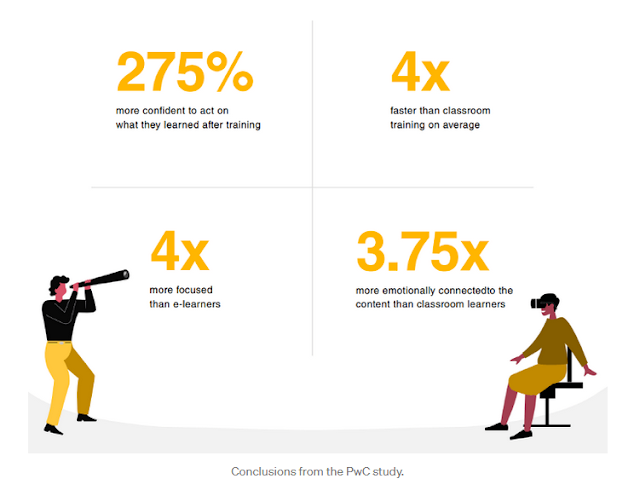
    This infographic summarizes the dominant conclusions:

    • 275% more confident to act on what they learned after training
    • 4x faster than classroom training on average
    • 4x more focused than e-learners
    • 3.75x more emotionally connected to the content than classroom learners.

    nfographic: 275% more confident, 4x faster, 4x more focused and 3.75x more emotionally connected to the content.


    LinkedIn post that mentions 4 times twice and nearly four times once.

    Capture of how the PwC report is being talked about on LinkedIn.
     
    A few more quotes, thanks to Google and a search on “VR 4x faster.” What seems to be a pattern about all of these results?


    What do these Google results have in common?

    They are all companies that sell some sort of VR product or service.

    Because I was curious, I checked out that vrowl dot io link (“Virtual Reality training is not effective”) just to see if it was presenting an alternate opinion. It’s a strawman argument; it puts up “not really real” protests against VR for learning and then explains them away. I’m telling ya, Beware the VR Strawman.

    What the Report Says

    Eckert, D., & Mower, A. (2020). The effectiveness of virtual reality soft skills training in the enterprise: a study. https://www.pwc.com/us/en/services/consulting/technology/emerging-technology/assets/pwc-understanding-the-effectiveness-of-soft-skills-training-in-the-enterprise-a-study.pdf

    Let’s ask Google Scholar what it thinks. It’s coming up with 11 cites. That’s not much at all. But as I showed above, the money shot is on the Internet, not in academic articles.

    Truly, the 4x faster learning quote is the runaway train of this report. 

    (more…)

  • Misleading Headline or I snagged a live one!

    Misleading Headline or I snagged a live one!


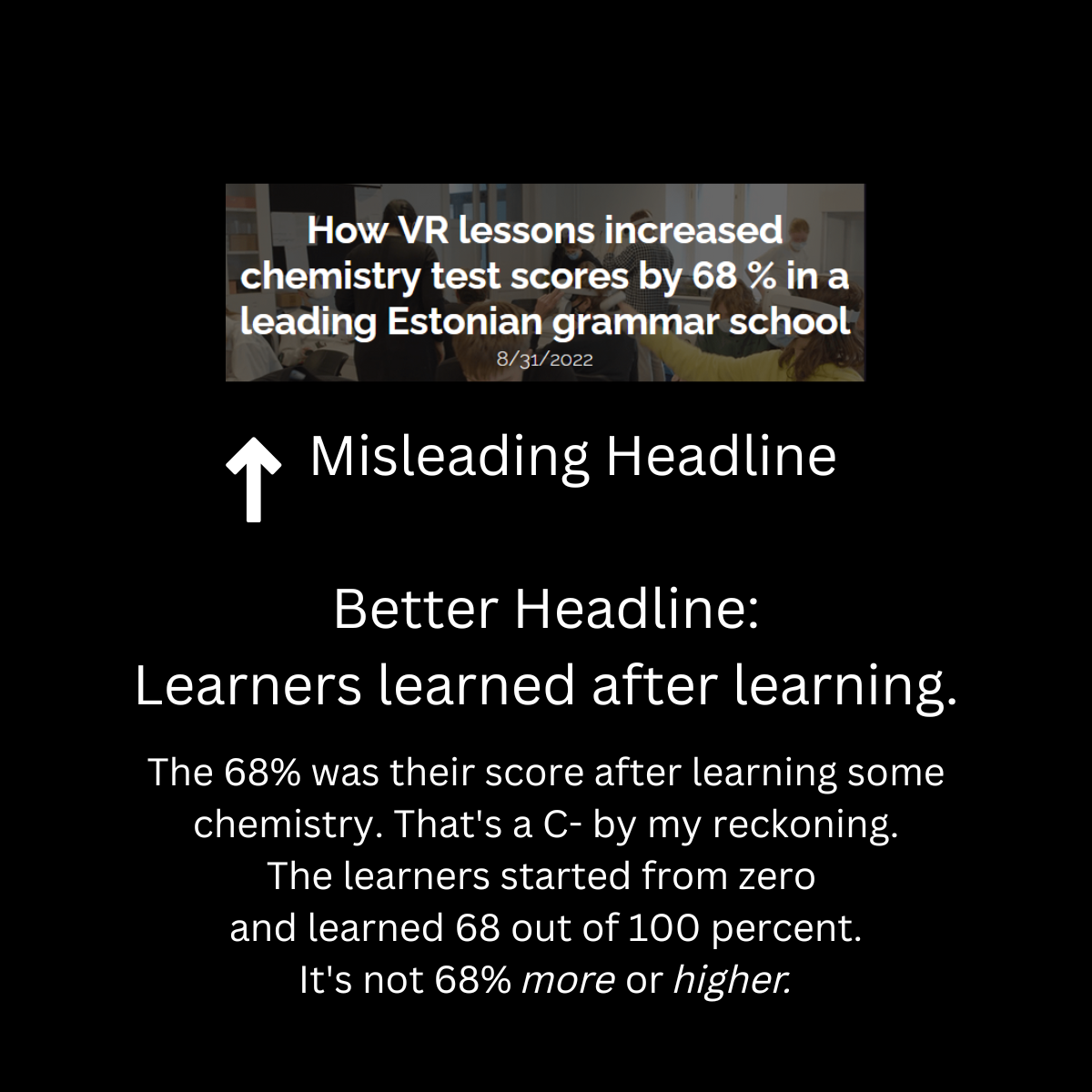
    Image of headline with text: How VR lessons increased chemistry test scores by 68 % in a leading Estonian grammar school. Further text indicates that is a misleading headline and that a better headline would be Learners learn after learning.

    Oh, I snagged a live one! I really didn’t think this image would garner much attention as my posts rarely do on these topics. 2022 has been a bad year for keeping XR friends.

    But I’ve been contacted directly by a nice LinkedIn link.  

    Incoming message

    (DM’ing instead of commenting on your recent post here.) 

     Why are you distorting the facts?

    The article says:

    “The survey revealed that students showed an average of 68 %
    improvement in a test taken after learning with Futuclass VR lessons
    compared to the results before the 30-minute VR lesson.”

    This is very different from “started from zero and learned 68 out of 100
    percent”. 

    The source is here, wasn’t hard to find. https://futuclass.com/blog/how-VR-lessons-increased-chemistry-test-scores-by-68-percentage/ 

    And looking up the teacher involved, quoted in the article, she has
    multiple publications at hard science institutions at Tallinn
    University. I somehow doubt she’d agree in your assessment on her
    scientific rigor. https://www.etis.ee/Portal/Persons/Display/95da33ee-9b4c-4e72-9cab-3e72e3791c0c

    I’m all for criticizing messaging and methodology of these “research”
    reports, but when you skew the actual facts you’re undermining your own
    point.

    So, my response:

    Good sleuthing!  I like that you want to look at the actual numbers.
      

    I did so. I did read the article before I made my post. 

    May I direct to a
    few more sentences lower down in the article?
     
    Some of these will be confusing, so by the end of this, we’ll have to
    look at the entire article and not just stick with exact sentences. 

    Here is the one you quoted and I do see it:
    “As a result, students showed an average of 68 % improvement in a test
    taken after learning the metal oxides during a 30-minute lesson using VR
    compared to the results before.” 
     

    This one is not clear what “to the results before” is actually referring
    to. Could it be referring to: other teaching, to non-teaching, to
    “before” teaching?  I read further down in the article to find out.
      

    This appears to be describing more of the method:  After testing
    different approaches, the best results proved to be with group work and
    paper worksheets. Students with VR headsets were expected to communicate
    what was going on and solve the worksheets together with the students
    without the VR sets.
      

    I thought that was interesting because it implies other approaches that
    but that this one was settled on and it included a non-tech component
    (paper worksheets).
      

    The next sentence is problematic: “Several studies have revealed that
    first-hand experience is four times more effective than traditional
    theory learning. “I believe that we should mix the experience from VR
    equipment and practical work and this would be effective learning,”
    admits Katrin Soika.”  

    It quotes “four times more effective than traditional learning theory”. 
    The “four times” is clued me in. The statement implies that VR is 4
    times as better than traditional teaching. This is debunked research (by
    me).  If it referring to the PwC study (https://www.5discovery.com/wp-content/uploads/2020/09/pwc-understanding-the-effectiveness-of-soft-skills-training-in-the-enterprise-a-study.pdf
    ), that study had learning take place in 1/4 the number of minutes that
    a classroom equivalent would have taken. Those are not apples to apples
    comparison, but it was published by PwC that they thought VR was, then,
    4x as effective. 


    Here is where we get to what the 68% was actually measuring: “With VR
    education, learners are inspired to discover for themselves. Students
    have an opportunity to learn by doing rather than passively reading or
    listening. After the VR chemistry lessons students were surveyed about
    their experience and the results were significant. The survey revealed
    that students showed an average of 68 % improvement in a test taken
    after learning with Futuclass VR lessons compared to the results before
    the 30-minute VR lesson.” 

    In that paragraph, it becomes clear that the 68% was the “average”
    improvement **compared to the results before the 30-minute VR lesson**.  
      

    That’s why I wrote: Learners learn after learning.  

    The 68% was the
    score that they received (on average) after engaging in a learning event
    – in this case – the 30 minute VR lesson.  
      

    So that’s why I wrote what I wrote.
     
    Do you think I missed anything else quantitative in the article? 

    _ _

    The source isn’t here

    About “the source isn’t here”

    That’s purposeful from me. I’m not out to point out the company or publisher’s name or link my comments with them on the LinkedIn network – especially when I have something negative to say. I let my hashtags carry the weight of passing my opinion around my network:

    #XR #VR #VREducation #VRForGood #edtech #Chemistry #ChemistryIsHardIGetIt #VRForLearning #ReadCarefully #WriteBetter

    Note: this article came to me via my LinkedIn network – via 2 friends, actually. So I’m only recirculating my opinion back out and NOT pointing out the article, company, or researchers.

    Additionally, I posted to LinkedIn one image and one line of text “Let’s be careful out there” (a reference to the TV show Hill Street Blues). That’s it. I didn’t include a link.

    _ _

    The researcher’s qualifications

    About the comment about the researcher’s qualifications: I don’t actually think the researcher/educator whose experience is IN this article wrote this article. There is no author quote, so I’d have to go with someone at Futuclass wrote this. I say that because some of the quotes for the researcher are put up close to sentences on something different– and thus, it doesn’t make sense in terms of writing. Usually evidence supports a claim, not says something very different and off tangent.  By the way, when I see this, I always try to figure in possible changes in translation between languages.  For example, could this article have been originally written in Estonian and then translated to English and thus some things just don’t sound like native English?  Yes, that’s possible. However, the problems I see in the writing are more along the lines of illogical ideas or “pushed” writing (advertising) than straight research.  So that would not invade actual word-for-word translations, but it would remain at the sentence & paragraph level- which is what I think I see.

    Here is an example:

    Several studies have revealed that first-hand
    experience is four times more effective than traditional theory
    learning. “I believe that we should mix the experience from VR
    equipment and practical work and this would be effective learning,”
    admits Katrin Soika.

    So the quote shows that Katrin wanted a mix of technology and practical work to create effective learning. That seems to be her point.  But the sentence just before makes the (wild) claim of the four times (but I’m not sure what of four times).  So the ideas don’t connect.

    BTW, the link to her qualifications is in another language. Regardless, I respect that she might have done some nice work here. Actually if you look at her quotes in isolation AND look at the “other properties” section – particularly with reference to chemistry education – I think that this educator is cooking with gas, as in, she’s doing well.

    Conclusion

    Overall my opinion is that I wish the “other properties” section would have actually made the headline and NOT the quantitative data. There is some really good stuff there. It has been 5 days since this interaction and no follow-up response from my link. 😟

    This is just another case of  if it looks too good to be true (68% improvement!!), it probably is.

  • STEM is hard; It’s the hard that makes it great.

    STEM is hard; It’s the hard that makes it great.


    Facebook post:

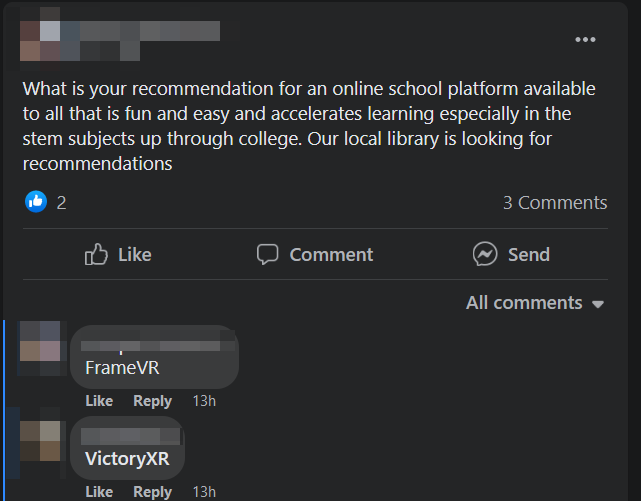
    What’s your recommendation for an online school platform available to all that is fun and easy and accelerates learning especially in stem (sic) subjects up through college. Our local library is looking for recommendations.

    First two responses:

    FrameVR

    VictoryXR 

    My response: Just for the record, it’s the hard that makes STEM learning good. (Gif of Geena Davis’ character from A League of Their Own catching a fast ball with her hand.)

    Screen capture of Facebook post by Heather Dodds with text: Just for the record, it's the hard of STEM learning that makes it good. Gif of Geena Davis catching fast ball with her hand from A League of Their Own.


    Absolutely; curiosity and perseverance matter. I loved physics in high school, but got a 64 on my first calculus-based physics exam in college. Drank 9 shots at TGIFridays that night and nearly puked in the parking lot. Later I professed true love for my ceiling fan.

    STEM is hard. 

     
    Add 10 years and I was tutoring students in Calculus. Add 17 years & I taught physics in college. Add 21 years and I was part of the team launching Calculus & Differential Equations courses for Computer Science majors. 

     
    A friend once counseled me: PhDs aren’t smarter, they’re tenacious; they hang on longer than everyone else. I bit in and did not let go. 

     
    Today, I can inform you that I completed my quantitative quasi-experimental nonrandomized control group pre test post test study with original research, analyzed with SPSS.

     
    And if you are rude to me, I make you call me Doctor.

    Meme from A League of Their Own with text: It's supposed to be hard. If it wasn't hard, everyone would do it. The hard is what makes it great" Photo of female baseball player at bat.

  • How to Balance Theory and Research

    How to Balance Theory and Research

    I love to dwell in both theory and research. Both are fascinating to me.

    But how do I balance theory and research when they conflict with each other?

    I share an example and I know this is stormy waters ahead for some readers because I’m going to create waves.

    Photo of waves set against a cloudy sky.

     Photo by Ant Rozetsky on Unsplash

    First, the theory; Andragogy or Adult Learning Theory credited to Malcolm Knowles and to smaller degrees to other theorists.  Before I go any further, I have to acknowledge that in 2022, there is a STRONG movement to discredit Knowles and Adult Learning Theory.  More than I can count, it’s currently cool to disrespect this around instructional design. It’s quite ugly.

    Examples:


    I find this trend really disturbing and an example of cancel culture. Realistically, I find that IDs that put no mental effort into truly studying Andragogy dismiss it out of hand as unreal based on their surface understanding. Said another way, they believe that they know what Andragogy is and then they say it does not exist. BTW, LinkedIn comments have become hot when I’ve described that THE MOST COMMON COMPLAINT against andragogy is that “children occasionally display these adult traits too, so, therefore, adult learning as an exclusive or separate thing does not exist.”  Heads-up: Classic  logical fallacy of composition

    Once in a while someone will ask “What is an adult anyway?” which I find to be at least a cognizant thought and then explain “Yes, defining an adult is the first exercise in an Adult Learning Theory class.” Duh. It’s actually really hard to define an adult because there are so many different standards. 

    In summary, using a logical fallacy of composition argument is already weak.

    Additionally, I find that Andragogy is well-respected, research-supported part of education around for over 30 years. What’s next to pick apart? Gender studies?!? 2022 does seem to be the Year to Attack Women. What about Black Cultural studies? How about studies about any particular group?? Or should I be saying “Any particular group that isn’t White Mainstream?”  See? That’s where cancel culture gets you eventually; no one is good enough. I reject all of this.

    Rinse & repeat on Brain-Based Learning.

      (more…)