My first article in this series garnered so much attention! But many folks tried to pass me Mirjam Neelen & Paul A. Kirschner’s Truth or Truthiness? Analysing a VR Study Using Gorard’s Sieve article on the PwC report entitled “The effectiveness of virtual reality soft skills training in the enterprise: a study” and all of its associated webpages like this one. I was like, I know! Mirjam & Paul wrote their article 2020 and I wrote about it in 2021. What’s cool is that separately, we both came to the same conclusions. That’s a good sign for our conclusions!
Short version: we both cast strong doubt on any conclusions.
Still, I realize the world does not revolve around me (sigh!). Some folks might have missed my long stream-of-consciousnesses article about the PwC report. I decided that the second article in this series should be an abbreviated and updated critique. Bear in mind that to reach the LinkedIn audience, I have to leave much nuance by the side of the road. If you have questions, just ask!
As Mario says “Here we go!”
What is Said About The Report
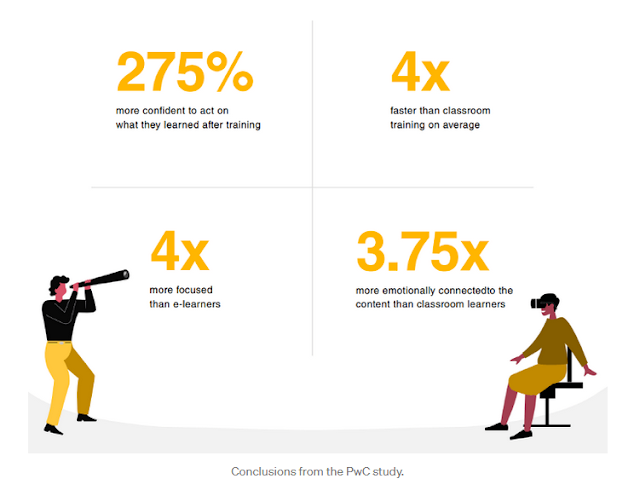
This infographic summarizes the dominant conclusions:
275% more confident to act on what they learned after training
4x faster than classroom training on average
4x more focused than e-learners
3.75x more emotionally connected to the content than classroom learners.
Capture of how the PwC report is being talked about on LinkedIn.
A few more quotes, thanks to Google and a search on “VR 4x faster.” What seems to be a pattern about all of these results?
What do these Google results have in common?
They are all companies that sellsome sort of VR product or service.
Because I was curious, I checked out that vrowl dot io link (“Virtual Reality training is not effective”) just to see if it was presenting an alternate opinion. It’s a strawman argument; it puts up “not really real” protests against VR for learning and then explains them away. I’m telling ya, Beware the VR Strawman.
Let’s ask Google Scholar what it thinks. It’s coming up with 11 cites. That’s not much at all. But as I showed above, the money shot is on the Internet, not in academic articles.
Truly, the 4x faster learning quote is the runaway train of this report.
I’m starting a new article series today, calling out ‘bad research’ or research that is quoted badly in virtual reality for educational use. I thought I would start with a whopper – a really egregious example to start this series with a bang. Then I checked my notes and realized that this example is from LAST MONTH, June 2023. I’m not even going into the vault for this. I’m barely picking myself up off the ground from the shock wave.
So, like Mario says “Here we go!”
What Is Said About The Research Versus What The Research Says
June 2023, LinkedIn Post:
“According to a study from the University of Maryland in 2018, learners remember an astounding 90% of what they experience in VR compared to merely 10% of what they read and 20% of what they hear.”
I believe this is the research referred to:
Krokos, E., Plaisant, C., & Varshney, A. (2019). Virtual memory palaces: immersion aids recall. Virtual reality, 23, 1-15. https://obj.umiacs.umd.edu/virtual_reality_study/10.1007-s10055-018-0346-3.pdf
Hey, I’ll give you the abstract because I know you don’t like to read long papers:
“Virtual reality displays, such as head-mounted displays (HMD), affords us a superior spatial awareness by leveraging our vestibular and proprioceptive senses, as compared to traditional desktop displays. Since classical times, people have used memory palaces as a spatial mnemonic to help remember information by organizing it spatially and associating it with sali�ent features in that environment. In this paper, we explore whether using virtual memory palaces in a head-mounted display with head-tracking (HMD condition) would allow a user to better recall information than when using a traditional desktop display with a mouse-based interaction (desktop condition). [OK skip to here because this is the interesting part:] We found that virtual memory palaces in HMD condition provide a superior memory recall ability compared to the desktop condition. We believe this is a frst step in using virtual environments for creating more memorable experiences that enhance productivity through better recall of large amounts of information organized using the idea of virtual memory palaces.”
Google Scholar tells me this study has been cited 461 times. That’s a low-medium citation number. Not bad, and remember that’s in ~3 years of time.
Believe it or not, I’m walking RIGHT PAST that 90%, 10%, and 20% because it has already be debunked here and here. Also, to be fair to the research paper, it never quotes those 10 and 20% numbers.
My Take on the Research
Research found 90.48% recall in the headset condition, with a 78.57% score from the desktop display control group. So that’s ~10% higher with the headset.
From Section 4.1 “Using a paired t test with Bonferroni–Holm correction, we calculated p = 0.0017 < 0.05 which shows that our result was statistically significant.”
Interesting. I’m not familiar with Bonferroni-Holm correction.Just looking at it, it appears to be a method of discarding some data. I wonder if NOT using it showed a not statistically significant difference between the 90 and 78. Their n was 40. Smaller group sizes means it can be harder to justify the data as fitting a normal bell curve.
Figure 5 shows the data and just looking at it, you can see that the numbers landed in similar scores. The boxes overlap, so whatever the effect of VR is, it’s not that substantial in this study. Students were learning, regardless.
But here comes the whopper. Check out this little detail in the Materials section:
“For this study, we used a traditional desktop with a 30 inch (76.2) cm—diagonal monitor and an Oculus DK2 HMD. The rendering for the desktop was configured to match that of the Oculus with a resolution of 1920 × 1080 pixels (across the two eyes) with a rendering field of view (FOV) of 100◦. In order to give the desktop display the same field of view as the HMD, the participants were positioned with their heads 10 inches (25.4 cm) away from the monitor.”
10 inches away
The “control group” sat 10 inches from their desktop monitor to use the desktop condition.
WHO DOES THAT?
You know, I was curious. I grabbed my ruler.
How far away are you sitting from YOUR monitor?
I’m currently sitting 24 inches from my monitor. I leaned in to feel what 10 inches is like.
At that point, it became no wonder to me that the control group scored about 10 points lower. It was maddening. Remember, the learners had to look all around themselves so completing learning at 10″ from the monitor would be…uh…weird?
This is a great example of not seeing the forest for the trees in VR in education design. In order to match the field of view, they forced learners to unusually use their desktop monitors.
There is too much. Let me sum up.
The quote is from a keynote speaker at a research conference. I can’t believe anyone in the audience did not flag the play on the quote, the percentages, or the design setup of the U. of Maryland study. At the industry.
The difference between 90 and 78 *might* be too close to call a difference caused by VR.
Setting up learners to use a monitor from 10 inches away is unusual, to say the least.
When research sets up unfair comparison conditions, the results should be questioned.
As Hill Street Blues would say, “Let’s be careful out there.”
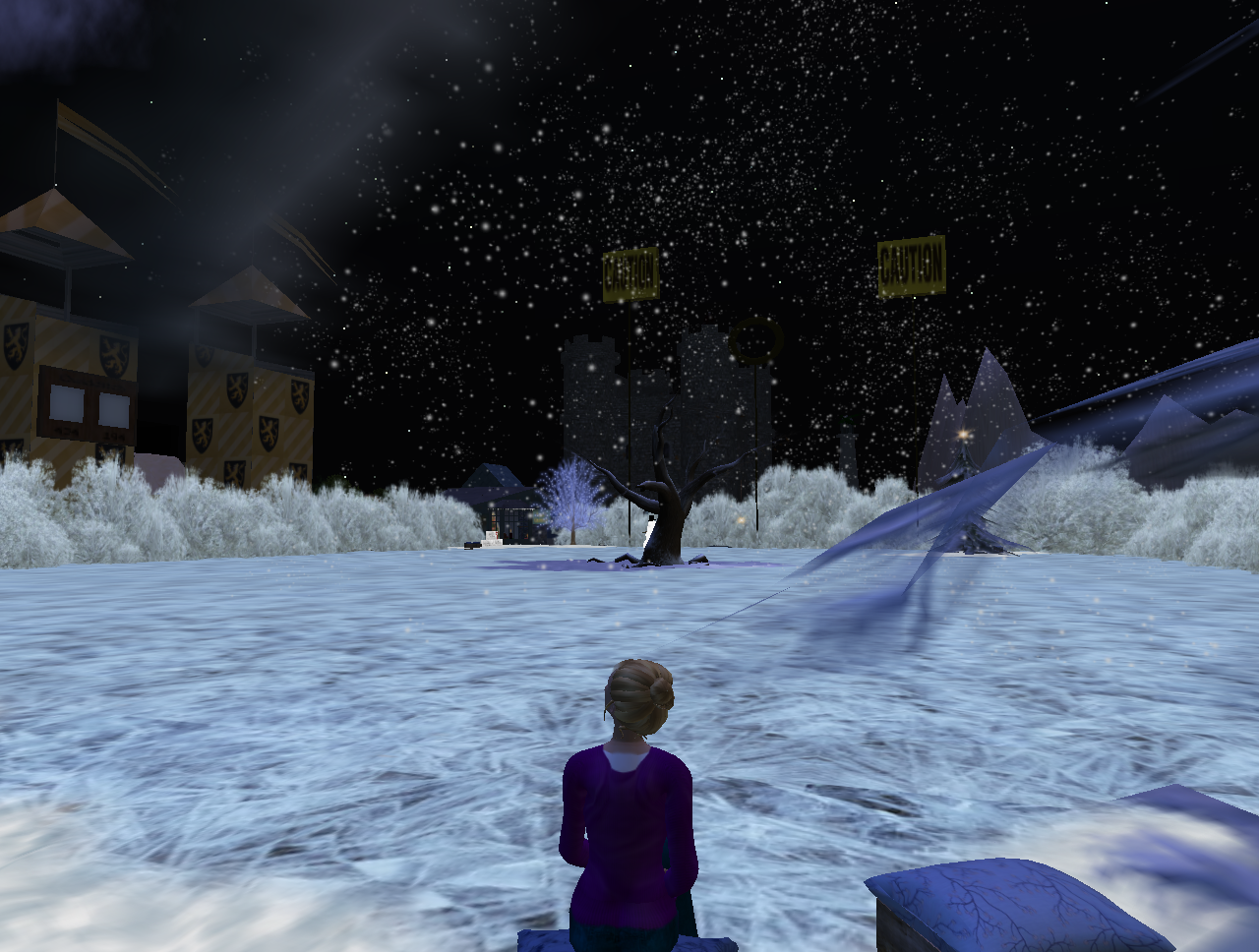
IMAGE: Second Life resident looking at snow falling on the Quidditch pitch of the nighttime VWER Campus, 2010.
This is some of what I call my “kick out writing” that I did not include in some recent published writing. It starts:
The
promise of the metaverse in education is like a mirage in the desert.
Educators seem to be forever awaiting the arrival of the metaverse but
still not yet embracing those technologies.
In 2003, #SecondLife
launched as an immersive persistent virtual world. Just three years
later, educators were publishing about their pioneering efforts on the
platform. Kemp & Daniel Livingstone (2006) suggested pairing Second Life with a learning management system (LMS), a suggestion familiar to #instructionaldesigners
of the Internet age. In 2007, the word “metaverse” first appeared in
educational publications (Tilili, 2022). The popularity of virtual
worlds briefly increased between 2007 and 2010. As cited in Warburton
(2009), Kirriemuir estimated that “three quarters of UK universities are
estimated to be actively developing or using Second Life.” This
adoption would wane by 2013 however after educational discounts were
discontinued and the initial fervor of virtual spaces gave way to empty
buildings and virtual ghost towns.
The arrival of the metaverse would have to wait a little while longer.
~
I just lean back in my chair and wax poetic sometimes. 💺 ✍
Have you ever been baptized? I mean adult baptism that you could remember. I’m not worried so much about your beliefs, what religion, or your soul (sorry, your circus, your monkeys).
I’ve been thinking about how baptism is like ‘play acting’ your death. Religiously, it is supposed to symbolize dying (going under the water) and being reborn (coming up out of the water).
Last Friday, March 10, 2023, AltspaceVR shut down. For those that study the interrelationship between avatars and human beings (i.e. the Proteus Effect), being inside a platform while it shut down was like a form of play acting your death.
I wasn’t planning on being inside the platform when it shut down. AltspaceVR was never one of my favorite VR platforms. But the educator community in Altspace was HUGE, HUGE, HUGE comparatively (Educators in VR claims 6,000 members now). The art & concert crowd was decent too; lots of creative & innovative stuff going on.
AltspaceVR had its annoyances.
It was a downloaded application = bulky, on a scale of 1 to 10. Don’t get me started on Steam.
Macs weren’t allowed in for the longest time.
Back in 2020 and early pandemic days, kids be-bopped in everywhere and were ALL OF 13 years of age,if you know what I mean.
But my biggest peeve? No public chat. So, never, ever was there the ability to share links, write snarky comments, spell out words, etc. Grr….Hard to believe a major platform would blank on something that Zoom can do.
But I digress.
I caught a friend live-casting from inside AltspaceVR inside the final hour. So I decided to go in to where he was. When I logged in, I could see the last few events holding up the tent poles.
In the final 3 days the events got really sad names:
Closing Celebration
Sunset Party
The Final Countdown
A Sad Tour
Africa Says Goodbye
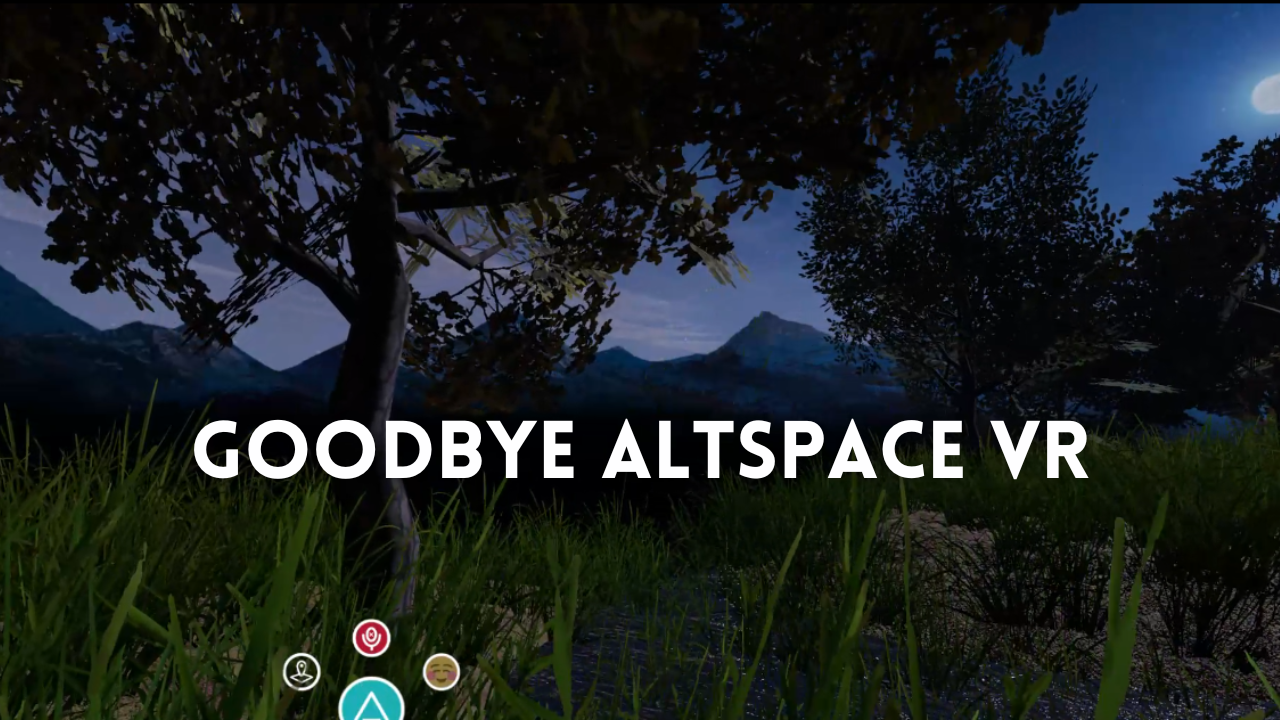
Goodbye Altspace
Party ’til the end
This is not goodbye
Goodbye to AltspaceVR
And some cheeky kids (?), “HELL NO! WE WON’T GO CAMPFIRE”
I joined The Sunset of AltspaceVR held by the classy group, EvolVR. I’d never been to their events.
I was warned 2 days before that the “end” would feel like a glitch.
But the overall impression I got as I walked around their Zen meditation space was two things:
1. Friends meeting up. Folks were in small groups. There were only a handful of solos like me. They were chipping in stories about not being sure they could log in, but they made it.
2. Unfair. The vibe, after being sad, was unfair. No one felt that what was happening was deserved.
Plenty of folks had been making comments in social media that the shutdown was ‘foreseen’ and ‘inevitable’. But still…it felt NOT FAIR. Like something GOOD was about to be GONE.
If I was asked what the mood was, it was like a funeral before a death.
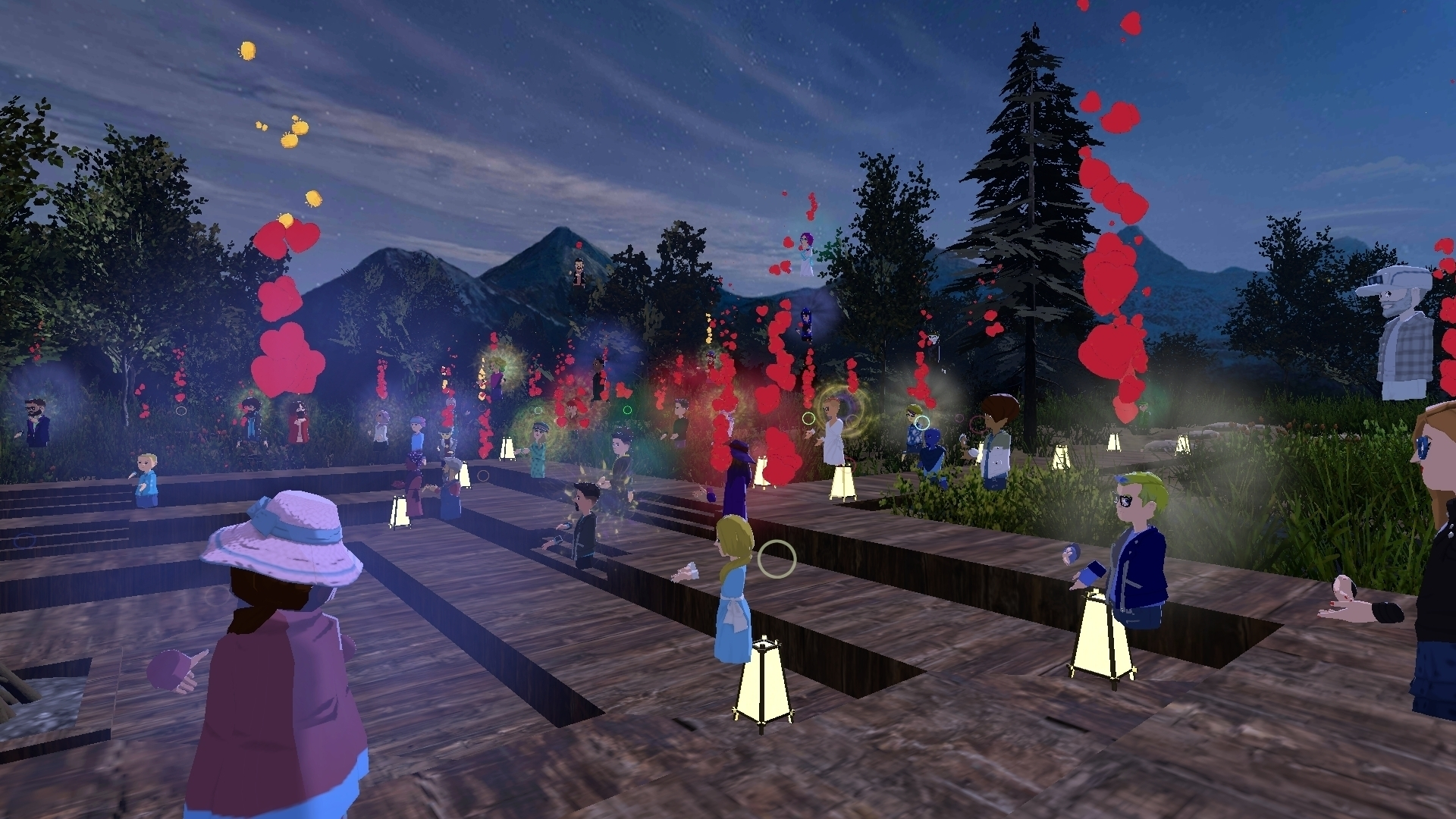
We heard stories, there was a song dedicated to the shutdown, and due to the magic of Altspace, we could see emojis from users in other instances so at times, the space was non-stop hearts.
I was quite surprised to hear developers, users, artists, designers profoundly THANK AltspaceVR for what it had done for their lives. There were many comments of “I changed because of AltspaceVR.”
We were given about 10 minutes to mill about and talk before the meditation host started the last planned event. Unfortunately, as a group, we were spreading from 3 instances to 5 instances with over 200 attendees. (Note: Altspace VR’s purported daily attendance total number was 1,000). We were told planned lantern releases were happening but I didn’t figure it out. I was one of the ones that preferred to take a slow walk around the Zen island, letting the tall grass brush past my avatar’s body, hands, and face. (Like that? How can I remember a physical feeling I NEVER HAD?)
We were pulled together for the final meditation and a scene change busted. Such is the way with a VR platform that had been getting less and less attention over the past 3 months. So we stayed put in the Zen space and the host told us he would mute the entire audience. There was one gasp of “What??” but really, we were already into step 3 of “From now on, you will not be able to do what you want to do” mode (aka, death).
He ran a lovely 5 minute meditation, asking us to conjure up our favorite AltspaceVR space and then imagine our loved AltspaceVR friends in that space with us. (Side note: I was QUITE surprised who ended up in my meditation…let’s just say that I’ve been working on my ‘pray for your enemies’ Christian element and whoa did they show up!! I guess the ‘love your enemies’ thing is really working for me. I had to smile as I saw them, with no anger, no hate, no disgust. I was just happy to see them. Sniff.😔)
Then, the clock ticked over from 1:00 p.m. Eastern US to 1:01, 1:02. By 1:03 the host said “Hell, we’re in overtime, I’m turning mics back on!” and he encouraged everyone that wanted to to join a hug puddle around him.
It looked lovely (it’s in the video below). But it was not for me.
I turned on my avatar’s non-existent heels and went back into the tall grass. I was moving towards the moon and the trees. I found some water to watch and I stayed looking down at the ripples. I could hear crickets.
And then, just as it was predicted, I was simply winked OUT of the space. It was 1:08 p.m. Eastern US. The crickets kept going. That was a bit spooky, but just like real death (I’ve heard) in that hearing goes on a little longer than heartbeats or sight (as the brain can operate on sound signals for longer without oxygen).
I just sat and listened. Listened for anything. Anything OTHER than crickets. Nope. Nothing. I sniffed a bit. 😓
After 1 minute, I had tried all the buttons. Silly me, you KNOW you are dying and yet you still think maybe I can get back into the space. Humans. (In hindsight, how amazingly ridiculous! I’m attending an event LITERALLY DESIGNED FOR DEATH. I know I’ll be glitched out. We’ll all be glitched out. It’s not personal. And yet, when the moment comes, there is a voice that says “Maybe I can get back into that event–already in overtime– that was designed to glitch me out.” Make note: whoever you are in life is EXACTLY who you will be in death.)
At 1:09 p.m. Eastern US, I used the X in the upper right hand window corner, and I closed the program. I took a few breaths.
Death.
Practicing death.
Like baptism. Because here I was breathing afterwards. I was OK. It was a computer program, after all, right?
When I was baptized, I was with a church and religion that did it up– they were the Baptists!! (Don’t worry, I’m not affiliated with them now. I jokingly say that I disagree with more of what the Baptists believe, than agree.) But I was in a 10,000 seat church where the dunk tank was the size of a HUGE bathtub or small pool suspended ABOVE THE MAIN STAGE where half of it was see-through glass.
I had been prepped on what would happen and prepped on how I would be wearing my 2 bed sheets. I’ll tell ya, THIS the Baptists can do AMAZINGLY. Women get 2 sheets. Men get 1. White. And they give you instructions on how to fold, tuck, and finagle those puppies so that nothing is seen–even soaking wet. Major applause! 👏
I’d opted for the “Yes please I do not want water going up my nose” technique where I put my nose in a crab claw pinch and had a washcloth over my nose and mouth.
There were 3 burly men in the tank: one walks you in, one dunks, and the other walks you out. It’s done slowly, one person at a time. Children first with lower water levels.
I was with the adults.
I went in as gracefully as one can when wrapped up tighter than a burrito. I put myself into my ‘one arm takes care of my nose and the other arm locks into the first arm’ and the burly man was ready to dunk. I honestly don’t remember the exact instruction but I think I had to bend my knees in already chest deep water.
I do remember the last thing I saw.
As as the warm water started to swirl really all around me, I saw BRIGHT LIGHTS, I mean, wicked bright lights (these are STAGE LIGHTS, yos!) beaming right down straight into my eyeballs. Too bright to look at, so I closed my eyes.
But for one brief moment, I thought, if this is what death feels like, it’s warm and bright and honestly not too bad.
And then I was up. Sputtering, but fine. I was being walked out and there was a little audience clapping (the baptism despite being SO visible was actually a sparsely attended church event). I was up on the floor walking over those mats that you can drip like a soaked rat over and I was off to the changing room to try to put myself back together. #hairdryerplease
So…what does all of THAT have to do with each other? It just makes me think about death, the before and the after.
Later that shutdown afternoon, someone wrote that a social VR platform has never shutdown before…so she was studying the timing. She’s on to something.
You see, I joined Second Life in 2008, now 15 years ago…and I’ve never left. I actually went back into Second Life 3 hours after this AltspaceVR shutdown event (after also having spent 1.5 hours in Mozilla Hubs). So I haven’t had to lose my avatar in Second Life.
Sure there are platforms I’ve been to once and I just don’t care to go back (I’m looking at you Cryptovoxels) but I haven’t had to see my scenes disappear. The AltspaceVR world creators took this very badly. They could remove their assets, but removing how things were set was very difficult. I feel for them.
They are porting off to other platforms (where the dead are, the vultures will gather) like Spatial, Mozilla Hubs, or FrameVR. I’ve seen one stupid but valiant attempt to lure folks by Virbela (stupid b/c you can import zero of your own assets into Virbela).
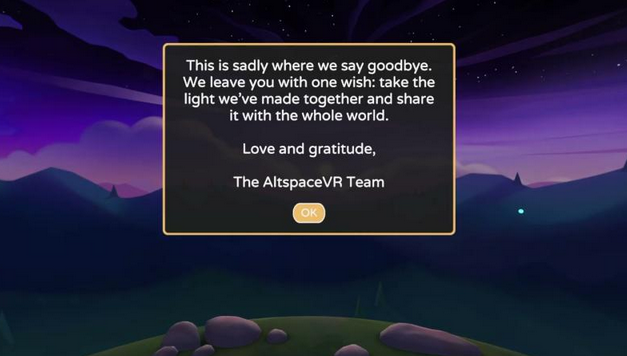
But I’m touched that the AltspaceVR folks seemed to know we were out here and having a hard time. They posted one final message (I’ve captured it from a friend).
Classy final touch, AltspaceVR.
Thank you and goodbye.
Please watch my video. And thank YOU!~
Note: this post is simultaneously posted to a LinkedIn article.
I’m getting a pretty strong reputation for being the most anti-XR person associated with XR. That’s fine. Proud of it. Trying hard to explain my point of view.
But I thought I would get into writing my prognostication about the future of XR.
In the next 5-10 years (closer to 10 than 5), the XR education market will explode. Entering the metaverse for a class or meeting will be JUST AS COMMON as entering a Zoom meeting is now (very common in 2023, and hated, such as the phrase “Zoom fatigue”). BTW, similarly maligned analogous technologies: PowerPoint or Second Life.
The quality of what will be produced will run the gamut; great to garbage.
After the market becomes saturated (and here comes the kicker) learning results will decrease (from what will appear to be ever increasing highs) and the overall impact of XR on education will be essentially nil. It will be “another thing”.
They occurred between 1997 – 2003 or so. It was a time when a dominant search engine, Google, had not yet risen to power. Multiple search engines vied for top spot. What was top spot, you say? It was “most pages indexed”.
How were the Wars fought? Each week, researchers would depth-check each search engine. Back then Yahoo was really the one folks thought would win, AskJeeves was in there, I think some Microsoft ones were in there.
Method:
They would search for something that does not exist. The results, therefore, would contain the entire pool of sites that the search engine HAD indexed and said, essentially, NOPE, not there, we don’t have that and we’ve checked everywhere.
How do you search for something that does not exist? Easy. Put your fingers over a keyboard and starting hitting keys.
Example:
fhdakfjklpoiovpoie
That ^ does not exist.
A return number on that from a search engine (yes, they used to return numbers, not today’s hopeless signal of ‘Next: 2, 3, 4,…27 million’) would tell you how many total web pages that engine had indexed. It was tracked week to week.
Yes, Google eventually won the Search Wars.
But even now, there are pockets that Google just can’t get to. See below.
I still find myself stunned that doctorates earned in other places outside of the US are dramatically cheaper and include things like “fully paid” and concepts like “…while you…”, “support for projects”, etc.
When I sat down to my first of three required residencies of my doctorate for Capella University, my fellow IDOL (instructional design for online learning) students started talking about prices…as one does with students ‘talking in the hall’. I had researched and sought out a program that met 2 requirements for me:
It must be online. That limited me to maybe 3-5 universities. (Capella, Walden…maybe Liberty?)
It must be the cheapest of those that met requirement #1.
As far as programs, faculty, type of research conducted..pah! I didn’t care. I knew all of that could be scrabbled together within a program. (I was right, although I’m pretty sure God had a lot to do with the fact that I found a dissertation chair that held his check-in meetings in Second Life.)
But #1 and #2, online and cheap were my by-words. Still, I can tell you that a price tag OVER US$50,000 was what I was facing. Capella refuses to estimate how long the “dissertation phase” will take because it varies by the learner and type of research. So the $50,000 was only for about 1.5 years of classes. Now that I’ve been there/done that, I can tell you that tuition at US$4,000 per 10 weeks during the dissertation phase is SUCH a ripoff. Anyways. 😡
As the students talked, I was astounded when they said that Capella was the cheapest option they had found and the next closest competitors were over US$100,000 for the degree. When I recovered from my shock (as I was still not liking the over $50,000 price tag) I thought about it and remembered that a friend had indicated her 6 figure student loan for her PhD.
Time warp: I remember thinking that those of us dedicated to math and science were supposed to get the carpet laid out for us in college. At least, that’s what it felt like in high school in the 80s–still swinging out of the space age, the shuttle was still going to space, and girls in particular needed to go into math and science. Where did those shiny promises go? They never showed up. Not once.
In the end, I did the entire degree “As fast as possible” since time was money. I do feel the dissertation phase is a ripoff as I had one 10 week term where I received one review of my writing (err…maybe a chapter…in dissertation terms). At no time— and I don’t mean to offend but– did I ever feel like I was receiving $400 a week of services from Capella. Nope. I shudder to think of the poor wages they were probably paying their faculty too. Blech. 😔
But I hear that doctorates can be had in Europe for dirt cheap prices US$3,000-$5,000 range and they throw in things like “getting a stipend”, “teaching while…” and that kind of stuff.
I pulled my PhD full time while I was also working full time and received NO support from my workplace (and I used my own data, nothing from my worksite). They were pleased as punch to have another faculty member with a doctorate (at no cost or burden to them) and I flew in under the radar of one of the last years they offered a raise with higher degrees earned. So I didn’t get paid to do it, but I was paid more once I had it. P.S. the very year that happened was the same year I was specifically told that I did NOT get a raise for my performance, as that was the lawsuit year where I whistle blew.
My total bill for my PhD was US$64,000. All in student loans. All student loans are now paid off.
The fact that Capella’s tuition magically was exactly the same as the maximum graduate student loan is/was a huge tip off. They are private and for-profit too. If there is ever a class action lawsuit against Capella for what feels like price fixing, gauging (?I don’t know what it would be called?), sign me up.
In the seven years when I was a boss of a remote team, I can pick out what was the best project solution that happened.
I’m referring to those instances when the university assigned Program Managers (mid-level management but truly low-level management, one drop kick above the bottom) to tow a particular project with our teams. We were assigned MANY of these. As a university fascinated with its own navel, we had to engage in constant projects with the goal to improve student completion rates (also similarly known as Satisfactory Academic Progress, SAP).
Many, many, MAAAAAANNNNNNYYYYY of these. At least one a month (minimum) was assigned to us Managers. I’d think of them as the MBA word-of-the-week projects or I’d call them Joe Babies (snicker, named after one of my bosses).
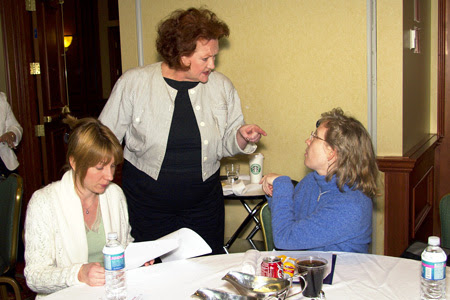
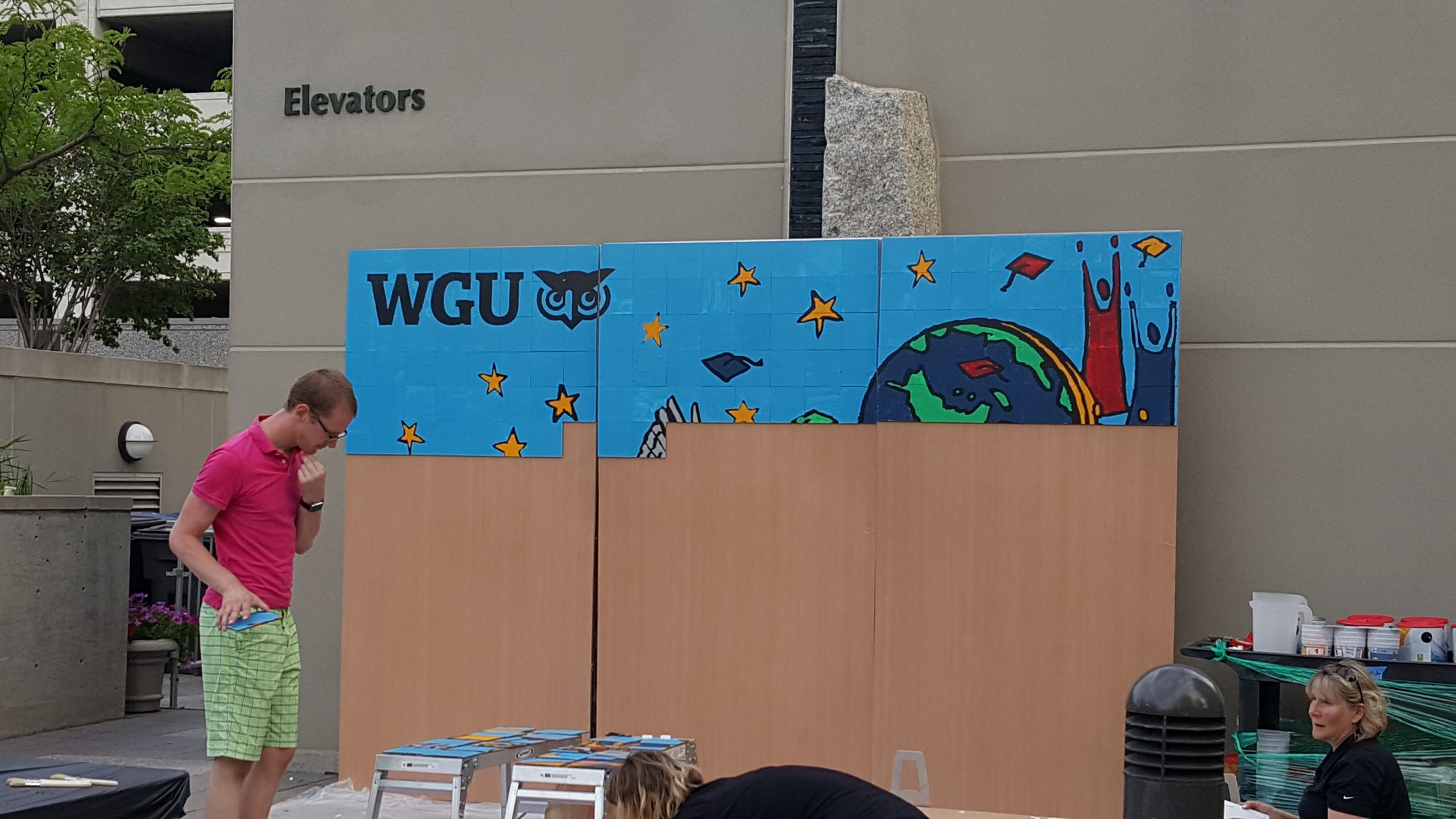
Oh the number of times I’d have to stand in front of my team with one of those large white note pads, pose a quandry, and then gather responses– SOO many. Rifs on the theme: Post-it ideas, round circles, etc.
Photographic examples:
But BY FAR, when I think about the BEST solution that arrived [note my
wording] during my tenure as a boss, I point to this one solution:
The project was: On our every 18 months Great Places To Work survey, Teams scored higher employee satisfaction than the University overall. The University thought that was BS….if employees are happy with their Team, they should be MADE TO BE just as happy with the overall University.
Translation: employees had the tendency to think that their immediate boss was trying their best under the working conditions, but the university frequently launched bonkers ideas that everyone was forced to comply with. (this data came from one of my 360 performance evaluations)
So I posed the question to my team (I was towing the line):
What would make this place an even better place to work?
My team came back with the answer. It was brilliant. I take no credit.
They said:
Taking leave of any kind (sick, vacation, even an afternoon off) is very difficult. Can we make taking leave better?
They were right! When I moved from Teachers College to General Education, asking about taking leave was my first question…because it was nearly impossible over in the TC.
This place would be better if we could support each other when we take leave. That includes all aspects of taking leave: asking, receiving, notifying, allocating of work load, and recovery time (climbing Mount Outlook).
OK, I said. Let’s put this into action.
And my job was to do just that: make leave easier to take. I showed consistency in establishing and applying rules for leave. I took work upon myself if I could.
But the solution itself was my team’s idea. And I loved them for it.
The Deputy Head of Conflict Related Sexual Violence (CSRV) Accountability within the UK Foreign, Commonwealth and Development Office (FCDO) is seeking to work with Office of the Prosecutor (OTP) of the International Crimes Court ICC to introduce AR/VR/XR into their conflict-related sexual violence program, centered on victim care.
They have 11 ideas where to incorporate XR:
AR to show the survivors injuries
AR witness representation/identity while testifying
A VR representation of a conflict community for the court
A VR representation of the conflict environment
VR for familiarisation
VR for survivor and witness mental health
Court VR social platform
VR for outreach and external education
Interactive courtroom proceedings
VR for staff training
VR Crime scene reconstructions
These ideas and applications are all stunningly wonderful for victim care. Read the article. It’s a great application of XR.
I’ve received some questions on my video and transcript posted here: https://heatheredodds.blogspot.com/2022/09/xr-will-not-cause-lasting-improvements.html
So I’ll add some clarifications:
1. There are weak points in my argument:
A. I argue that the learner is the still as-yet undiscovered cause of the flat lining of learning objective results media to media. I have NO data to back that up. That is a supposition by me. I suspect the data will have to come from brain studies.
B. My argument that learners in previous generations were NOT dumb is a bit of low…err…high?…blow. Certainly, there were dumb learners in the past.
However, I do not buy the modernist argument that when technology gets “better”, learning gets better. Nope. No. As I mentioned in the video, humans appear to have a learning speed limit. Said another way, the neural pathways of learning in a human brain are set. (Yup, I’m referring to brain-based learning theory here. You might know it as neuroscience.) Short of something like “Lawnmower Man” or a “Flowers for Algernon” royal technology/drug-induced fuck up, I don’t see humans getting smarter.
2. Let me be clear on my argument about results flat-lining and there being no “lasting improvement”. The “lasting improvement” that I’m mentioning are ONLY learning objectives. So said another way, if there was an exam covering X taught with media Y where students score Z right now….in 10 to 30 years, learners will still score Z even if XR is the media. I’m sticking to apples to apples comparisons. I’m NOT talking about other things like XR affordances, which would introduce apples to kiwi to melon comparisons….which are not comparisons and are not fair.
So I’m not talking about XR doing things like increasing access to resources due to manipulations of time, space, geography, physics, etc. Those things are affordances, the characteristics that belong or sort-of stick to a media form.
The conversation about affordances is fascinating and I’d love to have it! As a designer, knowing the positives and negatives about each media is my specialty! (See my XR platforms writing.) However, I’m also bound as designer to not force any decision about the “best” media upon a client. The clients decides what they will select, what they will pay for, what they will invest in long-term and thus the client accepts both the positive and negative consequences of their decision, their “opportunity cost”. So by default, I almost never like to say this is “the best” when it comes to an XR platform.
3. Timeline = I used smartphones as an example in the video but I’m really brief about it. But it is in somewhat recent memory that smartphones went from a new technology to everyone having one. How long did that take? Hmm… lemme check:
2022: as shown in the video there are enough smartphones in the US for every adult to have one. Translation = the US market is saturated. Smartphones are ubiquitous.
1992 to 2022. So that took 30 years.
I’m fine with adding in Moore’s Law here. So the adoption of XR until the point of it being ubiquitous and saturated– how long will that take?
Hmm… I’m guessing but I’m more comfortable saying closer the 10 years from 2022 than 5 years. That puts my guess at 2032.
Now now, you pro-XR folks out there! I heard your cry! 10 years!! Don’t be sad. Remember what is between HERE and THERE: a great big increase, an expansion, a bubble, GROWTH. It will be a good 10 years. (Imagine what the first 10 years was like for smartphone manufacturers Nokia and Apple, whoohoo!)





.png)



.png)