.png)
Credit: Midjourney and me. Prompt: film still, wide shot moon base, glowing moon bases are separated across the surface, mysterious, nighttime, blue and green color scheme. –style raw
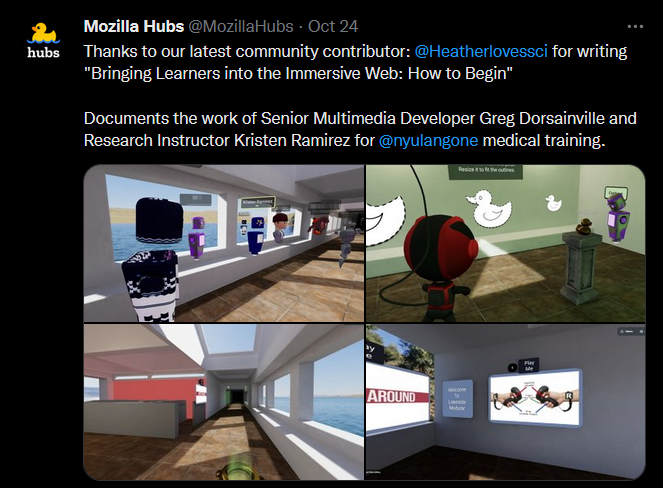


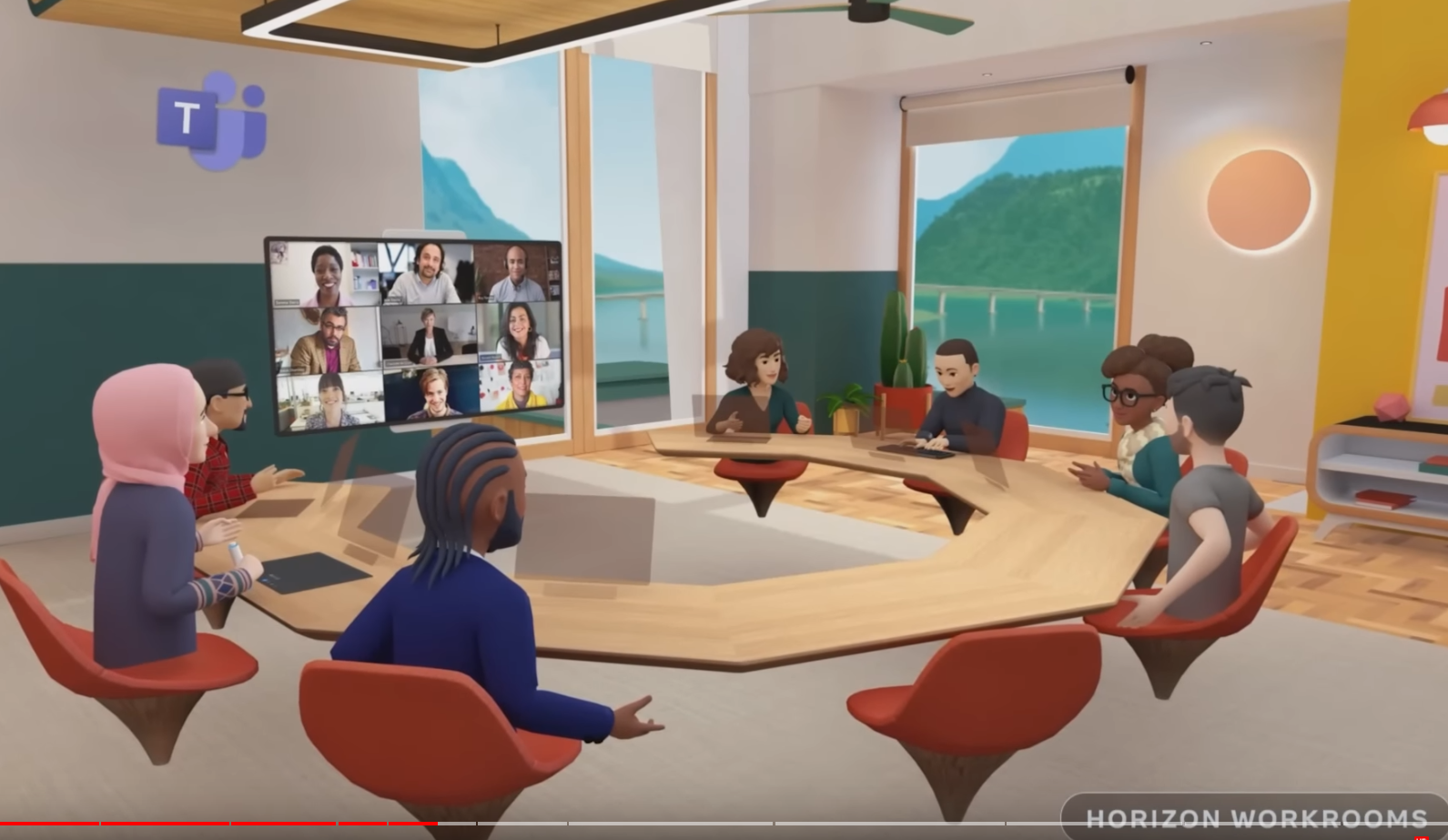
Then this week, Ford Motor Company just opened their IMG DEI Museum in FrameVR and I took a quick tour. Here are some photos from the space:


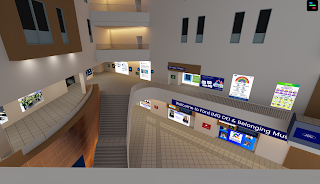
Video of the first few seconds being in the Ford IMG DEI space (no sound, 25 seconds)
Right off the bat, I liked how they were taking care of what could be first-time-ever XR users.
So two different WebXR experiences with two different orientations or Getting Started experiences.
It was nice to compare 2 entry experiences so closely together in time. I’m reminded of a recent quote:
“Design as if it [the technology] were something speaking to the learner.”
~Donald Clark with John Helmer, The Learning Hack podcast, S1E5 Online Educators.
The video – especially from the eye-viewpoint of the entering avatar nails the intro. Perfect.
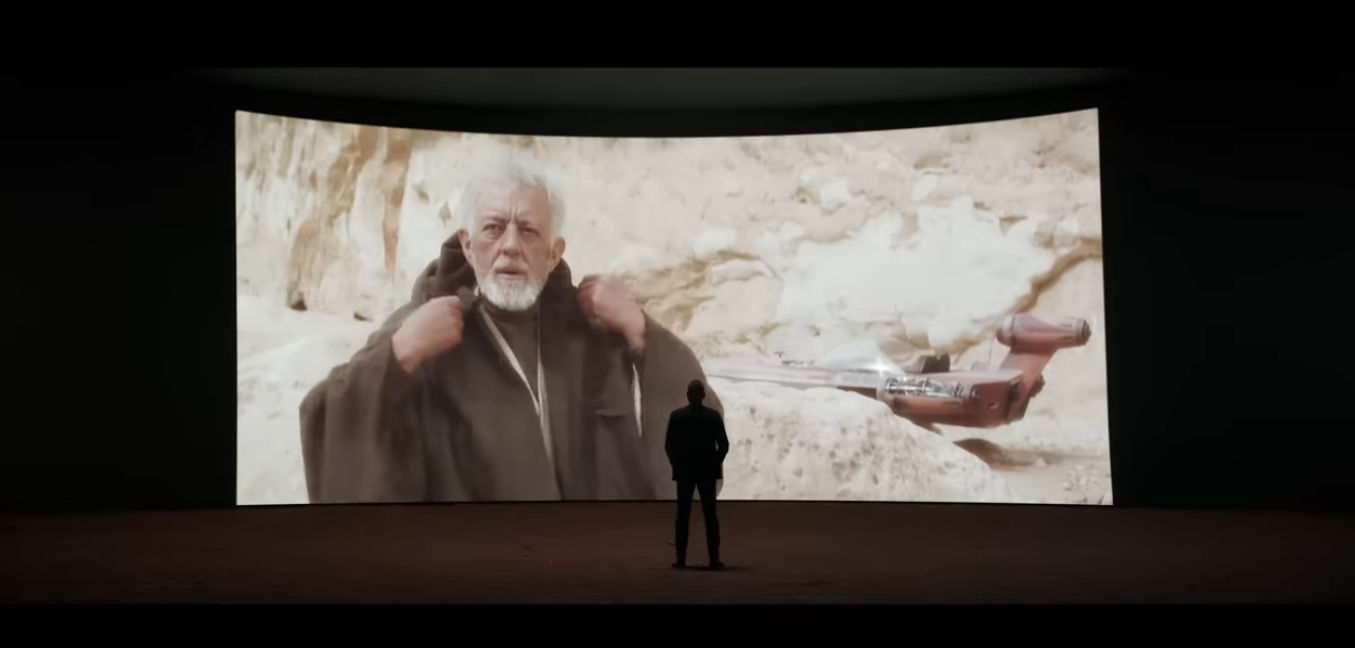
I’ve been thinking about applications of the metaverse and how those intersect with storytelling. One of the interesting characteristics of the metaverse is not just it as a place – with all the hardware and software trappings of avatar legs or not, realistic spaces or not, headset or not, basically what you can do and what you cannot do – but that it can impact your definition of self.
Premise: the metaverse is not just technology, the metaverse is how it makes you feel about yourself.
If you have Disney+, you may have seen Obi-Wan Kenobi: A Jedi’s Return, a documentary on the making of the Obi-Wan series.
I want to emphasize that this ‘original documentary special’ was directed by Deborah Chow, who also directed the series.
This isn’t just bits of archival footage patched together like how it was with the original Star Wars movies, although documentaries have now been re-made with a much greater story-telling focus. The same person who helped weave the story of Obi-Wan has also weaved the story of this documentary.
Storytelling: The Object Can Be Beyond A Place
This is a storytelling director telling a story.
Deborah Chow is in control and she knows what she wants you to see and feel. She plays up a visual theme that shows up over and over in this documentary:
An actor standing in and being impacted by a screen similar to the virtual production set: a space 21 feet tall, 75 foot diameter, run by 7 machines by ILM and Epic Games, with a 270-degree semicircular LED video wall called StageCraft, the LED Stage, or The Wall.
Image: Capture of The Wall from The Virtual Production of The Mandalorian.
Image: Depiction of how a virtual game engine camera can create a scene on demand.
To be very specific, there are many shots of Ewan McGregor, Hayden Christensen, and Deborah Chow standing in front of a very large screen and another camera is capturing their own faces & bodies while they are watching clips either from the Star Wars movie series or from the Obi-wan series. The implied idea is:
their emotions are your emotions.
They are feeling it like you are feeling it. Permission granted to forget that they acted in these visuals. They are sitting next to you now, eating popcorn, laughing, and getting teary eyed just the same as you. This theme is repeated over and over through the one hour.
Deborah Chow is making the point, I believe, that the Obi-Wan series was born and crafted crafted from existing Star Wars film lore. She’s not striking out new. She is claiming the heritage directly from the original Star Wars family. Also, she knows her series is #2 at bat; The Mandalorian came first. So the technical innovation of The Wall isn’t hers to claim. But she can show that she’s learning and growing from it as younger siblings often learn lessons from older siblings.
As the phrase goes, the early bird might get the word, but the second mouse gets the cheese.
Her innovation? She lets a Wall-like experience impact her characters in this documentary. This video has scenes from the teaser.
It’s the Wall as an actor emotionally experiences it. She takes the time to show you an actor’s face, body, and location near the Wall and then shows what the actor was seeing in that same moment.
She plays up the idea that Ewan McGregor had to study and pattern after Alec Guinness as an actor. He had to visualize who the character would be 10 years before the original Star Wars movies began. He’s impacted by the Wall. But when he does it, it gives you permission to do it.
She also plays up the re-meet of Hayden Christensen after more than decade separation; a person that’s older, wiser, and re-meets a colleague. Ever been there yourself?
Image: Capture of Hayden Christensen views the very beginning of A New Hope.
Image of Deborah Chow viewing an intense Hoth battle.
She’s using the Wall as not just something used to create surrounding scenes,
she’s using it to say ‘it impacts you.’
Image: A touching moment as Deborah Chow looks at the first introduction of Princess Leia.
Deborah Chow pointed up to The Wall and showed us that the metaverse is not just technology.
You could be forgiven if you thought that she was only going for nostalgia. ‘Isn’t this just wispy looks up to a screen?’
Image: Photo collage of Deborah Chow, Ewan McGregor, and Hayden Christensen looking up at screens. There is a faint glow of golden light on their faces.
No, I don’t think she is letting you off easily.
I think she’s saying ‘Obi-Wan’s story isn’t over yet. There is more. Come on, let’s find out.’
Image: Poster for Obi-Wan Kenobi: A Jedi’s Return documentary. Obi-Wan with back to viewer looks over a desert scene production set. Note that: this is not a Star Wars poster. This is a production poster; the Obi-Wan character sees the production crew.
Deborah Chow used the Wall as not just a scene but as an impact device. Disney is late and slow on their metaverse path. But they’ve been on their way as I talked about here. This deliberate storytelling combined with innovative technology is not a misstep.
The metaverse is not just a place you visit, it can impact your definition of self.
#Disney #Metaverse #TheWall #StageCraft #VirtualProduction #3D #Storytelling #ObiWanKenobi #Self #Define #Impact

Response post to: The Forgotten Stage of Human Progress
I’m knee deep in an XR implementation project. It’s going forward by
inches; each step aches with how small it is. If I measured it, it feels
like it would barely tick one mark on a stick. However, like a gardener
that makes one small snip here, one pull of a weed there, there is no
overnight transformation. But still– in the messy work of
IMPLEMENTATION, I’m making a garden that turns heads and makes people
think “I want to be there.”
Seriously, here is the garden:

Today is one of those days where it feels like we are going 2 steps backwards with no step forward. When you hear it mentioned quietly, but over and over and over, that one of the biggest implementation problems we have in XR for education is “sound” — WE ARE NOT KIDDING.
We have more problems with sound that with any other aspect of an experience. It is the TOP problem source.
Virbela had this problem in buckets. My hosts cringed every time I estimated that 20% of incoming users had sound problems. 20%! If YouTube had a 20% failure rate that they presented to users, they would far, far out of business by now.
I watched this video dated November 5, 2021 put out by Stanford University touting the first course taught in XR with Jeremy Bailenson where he claims it will be “an incredible journey for about half of this class”
Here is the video promo text:
“263 students, all with their own VR headsets, across 20 weeks and two courses, spent over 200,000 shared minutes together in the Metaverse. They engaged in large group field trips, small group discussions, performed live music and skits, and worked both alone and together to build their own virtual worlds.”
First: posed shot OR photoshopped image. Notice: no Zoom markings at all. It’s not “live”, people are not moving.

For someone like me with enough live event logistics and tech support experience, watching this video shows me that I suspected the course was riddled with sound problems.
The background music starts at 0:18, so “hearing” the students will be hard.
Watch for how much students were cordoned off into small groups (that’s not just a teaching method, that’s to put them soundwise AWAY from each other and minimize disruption) and then just listen to what you CAN hear of the sound provided in the video, you will get snippets and what you will hear will be blurbs of users acting more awkward and users waiting around on another user.
The “you made it” comment is somewhat telling. It is HARD to get users into XR. Admittedly, it might easier if you are at Stanford and everyone has an Oculus Quest 2 (Meta Quest). (smirk)

Privilege much?
At 1:14 there is a LOT of talk over and by 1:18 the video has been sped up to just overwhelm with ADDING models or processing to VR on the ENGAGE platform.
I’m not trying to douse flames of innovation here. But I’m trying to point out that implementation, as the Atlantic article points out, is a much messier, day-by-day process than the glitz and glamour of a moment.
The video shows THIS as what appears to be a class highlight moment.

The sound is a man speaking saying “Nice work everyone!”
Just let that sink in while looking at that image.
2021. Stanford University. That is one of our very best learning instituations, folks.
Ironically, all of the avatars with awkward arms ARE the users actually using headsets. That one avatar in the middle in the gray shirt with this hands at his sides? He is the one user in 2D, not a headset.
Snicker now, because he is the only one looking normal in this bunch.
Implementation is HARD!


Photo by Sophie Grieve-Williams on Unsplash
Hey, we’ll be having a Christmas party on December 18. You’re invited.
Actual party invitation

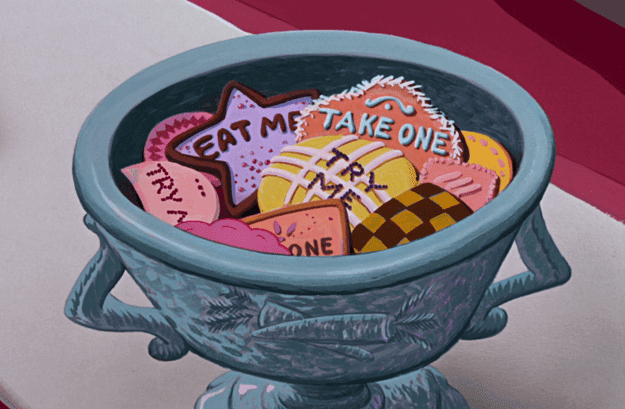
Now it’s a St. Nick’s Frosty Metaverse Party. I wonder if they served Metaverse cookies? 😣
Email:
Recently the concept of Education Metaverse is
sweeping the world. Lots of people are developing products and
researching on this topic. I have just co-published a concept paper on
Education Metaverse. If we can add Metaverse to our site, that would make it
more timely and trendy. Immersive Learning is the pedagogy underlying Education Metaverse. We just added Metaverse for Learning as a theme to (Anonymized Conference) 2022.
That’s an academic researcher advocating that an academic group should use a trendy word.
Metaverse Conference (not it’s real name)
Opening day (ahem, one day, but still). Opening seconds after 30 second countdown.
Camera goes on. Live microphone.
First word broadcast: “Shit.”
Presenter leans back in chair, takes earphones off, and says to someone back off camera, “What?”
Sighs quickly. Strips off headphones, jumps up out of chair, and runs out of room and off camera.
Dead air.
This is 9 a.m. local and 11 a.m. Eastern US time zone on a Thursday in mid-February. I’m just reminding you of that because I’m stating the point, as a conference organizer myself, that these folks were right in the sweet spot of being able to handle an emergency no-show. They had a 30 second jazzy countdown graphic, with music! They could have had a “green room” concept. They could have published their one-day schedule earlier before the conference so that each presenter had plenty of time to know exactly when they were on schedule. Their admin staff could have expressed the presentations times to the presenters in their own home/local time zone (that’s only polite). There are many support steps to prevent what happened—it’s not like this presenter was woken up at 3 a.m. to suddenly go on camera. That’s what I’m saying…
Presenter comes back into room.
With no apologizes starts talking about the difference between Mountain time and a new made-up phrase ‘Metaverse time’ (which turns out to be an old allusion, I think to Second Life time which was Pacific, where Second Life was headquartered, because the other co-presenter was an hour off…late, which can only be construed as Pacific time with reference to Mountain time.)
The next 30-40 minutes are a bit of a jumble as the original presenter patch-presents a ~15 minute introduction and then the intended host shows up and also presents at a first compacted and then expanded set of concepts (which is recycled from other conferences). The intended host, to my chagrin because I like him, doesn’t even know who is coming next on the schedule and when.
The rest of the day has only one session that I found grounded in research and practice. The other sessions wildly pushed the “technology” button for the Metaverse. ‘Want to get started in the Metaverse? Build something!!’ I was actually surprised how much the host college pushed their own technology classes, but then again, what are you going to get for free…
It appears that many attendees were newbies to Metaverse because they kept saying that the concepts were “new” to them.
A definite low-lite was when a fight broke out in the chat about the WHO. Yes, that WHO, (not the band or the Doctor.) I took a break at that point. It’s clear that politics is coming into the Metaverse with us.
There was one high-lite but I can’t say what it is without saying which conference it, therefore, was so I’ll let that go.
But over and over, institutions wonder why women and minorities do not feel welcome.
Revisit that first few seconds of broadcast. You had your chance, after weeks of social media buzz, to make an impact.
You did.
You advertised your quality.
In one word.
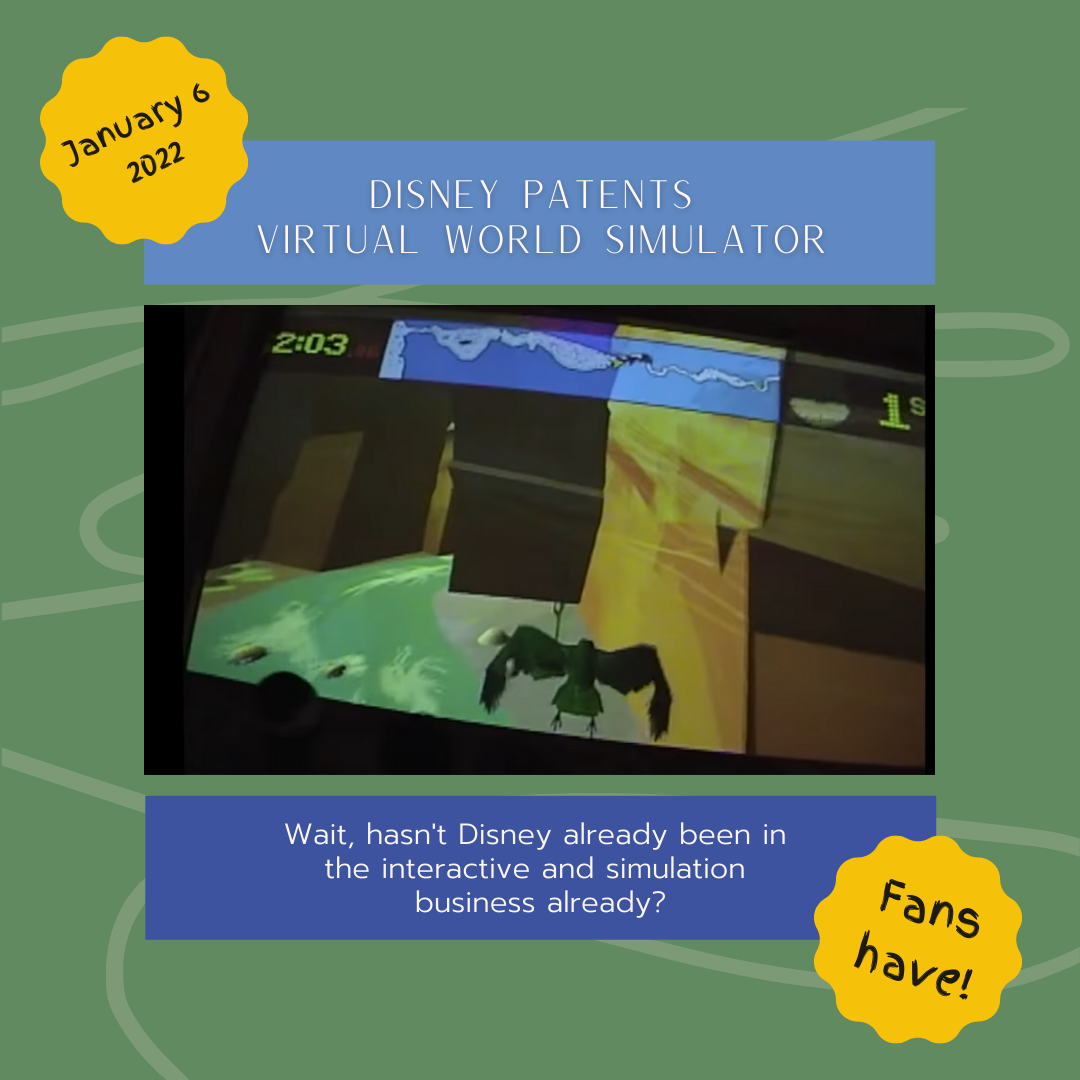

On January 6, 2022, Disney announced that it received a patent for what they called a Virtual World Simulator. Commentators on Twitter, Facebook, and blogs all began outputting opinions, most of them along the line of
“Is this Disney entering the metaverse?”
and
“Can Disney patent existing technology?”
Haters gonna hate.
Comment seen on Twitter:

Comments seen LinkedIn:

Matthew Wren on LinkedIn dug up the actual patent.
Both of us were reading it with an eye to “What makes this different or deserving of a patent?” To date, most commentators have their own ideas and this blog is represents my hypothesis.
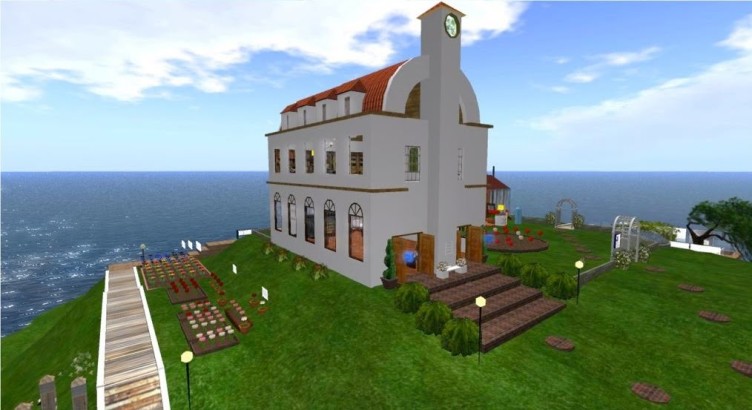

I purposely start articles with “A” when I mean to not be definitive but exemplary. In this case, I would like to pick out a few of the early education influencers and memories that I knew from Second Life (SL) (and Heritage Key, 3rd Rock Grid, OpenSim, and other early virtual worlds).
One of the observations that brings on this article (besides the true desire to give credit where credit is due) is that educators are starting to stream into the metaverse or cross reality (XR) – especially with the $299 Oculus headset cost and the pandemic forcing isolation – and I find that in education & XR development – there is a disturbing lack of knowledge of the foundation of virtual reality studies. That is, people that know about the role Second Life played in XR for learning research are not writing enough about it now so that what it did in the past is captured for the future.
Remember the ‘we stand on the shoulders of giants’ thing?
The giant is, in part, Second Life.
I would suggest that what is lacking in this background research is the fact that the vocabulary (and somewhat, the meaning) of words has changed so even a well-meant Google Scholar search might not pick up valid research from 10+ years ago because search terms were simply different words.
So, first – Search on virtual world (VW) as your primary term. Virtual world was a more dominant phrase than virtual reality. Other words to use: immersive, MUVE, multi-player online, persistent, HIVE (highly interactive virtual environments), online games, simulations, visualizations, online reenactments, distributed classrooms, and hypergrids. Indeed, find one good metastudy from ~2009 and you’ll probably hit the vocabulary jackpot. In researching this article, I found the term Sloodle which I had forgotten but that was an incorporation of SL into the Moodle course management system. You will find a great of research on identity, presence, and immersion with avatars (not so much with locations or “doing stuff” in VWs because object physics was/is very primitive and you can’t “do” too much there. There are pose balls, but really that’s a subject I’m not going to get into here). Bear in mind that headsets only existed in research so this was all what we would know in 2021 as 2D virtual reality or 2DVR (VR on flat screens, monitors, and tablets). Because there were few consumer headsets, there was no “us versus them” that you find now between 2D and Head Mounted Device-based (HMD) 3DVR.
Next, I very well realize that in some circles, Second Life causes giggling, either in derision (see the hype cycle image below) or in acknowledgement that SL did primarily serve the adult content market more than the education market. Sorry, but someone needs to write the obvious. Just recently, when the metaverse conversation popped up with some SL users on Twitter, they were adamant that they would never move to a platform that didn’t allow “adult content.” Second Life was never a place that you wanted to wander into the dark alleys as an educator. At least, if you did, you would learn some stuff you’d rather not know. The sexualization of Second Life is still prominent. Just do a google image search on second life. NSFW. Second Life was always a place for college and university educators (READ: Over 18 years of age).
 |
| Source: http://www.muvedesign.com/the-virtual-worlds-hype-cycle-for-2009/ |
Thus, educators tended to stick together. You heard about SL from another educator and you went in with them. I went in with a professional development group and had my first “meeting” in a hot tub at the Burning Life festival in SL in 2008.
There were some GREAT educator groups and some of them are still going! I mention my favorites:
Other groups still going but not necessarily education-focused nor restricted to Second Life:
Virtual Ability http://blog.virtualability.org/2021/08/by-gentle-heron-you-can-teleport-to-any.html
Non-profit Commons Community https://nonprofitcommons.avacon.org/
OpenSimulator Community Conference https://blog.inf.ed.ac.uk/atate/2021/10/31/oscc21/
Special shout out to independent journalists that still cover Second Life:
Ryan Schultz https://ryanschultz.com/
Daniel Voyager on Twitter @danielvoyager
Great “places to visit” included NASA, NOAA locations. Rockcliffe University Consortium, Glascow University Online, California State University, Chico (defunct? I think?). Then there were one-off builds that were also great like the Edgar Allen Poe House and the walk-through heart and colon.
During this same time, other virtual worlds were coming up and visiting them was fair game. My favorite was the short lived Heritage Key that needs to come back! That place was so cool and educational, you could visit Stonehenge over 5 different time periods and help build it
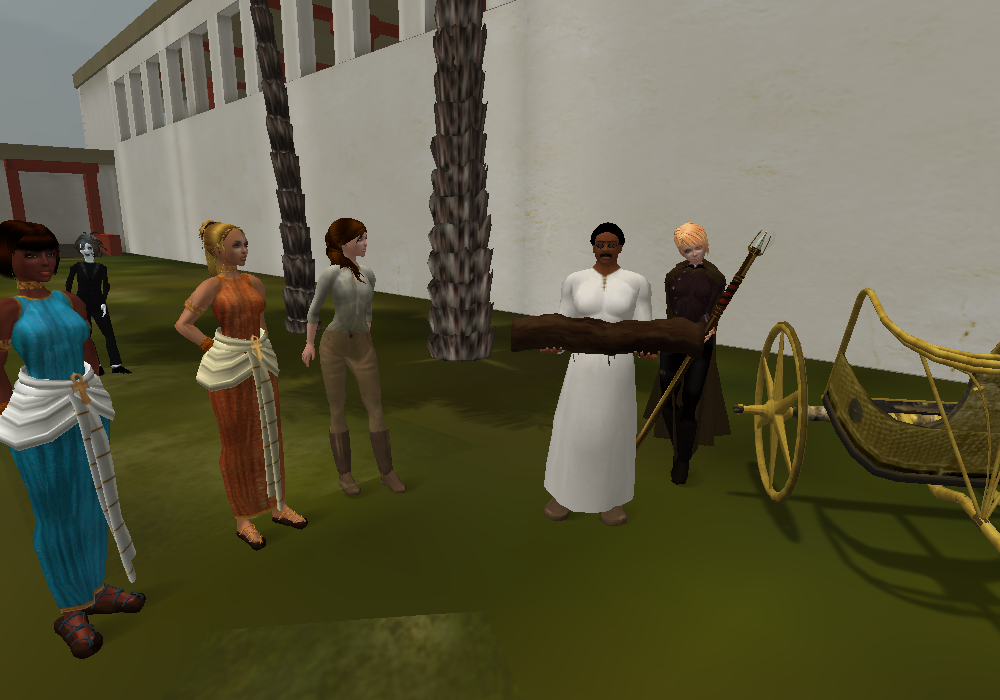 |
| What happens when 2 Egyptians, 2 Adventurers, 1 Druid and 1 Zombie all go to Ancient Thebes? |
There are many commentaries now. All of them have a piece of the truth. Probably the biggest factor was money. Hosting a grid literally cost money and universities had to pay for it. Over time, it just didn’t make sense to keep paying monthly for a place rarely visited.
College and university builds represented a huge investment of time. You should have heard how much the word “Primmy” was used back then. Primmy is short for primitive which meant the building blocks of virtual realities which are primitive shapes (spheres, cubes, columns, pyramids, etc.) Some clever instructors had their students do the builds and then called that assessment (I’m not calling that wrong, I’m just saying…clever.)
The locations, indeed, themselves brought on their own demise. Many builds became ghost towns because avatars would visit a “virtual campus” (OFTEN a replica of their real campus buildings (cough, mistake, cough) but walk inside the buildings that may or may not have had enough “prims” to put separate rooms inside those buildings, and so visitors found the building completely empty during off hours, wonder what the big deal was, and then leave.
This was one positive result of those early days. Many educators realized that “replicating reality” should NOT be the goal because for now, you’ll never get there. The human eye is too good at discrimination. But what you do want to do is the phantasmagorical.
Do the impossible. Virtual reality is very good at the impossible.
Remember this was before VR was called Social VR, so the ‘social’ part was truly touch and go. In SL, you either found groups of people or you didn’t. Most positive SL stories going around right now will involve relationships and groups. Truly today, I only go into SL for events. I hardly ever go in to just explore. It’s not built for that. What was it built for? Well, it had some characteristics that were interesting and unique. (Alt opinion here.)
First and foremost to me, every avatar is endowed as a creator. An educational psychologist I know immediately deemed this a “God complex” program. Indeed, every bell and whistle of creation (object creation and space manipulation) was available in the overwhelming UI. I’ve been a SL citizen for more than 10 years and still I don’t know what half of the UI choices are for. Even though I’ve done it a lot, I’m still not sure what rebaking does.
 |
| The original Second Life Ruth avatar |
The avatar customization is in Second Life (still) is top notch.
Seriously, OpenSim and Second Life have the best clothes’ animations! I once saw someone who wore a top hat to a Christmas party and the around the rim of the hat was a tiny puffing train! (If you are reading this and that was you, please reach out to me, I LOVED your hat!! I want a video of it!) But, I find Sandsar and sinespace is coming up fast on good clothes and avatars.
You can get married and divorced in Second Life. There are also active furry communities. I’ve got no comment on all of that. I would just remind everyone that what is in a virtual world is what you bring with you. It is definitely not all innocent and it is definitely not all healthy.
Even though you have creator controls, you cannot build just anywhere. Land is owned (permissioned) and you have to essentially pay to have land. Early objects were NOT copyright protected. So copying, stealing, and replicating was rampant. (Hat tip to Somnium Space, who addressed this problem from the very start by tying assets to NFTs.) I suspect a lot of artists hiked out of SL because their work didn’t stay under their control for long. For educators, there was an active “free sharing” market and I still wear my first set of “professional educators clothes” I picked up free from some place.
Hat tip to the word rezzing. I still use it. When I arrive somewhere, I rez in. The spot is the rez in spot. The current term in 2021 is “spawn point”. Yuck. I think this term, rez, should NOT be lost. Rez means resolving, which is what your avatar would do when it was still “coming into” the VR space. It’s the ghostly cloud you see here:
But I’d like to get to the tribute part of this tribute article. I would like especially point out the impact that John “Pathfinder” Lester had in Second Life. Everyone who was on staff for Linden Labs officially had a Linden last named avatar. John was Pathfinder Linden and all educators knew he was the one to talk to about ideas and problems. He “led the development of the education and healthcare markets while evangelizing the innovative use of virtual worlds in research, art and immersive learning.” Truly John cared and helped. I remember the day I sat next to his avatar at a meeting. I was so, so, so thrilled. But I never figured out why his avatar looked like a boot to me. It must be the eyelets and the shoestring. Apparently this is a bit of British culture I don’t know…that’s a character?
Early John:
 |
| Pathfinder Linden |
Many of us observed in stunned silence as Linden Labs pared down staff infamously. I watched in foreshadowing because I knew that it was like to work for a company that would drop you easily. I followed John’s blog “Be Cunning and Full of Tricks” closely during that time and noticed how he rebuilt his professional life.
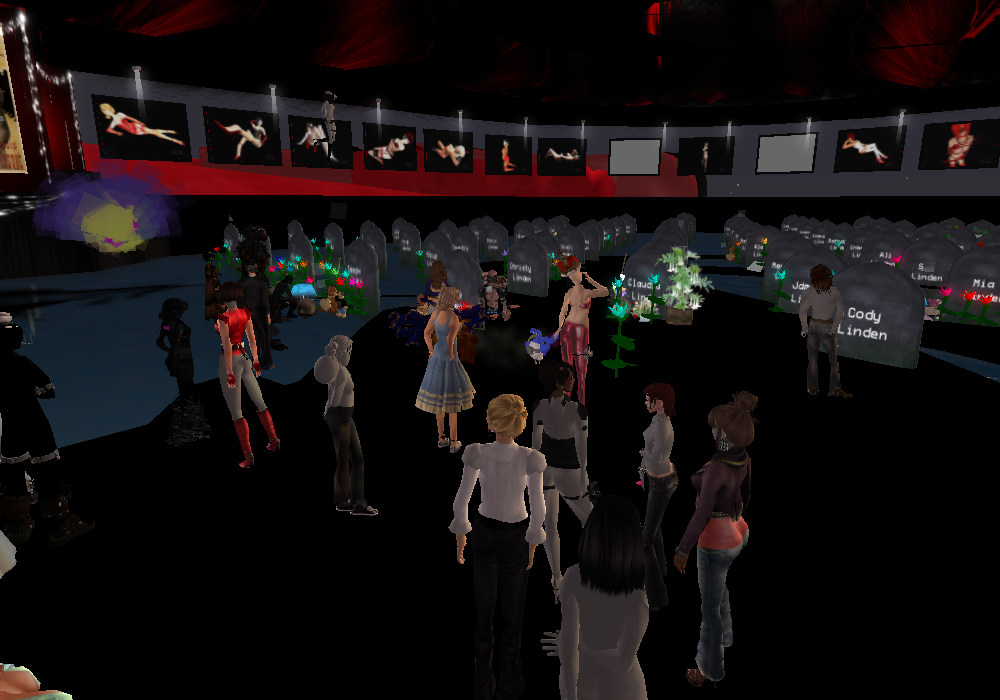
The Linden Graveyard. The fact that this place was made still haunts me.
John is doing well and every time I hear that he’s back near virtual worlds, I’m so pleased (and I’m still part of his fan club).
My last call of affection goes to the VWER Planning Committee of 2012. I’m still in touch with Evelyn. 🙂
So in response to the question: Is Second Life still around? Yes.
She has her children now, Sansar, sinespace, and High Fidelity.
See you in world!
#SecondLife #Metaverse #XR #VR #VirtualWorld #Avatar #Sansar #sinespace #HighFidelity #VWER #VWBPE #VirtualAbility #immersive #MUVE #multi-player online #persistent #HIVE #highlyinteractivevirtualenvironments #onlinegames #simulations #visualizations #onlinereenactments #distributedclassrooms #hypergrid #cyberspace
This article was posted simultaneously to my LinkedIn account on 11/23/2021. https://www.linkedin.com/pulse/tribute-second-life-yes-its-still-around-heather-dodds


