Tag: Metaverse

  • From Myths To Principles: Navigating Instructional Design in Immersive Environments Part 1 Introduction

    From Myths To Principles: Navigating Instructional Design in Immersive Environments Part 1 Introduction

    From Myths to Principles: Navigating Instructional Design in Immersive Environments

    Part 1 Introduction

    Decorative image with text: From Myths To Principles: Navigating Instructional Design in Immersive Environments with image of cloaked traveler on a mountian looking towards a break in gray clouds towards some buildings.

    This article begins a new series where I intend to continue to bust myths related to learning in immersive environments while also advocating for research-based decisions related to instructional design.

    Now if that sounded like gobbly-gook, this might not be the series for you. But, for anyone with an interest in virtual worlds, the metaverse, or even a simple 2D simulation and the uses of these for education, this is the RIGHT place for you.
     
    This is an updated version of my original 8-part Instructional Design in the Metaverse series. (Did you miss that? Here’s my 3 minute explainer video.) I estimate that I have at least 15 parts right now to start this series and new research comes in every day. However, this being my blog, I intend to spill a little more tea here than I do in other places.

    Buckle up buttercups
    !


    (more…)

  • Instructional Design in the Metaverse: Behind The Scenes

    Instructional Design in the Metaverse: Behind The Scenes


    Decorative image of a future metaverse city in blue and green tones.

    We should officially start our BTS story with the fact that this writing is a rejected academic book chapter.

    😱

    Rejected Book Chapter

    Yeah. No shame, however, tossed towards the editors.  Their decision gets to be their decision.

    I was unnerved that the editors were entirely China-based. I’m not saying one way or the other on that. Just that I’m aware that when political winds change, something that seemed like an OK idea at one point could become a very bad idea later.

    It was a bit of a strange call for chapters in the first place, putting
    ALL of the approval at the END of the writing process. I went through a
    review and a rewrite only to be informed after 8 months that my writing
    didn’t seem to fit what the editors were looking for.

    The only tip I’ll give about WHICH book it was was that I wrote a long section on myths and that aligned with the book’s title. 

    But…in the spirit of how the President of Stanford was brought down by
    what was originally a blog…I figured I’d go for it with
    self-publishing. Charging for a book? Right now, definitely not my
    style. Plus, I didn’t want to wait another 8 months for another academic
    publication process.  I told some of my ID friends that I would “juice
    it up” for LinkedIn and I did! The original chapter had NO images (strict publisher) and I
    whooped it up on LinkedIn with all kinds of visual “borrows” to help
    laymen deal with the academic language.

    Key Points

    1. Continuing to bang my drum on the 3 characteristics that make XR builds successful: reducing time, money, and/or danger.
    2. A focus on plot as the driving theme of an educational XR experience.
    3. A focus on purpose at every step in the process.

    And
    these 3 items are not new for me to say. I’ve been trying to get them
    into the academy since 2013 with my dissertation, or maybe a little
    earlier in a few mucky conference papers.

    Misinformation

    In my opinion, I pissed off some of both the XR research and XR industry stakeholders. And I got two rebuttals. The most attention and chuckling came from me doing a TLDR on the myth section and just coming out and saying

    Virtual Reality Causes Faster Learning – Myth

    That was surprising– mostly because I don’t expect to turn any aircraft carriers with that language. Did I? Time will tell.

    Indeed, support for and any engagement with the articles dropped off over time. It was as though literally if one posted ANYTHING with the word Metaverse it in, a whole crowd of whoopdeedooers would drop by, hit the clap button, wish you well and…disappear.  I mean I felt I wrote some uplifting, helpful, and cheap (for the price) advice in the latter articles and there…crickets.

    Coda

    There is too much XR-for-education misinformation going on out there for me to remain quiet on some of this shit.

    Just this morning, I woke up to find fresh serving in my LinkedIn feed.  It’s like I want to take a break from writing but the crap keeps flowing in the door.

    Screen capture of "report" text: The numbers show that virtual reality in the workplace can improve communication, togetherness, output satisfaction, and the experience of working together in virtual workshops.


    In one sentence, nearly every good research rule is broken:

    The numbers show that virtual reality in the workplace can improve communication, togetherness, output satisfaction, and the experience of working together in virtual workshops.

    “The numbers show” – that’s an appeal to research results.  What they mean is THEIR numbers from THEIR study which was not really structured as research at all. It was structured as a rah-rah-sis-boom-bah don’t-we-love-the-newest-shiniest-thing data collection exercise.

    “Improve communication” – how? how measured?

    Improve [implied] togetherness – how measured?

    Improve [implied] output satisfaction – that is a “like” study, which means nothing to productivity. Tricky there….using “output” to make you think these might be widgets. Nope.

    Improve [implied] the experience of working together in virtual workshops.  You know what ALSO improves the experience of working together in virtual workshops? Free food.

    All that implication was a bit of a grammatical somersault but alas, it is what it is. 

    Hopefully if you understood my point, you’d see that these “numbers” refer to novelty effect.  Pretty much on the nail head.  People had fun because it was new. It won’t always be new, so be careful. 

    AI

    Because I wrote and published this article series in 2023, a valid question must be asked: 

    Did I use AI at all in the writing of this?
    Answer: Yes. And I’ll tell you exactly where.

    When I was proofreading myself (so long after finishing writing), I wanted to check on a somewhat novel phrase that I was using (coining?) just to make sure that my intended meaning matched what others might think it means.

    I asked Bing to clarify the difference between these 2 phrases:

    • Non-cognitively comparable methods
    • Non-comparable cognitive methods

    Sure enough, Bing helped clarify that the ‘non-‘ in front is the item negated. That is:
    Non-cognitively comparable means that something is comparable but the DIFFERENCE is in the cognition. That’s exactly what I meant; the brain burden is different.  This occurs when studies try to compare textbook learning to VR learning. It’s non-cognitively comparable. Therefore, null results. It’s like dividing by zero.

    Non-comparable cognitive methods assumes that both methods are cognitive (yeah, duh) but that they are not comparable. No, that’s NOT what I meant. People try comparing like crazy, even if I don’t like.

    So I stuck with my original writing and phrase: non-cognitively comparable.

    And that’s the only AI I knowingly used. It’s possible that Google Scholar had some AI with reference writing?? But I don’t know that. That’s sort of pre-AI because really a reference is just an act of putting the right thing in the right place with the right formatting. It can be driven by code…not by some sort of intelligence.

    I did use Midjourney to make the artwork but that was completely separate from the writing (and was really fun and educational!)

    Conclusion

    In summary, in over 12,000 words, is there anything more I can say that I didn’t cover?

    Yes.

    I sincerely hope that my freely given advice is not lost on decision makers. I constantly write for someone with her hands on a multi-thousands or multi-millions of dollars budget  and she needs to KNOW WHAT TO DECIDE when she gets an XR or virtual reality for education proposal on her desk.

    I wrote all of this with NO tie to money whatsoever. I’m not employed. I do not work for a company that will sell you XR.  I’m not working as an instructional designer pushing XR choices on my bosses.  LinkedIn articles, unlike Medium articles, provide NO pay-per-click (although, to be fair Medium pays less than pennies per click..so comparing pennies to nothing is a bit of a low blow). I do not have a monetized YouTube account. I don’t have anything social media wise that makes me money.  I’m “employed” at my own Consulting business but that is just a front to make me “look” employed to LinkedIn. I’ve done no work for pay in 2023. Actually, during the writing and publication, I don’t own a car so I used the public bus and I utilized the provisions of a food pantry.  

    I have nothing at stake to sway a person one way or another. I’m simply calling out where the research points. I do hope it will be of value to someone.

    Here’s my LinkedIn video summary of the 8 articles. In under 3 minutes, you can get it all! The bad news? It will come at you VERY fast. 

  • Instructional Design in the Metaverse Part 8

    Instructional Design in the Metaverse Part 8

    Decorative image: Our metaverse explorer heads off into the golden sun.

    What fights won’t we fight? What is our secret weapon? And what lies ahead? It’s the final part of this series. 

    (more…)

  • Instructional Design in the Metaverse Part 7 Design and Build

    Instructional Design in the Metaverse Part 7 Design and Build


    Decorative image with text: Instructional Design in the Metaverse. Midjourney and me, and the mid-point is now behind us.

    Heading out with purpose, emotion, and awareness of real world.

    At this point, we have all of the building blocks ready to begin a design. We know what works from 2D learning and what to try with 3D learning. Beginning the steps to launch an XR experience can feel more like a User Experience (UX) project than an instructional design project, however. UX similarly uses storyboards, journey mapping, and personas which can be very helpful in designing emotion into the experience. Prototype versions can be ready for a few users to sample and give feedback. Overall, ID projects in the metaverse feel different because the designing and building phases blend together with test layouts requiring adjustment.

    Even at the final project launch, instructional designers (IDs) should observe how the learners are experiencing the design. IDs should be at the forefront with the learners, constantly evaluating what is working and what is not. It can be very helpful for IDs to observe what learners try first or how they explore the experience. In this way, design with this media is less of a one-way instance and more of an ongoing process. Remember D. Clark’s ‘always beginning, never ending’ design advice? The following three sections represent lessons already learned in ID for XR designs.

    1 Focus on Purpose

    Determining purpose at the earliest stage is critical because the purpose guides many of the upcoming ID decisions. Traditional ID projects begin with these questions that ask about the main learning objective or goal.

    • “What will students be able to do at the end of the course” (Stanford University, 2023).

    • “Focus on performance requirements” (Guy Wallace as quoted in Washburn, 2023).

    • “Identify desired results” (MIT Teaching and Learning Lab, 2023).

    • “Think about what people are truly trying to do and realize that’s a system” (Don Norman as quoted in Faller, 2017).

    However, because the metaverse is an experience for the learners, it can be thought of as a place and time; it is like a field trip. 


    Photo interior of the Sistine Chapel with painted walls and ceiling.

    Sistine Chapel (actual)

    Here is an example: An art history instructor wants to recreate a visit to the Sistine Chapel. Rather than first creating an XR building or finding an XR recreated chapel, the ID can determine what is the most important experience for the learner. It could be:

    • Appreciating Michelangelo’s artistic style

    • Imagining how the artist would have painted in the space

    • Discussing the role of sponsors for art

    • Viewing the artwork like real life (looking up)

    Each of those different purposes could generate a different learning design.

    Let’s say the instructor wants to emphasize viewing the artwork within the chapel, on the curved ceiling and the soaring upper walls and how this viewing angle intersects with perspective. Noting prior experiences, learners might have only seen this art somewhat straight-on from photographs. 


    Photo of the Noah ceiling bay at the Sistine Chapel. Viewing straight up into a ceiling bay. Note that from this view, both left and right are looking down, even when you are looking up.


    Viewing straight up into a ceiling bay. Note now from this view, both left and right are looking down, even when you are looking up. Michelangelo?! Escher much?

    In real life, the art appears above the viewer. Thus, there are two different points to view from: in photographs, the view is from what would be mid-air. In real life, the view is from the ground. 


    The Noah bay in context of the full ceiling where the shadow effect of a left and right curving side now make more visual sense above the chapel walls.

    Same ceiling bay, showing how the side pieces appear to “curve down” to vertical walls, creating a left/right sides illusion. So…WHAT is the PURPOSE you want to teach?

    In XR, designers could use either or both. The learners might be able to first view the artwork from the floor and then fly and compare looking at the art from mid-air. In this way, the learners will have comparative viewing from different angles
something that the real life Chapel can not easily provide. This satisfies the instructor’s request to focus on the viewing experience by providing a standard replication and then a different angle as comparison. 


    Side by side photo comparison of the real Sistine Chapel and a virtual Sistine Chapel. Except for some light, nearly indistinguishable from each other.

    Side by side photo comparison of the real Sistine Chapel and a virtual Sistine Chapel. Except for some light, nearly indistinguishable from each other. 

    A virtual Sistine Chapel is for sale at Sketchfab

    Sistine Chapel – virtual is for sale for $39 US at Sketchfab

    By thinking about the learner’s experience, the designer can start to list which aspects of the real world need to be replicated (e.g., gravity, enclosed space) and which aspects will not be from reality (e.g. flying on demand). In summary, this adage fits: begin with the end in mind.

    For XR designs, ask “what is the feeling that you want your learner to have?” That might come as a surprise– elevating feeling as a primary design priority. The next section will address why the feel of an XR design is more important than its content.

    2 Emotion Transcends Language

    Pixar is a highly successful storytelling company. In the Pixar narrative model, the highest production emphasis is placed on the emotions within the story (Khan Academy Labs, 2017). Characters and setting are considered secondarily. 


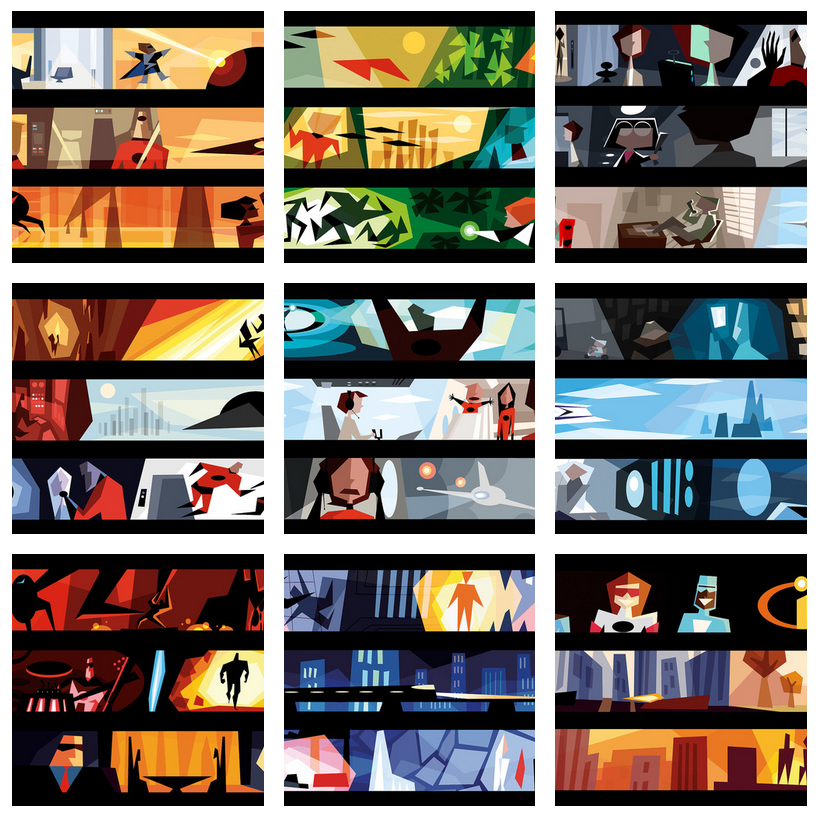
    Lou Romano created wordless, colored storyboards for The Incredibles based on a 1960s esthetic. It worked

    Lou Romano created wordless, colored storyboards for The Incredibles based on a 1960s esthetic. It worked. Everyone else could build from these emotion-evoking images.

    Emotional coinage works in XR storytelling because emotion transcends language; it does not need a text pop-up or an AI translator.

    When an emotion can be relayed in some sort of visual or sound media, the designer can worry less about language translation or exactness in the metaverse. XR works naturally in this realm. Combining emotion with narrative plot creates designs where the learner is truly at the center because the learner becomes the lead character in the story. They are pulled along the learning journey because their character (their avatar) is experiencing the story. 


    Disney advertising graphic from Secrets of the Empire, Star Wars. A robot gestures to children to help in the fight against Star Troopers.

    Credit: Disney. Concept art showing 3 great things: 1 A clear “invite” to join the story 2 Headsets and non-headset users portrayed simultaneously. 3 Girls clearly invited, who are, apparently, good shots.

    Alger illustrated these atomic design elements used to relay emotion: line, color, motion, lighting, spatial arrangement, sound timbre, haptic sensations, user proprioception, or visual elements like iridescence and specularity (2020). 


    Four panel graphic with text: How design creates feeling with examples from line, color, movement, and form/shape. Credit: Alger 2020.

    Just the basics of visual design, there is so much more for XR including sound design, body movement and placement, temperature and pressure, and smell!

    IDs might want to work with designers from industrial or interior design, architects, or public space planners. [Hot tip: want to read more? The Internet Library has The Pocket Universal Principles Of Design 150 Essential Tools.

    Capture from inside  The Pocket Universal Principles Of Design 150 Essential Tools with diagram showing that high ceilings evoke creativity and low ceilings foster focus.

    I like this page particularly linking ceiling height with “feeling” in spaces, proposing the high ceilings spur creativity whereas low ceilings foster focus.

    In planning a design, IDs can ask the instructor what the main emotion is that they want their learners to feel within the space (curiosity, happiness, fear, proficiency, etc.).

    The emotions can, of course, change as the story changes. In prototypes, IDs should ask learners what feelings they have in the XR space. Does the feeling match the purpose/goal? If not, the design needs to be changed to foster the emotion that is intended.

    3 Real World Correlation

    After the purpose is established and the central emotions are noted for a learning experience, the ID can determine how much of a real world correlation there is to the XR experience.

    For instance, when coming up against a design challenge in XR, IDs should ask, “How is this done in the real world?”

    The answer might be that the learner does a behavior (e.g. takes notes or alters a piece of equipment) or retrieves more information (e.g. looks at a reference source). With some consideration, the real world solution can be strategized together with the Multimedia Principles and created in XR. For example, if learners are struggling to remember a series of steps, do they need a nearby poster as a visual aid? If learners are getting something wrong with timing, do they need a stopwatch or clock? In XR, posters and clocks do not need to necessarily hang on walls

    Capture from a rabbit counting experience. The timer appears in the upper left corner indicating 33 seconds left. Timers and clocks can be placed anywhere in XR. 

    Timer appears in the upper left corner, but it could be placed anywhere, or appear on demand.

    Combining what we already know from the Multimedia Principles will maximize the opportunity to learn by placing the relevant information when and where the learner will need it.

    Starting with real world correlations is the healthy first step, but next, the IDs should consider what affordances XR can further provide. For example, do the learners need to fly or go inside an object? XR easily provides the ability to go through what would be solid objects like walls. Referring to a prior example, if a learner needs access to a clock, can a floating one be put into the learner’s field of view, but not necessarily on a wall or wrist? By imagining the experience in pieces or segments, an ID can deconstruct what is necessary to drive the experience along and then rebuild those segments with the added possibilities of 3D design.

    Here is another example: an experience is replicating a spacewalk in outer space. The learning objective is to have the learner follow the correct procedure despite stressful conditions. The learner needs to put on a space suit following the correct procedure and check it for safety before leaving the spaceship. The emotional tone is to be calm and methodical even if the situation is urgent. What is the real world correlation to this experience? It might be donning protective equipment at a cold weather research station. This is a cognitively correlated event; the thought process is very similar. Thus, we can use this real world event to drive the design of the XR event. Items need to be put on in a certain order and checked for safety before going outside. 


    Graphic with text: Analogous experiences showing that protective clothing for astronauts and Antarctic visitors are similar. Therefore, we could use the latter to help build XR instructions for the former.

    Bundle up, baby, it’s cold outside.

    The XR design might want to include an alarm sound or flashing light to create urgency. Some sort of ‘buddy check’ system might stand by so that after the learner puts on the equipment, it is checked by another entity. Including alarms and safety checks are correlations to real world elements that can be built into the experience. The details of surrounding walls and floors or what is happening outside the spaceship do not influence this learning event. Mayer (2020) refers to these as seductive details – interesting, but they detract from the learning. Therefore, those details can be minimized in the surrounding design.


    Part 8 is the last part!! It will acknowledge the limitations of what we know from research so far. But I’ve tucked one of my best tips into Part 8 before I conclude. Stay tuned, fellow babies*, for one last time.


    Decorative image: Prompt: Wide angle shot from the side, in the style of full color charcoal and Legend of Zelda game cover art, a female profile in a hooded cloak climbing up a mountain towards light, she carries a flame in one hand, in the style of deep indigo, light silver, enchanting lighting, blue and green color scheme –ar 16:9


    Part 1 was the Introduction.

    Part 2 covered Theory and Scope.

    Part 3 was Myths versus Reality.

    Part 4 covered the Characteristics of Success.

    Part 5 was What is the same between 2D and 3D design?

    Part 6 was What is different between 2D and 3D design?

    Want to see my full references? Have at it.

    *Apologies if you don’t catch the reference to Johnny Fever from WKRP where groups of people were “fellow babies”.

    ##InstructionalDesign #XR #Multimedia #Principles #Mayer #LXD #ID #InstructionalDesigner #WebXR #3D #2D #Approach #LearnerCentric #NarrativePlot #Storytelling #Purpose #Design #Emotion #PrinciplesOfDesign #RealWorld #Correlation #edtech #DonNorman #GuyWallace

  • Instructional Design in the Metaverse Part 6 What is Different?

    Instructional Design in the Metaverse Part 6 What is Different?


    Decorative image with text: Instructional Design in the Metaverse. Our metaverse explorer leaves the laboratory with the secrets to design and she heads out into the dark world.

    Welcome to Part 6! Are you alive? By my calculation, when this goes live, 3 intrepid souls have read all of Parts 1-5 before this. (Insert laughter with tears). Indeed, you may have found this in isolation of the other parts! That’s OK, I’m cool with modularization. Feel free to “go around the Horn” at some other point in the future and read Parts 1-5 later.

    Oh! And, for those 3 travelers AND everyone else, I am making an explainer video of all of this content. But it comes with 2 caveats:

    1. No references or quotes. Just ideas.

    2. Because it moves with a preset piece of music, each idea will have a limited amount of screen time: 2.4 seconds, to be precise.

    Finally, I’ll probably write a full BTS (Behind The Scenes) on this article series on my blog. For those of you that love BTS content, that one will be for you. Translation: these articles were NOT written to be sound-bite worthy.  What I write in the BTS will be.

    This is basically the second of two parts that were originally together: Part 5 is what is the SAME about designing between 2D and 3D and this is what is different.

    Long story short?

    Here is where the fun begins.

    Gif of Anakin Skywalker saying This is where the fun begins.

    2D to 3D: What Is Different

    A learner could learn from a book how to enter a store and buy something. A learner could also learn from entering a real store and buying something. Both are ways to complete the learning, but the designs– that is, how to structure the learning from start to finish, will be different. The book is analogous to direct instruction. There are times when direct instruction will be the better approach. The real store is analogous to experiential learning. There are times when experiential learning will be the better approach. The approaches are different; there is no inherently better approach for all situations.  

    These elements in this section are not meant to imply that they exclusively belong to XR media. That is, many other forms of media contain these same elements. These items are listed here because they are often found within and indeed are combined in design solutions in XR.

    1 Narrative Plot

    Clark and Mayer observed that humans are sense makers and attempt to derive meaning from life experiences (2016). Learners engage in making meaningful connections when words and pictures align during experiences. Meaning is also deeply embedded in the storytelling approach, where it is often the journey that the protagonist goes through that remains memorable long after a story has ended. D. Clark argued, “learning experiences are exactly that, experiences designed to change us, specifically our long term memories” (2022, p. 7). Further, D. Clark advocated for a balanced use of storytelling, explaining that it can bring life to dry information, but should not be overused and wander into a “Disneyfication of learning as entertainment” (2022, p. 7). Lastly, D. Clark argued that stories for learning should be designed as “always beginnings, never ends-in-themselves” if the learning is to be applicable beyond the experience, into the “long tail of practice, transfer, and performance” (2022, p. 7).

    Points for poetry, D. Clark! 

     â€œalways beginnings, never ends-in-themselves”


    Decorative Image: Our metaverse explorer is exchanging stories with other storytellers.

    Humans crave stories that bring meaning


    Indeed, the storytelling approach in learning pulls the learner through the experience. To use storytelling, the learner should experience a flow through their experience, a beginning and middle of the story. The end could happen in XR or more substantially outside of XR into desired application. The learning experience should be planned and not haphazard. Learners should be guided on a planned route. XR storytelling can be first person or group experiences. Regardless, each learner is a protagonist; their decisions determine what they will experience. Recalling the constructivist learning theory foundation, what the learners experience becomes the learning experience that is being designed for. If learners are exposed to situations where they actively construct their knowledge, then the reality that the learners construct was constructed by them, not constructed by the media or by others. Further, learners do not arrive as empty vessels to be passively filled with information if they are the protagonists of their own learning event. Learners add, sort, emphasize, or suppress new experiences when compared to old experiences.  Subsequently, a learner already experienced in real life (non-XR) is bringing those experiences into XR with them. In summary, learners arrive already ready to experience a story. Thus, narrative plot or a story arc is a good approach to XR instructional design.

    Plot, narrative, or narrative plot are all descriptions of phases within storytelling. There are slight variances in names but the phases generally focus on the user’s (or in our case, the learner’s) experience (Lichaw, 2016). 

    Narrative Plot steps from Lichaw: Exposition, Inciting incident,  Rising action, Crisis, Climax, Denoument, End.

    If you remember nothing else about designing educational XR, remember this.  Credit: Lichaw, 2016.

    These phases describe what is happening to the protagonist. In the case of XR, the learner is the star and they should be brought through these phases in an effective design plan. Table 1 compares a storytelling arc with the Pixar story arc, a story arc example of Cinderella, an XR story arc, and an XR narrative plot example. 

    Examples of the storytelling arc of 6 steps: Literary, Pixar, Cinderella, XR template, and XR example

    Examples of the storytelling arc of 6 steps: Literary, Pixar, Cinderella, XR template, and XR example

    Pixar story arc from Khan Academy. (2017). Pixar in a box: Introduction to storytelling [Video]. YouTube. https://youtu.be/1rMnzNZkIX0 Cinderella story arc derived from Kurt Vonnegut, as documented by Derek Sivers. (2009, September 1). https://sive.rs/drama

    Example of Narrative Plot in XR

    Introduction. The who, what, where, why, when of the experience is explained. The scene opens. This starts before the digital experience begins and lasts 30 seconds to a few minutes into the experience, depending on how much needs to be explained. This is the beginning of the exposition.

    Set the scene. Provide guidance on the affordances within the experience, how to communicate, walk, navigate, where is help (e.g. where is a digital companion). The learner is invited to move, change appearance, and communicate.

    Dilemma. Introduce the conflict or the scenario that the learner will participate in. The learner is presented with a challenge or problem. This is the inciting incident and rising action phases. This can be a great time to guide and practice small solutions to small problems.

    Crisis. The learner must act and initiate some sort of change. It is action-oriented, and the learner is on center stage.

    Change or Denouement. The results of the change have an impact on consequences or the environment. Said another way, the change ripples through the experience to change it for the learner. The results are non-trivial and not haphazard.

    Resolution or End. The mission is complete, and the world has changed around the learner. The learner is living out the consequences of their decision.

    Some research has shown that most of the instructional emphasis does not need to be within the XR experience itself. Dede (2021), when reflecting on what he now believes after over five decades of immersive learning research, said:

    “I used to believe that if you had resources, you should spend 95% of the resources on the immersive experience and then you just do a little thinking about what kind of induction you use before people go into immersion and what kind of post experience debriefing you do.  I’ve come to believe now that the induction and debriefing is where the learning takes place predominantly, and so designing those is very important.”

    This indicates the importance of the on-boarding and the follow up experiences. The story of an experience begins before something is activated and ends long after.

    The main point of keeping a narrative plot mindset in ID XR design is to keep the learner at the center of the experience. Every step of the narrative plot approach focuses on what the protagonist- that is, the learner- experiences: dilemmas, crisis, change, etc. This approach, then, keeps the ID focused on the learner’s experience, not the technology. For example, let’s say a platform can recreate the school environment down to the desks and chairs. An ID might reason, ‘This a great place to hold a class! I can assign classes to virtual rooms and the instructor can use web-sharing boards.’ 


    Capture of a classroom in virtual reality, complete with desks, chairs, and chalkboard.

    Don’t try this in VR

    That approach puts the technology first and does not consider the learner. It also recreates the problems of regular in-person classrooms and throws in a few more virtual problems as well (i.e., poor internet connections might have avatars distractedly appearing and disappearing). Rather, a learner-centric approach might ask “What is the main experience or emotion that the instructor wants the learners to have in this lesson?” As Mayer stated, “How can we adapt multimedia technology to aid human cognition?” (2020, p. 15). This might cause the ID to look at the entire XR event differently and not recommend a virtual classroom. There is more on emotion in design in Section 5.2.

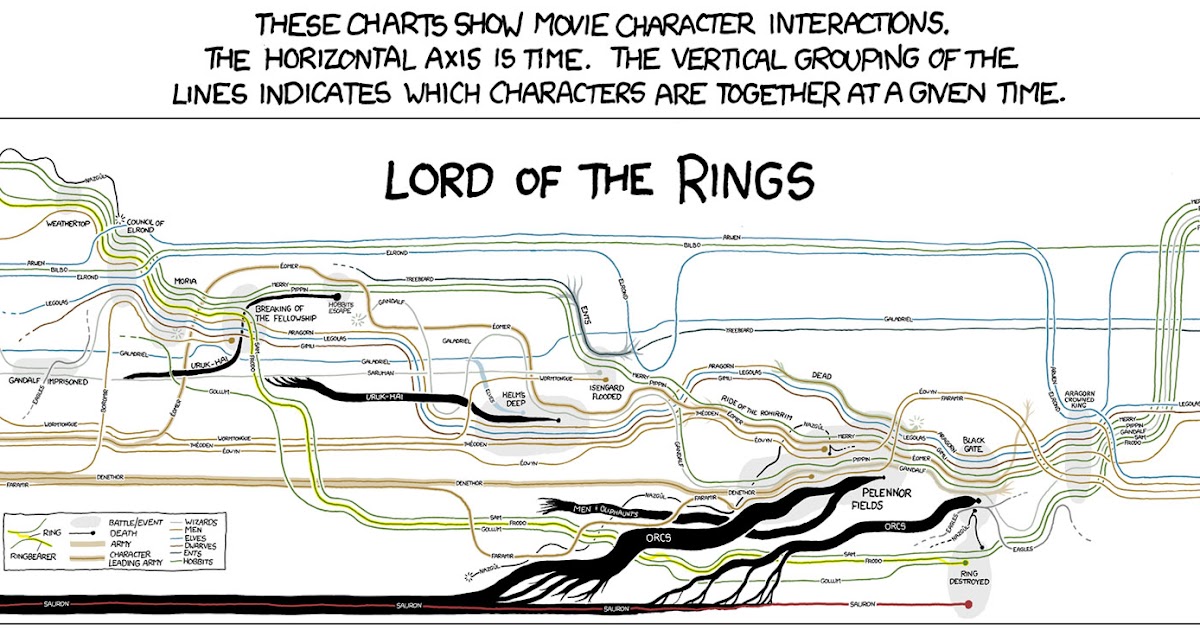
    Lord of the Rings Narrative Plot Diagram. Basical huge spaghetti.

     Credit: https://fbvisualisation.blogspot.com/2014/04/narrative-charts-tell-tale.html

    2 Visual and Sound Range

    For the ID, the added visual depth and sound possibilities beyond 2D must be designed. However, more to design means more risk. With XR, the added ability to put information anywhere has more risk of overwhelming the learner than helping the learner. Indeed, D. Clark (2022) agrees that Mayer’s Principles lean towards less is more.

    2.1 Visuals

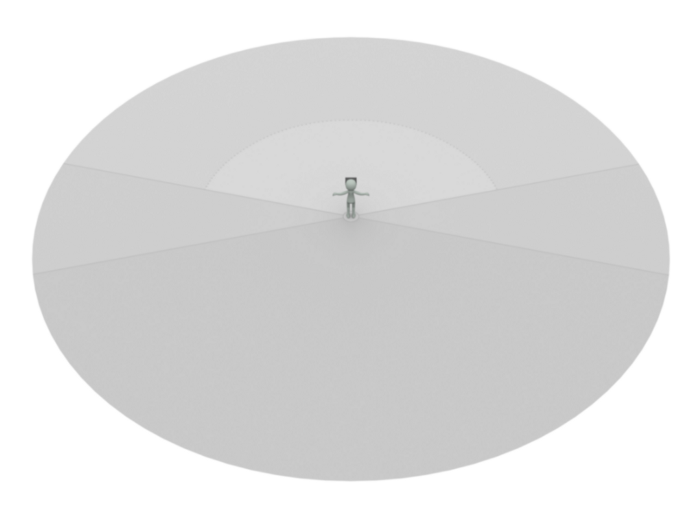
    Alger (2015) noted these basic principles for visual range called the Comfortable Content Zone: 77 degrees of viewing range side to side and a range of 0.5 to 20 meters in depth. There are Periphery Zones to the sides and above, but the learner should be only prompted to use those. 

    Diagram showing that main content should be placed between 0.5m and 20m to the front of the user. The sides are the peripheral zone and the back/behind is the curiosity zone. Anything within 0.5 of the user is the no-no zone, meaning put nothing there.

     Credit: Alger, 2015

    This reflects real life. If one was working at a workstation, critical information would be within easy viewing and reach. Other information could be available in what Alger calls the Curiosity Zone – behind and below the learner, but learners should be prompted, as in real life, by sound, light, or foreknowledge, to engage with that non-obvious space (2015).

    Alger (2015) further proposes that the visual hierarchy matches the importance of information. To find information in 3D, we look at the center ahead first, then left and right, then below, then above, then finally at our own bodies. Everything above eye level is for things beyond the learner’s control like weather, time, or authority notifications. Everything at or below eye level is within the learner’s control.

    Caption describes gif.
    Basic visualization of where a VR user would look for something; first center ahead, then left and right, then above and finally at the user’s own body.

    These user interface principles skew towards conservatism in detail; less is better. IDs should design minimal spaces, with prompts, and within easy arm reach. IDs can create storyboards with isomorphic qualities that both curve around the learner and contain planning space for the foreground, mid-ground, and background visuals.

    Capture showing how designs expand between foreground, midground and background.

    Credit: Alger, 2015.
     
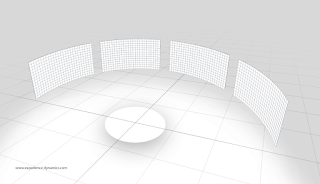
    Credit for below: ExperienceDynamics.com but I received these XR storyboards from the Interaction Design Foundation.
    XR storyboards, blank and capable of showing 3 scenes; the idea might be one scene per step in narrative plot.
     

    A center grid pattern has 4 rectangular grids out in front showing design spaces to use in XR around a user.

    Another type of XR storyboard; this showing 4 possible areas for the user to look at.
    Single scene XR Storyboard, emphasis on zones around the user.

    A single XR scene storyboard. Emphasis on the zones around the user.

    2.2 Sound

    Immersive sound is a rising field within XR design. Poor sound can ruin an XR experience. Experiences can have spatial sound where the loudness drops off over virtual distance or flat sound where the loudness is the same throughout the entire space. As much as possible, it is good accessible practice that all senses should have learner controls: brightness, sound, movement, and intensity. 

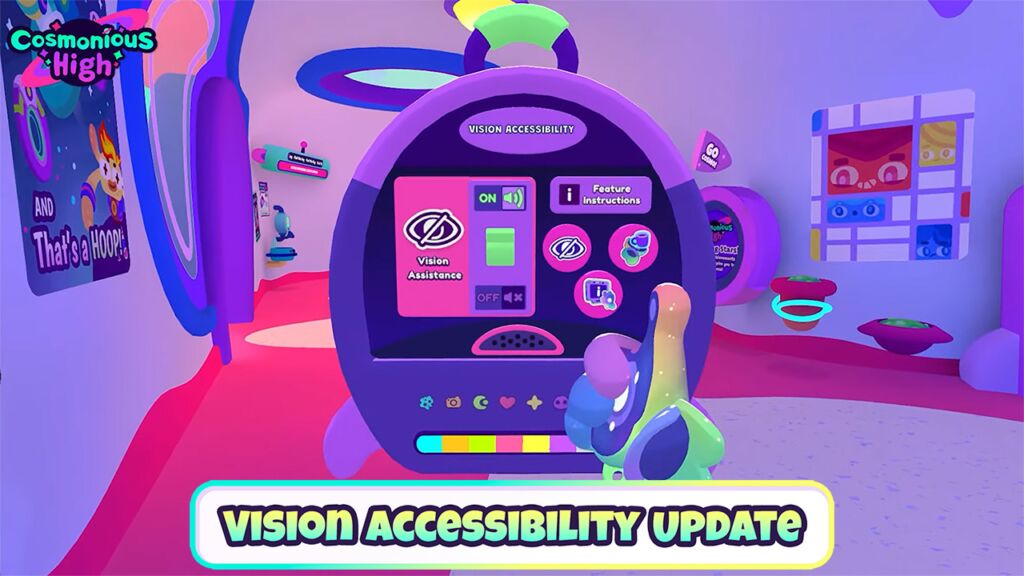
    Capture of inside Cosmonius High game showing more accessibility features that users can select.
    After Cosmonious High from Owlchemy Labs did some vision updates, they had over 1.53 million times users put their hand over an object to request text-to-speech–in one month and only with Quest users. Still think accessibility features are optional?
     

    Many platforms and experiences already contain volume controls for separate parts of the experience (e.g., voice chat, environment, or notifications all have separate volume controls). Learners should be trained on these controls at on-boarding.

    Capture from inside Cosmonious High game showing accessibility features


    Cosmonious High capture of some accessibility settings. Note that only one hand is needed to play this VR game.

    Generally, for information that is necessary for the learning event:

    • If the information is in speech, provide text equivalents (e.g., transcript).

    • If the information is in sound (environmental sounds or notifications), it should have equivalent visual and/or text indicators.

    • If the information is in text only, provide sound equivalents.

    2.3 Interaction & Movement

    Interactions in XR could be reaching, grabbing, and moving. Good experimental research exists from organizations like IEEE VR or ACM IUI on 3D user interface recommendations. Alger’s (2015) design advice showed a seated avatar seated work will be more comfortable than standing in XR.

    See Mike Alger's 2015 thesis for more but these images show where a user can be reasonably be asked to reach or gesture.

     Credit: Alger, 2015

    Almost every new XR user has walked their avatar into a wall. It happens. 


    Capture of my friend Peter when he walked his avatar into a corner.


    You stay in that corner until you can act like a good avatar, Peter!


    Given that the wall isn’t real, mistakes like this are forgiven quickly. IDs can ask learners to move. 

    (And Peter knew I took his picture at this moment above.)

    Movement in XR is an advantage of the metaverse. While research does not indicate that movement causes learning, it can greatly assist in the storytelling aspect of bringing a learner through an experience by requesting that the avatar move through the story in virtual space time.

    Movement is relative in this media. Frame of reference can be manipulated. The avatar can move, or the avatar can stay in one place and the scenes can move or change around them. There are a LOT of choices for movement in XR. From gaming research, it looks like most of the possibilities are aiming to reduce vestibular mismatch.

    In this area, movement-based engagement can be an area of exploration in designs. For example, asking learners to move to one side of the room or another is an interesting way to run a poll. XR movement often includes dancing and flying. Future research should explore the use of controllers or hand detection for learning.

    2.4 Emojis

    Many social XR platforms have incorporated emojis and they can be used for their apparent reasons: love, happy, sad, clapping, or raised hand. Within designs, learners can use them differently, that is for feedback, poll indicators, or silent ‘I need help’ indicators. Learners have been known to redefine emojis to mean whatever makes sense to them during a learning event.

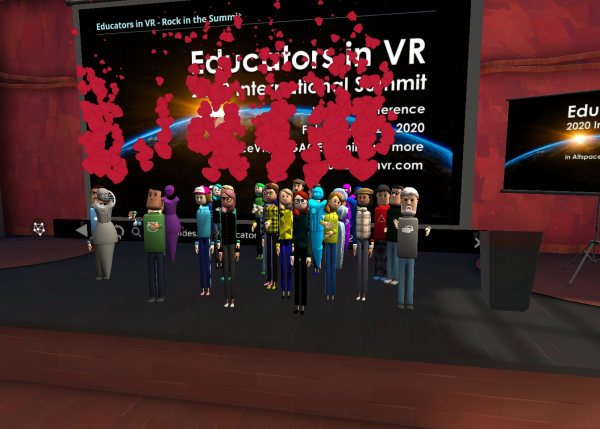
    Capture of a great moment from the start of the International Summit of Educators in VR. Each avatar chose to express a heart/love emoji.


    Cheers to Educators in VR for their use of emojis during their International Summit in 2020.
     

    Part 7 will cover designing and building XR experiences for learning. See you there!

    (more…)

  • Instructional Design in the Metaverse Part 5 Building Blocks

    Instructional Design in the Metaverse Part 5 Building Blocks

    This conceptual series proposes instructional design principles for the metaverse. This is Part 5. Today we start the building blocks of design. And the best news for instructional designers? So much of what we already know from two-dimensional learning will work in three-dimensions. Grab your toolbox, IDs!

    2D to 3D: What Is the Same

    Technology can benefit learning when the affordances are leveraged towards effective and evidence-based learning principles (Yeung, Carpenter, & Corral, 2021). Instructional design already has a depth of theory and research that shows that a learning experience is a “systemic, complex design” (Honebein & Reigeluth, 2023. p. 14).

    Yet, instructional designers (IDs) interested in the metaverse in education can be at risk for two unhelpful mindsets: first, thinking that IDs must become developers or second, succumbing to a ‘buy first, find a use for it later’ mentality. The first creates a substantial learning curve with the end result mostly being scenes or environments and 3D objects. Currently, AI is able to create scenes and objects (Sahu, Young, & Rai, 2021). As a consequence, the need for programmers may decrease. The second mindset leads to IDs to search for educational resources to justify the expense and bother of entering the metaverse. 

    Capture of a post with text: With the world in such a virtual/hybrid state, I'm curious if any of you have explored using (REDACTED) VR to enhance virtual new hire onboarding experiences. My boss ordered myself and one of my peers our own (REDACTED) devices to explore as this an add on to our current onboarding program, so I'd love to hear from people with similar use cases.

    Buy first, find a use for it later. Technocentric-design.

    Both of these mindsets miss the main point of instructional design. They sacrifice the learner-centric stance for a technology-centric stance (Mayer, 2020). Many of the 2D-based instructional design models, structures, and principles apply towards 3D learning (Dodds, 2021).

    What we already know should inform us as we make future 3D designs because as Alger stated, “Principles and processes of design are pretty universal because we’re usually designing for humans” (2020, 3:06).

    A further extension of this thought would be that IDs are not designing for technology. An ID focusing on 3D design for the first time can have an advantage because their experience will be from a novice’s viewpoint. Learners are novices. Thus, the ID experiences what the learners will later experience for the first time.

    Keeping the learner-centric point of view is key.

    This section emphasizes the use of Mayer’s Principles of Multimedia Design (Mayer, 2020, pp. 400-402, [Reminder, I covered the basics in Part 2]) because they are based on research. This list is not meant as a checklist. This is meant to remind IDs of what the correct design choice would be within a 3D experience.

    1 Reduce extraneous processing

    The Coherence, Signaling, Redundancy, Spatial Contiguity, and Temporal Contiguity Principles will assist in decisions about types of media (visual, text, audio) and where it will be placed or made available in XR experiences. Because of the enveloping nature of the 3D environment upon the learner, extra unnecessary material could interfere with the learning.

    1.1 Coherence

    Summary: “Weed out extraneous material”.

    ID: Minimize text, sounds, and movement that is not directly related to the learning goal.

    1.2 Signaling

    Summary: “Highlight important material.”

    ID: Use slow pulsating glows, arrows, or narrative prompts to focus the learner on the content.

    1.3 Redundancy

    Summary: “Do not add printed text that duplicates narration.”

    ID: Accessibility concerns dictate that information available via vision or sound should be made available in an alternate form. To follow the spirit of this principle, default settings can be set to include both alternates as activated, which could then be toggled off by the learner at will. XR accessibility research organizations such as XR Access or Virtual Ability should be consulted for further guidance.

    1.4 Spatial Contiguity

    Summary: “Place printed text near to the corresponding part of the graphic.”

    ID: There is more space to work with in 3D than 2D. The key with this principle will be to find just the right place to put the text. Some user experience (UX) testing in the form of A/B testing can help find the best placement.

    1.5 Temporal Contiguity

    Summary: “Present corresponding graphics and narration at the same time.”

    ID: Sound and action triggers can be timed within 3D programming.

    2 Managing essential processing

    The Segmenting, Pre-training, and Modality Principles help the designer place the necessary material in the right place and time for the learner to move the content into sensory memory, short-term memory, and into long-term memory.

    2.1 Segmenting

    Summary: “Break a lesson into learner-paced parts.”

    ID: Plan lessons with storyboards with scenes where the learner moves through the experience. Always provide an escape button that saves learner progress. If that is not possible, a confirmation dialog message can indicate that the learner upon re-entry will be returned to a certain spot.

    2.2 Pre-training

    Summary: “Provide pre-training in the names and characteristics of the key terms.”

    ID: Plan for pre- and post-experience briefing. Pre-training is analogous to reading the box when considering buying a game or reviewing choices in an online store. The learner experience starts there.

    2.3 Modality

    Summary: “Present words in spoken form.”

    ID: Especially for key vocabulary, provide sound files of pronunciation. This especially matters if the experience is designed for solo learner use.

    3 Fostering generative processing

    The Multimedia, Personalization, Voice, Image, Embodiment, Immersion and Generative Activity Principles help encourage learners to cognitively engage with the material and exert effort to make sense of it. It is this area of design where the ID is making sure that the learners are not passively accepting information but must do mental work with it.

    3.1 Multimedia

    Summary: “Use corresponding words and graphics to explain the material.”

    ID: XR is a natural fit for this principle because it nearly always contains simultaneous visuals and sounds. These can be timed together within 3D programming. An interesting design exercise for IDs, however, is to isolate certain aspects of a design and think through how it might work if only one channel of input was working. For example, in a tour of XR spaces, there might be a period of a few seconds of complete darkness between scenes. How are the learners guided by sound only during this time?

    3.2 Personalization

    Summary: “Put words in conversational language.”

    ID: Recorded audio should sound comfortably natural.

    3.3 Voice

    Summary: “Present spoken words in an appealing human voice.”

    ID: This applies most logically in XR to human sources of the spoken words. Poor sound can ruin an XR experience.

    3.4 Image

    Summary: “Do not put the instructor’s static image on the screen.”

    ID: The keyword in this principle is ‘static’. This would rarely be needed in XR. Exceptions might include biographies or eulogies.

    3.5 Embodiment

    Summary: “Have instructors display human-like gestures, eye contact, facial expressions, and body movements.”

    ID: The Proteus Effect shows that users change their behaviors depending on their avatars (Praetorius, & Görlich, 2020). Employers are becoming more interested in the use of the metaverse for meetings (Jaehnig, 2022). It is reasonable to predict that educators will be holding meetings that are now on-campus or in Zoom with their learners in the metaverse within five years. Due to the demand for these human-like behaviors, avatar creators and platforms are adding more movements like blinking, sitting, or gesturing.

    3.6 Generative Activity

    Summary: “Add prompts to engage in generative activities such as summarizing, mapping, drawing, imagining, self-testing, self-explaining, teaching, and enacting.”

    ID: Interestingly, here the research reaches a nexus; several different sources point in the same direction. Mayer called these generative activities and points to their use within the learning act, as a guided form of practice, “Insert prompts to engage in generative learning activities within the instructional episode” and “learners must use the material from the lesson rather than simply remember it” (2020, p. 371). From this, an activity within XR would be ideal. However, generative activities are not exclusive to happening within XR. Wallace stated in Washburn (2023) that all learning points to some place in the future where the results are played out–ideally in a workplace or high stakes setting; it is the final performance that counts. Dede (2021) pointed out the importance of onboarding and off-boarding as where the learning occurs primarily. Mayer conceded that generative activities likely need to be taught first as behaviors before asking a learner to perform them (2020). That is, learners need to be taught what summarizing is before being asked to summarize. This is a valid and somewhat overlooked point. D. Clark referred to these activities as “effortful learning” or “desirable difficulties” (2022, p. 3) and Thalheimer (2006) supported retrieval practice, spaced practice, or interleaving approaches. Each of these researchers has a slightly different view into the same problem.

    They seem to point to the need for a certain amount of learner effort (not just clicking), with guidance, that should occur within XR and then a follow-on amount of learner effort after leaving XR.

    What might this look like? Here, we reach the edges of known ID in the metaverse universe [Editor Heather here: fresh off the presses! This just hit ResearchGate last month: Collaborative generative learning activities in immersive virtual reality increase learning], but we can take with us what we already know.

    The key question to ask is: In real life, where do learners practice in place and later perform when the stakes really matter?  How something is done in real life should be the template that we use to start thinking of how the behavior should be prompted in the metaverse.

    Here is an example: Learners do science labs in real life. They practice doing a procedure under the watchful eye of an instructor. It is usually fine if they fail because they can start again but there is some risk and limitation of resources. In XR, the same lab can be set up as practice where learners can repeat interactions, control the speed, and engage in plausible manipulations of scientific equipment (Asare, Annan, & Ngman-Wara, 2022). The scripted practice available within XR should be added to other generative activities which could be inside and/or outside of XR such as learners self-explaining what is happening in the experiment during a video recording of the experience or learners teaching what would happen if the variables changed or if there was a chemical spill.

    3.7 Immersion

    Summary: “Do not convert lessons into 3D immersive virtual reality.”

    ID: At this point, this article series would appear to come to a stop.

    This last principle basically states do not use 3D. This article series posits, do use 3D, if it is the right thing to do. Returning to the beginning assumptions:

    1. Learners experience the virtual as real.

    2. Learning outcomes are expected to be equal to other media.

    It goes to follow, therefore, that if the designs will be accepted by the learners as real experiences and if the learning outcomes are the same as for other forms of media, the decision to go forward with the design should only occur if the lesson cannot reasonably be done in 2D and meets at least one of the conditions of saving time, money, or danger. Stepping outside of the learning objective decision, one could argue that 3D allows for added immersion and presence. But in that case, the ID should ask “Is immersion or presence critical to the learning objective?”

    Acknowledging the affordance of immersion, Mayer pointed out that the case for immersion is often wrapped into the learner’s feelings of interest and motivation (2020, p.361). The logic goes that if a learner is motivated, they will learn more. Research shows that interest and motivation wane and learning performance drains away with it.

    The case for presence can be tied with a personal feeling of being there. The more a learner takes on the experience as real and really happening to them, the more the learning should stick with them. Contrarily, research shows that distraction due to extraneous processing seems to cancel any benefit that might be gained (Mayer, 2020). In sum, the research does not predict at this time that presence will increase learning.

    Finally, this tidbit might tip the scales for a decision. Clark and Mayer recommended this strategy from e-learning: “Use facilitative techniques that support social presence” (2016, p. 313). This tips the balance of synchronous versus asynchronous learning towards synchronous and shows an affordance not before mentioned: the benefit of social learning in XR.

    Wise uses of XR seem to contain elements of bringing learners together.

    This should be leaned into in designs, if possible. Therefore, if learning designs can minimize extraneous processing and are best done in 3D, next we should ask what is different about designing for 3D.

    That will be Part 6. Stay tuned!


    Part 1 was the Introduction.

    Part 2 covered Theory and Scope.

    Part 3 was Myths versus Reality.

    Part 4 covered the Characteristics of Success.

    Want to see my full references? Have at it.


    Midjourney and Me. Prompt: Blend full color charcoal and game cover of Legends of Zelda, an attractive woman with short blonde hair and blue eyes wears hooded cloak, casting a glowing spell in a laboratory, cinematic lighting, fantasycore, blue and green color scheme


    #InstructionalDesign #XR #Multimedia #Principles #Mayer #LXD #ID #L&D #InstructionalDesigner #WebXR #3D #2D #ExtraneousProcessing #Coherence #Signaling #Redundancy #SpatialContiguity #TemporalContiguity #EssentialProcessing #Segmenting #PreTraining #Modality #GenerativeProcessing #Multimedia #Personalization #Voice #Image #Embodiment #GenerativeActivity #Immersion #Presence #EffortfulLearning #DesirableDifficulties #RetrievalPractice #SpacedPractice #Interleaving #LearnerCentric #edtech

  • Instructional Design in the Metaverse Part 4 Characteristics of Success

    Instructional Design in the Metaverse Part 4 Characteristics of Success


    Decorative image of in the style of Fantasia walking towards a magical kingdom. Text: Instructional Design in the Metaverse

    Welcome to Part 4 of this series that proposes instructional design principles for the metaverse. Hopefully, you’ve read Parts 1 – 3 because we need to remember this:

    Learning outcomes are expected to be equal to other media.

    So what are the characteristics that predict success for an educational experience? Read on.

    Characteristics of Success

    By the time IDs are often introduced to learning projects, the decision to incorporate XR technologies might already be made. Yet, IDs might be tasked with evaluating choices for off-the-shelf XR experiences or do-it-yourself (DIY) projects. Both choices have possibilities and limits and this part will point out what characteristics predict that an XR solution should work for a given implementation.

    IDs should complete a thorough market analysis for off-the-shelf experiences. However, learning standards and ratings have not moved from early research to implementation (Dreimane, 2020). Thus, the experiences vary in quality with some being quite poor.

    Screen capture inside an unnamed game on immunology.
    Yeah, I’m looking at you unnamed game on immunology.

    On the other hand, XR experiences not tagged as educational can be successfully used for learning with careful implementation.

    In a DIY project, IDs could be asked to learn 3D programming, such as Unity or Unreal. Artificial intelligence (AI) is beginning to be used for 3D development and this could assist IDs. If IDs do engage primarily in programming and building assets, there is a risk that they will take their eyes off the goal of representing the learner. An ID should be constantly asking the question,“what is the learner experiencing?” and making sure that all decisions align to the planned purpose.

    In general, the research up to this point indicates these three characteristics predict a successful XR educational experience:

    While having one of these characteristics is good for continuing development, having two or all three characteristics can lead to very successful full implementation. For example, an XR experience for wind turbine maintenance training would currently save time, money, and danger.


    Have all three regularly and you tend to be NASA.  https://accessmars.withgoogle.com/


    It Saves or Manipulates Time

    XR experiences can manipulate time for instruction. For instance, an experience could involve time travel, speeding up, slowing down, or pausing time. 

    Credit: River City Project, Harvard, Chris Dede: https://muve.gse.harvard.edu/screenshots

    [Editor Heather interjects: the River City Multi User Virtual Environment (MUVE) is a great example of time manipulation. Learners had to determine the cause of 3 diseases in a city on a river. This built pedagogically went where learners often struggle: determining cause in a multi-variable (READ: REAL WORLD, messy, wicked) system. The build could pause or speed up time–very helpful while waiting for bacteria to grow.

    With time paused in the middle of a process, visual cues can add positively to the instruction (Clark & Mayer, 2016).


    Navigation research that showed that getting navigation instructions from an avatar was better than just arrows. Note: VERY early research. Source: http://nectar.northampton.ac.uk/16606/1/Dohan_etal_ACM_2022_Deep_learning_based_recommenders_for_the_improved_user_navigation_in_VR.pdf

    XR experiences can also reduce instructional time overall because the training can be delivered more efficiently to the learners. For example, workplace training that has been preloaded onto VR headsets can be shipped to remote workers, saving travel time.

    Treating sea sick ship captains at sea with VR. Credit: https://youtu.be/E6jFqqy0wes?si=Eazci6iPap16hLsw

    IDs should be aware that with this characteristic, many 2D simulations can do the same time manipulation and savings for possibly lower costs.

    It Saves Money

    XR experiences can save money over other forms of learning. For example, it would cost a lot of money to take your learners to the Moon in real life. In XR, space travel is much cheaper.

    Capture from Mission: ISS. Space travel that is much cheaper than being an business oligarch.

    Those unfamiliar with development trends might comment that the metaverse is not currently cheaper than other media. As of this writing, costs are dropping [Editor Heather reminds you that 1 of the 2 things I actually liked about the PwC study was the calculation that if you make a build for more than 3,000 users, it will be cheaper overall to do in XR versus e-learning] with the arrival of artificial-intelligence (AI) developed resources. 

    Immersive web (WebXR) options allow approximately 20 learners to join one virtual space with a web browser, no additional equipment. Development prices do rise with more complexity.

    One final note: the ‘time is money’ statement does hold true here. Often, an XR experience that saves time also saves money.  

    It Reduces Danger

    This characteristic, the metaverse reduces danger, also includes impossible activities. While Alger (2015) properly suggested that any content that was inherently 3D in the first place is ideal for XR development, XR is not limited to the real and actual. It can expand to the phantasmagorical and impossible. For instance, taking learners to look inside of an operating nuclear reactor would be dangerous in real life. This can be replicated in XR with no added danger for the learners. 

    How a nuclear reactor generates electricity. Don’t try this at home unless you are in VR.

    IDs should remember that some environments in the metaverse can still represent psychological risk if not real danger. In the Proteus Effect, learners could change their behavior depending on what their avatar is experiencing (Praetorius, & Görlich, 2020). As a result, a learner’s avatar walking into fire might be a frightening experience even if it is physically safe. Examples of risks include claustrophobia, fear of heights, hostility, prejudices, and negative social pressures.

    In all cases, IDs should keep the learner primarily in mind. If it scares a learner and it was not meant to, it should be removed from the design.

    (more…)

  • Instructional Design in the Metaverse Part 3 Myths versus Reality

    Instructional Design in the Metaverse Part 3 Myths versus Reality


    Decorative image in the style of 1960 sci fi horror movie with text: Instructional Design in the Metaverse

    This conceptual series proposes instructional design principles for the metaverse. You’ve arrived at Part 3.

    TL;DR

    • XR causes more learning and faster – Myth
    • XR is active learning – Myth
    • More immersion is better than less – Myth
    • XR causes greater retention – Jury is still out.
    • XR increases empathy – Danger Will Robinson Danger
    • Learners and instructors like it – True! But this means nothing to learning.
    • XR can impact far transfer – Jury is still out.
    • Positives get published – True, so negative or null results often do not.

    Ready? Let’s do some myth busting.

    Myths versus Reality

    The metaverse in education is an emerging topic and a potentially lucrative field, possibly set to supplant learning management systems as the next industry-wide educational platform (Spilka, 2023). Improvements in technology are fostering an “anytime at anywhere” implementation of the metaverse (Tlili, Huang, Shehata, et al., 2022, p. 4). As interest in the metaverse as educational media has increased, misleading claims or myths have already circulated. These myths are often shrouded under the title of research until the curious probe a little deeper. This part will examine claims such as the metaverse will cause learners to learn more and faster, it represents active learning and is therefore better, it is more immersive than ever, learners retain more, it increases empathy, and learners like it so therefore they learn better. This section will mention areas where the research is still unknown, publishing bias, and what to look for when IDs read educational research on the metaverse.

    1 More and Faster

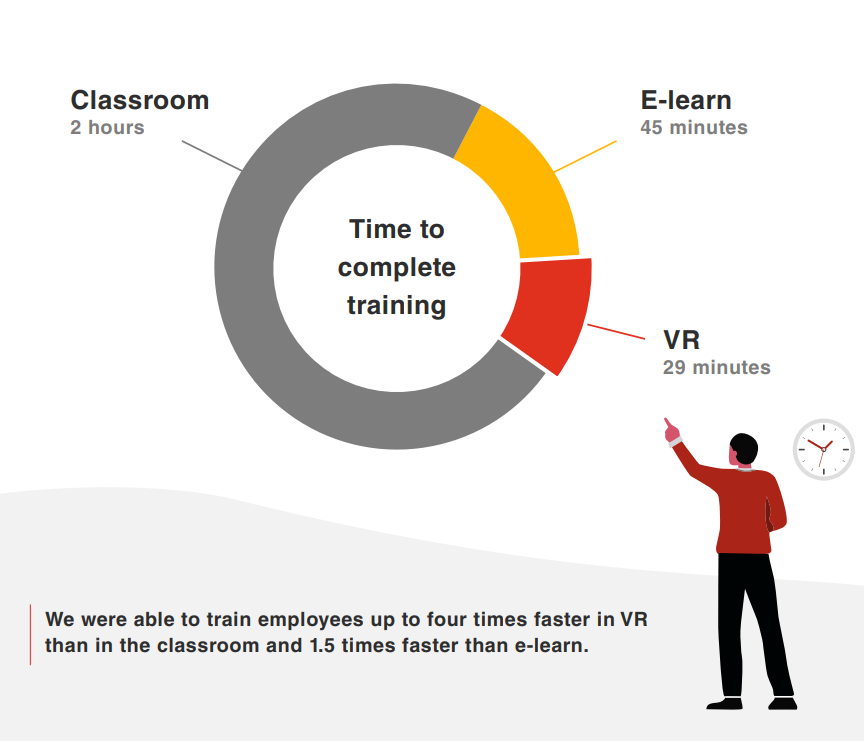
    Screen capture of report showing that VR took one-quarter of the time that classroom did, hence the origin of the VR is 4x faster myth.


    Faster. You keep using that word. I don’t think it means what you think it means.  (Note: this is also a woeful use of a time chart; three different times do not add up to a pie.)

    Learners in the metaverse will learn more and faster; this is the first claim examined. IDs should maintain a healthy skepticism of claims that a certain media causes dramatic learning improvements. Claims often do not communicate instructional methods as Beck, Morgado, and O’Shea (2023) pointed out. Instead, current publishing focuses on outcomes-based research or what Reigeluth and Honebein called research-to-prove results that are “typically operationalized by comparing a new medium to a traditional one” (2023, p. 2). For instance, a lesson in XR could be compared to a lesson in a textbook. Similarly, the National Academies of Science, Engineering, and Medicine advised that possible external validity of some studies is low in that “there is considerable evidence that a single instructional technology can lead to different outcomes when used by different learners in different contexts” (2018, p. 194). These claims usually represent the pitting of two very different instructional methods and thus cognitive workloads against each other.

    Here is an example of this claim. In a study incorporating virtual reality (VR) headsets for soft skills training, Scott Likens of PricewaterhouseCoopers claimed, “We found the realism and performance feedback in virtual reality simulations helped people learn faster and retain more information around soft skills,” (Zielinski, 2021, para. 9). However, the accompanying published report contradicted these claims. When comparing information retention in VR versus an e-learning course, the authors “quickly discovered retention scores were inconclusive, as the delta between pre and post-assessments in each modality was not significant” (Eckert & Mower, 2020, p. 44, emphasis added). Thus, the two different media showed no different learning outcomes.

    Another claim is that the isolation effect of a headset causes faster learning, perhaps arguing that less distraction equals more focus. In the same study, Likens stated, “A lot of courses that normally take an hour could be completed in 20 minutes through VR because people are so immersed in scenarios, there are fewer distractions and the learning is very concentrated” (Zielinski, 2021, para. 10). Referring to the same study, “VR was x4 faster than classroom and x1.5 faster than e-learning” (D. Clark, 2022, p. 190). Claims that learning is completed faster attempt to represent XR as a more efficient learning method, i.e., less time to learn equals learning faster. When compared to classroom learning, it is already known that 1:1 personalized learning is faster. In this case, the classroom learning was allotted to two hours and the VR experience took 29 minutes. Given that 29 minutes is approximately one-quarter of two hours, the touted line was that XR was four times (4x) faster. In fact, the XR media did not cause the learning to be completed faster, it was the 1:1 nature of the learning experience.

    [Editor Heather here: this is the same study I wrote about extensively here and here and my colleagues wrote about here, in case you want to read more.]

    Further, there is at least one study that refutes this focusing-causes-faster-learning claim. Makransky, Terkildsen, & Mayer have found that immersive metaverse environments can be sensory overload for learners and therefore decrease the learner’s focus (2019). On the whole, claims for increased speed can often be attributed to more efficient learning methods.

    Lauding the media that manipulated instructional methods hides the fact that the learner could achieve the same results in a different media, given comparable time and resources.

    Screen capture of comment where OP claims to "have seen stats that proclaim VR learning is up to 400% more effective than other forms of learning." Also, OP believes that VR learning sticks more.


    This is a 4x claim variant, with “recall up to 400%.” They throw in the ‘control the distractions’ claim too. Upon request, the OP refused to provide a source.


    [Editor Heather popping back in here about 5 months after this blog was originally published on 10/4/2023. I like to add examples “from the wild” when I see these claims and whaddaya know– a claim popped up yesterday! Here you go! Feast your eyes on the 4x claim along with the lack of reference/evidence/substantiation:

    This particular example of the 4x is buried with a pro-Microsoft Teams article that I actually agree with (and posted another blog about here: https://heatheredodds.blogspot.com/2023/12/youll-be-using-xr-in-2024-and-you-will.html )

    I’m curious that the 4x was applied to “retention rate” and “attention span” and was compared to Teams or Zoom, which, to the best of my knowledge WAS NOT in the 4x PwC study.

    I feel some, ahem, elaboration has occurred here.  And I find it interesting that while propping UP Teams (because it is rolling out immersive team meeting environments) this paragraph highlighted actually disses Teams.  I’m thinking this person is so excited and into rolling out stats that he’s confused stuff.

    2 Active Learning

    Screen capture of a comment claiming that being in a headset is the same as active learning.
    Claim: Being in a headset equals active learning.

    Some claims state that learner-instigated avatar movement, in the form of moving hands, heads, or bodies, or the first-person point of view makes XR learning inherently active as opposed to passive. Intentional avatar movement is associated with manipulating content, which is the term embodiment or embodied learning (Johnson-Glenberg, 2018; Markowitz, Laha, Perone, et al., 2018). The claim begins with the given that active learning is known to be better than passive learning. Because XR is body-movement active, it must be active learning and thus cause more learning  (Johnson-Glenberg, 2018). However, research has shown that while embodiment does have a connection to learning, it does not exclusively cause learning. Truly, “platform is not destiny” as Johnson‐Glenberg, Bartolomea, & Kalina stated in 2021 (p. 20). Just putting a learning experience with movement into XR does not make it active learning.

    3 More Immersion

    There are some claims that take issue with the second assumption stated earlier in this series: Learning outcomes are expected to be equal to other media (Mayer, 2020). These claims state that earlier comparative media studies did not show improved results because the technology then was older. Thus, technology now utilizes a better quality of immersion. This claim reflects a modernist philosophical approach: newer is better. Cummings and Bailenson (2016) reported that head tracking, stereoscopic visuals, and wider fields of view created more immersion than other visual or audio improvements. Yet Mayer wrote in 2020, “these comparisons between low-immersion and high-immersion media do not provide strong evidence for the instructional value of converting a 2D lesson rendered on a computer screen into a 3D lesson displayed with a head-mounted display in immersive virtual reality” (p. 365). Moreover, Abbas, Seoo, Ahn et al. (2023) found that high levels of presence did not impact user behaviors. Ochs and Sonderegger (2022) reported that learners that felt an increased sense of presence in VR scored worse on measures of memorization even when the learner simultaneously self-reported that they expected to do better in VR versus 2D. Finally, Makransky, Terkildsen, & Mayer found that VR causes more presence but less learning (2019).

    Overall, these claims also fail to acknowledge that the main subject in media studies are humans (not the media), and we already know a great deal about how humans learn in 3D environments. These spaces exist outside of technology and are called classrooms. These claims that newer XR will cause more learning look more like calls to buy the latest technology.

    That is not instructional design research, it is marketing.

    4 Greater Retention

    Capture of post with text: It has been proven that people learn better through an immersive experience and "retain material better".


    Claim: better retention, “it has been proven”. Not so much.

    This claim states that XR enhances knowledge retention (Victor, 2023). Studies of retention are still ongoing and difficult to find. Indeed, broad reviews such as those conducted by Hamilton, McKechnie, Edgerton, and Wilson (2021) commented that finding “learning outcomes, intervention characteristics, and assessment measures associated with immersive virtual reality use has been sparse” (2021, p. 1). This aligns with Beck, Morgado, and O’Shea who contended that, “Very few literature reviews focus on the educational practices and strategies used in immersive learning environments. Thus, the problem is that we are evaluating outcomes without a comparable way to describe the educational approaches that led to those outcomes” (2023, p. 2). Therefore, retention could be achieved with XR implementation, but without more research detail, greater results might be attributable to the method, not the media.

    The use of the metaverse in education is not yet common. It is difficult to find studies that measure retention within learners more than 10 to 21 days after instruction. Practical workplace implementation would require much longer retention times. Therefore, this claim has not yet been supported or refuted.

    5 Increase Empathy

    Capture of headline: Is VR the ultimate empathy machine?


    Someone seems to think so.

    Research on empathy indicates that this is an area of risk. Because of a first-person point of view in many XR experiences, learners perceive a direct impact of the experience which is meant to foster empathy. However, empathy, like presence, is nuanced. Indeed, in some empathy research, learners did not react with a positive and caring response, but instead with disgust and rejection (Bailenson, 2018). Thus, the objective of the experience might be not only missed but soured.

    Clark, when writing about accessible pedagogy in immersive learning, advised to avoid first-person depictions of marginalized groups because XR experiences cannot portray the depth and spectrum of a person’s life. “Instead of teaching students what it’s like to be blind, consider having them deconstruct the ways vision is assumed in how spaces are designed, as well as the ways their understandings of vision impact how they interact with others,” then “focus on bringing awareness to the assumptions built into the physical world around them” (J. Clark, 2021, Recommended Administrative Considerations section, para. 4). Therefore, XR to foster empathy should be approached with extreme caution.

    6 Learners and Instructors Like It

    Capture of impressively high "more confident" and "more emotionally connected" numbers from VR learning.

    Forward-looking statements of optimistic activity. Unfortunately NOT strongly connected to learning.

    This learning claim, that learners liking a learning experience will then learn more, is perhaps the most common. To the contrary, there is no research-based connection between liking an experience and learning success (Hughes, Gregory, Joseph, et al., 2016; Uttl, White, & Gonzalez, 2017) . Thalheimer further discounted the connection between learners liking their learning and achieving their learning, when he stated that “measuring interest is an inadequate way of measuring learning” (2018, p. 26). Therefore, while it is pleasant for learners to enjoy an experience, it has no firm connection to a learning outcome. Beyond the learner, education professionals should use caution when thinking that emotional motivation will work over the long term. Instructors often become enthralled with possibilities of XR and start to believe that the feeling of being there (a combination of presence, embodiment, and immersion) will make a positive difference. Research and theory are not forecasting this. However, the flame of excitement among professionals should not be extinguished. Clark and Mayer advocated for a tempered approach where the ID can keep to the best learning practices and not be distracted by the media:

    “The challenge in e‐learning, as in any learning program, is to build lessons in ways that are compatible with human learning processes. To be effective, instructional strategies must support these processes. That is, they must foster the psychological events necessary for learning. While the computer technology for delivery of e‐learning is upgraded regularly, the human side of the equation—the neurological infrastructure underlying the learning process—is very old and designed for change only over evolutionary time spans. In fact, technology can easily deliver more sensory data than the human nervous system can process. To the extent that attention‐grabbing audio and visual elements in a lesson interfere with human cognition, learning will be depressed” (2016, p. 24, emphasis added).

    7 Near Versus Far Transfer

    Claims about near transfer outcomes will be addressed just ahead [look for Whitney]. Results showing positive far transfer from XR applications, however, are elusive in a similar way to the retention results. Research shows equivalent or mixed performance to traditional media (Kaplan, Cruit, Endsley, et al., 2021; Makransky, Borre‐Gude, & Mayer, 2019) or worse performance (Makransky, Terkildsen, & Mayer, 2019; Parong & Mayer, 2018). In particular, Mayer offered the Immersion Principle in 2020 which stated: “People do not necessarily learn better in 3D immersive virtual reality than with a corresponding 2D desktop presentation” (p. 357).

    Intuitively, because XR can replicate real world environments where the learning would be applied, far transfer seems like a reachable goal. Tlili, Huang, Shehata, et al., 2022 wrote that the technology can enhance and allow for transfer. Johnson-Glenberg noted that despite requests for more research into XR, “resources and affordable technologies were not readily available” (2018, p. 7) for educational research and that “longitudinal effects of VR exposure are unknown at this point” (2018, p. 11). It is possible that not enough time has passed for the research community to measure the ‘far’ in far transfer. In general, the ability to do worked practice exercises repeatedly in simulated real-world contexts suggests that XR should be at least equivalent when compared to other media for far transfer. 

    8 Positives Get Published

    Research with positive results is published more often than research with negative or no results. This is not unique to metaverse applications. This is known as publication bias or the file drawer problem (Lederman & Lederman, 2016). It limits the results of a meta-analysis because if a particular form of learning is not effective, it usually is not published (CofrĂ©, NĂșñez., Santibåñez et al., 2019). Thus, the published collection showing positive results with XR dominates over the no significant difference results.

    As an added caveat, IDs should closely examine research funding sources and sponsors.

    How Will I Know?

    You are welcome for that earworm. Who doesn’t love Whitney, helping out with instructional design?
    Single cover of How Will I Know? By Whitney Houston.


    IDs are cautioned to examine metaverse research studies for these two major characteristics:

    1. Novelty effect. The novelty effect is when learners are exposed to a new media and they engage in increased effort and attention. It tends to positively impact learning outcomes (Metcalf, Chen, Kamarainen, et al., 2019) but not always (Huang, Roscoe, Johnson‐Glenberg, et al., 2021). Further, “studies of virtual reality-based learning are based on only short-term implementations, and although they might show statistically significant learning outcomes, the novelty effect is an important caveat to the research because many of these studies do not account for the decay of outcomes over longer periods of time.” (Metcalf, Chen, Kamarainen et al., 2019, p. 97)

    If a research study implements a one-time 20-minute XR intervention and claims to show learning improvement, the learners are likely experiencing the novelty effect.

    1. Non-cognitively comparable methods. Studies where the learner is not put into the same cognitive workload with two different media should be viewed with skepticism over claims of better results (Reigeluth & Honebein, 2023). For example, if a study stated that learners performed better in XR than paper-and-pencil-based learning, the results should be discounted due to the varying cognitive impact that the different media had on the learner (Parong & Mayer, 2021). In one example, the experimental learner group was exposed to VR training after the standard training and then scored higher than the control group (Seymour, Gallagher, Roman, et al., 2002). The total training time increased. This could have caused higher scores. The two conditions, therefore, were not comparable. Furthermore, the National Academies of Sciences, Engineering, and Medicine noted that the prevalence of WEIRD populations (Western, educated, industrialized, rich, and democratic) used in educational research inherently exclude diverse learner populations and this makes it difficult to draw solid conclusions for all humans in all learning situations (2018). Thus what works for one group of learners might not work, nor even be comparable, for another group.

    Clark and Mayer summarized how to examine research claims for e-learning, but these questions equally apply to XR research.

    • “Are the methods, content, learners, and context like yours?

    • Does the experimental group outscore the control at a significance level of p < .05? [Editor Heather here: How many of y’all KNOW what the phrase “statistically significant” means? I thought so. I’ll write a future article on it so that you stop banging the “XR will make a significant difference in education” phrase around. I hate that. Be warned.]

    • Does the effect size favor the experimental group at a 0.5 level or higher (2016, p. 63)?”

    IDs will likely encounter innovators and early adopters who have anecdotal stories of how XR improved learning.

    Screen capture of comment from VR conference: I work with students weekly. They bring me "bad" kids from a last effort school where the kids will be expelled if they cause trouble again. Some of which are older kids who struggle to read and write. "VR does NOT create better learning outcomes itself" is a very suspect sentence. I can tell you 100% that VR is creating better learning outcomes for these students. The key is engagement. These students engage in VR even though they won't engage in a school setting. I promise you they are learning and developing skills.

    A passionate-for-VR educator describing what is likely the novelty effect with their students.


    These stories should be accepted with grace, as every form of media has the possibility to hit the perfect instructional moment with the right learning at the right time for the right learners.


    Animated gif of sprinkling, meaning chef's kiss, perfect.


    I sprinkle just the right instructional media and methods here and PERFECTION.

    Longer term and wider implementation decisions, however, should be made more systematically, by thinking and rethinking the design decisions over time. IDs rarely have control over the large financial decisions that XR development requires, so their role can be one of consultant: offering all the options and pros and cons of each to the decision makers (Dodds, 2021). After reviewing research, IDs are ethically bound to point out if a learning objective can be met with a cheaper, more environmentally responsible, or more socially just media.

    In summary, “As a consumer of experimental research, you need to be picky!’ (Clark & Mayer, 2016, p. 56)


    Part 4 will answer “How do I know I’m on the right trail with this [assigned] XR project?” (Yeah, more Whitney!)

    Part 2 covered theory and scope

    Part 1 was the introduction.

    Want to see my full references? Have at it.


    #InstructionalDesign #XR #Myth #LearningMyths #XRMyths #Multimedia #Principles #Mayer #LXD #ID #InstructionalDesigner #WebXR #3D #2D #VRCausesFasterLearning #VRCausesMoreRetention #WEIRD #ActiveLearning #Immersion #Empathy #NearTransfer #FarTransfer #PositivesGetPublished #AcademicPublishing #NoveltyEffect #NonCognitivelyComparableMethods #HowToReadResearch #Anecdotes #Ethics #ExperimentalResearch

    This blog post is simultaneously posted to a LinkedIn article here. This post was updated on April 12, 2026 with an improved font.

  • Instructional Design in the Metaverse References

    Instructional Design in the Metaverse References


    As I post my Instructional Design in the Metaverse article series, I’m trying to add web links as directly as possible to the references, bearing in mind that most of my readers are like me and might not have institutional library access.

    However, I respect that some folks might want the whole formatted enchilada. So here you go!

    References

    Abbas, A., Seo, J., Ahn, S., Luo, Y., Wyllie, M. J., Lee, G., & Billinghurst, M. (2023). How immersive virtual reality safety training system features impact learning outcomes: An experimental study of forklift training. Journal of Management in Engineering, 39(1), 04022068.

    Alger, M. (2015, September). Visual design methods for virtual reality. Ravensbourne. http://aperturesciencellc.com/vr/VisualDesignMethodsforVR MikeAlger.pdf

    Alger, M. (2020). XR design theory and practice for digital eyewear. [Video]. YouTube. https://youtu.be/4o__z7aPlMw

    Asare, A. H. Y., Annan, J. N., & Ngman-Wara, E. I. (2022). The Effect of virtual laboratory on student teachers’ achievement in integrated science in Bagabaga College of Education, Tamale, Ghana. European Journal of Research and Reflection in Educational Sciences, 10(1).

    Bailenson, J. (2018). Experience on demand: What virtual reality is, how it works, and what it can do. WW Norton & Company.

    Beck, D., Morgado, L., & O’Shea, P. (2023). Educational practices and strategies with immersive learning environments: Mapping of reviews for using the metaverse. IEEE Transactions on Learning Technologies.

    Bretan, J. (2020, August 8). How teachers in Poland used Half-Life: Alyx and VR for remote teaching during a global pandemic. UploadVR. https://www.uploadvr.com/teachers-poland-half-life-alyx-vr/

    Checa, D., & Bustillo, A. (2023). Virtual reality for learning. In: Current Topics in Behavioral Neurosciences. Springer, Berlin, Heidelberg. https://doi.org/10.1007/7854_2022_404

    Clark, D. (2022). Learning experience design: How to create effective learning that works. Kogan Page Publishers.

    Clark, J. L. (2021, October 8). Recommendations for accessible pedagogy with immersive technology. #DLFteach Publications, 2. https://dlfteach.pubpub.org/pub/vol2-clark-recommendations-for-accessible-pedagogy-with-immersive-technology

    Clark, R. C., & Mayer, R. E. (2016). E-learning and the science of instruction: Proven guidelines for consumers and designers of multimedia learning. John Wiley & Sons.

    CofrĂ©, H., NĂșñez, P., Santibåñez, D., Pavez, J. M., Valencia, M., & Vergara, C. (2019). A critical review of students’ and teachers’ understandings of nature of science. Science & Education, 28, 205-248.

    Cummings, J. J., & Bailenson, J. N. (2016). How immersive is enough? A meta-analysis of the effect of immersive technology on user presence. Media psychology, 19(2), 272-309.

    Decherney, P. & Levander, C. (2020, April 23). The hottest job in higher education: Instructional designer. Inside Higher Ed. https://www.insidehighered.com/digital-learning/blogs/education-time-corona/hottest-job-higher-education-instructional-designer

    Dede, C. (2021). Looking back: Insights from a century of cumulative research in immersive learning [Video]. YouTube. https://www.youtube.com/live/l3tw6O8Hn-s?feature=share&t=1663

    Dodds, H. E. (2021). Immersive learning environments: Designing XR into higher education. A Practitioner’s Guide to Instructional Design in Higher Education. EdTech Books. https://edtechbooks.org/id_highered/immersive_learning_e

    Dreimane, L. F. (2020). Virtual reality learning experience evaluation tool for instructional designers and educators. In New perspectives on virtual and augmented reality (pp. 3-21). Routledge.

    Eckert, D., & Mower, A. (2020). The effectiveness of virtual reality soft skills training in the enterprise: a study. https://www.pwc.com/us/en/services/consulting/technology/emerging-technology/assets/pwc-understanding-the-effectiveness-of-soft-skills-training-in-the-enterprise-a-study.pdf

    Faller, P. (2017, October 3). Putting people first: Tips and advice from UX pioneer Don Norman. Adobe Blog. https://blog.adobe.com/en/publish/2017/10/03/putting-people-first-tips-and-advice-from-ux-pioneer-don-norman

    Fowler, C. (2015). Virtual reality and learning: Where is the pedagogy? British journal of educational technology, 46(2), 412-422.

    Hamilton, D., McKechnie, J., Edgerton, E., & Wilson, C. (2021). Immersive virtual reality as a pedagogical tool in education: a systematic literature review of quantitative learning outcomes and experimental design. Journal of Computers in Education, 8(1), 1-32.

    Honebein, P. C., & Reigeluth, C. M. (2023). How do we solve a problem like media and methods. In: West, R., & Leary, H. (Eds.), Foundations of learning and instructional design technology. https://edtechbooks.org/foundations_of_learn/also_32_media_method/simple

    Huang, W., Roscoe, R. D., Johnson‐Glenberg, M. C., & Craig, S. D. (2021). Motivation, engagement, and performance across multiple virtual reality sessions and levels of immersion. Journal of Computer Assisted Learning, 37(3), 745-758.

    Hughes, A. M., Gregory, M. E., Joseph, D. L., Sonesh, S. C., Marlow, S. L., Lacerenza, C. N., Benishek, L.E., King, H. B., & Salas, E. (2016). Saving lives: A meta-analysis of team training in healthcare. Journal of Applied Psychology, 101(9), 1266.

    Jaehnig, J. (2022, November 11). ExpressVPN survey explores immersive tech in the workplace. AR Post. https://arpost.co/2022/11/11/expressvpn-survey-immersive-tech-workplace/

    Johnson-Glenberg, M. C. (2018). Immersive VR and education: Embodied design principles that include gesture and hand controls. Frontiers in Robotics and AI, 81.

    Johnson‐Glenberg, M. C., Bartolomea, H., & Kalina, E. (2021). Platform is not destiny: Embodied learning effects comparing 2D desktop to 3D virtual reality STEM experiences. Journal of Computer Assisted Learning, 37(5), 1263-1284.

    Kaplan, A. D., Cruit, J., Endsley, M., Beers, S. M., Sawyer, B. D., & Hancock, P. A. (2021). The effects of virtual reality, augmented reality, and mixed reality as training enhancement methods: A meta-analysis. Human factors, 63(4), 706-726.

    Khan Academy. (2017). Pixar in a box: Introduction to storytelling [Video]. YouTube. https://youtu.be/1rMnzNZkIX0

    Lederman, N.G., & Lederman, J.S. (2016). Publishing findings that are not significant: Can non-significant findings be significant? J Sci Teacher Educ 27, 349–355. https://doi.org/10.1007/s10972-016-9475-2

    Lichaw, D. (2016). The user’s journey: Storymapping projects that people love. New York: Rosenfeld Media

    Makransky, G. (2023). The immersion principle in multimedia learning. In R. E. Mayer & L. Fiorella (Eds.), The Cambridge handbook of multimedia learning (pp. 296–302). (3rd ed.). New York: Cambridge University Press.

    Makransky, G., Borre‐Gude, S., & Mayer, R. E. (2019). Motivational and cognitive benefits of training in immersive virtual reality based on multiple assessments. Journal of Computer Assisted Learning, 35(6), 691-707.

    Makransky, G., Terkildsen, T. S., & Mayer, R. E. (2019). Adding immersive virtual reality to a science lab simulation causes more presence but less learning. Learning and instruction, 60, 225-236.

    Markowitz, D. M., Laha, R., Perone, B. P., Pea, R. D., & Bailenson, J. N. (2018). Immersive virtual reality field trips facilitate learning about climate change. Frontiers in psychology, 9, 2364.

    Mayer, R. E. (2020). Multimedia learning (3rd ed). New York: Cambridge University Press. https://www.cambridge.org/highereducation/books/multimedia-learning/FB7E79A165D24D47CEACEB4D2C426ECD#overview

    Metcalf, S. J., Chen, J. A., Kamarainen, A. M., Frumin, K. M., Vickrey, T. L., Grotzer, T. A., & Dede, C. J. (2019). Transitions in student motivation during a MUVE-based ecosystem science curriculum: An evaluation of the novelty effect. In Emerging technologies in virtual learning environments (pp. 96-115). IGI Global.

    MIT Teaching and Learning Lab. (2023). Where to start: Backward design https://tll.mit.edu/teaching-resources/course-design/backward-design/

    National Academies of Sciences, Engineering, and Medicine (2018). How people learn II: Learners, contexts, and cultures. Washington, DC: The National Academies Press. https://doi.org/10.17226/24783

    Ochs, C., & Sonderegger, A. (2022). The interplay between presence and learning. Frontiers in Virtual Reality, 3, 742509.

    Parong, J., & Mayer, R. E. (2018). Learning science in immersive virtual reality. Journal of Educational Psychology, 110(6), 785.

    Parong, J., & Mayer, R. E. (2021). Cognitive and affective processes for learning science in immersive virtual reality. Journal of Computer Assisted Learning, 37(1), 226-241.

    Praetorius, A. S., & Görlich, D. (2020, September). How avatars influence user behavior: A review on the proteus effect in virtual environments and video games. In Proceedings of the 15th International Conference on the Foundations of Digital Games (pp. 1-9).

    Reigeluth, C. M., & Carr-Chellman, A. A. (Eds.). (2009). Instructional-design theories and models, volume III: Building a common knowledge base. (Vol. 3). Routledge.

    Reigeluth, C. M., & Honebein, P. C. (2023). Will instructional methods and media ever live in unconfounded harmony? Generating useful media research via the instructional theory framework. Educational technology research and development, 1-21.

    Sahu, C. K., Young, C., & Rai, R. (2021). Artificial intelligence (AI) in augmented reality (AR)-assisted manufacturing applications: a review. International Journal of Production Research, 59(16), 4903-4959.

    Schmidt, M., & Glaser, N. (2021). Investigating the usability and learner experience of a virtual reality adaptive skills intervention for adults with autism spectrum disorder. Educational Technology Research and Development, 69(3), 1665-1699.

    Seymour, N. E., Gallagher, A. G., Roman, S. A., O’brien, M. K., Bansal, V. K., Andersen, D. K., & Satava, R. M. (2002). Virtual reality training improves operating room performance: results of a randomized, double-blinded study. Annals of surgery, 236(4), 458.

    Shi, F., & Evans, J. (2023). Surprising combinations of research contents and contexts are related to impact and emerge with scientific outsiders from distant disciplines. Nature Communications, 14(1), 1641.

    Spilka, D. (2023, February 10). Immersive inspiration: Why extended reality learning holds multi-sector potential. AR Post. https://arpost.co/2023/02/10/extended-reality-learning-potential/

    Stanford University. (2023). Teacher-centered vs. Student-centered course design. https://teachingcommons.stanford.edu/teaching-guides/foundations-course-design/theory-practice/teacher-centered-vs-student-centered

    Thalheimer, W. (2006). Spacing learning events over time: What the research says. https://www.worklearning.com/wp-content/uploads/2017/10/Spacing_Learning_Over_Time__March2009v1_.pdf

    Thalheimer, W. (2018). The learning-transfer evaluation model: Sending messages to enable learning effectiveness. https://www. worklearning.com/wp-content/uploads/2018/02/Thalheimer-The-Learning-Transfer-Evaluation-Model-Report-for-LTEM-v11a-002.pdf

    Tlili, A., Huang, R., Shehata, B., Liu, D., Zhao, J., Metwally, A,, Wang, H., Denden, M., Bozkurt, A., Lee, L., Beyoglu, D., Altinay, F., Sharma, R.C., Altinay, Z., Li, Z., Liu, J., Ahmad, F., Hu, Y., Salha, S.,
 Burgos, D. (2022). Is Metaverse in education a blessing or a curse: a combined content and bibliometric analysis. Smart Learning Environments, 9: 24.

    Uttl, B., White, C. A., & Gonzalez, D. W. (2017). Meta-analysis of faculty’s teaching effectiveness: Student evaluation of teaching ratings and student learning are not related. Studies in Educational Evaluation, 54, 22-42.

    Victor, M. (2023). The impact of virtual reality on historical education: An investigation into the effectiveness and efficacy of immersive learning experiences. International Journal of History Research, 3(2), 27-38.

    Washburn, B. (2022). Instructional design for non-training professionals. Endurance Learning. https://endurancelearning.com/blog/id-for-non-training-professionals/

    Yeung, K. L., Carpenter, S. K., & Corral, D. (2021). A comprehensive review of educational technology on objective learning outcomes in academic contexts. Educational psychology review, 1-48.

    Zielinski, D. (2021, March 8). The growing impact of virtual reality training. HR Magazine. https://www.shrm.org/hr-today/news/hr-magazine/spring2021/pages/virtual-reality-training-spreads-its-wings.aspxZiker, C., Truman, B., & Dodds, H. (2021). Cross reality (XR): Challenges and opportunities across the spectrum. In: Ryoo, J., & Winkelmann, K. (Eds.) Innovative Learning Environments in STEM Higher Education. SpringerBriefs in Statistics. Springer, Cham. https://doi.org/10.1007/978-3-030-58948-6_4
  • Instructional Design in the Metaverse Part 2 Theory and Scope

    Instructional Design in the Metaverse Part 2 Theory and Scope


    Decorative image with text: Instructional Design in the Metaverse

    Credit: Midjourney and Me. Prompt: retrofuturistic city, monorails, glowing lights, nighttime, blue and green color scheme, mysterious –style raw –ar 16:9

    This conceptual series proposes instructional design principles
    for the metaverse. You’ve arrived at Part 2 where I cover theory,
    application, and scope.


    If you are a theory nerd like me, you’ll love this part. If not, hang on to your butts. 


    Theory and application


    Metaverse educational experiences, as replications of known reality, can draw from every major learning theory already in existence because metaverse experiences are often copies of the real world. Checa and Bustillo
    asserted that constructivism, behaviorism, cognitivism, and
    connectivism can be foundations for a wide variety of XR pedagogical
    approaches (2023). However, the specific affordances of presence and
    embodiment in the metaverse indicate that existing approaches that
    include simulations and experiential learning are applicable (Checa
    & Bustillo, 2023; Johnson-Glenberg, 2018; Reigeluth, & Carr-Chellman, 2009). Specifically, cognitivism and constructivism theories are often cited for the metaverse.


    On the other hand, there is new research calling for more
    nuanced theories that reflect the social and learner-centered
    environments in the metaverse, e.g. connectivism or complexity theory
    (Checa & Bustillo, 2023; Schmidt & Glaser, 2021).
    Cognitivism and constructivism will be expanded upon here as they
    relate to research and application, beginning with cognitivism.


    Cognitive learning theory historically reflects the strong
    influence from the computer science discipline wherein XR applications
    are understood as input/output platforms controlled by programming.
    Learner experiences are transactional and computational. A learner is
    faced with a choice, they take that choice, and the program reacts. As
    such, the experiences appear to have a cause-and-effect flow with
    computers and learners both mediating the processing. For instructional
    designers specifically, a deeper understanding of the cognitive theory
    of multimedia learning, where visuals and audio have been studied with
    respect to learning, is required to apply the advice within Section 4 of
    this series.


    Theories begin with a set of assumptions based on observation. Mayer’s (2020) cognitive theory of multimedia design has three critical assumptions:

    • Dual channel: Humans can accept information only via sight and sound inputs.
    • Limited capacity:
      Humans have neuronal limits as to how fast information can be sensed,
      kept in working memory, and then moved to long-term memory.
    • Active processing: Humans bring prior experiences to their learning and actively think about information as they are processing it.


    Based on those assumptions, the cognitive theory of multimedia design focuses on the human processing system. 

    Mayer’s Cognitive Theory of Multimedia Design (2014 edition)


    There are two input channels (eyes and ears) where words and
    pictures enter sensory memory, then processing through working memory
    where sounds and images may interchange and conflict, finally moving to
    long term memory where information is integrated into prior knowledge.
    Words can be sensed by both eyes and ears. Selecting which words to
    focus on can cause conflict because the brain converts words to sounds
    inside of processing. This increases cognitive workload if an external
    voice is speaking while the learner’s internal voice is reading. This
    theory is relevant in that immersive experiences can provide words,
    voices, and graphics which, when simultaneously present
    in working memory, can increase cognitive workload, making long-term
    learning difficult. Because XR can provide an immersive environment of
    words, text, and sound surrounding learners, the risk is high that
    learners could be exposed to these cognitive conflicts. Section 4 will
    explore these pitfalls and how to avoid them. I will look briefly at
    constructivism next. 


    Constructivist learning theory postulates that learners
    construct their knowledge through experience; learners do not arrive as
    blank slates. With a wide variety of possibilities of the metaverse, IDs
    can think that constructivism represents a constantly growing approach
    to learning – learners could even create objects in 3D to construct
    their knowledge. However, a closer examination of this theory is
    required. In constructivism, new knowledge is connected to older
    knowledge in a way similar to the act of construction, just as boards
    are attached one upon another to build up a building. For IDs,
    constructivist theory appears both while designing step-wise learning
    experiences and in knowing that learners arrive in XR with preconceptions from prior experiences
    (Checa & Bustillo, 2023). It is in these preconceptions that
    learners will recognize and begin to process the experience. For
    example, if a learner arrives in an office building XR environment, they
    may begin to process the experience as work training. In this way, the
    learner might not need to be prompted that work behaviors are expected. 

    Givens


    It is important to note that both of these theories keep the learner, not the technology, primarily in mind
    when thinking of how learning will occur. Drawing from the indicated
    research, two further assumptions are held in this series and will be
    treated as givens:

    1. Learners experience the virtual as real. (Bailenson, 2018, p. 46)
    2. Learning outcomes are expected to be equal to other media. (Mayer, 2020, p. 357)


    Understanding how theory informs daily practice and design
    requires some finesse as rarely does an ID wake up and say, “I’m going
    to design pure cognitivist lessons today.”


    Instead, theory provides the guide when the ID is facing a decision where the better path is not apparent.


    Theories offer “guidelines on motivations, learning processes
    and learning outcomes for the learners” (Checa & Bustillo, 2023,
    p.5). A theory can point to methods, approaches, and strategies. Indeed,
    the mistake of not drawing upon a learning theory that is apparent in
    earlier research should not be repeated (Beck, Morgado, & O’Shea, 2023; Checa & Bustillo, 2023; Fowler, 2015).


    Overall, this series lands squarely within Pasteur’s Quadrant, contributing to both fundamental and practical applications (Shi & Evans, 2023). 

    Graphic display of Pasteur's Quadrant where basic fundamental research overlpas with everyday use research. This is similar to pasteurization; it pointed the way to germ theory (basic fundamental research) but applied in everyday life (by making milk safe to drink).

    Pasteur’s Quadrant: The type of research that quests for fundamental
    understanding AND can be used every day, like pasteurization. This
    article series lands in that sweet spot.


    This series is fundamental because it draws primarily from the
    cognitive theory of multimedia design and it examines research designs
    and results. It is practical in that it provides many examples based on
    the author’s XR design experiences. (You’ll see, it’s coming in a
    future Part.) As Mayer suggested, this type of approach is “basic
    research in applied situations” (2020, p. 22). Pasteur’s Quadrant lends
    light on exploratory topics. In this case, I have some basic theory from
    2D learning, but there is much more 3D nuance unknown. Progress in this
    field will require that theory and applied research move forward hand
    in hand.


    Fortunately, being in Pasteur’s quadrant provides hints at
    further unanswered puzzles beyond this series. For example, what is the
    connection between the popular XR game emotional coinage of fear and
    successful XR applications for the training of the emergency services:
    fire, police, military, and medical personnel? The answer to that quest
    will wait for another day. Before I begin an examination of research
    myths (upcoming Part 3), I need to explain what can and cannot be
    covered in a series of this breadth.


    Scope


    This series leaves many topics by the wayside: defining the
    metaverse in education, qualifying and categorizing experiences,
    affordances and constraints, and accessibility options. Doubtless, each
    of those topics deserves a series of its own [note to self] but there is
    no space to address them here. This series does provide insight into
    four areas:

    • interpreting research to rout out myths
    • looking for the characteristics of success in XR educational designs
    • using ID theory to inform the building blocks of design
    • tips for implementing an XR design project.


    The specific research gap that this series addresses is the
    missing connection between known design principles and practical
    applications of ID in the metaverse. Makransky
    commented on the lack of connection between the cognitive theory of
    multimedia design and instructional design in virtual reality,  stating
    that “research that has investigated instructional design implications
    in immersive learning environments is severely limited” (2023, p. 5).
    Beck, Morgado, and O’Shea surveyed that “mostly papers discuss
    opportunities and challenges or compare outcomes, rather than expose
    details on educational practices or strategies” (2023, p. 2).  Reigeluth
    and Honebein suggested that research-to-prove should be replaced with
    research-to-improve when a technology is in its early developmental
    stage (2023). Such research should limit itself to suggesting “possible
    ideas for actions and improvement” (Reigeluth & Honebein, 2023, p. 2). Finally, the emergent use of XR technology has precipitated haphazard designs lacking guidance:


    “In these early days, trial and error plays an outsized role in
    design. Education researchers borrow heavily from the entertainment
    designers, who focus on engagement, and not necessarily on retention of
    content. The dearth of studies highlights the urgency for a set of
    guidelines for designing content that allows users to make appropriate
    choices in a spherical space.” (Johnson-Glenberg, 2018, p. 7).


    It is hoped that this series lends to two facets of instructional design. First, the thinking side of design, when a designer must choose one approach or another. This series strives to give the best advice. Second, the implementing
    side of design where designers arrive directly into the metaverse to
    see what their learners will experience. This series, then, points the
    way. 

    Part 3 will approach research myths surrounding the metaverse in
    education.  


    (more…)