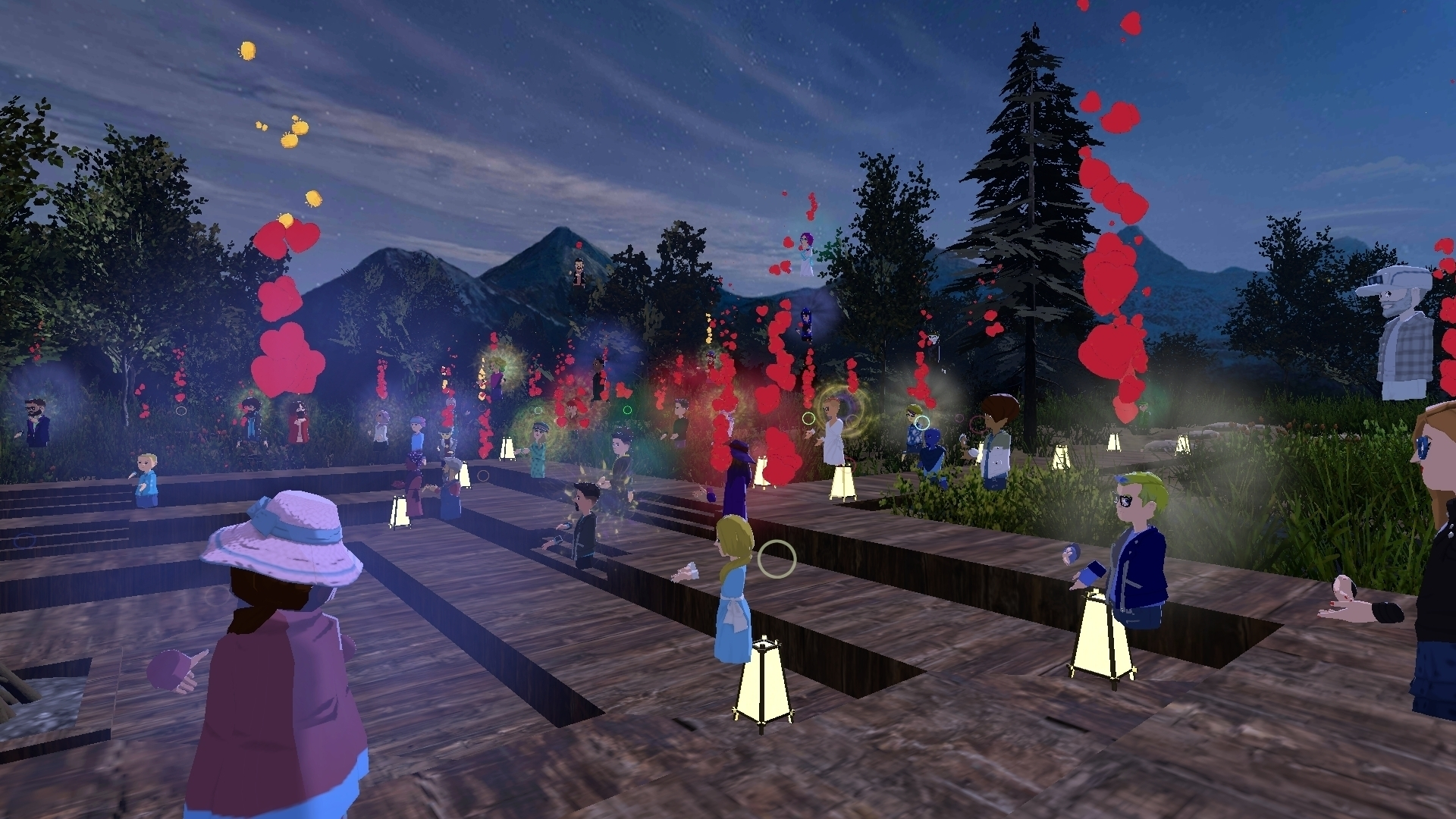
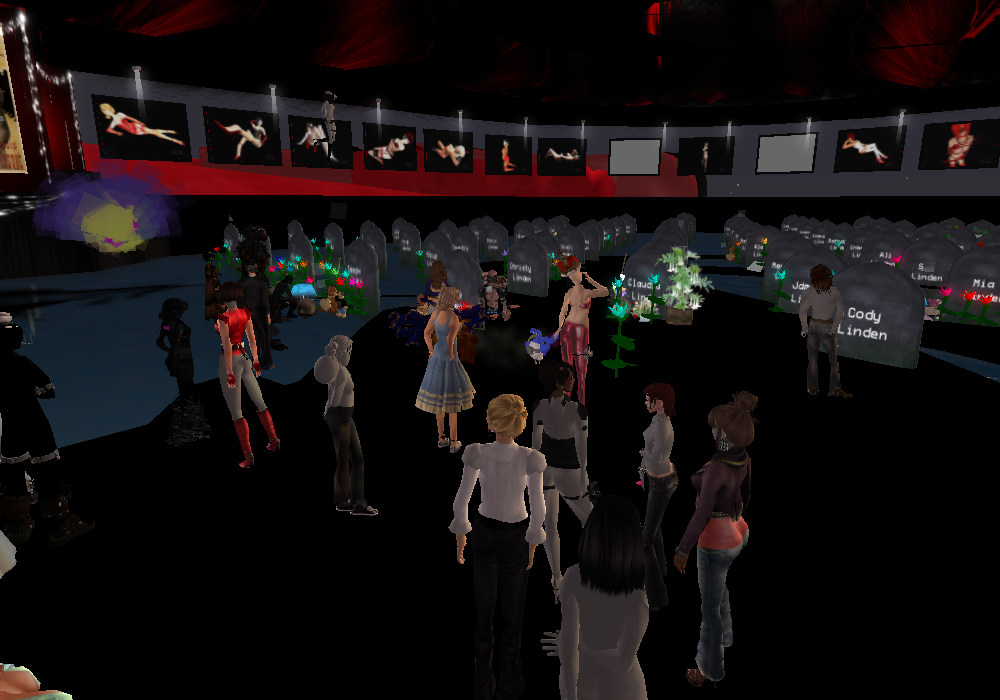
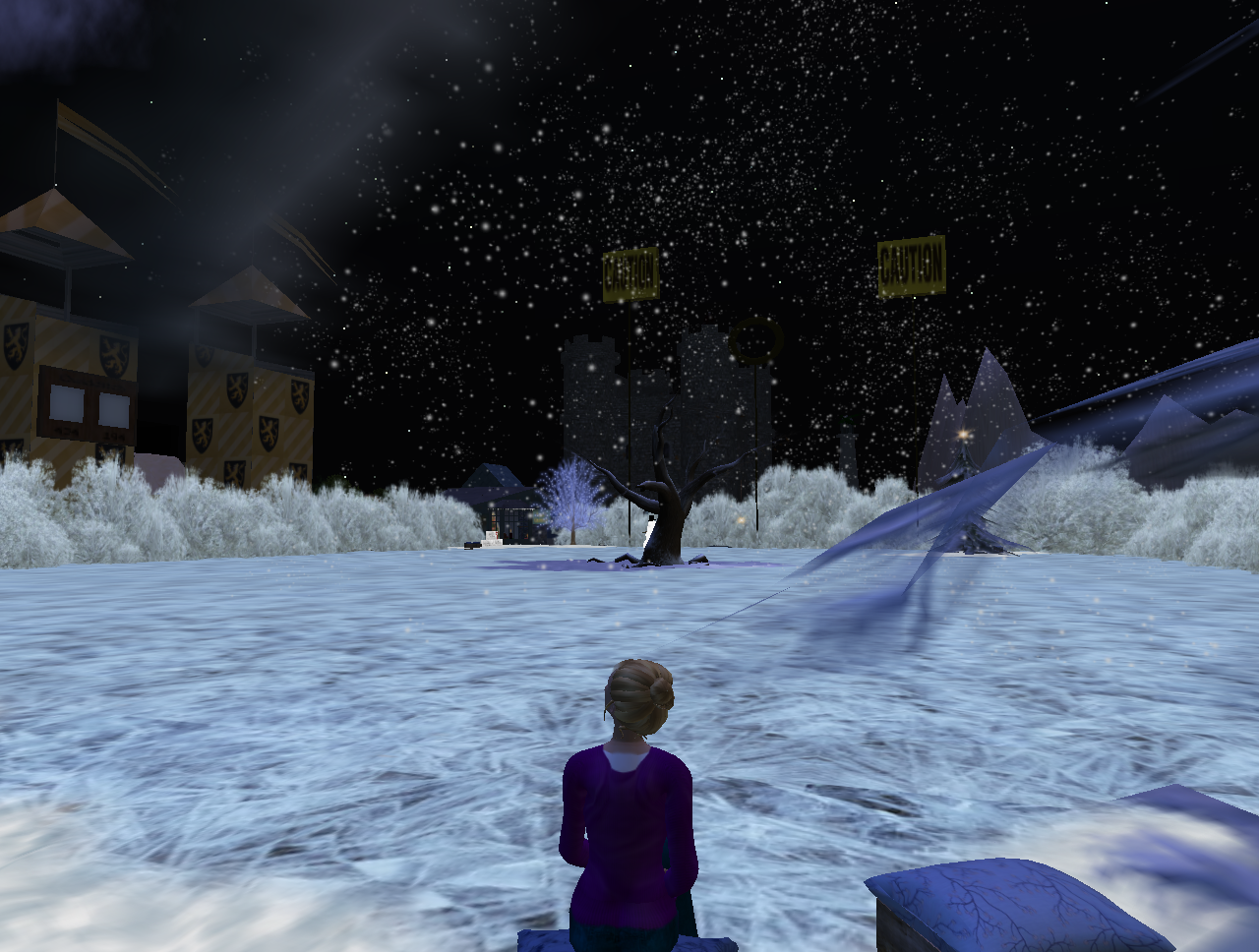
IMAGE: Second Life resident looking at snow falling on the Quidditch pitch of the nighttime VWER Campus, 2010.
This is some of what I call my “kick out writing” that I did not include in some recent published writing. It starts:
The
promise of the metaverse in education is like a mirage in the desert.
Educators seem to be forever awaiting the arrival of the metaverse but
still not yet embracing those technologies.
In 2003, #SecondLife
launched as an immersive persistent virtual world. Just three years
later, educators were publishing about their pioneering efforts on the
platform. Kemp & Daniel Livingstone (2006) suggested pairing Second Life with a learning management system (LMS), a suggestion familiar to #instructionaldesigners
of the Internet age. In 2007, the word “metaverse” first appeared in
educational publications (Tilili, 2022). The popularity of virtual
worlds briefly increased between 2007 and 2010. As cited in Warburton
(2009), Kirriemuir estimated that “three quarters of UK universities are
estimated to be actively developing or using Second Life.” This
adoption would wane by 2013 however after educational discounts were
discontinued and the initial fervor of virtual spaces gave way to empty
buildings and virtual ghost towns.
The arrival of the metaverse would have to wait a little while longer.
~
I just lean back in my chair and wax poetic sometimes. 💺 ✍
Have you ever been baptized? I mean adult baptism that you could remember. I’m not worried so much about your beliefs, what religion, or your soul (sorry, your circus, your monkeys).
I’ve been thinking about how baptism is like ‘play acting’ your death. Religiously, it is supposed to symbolize dying (going under the water) and being reborn (coming up out of the water).
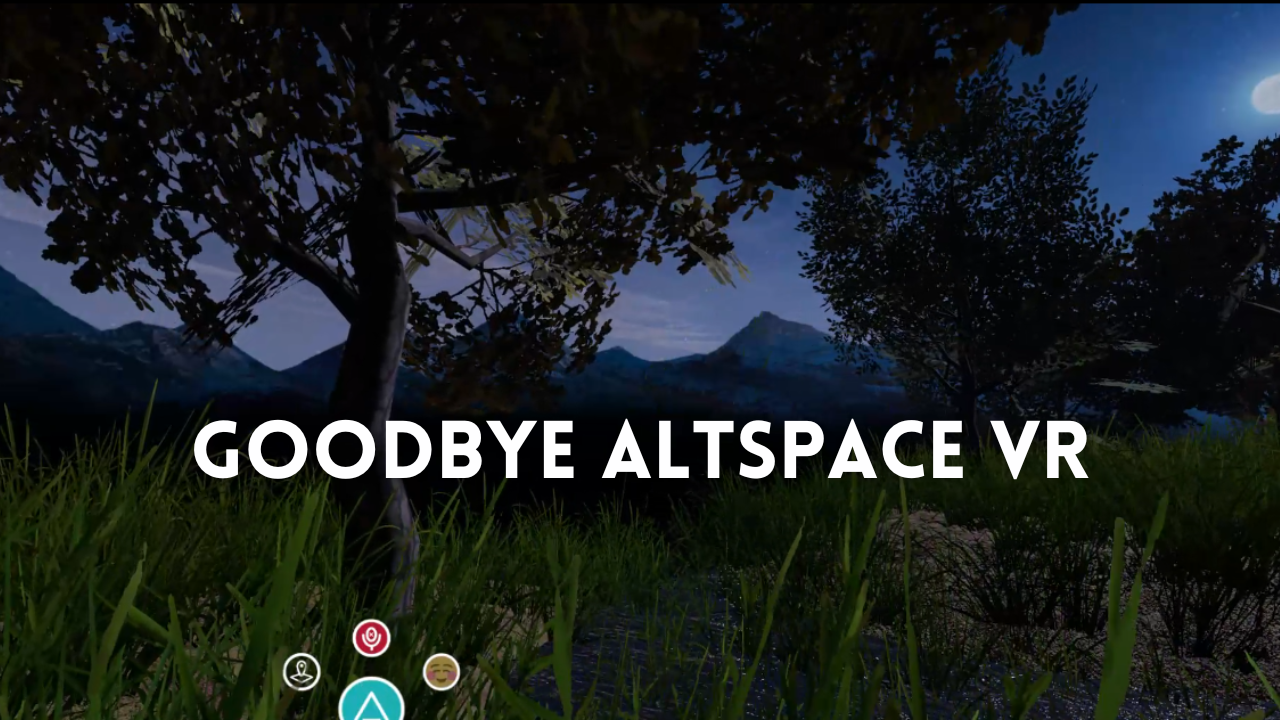
Last Friday, March 10, 2023, AltspaceVR shut down. For those that study the interrelationship between avatars and human beings (i.e. the Proteus Effect), being inside a platform while it shut down was like a form of play acting your death.
I wasn’t planning on being inside the platform when it shut down. AltspaceVR was never one of my favorite VR platforms. But the educator community in Altspace was HUGE, HUGE, HUGE comparatively (Educators in VR claims 6,000 members now). The art & concert crowd was decent too; lots of creative & innovative stuff going on.
AltspaceVR had its annoyances.
It was a downloaded application = bulky, on a scale of 1 to 10. Don’t get me started on Steam.
Macs weren’t allowed in for the longest time.
Back in 2020 and early pandemic days, kids be-bopped in everywhere and were ALL OF 13 years of age,if you know what I mean.
But my biggest peeve? No public chat. So, never, ever was there the ability to share links, write snarky comments, spell out words, etc. Grr….Hard to believe a major platform would blank on something that Zoom can do.
But I digress.
I caught a friend live-casting from inside AltspaceVR inside the final hour. So I decided to go in to where he was. When I logged in, I could see the last few events holding up the tent poles.
In the final 3 days the events got really sad names:
Closing Celebration
Sunset Party
The Final Countdown
A Sad Tour
Africa Says Goodbye
Goodbye Altspace
Party ’til the end
This is not goodbye
Goodbye to AltspaceVR
And some cheeky kids (?), “HELL NO! WE WON’T GO CAMPFIRE”
I joined The Sunset of AltspaceVR held by the classy group, EvolVR. I’d never been to their events.
I was warned 2 days before that the “end” would feel like a glitch.
But the overall impression I got as I walked around their Zen meditation space was two things:
1. Friends meeting up. Folks were in small groups. There were only a handful of solos like me. They were chipping in stories about not being sure they could log in, but they made it.
2. Unfair. The vibe, after being sad, was unfair. No one felt that what was happening was deserved.
Plenty of folks had been making comments in social media that the shutdown was ‘foreseen’ and ‘inevitable’. But still…it felt NOT FAIR. Like something GOOD was about to be GONE.
If I was asked what the mood was, it was like a funeral before a death.
We heard stories, there was a song dedicated to the shutdown, and due to the magic of Altspace, we could see emojis from users in other instances so at times, the space was non-stop hearts.
I was quite surprised to hear developers, users, artists, designers profoundly THANK AltspaceVR for what it had done for their lives. There were many comments of “I changed because of AltspaceVR.”
We were given about 10 minutes to mill about and talk before the meditation host started the last planned event. Unfortunately, as a group, we were spreading from 3 instances to 5 instances with over 200 attendees. (Note: Altspace VR’s purported daily attendance total number was 1,000). We were told planned lantern releases were happening but I didn’t figure it out. I was one of the ones that preferred to take a slow walk around the Zen island, letting the tall grass brush past my avatar’s body, hands, and face. (Like that? How can I remember a physical feeling I NEVER HAD?)
We were pulled together for the final meditation and a scene change busted. Such is the way with a VR platform that had been getting less and less attention over the past 3 months. So we stayed put in the Zen space and the host told us he would mute the entire audience. There was one gasp of “What??” but really, we were already into step 3 of “From now on, you will not be able to do what you want to do” mode (aka, death).
He ran a lovely 5 minute meditation, asking us to conjure up our favorite AltspaceVR space and then imagine our loved AltspaceVR friends in that space with us. (Side note: I was QUITE surprised who ended up in my meditation…let’s just say that I’ve been working on my ‘pray for your enemies’ Christian element and whoa did they show up!! I guess the ‘love your enemies’ thing is really working for me. I had to smile as I saw them, with no anger, no hate, no disgust. I was just happy to see them. Sniff.😔)
Then, the clock ticked over from 1:00 p.m. Eastern US to 1:01, 1:02. By 1:03 the host said “Hell, we’re in overtime, I’m turning mics back on!” and he encouraged everyone that wanted to to join a hug puddle around him.
It looked lovely (it’s in the video below). But it was not for me.
I turned on my avatar’s non-existent heels and went back into the tall grass. I was moving towards the moon and the trees. I found some water to watch and I stayed looking down at the ripples. I could hear crickets.
And then, just as it was predicted, I was simply winked OUT of the space. It was 1:08 p.m. Eastern US. The crickets kept going. That was a bit spooky, but just like real death (I’ve heard) in that hearing goes on a little longer than heartbeats or sight (as the brain can operate on sound signals for longer without oxygen).
I just sat and listened. Listened for anything. Anything OTHER than crickets. Nope. Nothing. I sniffed a bit. 😓
After 1 minute, I had tried all the buttons. Silly me, you KNOW you are dying and yet you still think maybe I can get back into the space. Humans. (In hindsight, how amazingly ridiculous! I’m attending an event LITERALLY DESIGNED FOR DEATH. I know I’ll be glitched out. We’ll all be glitched out. It’s not personal. And yet, when the moment comes, there is a voice that says “Maybe I can get back into that event–already in overtime– that was designed to glitch me out.” Make note: whoever you are in life is EXACTLY who you will be in death.)
At 1:09 p.m. Eastern US, I used the X in the upper right hand window corner, and I closed the program. I took a few breaths.
Death.
Practicing death.
Like baptism. Because here I was breathing afterwards. I was OK. It was a computer program, after all, right?
When I was baptized, I was with a church and religion that did it up– they were the Baptists!! (Don’t worry, I’m not affiliated with them now. I jokingly say that I disagree with more of what the Baptists believe, than agree.) But I was in a 10,000 seat church where the dunk tank was the size of a HUGE bathtub or small pool suspended ABOVE THE MAIN STAGE where half of it was see-through glass.
I had been prepped on what would happen and prepped on how I would be wearing my 2 bed sheets. I’ll tell ya, THIS the Baptists can do AMAZINGLY. Women get 2 sheets. Men get 1. White. And they give you instructions on how to fold, tuck, and finagle those puppies so that nothing is seen–even soaking wet. Major applause! 👏
I’d opted for the “Yes please I do not want water going up my nose” technique where I put my nose in a crab claw pinch and had a washcloth over my nose and mouth.
There were 3 burly men in the tank: one walks you in, one dunks, and the other walks you out. It’s done slowly, one person at a time. Children first with lower water levels.
I was with the adults.
I went in as gracefully as one can when wrapped up tighter than a burrito. I put myself into my ‘one arm takes care of my nose and the other arm locks into the first arm’ and the burly man was ready to dunk. I honestly don’t remember the exact instruction but I think I had to bend my knees in already chest deep water.
I do remember the last thing I saw.
As as the warm water started to swirl really all around me, I saw BRIGHT LIGHTS, I mean, wicked bright lights (these are STAGE LIGHTS, yos!) beaming right down straight into my eyeballs. Too bright to look at, so I closed my eyes.
But for one brief moment, I thought, if this is what death feels like, it’s warm and bright and honestly not too bad.
And then I was up. Sputtering, but fine. I was being walked out and there was a little audience clapping (the baptism despite being SO visible was actually a sparsely attended church event). I was up on the floor walking over those mats that you can drip like a soaked rat over and I was off to the changing room to try to put myself back together. #hairdryerplease
So…what does all of THAT have to do with each other? It just makes me think about death, the before and the after.
Later that shutdown afternoon, someone wrote that a social VR platform has never shutdown before…so she was studying the timing. She’s on to something.
You see, I joined Second Life in 2008, now 15 years ago…and I’ve never left. I actually went back into Second Life 3 hours after this AltspaceVR shutdown event (after also having spent 1.5 hours in Mozilla Hubs). So I haven’t had to lose my avatar in Second Life.
Sure there are platforms I’ve been to once and I just don’t care to go back (I’m looking at you Cryptovoxels) but I haven’t had to see my scenes disappear. The AltspaceVR world creators took this very badly. They could remove their assets, but removing how things were set was very difficult. I feel for them.
They are porting off to other platforms (where the dead are, the vultures will gather) like Spatial, Mozilla Hubs, or FrameVR. I’ve seen one stupid but valiant attempt to lure folks by Virbela (stupid b/c you can import zero of your own assets into Virbela).
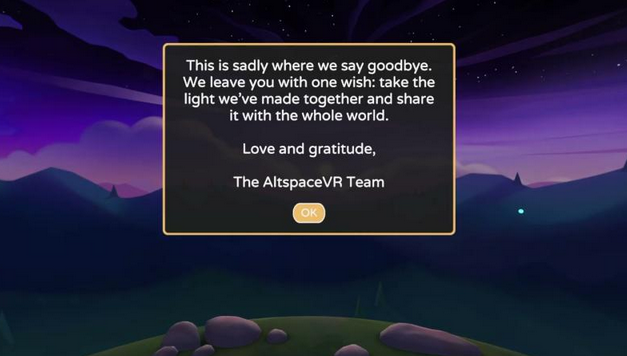
But I’m touched that the AltspaceVR folks seemed to know we were out here and having a hard time. They posted one final message (I’ve captured it from a friend).
Classy final touch, AltspaceVR.
Thank you and goodbye.
Please watch my video. And thank YOU!~
Note: this post is simultaneously posted to a LinkedIn article.
I purposely start articles with “A” when I mean to not be definitive but exemplary. In this case, I would like to pick out a few of the early education influencers and memories that I knew from Second Life (SL) (and Heritage Key, 3rd Rock Grid, OpenSim, and other early virtual worlds).
One of the observations that brings on this article (besides the true desire to give credit where credit is due) is that educators are starting to stream into the metaverse or cross reality (XR) – especially with the $299 Oculus headset cost and the pandemic forcing isolation – and I find that in education & XR development – there is a disturbing lack of knowledge of the foundation of virtual reality studies. That is, people that know about the role Second Life played in XR for learning research are not writing enough about it now so that what it did in the past is captured for the future.
Remember the ‘we stand on the shoulders of giants’ thing?
The giant is, in part, Second Life.
I would suggest that what is lacking in this background research is the fact that the vocabulary (and somewhat, the meaning) of words has changed so even a well-meant Google Scholar search might not pick up valid research from 10+ years ago because search terms were simply different words.
So, first – Search on virtual world (VW) as your primary term. Virtual world was a more dominant phrase than virtual reality. Other words to use: immersive, MUVE, multi-player online, persistent, HIVE (highly interactive virtual environments), online games, simulations, visualizations, online reenactments, distributed classrooms, and hypergrids. Indeed, find one good metastudy from ~2009 and you’ll probably hit the vocabulary jackpot. In researching this article, I found the term Sloodle which I had forgotten but that was an incorporation of SL into the Moodle course management system. You will find a great of research on identity, presence, and immersion with avatars (not so much with locations or “doing stuff” in VWs because object physics was/is very primitive and you can’t “do” too much there. There are pose balls, but really that’s a subject I’m not going to get into here). Bear in mind that headsets only existed in research so this was all what we would know in 2021 as 2D virtual reality or 2DVR (VR on flat screens, monitors, and tablets). Because there were few consumer headsets, there was no “us versus them” that you find now between 2D and Head Mounted Device-based (HMD) 3DVR.
Next, I very well realize that in some circles, Second Life causes giggling, either in derision (see the hype cycle image below) or in acknowledgement that SL did primarily serve the adult content market more than the education market. Sorry, but someone needs to write the obvious. Just recently, when the metaverse conversation popped up with some SL users on Twitter, they were adamant that they would never move to a platform that didn’t allow “adult content.” Second Life was never a place that you wanted to wander into the dark alleys as an educator. At least, if you did, you would learn some stuff you’d rather not know. The sexualization of Second Life is still prominent. Just do a google image search on second life. NSFW. Second Life was always a place for college and university educators (READ: Over 18 years of age).
Thus, educators tended to stick together. You heard about SL from another educator and you went in with them. I went in with a professional development group and had my first “meeting” in a hot tub at the Burning Life festival in SL in 2008.
There were some GREAT educator groups and some of them are still going! I mention my favorites:
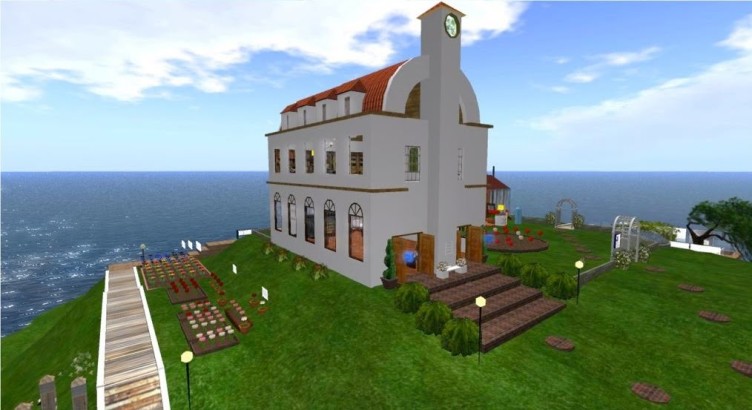
Virtual Worlds Educators Roundtable (VWER) – my home base and it is still going! I volunteered on the organizing committee and hosted a “Reading Meeting” where we invited the author of an article in for a presentation and Q&A (I was able to talk with the Whyville Pox article researcher, which is still a GREAT study). At its heyday, VWER had 2 grids: 1 for meetings and we had a Quidditch pitch/outdoor ice skating rink and 1 for parcels for educators as a sandbox and I had a virtual office.
Great “places to visit” included NASA, NOAA locations. Rockcliffe University Consortium, Glascow University Online, California State University, Chico (defunct? I think?). Then there were one-off builds that were also great like the Edgar Allen Poe House and the walk-through heart and colon.
During this same time, other virtual worlds were coming up and visiting them was fair game. My favorite was the short lived Heritage Key that needs to come back! That place was so cool and educational, you could visit Stonehenge over 5 different time periods and help build it
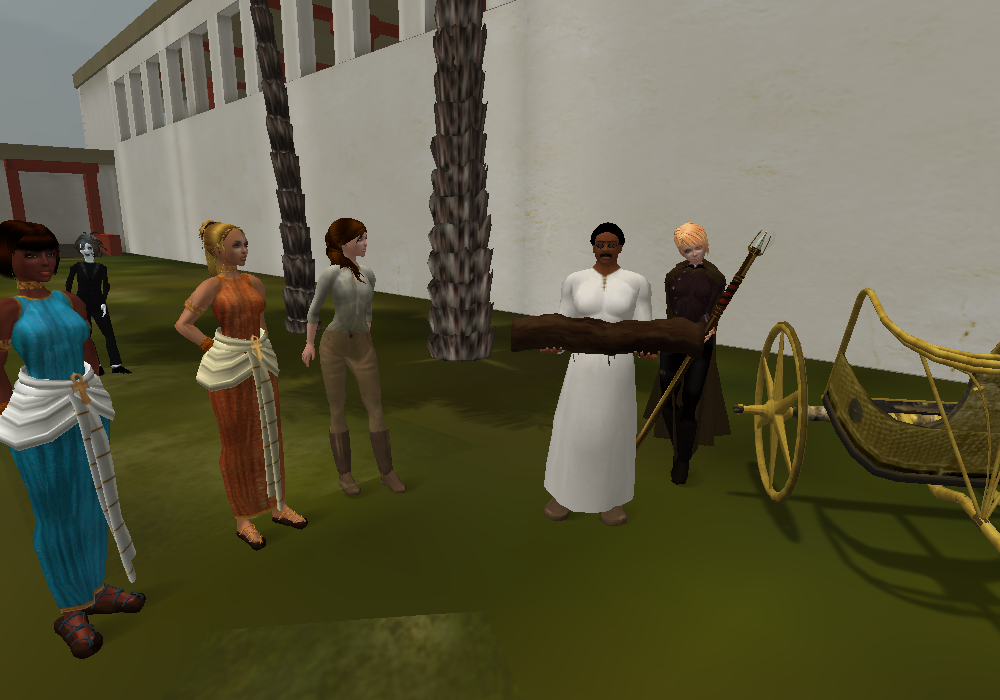
What happens when 2 Egyptians, 2 Adventurers, 1 Druid and 1 Zombie all go to Ancient Thebes?
So…what happened?
There are many commentaries now. All of them have a piece of the truth. Probably the biggest factor was money. Hosting a grid literally cost money and universities had to pay for it. Over time, it just didn’t make sense to keep paying monthly for a place rarely visited.
College and university builds represented a huge investment of time. You should have heard how much the word “Primmy” was used back then. Primmy is short for primitive which meant the building blocks of virtual realities which are primitive shapes (spheres, cubes, columns, pyramids, etc.) Some clever instructors had their students do the builds and then called that assessment (I’m not calling that wrong, I’m just saying…clever.)
The locations, indeed, themselves brought on their own demise. Many builds became ghost towns because avatars would visit a “virtual campus” (OFTEN a replica of their real campus buildings (cough, mistake, cough) but walk inside the buildings that may or may not have had enough “prims” to put separate rooms inside those buildings, and so visitors found the building completely empty during off hours, wonder what the big deal was, and then leave.
This was one positive result of those early days. Many educators realized that “replicating reality” should NOT be the goal because for now, you’ll never get there. The human eye is too good at discrimination. But what you do want to do is the phantasmagorical.
Do the impossible. Virtual reality is very good at the impossible.
Remember this was before VR was called Social VR, so the ‘social’ part was truly touch and go. In SL, you either found groups of people or you didn’t. Most positive SL stories going around right now will involve relationships and groups. Truly today, I only go into SL for events. I hardly ever go in to just explore. It’s not built for that. What was it built for? Well, it had some characteristics that were interesting and unique. (Alt opinion here.)
Born creator
First and foremost to me, every avatar is endowed as a creator. An educational psychologist I know immediately deemed this a “God complex” program. Indeed, every bell and whistle of creation (object creation and space manipulation) was available in the overwhelming UI. I’ve been a SL citizen for more than 10 years and still I don’t know what half of the UI choices are for. Even though I’ve done it a lot, I’m still not sure what rebaking does.
The original Second Life Ruth avatar
The default avatar was “Ruth”. She made new users learn how to change appearances. Impressive abs though. She must have never eaten a potato chip.
Avatar customization
The avatar customization is in Second Life (still) is top notch.
Seriously, OpenSim and Second Life have the best clothes’ animations! I once saw someone who wore a top hat to a Christmas party and the around the rim of the hat was a tiny puffing train! (If you are reading this and that was you, please reach out to me, I LOVED your hat!! I want a video of it!) But, I find Sandsar and sinespace is coming up fast on good clothes and avatars.
You can get married and divorced in Second Life. There are also active furry communities. I’ve got no comment on all of that. I would just remind everyone that what is in a virtual world is what you bring with you. It is definitely not all innocent and it is definitely not all healthy.
Even though you have creator controls, you cannot build just anywhere. Land is owned (permissioned) and you have to essentially pay to have land. Early objects were NOT copyright protected. So copying, stealing, and replicating was rampant. (Hat tip to Somnium Space, who addressed this problem from the very start by tying assets to NFTs.) I suspect a lot of artists hiked out of SL because their work didn’t stay under their control for long. For educators, there was an active “free sharing” market and I still wear my first set of “professional educators clothes” I picked up free from some place.
Hat tip to the word rezzing. I still use it. When I arrive somewhere, I rez in. The spot is the rez in spot. The current term in 2021 is “spawn point”. Yuck. I think this term, rez, should NOT be lost. Rez means resolving, which is what your avatar would do when it was still “coming into” the VR space. It’s the ghostly cloud you see here:
We would lost without our Path…finder
But I’d like to get to the tribute part of this tribute article. I would like especially point out the impact that John “Pathfinder” Lester had in Second Life. Everyone who was on staff for Linden Labs officially had a Linden last named avatar. John was Pathfinder Linden and all educators knew he was the one to talk to about ideas and problems. He “led the development of the education and healthcare markets while evangelizing the innovative use of virtual worlds in research, art and immersive learning.” Truly John cared and helped. I remember the day I sat next to his avatar at a meeting. I was so, so, so thrilled. But I never figured out why his avatar looked like a boot to me. It must be the eyelets and the shoestring. Apparently this is a bit of British culture I don’t know…that’s a character?
Early John:
Pathfinder Linden
Many of us observed in stunned silence as Linden Labs pared down staff infamously. I watched in foreshadowing because I knew that it was like to work for a company that would drop you easily. I followed John’s blog “Be Cunning and Full of Tricks” closely during that time and noticed how he rebuilt his professional life.
This article was posted simultaneously to my LinkedIn account on 11/23/2021. https://www.linkedin.com/pulse/tribute-second-life-yes-its-still-around-heather-dodds
A long film that dives deeply into multiple aspects of avatars in virtual worlds. Touching story of how the disabled can use VWs to explore friendship and relationships.
As of November 2021, Draxtor is still a resident of VWs and can be found communicating about them.
Video description from YouTube:
[ ***WINNER JURY AWARD & WINNER AUDIENCE AWARD BEST DOCUMENTARY @ Riverside International Film Festival, Riverside, CA, 2019 +++++WINNER JUDGES CHOICE AWARD @ Monarch Film Festival, Pacific Grove, CA, 2018+++++AWARD OF RECOGNITION @ IndieFEST Film Awards, La Jolla, CA, 2018++++SEMI FINALIST @ Hollywood International Independent Documentary Awards, Los Angeles, CA, 2018 ****]
“Our Digital Selves: My Avatar is me!” tells the story of 13 ability-diverse global citizens as they explore their identity through artistic expression and making a home for themselves in the VR Metaverse.
Filmmaker Bernhard Drax travels from Los Angeles to rural South England to explore why people ranging from 24 to 92 years of age find solace and inspiration in a user-created digital wonderland that only exists inside their computers.
Drax sends his documentarian avatar Draxtor Despres into the virtual universe of Second Life as well as next generation VR platforms like High Fidelity and Sansar where he meets a 40-something disabled Chicago native feels best represented by a colorful superhero gecko and Cody LaScala – confined to a wheelchair his entire life – who makes his avatar an exact replica of his physical self.
The film follows researchers Tom Boellstorff and Donna Davis as well as leading technologists in Silicon Valley who intend to – as they say – “design the future of social VR with disability in mind”.
As Boellstorff and Davis finish up their 3-year study on embodiment and place-making in VR, made possible by a grant from the National Science Foundation, the film comes as a compressed visual compendium to a seemingly unlimited array of possibilities for human interaction via the embodied symbolism of the avatar.
Unique in its narrative approach, “Our Digital Selves” weaves together physical and virtual cinematography as the protagonists’ backstories are re-enacted via real time animation [Machinima].
Contact drax at draxtor dot com for more information
This is a haunting documentary about 2 women who gave up their real lives in pursuit of virtual relationships. In both examples, the couples met in real life and the resulting relationship was either non-existent or weird.
This video has been tagged by the CBC as showing examples of gaming addiction and provides links for the left-behind spouse as “widows”, i.e. World of Warcraft Widows, Everquest Widows, etc.
It seems to want Flash to play now (since 2008/2009) and I won’t bother. But it is a hugely disturbing video for me and very important.
.png)