Tag: Training

  • Bizarro World Training

    Bizarro World Training


    Photo of light bulbs hanging upside down from a wooden bar.


    Photo by Christopher Machicoane-Hurtaud on Unsplash 

    I was given an assignment to go over good student appointments on the phone protocols with my online faculty.  This was one of those “somebody’s done it wrong so we all need to be punished” training assignments.

    I was pissed. My team was great on the phone. How did I know?

    1. I trained them.

    2. I observed them.

    3. Better than #1 or #2, my team understood that our behaviors with students on the phone reflected upon all of us, not one of us. As the Disney song says “We’re all in this together”.  You’re welcome for that earworm.😛

    So I was mad and didn’t want to do the training. But I had 2 items in my favor:

    1. We could design and run the training any way we wanted to. We only had to make “recordings” of the training.

    2. My boss didn’t care to check on the deets. He just wanted to hear that I had completed the training with my team.

    So…. I decided to do Bizarro World Training. That is, the opposite of everything that should be done, we were going to do.

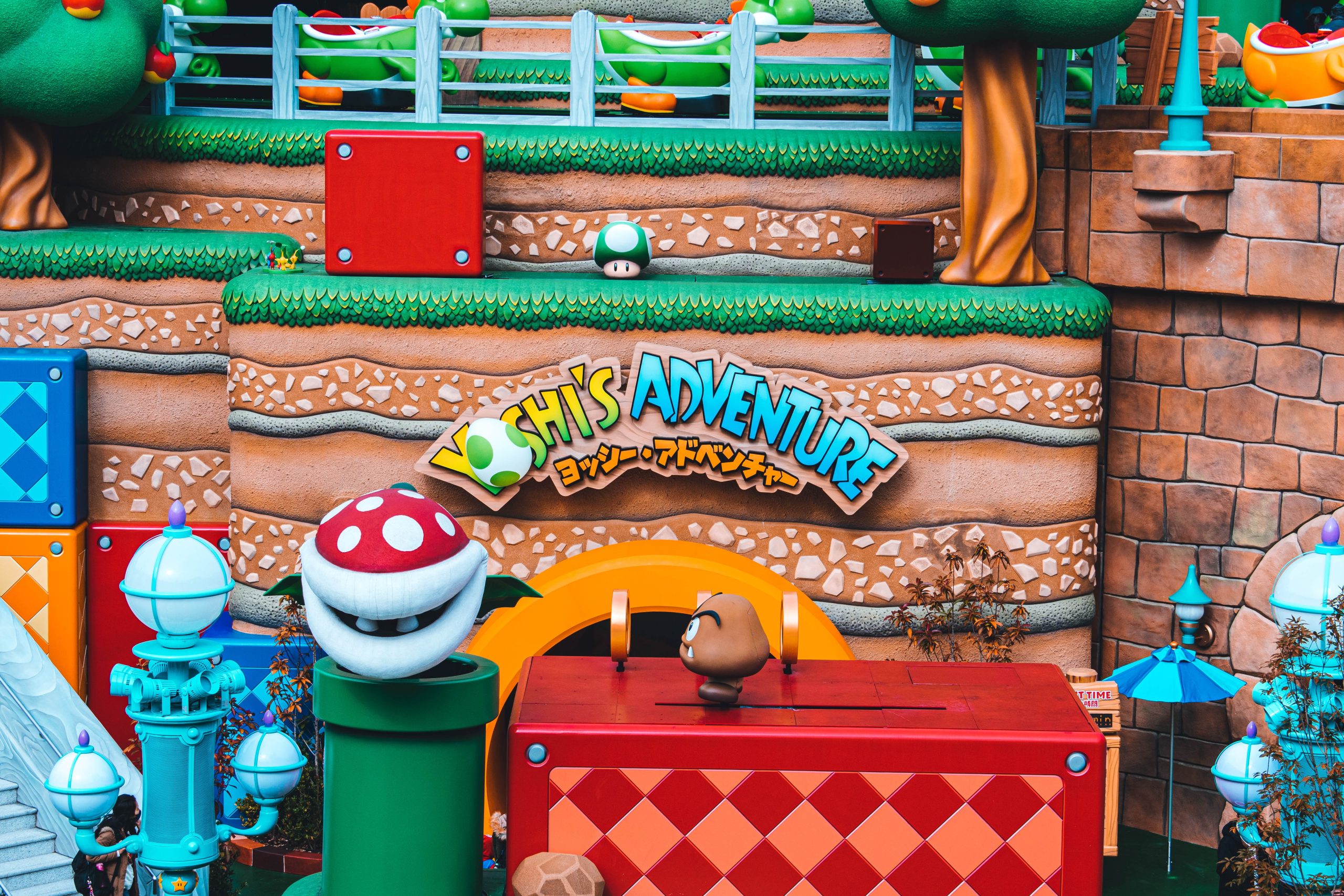
    Photo of Yoshi's Adventure Park somewhere in the real world, made in the likeness of the Super Mario computer game.

    Photo by Roméo A. on Unsplash

    I directed my team to team into teams of 2 and they had a certain amount of time to make a recording of “The worst faculty – student phone call ever.”

    They would make a recording – it could include video or not but everyone on the team had to appear at least once in a recording, being either the faculty or the student.

    We would watch all of the recordings at one team meeting one week.

    The results were PERFECT.⭐

    I had faculty who started the video literally with her feet up on her home desk, doing her nails. She just casually called a student. She was completely oblivious to the student’s needs and had not prepared at all.

    Another faculty gave off-the-cuff advice, dismissing everything that the student thought *might* be important and just said things like “yeah, whatever!” It was like the most un-clued-in faculty member ever.

    But the winning entry was a faculty member who called a student and they arranged for massive interruptions by their kids during the phone call– on both ends. The student threatened their kids on the phone. Yes as online faculty we hear that a lot “If you don’t quiet down, I’m gonna [insert true reason to call DFS on the student]!”

    But that was not all, the faculty member’s kids broke into the call too, explaining things they were excited about and playing the violin right next to the phone.

    The call devolved into just a cacophony of the faculty member and student yelling at each other to barely be heard.

    We were all dying of laughter, tears streaming out of our eyes, when we finished with this training.

    I kept the recordings and used them to train new faculty. 

    Always with the qualifier, “Here’s how NOT to do it.”

    #SomeOfMyBestTrainingEver

    #training #elearning #OnlineLearning #faculty #leadership #edtech #InstructionalDesign #BizarroWorld #WhatHappensWhenYourLeaderIsAnInstructionalDesigner 

    Article also posted to LinkedIn. https://www.linkedin.com/pulse/bizarro-world-training-heather-elizabeth-dodds-ph-d-

  • Virtual Reality for Soft Skills…Maybe

    Virtual Reality for Soft Skills…Maybe


    There you are, eating your morning bowl of cereal. You glance at your social media feed. Up pops these images:


    Screen captures of infographics and images made from the 2020 PwC VR for Soft Skills Training Report. In the lower right hand corner, a person is wearing a headset and looking amazed.

    Wow. Even the infographic people seem amazed.

    But
    if it is too good to be true, it probably is, at least where research
    and marketing intersect. Not to worry! I’m here to tear apart this and
    see what’s inside. Can virtual reality (VR) teach soft skills training?
    Verdict: Maybe.

    My Executive Summary:


    Heather's summary of the PwC analysis:  2 results are garbage (confidence and focus) 1 result is just okay (faster), 1 result in good (more effective) and 1 result was buried, than the learning had no significant difference.

    Let’s start with the nuts and bolts.

    Citation & Report

    Mower,
    Andrea. “The effectiveness of virtual reality soft skills training in
    the enterprise: a study”. [Place of publication not identified]:
    PricewaterhouseCoopers, 2020. Online. Internet. 21 Aug 2021. .
    Available: https://www.pwc.com/us/vlearning.

    Despite that
    academic-y looking citation, the writing does profess itself to be a
    report, not research. That’s good because reports are not held to the
    same standards of rigor as research.

    What you find at that web
    link, however, is NOT the full report. You are looking at the corporate
    summary. Remember that technically, PwC is not in the VR business (a
    plus) so they are not selling you something about VR. They are only telling about how some VR training went at their company.

    Something
    quoted the report as “73 pages” but the website is not 73 pages long,
    so I had to find the actual report. That took a little more digging but I
    found it here: https://www.5discovery.com/wp-content/uploads/2020/09/pwc-understanding-the-effectiveness-of-soft-skills-training-in-the-enterprise-a-study.pdf

    Experimental Design

    Disclosure is right up front (first sentence!) that:

    “supported by Oculus for Business and Talespin,”

    Good
    disclosure; it’s good practice. While I’m not loving that it is
    sponsored by a VR headset manufacturer and training creator, knowing
    this lets me view this with the appropriate amount of critical thinking.

    Their study started in 2019 and ended in February 2020, so they indicated when it was run.

    Note:
    Every piece of research that touches 2020 and forward into the near
    pandemic future, should clearly mention WHEN the study was run, because
    the COVID pandemic is impacting every part of our lives.  COVID does impact “reports” and we need to know if these are ‘at-home-stressed-but-sent-a-headset’ users.

    They had a hypothesis: Our
    hypothesis was that training using VR is more effective in achieving
    learning outcomes than traditional training methods (classroom or non-VR
    digital experiences).

    Remember that a
    hypothesis in experiments is good. Hypotheses guide us to our data and
    results. Bias in experiments is bad. Bias makes us ignore our data and
    results.

    And PwC defined “more effective”  with:

    • Employee satisfaction
    • Learner flexibility
    • Comfortable learning environment
    • Improved attention
    • Higher information retention
    • Confidence building

    That definition of “more effective” is a little murky. Usually time plays a very definitive role in “effective” measurements. For example: widgets produced over time. Here, time is not actually mentioned and yet time is prominent in the infographic stats later. Hmm..

    In their experimental design, PwC appears to think that they have made comparable training: 

    • classroom,
    • e-learn,
    • v-learn (VR).

    Oo, bust here.  While I hat tip to the innovative thought process expressed here, to take advantage of what VR can offer…

    “The
    classroom and e-learn course experiences were linear: A video was
    shown, the learners asked some questions, then the next scenario was
    presented.”

    “However, we determined this linear approach would not
    leverage any advantages of the VR modality. We hypothesized that
    placing the learner directly in the scenarios covered in the curriculum
    and giving them the ability to act as they might in real life would be
    more rewarding for them.” (p. 16)

    … but, owch, non-comparable methods!!  If you literally taught the information differently, you cannot compare the methods and thus, you cannot compare the results
    The key to making a good design that includes VR (and I’m giving you
    the $64,000 answer here for anyone designing “compare” research with VR)
    is to put it up against something very, very cognitively similar. 
    Right now, that technology is 360 video where you put in branching
    decisions. And add haptic bodysuits & controllers. But that convo
    is for another day.

    Now to parse out the difference between 360
    video and VR, you’ll need thousands of users. Not many investors right
    now have the willingness to spend thousands of dollars in equipment and
    time to collect that much data.  And even when you get there, you
    probably won’t find much a of difference. Why? Well, take a look at what
    you designed.  If you make a cognitively similar experience and run
    humans through it, it actually makes sense that no significant difference in the data will arise. 
    Remember at this point, I’m talking about learning outcomes ONLY, no
    other characteristic. Also, go back and look at the hypothesis. They
    already thought that the ‘learning outcomes’ would be the same (READ:
    same scores on tests) but that they could achieve those learning
    outcomes “more effectively”. That’s interesting. I wonder how much of
    this report was written from hindsight and how much was written before
    the study started. (This is why you write your hypothesis first–before
    your study.) That hypothesis is now possibly showing a bias…did they
    *think* it was going to turn out…the way it did?

    Number of participants: 1600 possible. Good. But they never disclose how many learners they actually had in each group (their Ns).
    Therefore, I’m going to call this a strong negative because they could
    have included that number (I don’t see a business reason to conceal
    it).

    Experiences: 5-7 minutes long

    Did use Oculus Quest (ahem)

    Did use Oculus for Business for remote device management

    Honorable
    mention in the report: Using the phrase “not the most gratifying” when
    talking about tagging and inventorying what must have been more than 300
    pieces of equipment.

    One more small note: The report does a nice
    job explaining how they decided to buy 100 headsets and what the cost
    and time of developing the v-learning training was. It is outside of my
    scope to analyze that but I will recommend it as good to read. Remember
    that if the cost of v-learn is dropping, it becomes a better and better
    choice over time. They do those calculations and find that it becomes
    the better choice at 3,000 users/learners.

    Let’s see what the data shows:

    Screen capture of the 4 key metrics that were made into the infographic, claiming that VR is: 4x faster to train than the classroom, 275% more confident than the classroom learners,  3.75x more emotionally connected than classroom learners, and 4x more focused than their peers.

    4x faster to train than in the classroom

    I
    might have to cede this one right off the bat because VR does provide a
    1:1 experience that most classrooms cannot beat. How many classrooms
    can provide– minute for minute– the same 1:1 attention of the teacher
    to the student? Erps. Few.

    Fly in ointment? VR can cost a great deal of money for development and for the equipment. READ: the set up.

    Counter to that?
    VR can be done for very little money and because training can be
    replicated a billion times when a 1:1 teacher cannot be replicated, VR
    wins the day on this claim.  READ: it CAN save time but after
    development is done.

    I still don’t like comparing “classroom” to VR, such a not-fair comparison.

     “What
    took two hours to learn in the classroom could possibly be learned in
    only 30 minutes using VR. When you account for extra time needed for
    first-time learners to review, be fitted for and be taught to use the VR
    headset, V-learners still complete training three times faster than
    classroom learners. And that figure only accounts for the time actually
    spent in the classroom, not the additional time required to travel to
    the classroom itself.”  

    In the report, they shared numbers in minutes. 

    Classroom:
    2 hours (Watch that crossfire, boys! They didn’t express this as 120
    minutes. Heather gives PwC a strong look for that. Don’t be mean. Or
    get a better editor.)

    E-learn: 45 minutes

    V-learn: 29 minutes

    29 * 4 = 116

    116 is close to 120. Therefore, saying V-learn is 4 times faster is accurate. [Edit: In future writing, I clarify that stating “4 times” or “4x” is not a data lie, but it expressing a truth in a deceptive way. Learners didn’t learn four times faster, the literal training session was 1/4 as long in time. So they sat through LESS training time. That doesn’t mean that they learned faster.}

    275% more confident to apply skills learned after training

    This is a poor item to measure when we are focusing on learning outcomes.  The Dunning-Kruger effect says that those least able to accurately self-measure something are actually the worst at that thing.

    They
    make an argument that particularly with soft skills, confidence AFTER
    training would help implement the soft skills in the workplace. I liked
    their design inside the V-learn module. Learners had to say their lines in the simulation. Nice touch!

    But alas, this is all future prognostication and not actual data. We can hope for something but that doesn’t mean that our hope leads to actual results.

    Screen capture of graph from report showing all numbers higher than 100% for confidence, but we can't tell what the percentages are exactly higher than.


    166% and 275% of what?  Where is the 100% in this diagram? Said another way, what is the baseline? Zero?

    I still can’t find this in the report.

    3.75 x more emotionally connected to the content than classroom learners 

    I’m
    not going to pick this one apart much because the errors should be
    apparent.  Often VR presents training as first person– meaning the user
    looking through the headset is often the protagonist of the adventure.
    Therefore, a story happening personally to the user creates more emotional connection than the same story in a classroom. This comes from the bucket labelled obvious
    and is frivolous data.  It also blatantly shows what’s wrong with using
    non-comparable instructional designs.  This is an apples to oranges
    comparison.

    FURTHER, newer data is showing that types of empathy count…not just general empathy or emotional connection.

    4x more focused than their e-learning peers

    There
    are some great accessibility studies and autism spectrum studies coming
    out that are showing us some very interesting research (really, it’s a watch this space
    stuff) that VR can be more cognitively overwhelming for some learners
    and hence every measurement that says learners have more brain
    engagement could actually be learners overwhelmed (yeah, obvious bucket
    again).  

    But let’s look at what was actually said here:


    Screen capture of table from report: Focus is on the questions:  How many times were you multitasking or distracted during this experience? and How many minutes do you estimate it took to get back on task?

    “With
    VR learning, users are significantly less distracted. In a VR headset,
    simulations and immersive experiences command the individual’s vision
    and attention. There are no interruptions and no options to multitask.
    In our study, VR-trained employees were up to four times more focused
    during training than their e-learning peers and 1.5 times more focused
    than their classroom colleagues. When learners are immersed in a VR
    experience, they tend to get more out of the training and have better
    outcomes.”

    It doesn’t say how the “more focused” was measured? I
    wonder?  Remember the clue to look closer is when the presentation tends
    to do a ‘hand wave’ approach on something.  It’s equivalent to
    misdirection by a magician.  If you look over here, you are not looking
    over there.  The text says “There are no interruptions and no options to
    multitask”.  Yes, the Oculus Quest headset design doesn’t allow a user
    to look around or to (reasonably) be interrupted by messages from outside of
    the experience.  But did that mean interruptions didn’t happen?  What
    about a “this is pulling my hair” message?  Or “it’s fuzzy” or even “I’m
    gonna puke.”   Those are interruptions caused from the inside out. 
    Were those counted?

    In the report, it looks like self-disclosure:

    Screen capture of Improved attention section of report: 45The Effectiveness of Virtual Reality Soft Skills Training in the EnterpriseAs identified in our key findings, VR-trained learners were up to four times less distracted during training than their e-learning peers and 1.5 times less distracted than their classroom peers. This was self-reported, and the team did not use any passive technology to observe this attribute. Based on experience and months of observation, the team actually felt the self-reported statistic was lower than what we observed. However, the statistic was significant and should result in higher learner comprehension and retention.

    At
    this point in the paper (p. 45), my hackles are going up because you
    cannot see data (self-reported), acknowledge it (we thought it was
    higher), then throw it out (“the statistic was significant and should
    result”??).  What? PwC?  My doubt meter is red-lining at this stage.
    Insert Mr. Potato angry eyes.

    5. VR learning can be more cost-effective at scale

    Interestingly,
    this didn’t make an infographic!! What?? What a shame because right
    here I AGREE with this paper!!!!!!!!!!!! ARGH!~!

    YES, YES, YES. VR
    is more expensive to make once (but that cost is dropping) and it can
    be replicated (which is where you win) but it is also showing
    impressive  results in FLEXIBILITY (meaning, you can change up the
    conditions quickly). VR can be made cheaply, which also means basically,
    but that might not be a bad thing.  Get over the hump of the novelty
    effect and design a basic experience which is accessible to many
    learners and you are in an effective horse race with other forms of
    learning.  What I’m trying to say is that basic and/or cheap isn’t
    necessarily bad in VR.  It should not be thrown out. Because this is
    where VR is going to eventually win.

    They are using their own
    costs and admittedly, the fact that it’s a large study now hurts them
    because that means more money was outlaid to get the training started.  

    Revisiting how many actual participants???
    They said 1600 eligible but they never said how many it was AND then
    they said that they “offered” v-learn to the classroom and e-learn
    participants as an option (and those went on to answer a smilie sheet on
    how much they liked it).

    One Result Buried

    OMG look at this that they tucked into the back of the paper, I didn’t even know it was there!!!!! Page 44.

    Screen capture from Higher Information Retention section of paper: We quickly discovered retention scores were inconclusive, as the delta between pre- and post-assessments in each modality was not significant. Indeed, the assessment team underestimated the previous knowledge experience our test population had on the diversity and inclusion topic. In hindsight, we should have selected a topic that was not already in our curriculum or selected a different test group that had not already been immersed in similar training.
    PwC study conclusion: No significant difference in retention

    No SIGNIFICANT DIFFERENCE in RETENTION!!!!!!!!!!!!!!!!!!!!!!!!!!!!!!!!!!!!!!!!

    I’m
    currently on the floor laughing because that is what research data has
    lead us to predict all along.  No difference.  They’re blaming the
    content in this case. OK, picking myself up off the floor and dusting
    myself off. Insert droll look here. It’s not the content, yo.

    What PwC is missing right here is this: No significant difference results eventually means that the cheaper option to learn the same material will be market dominant. Translation: make VR easier to MAKE and VR will be bought. Cha-ching.

    Final verdict: Mixed Bag

    •2 metrics (confidence, focus) = garbage

    •1 metric (faster) = just okay

    •1 metric (cost effective) = good

    •1 result (no significant difference) = buried

    Conclusions

    • Enough doubt to worry about other PwC infographics

    • Overall, not bad for a “report”

    Not research.

    Can
    VR teach soft skills? It appears so, yes, at least as well as
    classroom and elearn options. (No comment on the quality of the
    instruction or the assessment.) Right now, v-learn is an expensive
    choice. But the price for development IS dropping. I have high hopes.

    Title image for article: Analysis of PwC Virtual Reality (VR) Soft Skills Training Study 2020. Verdict: Mixed Bag. Image of shopping cart with various brown boxes.

    This was my 3rd planned article on analyzing research.

    1st article Study Does NOT Show That Instructional Designers Drive Better Student Outcomes.

    2nd article “What Happened When Student Brains — On VR — Were Scanned” Is Analyzed

    This is my 2nd article of three specifically about VR research.

    1st article “What Happened When Student Brains — On VR — Were Scanned” Is Analyzed

    More
    to come in the next few days because the next article is already
    written. That will end, hopefully (!), my series on poor VR &
    learning research. [Edit from the future: The bad research as kept on coming. My “Seeking Integrity” Series refreshes this topic.]

    #Research #VRResearch #VRReport #PwC
    #SoftSkills #Faster #Confidence #Emotion #Focus #NoSignificantDifference
    #OculusQuest #elearn #vlearn #Talespin #NotResearch

     

    This is a copy of the same article that I posted to LinkedIn on August 25, 2021. This post was slightly edited on April 11, 2026 with an improved font, re-placed banner image, and added link to further writing on this PwC study.

  • Analysis of “Is VR the Future of Employee Training Programs? Bank of America Thinks So”

    Analysis of “Is VR the Future of Employee Training Programs? Bank of America Thinks So”

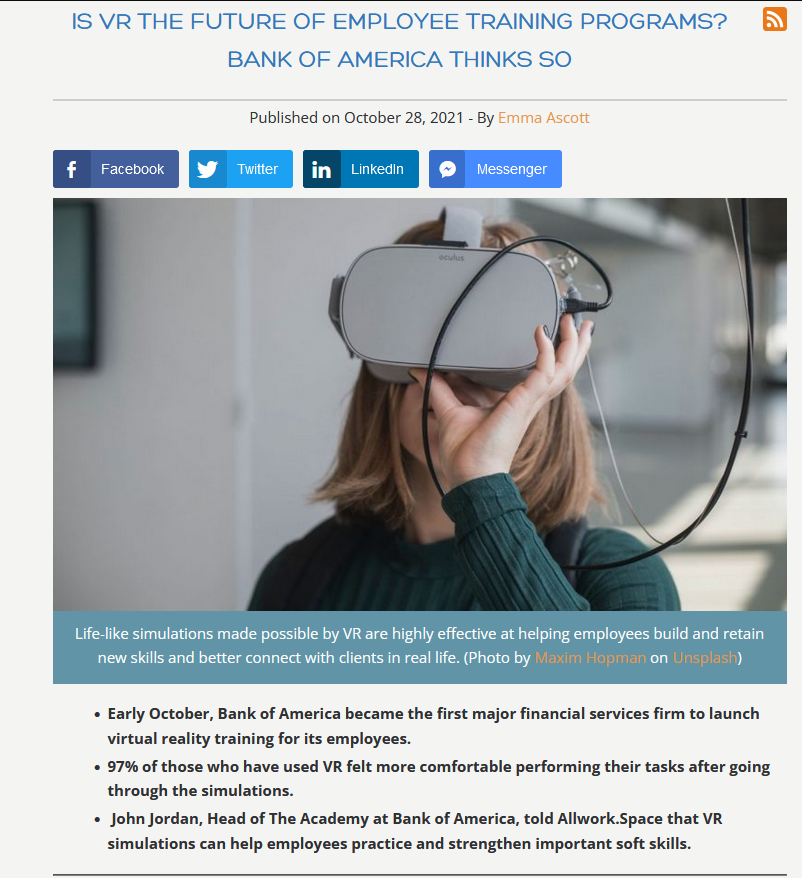
    Article: Is VR the Future of Employee Training Programs? Bank of America Thinks So

    Published on October 28, 2021 – By Emma Ascott

    Within the article, links to press release,

    Bank of America is First in Industry to Launch Virtual Reality Training Program in Nearly 4,300 Financial Centers

    by Bank of America (BoA) dated October 7, 2021 here: https://newsroom.bankofamerica.com/content/newsroom/press-releases/2021/10/bank-of-america-is-first-in-industry-to-launch-virtual-reality-t.html

    I find 3 errors:

    1. The bolded statements right at the top of the allwork article version allude to “executive summary” or “highlights”. But look at that middle one. Remember, when you do something to get your audience’s attention (97%!), you better deserve it. In this case, BoA really does not.

    2. The general hand-wave effect of statements made throughout are signalling a weak foundation. I worry about this. Who sold what snake oil to which BoA leader for this entire project to proceed.

    3. A lack of needs analysis might have happened, but claiming that a “lack of evidence” is evidence for something is shaky ground. Nonetheless, BoA leaves a few hints. (“We are constantly seeking ways to implement advanced technologies that
    offer better solutions for our teammates and our clients. “)

    Bonus points: the headset are rolling out at 4,300 locations but called “VR”—- which is funny because you could roll out VR at an infinite number of locations with zero headsets (cough WebXR)…but I guess that memo didn’t make it around.

    1. You got my attention, bold bullet

     Immediately one’s hackles are raised by bullet #2.

    •  97% of those who have used VR felt more comfortable performing their tasks after going through the simulations. 

     I mean. really. Here, I fixed it for you:

    •   97% felt more comfortable performing their tasks after going through the training. 


    Don’t you feel bad for that 3%? I worry that they don’t work for BoA anymore (giggle). But statistically, they had 400 employees in their pilot test group so that means 12 employees didn’t “feel more comfortable”. Any bets on vertigo? I’m going with that.
    But hey, let’s pass some kudos to the training department at BoA because 97% of the employees DID feel “more comfortable” performing their tasks after going through the training. So yay! You ARE making an impact. 
    Back to being cynical though, it’s throwing around a number like 97% that just stirs the pot of folks’ angst with math and understanding. I bet that if I took a ‘flash survey’ of readers of this article, I’d get some people who would say “learners that used VR got a 97% on their BoA test”. Yeah, it doesn’t say that at all. 


    2. Hand Wave Statements

    I must credit the “hand wave” phrase to my former colleague Gideon Weinstein when we used to do Master’s Degree Oral Defense Examinations together. He’d say “We don’t allow ‘hand wave’ explanations in math.” This means that you can’t get to a formula, for example, and instead of saying “we just solve it from here”. You MUST show your work and that includes showing every step of the solution. No hand waving as if it is so obvious that we don’t need to explain it.

    So this article does an uncomfortable amount of hand waving. It’s tucked in with weak evidence statements which I also indicate.

    👋 = hand wave evidence

    😔 = weak evidence, could be improved with more specificity


    Whether helping a client through a difficult moment or picking up on cues from a person who didn’t even realize they needed help understanding their accounts, the life-like 👋 simulations made possible by VR are highly effective👋 at helping employees 😔 build and retain 😔 new skills and 😔 better connect 😔 with clients in real life.   

    Currently, we offer five training modules but are slated to roll out a total of 20 different VR simulations that will help our teammates practice a wide range of skills such as 😔strengthening and deepening relationships😔 with clients and 😔 listening and responding with empathy.  😔

    We began piloting the VR program in 2019 and 😔after seeing its success in driving employee engagement and knowledge retention, 😔  [notice that they *could* tell you more about this success but they do NOT. So there are no claims of “better” here. We could guess that the VR learning was “equal” to other forms of learning.] 👋 it became clear👋 this was a program we wanted to extend to more employees.   

    👋We know VR is a highly effective,👋 immersive learning technology that
    helps teammates to be
    😔 more engaged 😔, [“more engaged” is really questionable wording for VR, it often seems to mean “we cut off all vision except what we want you to see and we dominate the sounds with what we want you to hear, so you are forced to pay more attention to the training.” See more engaged from the PwC report for further explanation of how this is problematic.] 😔 better prepared 😔 [what is “better”?] 👍 and develop new skills more quickly. 👍 [yes, agreed, quickly is the right word here IF there are enough headsets] It’s an 👋 intuitive tool 👋 [would the 12 think so?] 👍 that allows teammates to practice client interactions on their own time and at their own speed in a realistic environment. 👍   [OK, that appears to be true!]


    👋VR has shown early promise for replicating real-life scenarios
    and giving our teammates meaningful practice and confidence.
    👋Following a
    successful pilot with 400 employees, 97% of the participants felt more
    comfortable performing their tasks after going through the simulations.
    By giving employees the tools to be more prepared and confident in their
    roles, 😔 we can create a better overall experience for both our employees
    and our clients.😔    [that’s a reaching statement, but this isn’t research, so…]


    At Bank of America, we pride ourselves on being a great place to work,
    and that includes providing best-in-class learning programs and
    meaningful career growth opportunities. VR is one of the many ways we
    are using world-class technology to increase skill development, support
    internal mobility, and ensure all teammates have access to the resources
    they need to grow in their current roles and build new skills. 👋VR has a
    long list of benefits,
    👋but there are many other learning formats and
    advanced technologies that can be useful for training, depending on the
    need. 


    Not hand waving but just somewhat poor writing/editing

     At least twice, the article nearly word-for-word copies itself. Erp. I could be fussy, but that just seems suspect.


     3. Lack of needs analysis

    My designer buddies would recognize what a needs analysis or gap analysis is. It’s also the “A” section of the ADDIE design process. It means that training must solve a problem. If there is no problem, don’t design training. This article is not specific on what the problem was prior to the decision to use headsets. Admittedly, they are a business talking about a business decision so it is unlikely that they’ll say “our previous training was poor.” 

    The other flag that is noticeable is that BoA keeps justifying this decision along the lines of wanting to be first:

    Bank of America became the first major financial services firm to launch virtual reality training for its employees.   

    In early October, Bank of America became the first financial services firm to launch virtual reality (VR) training in all of its nearly 4,300 financial centers nationwide.  

     Bank of America is the first financial services firm to launch virtual reality (VR) training in nearly 4,300 financial centers nationwide, making this the latest in our long-standing investment in the success of our people. Currently, we offer five training modules but are slated to roll out a total of 20 different VR simulations that will help our teammates practice a wide range of skills such as strengthening and deepening relationships with clients and listening and responding with empathy.  

    We are constantly seeking ways to implement advanced technologies that
    offer better solutions for our teammates and our clients.  

    At Bank of America, we pride ourselves on being a great place to work,
    and that includes providing best-in-class learning programs and
    meaningful career growth opportunities. VR is one of the many ways we
    are using world-class technology to increase skill development, support
    internal mobility, and ensure all teammates have access to the resources
    they need to grow in their current roles and build new skills. VR has a
    long list of benefits, but there are many other learning formats and
    advanced technologies
    that can be useful for training, depending on the
    need.

    As a business, they can use that language. But it weakens the use of this article as “evidence” and some will try to do that.  


    Thus, I wrote this piece and will pass it out whenever needed. 


    Remember, I’m for virtual reality for learning. And I do entirely predict that the learners here with BoA will be able to learn the soft skills presented to them.  Yes.

    But when it comes to pass there are no learning gains (aka, it is not BETTER than, say, e-learning) for 50,000 employees over 4,300 financial centers, which leader is going to be OK with the cost of ~12,000 headsets and the cost to develop that training??  This is a major investment on a leap here.

    Man looks at graph that goes down and up.


    Over time, the cost to develop VR training and to own VR headsets will drop. Yes.

    Over time, any apparent “learning objective gains” by VR will normalize (the novelty effect will wear off). Yes.

    So can/should BoA continue with VR?  Yes. Sure.

    That’s not the problem.

    It is thinking that XR is new, amazing, and solves world peace in the training realm.

    That’s the problem.

    Because it does not. 

    I’ll stay vigilant and call out bad uses of XR when I see them.

    (more…)