[EDIT: This post was originally written in January 2023 and lightly edited in 2025]
Jeremy Bailenson
As much as I admire Jeremy Bailenson’s research work (really!) his Communication 166/266 Virtual People course in June 2021 had some real problems. In its defense, it was a first-of-its-kind course, even if it wasn’t the very first course in VR. Depending on how to define VR versus XR, groups of this size, 263, have met synchronously in other platforms.
Boast Much?
Bailenson defends: “To the best of my knowledge, nobody has networked hundreds of students
(with) VR headsets for months at a time in the history of virtual
reality, or even in the history of teaching.”
The scale of this course is what sets it apart compared to other “in-VR” courses. In addition to having a relatively large number of students enrolled in the course, we also had a large number of sessions taking place in VR over time, many of which were in a networked virtual environment. To our knowledge, prior courses that have used VR in an educational setting have rarely accomplished all three of these criteria.
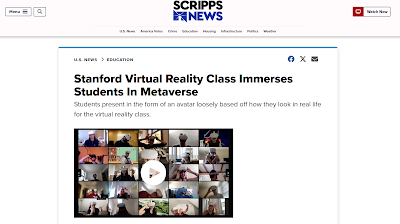
Here is a YouTube video, Stanford “Virtual People” class in the Metaverse posted by Bailenson.
In addition to the headsets, the course also needed software to connect
the students and teachers. For this, Bailenson said the university
decided to use the ENGAGE virtual communication system. ENGAGE is used by major companies and educational organizations to hold virtual meetings and events.
A Big Problem
I looked at some of the film clips closely. I searched and the early clips appear to be deleted off of YouTube. I have facilitated small and large events in XR.
In the video clips of this course, I can detect that sound appeared to be a somewhat major problem in the platform; getting users to hear, signal that they could hear, or having multiple groups in one space (like a lab) and hear over top of each other.
The Headsets
Learners in the course received the Quest 2 headsets.
“Virtual Reality is becoming mainstream, with more than ten million
systems being used in the United States alone. This class examines VR
from the viewpoint of various disciplines, including popular culture,
engineering, behavioral science, and communication. Each student will receive an Oculus Quest 2 headset, and the bulk of our learning will
occur while immersed in VR.”
The Facebook login requirement had sparked complaints and privacy
worries, leading some organizations to seek a workaround. Stanford
University uses Meta’s headsets in its courses on VR, said Jeremy
Bailenson, the founding director of the institution’s Virtual Human
Interaction Lab. To ensure student privacy, the lab had to seek Meta’s help in creating anonymized accounts for classroom use.
While the experience was good in that, at the beginning of trying out any new technology, there will be false starts. Said another way, it is good to learn that bringing in 30 learners to one large-ish lab space to teach separate labs of 5 people each won’t work if there is flat sound. That has be learned. I think his course showed that.
But overall, conducting a course with donated technology and then turning around and saying the learning was great* is a conflict of interest.
I found a written summary here, but it’s light on conclusions. There a few glimmers, but otherwise, they did seem to hint that the groups versus sound problems that appeared in the video did happen.
* What does “the learning was great” actually mean? Bailenson and Han claimed better presence, enjoyment, motivation, and transfer. While I could let you consider if any of those deserve merit, I railed against the conclusions of the course in my The Immersion Delusion post. This post, being written more than 2 years before I hit publish, focuses on the hype just as the course was starting. Therefore, obviously, this particular post does not hit hard on hype versus results. It only focuses on hype and the conflict of interest of hitting the airwaves with how amazing your course must be, to be a first of its kind, learning about VR in VR, yada yada yada.
[EDIT: I decided to publish this post on 12/26/2025. I’ve done quite a deeper dive on that course and the publications around it. I feel even more confident and I edited this article to come right out and say that Bailenson had a conflict of interest, rather than a “dis-authentic event in research” around the entire course and following publications.]
From Myths to Principles: Navigating Instructional Design in Immersive Environments
Part 2: The Immersive Environment Delusion
Image: Me and Copilot working on this using the article title, The Computer Delusion but making it personal, jazzy, and teal.
In Part 1, we introduced this new series, From Myths to Principles: Navigating Instructional Design in Immersive Environments. This is an update from my 2022 series.
In this Part 2, we’re going to go through some backstory showing the educators in Second Life was the first wave of hype for using immersive environments and we’ll look at one recent example from Stanford University with their “Virtual People” course.
Here we go!
History repeats itself
The history of educational technology is a rhyme that repeats. Initial pitches have created optimism that the next big thing in technology will revolutionize education. Oppenheimer (1997) in a really well written article illustrated part of the history of educational technology by citing four examples:
Edison’s 1922 prediction that the motion picture will revolutionize education.
Levenson’s claim that radios will become common in every classroom.
Skinner asserted that learners with teaching machines could learn twice as much.
Clinton campaigned that computers are a bridge to the twenty-first century. (para. 1)
The motion picture, the radio receiver, programmed instruction, and computers in the classroom have all failed to significantly impact learner performance. The past 102 years have not been kind to hyped educational technology predictions.
I can hear you through the nether. There are some saying “But the metaverse is different!” Sit down. 👈😠 I’ll deal with you soon enough.
Cuban (1986) further suggested that this educational technology adoption cycle follows a predictable pattern. First, the earliest research will be produced by the technology producers themselves. Second, problems arise with adoption. Learner performance does not improve over the long term. The final stage in the cycle is blame-finding with reasons ranging from not enough money, educator resistance, and educational systems resistant to change. The methods and reasoning for incorporating the technology are rarely addressed in the historical or market record. The reader of this series might recognize these statements already being made about immersive experiences. As such, hype cycles for immersive experiences are already underway.
This last point deserves emphasis. Here are the steps again:
1. Tech producers make the first “research”. 2. Tech adopted, but learner performance does not improve long term. 3. Blame-finding ensues.
I wanted to emphasize these points because they are going to appear in the research record that I will present.
Boom and bust cycles
Immersive experiences have already weathered several boom and bust cycles. One cycle began between 2003 and 2009. The desktop-based virtual reality program called Second Life, created by Linden Lab, attracted over 100 universities (Brown & Sugar, 2009) and thousands of dollars of investment (Wecker, 2014).
In a sudden decision, Linden Lab eliminated its 50% discount for educational institutions (Harrison, 2010). What resulted was an educator exodus and fracture in the faith of immersive experiences for education. When referring to the shutdown of Woodbury University’s virtual campus for breach of conduct, Jordan Bellino, a senior learner at the institution, described the hazard when one major company dominates use:
The incident suggests the dangers of online meeting spaces’ being run by companies, which get to decide who participates and who doesn’t. “It took years and thousands of dollars to make that virtual campus happen,” he said, “and it all vanished in a matter of an hour because Linden Lab pushed a button.” (Young, 2010, para. 12)
Major technology companies can single-handedly dictate use of immersive environments. This would be a valuable lesson lost before the next boom cycle began in 2018.
First course in virtual reality
After the launch of the consumer-oriented Quest headsets and the mandate for remote learning due to the COVID pandemic in 2020, interest in immersive environments surged. In June of 2021, Stanford opened their Virtual People course to 263 learners (Bailenson, 2021).
The course was touted to be the first class in the world to be held inside of virtual reality (Hadhazy, 2021) which seemed to cast aside the nearly two-decade deep body of research on courses held as immersive experiences. The prestige of the course was further hyped when one of the course professors boasted:
I can now stand up in front of all my students and there’s, you know, two hundred in the class, and I can say you will actually have a better chance of getting a job in the Valley because of taking this class because as of about a year ago, the most sought-after job in the Valley went from a data scientist to a VR engineer. (Bellini, 2024, para 12)
The VR-based learning resulted in greater presence, enjoyment, motivation, and transfer (Han & Bailenson, 2024). However, within the course, all was not well. Video clips from the class showed learners struggling to control their avatars (Bailenson, 2021) and attending class just to stand around in circles (Bellini, 2021).
(In case video does not display, it’s here: https://youtu.be/gOLI_OIV3nc?si=jv2LF-d4Dz8sIZsf)
In spite of the boasting, published reports illuminated problems with onboarding learners to the VR headset experience, unexpected software updates, and sudden platform shutdowns (Han & Bailenson, 2024).
The instructional design was described as learning by doing, but the syllabus showed a majority of outside-of-virtual-world writing and quiz items. Within the immersive environment, there were required weekly discussion sessions (Han et al., 2022) and one project where learners could import 3D (three-dimensional) objects to make a unique VR environment. My translation? That’s not much doing, actually, as it relates to being a “virtual person”.
Much to the professors’ astonishment, one group of learners made a mock fake moon landing production set (Brown et al., 2023). For the course instructors, this suddenly raised the specter that immersive experiences can create false depictions or fake memories, a topic that will be revisited in the ethical labyrinths section of this series.
In Part 3, I’ll share another example of boom and bust from the immersive environments-for-education market.
Post-publication edit:
They say there is no editor like the “Publish” button and that makes me laugh because you DO spot errors after something has been published. But in this case, it’s not an error that I want to address, I want to add more depth and context to this post. Since it’s my blog, I can. This work was previously planned to be a book chapter and as such, I held my tongue on some of my more pointed criticism and images. But here, I can lay out things more directly.
Directly I am pointing to the Communication 166/266:Virtual People course as a poor design from an instructional designers point of view. I have studied the syllabus and read several articles and watched videos produced about the course. You can read the syllabus.
What I can’t find is how many credits the course was. Just guessing from the workload in the syllabus, I’d guess 2 credits. Could be 3 but it also could be 1. I severely doubt it’s 4.
Where do I get the platform to critique this course?
1. I have 14 years full time experience teaching online. Until ~2034, there are very few that can match me with that kind of full time teaching experience. Now Bailenson’s class was arguably not “online” by definition (it happened in June 2021 or so and that would be post-shutdown), but it appears to have happened entirely remotely with the exception of picking up the headsets. So I can claim some expertise about what SHOULD happen with digital-based instruction. 2. My doctorate is in Instructional Design specifically *for Online Learning*. So I’ve spent my time focusing on that. 3. My research focus was and is learning in immersive environments (hence this article series). 4. Uniquely, I ALSO taught a course using the Meta Quest 2s which had a similar “survey” type of design. So what Bailenson did by visiting topics each week briefly is NOT part of my critique.
Three things are my main concerns here: 1. Video clips show a ridiculous amount of on-boarding malarkey. Said another way, bringing learners into a 3D environment, not acclimating them to this and then bringing in various models and just letting the users play is nice for an introduction. It does NOT make a course and certainly it does not argue for a widespread use of the technology.
I’m sure that in one version of the video, I could hear learners over and over again gathered in small groups supposedly “doing” something in VR only to hear “can anyone hear me?” as a COMMON statement. Take my word for it; a class filled from beginning to end with learners not being able to hear or be heard does not count for much learning.
My point: there isn’t evidence that anything other than some “visits” to VR happened. And yet, over and over, this flagship course (my phrase) has learners that can’t walk, wave, or follow instructions and (I guess) hear instructions. After week one, the learners *should* be on-boarded, all practiced up and ready to do harder things. ‘Just walk over here for a group photo’ should not feel like an instructionally-impossible task– and the videos sure do make it look like it was.
(I had to giggle because in that “all class” photo, there is one avatar in 2D (not in a headset, because they don’t have hands and their movement is all 2D-type) and they are the only one that looks “logical” in their behaviors.)
2. Bailenson really shows his excitement (in the somewhat unprofessional video) but also the “un-put-togetherness” of this experience with the quote I provided:
I
can now stand up in front of all my students and there’s, you know, two
hundred in the class, and I can say you will actually have a better
chance of getting a job in the Valley because of taking this class
because as of about a year ago, the most sought-after job in the Valley
went from a data scientist to a VR engineer. (Bellini, 2024, para 12)
I find it VERY hard to believe that this one course at the 100 and 200 level will lead for a number like 200 new VR engineer’s getting jobs in “the Valley”. Insert hard eyeroll here. 🙄 It looks extra bravado-y when he phrases it as “I can now stand up” as if he’s really planning to do this or HAS done it. It’s a brag. No humble about it. Last I checked, the Valley wants to hire computer scientists, who should be in calculus class at the same time as this headset romp. Fact check: The Valley has been laying off VR teams. So how’s that ‘better chance of getting a job’ brag going for ya?
3. The learn-by-doing quote gets under my skin as an instructional designer. Learn WHAT by doing WHAT, in this case? His students had to use pre-existing 3D models included in the ENGAGE platform (OK, fine– but note that I didn’t see ANY examples of models beyond ones we’ve already seen in ENGAGE advertising) to build a scene that was basically their final project.
(Again, disclosure: my students final project was a video mock-up of an immersive experience that they would design, if they could. The course taught no programming skills.)
So OK, it’s fine that learners can’t program after 1 course. Totally understood. But then the learners put together a final project scene that sounds like Bailenson’s team spit out their coffee over…J. Brown source described the team experience as, “jarring” and wanted to coin a new phrase, “mis-experience.” What the phrase? Garbage in, garbage out? You don’t design a compelling course and the results surprise you? Sigh.
It appears that they took the “made lemonade from lemons” approach. Note that I haven’t mentioned ANYTHING about comparative learning outcomes related to this heralded course. Because there isn’t any data on that. Not like there should be, but the research is remarkably silent on that.
Also fact check on this: the Meta Quest 2 headsets are officially OUT of support and sale from Meta. So they are, as of this writing, outdated. I wonder how it’s going over there at Stanford. Do they just ring up Mark and ask for 266 more headsets in the Meta Quest 3 type now?
I haven’t mentioned much, (actually I left it OUT), how much ENGAGE got free advertising from this mess. That’s because they are really the main characters in the NEXT episode.
Brown, A., & Sugar, W. (2010). Second life in education: The case of commercial online virtual reality applied to teaching and learning. Themes in Science and Technology education, 2(1-2), 107-115.
Brown, J., Bailenson, J., & Hancock, J. (2023). Misinformation in virtual reality. Journal of Online Trust and Safety, 1(5).
Cuban, L. (2001). Oversold and underused: Computers in the classroom. Cambridge, MA: Harvard University.
Han, E., & Bailenson, J. N. (2024). Lessons for/in virtual classrooms: designing a model for classrooms inside virtual reality. Communication Education, 73(2), 234-243.
Harrison, D. (2010, November 3). Linden Lab to end Second Life educational discounts. THE Journal. https://thejournal.com/Articles/2010/11/03/Linden-Lab-To-End-Second-Life-Educational-Discounts.aspx?Page=1
I’m knee deep in an XR implementation project. It’s going forward by
inches; each step aches with how small it is. If I measured it, it feels
like it would barely tick one mark on a stick. However, like a gardener
that makes one small snip here, one pull of a weed there, there is no
overnight transformation. But still– in the messy work of
IMPLEMENTATION, I’m making a garden that turns heads and makes people
think “I want to be there.”
Seriously, here is the garden:
Today is one of those days where it feels like we are going 2 steps backwards with no step forward. When you hear it mentioned quietly, but over and over and over, that one of the biggest implementation problems we have in XR for education is “sound” — WE ARE NOT KIDDING.
We have more problems with sound that with any other aspect of an experience. It is the TOP problem source.
Virbela had this problem in buckets. My hosts cringed every time I estimated that 20% of incoming users had sound problems. 20%! If YouTube had a 20% failure rate that they presented to users, they would far, far out of business by now.
I watched this video dated November 5, 2021 put out by Stanford University touting the first course taught in XR with Jeremy Bailenson where he claims it will be “an incredible journey for about half of this class”
Here is the video promo text:
“263 students, all with their own VR headsets, across 20 weeks and two courses, spent over 200,000 shared minutes together in the Metaverse. They engaged in large group field trips, small group discussions, performed live music and skits, and worked both alone and together to build their own virtual worlds.”
First: posed shot OR photoshopped image. Notice: no Zoom markings at all. It’s not “live”, people are not moving.
For someone like me with enough live event logistics and tech support experience, watching this video shows me that I suspected the course was riddled with sound problems.
The background music starts at 0:18, so “hearing” the students will be hard.
Watch for how much students were cordoned off into small groups (that’s not just a teaching method, that’s to put them soundwise AWAY from each other and minimize disruption) and then just listen to what you CAN hear of the sound provided in the video, you will get snippets and what you will hear will be blurbs of users acting more awkward and users waiting around on another user.
The “you made it” comment is somewhat telling. It is HARD to get users into XR. Admittedly, it might easier if you are at Stanford and everyone has an Oculus Quest 2 (Meta Quest). (smirk)
Privilege much?
At 1:14 there is a LOT of talk over and by 1:18 the video has been sped up to just overwhelm with ADDING models or processing to VR on the ENGAGE platform.
I’m not trying to douse flames of innovation here. But I’m trying to point out that implementation, as the Atlantic article points out, is a much messier, day-by-day process than the glitz and glamour of a moment.
The video shows THIS as what appears to be a class highlight moment.
The sound is a man speaking saying “Nice work everyone!”
Just let that sink in while looking at that image.
2021. Stanford University. That is one of our very best learning instituations, folks.
Ironically, all of the avatars with awkward arms ARE the users actually using headsets. That one avatar in the middle in the gray shirt with this hands at his sides? He is the one user in 2D, not a headset.
Snicker now, because he is the only one looking normal in this bunch.