Tag: Second Life

  • From Myths to Principles Part 2 The Immersive Environment Delusion

    From Myths to Principles Part 2 The Immersive Environment Delusion

    From Myths to Principles: Navigating Instructional Design in Immersive Environments

    Part 2: The Immersive Environment Delusion

    Decorative scifi retrofuturism image of a person morphing with a computer.
    Image: Me and Copilot working on this using the article title, The Computer Delusion but making it personal, jazzy, and teal.


    In Part 1, we introduced this new series, From Myths to Principles: Navigating Instructional Design in Immersive Environments. This is an update from my 2022 series.

    In this Part 2, we’re going to go through some backstory showing the educators in Second Life was the first wave of hype for using immersive environments and we’ll look at one recent example from Stanford University with their “Virtual People” course.

    Here we go!

    History repeats itself

    The history of educational technology is a rhyme that repeats. Initial pitches have created optimism that the next big thing in technology will revolutionize education. Oppenheimer (1997) in a really well written article illustrated part of the history of educational technology by citing four examples:
    1. Edison’s 1922 prediction that the motion picture will revolutionize education.
    2. Levenson’s claim that radios will become common in every classroom.
    3. Skinner asserted that learners with teaching machines could learn twice as much.
    4. Clinton campaigned that computers are a bridge to the twenty-first century. (para. 1)

    The motion picture, the radio receiver, programmed instruction, and computers in the classroom have all failed to significantly impact learner performance. The past 102 years have not been kind to hyped educational technology predictions.


    I can hear you through the nether.
    There are some saying “But the metaverse is different!”
    Sit down. 👈😠
    I’ll deal with you soon enough.


    Cuban (1986) further suggested that this educational technology adoption cycle follows a predictable pattern. First, the earliest research will be produced by the technology producers themselves. Second, problems arise with adoption. Learner performance does not improve over the long term. The final stage in the cycle is blame-finding with reasons ranging from not enough money, educator resistance, and educational systems resistant to change. The methods and reasoning for incorporating the technology are rarely addressed in the historical or market record. The reader of this series might recognize these statements already being made about immersive experiences. As such, hype cycles for immersive experiences are already underway.
     
    This last point deserves emphasis. Here are the steps again:

    1. Tech producers make the first “research”.
    2. Tech adopted, but learner performance does not improve long term.
    3. Blame-finding ensues.

    I wanted to emphasize these points because they are going to appear in the research record that I will present.

    Boom and bust cycles


    Immersive experiences have already weathered several boom and bust cycles. One cycle began between 2003 and 2009. The desktop-based virtual reality program called Second Life, created by Linden Lab, attracted over 100 universities (Brown & Sugar, 2009) and thousands of dollars of investment (Wecker, 2014).

    In a sudden decision, Linden Lab eliminated its 50% discount for educational institutions (Harrison, 2010). What resulted was an educator exodus and fracture in the faith of immersive experiences for education. When referring to the shutdown of Woodbury University’s virtual campus for breach of conduct, Jordan Bellino, a senior learner at the institution, described the hazard when one major company dominates use:

    The incident suggests the dangers of online meeting spaces’ being run by companies, which get to decide who participates and who doesn’t. “It took years and thousands of dollars to make that virtual campus happen,” he said, “and it all vanished in a matter of an hour because Linden Lab pushed a button.” (Young, 2010, para. 12)

    Major technology companies can single-handedly dictate use of immersive environments. This would be a valuable lesson lost before the next boom cycle began in 2018.

    First course in virtual reality 


    After the launch of the consumer-oriented Quest headsets and the mandate for remote learning due to the COVID pandemic in 2020, interest in immersive environments surged. In June of 2021, Stanford opened their Virtual People course to 263 learners (Bailenson, 2021). 


    Source: https://news.stanford.edu/stories/2021/11/new-class-among-first-taught-entirely-virtual-reality

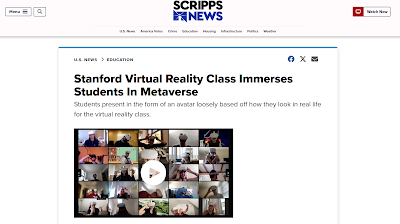
    Source: https://www.scrippsnews.com/us-news/education/stanford-virtual-reality-class-puts-students-in-metaverse

    The course was touted to be the first class in the world to be held inside of virtual reality (Hadhazy, 2021) which seemed to cast aside the nearly two-decade deep body of research on courses held as immersive experiences. The prestige of the course was further hyped when one of the course professors boasted:

    I can now stand up in front of all my students and there’s, you know, two hundred in the class, and I can say you will actually have a better chance of getting a job in the Valley because of taking this class because as of about a year ago, the most sought-after job in the Valley went from a data scientist to a VR engineer. (Bellini, 2024, para 12)

    The VR-based learning resulted in greater presence, enjoyment, motivation, and transfer (Han & Bailenson, 2024). However, within the course, all was not well. Video clips from the class showed learners struggling to control their avatars (Bailenson, 2021) and attending class just to stand around in circles (Bellini, 2021).


    (In case video does not display, it’s here: https://youtu.be/gOLI_OIV3nc?si=jv2LF-d4Dz8sIZsf)


    In spite of the boasting, published reports illuminated problems with onboarding learners to the VR headset experience, unexpected software updates, and sudden platform shutdowns (Han & Bailenson, 2024). 

    The instructional design was described as learning by doing, but the syllabus showed a majority of outside-of-virtual-world writing and quiz items. Within the immersive environment, there were required weekly discussion sessions (Han et al., 2022) and one project where learners could import 3D (three-dimensional) objects to make a unique VR environment. My translation? That’s not much doing, actually, as it relates to being a “virtual person”. 
     
    Much to the professors’ astonishment, one group of learners made a mock fake moon landing production set (Brown et al., 2023). For the course instructors, this suddenly raised the specter that immersive experiences can create false depictions or fake memories, a topic that will be revisited in the ethical labyrinths section of this series.


    In Part 3, I’ll share another example of boom and bust from the immersive environments-for-education market.

    Post-publication edit:


    They say there is no editor like the “Publish” button and that makes me laugh because you DO spot errors after something has been published.  But in this case, it’s not an error that I want to address, I want to add more depth and context to this post. Since it’s my blog, I can.  This work was previously planned to be a book chapter and as such, I held my tongue on some of my more pointed criticism and images. But here, I can lay out things more directly.

    Directly I am pointing to the Communication 166/266:Virtual People course as a poor design from an instructional designers point of view.  I have studied the syllabus and read several articles and watched videos produced about the course.  You can read the syllabus.


    What I can’t find is how many credits the course was. Just guessing from the workload in the syllabus, I’d guess 2 credits.  Could be 3 but it also could be 1. I severely doubt it’s 4.

    Where do I get the platform to critique this course?

    1. I have 14 years full time experience teaching online. Until ~2034, there are very few that can match me with that kind of full time teaching experience.  Now Bailenson’s class was arguably not “online” by definition (it happened in June 2021 or so and that would be post-shutdown), but it appears to have happened entirely remotely with the exception of picking up the headsets.  So I can claim some expertise about what SHOULD happen with digital-based instruction.
    2. My doctorate is in Instructional Design specifically *for Online Learning*. So I’ve spent my time focusing on that.
    3. My research focus was and is learning in immersive environments (hence this article series).
    4. Uniquely, I ALSO taught a course using the Meta Quest 2s which had a similar “survey” type of design. So what Bailenson did by visiting topics each week briefly is NOT part of my critique.

    Three things are my main concerns here:
    1. Video clips show a ridiculous amount of on-boarding malarkey.  Said another way, bringing learners into a 3D environment, not acclimating them to this and then bringing in various models and just letting the users play is nice for an introduction. It does NOT make a course and certainly it does not argue for a widespread use of the technology.

    I’m sure that in one version of the video, I could hear learners over and over again gathered in small groups supposedly “doing” something in VR only to hear “can anyone hear me?” as a COMMON statement.  Take my word for it; a class filled from beginning to end with learners not being able to hear or be heard does not count for much learning.

    My point: there isn’t evidence that anything other than some “visits” to VR happened.  And yet, over and over, this flagship course (my phrase) has learners that can’t walk, wave, or follow instructions and (I guess) hear instructions. After week one, the learners *should* be on-boarded, all practiced up and ready to do harder things. ‘Just walk over here for a group photo’ should not feel like an instructionally-impossible task– and the videos sure do make it look like it was. 

    (I had to giggle because in that “all class” photo, there is one avatar in 2D (not in a headset, because they don’t have hands and their movement is all 2D-type) and they are the only one that looks “logical” in their behaviors.)

    2. Bailenson really shows his excitement (in the somewhat unprofessional video) but also the “un-put-togetherness” of this experience with the quote I provided:

    I
    can now stand up in front of all my students and there’s, you know, two
    hundred in the class, and I can say you will actually have a better
    chance of getting a job in the Valley because of taking this class
    because as of about a year ago, the most sought-after job in the Valley
    went from a data scientist to a VR engineer. (Bellini, 2024, para 12)


    I find it VERY hard to believe that this one course at the 100 and 200 level will lead for a number like 200 new VR engineer’s getting jobs in “the Valley”.  Insert hard eyeroll here. 🙄  It looks extra bravado-y when he phrases it as “I can now stand up” as if he’s really planning to do this or HAS done it.  It’s a brag.  No humble about it.  Last I checked, the Valley wants to hire computer scientists, who should be in calculus class at the same time as this headset romp. Fact check: The Valley has been laying off VR teams.  So how’s that ‘better chance of getting a job’ brag going for ya?

    3. The learn-by-doing quote gets under my skin as an instructional designer. Learn WHAT by doing WHAT, in this case? His students had to use pre-existing 3D models included in the ENGAGE platform (OK, fine– but note that I didn’t see ANY examples of models beyond ones we’ve already seen in ENGAGE advertising) to build a scene that was basically their final project. 

    (Again, disclosure: my students final project was a video mock-up of an immersive experience that they would design, if they could. The course taught no programming skills.) 

    So OK, it’s fine that learners can’t program after 1 course. Totally understood. But then the learners put together a final project scene that sounds like Bailenson’s team spit out their coffee over…J. Brown source described the team experience as, “jarring” and wanted to coin a new phrase, “mis-experience.”  What the phrase? Garbage in, garbage out?  You don’t design a compelling course and the results surprise you?  Sigh.

    It appears that they took the “made lemonade from lemons” approach. Note that I haven’t mentioned ANYTHING about comparative learning outcomes related to this heralded course. Because there isn’t any data on that. Not like there should be, but the research is remarkably silent on that.

    Also fact check on this: the Meta Quest 2 headsets are officially OUT of support and sale from Meta. So they are, as of this writing, outdated.  I wonder how it’s going over there at Stanford. Do they just ring up Mark and ask for 266 more headsets in the Meta Quest 3 type now?

    I haven’t mentioned much, (actually I left it OUT), how much ENGAGE got free advertising from this mess.  That’s because they are really the main characters in the NEXT episode.

    References

    Bailenson, J. M. (2021). Stanford “Virtual People” class in the metaverse. [Video.] YouTube. https://youtu.be/gOLI_OIV3nc?si=if6DbOX43GESWTBd

    Bellini, J. (2021, December 7). Stanford virtual reality class immerses students in metaverse. Scripps News. https://www.scrippsnews.com/us-news/education/stanford-virtual-reality-class-puts-students-in-metaverse

    Brown, A., & Sugar, W. (2010). Second life in education: The case of commercial online virtual reality applied to teaching and learning. Themes in Science and Technology education, 2(1-2), 107-115.

    Brown, J., Bailenson, J., & Hancock, J. (2023). Misinformation in virtual reality. Journal of Online Trust and Safety, 1(5).

    Cuban, L. (2001). Oversold and underused: Computers in the classroom. Cambridge, MA: Harvard University.

    Hadhazy, A. (2021, November 5). Stanford course allows students to learn about virtual reality while fully immersed in VR environments. Stanford Report. https://news.stanford.edu/stories/2021/11/new-class-among-first-taught-entirely-virtual-reality

    Han, E., & Bailenson, J. N. (2024). Lessons for/in virtual classrooms: designing a model for classrooms inside virtual reality. Communication Education, 73(2), 234-243.

    Harrison, D. (2010, November 3). Linden Lab to end Second Life educational discounts. THE Journal. https://thejournal.com/Articles/2010/11/03/Linden-Lab-To-End-Second-Life-Educational-Discounts.aspx?Page=1

    Oppenheimer, T. (1997, July). The computer delusion. The Atlantic. https://www.theatlantic.com/magazine/archive/1997/07/the-computer-delusion/376899/

    Wecker, M. (2014, April 22). What ever happened to Second Life? Chronicle Vitae. https://chroniclevitae.com/news/456-what-ever-happened-to-second-lifeYoung, J. (2010, April 21). Woodbury U. banned from Second Life, again. Chronicle of Higher Education. Wired Campus. https://www.chronicle.com/blogs/wiredcampus/woodbury-u-banned-from-second-life-again
    (more…)

  • Happy 20th Birthday Second Life

    Happy 20th Birthday Second Life


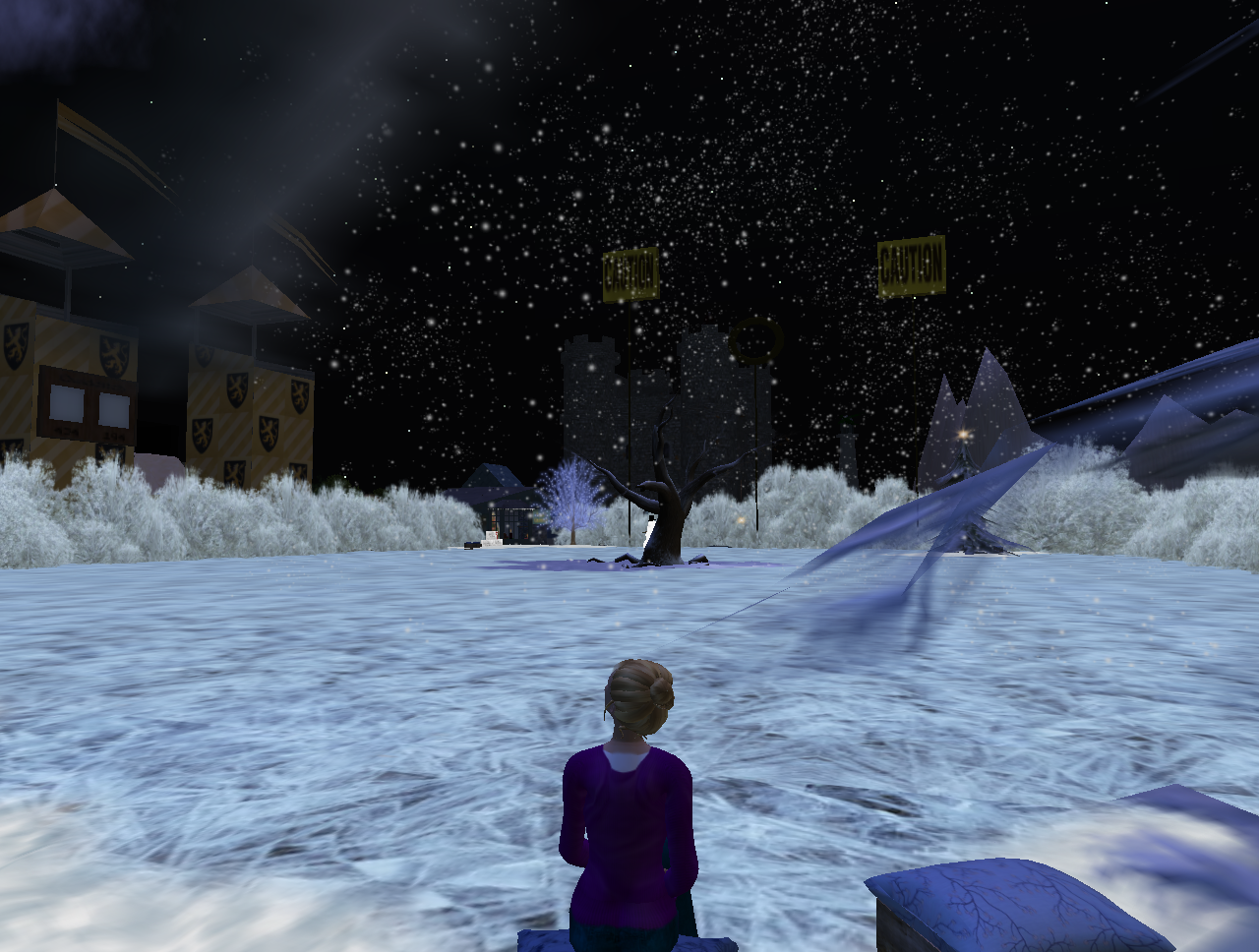
    Second Life resident looking at snow falling on the Quidditch pitch of the nighttime VWER Campus, 2010.

    IMAGE: Second Life resident looking at snow falling on the Quidditch pitch of the nighttime VWER Campus, 2010.


    This is some of what I call my “kick out writing” that I did not include in some recent published writing. It starts:

    The
    promise of the metaverse in education is like a mirage in the desert.
    Educators seem to be forever awaiting the arrival of the metaverse but
    still not yet embracing those technologies.

    In 2003, #SecondLife
    launched as an immersive persistent virtual world. Just three years
    later, educators were publishing about their pioneering efforts on the
    platform. Kemp & Daniel Livingstone (2006) suggested pairing Second Life with a learning management system (LMS), a suggestion familiar to #instructionaldesigners
    of the Internet age. In 2007, the word “metaverse” first appeared in
    educational publications (Tilili, 2022). The popularity of virtual
    worlds briefly increased between 2007 and 2010. As cited in Warburton
    (2009), Kirriemuir estimated that “three quarters of UK universities are
    estimated to be actively developing or using Second Life.” This
    adoption would wane by 2013 however after educational discounts were
    discontinued and the initial fervor of virtual spaces gave way to empty
    buildings and virtual ghost towns.

    The arrival of the metaverse would have to wait a little while longer.

    ~

    I just lean back in my chair and wax poetic sometimes. 💺 ✍

    Happy 20th Birthday Second Life


  • A Tribute to Second Life. Yes, it’s still around.

    A Tribute to Second Life. Yes, it’s still around.


    I purposely start articles with “A” when I mean to not be definitive but exemplary. In this case, I would like to pick out a few of the early education influencers and memories that I knew from Second Life (SL) (and Heritage Key, 3rd Rock Grid, OpenSim, and other early virtual worlds).

    One of the observations that brings on this article (besides the true desire to give credit where credit is due) is that educators are starting to stream into the metaverse or cross reality (XR) – especially with the $299 Oculus headset cost and the pandemic forcing isolation – and I find that in education & XR development – there is a disturbing lack of knowledge of the foundation of virtual reality studies. That is, people that know about the role Second Life played in XR for learning research are not writing enough about it now so that what it did in the past is captured for the future.

    Remember the ‘we stand on the shoulders of giants’ thing?

    The giant is, in part, Second Life.

    I would suggest that what is lacking in this background research is the fact that the vocabulary (and somewhat, the meaning) of words has changed so even a well-meant Google Scholar search might not pick up valid research from 10+ years ago because search terms were simply different words.

    So, first – Search on virtual world (VW) as your primary term. Virtual world was a more dominant phrase than virtual reality. Other words to use: immersive, MUVE, multi-player online, persistent, HIVE (highly interactive virtual environments), online games, simulations, visualizations, online reenactments, distributed classrooms, and hypergrids. Indeed, find one good metastudy from ~2009 and you’ll probably hit the vocabulary jackpot. In researching this article, I found the term Sloodle which I had forgotten but that was an incorporation of SL into the Moodle course management system. You will find a great of research on identity, presence, and immersion with avatars (not so much with locations or “doing stuff” in VWs because object physics was/is very primitive and you can’t “do” too much there. There are pose balls, but really that’s a subject I’m not going to get into here). Bear in mind that headsets only existed in research so this was all what we would know in 2021 as 2D virtual reality or 2DVR (VR on flat screens, monitors, and tablets). Because there were few consumer headsets, there was no “us versus them” that you find now between 2D and Head Mounted Device-based (HMD) 3DVR.

    Next, I very well realize that in some circles, Second Life causes giggling, either in derision (see the hype cycle image below) or in acknowledgement that SL did primarily serve the adult content market more than the education market. Sorry, but someone needs to write the obvious. Just recently, when the metaverse conversation popped up with some SL users on Twitter, they were adamant that they would never move to a platform that didn’t allow “adult content.” Second Life was never a place that you wanted to wander into the dark alleys as an educator. At least, if you did, you would learn some stuff you’d rather not know. The sexualization of Second Life is still prominent. Just do a google image search on second life. NSFW. Second Life was always a place for college and university educators (READ: Over 18 years of age). 


    Gartners Hype Cycle for Social Virtual Worlds showing a start at 1987 and going to 2012.
    Source: http://www.muvedesign.com/the-virtual-worlds-hype-cycle-for-2009/


    Thus, educators tended to stick together. You heard about SL from another educator and you went in with them. I went in with a professional development group and had my first “meeting” in a hot tub at the Burning Life festival in SL in 2008.

    There were some GREAT educator groups and some of them are still going! I mention my favorites:

    1. Virtual Worlds Educators Roundtable (VWER) – my home base and it is still going! I volunteered on the organizing committee and hosted a “Reading Meeting” where we invited the author of an article in for a presentation and Q&A (I was able to talk with the Whyville Pox article researcher, which is still a GREAT study). At its heyday, VWER had 2 grids: 1 for meetings and we had a Quidditch pitch/outdoor ice skating rink and 1 for parcels for educators as a sandbox and I had a virtual office.
    2. Virtual Worlds Best Practices in Education (VWBPE) Conference – still going as of 2025!
    3. Real Life Educators in Second Life is an in-world group (READ: notification list) you can join. Users post different events to that group.
    4. ISTE  https://www.iste.org/…/explore-these-virtual-worlds
    5. VSTE: VA Soc. for Tech in Education https://vste.org/
    6. Second Life Community Convention (SLCC) – a larger group but education was a subset. Now defunct.
    7. The SLED group – an email list serv that had the first collection of educators as subscribers. Now defunct.

    Other groups still going but not necessarily education-focused nor restricted to Second Life:

    Virtual Ability http://blog.virtualability.org/2021/08/by-gentle-heron-you-can-teleport-to-any.html

    Non-profit Commons Community https://nonprofitcommons.avacon.org/

    OpenSimulator Community Conference https://blog.inf.ed.ac.uk/atate/2021/10/31/oscc21/

    Special shout out to independent journalists that still cover Second Life:

    Ryan Schultz https://ryanschultz.com/

    Daniel Voyager on Twitter @danielvoyager

    Great “places to visit” included NASA, NOAA locations. Rockcliffe University Consortium, Glascow University Online, California State University, Chico (defunct? I think?). Then there were one-off builds that were also great like the Edgar Allen Poe House and the walk-through heart and colon.

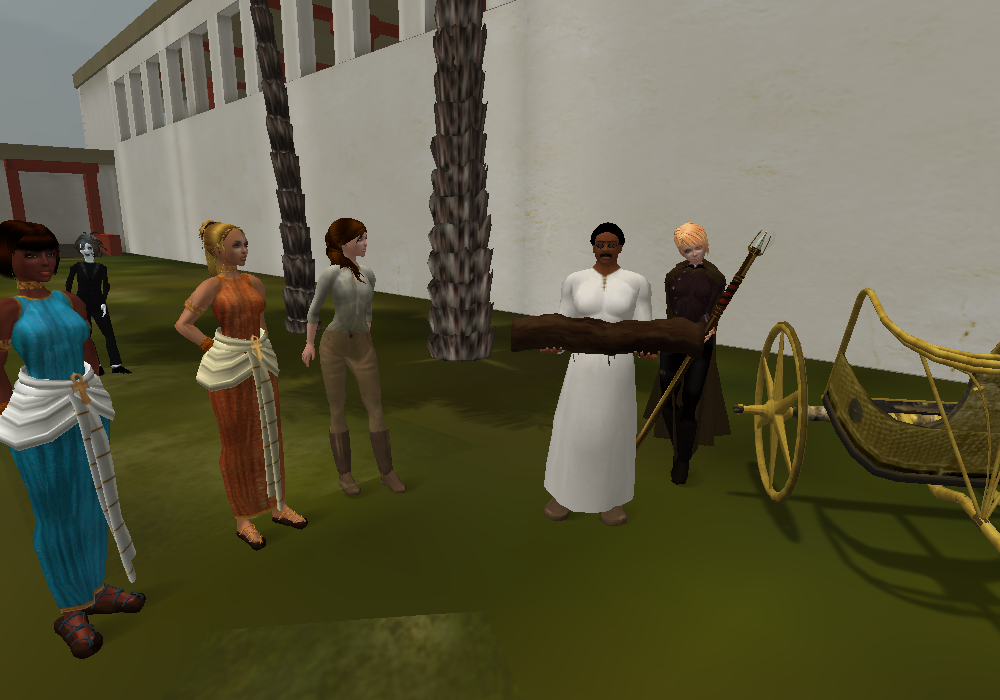
    During this same time, other virtual worlds were coming up and visiting them was fair game. My favorite was the short lived Heritage Key that needs to come back! That place was so cool and educational, you could visit Stonehenge over 5 different time periods and help build it

    You could travel to both Egypt and Stonehendge in Heritage Key.  Avatars received costumes and had roles to play at each site.
    What happens when 2 Egyptians, 2 Adventurers, 1 Druid and 1 Zombie all go to Ancient Thebes?

    So…what happened?

    There are many commentaries now. All of them have a piece of the truth. Probably the biggest factor was money. Hosting a grid literally cost money and universities had to pay for it. Over time, it just didn’t make sense to keep paying monthly for a place rarely visited.

    College and university builds represented a huge investment of time. You should have heard how much the word “Primmy” was used back then. Primmy is short for primitive which meant the building blocks of virtual realities which are primitive shapes (spheres, cubes, columns, pyramids, etc.) Some clever instructors had their students do the builds and then called that assessment (I’m not calling that wrong, I’m just saying…clever.)

    The locations, indeed, themselves brought on their own demise. Many builds became ghost towns because avatars would visit a “virtual campus” (OFTEN a replica of their real campus buildings (cough, mistake, cough) but walk inside the buildings that may or may not have had enough “prims” to put separate rooms inside those buildings, and so visitors found the building completely empty during off hours, wonder what the big deal was, and then leave.

    This was one positive result of those early days. Many educators realized that “replicating reality” should NOT be the goal because for now, you’ll never get there. The human eye is too good at discrimination. But what you do want to do is the phantasmagorical.

    Do the impossible. Virtual reality is very good at the impossible.

    Remember this was before VR was called Social VR, so the ‘social’ part was truly touch and go. In SL, you either found groups of people or you didn’t. Most positive SL stories going around right now will involve relationships and groups. Truly today, I only go into SL for events. I hardly ever go in to just explore. It’s not built for that. What was it built for? Well, it had some characteristics that were interesting and unique. (Alt opinion here.)

    Born creator

    First and foremost to me, every avatar is endowed as a creator. An educational psychologist I know immediately deemed this a “God complex” program. Indeed, every bell and whistle of creation (object creation and space manipulation) was available in the overwhelming UI. I’ve been a SL citizen for more than 10 years and still I don’t know what half of the UI choices are for. Even though I’ve done it a lot, I’m still not sure what rebaking does.

    Screen capture of the original Ruth avatar from Second Life.
    The original Second Life Ruth avatar


    The default avatar was “Ruth”. She made new users learn how to change appearances. Impressive abs though. She must have never eaten a potato chip.

    Avatar customization

    The avatar customization is in Second Life (still) is top notch.

    Seriously, OpenSim and Second Life have the best clothes’ animations! I once saw someone who wore a top hat to a Christmas party and the around the rim of the hat was a tiny puffing train! (If you are reading this and that was you, please reach out to me, I LOVED your hat!! I want a video of it!) But, I find Sandsar and sinespace is coming up fast on good clothes and avatars.

    You can get married and divorced in Second Life. There are also active furry communities. I’ve got no comment on all of that. I would just remind everyone that what is in a virtual world is what you bring with you. It is definitely not all innocent and it is definitely not all healthy.

    Even though you have creator controls, you cannot build just anywhere. Land is owned (permissioned) and you have to essentially pay to have land. Early objects were NOT copyright protected. So copying, stealing, and replicating was rampant. (Hat tip to Somnium Space, who addressed this problem from the very start by tying assets to NFTs.) I suspect a lot of artists hiked out of SL because their work didn’t stay under their control for long. For educators, there was an active “free sharing” market and I still wear my first set of “professional educators clothes” I picked up free from some place.

    Hat tip to the word rezzing. I still use it. When I arrive somewhere, I rez in. The spot is the rez in spot. The current term in 2021 is “spawn point”. Yuck. I think this term, rez, should NOT be lost. Rez means resolving, which is what your avatar would do when it was still “coming into” the VR space. It’s the ghostly cloud you see here:

    We would lost without our Path…finder

    But I’d like to get to the tribute part of this tribute article. I would like especially point out the impact that John “Pathfinder” Lester had in Second Life. Everyone who was on staff for Linden Labs officially had a Linden last named avatar. John was Pathfinder Linden and all educators knew he was the one to talk to about ideas and problems. He “led the development of the education and healthcare markets while evangelizing the innovative use of virtual worlds in research, art and immersive learning.” Truly John cared and helped. I remember the day I sat next to his avatar at a meeting. I was so, so, so thrilled. But I never figured out why his avatar looked like a boot to me. It must be the eyelets and the shoestring. Apparently this is a bit of British culture I don’t know…that’s a character?

    Early John:


    Pathfinder Linden


    Many of us observed in stunned silence as Linden Labs pared down staff infamously. I watched in foreshadowing because I knew that it was like to work for a company that would drop you easily. I followed John’s blog “Be Cunning and Full of Tricks” closely during that time and noticed how he rebuilt his professional life.

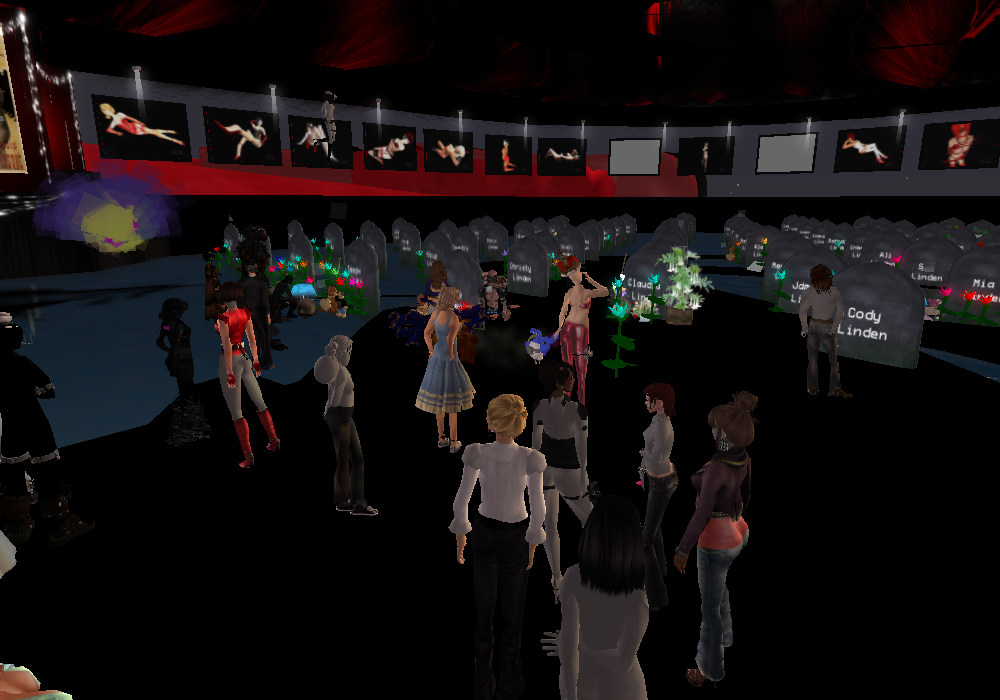
    The Linden Graveyard. This image specifically shows the named gravestones as many Linden Lab employees were let go over time. Note this space is NSFW.


    The Linden Graveyard. The fact that this place was made still haunts me. 

    John is doing well and every time I hear that he’s back near virtual worlds, I’m so pleased (and I’m still part of his fan club).

    My last call of affection goes to the VWER Planning Committee of 2012. I’m still in touch with Evelyn. 🙂

    • AJ Kelton, Montclair State University (SL: AJ Brooks)
    • Joe Essid, University of Richmond (SL: Ignatius Onomatopoeia)
    • Ann Steckel, California State University, Chico (SL: Olivia Hotshot)
    • Evelyn McElhinney, Glasgow Caledonian University (SL: Kali Pizarro)
    • Margaret Czart, University of Illinois at Chicago (SL: Margaret Michalski)
    • Charlotte Burch, retired middle school principal/Pres. Friends of Humboldt Bay NWR (SL: Mimi Muircastle)

    So in response to the question: Is Second Life still around? Yes.

    She has her children now, Sansar, sinespace, and High Fidelity.

    See you in world!

    #SecondLife #Metaverse #XR #VR #VirtualWorld #Avatar #Sansar #sinespace #HighFidelity #VWER #VWBPE #VirtualAbility #immersive #MUVE #multi-player online #persistent #HIVE #highlyinteractivevirtualenvironments #onlinegames #simulations #visualizations #onlinereenactments #distributedclassrooms #hypergrid #cyberspace


    This article was posted simultaneously to my LinkedIn account on 11/23/2021. https://www.linkedin.com/pulse/tribute-second-life-yes-its-still-around-heather-dodds

  • Videos on avatars

    Videos on avatars


    Our Digital Selves: My Avatar is Me by Draxtor

    https://youtu.be/GQw02-me0W4 1:13:56

    Heather’s review.

    A long film that dives deeply into multiple aspects of avatars in virtual worlds.  Touching story of how the disabled can use VWs to explore friendship and relationships.

    As of November 2021, Draxtor is still a resident of VWs and can be found communicating about them.

     Video description from YouTube:

    [ ***WINNER JURY AWARD & WINNER AUDIENCE AWARD BEST DOCUMENTARY @ Riverside International Film Festival, Riverside, CA, 2019 +++++WINNER JUDGES CHOICE AWARD @ Monarch Film Festival, Pacific Grove, CA, 2018+++++AWARD OF RECOGNITION @ IndieFEST Film Awards, La Jolla, CA, 2018++++SEMI FINALIST @ Hollywood International Independent Documentary Awards, Los Angeles, CA, 2018 ****]

    [**** blogs about this film:

    Virtual Ability = http://blog.virtualability.org/2018/0… + http://blog.virtualability.org/2018/0… + http://blog.virtualability.org/2018/0… + http://blog.virtualability.org/2018/0…

    Deanya’s guest blog = http://www.draxtor.com/blog/2018/5/17…

    Inara = https://modemworld.me/2018/05/18/empo…

    Strawberry = https://strawberrysingh.com/2018/05/1…

    Ryan = https://ryanschultz.com/2018/05/17/dr… **** ]

    “Our Digital Selves: My Avatar is me!” tells the story of 13 ability-diverse global citizens as they explore their identity through artistic expression and making a home for themselves in the VR Metaverse.

    Filmmaker Bernhard Drax travels from Los Angeles to rural South England to explore why people ranging from 24 to 92 years of age find solace and inspiration in a user-created digital wonderland that only exists inside their computers.

    Drax sends his documentarian avatar Draxtor Despres into the virtual universe of Second Life as well as next generation VR platforms like High Fidelity and Sansar where he meets a 40-something disabled Chicago native feels best represented by a colorful superhero gecko and Cody LaScala – confined to a wheelchair his entire life – who makes his avatar an exact replica of his physical self.

    The film follows researchers Tom Boellstorff and Donna Davis as well as leading technologists in Silicon Valley who intend to – as they say – “design the future of social VR with disability in mind”.

    As Boellstorff and Davis finish up their 3-year study on embodiment and place-making in VR, made possible by a grant from the National Science Foundation, the film comes as a compressed visual compendium to a seemingly unlimited array of possibilities for human interaction via the embodied symbolism of the avatar.

    Unique in its narrative approach, “Our Digital Selves” weaves together physical and virtual cinematography as the protagonists’ backstories are re-enacted via real time animation [Machinima].

    Contact drax at draxtor dot com for more information

    [copyright 2018 draxtor™…and media for all!]


    Strangers in Paradise, CBC Documentary

    https://www.escapistmagazine.com/cbc-documentary-looks-at-second-life-cheaters

    https://www.cbc.ca/fifth/2008-2009/strangers_in_paradise/video.html

    Heather’s review:

    This is a haunting documentary about 2 women who gave up their real lives in pursuit of virtual relationships. In both examples, the couples met in real life and the resulting relationship was either non-existent or weird.

    This video has been tagged by the CBC as showing examples of gaming addiction and provides links for the left-behind spouse as “widows”, i.e. World of Warcraft Widows, Everquest Widows, etc.

    It seems to want Flash to play now (since 2008/2009) and I won’t bother.  But it is a hugely disturbing video for me and very important.