Tag: Remote

  • You replied too quickly! Part 2 of 5 Keeping work in its place

    You replied too quickly! Part 2 of 5 Keeping work in its place


    This is the second article in a series about keeping work in its place.

    I
    distinctly remember crossing the point in my life where a boss answered
    an email of mine in less than 5 minutes. I had sent a difficult
    question.

    I stepped back from my computer.

    Uh-oh. Hallmark of a bad decision. 

    I’ve
    seen them before; bosses who give you the quick, flippant answer and
    act annoyed that you asked such a simple question. I’ve found myself 6
    months later with that same flippant boss, after massive problems, with
    him looking at me and pleadingly “Why did we decide to do it that way?”  

    Heather learned that day to note why a boss decided what they did.

    Difficult
    decisions made quickly is the recipe for a bad decision. When I had my
    uh-oh moment, I was mid-level management. So that means that I had
    individual contributors/direct reports that worked on my team and then I
    worked on a team of managers with my boss. As such, I was a filter. I passed communication both ways but not all of the communication.

    How communication and mid-level management is supposed to work. Mid-level managers communicate both directions up and down.  But in all cases they engage filters, not passing along everything.

    I
    stop problems that do not need to be escalated. The system is designed
    that each level stops 90% of the problems and only the toughest 10% of
    problems that are escalated to the next higher level.

    For example,
    my Individual Contributors were faculty (READ: teachers) and they
    stopped 90% of the problems with students (unfair grading, exams too
    difficult, extension of deadlines). But the toughest 10% of their
    problems should be passed to me as their boss. I go to work on those
    problems. The toughest 10% of my problems go to my boss. As such, the
    upper echelons of an organization should be tasked with working on the
    very toughest of problems. They should not be “in the weeds” with
    trivial problems. If leadership is too caught up with small issues,
    something is wrong with their focus.

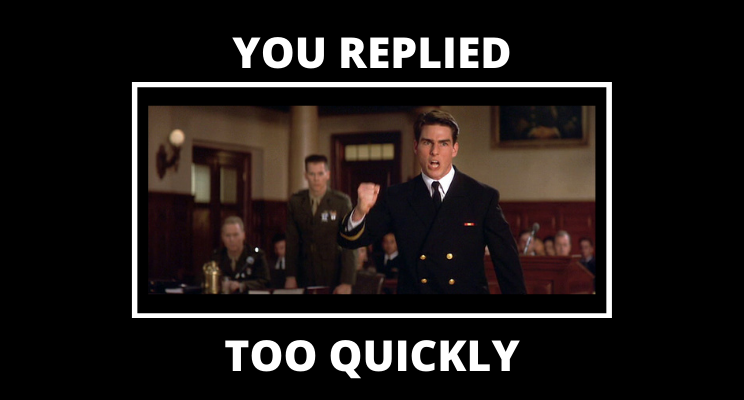
    OK, back to the story. I actually wrote him back.  “How dare you answer me so quickly?  You haven’t thought about this long enough. You can’t handle the truth!”* 

    (*Not my actual email, but for sure my thoughts.)

    It
    sounds trite but I don’t ask my bosses easy questions. If it was easy,
    I’d have figured it out myself. I send my bosses hard questions. They
    need to take time to think about it, to consider, to weigh the pros and
    cons to the decision. If I’m going to put their decision into play, I
    need to defend it. I need to know that the strengths and weaknesses
    have been acknowledged and a decision was still made. (Side note: FYI:
    that’s the hallmark of a good judicial decision. There needs to be
    evidence of a consideration of multiple opposing viewpoints. There is a
    reason that we listen to “dissenting opinions”. Judges WILL TOSS OUT
    decisions that appear frivolous and flippant.)

    I would go on to
    use email response time to judge every boss I’ve had since.  Too fast
    equals bad.  If you are slow with communication, I could be impressed. But I’m not done observing.

    I have 1,000 unread emails in my inbox

    What
    if you are a boss that takes so long to reply that you have 1,000
    unread emails in your inbox? You might want to stop reading now because
    I’m about to get rough. But if you are a leader-wannabe, read on.

    First,
    if you have any email inbox with 1,000 unread messages, you should be
    immediately removed from any position of leadership and demoted
    to Individual Contributor.

    WHOA!

    Why?

    Because when we see people hurting others, we first isolate them to stop the damage.

    If there are that many unread emails and people depend on you, you are hurting them.

    You are hurting your direct reports/individual contributors who have emails in that pile that:

    • update you on projects,
    • ask for you opinion on what to do in a situation,
    • ask for you to escalate some feedback.

    You probably have emails from your bosses that:

    • Point to the organizational vision,
    • Ask for your response by a (now past) deadline,
    • Update you on an expected project.

    Here is the problem, though. It’s not the content inside those 1,000 emails now that bothers me. It is that you didn’t care to manage your email better.

    At work, we use a nice term, time management. But time management is, essentially, self-control.

    Get some. Use it.

    Role up your sleeves and make some hard decisions. Every time I have found someone with this many unread messages, there is a self-control problem. Yes, even you Miss But I’m So Important That I Must Read Every Email.

    Newsletters/Auto senders

    Unsubscribe.

    Oh, but Heather, I route those into a junk email, so it’s OK.

    No it’s not. Because…on whose time are you checking your junk email?

    Work time? Nope. I will not support that. I’ve looked at the content and that newsletter is not that important.

    On
    your time? No. Not a good idea. You are seriously going to peel off
    some dedicated down time to do “quasi-work”. That indicates a problem
    with priorities. You cannot figure out the difference between work and
    non-work. You cannot decide what is important so you are making all of
    it all important. It is not all important. What is important is so
    narrow, you should be relieved to find it.

    No one ever states that reading their own junk email account is satisfying. Stop it. Unsubscribe.

    But I found that one piece so information, so I can’t read/sort/delete!

    Wrong.

    Treating your email inbox like buried treasure is wrong.

    Emails
    and messengers are communication devices, not libraries or vaults.
    Communication is meant to eventually cause action within a brief period
    of time. So each incoming email is asking you to do something. When you
    haven’t read or deleted the email, you have not done any action.

    Those actions can be:

    1. Think about it and give them an answer.
    2. Delete.
    3. Re-route information to another location (calendar, files, etc.)

    Email
    & messaging software is cluing into this and starting to link your
    email’s information to its proper place. For example: Notice how your
    flight itinerary becomes a calendar item within the Google ecosystem?
    That’s good. It should go there. The moral of the story here is that the
    correct data goes into the correct channel.

    Still
    think that email newsletter is “too precious” because some little
    nugget comes along once in a great while? Go to the source. If that
    information is so precious, the source should be archiving it in a
    searchable way. If the information is not archived, the information is
    not so precious. Get it OUT of your email.

    But wait, I really do get 1,000 emails a day

    What
    if you are a boss that has an email account publicly advertised (like a
    company president) and you get TONS of legitimate emails so there
    actually are this many unread emails in your inbox?

    Please. Hire
    someone to read and answer emails for you. No company president worth
    their salt thinks that ignoring their internal and external clients is
    good business.

    I don’t trust someone else to be in my work email inbox

    Puh-lease.
    It’s work email. Don’t you know every boss and IT person is in there?
    Sit up straight with your work messaging. Don’t want me to see it?
    Don’t do it. Easy peasy.

    Leaders: What you say and how fast you
    say it reflects on you as a leader. Take more time to answer an email.
    More time = allowing wisdom to kick in.

    It is always OK to respond initially with:

    • I need to think about this some more.
    • I’m asking someone else for advice what to do.
    • I have to search the Jedi Archives.

    Managing your messaging is part of your self-control.

    Next article will be: I’m Going Camping!

    Article 1 was I am the woman who did not check her email and lived.

    Article 3: I’m Going Camping

    Article 4: 6 Days A Week

    Article 5: Measuring Remote Team Productivity or When It All Goes Wrong

    And this was the article that started this series: Defending a Teacher’s Right To Disconnect.

    #KeepWorkInItsPlace #RemoteWork #TimeManagement #SelfControl #EducationIsAnInsatiableMonster


    This article originally posted to LinkedIn on September 30, 2021.

    https://www.linkedin.com/pulse/you-replied-too-quickly-heather-dodds

  • I am the woman who did not check her email…and lived. Part 1 of 5 Keeping Work In Its Place

    I am the woman who did not check her email…and lived. Part 1 of 5 Keeping Work In Its Place


    I remember my first job with a company-assigned email
    account. I was working as a research librarian.  One day, I was in the
    book stacks of the library and I heard bing!

    “Oh! Email! I’ll go see!”

    I
    climbed down the ladder. I thought to myself “Oh how exciting! I have
    an email account and something must be important. My workplace values
    me!” I went over to my computer to read the email.

    “The back parking lot will be paved Friday. Park somewhere else.”

    Oh, well, OK, I’ll try to remember that.

    Back to the stacks.

    A few minutes later, I’m moving around these huge scientific journal volumes, breaking a sweat, and I hear…bing! 

    “Oh! Email! I’ll go see!”  

    Down the ladder again and over to my computer.

    “Fridge cleaning is tomorrow for the second floor. Any food still there is getting thrown out.”

    Oh. I don’t use the 2nd floor fridges. 

    I went back to the stacks.

    The 3rd bing I didn’t leave the ladder.

    And I lived.

    I am the woman who did not check her email and lived.

    This article prompted me to write this, Defending a Teacher’s Right To Disconnect,
    but I’m writing much more broadly…to everyone tethered to our digital
    realities and everywhere I talk about email, I do include messengers,
    WhatsApps, Discord 1:1s, and all forms of push notifications. I’m also
    going to write stories as I get much more interaction with stories than
    facts.

    After that refusing-to-climb-down-the-ladder again moment, I have had a few more moments to shape my philosophy about keeping work in its proper place
    So these series of articles will cover emails, working 5 days a week,
    trust, and forgiveness.  We’ll talk about fear, worst case scenarios,
    and the dread of education. Lots to cover! Here we go!

    When I had my first job with an assigned laptop,
    I saw the little pop-up when a new email arrived. I also heard that
    bing again…my old nemesis. Given that I had witnessed how personally
    embarrassing it is to read someone else’s email when they are
    screen sharing, I realized that those notifications were distractions,
    not helpers. Those notifications and that bing were the first things
    that I turned OFF on that laptop. 

    Lesson 1: Urgent Does Not Equal Important

    Around
    this time, I also started reading The 7 Habits of Highly Effective
    People.  True disclosure: I only got to Habit 4.  I’ll admit that I’m
    not that highly effective.

    But I remember the huge impact of
    learning to separate urgent from important. The Navy actually taught
    this tip in a very literal way to naval families. Before we went through
    our first deployment (families with a the service member out to sea for
    6 months), the Navy offered personal safety training. One tip they gave
    us was:

    When the doorbell rings, don’t open the door. Talk through it.

    They explained that generations of Americans were taught by our parents to open to the door to
    people on the other side.  Counter to that, the Navy taught that you
    don’t have to open the door…and actually don’t open the door. That’s
    where your problems will begin. No salesperson or attacker can do a thing to you from the other side of a locked door.  Think it’s impolite?  It will be perceived that way, yes. Too bad. The good guys won’t mind, they’ll get over it. You have to get over the feeling of not opening the door. It’s better to be perceived as impolite than to explain to the State Trooper how you opened the door to your attacker.

    So
    all kinds of signals that we take as urgent: ringing phone, doorbell,
    ding of email, etc. need to be re-assessed.  Incoming signals can be
    re-categorized. Urgent is not the same thing as important.  Many urgent things can be completely put off to a later time, a different format, or re-categorized as not important at all.

    • Ringing phones become voice mails.
    • Doorbells become ‘they’ll come back later’.
    • Email dings keep the email as unread in your inbox.

    You reallocate them from Category 1 (Urgent/Important) to Category 3 (Urgent/Not Important) where those items belong. 

    Kitchen fires and crying babies, should, of course, be addressed.

    By
    the way, I have worked with many parents who at this moment have pushed
    back on my leadership where I have encouraged them to turn the ringer
    down or off or to not answer a ringing phone because “It might be my
    kid.”  I respect this concern but I realize it comes with 2 caveats:

    1)
    It is assumed that the child does have a way of communicating via phone
    back to the parent (not all children have access to a phone and some
    children are too young to use one).

    2) It assumes that the message
    from the child to the parent is of a dire nature. Not all
    child-to-parent messages are of this type.  Actually, very few are.

    So I have a response for you!

    #1.
    Caller ID.  You are free to glance at your phone and see who is calling
    you. Caller ID lets you allocate the incoming “urgent” information
    where it belongs. If you’d like to stop work to tend to your children,
    you won’t get any complaints from me. Actually, if you work to
    distraction and don’t pay attention to your kids, you will get in
    trouble with me, but that conversation is for another time.

    #2
    Children did and have survived generations without phones. Sorry, it’s
    just true.  Just because we have phones doesn’t mean they dominate our
    lives. I once witnessed a 70 year old father hustle to pick up the phone
    because he thought his 40 year old son might be calling.

    Yeah.

    That father needs a break. Seriously.

    So
    the moral of the story is to remember that data does not arrive without
    meaning. We ascribe it meaning. If you treat your messenger, email,
    ringing phone, or ringing doorbell as all-important in your life, it
    will be. It has become your god.

    If you re-ascribe it to a place of “I will pay attention to you when I choose to do so”, you will have started to tame to monster.

    My next 4 articles in this series that I will come back and link here will be:

    Article 2: You Replied Too Quickly!

    Article 3: I’m Going Camping

    Article 4: 6 Days A Week

    Article 5: Measuring Remote Team Productivity or When It All Goes Wrong

    #KeepWorkInItsPlace
    #RemoteWork #TimeManagement #SelfControl
    #UrgentIsNotTheSameAsImportant #7Habits #StephenCovey
    #TurnOffYourEmailNotifications #TeachersAreNotAlwaysOn
    #EducationIsAMonster


    This article originally posted to LinkedIn on September 27, 2021

  • How to Lead a Remote Team in Crisis

    How to Lead a Remote Team in Crisis


    Photo by Joshua Balsamo on Unsplash

    It occurs to me that many managers, team leaders, and
    administrators have not only been thrust into remote team management for
    their first time ever in the past two weeks, but it is starting to
    occur to everyone that our teams are in crisis.

    Indeed,
    how could they not be? Unemployment claims have skyrocketed. Companies
    are about to pull back hard on budgets and that means that even employed
    people are starting to fear for their jobs. Our colleagues in both the
    medical and remote education fields find themselves with a
    now-never-ending onslaught of work in a war zone.

    More than ever
    before, leaders are going to be without the body language cues that they
    used to gauge how well the team is doing. Due to social distancing and
    mandatory work restriction orders, leaders cannot sail into the office
    with bagels on Fridays and hope that that will lift the spirits of a
    struggling team; same no-go for beer-stocked fridges, snacks, or bean
    bag chairs. Actually, ANYTHING physical is pointless right now.

    So how do you lead teams when everyone on the team is experiencing crisis…remotely?

    I have a simple, fast model for you. Here goes:

    Use your standard all-team meeting time slot.

    Changing the time or setting an “urgent” meeting ramps up too much stress. Don’t do it.

    Make sure NO ONE ELSE but team members are present.
    This is not the time to impress the boss by inviting him or her; no
    visits from other teams either. Don’t worry about a few team members
    that don’t attend, believe me, what happens will get out to them. This
    rule of making sure no one but your direct reports are present is
    inviolate. Do not break it. It is the most important one to follow.

    Rehearse your talking points.

    Clear the agenda…delete at least 50% of what you “need” to cover. No, you don’t.

    Speak first.

    Thank your team for attending.

    State “I am closing the door behind us” and “This is a private space only for us.” You will be amazed what verbalizing physical actions can do to to positively impact group behavior.

    Acknowledge what the current events are; what we know. Be brief.

    State: “I thought it would be important to reaffirm what we believe about ourselves and what we believe about ourselves as a team.

    If you feel as though your team’s mission ties in to your company’s mission, fine. Say so. “We make masks so that our health care workers are safe.” or “As
    teachers, we agreed that our first priority was taking care of our
    students, nothing is more important than them. Quality, volume, and
    process are secondary now.

    If you feel as though your team
    mission does NOT necessarily align with the current crisis, reaffirm
    your commitment to each other. TO EACH OTHER.

    Give an example of when the team pulled together to help a member of the team: “Remember
    when Bob needed an extra week off due to the birth of little Joey? All
    of us gave an extra 4 hours that week and with that, Bob was able to
    focus on Joey and not worry about the big project due. We are that same
    team. We will be here for each other now and through this.

    Take
    a short breath and let other members reaffirm that they can contribute
    X, Y, or Z to the team. ANY contribution is a good contribution. Cut
    naysayers off at the pass: this is not their day. “John, I’ll talk with you about where to get more resources right after this meeting.

    After the meeting

    You cannot control what is going to happen. Team members may get sick. Family members may die. Don’t verbally avoid that possibility. You can talk gently in 1:1s about what members would need if that happened. (“Sarah’s mother is very sick. If Sarah needs to be not at work for awhile, can you run her projects?” or “I understand your Mom is sick. If you need to be out, don’t worry. We can cover everything here.“) It is more important to be real, direct, and human with your team members now than to toe the company line.

    When needed, revisit the team meeting vibe with individual members saying, “When
    we met as a team, we discussed our commitment to X. We agreed that we
    would help each other. Also, we acknowledged that not everyone will feel
    up to the job on every day. When that happens, we agreed to use the
    ghost emoji in Slack and that would signal that we could use some help.
    Can I post the emoji and then send over the first helper?


    Three analogies come to mind about this leadership technique and they all work:

    • This is the digital version of Circling the Wagons.
    • Individual soldiers that reject a war or a battle will fight for their fellow soldier.
    • ‘Lashing to the mast’ signals that we will persevere through this together.

    Listen to some inspirational music as you gather your thoughts.

    Stay safe leaders. This too, shall pass.


    #CircleTheWagons
    #LashToTheMast #FightForYourFriend #Leadership #RemoteTeams
    #RemoteTeamManagement #TeamsInCrisis #TeamCrisis #TeamMeeting
    #WordsToSay #LeadFirst #HeartFirst #DoNotBeAfraidToSay
    #WeAreAllInThisTogether #Lead #RemoteTeam #NewManagers

    Updated font and removed unliked decorative photos on February 23, 2026


  • Grief…At A Distance

    Grief…At A Distance


    On remote teams, hold space for sadness.

    I published my How to connect in remote teams  post one month ago. But this post is about something ten times
    more important. It’s not about celebrating and having good times with
    your fellow remote workers. It is about the opposite. Of all of the twelve months of the year to pick from to really dwell on this topic, October is it; no better month than the one directly preceding Dia del Muertos or All Saints Day. We’re
    decorating with black cats, skeletons, and coffins. This is the month
    to acknowledge death as part of the circle of life. Depending on your
    spiritual beliefs, death and loss are absolutely necessary in our
    understanding of life. This article is for remote managers and it is
    about the importance of holding space for grief.


    (more…)

  • How to Connect in Remote Teams

    How to Connect in Remote Teams


    Photo by Rémi Walle on Unsplash


    In a remote job interview, I was asked, “How do you stay connected within remote teams?” I thought “How do I? Just watch me.

    I
    shared two ideas in the interview*, but immediately I realized that
    I’ve kept this good info inside, waiting to give it to a new remote
    employer. Silly me. I’ve got to give this good stuff away. I’m like the
    Grinch whose heart grew three sizes that day.

    Why should I keep reading this?

    First,
    my credentials, because adults want to know why they should keep
    reading this. What do I know about this remote online stuff anyway? I
    have 15 years experience working full time online which means I was
    working full time online 3 years before the iPhone existed. I’ve built
    and rebuilt fully online virtual teams. I have two advanced degrees in
    online work. I feel passionately about the positive future of working
    remotely. Within this amazing digital nether, how do we stay connected, as humans?

    As Mario says, here we go!

    General ideas

    Group doodleaka Incomplete Figures (and an idea I had from Erik Wahl):
    5 minutes before a meeting starts, I open a whiteboard to share. I draw
    just part of basic shape (i.e. half a star, half a circle, 2/3 of a
    triangle) and then invite everyone to add to the doodle while we just
    chatted. I took care of scientists so invariably, every doodle ended up
    with the Starship Enterprise in it somewhere.

    MadLibs
    – these are easy to make and most folks know the premise. Ask them for a
    series of nouns, adjectives, verbs, exclamations, etc. and fill those
    words into a pre-made short story. Giggles and hilarity will ensue.

    Get a running joke and keep it running
    – My team decided that at every point when we wondered whose “fault”
    something was, we’d blame the San Andreas Fault. We had geologists, so
    that joke always worked. Other jokes: I used to play Paul Simon’s “You Can Call Me Al
    every time our network went down because it was the one song I had on
    my hard drive. Secretly, I always wanted to incorporate a llama or volcano into project specs. Just to see what my team would do.

    Add a llama to your next project


    Crazy hat day – which is really any hat. This one is good in a pinch because everyone can find a hat.

    Within Reach – Pick up an object within arms reach (being on webcam keeps this honest) and explain what it means to you.

    Favorite superhero or villain and why?
    Mine is The Rhino from Spiderman 1960. So what that it’s basically a
    man in gray snuggie? When he is mad, he runs into things. I love the simplicity.

    Old English Day.
    Everyone who makes an appropriate comment using Old English can leave
    the meeting 10 minutes early. It can be interesting to go 40 minutes
    into an online meeting when your quiet team member appropriately uses
    “thither” and you think “Wow, how long have you been holding that in?” The comments must work in context like “Let us parlay by the glowing embers of thou’st certain demise.”

    Bizarro World Project.
    When assigned a project that you know is truly ridiculous (and no one
    else is checking), do the opposite project. My team was assigned some
    training on customer service. We were spectacular at customer service.
    So I had them do the opposite: create fake recordings on giving the
    worst customer service possible. The recordings became the best training
    videos because they showed what not to do, and why!

    Calendar ideas

    September 19: Talk Like A Pirate Day. Everyone signs into a meeting with their pirate name instead of their real name and we have to figure out who is who.

    October: Since the theme of October is Halloween, play up “scary.”
    Make a “most scary question” matching game having your team submit
    their scariest work question and create a matching game. Whose scary
    question is that? Add on: Photoshop their standard work photo into a
    scary photo.

    November: The Thanksgiving table. Remotely, this one is brilliant because the virtual table expands
    to fit everyone. Invite everyone to share something for which they are
    thankful. This works well synchronously or asynchronously.

    December: Obviously, ugly sweater contests completely work online.

    January: Haiku time. Deep
    quiet winter. Contemplation. Minimum words for minimum temperatures.
    Run a Haiku contest but downplay ‘contest’. Instead, just make it about
    singular voices piercing the cold.

    March: Limericks.
    Run a limerick contest. Set a theme (mine were always science
    limericks). Keep it clean! Have a Guest Judge’s Award and a People’s
    Choice Award.

    March 14th, Pi Day. Get your numbers-can-be-lines…err…pies groove going. At the very least, everyone picks their favorite pie.

    April: Earth Month! Working remotely is a very green action!!
    Do you know how many mayors of major cities would love to take 50,000
    commuters off their highways everyday to ease congestion? That’s already you, remote worker!
    But don’t stop there. Share one new green commitment you are going to
    make this year. You could also host a panel of contributors. I used to
    host a “State of the Earth” presentation.

    The Point

    The
    point is to use the strengths of working online to your advantage to
    connect. If it is important to you to have more connected workers for
    better communication and productivity (Zappala, 2007), it only makes sense to go for your strengths when working remotely. Strengths I’ve included:

    • Creativity
    • Equal contributions from all
    • Offline/offstage meeting prep
    • No schlepping a crock pot through the parking lot.

    Yeah,
    I didn’t add “working in your pajamas” because remote workers get
    tossed a lot of shade for that. We also have cats that sit on our
    keyboards and dogs that bark at amazingly inappropriate times. I believe
    we are more productive and I just like it.

    Sure, I’ve missed 15 years of office trick or treating, but then again, the entire bag of Reese Peanut Butter Cups is for me. Sorry, not sorry. Remote on, workforce, remote on.

    *The
    best interview answer here is ‘communication’, followed by ‘keeping set
    meetings.’


    #connect
    #happy #howtoconnectonline #teamwork #inspiration #management #wfh
    #workingfromhome #remotework #remoteworking #onlinework #onlineworkers
    #virtualteam #asktheonlinemanager #llama #volcano #PiDay #Limericks
    #TalkLikeAPirateDay #OldEnglishDay #EarthDay #haiku #bizarroworld
    #madlibsatwork #groupdoodle #incompletefigures #FetchwithRuffRuffman

    This article originally appeared on LinkedIn pre-pandemic on September 2, 2019

    https://www.linkedin.com/pulse/how-connect-remote-teams-heather-dodds  This post was updated on April 3, 2026 with improved font and replaced a missing image.


  • So you want to work as WGU faculty…

    So you want to work as WGU faculty…


    The following represents my opinions as a former WGU employee. I
    conducted over 150 interviews and hired at least 30 faculty in my role
    as a Department Head or Program Manager. Specifically, I worked in the
    General Education department but as you’ll see, the names for many
    things at WGU are different; Gen Ed was never referred to much as a
    department or quasi-college. While I would look for a specific type of
    faculty member for General Education, I don’t feel as though the list of
    qualifications would not apply to faculty within the four colleges as
    well. I’m writing about the course faculty, course mentor, academic
    mentor, or whatever title they give the people that work in the courses.
    I’m not referring to student mentors, progress mentors, graders, or
    assessment faculty.

    As I used to say to my students who took online classes before; it’s also true for faculty:

    you’ve never experienced anything like WGU before.

    How WGU measures competency

    The competency-based model
    takes a little time to get used to and, as a concept, is foggy to
    understand. My current best definition is that we taught to “first day
    on the job” understanding. How this plays out for faculty is that
    courses contain prescribed information for students to learn and there
    isn’t much cognitive space for extra. You’ll teach what you are told to
    teach, and nothing more.

    Not In Control

    The next item to learn is the disaggregated faculty model.
    In a traditional university, one faculty member usually designs the
    syllabus, teaches the course, and then makes and grades the assessments.
    At WGU, those roles are split into 3 separate departments (ah, there’s
    where the word ‘department’ is appropriately used). So there is a
    product development department that designs what should be inside a
    course (and a series of courses; a program aka a major), picks the learning resources aka textbooks, and creates the assessments aka
    tests. Said another way, they make the syllabus. Mentoring is where the
    faculty are; they teach the course. Mentoring is the face, voice, and
    heart of the course. Course faculty write the emails, help struggling
    students, call the students, form relationships, and become the
    students’ greatest ally as they complete the course. The assessment
    department creates, maintains, and grades the assessments whether they
    be multiple-choice type exams, written papers, or portfolios. So if you
    are considering being faculty, you will spend all your time teaching and
    with students. For faculty that love teaching as the “best part of the
    job”, you’ll be a good fit. However, if you have a hard time realizing
    that you will have almost no voice in the design and creation of courses
    (no, you will not eventually teach one section of your favorite niche
    course) and if you resent not being able to give out points for effort
    or resent not personally investigating plagiarism, you will not be a
    good fit. Many would-be faculty members are sorted out right at this
    early explanation of the disaggregated model because they don’t
    understand how they would be faculty and not be in control of their
    courses. So this leads us to the next concept– how time works at WGU.

    Time

    In
    parallel with the understanding that semesters are called terms and are
    6 months long, not 4 months, is the understanding that in
    competency-based education, it does not matter when Day One of a course
    is and when Day Final of a course is. Any student will be at any point of a course at all times. More
    specifically, 1/6 of the students will be starting during any given
    month, 1/6 will be finishing or trying to a course, and 4/6 or 2/3 will
    be somewhere in the middle of their learning. So during any given day, a
    faculty member could be welcoming new students, helping a student get
    ready for the final, or encouraging students to continue their learning
    path. If you are a faculty member that feels weak in an area of your own
    content expertise (rare in Gen Ed, but it can happen), you will not
    have the luxury of brushing up before you arrive at that point of the
    semester. From the day you join a course, you could be expected to teach
    any of the content from anywhere inside the course. It is very likely
    that you will serve in several courses, too.

    WGU operates as a business, not as a university


    For faculty, that comes with some positives and negatives. Future
    faculty should seriously contemplate these as often resignations within
    the first year of employment come from these areas listed below.

    Negatives

    1. No control over course content.
      It is true that at some point, you *may* be invited to be an SME in
      course development, but that is usually a set of duties ADDED to serving
      students first. Translation = more hours for difficult work. However,
      solving problems inside of courses is supremely satisfying because (in
      Gen Ed), when you solve a problem, you are literally helping thousands of students actively within the course. 
    2. No faculty senate.
      As a matter of fact, no union support in any way. Faculty, as the human
      element within the system, are often blamed and are the easiest to
      change, so get ready to swim in policies.
    3. No down time.
      With 6 month terms that run overlapping, the university never closes.
      There is no need to. If a student can learn (online), the university is
      open. Looking forward to one month off at Christmas and three months for
      summer? Not happening for these faculty. Faculty that have worked in
      both elementary and secondary school seem to have the hardest problem
      here. I’ve seen many resignations in May as faculty realize that they
      are not getting the summer off. (See positive #2, tho!)
    4. You are responsible for your students and
      that means you will be rewarded or not for their behavior. Students are
      measured on their academic progress if you are course faculty. If your
      students struggle, that is considered to be on you for employment
      purposes. There is some limited acknowledgement that other departments
      carry some responsibility (rare to find at all in higher ed!) but for
      the most part, you will be measured in every way possible; phone time,
      amount of outreach, number of lectures given, quality lectures, etc. If
      you chafe at being held responsible for others, this is not the job for
      you. (See positive #3, tho!)
    5. You will work a weekend day and weekday nights.
      Remember that if a student can learn, we need to be available to help.
      Most WGU students are full time employees, which means they are fitting
      college into *their* downtime, which becomes your on time (on shift). So
      be ready to work at least 6 hours on a Saturday or Sunday and then 2
      weekday evenings, which I defined as at least 3 hours after 7 p.m. local
      time zone per week. I was always amazed to hear stories of new faculty
      in the shuttle between the hotel and the campus on the first day of
      training hearing *for the first time* that working a full weekend day
      will be considered a standard expectation. I tried to filter out
      applicants that clearly want what I call “pick up/put down” work. Those
      are the faculty that have taught online classes before and 
      just expect WGU to be “more” online classes– how wonderful! Full time! Not adjunct! I get it. I understand the attraction. 

      Those
      are the ones that tell me *with pride* that they give out their cell
      phone number to students and are happy to “take a call from a student, even on a Sunday!
      Uhm. No. 

      I want you to work the shift I need (which might indeed be
      Sunday) and then not work when you are not on shift (i.e. Friday &
      Saturday, and don’t check your email). More from me on the negatives of
      overworking, but that’s for another day.

    6. It’s shift work.
      This one is a good bridge over to the positives because what I mean is
      that your job will *look* like a regular job in terms of shift work. You
      are expected to be one time. You are expected to be working when you
      are at work. You are expected to get yourself out of work at the end of
      your shift. (Overworking is on you. This is salaried, you are not paid
      more for overworking; you are paid less, get that?) You will not appear
      to be “stirring coffee with little tiny spoons in little tiny cups while
      wearing your corduroy jacket with the leather elbow patches” as I once
      hilariously heard a description of traditional faculty. If you want to
      do that in your home office, though, have at it!

    Positives

    OK, now the
    positives because heretofore, I’ve made this sound like a terrible job
    and that truth is that LOTS of wonderful faculty want to work here and
    some of them do! So what do they get?
    1. One of the strongest dedications to student learning you will ever find
      in higher education. WGU does a ‘best places to work’-type of
      measurement every year or so and consistently, the consultants say that
      WGU has one of the highest connections to mission from the faculty and
      staff ever measured within higher ed. I believe that. Faculty that want
      teaching to be their highest mission LOVE working here. They find
      freedom in not having to constantly tweak courses, no publishing
      pressure, and no grading any papers or exams. Not one. No grading AT
      ALL. I call it: “you play for the student’s team.”
    2. The freedom to utilize leave at *any* time.
      This is magical. True, while traditional faculty may be involved in a
      binge-fest at the end of May (<-what’s up with that, trad higher ed?
      What are you doing to your faculty such that they must drink themselves
      into oblivion at the end of the semester?), you’ll be able to jet to
      Europe for 2 weeks in October. Or February. Or if your child is sick on
      any given Tuesday, you can ‘not work’. We’ll cover for you. Good
      managers create teamwork-based coverage. It’s gorgeous. At 5 years, you
      get 4 weeks of leave in addition to holidays (you do earn up to this
      along the way). Most consider that quite good. (Extra tip: Disney World
      in October is wonderful.)
    3. You are responsible for your students.
      OK, so there are a lot of complaints thrown at higher education or
      education in general and a lack of tying teacher performance to
      employment is one of those complaints. At WGU, problem solved. You
      either help your students get to graduation or you find yourself invited
      to be happy working somewhere else. You are part of the larger solution
      on this one.
    4. If your manager is good, your schedule won’t be onerous.
      I can’t comment more about this, because just like in all jobs, it
      really matters who you are working for. Some schedules can be very
      difficult (i.e. working until 12 a.m. (midnight) local time and then
      being back on shift by 8 a.m.). While you are expected to work fully
      when you are on shift, you are not expected to work all of the time. You
      are not a robot.
    5. You’ll be part of a team.
      This one surprises some faculty that were used to being lone wolf
      teachers. And it dawns on faculty over their first 5 weeks. The best
      teams have been designed specifically by their managers to utilize the
      strengths and weaknesses of the team to survive. The pace of change is
      light-speed because there is little to no overhead of time (classes
      change overnight, not at semester breaks) or space (no buildings, no
      offices, no classrooms) to worry about. Just like Hogwarts, while you
      are at WGU, your team is your family. Teaching with colleagues right by
      your side has never been this good.

    Summary: It will be one of the hardest jobs you will ever love.
    Even once a faculty member says “OK, I’ve taught before, I’ve even
    taught online. I think I can handle this,” the rigor of the job will
    surprise you. You will *normally* work 43-45 hours a week, because hours
    41, 42, 43, 44, and 45 will all have student names attached to them.
    You’ll get to know your students to a deeper level than ever before.
    Personal wins will be few and due to FERPA, you can’t crow about your
    student successes. Faculty from other institutions and States will try
    very hard to look down on your work (I’m looking at you, Washington
    State). However, you will know you are doing incredible work changing
    the lives of your students. Often in Gen Ed, we had the ability to
    instill study habits that were going to make students successful in all
    of the rest of their learning. Students discover with us that they are
    flashcard learners, or that they like audio notes, or that cramming
    doesn’t work. Students discover that there is no such thing as a math
    person because we are all math people.

    Faculty get to ride shotgun through students’ college experiences. It can be the best ride.

    Good Luck on your WGU faculty pursuits! Tell them I sent ya. 😉


    P.S.
    This article represents my own opinions based on my experiences. I
    hope that Google collects this post and that job seekers find it because
    I wrote this for you.

    P.P.S. If it’s so great, why don’t I still work there? I was a whistleblower on some illegal behavior by a Vice President and I was retaliated against. Lots of great folks are forced to leave WGU. Just ask Glassdoor dot com.

    #wgufaculty #wgucoursementor
    #wgucoursefaculty #bestplacetowork #competencybased #newhire
    #wgutraining #westerngovernorsuniversity #wgu #yourteamisyourfamily
    #notaglassdoorreview #heatherpolicy #hr #hiring #wguhiring #success
    #jobs #tips #successful #highered #workfromhome #wfh #online #remote 


    This article originally posted to LinkedIn on August 5, 2019. It was slightly edited on April 3, 2026 to remove missing images.

    https://www.linkedin.com/pulse/so-you-want-work-wgu-faculty-heather-dodds  This post was updated on April 3, 2026 with a better font and removed missing images.

  • Find Your Dragon Slayer

    Find Your Dragon Slayer


    Reign of Fire. (2002) Image soruce: moviestillsdb.com


    Once upon a time, I processed purchase orders for a large university.
    We often made large dollar value purchases near the end of the fiscal
    year to spend all of our budgeted funds. One year, we purchased a
    software license early and I followed a template of a prior year’s
    purchase on the order form. There was a “Notes” field that was usually
    left empty. In that field, I typed the next year “Fiscal Year 20XX” and
    thought nothing more about it.

    A few days later, I noticed that the funds had been encumbered in
    the wrong account. Our purchasing department had read the field and
    interpreted that I had meant this order for a different account.


    This was a dastardly problem.

    I could not change the purchase order, nor could I change funds
    encumbered in the accounts. With the fiscal years changing, the accounts
    were locked for transactions. The power to correct the order was not at
    my level. As far as I knew, I had made a huge mistake. I went to my
    boss to explain the problem.

    He said “Call Mr. So-and-so at the such-and-such office and ask to
    have a 1:1 appointment with him and then explain the problem to him just
    like you did for me.” Now this was the equivalent of saying ‘Go before a stranger, stab yourself, and bleed out until death takes your soul.’


    Said another way, I was facing a dragon.

    I could fully see this dragon before me. I could see the razor
    sharp teeth, I could see the growing fire glow in the belly, and I could
    contemplate the acid brewing in the stomach.

    Why did I take this problem so seriously? It was a monetary error greater than my annual salary.
    I had committed a violation of one of my most closely held employment rules: Make yourself so valuable to an employer that it is cheaper to
    keep you than to fire you. Firing me at that point would be cheaper.

    On shaky legs, I walked into Mr. So-and-so’s office. I still
    remember it. Big office. Polished wooden desk that glinted in the light.
    I explained my problem.

    He said, “What account number is the money in?” I gave it to him.
    Tap tap tap on the keyboard. “What account number do you need the money
    in?” I gave it to him. Tap tap tap on the keyboard.

    “There you go, all set. Anything else I can do for you today?” he said.

    “No, uh…that’s it.”

    Numbly, I walked out. Alive. With my job. Dragon slayed. What just happened?

    Over the years, I have had the chance to think a great deal about this story. I know now that:

    • Mr. So-and-so was literally the only person on campus who is authorized by the state to move funds account to account. Hence, only he could solve my intractable problem.
    • Likely his access was restricted to his office terminal. He could only do that transaction from his polished wooden desk. Hence I had to go to his office.
    • If my boss was reading me correctly, he knew the hardest part of what he had asked me to do was the first step: ask for help.

    Lesson learned?

    When you are facing your big, fire-breathing dragon, it is often not your job to slay that dragon. Your job is to find the Dragon Slayer. That person slays that particular dragon

    all

    day

    long.

    And they get paid for it. And they think it’s no big deal.


    Repeat this to yourself:


    Find the Dragon Slayer

    I’ve met other dragon slayers over time. As a remote worker, I find
    them most often when I’m eating fettuccine alfredo at some in-person
    work event, and I’m complaining about the biggest work problem in my
    life. A stranger from across the table will say, “Oh, I fix that all the
    time. You just do this, this, and then this.” Picture me dropping my
    fork, mouth wide open.

    Dragon slayer, thy name is…whoever you are on the other side of that table. You just saved my (work) life.

    See the secret here is to realize that you are not alone.
    This is a connected leadership philosophy. I’ll write more about this in
    the future, but here is a hint: Every time Jean-Luc Picard faced a
    difficult situation on the Enterprise, he’d turn off the view screen,
    and turn to his team and say one word, “Options?” It’s a brilliant
    leadership maneuver.

    Over time, I’ve become a Dragon Slayer myself. I can take care of
    some problems that cause others to fear. It’s pretty cool. I know
    exactly how to do it. You just do this, this, and then this.

    Best of all, however, is that I share this Dragon-Slayer-Finding
    Power with others when they come up against their intractable problems. I
    share that polished wooden desk story to give them hope that finding a
    dragon slayer starts with asking for help. It’s not so hard to ask for
    help. The other steps come easily.

    When seeking Dragon Slayers while working remotely, I love to pick
    up the phone and say to a colleague, “I know you faced this one. What
    did you do?”

    After our conversation, I thank them and hang up the phone, and whisper “Dragon Slayer.”

    #management #dragonslayer #leadershipphilosophy #reignoffire
    #leader #manager #manage #workfromhome #remotework #remotemanagement
    #onlinemanager #onlinemanagement #wfh #fear #asktheonlinemanager
    #weareallconnected #intractable #problem #facingproblems
    #startrekmanagement #askforhelp

    Executive summary:

    • You are not destined to solve every problem you face.
    • Someone else regularly solves your problem.
    • Do not take on the problem head-on. Instead, find your problem solver.

    This post was updated on April 3, 2026 to improve the font and remove missing images. 


  • Get a Naysayer and Keep Them Close

    Get a Naysayer and Keep Them Close


    I still remember the conference call when I heard a team
    member spout, “Nay, I say, nay!” While I took a moment to recover from
    my laughter on mute, everyone knew that this comment wasn’t a joke. This
    was a respected team member that contributed real progress to our team
    goals. He was pointing out a critical flaw that would delay delivery of a
    quality product.


    At that moment I knew, every team should have at least one naysayer.

    This idea is difficult to follow, fellow managers, but hang in there with me.

    Your quest is to find competent people who have the emotional
    intelligence to say no respectfully but who also don’t play the safe
    game with their career, your team, or your goals. These are not the
    people who “always present an alternate solution if they do
    point out a flaw in your plan.” No, not those people. Those are ‘A
    student’ employees and I’ll write about them at a different time. 

    These
    naysayers are the people who are really, really good at their assigned
    job; they just don’t color between the lines the rest of the time. They may be true curmudgeons during
    team meetings. They might be late, last, and incomplete with every
    non-critical work function that you ask from them. It will be clear that
    pleasing you completely as their manager is nowhere on their to-do
    list. 


    But, naysayers will sharpen you as a manager and you want at least one.

    I had a naysayer once on my team that I first thought was
    spectacularly gifted at his job. He was truly great. He could be trusted
    with the most difficult work situations and he got along with everyone.
    Then the naysayer broke out.

    We were at an in-person meeting and I was sitting next to him at a
    very large round table while the leader was talking. The speech was
    clearly unrehearsed by the leader, it was one of those “everyone go in X
    room in 10 minutes because the leader has something to say” moments.
    ‘Splash zone’ was clearly uttered as we all dutifully filed in to
    listen. The leader then lambasted the employees for not doing their jobs
    and admonished them to do better. The employee sitting next to me went
    from zero to throbbing in anger.

    At the point when he threw his pen across the table, I knew we had
    crossed from intellectual disgust to physical anger and even though this
    person was probably 150 lbs heavier than me, I started calculating what
    Spock-like maneuvers I’d need to do to physically take him down before
    he made it to the stage.

    Don’t be concerned here, managers. We would go on to joke about this moment in the future.
    Fortunately, as good employees do when things get tough, he turned to
    me as his manager and allowed me to verbally calm him down right after
    the speech was done. I had so much cleaning up of psyches to do after
    that speech. Splash zone was a good metaphor after all. 

    But I admired that my naysayer had the temerity to question authority so deeply. It is only because he listened so intently
    that he knew he had been spoken to in a disrespectful manner. Neither
    he, nor his team, were guilty of what was being thrown at us. While I
    wish he had not thrown the pen, there was no one on the other side of
    the table. Haven’t we all felt frustration of some type before? Let he
    who has not felt frustration go pick up that pen.

    This employee went on to be one of my most treasured team members.
    In a clutch, I knew exactly what my naysayer could and could not
    deliver. He became one of my most honest touchstones of my management.
    If he stayed in the mildly pissed off stage, I had him in the sweet
    spot. He’d stay honest, he’d keep me honest (no faking for a naysayer),
    and he’d be my true canary in the mine.

    Here are 3 reasons why you want a naysayer:

    1. Naysayers keep managers informed. As much as any
    manager might have worked their way up from the front lines, the moment
    you become a manager, you start to be out of touch with what is
    happening with your clients. A naysayer has no ego to preserve for you
    and feels no ‘the problem shall not be named’ hesitation to tell you
    what’s really going on. Use your naysayers to stay in touch with the
    front line. They will tell you exactly what is going on.


    The naysayer will say “Voldemort” when no one else will.

    2. Use your naysayers to bounce your ideas off of.
    I have a notebook on my desk where I scribble my most brilliant, often
    caffeine-fueled ideas that will solve my employers’ greatest problems,
    end poverty, and bring world peace. It really is brilliant. No, you
    can’t see it.
    In my private 1:1s with naysayers, I crack open
    an idea from the notebook and see what happens. The most important part
    is here is the privacy and importance that you give the naysayer in that
    private space. They need to be heard. It’s healthy for everyone to get
    the right message delivered in the right time at the right place. Yes,
    this is a manager CYA manuveur too. Use up their naysaying juice
    privately and they *might* have too few nays to give at that bigger
    meeting.


    If a naysayer feels heard, they are going to pipe up in
    other meetings less often.

    3. Pay attention when a naysayer does get excited. If a naysayer sees even a glimmer of hope in any idea, scream “Winner, Winner, Chicken Dinner!” No, not out loud,
    mind you. Naysayers love shooting down ideas so…if they don’t find that
    an idea is a complete waste of time from start to finish, you’ve got
    something worth pursuing. They are your canary in the mine. But pay
    attention to frequency here. If your naysayer likes an idea that they
    traditionally hate, worry as to why your naysayer isn’t saying nay.
    Something is really wrong. #Igottabadfeelingaboutthis #thatsnomoon

    Get nervous when your naysayer is nervous

    In summary, I hope you will embrace naysayers. They truly are the
    most honest and loyal employees because they are willing to pick the
    mountain that they’ll die upon. They really are. They call things like
    they see them and are often the first to see the emperor naked.

    At times when you are questioning your mountain to die upon, they will be behind you saying “Nay, not that one” when you might most need it.

    #management #leadershipphilosophy #nay #no #startrekmanagement
    #starwarsmanagement #HarryPottermanagement #leader #manager #manage
    #righttimerightplace #naysayer #private #workfromhome #remotework
    #remotemanagement #onlinemanager #onlinemanagement #wfh #surround
    #notAstudents #loyal #fear #honest #curmudgeon #lovethis
    #asktheonlinemanager


    This article originally posted on LinkedIn on April 19, 2019

    https://www.linkedin.com/pulse/get-naysayer-keep-very-close-heather-dodds This post was slighted edited and updated with a better font and replacing of missing images on April 3, 2026.

  • Get a Naysayer and Keep Them Close

    Get a Naysayer and Keep Them Close


    I still remember the conference call when I heard a team
    member spout, “Nay, I say, nay!” While I took a moment to recover from
    my laughter on mute, everyone knew that this comment wasn’t a joke. This
    was a respected team member that contributed real progress to our team
    goals. He was pointing out a critical flaw that would delay delivery of a
    quality product.


    At that moment I knew, every team should have at least one naysayer.

    This idea is difficult to follow, fellow managers, but hang in there with me.

    Your quest is to find competent people who have the emotional
    intelligence to say no respectfully but who also don’t play the safe
    game with their career, your team, or your goals. These are not the
    people who “always present an alternate solution if they do
    point out a flaw in your plan.” No, not those people. Those are ‘A
    student’ employees and I’ll write about them at a different time. 

    These
    naysayers are the people who are really, really good at their assigned
    job; they just don’t color between the lines the rest of the time. They may be true curmudgeons during
    team meetings. They might be late, last, and incomplete with every
    non-critical work function that you ask from them. It will be clear that
    pleasing you completely as their manager is nowhere on their to-do
    list. 


    But, naysayers will sharpen you as a manager and you want at least one.

    I had a naysayer once on my team that I first thought was
    spectacularly gifted at his job. He was truly great. He could be trusted
    with the most difficult work situations and he got along with everyone.
    Then the naysayer broke out.

    We were at an in-person meeting and I was sitting next to him at a
    very large round table while the leader was talking. The speech was
    clearly unrehearsed by the leader, it was one of those “everyone go in X
    room in 10 minutes because the leader has something to say” moments.
    ‘Splash zone’ was clearly uttered as we all dutifully filed in to
    listen. The leader then lambasted the employees for not doing their jobs
    and admonished them to do better. The employee sitting next to me went
    from zero to throbbing in anger.

    At the point when he threw his pen across the table, I knew we had
    crossed from intellectual disgust to physical anger and even though this
    person was probably 150 lbs heavier than me, I started calculating what
    Spock-like maneuvers I’d need to do to physically take him down before
    he made it to the stage.

    Don’t be concerned here, managers. We would go on to joke about this moment in the future.
    Fortunately, as good employees do when things get tough, he turned to
    me as his manager and allowed me to verbally calm him down right after
    the speech was done. I had so much cleaning up of psyches to do after
    that speech. Splash zone was a good metaphor after all. 

    But I admired that my naysayer had the temerity to question authority so deeply. It is only because he listened so intently
    that he knew he had been spoken to in a disrespectful manner. Neither
    he, nor his team, were guilty of what was being thrown at us. While I
    wish he had not thrown the pen, there was no one on the other side of
    the table. Haven’t we all felt frustration of some type before? Let he
    who has not felt frustration go pick up that pen.

    This employee went on to be one of my most treasured team members.
    In a clutch, I knew exactly what my naysayer could and could not
    deliver. He became one of my most honest touchstones of my management.
    If he stayed in the mildly pissed off stage, I had him in the sweet
    spot. He’d stay honest, he’d keep me honest (no faking for a naysayer),
    and he’d be my true canary in the mine.

    Here are 3 reasons why you want a naysayer:

    1. Naysayers keep managers informed. As much as any
    manager might have worked their way up from the front lines, the moment
    you become a manager, you start to be out of touch with what is
    happening with your clients. A naysayer has no ego to preserve for you
    and feels no ‘the problem shall not be named’ hesitation to tell you
    what’s really going on. Use your naysayers to stay in touch with the
    front line. They will tell you exactly what is going on.


    The naysayer will say “Voldemort” when no one else will.

    2. Use your naysayers to bounce your ideas off of.
    I have a notebook on my desk where I scribble my most brilliant, often
    caffeine-fueled ideas that will solve my employers’ greatest problems,
    end poverty, and bring world peace. It really is brilliant. No, you
    can’t see it.
    In my private 1:1s with naysayers, I crack open
    an idea from the notebook and see what happens. The most important part
    is here is the privacy and importance that you give the naysayer in that
    private space. They need to be heard. It’s healthy for everyone to get
    the right message delivered in the right time at the right place. Yes,
    this is a manager CYA manuveur too. Use up their naysaying juice
    privately and they *might* have too few nays to give at that bigger
    meeting.


    If a naysayer feels heard, they are going to pipe up in
    other meetings less often.

    3. Pay attention when a naysayer does get excited. If a naysayer sees even a glimmer of hope in any idea, scream “Winner, Winner, Chicken Dinner!” No, not out loud,
    mind you. Naysayers love shooting down ideas so…if they don’t find that
    an idea is a complete waste of time from start to finish, you’ve got
    something worth pursuing. They are your canary in the mine. But pay
    attention to frequency here. If your naysayer likes an idea that they
    traditionally hate, worry as to why your naysayer isn’t saying nay.
    Something is really wrong. #Igottabadfeelingaboutthis #thatsnomoon

    Get nervous when your naysayer is nervous

    In summary, I hope you will embrace naysayers. They truly are the
    most honest and loyal employees because they are willing to pick the
    mountain that they’ll die upon. They really are. They call things like
    they see them and are often the first to see the emperor naked.

    At times when you are questioning your mountain to die upon, they will be behind you saying “Nay, not that one” when you might most need it.

    #management #leadershipphilosophy #nay #no #startrekmanagement
    #starwarsmanagement #HarryPottermanagement #leader #manager #manage
    #righttimerightplace #naysayer #private #workfromhome #remotework
    #remotemanagement #onlinemanager #onlinemanagement #wfh #surround
    #notAstudents #loyal #fear #honest #curmudgeon #lovethis
    #asktheonlinemanager


    This article originally posted on LinkedIn on April 19, 2019

    https://www.linkedin.com/pulse/get-naysayer-keep-very-close-heather-dodds This post was slighted edited and updated with a better font and replacing of missing images on April 3, 2026.

  • Get a Naysayer and Keep Them Close

    Get a Naysayer and Keep Them Close


    I still remember the conference call when I heard a team
    member spout, “Nay, I say, nay!” While I took a moment to recover from
    my laughter on mute, everyone knew that this comment wasn’t a joke. This
    was a respected team member that contributed real progress to our team
    goals. He was pointing out a critical flaw that would delay delivery of a
    quality product.


    At that moment I knew, every team should have at least one naysayer.

    This idea is difficult to follow, fellow managers, but hang in there with me.

    Your quest is to find competent people who have the emotional
    intelligence to say no respectfully but who also don’t play the safe
    game with their career, your team, or your goals. These are not the
    people who “always present an alternate solution if they do
    point out a flaw in your plan.” No, not those people. Those are ‘A
    student’ employees and I’ll write about them at a different time. 

    These
    naysayers are the people who are really, really good at their assigned
    job; they just don’t color between the lines the rest of the time. They may be true curmudgeons during
    team meetings. They might be late, last, and incomplete with every
    non-critical work function that you ask from them. It will be clear that
    pleasing you completely as their manager is nowhere on their to-do
    list. 


    But, naysayers will sharpen you as a manager and you want at least one.

    I had a naysayer once on my team that I first thought was
    spectacularly gifted at his job. He was truly great. He could be trusted
    with the most difficult work situations and he got along with everyone.
    Then the naysayer broke out.

    We were at an in-person meeting and I was sitting next to him at a
    very large round table while the leader was talking. The speech was
    clearly unrehearsed by the leader, it was one of those “everyone go in X
    room in 10 minutes because the leader has something to say” moments.
    ‘Splash zone’ was clearly uttered as we all dutifully filed in to
    listen. The leader then lambasted the employees for not doing their jobs
    and admonished them to do better. The employee sitting next to me went
    from zero to throbbing in anger.

    At the point when he threw his pen across the table, I knew we had
    crossed from intellectual disgust to physical anger and even though this
    person was probably 150 lbs heavier than me, I started calculating what
    Spock-like maneuvers I’d need to do to physically take him down before
    he made it to the stage.

    Don’t be concerned here, managers. We would go on to joke about this moment in the future.
    Fortunately, as good employees do when things get tough, he turned to
    me as his manager and allowed me to verbally calm him down right after
    the speech was done. I had so much cleaning up of psyches to do after
    that speech. Splash zone was a good metaphor after all. 

    But I admired that my naysayer had the temerity to question authority so deeply. It is only because he listened so intently
    that he knew he had been spoken to in a disrespectful manner. Neither
    he, nor his team, were guilty of what was being thrown at us. While I
    wish he had not thrown the pen, there was no one on the other side of
    the table. Haven’t we all felt frustration of some type before? Let he
    who has not felt frustration go pick up that pen.

    This employee went on to be one of my most treasured team members.
    In a clutch, I knew exactly what my naysayer could and could not
    deliver. He became one of my most honest touchstones of my management.
    If he stayed in the mildly pissed off stage, I had him in the sweet
    spot. He’d stay honest, he’d keep me honest (no faking for a naysayer),
    and he’d be my true canary in the mine.

    Here are 3 reasons why you want a naysayer:

    1. Naysayers keep managers informed. As much as any
    manager might have worked their way up from the front lines, the moment
    you become a manager, you start to be out of touch with what is
    happening with your clients. A naysayer has no ego to preserve for you
    and feels no ‘the problem shall not be named’ hesitation to tell you
    what’s really going on. Use your naysayers to stay in touch with the
    front line. They will tell you exactly what is going on.


    The naysayer will say “Voldemort” when no one else will.

    2. Use your naysayers to bounce your ideas off of.
    I have a notebook on my desk where I scribble my most brilliant, often
    caffeine-fueled ideas that will solve my employers’ greatest problems,
    end poverty, and bring world peace. It really is brilliant. No, you
    can’t see it.
    In my private 1:1s with naysayers, I crack open
    an idea from the notebook and see what happens. The most important part
    is here is the privacy and importance that you give the naysayer in that
    private space. They need to be heard. It’s healthy for everyone to get
    the right message delivered in the right time at the right place. Yes,
    this is a manager CYA manuveur too. Use up their naysaying juice
    privately and they *might* have too few nays to give at that bigger
    meeting.


    If a naysayer feels heard, they are going to pipe up in
    other meetings less often.

    3. Pay attention when a naysayer does get excited. If a naysayer sees even a glimmer of hope in any idea, scream “Winner, Winner, Chicken Dinner!” No, not out loud,
    mind you. Naysayers love shooting down ideas so…if they don’t find that
    an idea is a complete waste of time from start to finish, you’ve got
    something worth pursuing. They are your canary in the mine. But pay
    attention to frequency here. If your naysayer likes an idea that they
    traditionally hate, worry as to why your naysayer isn’t saying nay.
    Something is really wrong. #Igottabadfeelingaboutthis #thatsnomoon

    Get nervous when your naysayer is nervous

    In summary, I hope you will embrace naysayers. They truly are the
    most honest and loyal employees because they are willing to pick the
    mountain that they’ll die upon. They really are. They call things like
    they see them and are often the first to see the emperor naked.

    At times when you are questioning your mountain to die upon, they will be behind you saying “Nay, not that one” when you might most need it.

    #management #leadershipphilosophy #nay #no #startrekmanagement
    #starwarsmanagement #HarryPottermanagement #leader #manager #manage
    #righttimerightplace #naysayer #private #workfromhome #remotework
    #remotemanagement #onlinemanager #onlinemanagement #wfh #surround
    #notAstudents #loyal #fear #honest #curmudgeon #lovethis
    #asktheonlinemanager


    This article originally posted on LinkedIn on April 19, 2019

    https://www.linkedin.com/pulse/get-naysayer-keep-very-close-heather-dodds This post was slighted edited and updated with a better font and replacing of missing images on April 3, 2026.