From Myths to Principles: Navigating Instructional Design in Immersive Environments
Part 3 The Case Against Virtual Campuses
 |
|
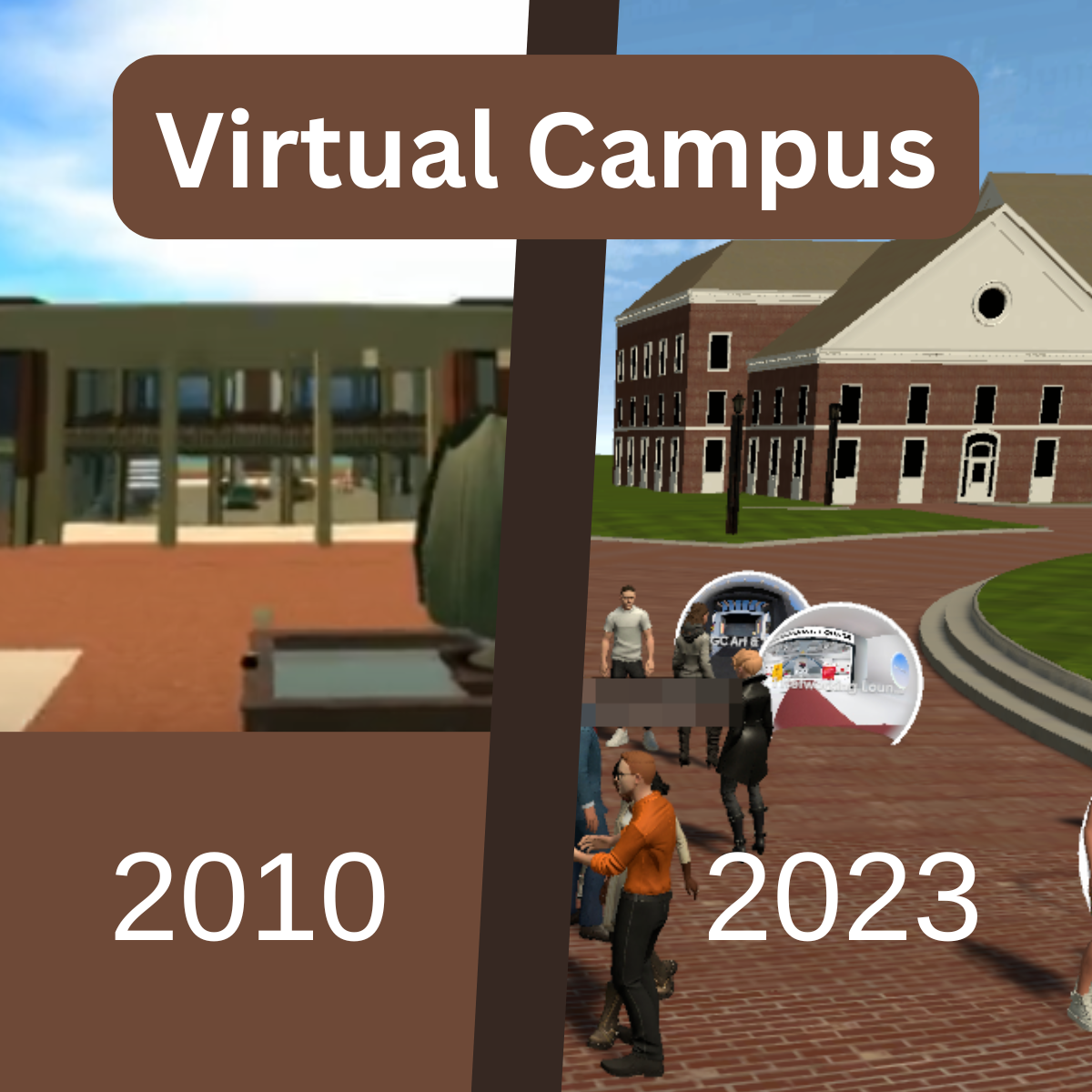
Virtual Campuses: 2010 and 2023. Not much has changed; they still don’t work.
|
I write this title with a tinge of irony. I’ve owned virtual campuses. I’ve worked on virtual campuses. If asked to work on a virtual campus again, I’d likely say yes. So what’s my beef with virtual campuses?
I feel that a sober-eyed look at virtual campuses* is necessary.
Following the philosophy of ““those who cannot remember the past are condemned to repeat it” (Santayana), here is Part 3 of my series: From Myths to Principles; Navigating Instructional Design in Immersive Environments.
The rise and fall of the metaversity
In Part 2 of this series,I examined two examples from the history of immersive learning. First, I showed the parallels when companies like Meta and Linden Lab dominate a single platform for immersive learning designs. The lesson is that what is allowed one day can quickly become disallowed the next day. Second, I pointed out the inappropriate boasting and poor course design used in the “first course in virtual reality” by Stanford University. In these recent cases (Meta and Stanford University) there was a remarkable lack of awareness of the history of immersive learning. Said another way, mistakes of the past were repeated.
In another example of history repeating itself, ten colleges and universities adopted digital twin campuses in June 2022 using the ENGAGE platform with monetary support and donated VR headsets from Meta (Koenig, 2022). These metaversity locations recreated (or created!) campus buildings to allow learners to gather on the virtual campus.
Eight years prior, Second Life (SL) campus buildings were “designed to mimic real-world architectural equivalents” but had become “abandoned ghost towns” (Wecker, 2014).
The early Second Life virtual campus creations were often the result of student projects. Confusingly, the professors who designed and assigned these projects touted the work of creating faithful campus recreations as creative and thus, at the highest level of Bloom’s cognitive learning objectives. I’m inserting a heavy eye roll here because that’s really stretching the justification of working in virtual reality to an extreme point. Plus, I have to point out: what does next year’s class build if this year’s class made the campus? My point is that simply building campus buildings (so that you can have a virtual campus!) is a project idea that runs out of steam. Things got really interesting right after the SL virtual campuses were launched. Everyone involved noticed that the spaces were not being utilized.
Students were asked why they weren’t visiting the virtual campus.
The answer was simple.
No one was there.
You see, you could have the most amazing design with all of the bells and whistles (really!), but if people were not there, then people found that there was no compelling reason to return. Admissions folks had no compelling reason to be in the virtual admissions building, same for financial aid teams. Even library teams today in virtual reality struggle to staff spaces with the same spread as IRL (in real life) libraries.
During a recent tour of the University of Maryland Global Campus metaversity campus, the audio connection failed. The host did not offer any tech support. The experience showcased empty buildings during what was a busy time of the academic semester. To be fair, I understand the implications of FERPA which might have predicted that students were in classroom spaces separate from public spaces. However, it is logical that on any campus, students could still be found in public space buildings like the networking lounge. These accurate campus recreations rarely spur more than a passing interest to learners.
The ten colleges and universities in this project are now facing the end of the project and the initial funding is ending. Steven Van Hook commented that, “Administrators may speak of their twin campuses in glittering terms on the record –then off the record talk about their regrets and what else they could have bought for the hundreds of thousands of dollars” (VWBPE, 2024). According to Temple University’s Kathy Hirsh Pasek, “A year ago, a lot of companies were going full steam ahead. Today’s that’s not true; they’ve rerouted a lot of their funds for AI and Twitter alternatives” (Coffey, 2023, para. 37) Institutions made the decision to adopt immersive experiences but do not appear to know how to make wise decisions when generous funding stops and societal attention moves on.
The key problems
Therefore, throughout these first three parts of this series, there are several challenges apparent. Instructional designers and administrators must wade through the myriad of claims derived from dubious research studies. It feels like chicanery to figure out which statements about immersive experiences for learning are authentic and do point the way to future positive outcomes and which statements are in doubt. The first issue is with interpreting research wisely. Every research study has inherent flaws; no one study can definitively provide answers to all of education’s questions. This situation is made worse when the research is translated into social media and seems to tout incredible claims (Lanier et al., 2019).
Therefore, the conundrum has been illuminated. The myths that appear to come from a research basis must be dispelled. Next, the very basis of the published research record is at risk of bias and problems. This series will inform on what characteristics to look for in published research. Finally, if one were to step around the research interpretation problems, what is the system for building and using immersive experiences for its best advantage? This series will attempt to answer these questions. This series then forms the navigator role for instructional designers and administrators figuring out how to chart a route to a successful implementation.
Post Script
*virtual campuses
I’m using the term virtual campuses to specifically refer to real work recreations of campus spaces like quads and lecture halls. I am not referring to simulations (for example in science courses) or spaces specifically designed for social use (for example, dance halls).
Virtual campuses were designed as early as 1999 as text-based educational MUVEs (multi user virtual environments). This example classroom shows “the room’s description, list of contents, who is in the room, the exits, and links to applications” (Maher, et al., 1999).
 |
| Technically, ‘Nobody else is here’ might have been foresight. |
The metaversity concept is not to be confused with metauniversities, which are global collaborating universities (Costanza, et al., 2021). It appears as though the metaversity term became popular in 2021 and the company ENGAGE is not the only entity to claim it.
Coffey, L. (2023, July 11). “Metaversities” face virtual learning’s financial reality. Inside Higher Ed | Higher Education News, Events and Jobs. https://www.insidehighered.com/news/tech-innovation/teaching-learning/2023/07/11/metaversities-face-virtual-learnings-financial
Costanza, R., Kubiszewski, I., Kompas, T., & Sutton, P. C. (2021). A global metauniversity to lead by design to a sustainable well-being future. Frontiers in Sustainability, 2, 653721.
Koenig, R. (2022, June 6). With Money From Facebook, 10 Colleges Turn Their Campuses into ‘Metaversities.’ EdSurge. https://www.edsurge.com/news/2022-06-01-with-money-from-facebook-10-colleges-turn-their-campuses-into-metaversities
Lanier, M., Waddell, T. F., Elson, M., Tamul, D. J., Ivory, J. D., & Przybylski, A. (2019). Virtual reality check: Statistical power, reported results, and the validity of research on the psychology of virtual reality and immersive environments. Computers in Human Behavior, 100, 70–78. https://doi.org/10.1016/j.chb.2019.06.015
Maher, M. L., Skow, B., & Cicognani, A. (1999). Designing the virtual campus. Design Studies, 20(4), 319-342.
Wecker, M. (2014, April 22). What ever happened to Second Life? Chronicle Vitae. https://chroniclevitae.com/news/456-what-ever-happened-to-second-life
#VirtualCampus #edtech #VirtualUniversity
This article is simultaneously posted to LinkedIn and to my blog. My copyrights are retained. This article cannot be used to train AI.
(more…)