Tag: immersive learning

  • XR for education propaganda – EDUMetaverse

    XR for education propaganda – EDUMetaverse


    Decorative image of an analog bullshit meter

    propaganda: 

    1 – ideas, facts, or allegations spread deliberately to further one’s cause or to damage an opposing cause

    also

    : a public action having such an effect

    2: the spreading of ideas, information, or rumors for the purpose of helping or injuring an institution, a cause, or a person

    Merriam-Webster Dictionary entry


    I was so tempted to make a reaction video to this video within Andrew Wright’s LinkedIn post.  But no. Instead, I’ll just point out the XR for education problems therein.

    Post:

    If you’re wondering what #immersivelearning looks like. Watch the clip of today’s onsite session till the end. Innovate, Engage, Inspire
    This is not a ‘flash over substance’ experience, at EDUmetaverse, this is the real deal!

    Consider that this is one lesson of ten, from one world out of a hundred, you’ll then get some idea of what we’ve spent five years creating.

    Designed by teachers, for teachers. Available now as part of our education bundle for 2026.
    All you need is a browser..

    ✅ Immersive Worlds
    ✅ Engaging PBL
    ✅ Relevant Content
    ✅ Curriculum aligned
    ✅ A.I Literacy embedded
    ✅ STEM based
    ✅ Teacher Created

    What are you waiting for? Get in touch today.
    www.edumetaverse.com.au

    #educationevolved #ai #vr #mixedreality #3ddesign #stem #webxr #pbl #generativeai Frame MeshyAI Lauren Main Andrew Google Flow Apple

    Strong Words

    Wondering what immersive learning looks like?
    Not ‘flash over substance’?
    The real deal!
    1 of 10, 1 of 100!
    Spent 5 years creating

    Designed by teachers, for teachers (ouch. I apologize to teachers on EDUMetaverse’s behalf, cause EDUMetaverse has a tendency to throw y’all under the bus, regularly.)


    Then a bunch of key phrases: STEM, relevant, immersive! Probably written by AI. 🙄
     
    I did not find the same video posted to any other EDUMetaverse social media (huh? 🙄) . I’m going to show screen captures with my written descriptions.

    Opening scene, upbeat music: It’s Avatar Andrew inside of a FrameVR/Virbela world that looks like a stadium during winter. Avatar Andrew is standing on a blue running track looking towards empty wooden spectator seats where a real world ski jumping video clip plays and 2D picture of a 3D model of a ski jump is displayed.

    Students are watching a flat screen monitor 🙄, where an EDUMetaverse world is shown and inside that world there is what looks like an EDUMetaverse produced video and some Olympics mascots. (I searched for matching clip or 3D model, didn’t easily find anything but it isn’t hard to guess that they could have been made by AI.)

    Capture of students looking into EDUMetaverse world

    An interface shows a 3D ski jump model. I’ve never used EDUMetaverse, so I’m guessing this is a compose or build-type of interface. Interestingly, we can see that AI is doing the building because there is text: “Prompt: An olympic ski jumper in jump mode leaning forward over skis…” and “Generating 70%”.  In my experience with VirBELA, this looks like a VirBELA-like interface. Note: this supposed result doesn’t appear anywhere in the video. (cough, AI fail? 🙄 cough)

    Capture of program interface. Unsure if this is EDUMetaverse generative AI for 3D object creation.


    A little more video of Avatar Andrew watching real world ski jumping video in world. 🙄

    Then what must be a post-production edited still shot (NOT video) because an innocent student appears to be pointing to something that doesn’t exist but a ski jump has been placed into the shot. This is AR-like. In my opinion, this is a faked video shot and it is poorly done. 🙄  For fun, I noticed the colored bracelet. Can we see it elsewhere in the video OR was the student’s hand a new creation from somewhere else? (Spoiler: yup, the bracelet is on a student later).

     
    Capture of video moment when a fake ski jump is placed into a real classroom
    Nomination for worst AR faked video shot


    Then a slick EDUMetaverse video clip of a ski jumper.

     
    Capture of a ski jumper with a stunning view of mountains


    I asked Google Image to find this image as I thought it might have been a clip produced by the Olympic organizers or broadcasters. Result: “No exact matches found. This could mean the image is unique or has not been widely shared yet.”  Technically, that is one hell of a ski jumping video clip if it was based on ANY form of real reality cause the top of that ski jump is literally as tall as mountains. 🙄

    Capture of Google image search results that do not show any 'exact matches'

    Then back to videos of students sketching a ski jump. At this point, I don’t know why since I thought this was a pro-VR video. But I have had a great deal of fun with The Sum of All Thrills where one designs a roller coaster so I’m aware that working on design is a fun step.

    Capture of students drawing ski jumps on paper.


    Students are creating a ski jump from a cardboard box. Imagine my surprise. Is this a middle design–like between the drawn designs and the 3D one? Looks fun…but…why are they doing this? 🙄

    Capture of students forming ski jumps from pieces of card board boxes


    Quick shot of a student navigating inside of the VR world that is simultaneously displayed on a bigger screen. I don’t know why the student is doing this. 🙄 Displaying it on a bigger screen is intriguing, though.

    Final scenes with students show them letting a marble roll down and off their cardboard ski jump models. At this point, I’m like “OK, let’s take these skills into VR somehow or…what?”  No joy. 🙄 It doesn’t have to go back into VR, I know that. But this is a VR company so I’m looking for them to clinch the promo.  

    Lesson had a claim to be related to STEM (overall EDUMetaverse website claims that their lessons have ‘PBL packs’, problem-based learning) but I’m not sure I ever saw any math, anything measured or calculated. 🙄

    Capture of cardboard ski jump with marble rolling down


    But the piece de resistance that threw me over the edge was the post-production video edit of a ski jumping going the wrong direction on to/ off of the cardboard ski jump.
     

    Capture from video of ski jumper beginning to land on the bottom of the ski jump

    Yup, ski jump is definitely going UP the jump, left to right across the screen. 

    Capture of ski jumper going up a ski jump and sailing into the air
    Dear Jumper, that is not the correct way to use our ski jump.


    Executing a truly miraculous pivot 90° to the right at the height of the jump. Impressive for a ski jumper, that is. To be fair, less impressive for a freestyle skier. 😒


    Capture of a ski jumper turning right in mid air 
     
     
    Really nailed the landing well. On the desk. Which wasn’t really part of any of the students’ designs. This is one prescient ski jumper. 
     
    Capture of a ski jumper landing perfectly on a student desk


    Who is Veo anyway? I just noticed their watermark in the corner.
     
    Capture of a ski jumper sliding during a landing on a student desk


    I won’t link to Veo here because when I surfed there, it took over my browser dominantly. I would steer clear. 
    Search results for what is veo
    Veo makes AI-generated Clips.


    Educational value

    So…how does this product (which provides no prices upfront, you need to ask for a quote and hope for your educational discount…from a company with EDU in their name 🙄) actually add to the educational experience where students made ski jumps and rolled marbles off of them?
    Gif for the concept of lost or nothing from Pulp Fiction


    • The students watched a video about ski jumping inside a virtual world.
    • Then they did something with generative AI about making a ski jumper?
    • Then they made their own ski jump models out of cardboard and rolled marbles off of them.

    I didn’t see any measurement of angles or distance.

    I even think the students’ faces look a little disappointed as their marble doesn’t sail up into the air much like a ski jumper does.


    before and after


    So where’s the learning added? Where is the advantage of using the product? 

    where’s the beef?


    Students could have watched that 2D ski jumper video outside of the Olympic world.  Technically, everything I saw happening in world was unnecessary.  
     
    Yeah, it would be a tad more boring but when the immersive Olympic world doesn’t add anything, it is a distraction. Unnecessary information should be removed (Mayer’s Principle of Coherence).

    BTW, who’s going to tell them that PBL is falling out of fashion?

     
    Gif of Kristoff from Frozen saying Somebodys got to tell him


    So let’s score them against their words

    Wondering what immersive learning looks like?

    No, but that’s because I’m a specialist in immersive learning. What you’ve shown ain’t it.


    Not ‘flash over substance’?

    The video and supposed learning has no real substance. You might want to re-think using the phrase ‘not flash’.

    The real deal!

    😆

    1 of 10, 1 of 100!

    When in doubt, dazzle them with statistics!

    Spent 5 years creating

    what. a. waste.

    BTW, your YouTube says you went AI crazy 6 months ago. Sure you want to stick with 5 years?

    EDUMetaverse reputation

    Interestingly, EDUMetavere’s YouTube account is empty! What?
    Capture of EDUMetaverse YouTube account which is completely empty of videos
    This channel doesn’t have any content. You’re telling me.

    And Andrew’s YouTube account is full! huh?  (No comment on this Jess Jones AI agent…but…let’s just say there is a LOT of content with her.)

     
    Did you know that you can spin up ‘blank’ avatars, basically avatar bots, in VirBELA based products? 
     
    Advertised image from EDUMetaverse for a global topic world. Avatars are seen in a UN-like room.
    I got $5  💸saying this image contains bots


    Summary

    I don’t begrudge the students. Poor souls having to be dragged into this. They remind me of the poor HTC Vive students.  I’m glad the students made their cardboard ski jumps IRL.  But somebody get them a tape measure. Get a physics teacher in there!

    But for the love of God, please have your fake AI video have the ski jumper going down and then up OFF OF THE SKI JUMP, not the opposite. That is, if you are going to highly produce your propaganda about how your VR helps learning, have the ski jumper go from right to left, not left to right.  

    Here’s how to goes:

    Gif of an actual real ski jumper
    Notice how the ski jumper slides down and jumps up off the ramp?


    What’s my main problem with the video/post? 

    It does a terrible job of portraying a possible way to use XR for education. Even if one looked past the faked video shots (and I don’t have a direct beef against using AI for video clips, even though I mourn for the proper actors put out of jobs with this), teaching this way with XR is awful.  I see no educational benefit at all.

    All in all, posts like this (and Andrew posts like this very often) do more harm than good to the XR for education industry. 

    Over and out.

    Post script


    I usually add more to my blog posts after publication; don’t be weirded out. But this one is quite the eyebrow raiser. 

    The blogger records show that I published this blog post on Saturday February 7, 2026 at 11:27 A.M. EST.

    On ~Sunday February 8, 2026, Andrew Wright published on LinkedIn that he was leaving EDUMetaverse, a company by his own LinkedIn tagline he “created” saying that “the project is now in safe, capable hands.”

    I’m not implying that Andrew lost his job with EDUMetaverse because of my blog post. Far from it. My read stats of this blog post immediately upon posting/sharing it and all up to this very moment of writing this post script on February 14, 2026 show that there have been at best ~2 views.  I highly doubt that Andrew was one and EDUMetaverse (whomever that is) was the other.

    But the coincidence is A-MAZ-ING.

    And if you followed my inference in my blog post, I immediately wondered if Jess was taking over at EDUMetaverse. 😖

    An interesting idea: build AI…and it takes your…job? 😕

  • When Tech Platforms Donate The Resources

    When Tech Platforms Donate The Resources


    [EDIT: This post was originally written in January 2023 and lightly edited in 2025]

    Jeremy Bailenson

    As much as I admire Jeremy Bailenson’s research work (really!) his Communication 166/266 Virtual People course in June 2021 had some real problems. In its defense, it was a first-of-its-kind course, even if it wasn’t the very first course in VR. Depending on how to define VR versus XR, groups of this size, 263, have met synchronously in other platforms.

    Boast Much?

    Bailenson defends: “To the best of my knowledge, nobody has networked hundreds of students
    (with) VR headsets for months at a time in the history of virtual
    reality, or even in the history of teaching.”

    Further, he states:

    The scale of this course is what sets it apart compared to other “in-VR” courses. In addition to having a relatively large number of students enrolled in the course, we also had a large number of sessions taking place in VR over time, many of which were in a networked virtual environment. To our knowledge, prior courses that have used VR in an educational setting have rarely accomplished all three of these criteria.


    Here is a YouTube video, Stanford “Virtual People” class in the Metaverse posted by Bailenson.

    The ENGAGE Platform

    In the video clips, we see the ENGAGE platform.

    Why ENGAGE? It was not deeply explained, here:

    In addition to the headsets, the course also needed software to connect
    the students and teachers. For this, Bailenson said the university
    decided to use the ENGAGE virtual communication system. ENGAGE is used by major companies and educational organizations to hold virtual meetings and events.

    A Big Problem


    I looked at some of the film clips closely. I searched and the early clips appear to be deleted off of YouTube.  I have facilitated small and large events in XR.  

    In the video clips of this course, I can detect that sound appeared to be a somewhat major problem in the platform; getting users to hear, signal that they could hear, or having multiple groups in one space (like a lab) and hear over top of each other.

    The Headsets

    Learners in the course received the Quest 2 headsets.

    “Virtual Reality is becoming mainstream, with more than ten million
    systems being used in the United States alone. This class examines VR
    from the viewpoint of various disciplines, including popular culture,
    engineering, behavioral science, and communication. Each student will receive an Oculus Quest 2 headset, and the bulk of our learning will
    occur while immersed in VR.”

    Each student was given the headset:

    Each was given an Oculus Quest 2 headset

    According to another course from 2022, headsets were to be returned at the end of the semester:

    Screen capture of a Stanford 2022 course with price of US$3699 saying headset would be provided but must be returned

    Facebook Meta provided a “workaround” for the forced use of Facebook accounts in the headsets:

    The Facebook login requirement had sparked complaints and privacy
    worries, leading some organizations to seek a workaround. Stanford
    University uses Meta’s headsets in its courses on VR, said Jeremy
    Bailenson, the founding director of the institution’s Virtual Human
    Interaction Lab. To ensure student privacy, the lab had to seek Meta’s help in creating anonymized accounts for classroom use.
     

    This article comes right out and says this:

    And money for the project—as well as donated VR headsets for students at
    the participating colleges—comes from Meta, the company that owns
    Facebook.

    The connection between Facebook Meta and Stanford has been documented.

    While the experience was good in that, at the beginning of trying out any new technology, there will be false starts. Said another way, it is good to learn that bringing in 30 learners to one large-ish lab space to teach separate labs of 5 people each won’t work if there is flat sound. That has be learned. I think his course showed that.

    But overall, conducting a course with donated technology and then turning around and saying the learning was great* is a conflict of interest.

    I found a written summary here, but it’s light on conclusions. There a few glimmers, but otherwise, they did seem to hint that the groups versus sound problems that appeared in the video did happen.

    * What does “the learning was great” actually mean?  Bailenson and Han claimed better presence, enjoyment, motivation, and transfer. While I could let you consider if any of those deserve merit, I railed against the conclusions of the course in my The Immersion Delusion post.  This post, being written more than 2 years before I hit publish, focuses on the hype just as the course was starting. Therefore, obviously, this particular post does not hit hard on hype versus results. It only focuses on hype and the conflict of interest of hitting the airwaves with how amazing your course must be, to be a first of its kind, learning about VR in VR, yada yada yada. 

    [EDIT: I decided to publish this post on 12/26/2025. I’ve done quite a deeper dive on that course and the publications around it.  I feel even more confident and I edited this article to come right out and say that Bailenson had a conflict of interest, rather than a “dis-authentic event in research” around the entire course and following publications.]

     
    Learning About VR in VR

    Video of spaces from Victory XR  (Unsure if these were used in the Stanford course or not)

  • From Myths to Principles Part 6 Myth: Immersive learning is active learning

    From Myths to Principles Part 6 Myth: Immersive learning is active learning

    From Myths to Principles: Navigating Instructional Design in Immersive Environments

    Part 6 Myth: Immersive learning is active learning

    Photo by Blake Cheek on Unsplash

    The next myth is that learning in immersive experiences is active, kinesthetic, or like an internship, which is “the way most people learn best” (D’Agostino, 2022, para 17.)


    Active learning was first associated with immersive experiences because learners could observe or engage with or, more properly described, engage within simulations (Dede, 2009). The term active simply meant that the learner was present at a simulated place and time; the original use of the active learning phrase with reference to immersive experiences did not imply that a learner could do anything other than observe. The emphasis was much more on the time and space travel afforded by XR.

    This claim has been controversial (Khorasani et al., 2023), in part because of the differing degrees of activity that a learner can have – ranging from simply being inside an immersive environment and observing (e.g. historical re-enactment simulations) to taking actions that have non-trivial consequences (e.g. practicing a surgical technique).

    Active learning is a phrase on the move


    Dede (2009) referred to actional immersion as situations where learner actions have “novel, intriguing consequences” that are “highly motivating and sharply focus attention.” (p. 66). The active learning claim moved from a focus on the learner’s actions and instead focused on the learner’s body ownership illusion. Further, the relationship between user bodies and virtual depictions (avatars) was reformulated and later called implicit learning (Slater, 2017, p. 29).

    I want to pause here and really dissect the difference because in this area, there has definitely been vocabulary “drift”.  Learner’s actions focus on what the learner causes to happen.  Learner’s body ownership focuses on parts of the body that the learner uses to cause actions.

    For example, picture a chemistry lab simulation.

    Image: Labster

    Focusing on the learner’s actions means that we could use a 2D display screen and mouse and have the learner click on the pipette, click on a liquid to suck up with the pipette, and then click on a vial within which to dispense the liquid.  Those could be right to left actions, but the learner is causing the actions to happen on the screen. They are using a mouse and moving their hand generally right to left.  No hand needs to be visible to do these actions. Activities could be “ghost like” in that they could be caused by no visual physical object whatsoever.  In reality, the computer mouse is doing the most physical ‘work’.

    Focusing on the learner’s body ownership however, would have the learner reaching out (they need to be able to reach) to the pipette, to grab it (they need to be able to firmly grasp), to possible depress the button on the top to create the needed suction, to move the pipette, see the liquid and subsequent vial, and depress the button to dispense the liquid. The movements could be all right to left. Key in this visual depiction, however, is A HAND with workable fingers that is somehow connection via experience to a learner’s IRL hand.

    In the former example, the learner causes the actions to occur but we are not focused on their body parts doing the action. In the latter example, we are very interested in the body parts doing work that is replicate (in this case) to the real world work of operating a pipette. In the former, we could have confidence that a learner is exposed to the cause and effect of pipette work; it sucks up a reliable amount of liquid and can squirt it back out. In the latter, we could have confidence that a learner is exposed to how pipettes physically work (button press down equal prime for suck, release equals suck, button press down again equals squirt). 

    See that the focus is different?

    My point is that the FOCUS of what was coming to be called active learning with reference to XR was changing already between 2009 and 2017.


    Drawing from the educational history of the Montessori method and considering the interfaces available within immersive experiences, implicit bodily learning (from 2017) transformed to embodied learning (by 2018). Indeed, Johnson-Glenberg initially postulated that “doing actual physical gestures in a virtual environment should have positive, and lasting, effects on learning in the real world” (2018, p. 1). Movement became synonymous with active learning. “Active, motor-driven concepts may stimulate distributed semantic networks (meaning), as well as the associated motor cortices which would have been used to learn long ago, in childhood” (Johson Glenberg, 2018 p. 3). [Hat tip, by the way to all research into the mind-body connection within learning. This post throws no shade on the phenomena.] With specific, other than meaningful, actions now excluded, some researchers appeared to support the claim that all movement somehow begets learning. (That sentence is confusing, I wrote it and even I’m wondering what I meant. It’s this: Inside a XR-for-learning experience, a learner might be instructed to do something. Pick this up, move it there.  Because that learning is specific to the learning event, I’m setting it aside. It’s not part of this argument.  What I am referring to are the learner-instigated but non-instructed movements. Let’s say, a learner joins XR and wanders to the left for 2 minutes before a lesson begins. Or let’s say instead of looking to the “front” at the end of the experience, the learner is looking to the “back”. These random but learner-instigated actions are…wait for it…somehow the secret sauce of learning in XR.  I kid you not. I really try to pin down the meaning from educators that belief this myth and THIS is what they come up with; because you can move in XR, you are learning (more) in XR.


    The supporting hypothesis then became that immersive experiences are an inherently active learning method precisely because the learner can move. 

     I’m going to repeat that for emphasis:

    The supporting hypothesis then became
    that immersive experiences are an inherently active learning method
    precisely because the learner can move. 

    The Emperor’s New Clothes. Image by Helen Stratton, Public domain, via Wikimedia Commons

    Did you catch that? Are you catching on? Aren’t the emperor’s new clothes splendid?


    By incorporating the word “active” educators are reminded of the belief that active learning is better than passive learning (Slater, 2017). Ooo! Shade thrown there, for sure, because no teacher wants to be accused of being a passive educator.

    [BTW, there is reams of garbage research out there for anyone looking for a topic. Go ahead and dig into active versus passive in educational psychology papers. It’s almost as big of a research garbage dump as XR; teachers radically redefine and appeal to this topic. My point is that the appeal to “active learning” when coupled with XR provides scant evidence of such. To this day, I RARELY see active learning in XR.]


    Let’s bear down now. To be specific, the ‘active learning’ coupling with ‘XR’ claim is not about being fidgety, randomly moving about, or purely reacting as a user would in a game. It is movement, usually performed by the learner via an avatar or minimally via hand controllers where the learner is autonomously and purposely manipulating content.  This is known as embodiment or embodied learning (Johnson-Glenberg, 2018; Markowitz et al., 2018) although definitions of embodiment vary. The definitions vary including how much a learner is embodied. It should also be noted that the term embodiment is often used interchangeably with ‘embodied learning’, which is a theory that the meaningful gestures in and with the environment aid a learner’s cognitive processes (that’s the no shade thing I referred to earlier). But even ’embodiment’ and ’embodied learning’ are slightly different things. Whew! Keeping up?

    The Emperor’s clothes should be splendid


    In 2018, Johnson-Glenberg claimed that presence and embodiment were “profound affordances” of immersive environments and this embodiment affordance should facilitate learner control, also known as agency (p. 1). One further hat tip to Mina: she did actually use a somewhat scientific body action in her research –I believe it was catching butterflies with a butterfly net– something that biologists WOULD do with their bodies. So it’s a real world action.  I point this out because some XR actions are nonsensical. I’m looking at you people who change vocabulary words to bouncing balls or something.

    But aren’t


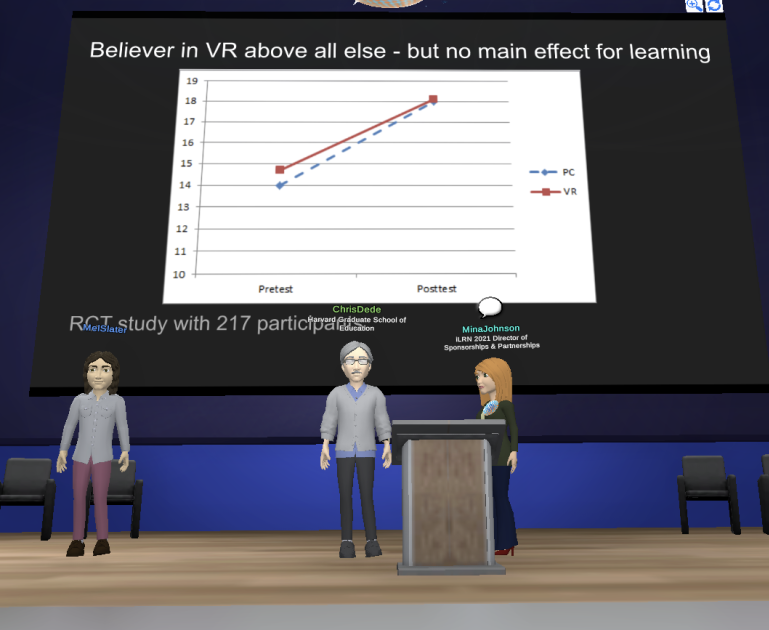
    A follow-up paper by Mina, however, found that while embodiment does have a connection to learning, it does not exclusively cause learning, or perhaps better said, it doesn’t interact with learning. Referring to high or low embodied VR and the connection to learning, “platform is not destiny” (Johnson‐Glenberg et al., 2021, p. 20). So in lay talk that means it had no effect.

    A capture that fell flat with the audience: VR had no effect on learning, even when embodied.


    This confounding (confusing/muddling up/drift of vocabulary) of movement in immersive experiences with active learning forms the myth. Because active learning is considered better than passive learning, claims are made that immersive experiences must cause more learning due to the body-movement connection. The research, however, does not support that claim.

    The active learning myth appears to be referred to more often in academic literature than evidence to the contrary. It is true that immersive experiences can allow for more movement-based learning experiences than other forms of media, but it is not definitive that immersive experiences cause learning simply because they can contain learner movement or agency.

    Just because you can move in XR, doesn’t mean you do learn. Full stop.

    Part 7 will be our last myth for this series: Immersive learning causes empathy.

    References

    D’Agustino, S. (2022, August 3). College in the metaverse is here. Is higher ed ready? Inside Higher Ed. https://www.insidehighered.com/news/2022/08/03/college-metaverse-here-higher-ed-ready

    Dede, C. (2009). Immersive interfaces for engagement and learning. Science, 323(5910), 66–69. https://doi.org/10.1126/science.1167311

    Johnson-Glenberg, M. C. (2018). Immersive VR and education: Embodied design principles that include gesture and hand controls. Frontiers in Robotics and AI, 81.

    Johnson‐Glenberg, M. C., Bartolomea, H., & Kalina, E. (2021). Platform is not destiny: Embodied learning effects comparing 2D desktop to 3D virtual reality STEM experiences. Journal of Computer Assisted Learning, 37(5), 1263-1284.

    Khorasani, S., Syiem, B. V., Nawaz, S., Knibbe, J., & Velloso, E. (2023). Hands-on or hands-off: Deciphering the impact of interactivity on embodied learning in VR. Computers & Education: X Reality, 3, 100037.

    Markowitz, D. M., Laha, R., Perone, B. P., Pea, R. D., & Bailenson, J. N. (2018). Immersive virtual reality field trips facilitate learning about climate change. Frontiers in Psychology, 9, 2364.

    Slater, M. (2017). Implicit learning through embodiment in immersive virtual reality. Virtual, augmented, and mixed realities in education, 19-33.

    The content cannot be used to train or be reviewed by AI. All copyrights retained.

    Did you miss the other parts of this series? Here they are!

    Part 1: From Myths To Principles: Navigating Instructional Design in Immersive Environments

    Part 2: The Immersive Environment Delusion

    Part 3: The Case Against Virtual Campuses

    Part 4: Myth: Learners Learn Faster

    Part 5: Myth: Learners Learn More

    Part 6: Myth: Immersive learning is active learning

    Part 7: Myth: Immersion Creates Empathy

    Part 8: Ethical Labyrinths, Interpreting Research

    Did you miss the other parts of this series? Here they are!

    Part 1: From Myths To Principles: Navigating Instructional Design in Immersive Environments

    Part 2: The Immersive Environment Delusion

    Part 3: The Case Against Virtual Campuses

    Part 4: Myth: Learners Learn Faster

    Part 5: Myth: Learners Learn More

    Part 6: Myth: Immersive learning is active learning

    Part 7: Myth: Immersion Creates Empathy

    Part 8: Ethical Labyrinths, Interpreting Research

    Part 9: Ethical Labyrinths, Biased Content Creation

  • From Myths to Principles Part 5: Myth: Learners Learn More

    From Myths to Principles Part 5: Myth: Learners Learn More

    From Myths to Principles: Navigating Instructional Design in Immersive Environments
    Part 5 Myth: Learners learn more

    The
    foundation of all learning, or child’s first book, by which a child
    will learn more in one month than by many others in twelve, Author Unknown, Date 1800. Source: Compositor, University of Birmingham

    Myth: Learners learn more in immersive experiences

    This myth shrouds itself within a cloak of research. Citations will state that learning in immersive experiences is somehow greater when pitted against an implied traditional learning approach. The claim could appear as retention, but it is related to how well the learning was accomplished when measured up against learning objectives or a final goal.

    When referring to the PricewaterhouseCoopers (PwC) report results mentioned earlier in this article series, Scott Likens claimed, “We found the realism and performance feedback in virtual reality simulations helped people learn faster and retain more information around soft skills,” (Zielinski, 2021, para. 9). He claimed they retained more information. This specific claim has been repeated in academic literature, which stated, “Studies have found that students who use XR training are more engaged with the content, display more confidence with the material, and retain more information than students who use traditional training methods.” (Rode, 2024, para 2.)

    A close examination of the PwC report, however, reveals that the claim was unsupported within the report’s own data. When comparing information retention in VR versus an e-learning course, the authors “quickly discovered retention scores were inconclusive, as the delta between pre-and post-assessments in each modality was not significant” (Eckert & Mower, 2020, p. 44). Thus, there was no statistical difference between VR-based, e-learning, and traditional classroom learning. 

    Claiming
    something happened but your instrument didn’t pick it up is the knomes-did-it territory of cause-and-effect, dudes. Watch out.


    The report therefore does not provide statistical evidence of more or greater learning within VR, yet it has been cited in academic publications (O’Dwyer, 2021, Etienne et al., 2022,  Jelki et al., 2022; Bäckelin, 2023; Etienne et al., 2023; Lønne et al,. 2023) and touted in media outlets (Murad, 2023; Schwantes, 2020). For the dubious claims, the report has been debunked as untrustworthy (Neelen & Kirschner, 2020). 

    There are similar claims about greater learning retained from immersive experiences. Advocates for digital twin campus environments claimed that they “create greater retention of the information that is learned” (D’Agustino, 2022, para. 5) and “students’ grades go up” (Victory XR, 2024, Who We Are). 


    While this is just one tiny sentence, keep in mind how much money VictoryXR makes from these claims.


    In another example, the CEO of the Miami Children’s Health System touted that learners had 80% retention after one year after using VR, but traditional learners had 20% retention. A close look at the supporting documentation shows that the CEO actually said that the difference between VR learners and traditional learners can be the 80% to 20% difference. 


    However, the CEO’s statement did not refer to any published results; it was opinion. The CEO explained their claim by saying that, “The level of understanding through VR is great because humans are primarily visual, and VR is a visual format” (Gaudiosi, 2021, para. 4). Cue learning styles!

    Nonetheless, the quote of 80% retention has made its way into academic research (Iacono & Vercelli, 2019; Mathew & Pillai, 2020; Ternès, 2018). Some claims are extreme. One keynote speaker, Alvin Graylin, speaking as a leader at HTC (a VR headset maker) declared that as a result of VR use in the classroom, “Every single child has the potential to be a genius” (Educators in VR, 2020, 23:33). 


    “Every single child has the potential to be a genius.” You just need to buy a (HTC) headset.

    Justification for the greater learning or retention claims seems to be conjecture. Claims refer to how real an immersive experience feels to a learner. Returning to the PwC report, Likens credited “the realism and performance feedback…helped people..retain more information.” (Zielinski, 2021, para. 9). But long term studies measuring retention are hard to find within the body of academic literature. Some studies measure retention three weeks after the immersive experiences. Given that many of the examples of immersive experiences relate to hands-on disciplines like nursing or construction, things learned in immersive experiences would be needed on the job more than three weeks after the training.

    Hamilton et al. (2020) stated that finding “learning outcomes, intervention characteristics, and assessment measures associated with immersive virtual reality has been sparse” (p. 1). Beck, Morgado, and O’Shea (2023) pointed out that details of methods are missing so that outcomes become questionable, “Very few literature reviews focus on the educational practices and strategies used in immersive learning environments. Thus, the problem is that we are evaluating outcomes without a comparable way to describe the educational approaches that led to those outcomes” (p. 2). Lawson et al. (2024) completed a systematic review of immersive experiences and found that research studies rarely isolate instructional methods and conditions when describing research studies and thus impact real world classroom decisions.

    Meta analyses are starting to illuminate this area. Akgün and Atıcı (2022) observed that there was only a moderate effect on learner achievement after surveying 31 studies. Kaplan, Cruit, Endsley, Beers, Sawyer and Hancock found that “XR does not express a different outcome than training in a non-simulated, control environment. It is equally effective at enhancing performance” (2020, p. 1) Some researchers are starting to incorporate machine learning and artificial intelligence into this challenge in order to determine what the published records states about immersive experiences. Markowitz et al. (2024) recently surveyed 196,734 paper abstracts with this method.

    Basically
    this graph says that because the numbers are so small and so close to
    zero, there is no discernible effect of VR on learning, regardless of
    immersion (Kaplan et al., 2020).
     

    (more…)

  • From Myths to Principles Part 3 The Case Against Virtual Campuses

    From Myths to Principles Part 3 The Case Against Virtual Campuses


    From Myths to Principles: Navigating Instructional Design in Immersive Environments
    Part 3 The Case Against Virtual Campuses

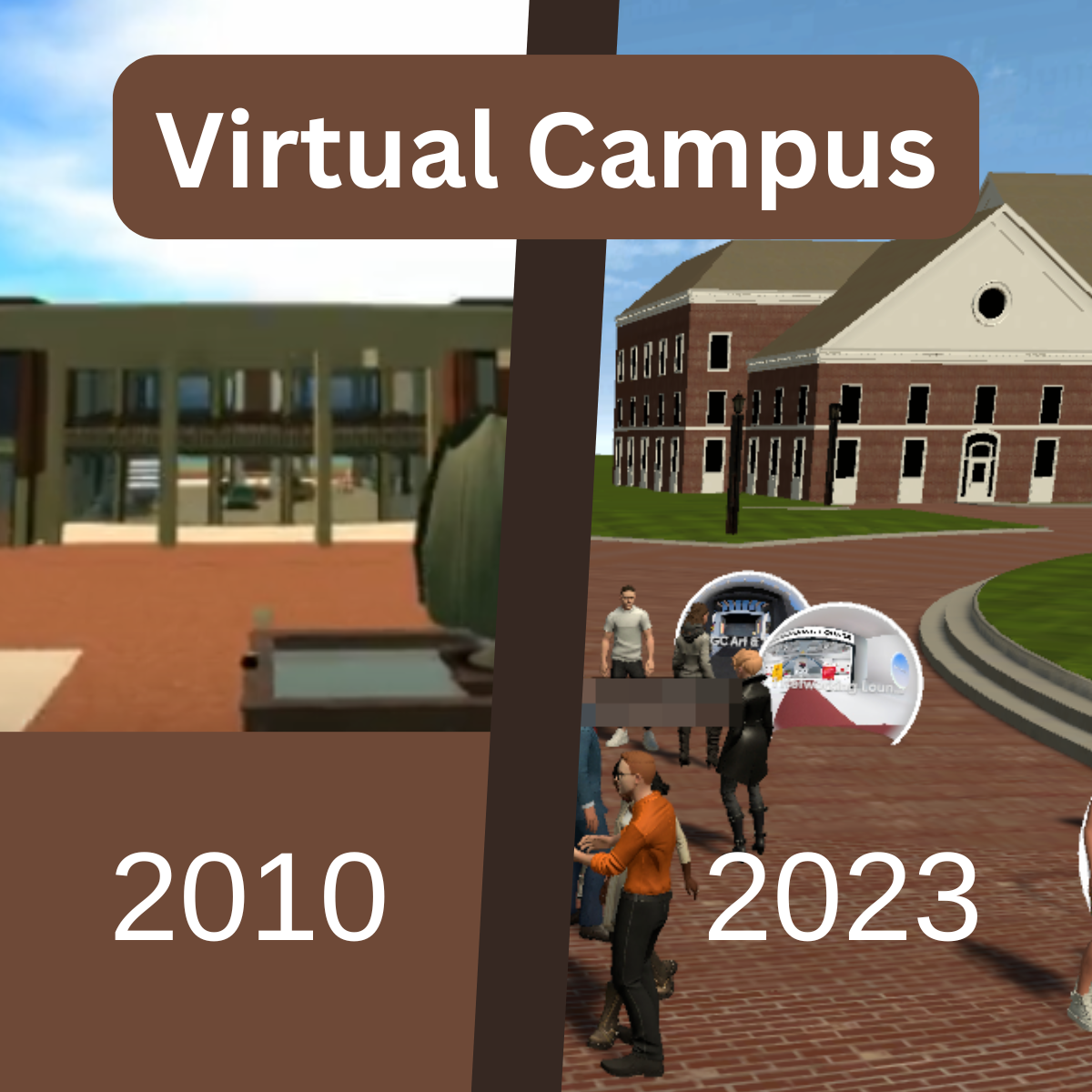
    Virtual Campuses: 2010 and 2023. Not much has changed; they still don’t work.


    I write this title with a tinge of irony. I’ve owned virtual campuses. I’ve worked on virtual campuses. If asked to work on a virtual campus again, I’d likely say yes.  So what’s my beef with virtual campuses?

    I feel that a sober-eyed look at virtual campuses* is necessary.

    Following the philosophy of ““those who cannot remember the past are condemned to repeat it” (Santayana), here is Part 3 of my series: From Myths to Principles; Navigating Instructional Design in Immersive Environments.

    The rise and fall of the metaversity

    In Part 2 of this series,I examined two examples from the history of immersive learning. First, I showed the parallels when companies like Meta and Linden Lab dominate a single platform for immersive learning designs. The lesson is that what is allowed one day can quickly become disallowed the next day. Second, I pointed out the inappropriate boasting and poor course design used in the “first course in virtual reality” by Stanford University. In these recent cases (Meta and Stanford University) there was a remarkable lack of awareness of the history of immersive learning. Said another way, mistakes of the past were repeated.

    In another example of history repeating itself, ten colleges and universities adopted digital twin campuses in June 2022 using the ENGAGE platform with monetary support and donated VR headsets from Meta (Koenig, 2022). These metaversity locations recreated (or created!) campus buildings to allow learners to gather on the virtual campus. 

    Eight years prior, Second Life (SL) campus buildings were “designed to mimic real-world architectural equivalents” but had become “abandoned ghost towns” (Wecker, 2014). 

    The early Second Life virtual campus creations were often the result of student projects. Confusingly, the professors who designed and assigned these projects touted the work of creating faithful campus recreations as creative and thus, at the highest level of Bloom’s cognitive learning objectives. I’m inserting a heavy eye roll here because that’s really stretching the justification of working in virtual reality to an extreme point.  Plus, I have to point out: what does next year’s class build if this year’s class made the campus?  My point is that simply building campus buildings (so that you can have a virtual campus!) is a project idea that runs out of steam. Things got really interesting right after the SL virtual campuses were launched.  Everyone involved noticed that the spaces were not being utilized. 

    Students were asked why they weren’t visiting the virtual campus. 

    The answer was simple.

    No one was there.

    You see, you could have the most amazing design with all of the bells and whistles (really!), but if people were not there, then people found that there was no compelling reason to return. Admissions folks had no compelling reason to be in the virtual admissions building, same for financial aid teams. Even library teams today in virtual reality struggle to staff spaces with the same spread as IRL (in real life) libraries.

    During a recent tour of the University of Maryland Global Campus metaversity campus, the audio connection failed. The host did not offer any tech support. The experience showcased empty buildings during what was a busy time of the academic semester. To be fair, I understand the implications of FERPA which might have predicted that students were in classroom spaces separate from public spaces. However, it is logical that on any campus, students could still be found  in public space buildings like the networking lounge. These accurate campus recreations rarely spur more than a passing interest to learners. 


    The ten colleges and universities in this project are now facing the end of the project and the initial funding is ending. Steven Van Hook commented that, “Administrators may speak of their twin campuses in glittering terms on the record –then off the record talk about their regrets and what else they could have bought for the hundreds of thousands of dollars” (VWBPE, 2024). According to Temple University’s Kathy Hirsh Pasek, “A year ago, a lot of companies were going full steam ahead. Today’s that’s not true; they’ve rerouted a lot of their funds for AI and Twitter alternatives” (Coffey, 2023, para. 37) Institutions made the decision to adopt immersive experiences but do not appear to know how to make wise decisions when generous funding stops and societal attention moves on.

    The key problems

    Therefore, throughout these first three parts of this series, there are several challenges apparent. Instructional designers and administrators must wade through the myriad of claims derived from dubious research studies. It feels like chicanery to figure out which statements about immersive experiences for learning are authentic and do point the way to future positive outcomes and which statements are in doubt. The first issue is with interpreting research wisely. Every research study has inherent flaws; no one study can definitively provide answers to all of education’s questions. This situation is made worse when the research is translated into social media and seems to tout incredible claims (Lanier et al., 2019).

    Therefore, the conundrum has been illuminated. The myths that appear to come from a research basis must be dispelled. Next, the very basis of the published research record is at risk of bias and problems. This series will inform on what characteristics to look for in published research.  Finally, if one were to step around the research interpretation problems, what is the system for building and using immersive experiences for its best advantage? This series will attempt to answer these questions. This series then forms the navigator role for instructional designers and administrators figuring out how to chart a route to a successful implementation.

    Post Script

    *virtual campuses

    I’m using the term virtual campuses to specifically refer to real work recreations of campus spaces like quads and lecture halls. I am not referring to simulations (for example in science courses) or spaces specifically designed for social use (for example, dance halls).

    Virtual campuses were designed as early as 1999 as text-based educational MUVEs (multi user virtual environments). This example classroom shows “the room’s description, list of contents, who  is in the room, the exits, and links to applications” (Maher, et al., 1999).

    Technically, ‘Nobody else is here’ might have been foresight.

    The metaversity concept is not to be confused with metauniversities, which are global collaborating universities (Costanza, et al., 2021). It appears as though the metaversity term became popular in 2021 and the company ENGAGE is not the only entity to claim it.

    Coffey, L. (2023, July 11). “Metaversities” face virtual learning’s financial reality. Inside Higher Ed | Higher Education News, Events and Jobs. https://www.insidehighered.com/news/tech-innovation/teaching-learning/2023/07/11/metaversities-face-virtual-learnings-financial

    Costanza, R., Kubiszewski, I., Kompas, T., & Sutton, P. C. (2021). A global metauniversity to lead by design to a sustainable well-being future. Frontiers in Sustainability, 2, 653721.

    Koenig, R. (2022, June 6). With Money From Facebook, 10 Colleges Turn Their Campuses into ‘Metaversities.’ EdSurge. https://www.edsurge.com/news/2022-06-01-with-money-from-facebook-10-colleges-turn-their-campuses-into-metaversities

    Lanier, M., Waddell, T. F., Elson, M., Tamul, D. J., Ivory, J. D., & Przybylski, A. (2019). Virtual reality check: Statistical power, reported results, and the validity of research on the psychology of virtual reality and immersive environments. Computers in Human Behavior, 100, 70–78. https://doi.org/10.1016/j.chb.2019.06.015

    Maher, M. L., Skow, B., & Cicognani, A. (1999). Designing the virtual campus. Design Studies, 20(4), 319-342.

    Wecker, M. (2014, April 22). What ever happened to Second Life? Chronicle Vitae. https://chroniclevitae.com/news/456-what-ever-happened-to-second-life

    #VirtualCampus #edtech #VirtualUniversity

    This article is simultaneously posted to LinkedIn and to my blog. My copyrights are retained. This article cannot be used to train AI.


    (more…)

  • From Myths to Principles Part 2 The Immersive Environment Delusion

    From Myths to Principles Part 2 The Immersive Environment Delusion

    From Myths to Principles: Navigating Instructional Design in Immersive Environments

    Part 2: The Immersive Environment Delusion

    Decorative scifi retrofuturism image of a person morphing with a computer.
    Image: Me and Copilot working on this using the article title, The Computer Delusion but making it personal, jazzy, and teal.


    In Part 1, we introduced this new series, From Myths to Principles: Navigating Instructional Design in Immersive Environments. This is an update from my 2022 series.

    In this Part 2, we’re going to go through some backstory showing the educators in Second Life was the first wave of hype for using immersive environments and we’ll look at one recent example from Stanford University with their “Virtual People” course.

    Here we go!

    History repeats itself

    The history of educational technology is a rhyme that repeats. Initial pitches have created optimism that the next big thing in technology will revolutionize education. Oppenheimer (1997) in a really well written article illustrated part of the history of educational technology by citing four examples:
    1. Edison’s 1922 prediction that the motion picture will revolutionize education.
    2. Levenson’s claim that radios will become common in every classroom.
    3. Skinner asserted that learners with teaching machines could learn twice as much.
    4. Clinton campaigned that computers are a bridge to the twenty-first century. (para. 1)

    The motion picture, the radio receiver, programmed instruction, and computers in the classroom have all failed to significantly impact learner performance. The past 102 years have not been kind to hyped educational technology predictions.


    I can hear you through the nether.
    There are some saying “But the metaverse is different!”
    Sit down. 👈😠
    I’ll deal with you soon enough.


    Cuban (1986) further suggested that this educational technology adoption cycle follows a predictable pattern. First, the earliest research will be produced by the technology producers themselves. Second, problems arise with adoption. Learner performance does not improve over the long term. The final stage in the cycle is blame-finding with reasons ranging from not enough money, educator resistance, and educational systems resistant to change. The methods and reasoning for incorporating the technology are rarely addressed in the historical or market record. The reader of this series might recognize these statements already being made about immersive experiences. As such, hype cycles for immersive experiences are already underway.
     
    This last point deserves emphasis. Here are the steps again:

    1. Tech producers make the first “research”.
    2. Tech adopted, but learner performance does not improve long term.
    3. Blame-finding ensues.

    I wanted to emphasize these points because they are going to appear in the research record that I will present.

    Boom and bust cycles


    Immersive experiences have already weathered several boom and bust cycles. One cycle began between 2003 and 2009. The desktop-based virtual reality program called Second Life, created by Linden Lab, attracted over 100 universities (Brown & Sugar, 2009) and thousands of dollars of investment (Wecker, 2014).

    In a sudden decision, Linden Lab eliminated its 50% discount for educational institutions (Harrison, 2010). What resulted was an educator exodus and fracture in the faith of immersive experiences for education. When referring to the shutdown of Woodbury University’s virtual campus for breach of conduct, Jordan Bellino, a senior learner at the institution, described the hazard when one major company dominates use:

    The incident suggests the dangers of online meeting spaces’ being run by companies, which get to decide who participates and who doesn’t. “It took years and thousands of dollars to make that virtual campus happen,” he said, “and it all vanished in a matter of an hour because Linden Lab pushed a button.” (Young, 2010, para. 12)

    Major technology companies can single-handedly dictate use of immersive environments. This would be a valuable lesson lost before the next boom cycle began in 2018.

    First course in virtual reality 


    After the launch of the consumer-oriented Quest headsets and the mandate for remote learning due to the COVID pandemic in 2020, interest in immersive environments surged. In June of 2021, Stanford opened their Virtual People course to 263 learners (Bailenson, 2021). 


    Source: https://news.stanford.edu/stories/2021/11/new-class-among-first-taught-entirely-virtual-reality

    Source: https://www.scrippsnews.com/us-news/education/stanford-virtual-reality-class-puts-students-in-metaverse

    The course was touted to be the first class in the world to be held inside of virtual reality (Hadhazy, 2021) which seemed to cast aside the nearly two-decade deep body of research on courses held as immersive experiences. The prestige of the course was further hyped when one of the course professors boasted:

    I can now stand up in front of all my students and there’s, you know, two hundred in the class, and I can say you will actually have a better chance of getting a job in the Valley because of taking this class because as of about a year ago, the most sought-after job in the Valley went from a data scientist to a VR engineer. (Bellini, 2024, para 12)

    The VR-based learning resulted in greater presence, enjoyment, motivation, and transfer (Han & Bailenson, 2024). However, within the course, all was not well. Video clips from the class showed learners struggling to control their avatars (Bailenson, 2021) and attending class just to stand around in circles (Bellini, 2021).


    (In case video does not display, it’s here: https://youtu.be/gOLI_OIV3nc?si=jv2LF-d4Dz8sIZsf)


    In spite of the boasting, published reports illuminated problems with onboarding learners to the VR headset experience, unexpected software updates, and sudden platform shutdowns (Han & Bailenson, 2024). 

    The instructional design was described as learning by doing, but the syllabus showed a majority of outside-of-virtual-world writing and quiz items. Within the immersive environment, there were required weekly discussion sessions (Han et al., 2022) and one project where learners could import 3D (three-dimensional) objects to make a unique VR environment. My translation? That’s not much doing, actually, as it relates to being a “virtual person”. 
     
    Much to the professors’ astonishment, one group of learners made a mock fake moon landing production set (Brown et al., 2023). For the course instructors, this suddenly raised the specter that immersive experiences can create false depictions or fake memories, a topic that will be revisited in the ethical labyrinths section of this series.


    In Part 3, I’ll share another example of boom and bust from the immersive environments-for-education market.

    Post-publication edit:


    They say there is no editor like the “Publish” button and that makes me laugh because you DO spot errors after something has been published.  But in this case, it’s not an error that I want to address, I want to add more depth and context to this post. Since it’s my blog, I can.  This work was previously planned to be a book chapter and as such, I held my tongue on some of my more pointed criticism and images. But here, I can lay out things more directly.

    Directly I am pointing to the Communication 166/266:Virtual People course as a poor design from an instructional designers point of view.  I have studied the syllabus and read several articles and watched videos produced about the course.  You can read the syllabus.


    What I can’t find is how many credits the course was. Just guessing from the workload in the syllabus, I’d guess 2 credits.  Could be 3 but it also could be 1. I severely doubt it’s 4.

    Where do I get the platform to critique this course?

    1. I have 14 years full time experience teaching online. Until ~2034, there are very few that can match me with that kind of full time teaching experience.  Now Bailenson’s class was arguably not “online” by definition (it happened in June 2021 or so and that would be post-shutdown), but it appears to have happened entirely remotely with the exception of picking up the headsets.  So I can claim some expertise about what SHOULD happen with digital-based instruction.
    2. My doctorate is in Instructional Design specifically *for Online Learning*. So I’ve spent my time focusing on that.
    3. My research focus was and is learning in immersive environments (hence this article series).
    4. Uniquely, I ALSO taught a course using the Meta Quest 2s which had a similar “survey” type of design. So what Bailenson did by visiting topics each week briefly is NOT part of my critique.

    Three things are my main concerns here:
    1. Video clips show a ridiculous amount of on-boarding malarkey.  Said another way, bringing learners into a 3D environment, not acclimating them to this and then bringing in various models and just letting the users play is nice for an introduction. It does NOT make a course and certainly it does not argue for a widespread use of the technology.

    I’m sure that in one version of the video, I could hear learners over and over again gathered in small groups supposedly “doing” something in VR only to hear “can anyone hear me?” as a COMMON statement.  Take my word for it; a class filled from beginning to end with learners not being able to hear or be heard does not count for much learning.

    My point: there isn’t evidence that anything other than some “visits” to VR happened.  And yet, over and over, this flagship course (my phrase) has learners that can’t walk, wave, or follow instructions and (I guess) hear instructions. After week one, the learners *should* be on-boarded, all practiced up and ready to do harder things. ‘Just walk over here for a group photo’ should not feel like an instructionally-impossible task– and the videos sure do make it look like it was. 

    (I had to giggle because in that “all class” photo, there is one avatar in 2D (not in a headset, because they don’t have hands and their movement is all 2D-type) and they are the only one that looks “logical” in their behaviors.)

    2. Bailenson really shows his excitement (in the somewhat unprofessional video) but also the “un-put-togetherness” of this experience with the quote I provided:

    I
    can now stand up in front of all my students and there’s, you know, two
    hundred in the class, and I can say you will actually have a better
    chance of getting a job in the Valley because of taking this class
    because as of about a year ago, the most sought-after job in the Valley
    went from a data scientist to a VR engineer. (Bellini, 2024, para 12)


    I find it VERY hard to believe that this one course at the 100 and 200 level will lead for a number like 200 new VR engineer’s getting jobs in “the Valley”.  Insert hard eyeroll here. 🙄  It looks extra bravado-y when he phrases it as “I can now stand up” as if he’s really planning to do this or HAS done it.  It’s a brag.  No humble about it.  Last I checked, the Valley wants to hire computer scientists, who should be in calculus class at the same time as this headset romp. Fact check: The Valley has been laying off VR teams.  So how’s that ‘better chance of getting a job’ brag going for ya?

    3. The learn-by-doing quote gets under my skin as an instructional designer. Learn WHAT by doing WHAT, in this case? His students had to use pre-existing 3D models included in the ENGAGE platform (OK, fine– but note that I didn’t see ANY examples of models beyond ones we’ve already seen in ENGAGE advertising) to build a scene that was basically their final project. 

    (Again, disclosure: my students final project was a video mock-up of an immersive experience that they would design, if they could. The course taught no programming skills.) 

    So OK, it’s fine that learners can’t program after 1 course. Totally understood. But then the learners put together a final project scene that sounds like Bailenson’s team spit out their coffee over…J. Brown source described the team experience as, “jarring” and wanted to coin a new phrase, “mis-experience.”  What the phrase? Garbage in, garbage out?  You don’t design a compelling course and the results surprise you?  Sigh.

    It appears that they took the “made lemonade from lemons” approach. Note that I haven’t mentioned ANYTHING about comparative learning outcomes related to this heralded course. Because there isn’t any data on that. Not like there should be, but the research is remarkably silent on that.

    Also fact check on this: the Meta Quest 2 headsets are officially OUT of support and sale from Meta. So they are, as of this writing, outdated.  I wonder how it’s going over there at Stanford. Do they just ring up Mark and ask for 266 more headsets in the Meta Quest 3 type now?

    I haven’t mentioned much, (actually I left it OUT), how much ENGAGE got free advertising from this mess.  That’s because they are really the main characters in the NEXT episode.

    References

    Bailenson, J. M. (2021). Stanford “Virtual People” class in the metaverse. [Video.] YouTube. https://youtu.be/gOLI_OIV3nc?si=if6DbOX43GESWTBd

    Bellini, J. (2021, December 7). Stanford virtual reality class immerses students in metaverse. Scripps News. https://www.scrippsnews.com/us-news/education/stanford-virtual-reality-class-puts-students-in-metaverse

    Brown, A., & Sugar, W. (2010). Second life in education: The case of commercial online virtual reality applied to teaching and learning. Themes in Science and Technology education, 2(1-2), 107-115.

    Brown, J., Bailenson, J., & Hancock, J. (2023). Misinformation in virtual reality. Journal of Online Trust and Safety, 1(5).

    Cuban, L. (2001). Oversold and underused: Computers in the classroom. Cambridge, MA: Harvard University.

    Hadhazy, A. (2021, November 5). Stanford course allows students to learn about virtual reality while fully immersed in VR environments. Stanford Report. https://news.stanford.edu/stories/2021/11/new-class-among-first-taught-entirely-virtual-reality

    Han, E., & Bailenson, J. N. (2024). Lessons for/in virtual classrooms: designing a model for classrooms inside virtual reality. Communication Education, 73(2), 234-243.

    Harrison, D. (2010, November 3). Linden Lab to end Second Life educational discounts. THE Journal. https://thejournal.com/Articles/2010/11/03/Linden-Lab-To-End-Second-Life-Educational-Discounts.aspx?Page=1

    Oppenheimer, T. (1997, July). The computer delusion. The Atlantic. https://www.theatlantic.com/magazine/archive/1997/07/the-computer-delusion/376899/

    Wecker, M. (2014, April 22). What ever happened to Second Life? Chronicle Vitae. https://chroniclevitae.com/news/456-what-ever-happened-to-second-lifeYoung, J. (2010, April 21). Woodbury U. banned from Second Life, again. Chronicle of Higher Education. Wired Campus. https://www.chronicle.com/blogs/wiredcampus/woodbury-u-banned-from-second-life-again

    (more…)

  • From Myths To Principles: Navigating Instructional Design in Immersive Environments Part 1 Introduction

    From Myths To Principles: Navigating Instructional Design in Immersive Environments Part 1 Introduction

    From Myths to Principles: Navigating Instructional Design in Immersive Environments

    Part 1 Introduction

    Decorative image with text: From Myths To Principles: Navigating Instructional Design in Immersive Environments with image of cloaked traveler on a mountian looking towards a break in gray clouds towards some buildings.

    This article begins a new series where I intend to continue to bust myths related to learning in immersive environments while also advocating for research-based decisions related to instructional design.

    Now if that sounded like gobbly-gook, this might not be the series for you. But, for anyone with an interest in virtual worlds, the metaverse, or even a simple 2D simulation and the uses of these for education, this is the RIGHT place for you.
     
    This is an updated version of my original 8-part Instructional Design in the Metaverse series. (Did you miss that? Here’s my 3 minute explainer video.) I estimate that I have at least 15 parts right now to start this series and new research comes in every day. However, this being my blog, I intend to spill a little more tea here than I do in other places.

    Buckle up buttercups
    !


    (more…)

  • Prognostication

    Prognostication


    Photo by Olena Kamenetska on Unsplash

    I’m getting a pretty strong reputation for being the most anti-XR person associated with XR. That’s fine. Proud of it. Trying hard to explain my point of view.

    But I thought I would get into writing my prognostication about the future of XR.

    In the next 5-10 years (closer to 10 than 5), the XR education market will explode. Entering the metaverse for a class or meeting will be JUST AS COMMON as entering a Zoom meeting is now (very common in 2023, and hated, such as the phrase “Zoom fatigue”). BTW, similarly maligned analogous technologies: PowerPoint or Second Life.

    The quality of what will be produced will run the gamut; great to garbage.

    After the market becomes saturated (and here comes the kicker) learning results will decrease (from what will appear to be ever increasing highs) and the overall impact of XR on education will be essentially nil.  It will be “another thing”.

    There. Forecast made.