Tag: History

  • From Myths to Principles Part 2 The Immersive Environment Delusion

    From Myths to Principles Part 2 The Immersive Environment Delusion

    From Myths to Principles: Navigating Instructional Design in Immersive Environments

    Part 2: The Immersive Environment Delusion

    Decorative scifi retrofuturism image of a person morphing with a computer.
    Image: Me and Copilot working on this using the article title, The Computer Delusion but making it personal, jazzy, and teal.


    In Part 1, we introduced this new series, From Myths to Principles: Navigating Instructional Design in Immersive Environments. This is an update from my 2022 series.

    In this Part 2, we’re going to go through some backstory showing the educators in Second Life was the first wave of hype for using immersive environments and we’ll look at one recent example from Stanford University with their “Virtual People” course.

    Here we go!

    History repeats itself

    The history of educational technology is a rhyme that repeats. Initial pitches have created optimism that the next big thing in technology will revolutionize education. Oppenheimer (1997) in a really well written article illustrated part of the history of educational technology by citing four examples:
    1. Edison’s 1922 prediction that the motion picture will revolutionize education.
    2. Levenson’s claim that radios will become common in every classroom.
    3. Skinner asserted that learners with teaching machines could learn twice as much.
    4. Clinton campaigned that computers are a bridge to the twenty-first century. (para. 1)

    The motion picture, the radio receiver, programmed instruction, and computers in the classroom have all failed to significantly impact learner performance. The past 102 years have not been kind to hyped educational technology predictions.


    I can hear you through the nether.
    There are some saying “But the metaverse is different!”
    Sit down. 👈😠
    I’ll deal with you soon enough.


    Cuban (1986) further suggested that this educational technology adoption cycle follows a predictable pattern. First, the earliest research will be produced by the technology producers themselves. Second, problems arise with adoption. Learner performance does not improve over the long term. The final stage in the cycle is blame-finding with reasons ranging from not enough money, educator resistance, and educational systems resistant to change. The methods and reasoning for incorporating the technology are rarely addressed in the historical or market record. The reader of this series might recognize these statements already being made about immersive experiences. As such, hype cycles for immersive experiences are already underway.
     
    This last point deserves emphasis. Here are the steps again:

    1. Tech producers make the first “research”.
    2. Tech adopted, but learner performance does not improve long term.
    3. Blame-finding ensues.

    I wanted to emphasize these points because they are going to appear in the research record that I will present.

    Boom and bust cycles


    Immersive experiences have already weathered several boom and bust cycles. One cycle began between 2003 and 2009. The desktop-based virtual reality program called Second Life, created by Linden Lab, attracted over 100 universities (Brown & Sugar, 2009) and thousands of dollars of investment (Wecker, 2014).

    In a sudden decision, Linden Lab eliminated its 50% discount for educational institutions (Harrison, 2010). What resulted was an educator exodus and fracture in the faith of immersive experiences for education. When referring to the shutdown of Woodbury University’s virtual campus for breach of conduct, Jordan Bellino, a senior learner at the institution, described the hazard when one major company dominates use:

    The incident suggests the dangers of online meeting spaces’ being run by companies, which get to decide who participates and who doesn’t. “It took years and thousands of dollars to make that virtual campus happen,” he said, “and it all vanished in a matter of an hour because Linden Lab pushed a button.” (Young, 2010, para. 12)

    Major technology companies can single-handedly dictate use of immersive environments. This would be a valuable lesson lost before the next boom cycle began in 2018.

    First course in virtual reality 


    After the launch of the consumer-oriented Quest headsets and the mandate for remote learning due to the COVID pandemic in 2020, interest in immersive environments surged. In June of 2021, Stanford opened their Virtual People course to 263 learners (Bailenson, 2021). 


    Source: https://news.stanford.edu/stories/2021/11/new-class-among-first-taught-entirely-virtual-reality

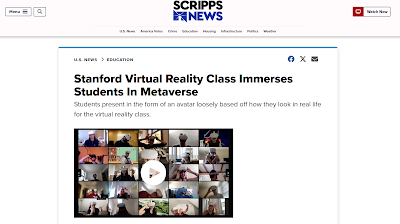
    Source: https://www.scrippsnews.com/us-news/education/stanford-virtual-reality-class-puts-students-in-metaverse

    The course was touted to be the first class in the world to be held inside of virtual reality (Hadhazy, 2021) which seemed to cast aside the nearly two-decade deep body of research on courses held as immersive experiences. The prestige of the course was further hyped when one of the course professors boasted:

    I can now stand up in front of all my students and there’s, you know, two hundred in the class, and I can say you will actually have a better chance of getting a job in the Valley because of taking this class because as of about a year ago, the most sought-after job in the Valley went from a data scientist to a VR engineer. (Bellini, 2024, para 12)

    The VR-based learning resulted in greater presence, enjoyment, motivation, and transfer (Han & Bailenson, 2024). However, within the course, all was not well. Video clips from the class showed learners struggling to control their avatars (Bailenson, 2021) and attending class just to stand around in circles (Bellini, 2021).


    (In case video does not display, it’s here: https://youtu.be/gOLI_OIV3nc?si=jv2LF-d4Dz8sIZsf)


    In spite of the boasting, published reports illuminated problems with onboarding learners to the VR headset experience, unexpected software updates, and sudden platform shutdowns (Han & Bailenson, 2024). 

    The instructional design was described as learning by doing, but the syllabus showed a majority of outside-of-virtual-world writing and quiz items. Within the immersive environment, there were required weekly discussion sessions (Han et al., 2022) and one project where learners could import 3D (three-dimensional) objects to make a unique VR environment. My translation? That’s not much doing, actually, as it relates to being a “virtual person”. 
     
    Much to the professors’ astonishment, one group of learners made a mock fake moon landing production set (Brown et al., 2023). For the course instructors, this suddenly raised the specter that immersive experiences can create false depictions or fake memories, a topic that will be revisited in the ethical labyrinths section of this series.


    In Part 3, I’ll share another example of boom and bust from the immersive environments-for-education market.

    Post-publication edit:


    They say there is no editor like the “Publish” button and that makes me laugh because you DO spot errors after something has been published.  But in this case, it’s not an error that I want to address, I want to add more depth and context to this post. Since it’s my blog, I can.  This work was previously planned to be a book chapter and as such, I held my tongue on some of my more pointed criticism and images. But here, I can lay out things more directly.

    Directly I am pointing to the Communication 166/266:Virtual People course as a poor design from an instructional designers point of view.  I have studied the syllabus and read several articles and watched videos produced about the course.  You can read the syllabus.


    What I can’t find is how many credits the course was. Just guessing from the workload in the syllabus, I’d guess 2 credits.  Could be 3 but it also could be 1. I severely doubt it’s 4.

    Where do I get the platform to critique this course?

    1. I have 14 years full time experience teaching online. Until ~2034, there are very few that can match me with that kind of full time teaching experience.  Now Bailenson’s class was arguably not “online” by definition (it happened in June 2021 or so and that would be post-shutdown), but it appears to have happened entirely remotely with the exception of picking up the headsets.  So I can claim some expertise about what SHOULD happen with digital-based instruction.
    2. My doctorate is in Instructional Design specifically *for Online Learning*. So I’ve spent my time focusing on that.
    3. My research focus was and is learning in immersive environments (hence this article series).
    4. Uniquely, I ALSO taught a course using the Meta Quest 2s which had a similar “survey” type of design. So what Bailenson did by visiting topics each week briefly is NOT part of my critique.

    Three things are my main concerns here:
    1. Video clips show a ridiculous amount of on-boarding malarkey.  Said another way, bringing learners into a 3D environment, not acclimating them to this and then bringing in various models and just letting the users play is nice for an introduction. It does NOT make a course and certainly it does not argue for a widespread use of the technology.

    I’m sure that in one version of the video, I could hear learners over and over again gathered in small groups supposedly “doing” something in VR only to hear “can anyone hear me?” as a COMMON statement.  Take my word for it; a class filled from beginning to end with learners not being able to hear or be heard does not count for much learning.

    My point: there isn’t evidence that anything other than some “visits” to VR happened.  And yet, over and over, this flagship course (my phrase) has learners that can’t walk, wave, or follow instructions and (I guess) hear instructions. After week one, the learners *should* be on-boarded, all practiced up and ready to do harder things. ‘Just walk over here for a group photo’ should not feel like an instructionally-impossible task– and the videos sure do make it look like it was. 

    (I had to giggle because in that “all class” photo, there is one avatar in 2D (not in a headset, because they don’t have hands and their movement is all 2D-type) and they are the only one that looks “logical” in their behaviors.)

    2. Bailenson really shows his excitement (in the somewhat unprofessional video) but also the “un-put-togetherness” of this experience with the quote I provided:

    I
    can now stand up in front of all my students and there’s, you know, two
    hundred in the class, and I can say you will actually have a better
    chance of getting a job in the Valley because of taking this class
    because as of about a year ago, the most sought-after job in the Valley
    went from a data scientist to a VR engineer. (Bellini, 2024, para 12)


    I find it VERY hard to believe that this one course at the 100 and 200 level will lead for a number like 200 new VR engineer’s getting jobs in “the Valley”.  Insert hard eyeroll here. 🙄  It looks extra bravado-y when he phrases it as “I can now stand up” as if he’s really planning to do this or HAS done it.  It’s a brag.  No humble about it.  Last I checked, the Valley wants to hire computer scientists, who should be in calculus class at the same time as this headset romp. Fact check: The Valley has been laying off VR teams.  So how’s that ‘better chance of getting a job’ brag going for ya?

    3. The learn-by-doing quote gets under my skin as an instructional designer. Learn WHAT by doing WHAT, in this case? His students had to use pre-existing 3D models included in the ENGAGE platform (OK, fine– but note that I didn’t see ANY examples of models beyond ones we’ve already seen in ENGAGE advertising) to build a scene that was basically their final project. 

    (Again, disclosure: my students final project was a video mock-up of an immersive experience that they would design, if they could. The course taught no programming skills.) 

    So OK, it’s fine that learners can’t program after 1 course. Totally understood. But then the learners put together a final project scene that sounds like Bailenson’s team spit out their coffee over…J. Brown source described the team experience as, “jarring” and wanted to coin a new phrase, “mis-experience.”  What the phrase? Garbage in, garbage out?  You don’t design a compelling course and the results surprise you?  Sigh.

    It appears that they took the “made lemonade from lemons” approach. Note that I haven’t mentioned ANYTHING about comparative learning outcomes related to this heralded course. Because there isn’t any data on that. Not like there should be, but the research is remarkably silent on that.

    Also fact check on this: the Meta Quest 2 headsets are officially OUT of support and sale from Meta. So they are, as of this writing, outdated.  I wonder how it’s going over there at Stanford. Do they just ring up Mark and ask for 266 more headsets in the Meta Quest 3 type now?

    I haven’t mentioned much, (actually I left it OUT), how much ENGAGE got free advertising from this mess.  That’s because they are really the main characters in the NEXT episode.

    References

    Bailenson, J. M. (2021). Stanford “Virtual People” class in the metaverse. [Video.] YouTube. https://youtu.be/gOLI_OIV3nc?si=if6DbOX43GESWTBd

    Bellini, J. (2021, December 7). Stanford virtual reality class immerses students in metaverse. Scripps News. https://www.scrippsnews.com/us-news/education/stanford-virtual-reality-class-puts-students-in-metaverse

    Brown, A., & Sugar, W. (2010). Second life in education: The case of commercial online virtual reality applied to teaching and learning. Themes in Science and Technology education, 2(1-2), 107-115.

    Brown, J., Bailenson, J., & Hancock, J. (2023). Misinformation in virtual reality. Journal of Online Trust and Safety, 1(5).

    Cuban, L. (2001). Oversold and underused: Computers in the classroom. Cambridge, MA: Harvard University.

    Hadhazy, A. (2021, November 5). Stanford course allows students to learn about virtual reality while fully immersed in VR environments. Stanford Report. https://news.stanford.edu/stories/2021/11/new-class-among-first-taught-entirely-virtual-reality

    Han, E., & Bailenson, J. N. (2024). Lessons for/in virtual classrooms: designing a model for classrooms inside virtual reality. Communication Education, 73(2), 234-243.

    Harrison, D. (2010, November 3). Linden Lab to end Second Life educational discounts. THE Journal. https://thejournal.com/Articles/2010/11/03/Linden-Lab-To-End-Second-Life-Educational-Discounts.aspx?Page=1

    Oppenheimer, T. (1997, July). The computer delusion. The Atlantic. https://www.theatlantic.com/magazine/archive/1997/07/the-computer-delusion/376899/

    Wecker, M. (2014, April 22). What ever happened to Second Life? Chronicle Vitae. https://chroniclevitae.com/news/456-what-ever-happened-to-second-lifeYoung, J. (2010, April 21). Woodbury U. banned from Second Life, again. Chronicle of Higher Education. Wired Campus. https://www.chronicle.com/blogs/wiredcampus/woodbury-u-banned-from-second-life-again

    (more…)

  • A History of XR Cross Reality Part 6 of 6

    A History of XR Cross Reality Part 6 of 6


    Almost there! Only five years to go and then into the future, she writes and points like Doc Brown.

    2014 – Future

    2015 Google Cardboard

    Source: Wikicommons

    Google (again? They were just in Part 5) sends out Google cardboard in the New York Times (and other media),
    expanding the new idea– a cheap VR viewer where you use your
    smartphone and some special apps. Pluses: mass market availability,
    cheap, created buzz. Negatives: absolutely no hands. People want to do
    more than look, they want to touch.

    2016 Emotiv

    Source: Wikicommons

    OK
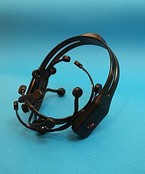
    – I will go on record and say I do not like this product. It records
    the user’s brain waves when a certain action is requested (like open
    email) and then translates future instances of those brain waves as
    commands to repeat the learned action. Why don’t I like this? I cannot
    find many instances of telekinesis that have worked so far for humanity.
    Maybe in a future I can’t see, but for now, nope.  Just remember, there
    is no spoon.

    2016 Mobile World Congress – Facebook gets into the VR action. 

    It is interesting to note that when very large corporations make steps into a certain technology, all of our heads should be turning. 

    Facebook’s
    virtual world Horizon (once called Spaces) just opened in October 2019.
    Horizon so far doesn’t seem to be getting a warm reception. [Update: Horizons was set to shutdown and then quickly backtracked this decision in 2026.] 

    This
    invention represents an inflection point in technology where
    we double back on ourselves and create a conundrum. When asked if they
    would utilize a virtual world to ‘be’ (embodiment) with their friends, I
    see most regular users of Facebook shying away from the concept. These
    are the same users that lived totally without Facebook…uh…before
    Facebook. As such, they were synchronously and physically with
    people before. Being with people should not, by itself, weird out this
    population. So why the hesitation near this concept now? Are we
    ‘friends’ with people and do things within Facebook that we would not do
    when in-person with them? #Research needed here.

    2019 January – Apple patenting new gesture capture devices? 

    Maybe?
    As I’ve said though, no need for gloves or devices attached to people.
    Ditch that idea. New gestures to mean new things though?? [Edit: I’ve deleted and now downplayed Apple here, they did got for a high end “Pro” headset…that didn’t do so well.]

    2019 October – AWE conference in Munich #AWE2019

    The headset detects hands. At the time, cool.

    2019 – Magic Leap

    I don’t love this product. Why? See my Future of XR Headsets article. Magic Leap can be redeemed in my opinion though. I will wait this out. [Update: Magic Leap died in 2024 and been resuscitated in 2025.]

    2019 – Microsoft Hololens 2

    Excellent
    product. Why? Because the person looking at the user can see their
    eyes. Besides what I wrote about in my Future of XR Headsets article,
    Microsoft has taken a page from their own (MS Office) playbook for this
    launch. They are going directly to the business market. As such, there
    will be back-pressure into education to prepare learners for the
    workplace. This product has many of the characteristics of future
    success.

    2019 – example of room-based VR

    The plus here? Accessibility. Also, you could get more people into
    the same experience. So this is VR for more than one person.

    2019 – Microsoft demo of a hologram gives a partial keynote speech in Japanese, when the speaker does not speak Japanese at all. 

    Very much #thefutureistoday.

    2019 – Disney’s The Void – example of location-based VR. 

    Negatives:
    Must go to a location to experience this. Experience is not cheap.
    Positives: Increase in quality content (Star Wars!) and you can
    experience this in group (more than one at a time).
    [Update: The Void died in the pandemic due to financial problems.]

    So my predictions for the future of XR *based* on studying the past:

    • Text will be a continuing necessity. Put it everywhere and in everything you can. Text has over a 2000 year history
      in human interfaces; it is a winner. We need 3D fonts that can work
      “floating” and over the top of a variety of light and dark backgrounds
      and we need them yesterday.  #3DFonts
    • User-customized ways of interacting with large amounts of information. 
    • Tech not touching you that still works.
    • No need for gloves.
    • First forms of what works will likely be two technologies squished together. 
    • Seeing your user as a human will be more important than the tech itself.

    Interesting
    that phone and sound are almost non-existent in my XR research. I
    didn’t avoid it, but it also didn’t really show up as a necessary future
    player. I’ll keep cogitating on that.

    Keep an eye on science fiction. If you noticed, my sci fi sources dried up about 5 years ago and everything I shared was
    a technological innovation. What Sci Fi sources are predicting the near
    and far future? Battlestar Galactica? Handmaid’s Tale? The Marvel
    Universe? [Update: it was much more Handmaid’s Tale that I care to think about.]

    Amara’s Law: We tend to overestimate the effect of a technology in the short run and underestimate the effect in the long run.

    Going
    forward, I am very interested to trace the justice concept (remember
    Plato?) through this technology. It is significant that we can
    criticize much of the current XR environment as being made by young,
    white males in silicon valley. We need diversity and inclusion inside
    the workforce making XR.

    What comes next? I can’t wait to find out.

    Miss any of the prior history of XR and you are curious? Have at it!

    Part 1 380 B.C. to 1880 

    Part 2 1881 to 1909

    Part 3 1910 to 1965

    Part 4 1966 – 1998

    Part 5 1999 – 2013

    Part 6  2014 – Future

    Have any time points that you think I should include? Tell us as a comment!

    #Reality
    #CrossReality #MixedReality #VirtualReality #AugmentedReality
    #VirtualWorlds #Design #Transmedia #XR #VR #AR #ARVRinEdu #EdTech
    #Innovation #GoogleCardboard #Emotiv #FacebookVR #FacebookVW
    #FacebookHorizon #AppleGestures #iLRN #AWE #MagicLeap #MicrosoftHolens2
    #MicrosoftHologram #OmegaOphthalmics #DisneyTheVoid #Samsung2020
    #GooglePixel4 #AppleAR #Spectacles #SmellOVision #FutureTrends #3DText
    #YourUserIsHuman


    This article originally appeared on LinkedIn on December 2, 2019. Updated on March 31, 2026 with replaced images and I deleted some (now embarrassing) future predictions.

  • A History of XR Cross Reality Part 5 of 6

    A History of XR Cross Reality Part 5 of 6


    As a reminder, we are using science fiction as our time
    machine vehicle to examine how good we are at predicting the future and
    our intention is to predict the future of cross realities (XR).

    1999 – 2013

    1999 Tom Clancy’s Net Force

    I
    think I am probably one of the only writers that would put this in an
    XR history timeline. The namesake is a police force of a future internet
    where world citizens can relinquish country-based citizenship and
    become a citizen of the internet. But the prediction I liked was the
    description of how the internet could become an interface where the user
    could customize their interaction with it. It is hard to describe (read
    the book!). I find that prediction really tantalizing. The
    closest reality we have right now is the fact that everyone’s home
    screen on their smart phones is different, but this interaction with
    large data sets is still in front of us. More on this topic in 2007.

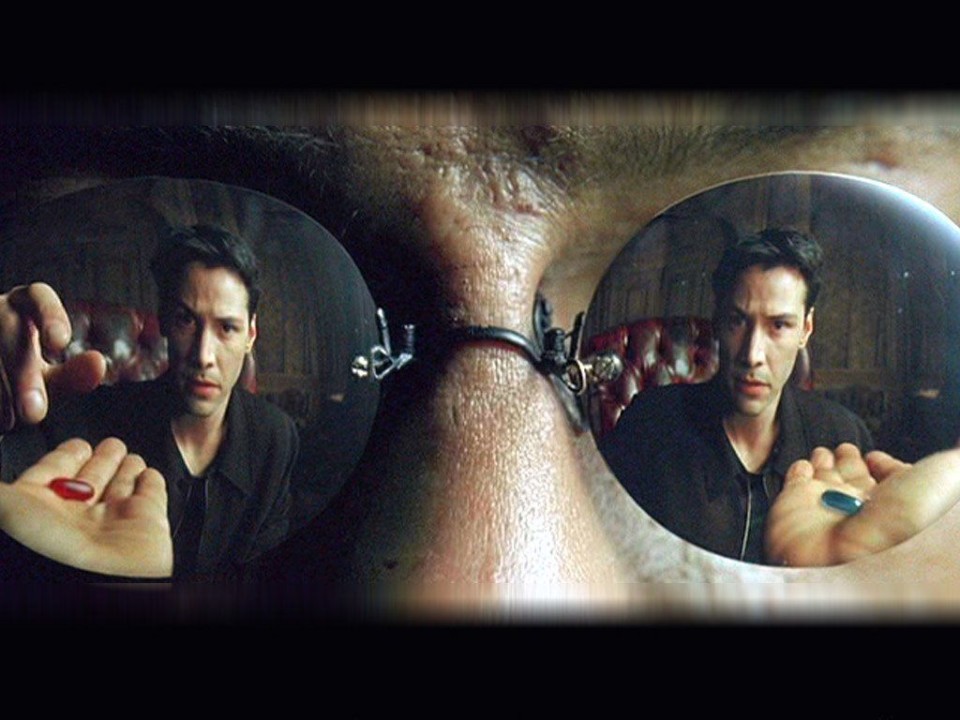
    1999 The Matrix – considered the first truly dark interpretation of the power of the internet. 

    Capture from The Matrix. Neo comes to grips with the figurative Matrix.
    Source: IMDB

    In this story, the internet is a place to escape from. Take
    one more look at that date: 1999. We’re really only about four years
    after the big 1995 America Online expansion of subscribers. Only four
    years and we’re already starting to suspect that this internet thing is
    something to be wary of.

    2002 Minority Report – Gloves used to manipulate screens and displays. 

    Source: IMDB

    I
    agree with the futurists that say that this vision of screens and
    displays will be accurate (floating in the air, perhaps only visible to
    the direct user). However, I predict: ditch the gloves.
    You won’t need them in the future. Radar will be able to detect your
    finger location in real time, so you don’t have to wear a device on or
    in your body for this functionality.

    2003 – Birth of Second Life – an immersive persistent world. 


    It’s still around. But multiple iterations of virtual worlds now exist.  

    2007 The Croquet Project.
    This is a now defunct project that basically embodied Tom Clancy’s
    customizable browser. I love the idea. I still think that versions of
    this idea will arrive in the future.  (Sorry the picture below does not
    come close to showing what it was. It’s hard to use images to describe
    this.)

    Source: Wikicommons

    2007
    – The first iPhone. Hard to believe we’ve been through all this history
    and only just now did we arrive at the first smartphone.

    Source: Wikicommons

    2010 – The first tablet, the iPad. 

    Source: Wikicommons

    I
    didn’t originally plan to take us directly from Apple launch of iPhone
    to launch of iPad, but I would like to show the likely user experience
    pathway between these two items. Let’s pretend we are in an Apple
    meeting room in 2008. We’re asked “What are our users experiencing?” The
    report is “Well, they like pulling up the internet and messaging from
    wherever, but still when they get on a (frequent) business flight, they
    lug along their full laptop (for work files), a book (for reading when
    they have a few hours ahead), some magazines (for light reading during
    short delays) and something that might play a few very small videos.” So
    Apple sees 3 different devices:

    A phone – that does what phones do, and a little more

    A laptop – that carries huge files and has a keyboard, but is otherwise clunky to carry

    Print media & some stored music – stored on a device that does ONLY that function

    So the iPad is the combination of those three needs. You might remember that the iPad was not launched as a phone replacement though.
    Need a phone for communication? Actually, not so much. We now know that
    smartphones are used for phone communication 5% of the time. That’s 95%
    of the time they are not used as phones. The iPad allowed all of those
    other needs to be met. Remember that Disney robot vacuuming, but the
    true future was the combination robot vacuum. The combination – put
    technologies together- wins again!

    2013 Microsoft Kinect – Defunct but considered a commercial success at 35 million units sold. 

    Source: Wikicommons

    Personally,
    I love this device for the accessibility. Nothing touches the body! You
    could be in a wheelchair and use this. You could not have hands and use
    this. Love this idea! I pin this as a VERY future workable idea: devices that do not need to touch you.

    2013 “Modern” smartwatches born.

    2013 Google Glass – another defunct innovation

    Source: Wikicommons

    Interesting
    to note the privacy backlash that happened in 2013. Everyone was
    concerned that the camera on the Glass (wore by the user) would be
    watching & recording them (not the user). Fast forward to
    2019 and people whip out their phone, camera, & filter in a second!
    My, how times change!

    [Update from 2026: The backlash against Meta’s AR glasses grows.]

    In case you missed the other articles in this timeline, here they are:

    Part 1 380 B.C. to 1880 

    Part 2 1881 to 1909

    Part 3 1910 to 1965

    Part 4 1966 – 1998

    Part 5 1999 – 2013

    Part 6  2014 – Future

    #Reality
    #CrossReality #MixedReality #VirtualReality #AugmentedReality
    #VirtualWorlds #Design #Transmedia #XR #VR #AR #ARVRinEdu #EdTech
    #Innovation #TomClancy #NetForce #Matrix #MinorityReport #ARGloves
    #SecondLife #CroquetProject #iPhone #iPad #MicrosoftKinect #GoogleGlass

    This article originally posted to LinkedIn on December 1, 2019. Updated font on March 31, 2026 with replaced images.

  • A History of XR Cross Reality Part 4 of 6

    A History of XR Cross Reality Part 4 of 6


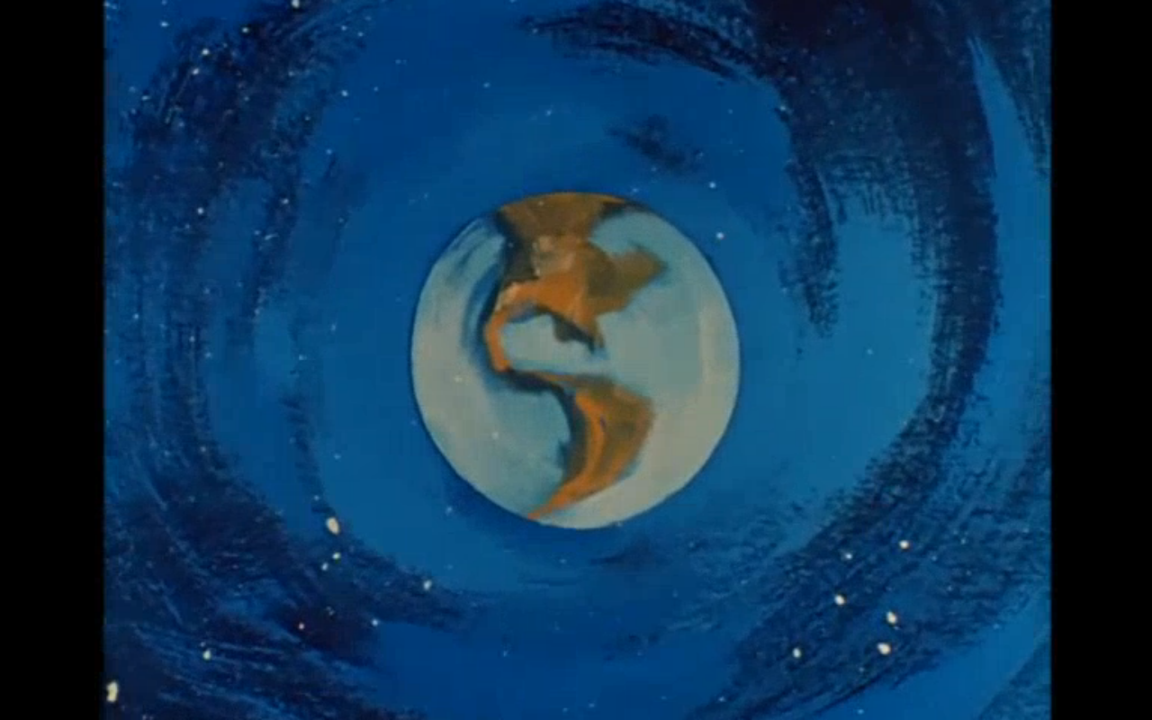
    Decorative image of Earth from the Jetsons TV cartoon series.

    If you persevered through Parts 1, 2, and 3,
    well done! For me, the fun starts now as the timeline now includes my
    lifetime which means I can remember and attest to the impact that
    science fiction has had on our cross reality creations. We have color TV
    so let’s almost finish up the 20th century!

    1966 – 1998

    1966
    Star Trek and the communicator – a hand held device that could do
    several functions, all without cords, wires, or being at a
    panel/payphone.

    Photo of James Kirk character from Star Trek, holding a communicator device.

    1968 Heads-Up Display suggested for civilian, private use.

    1969
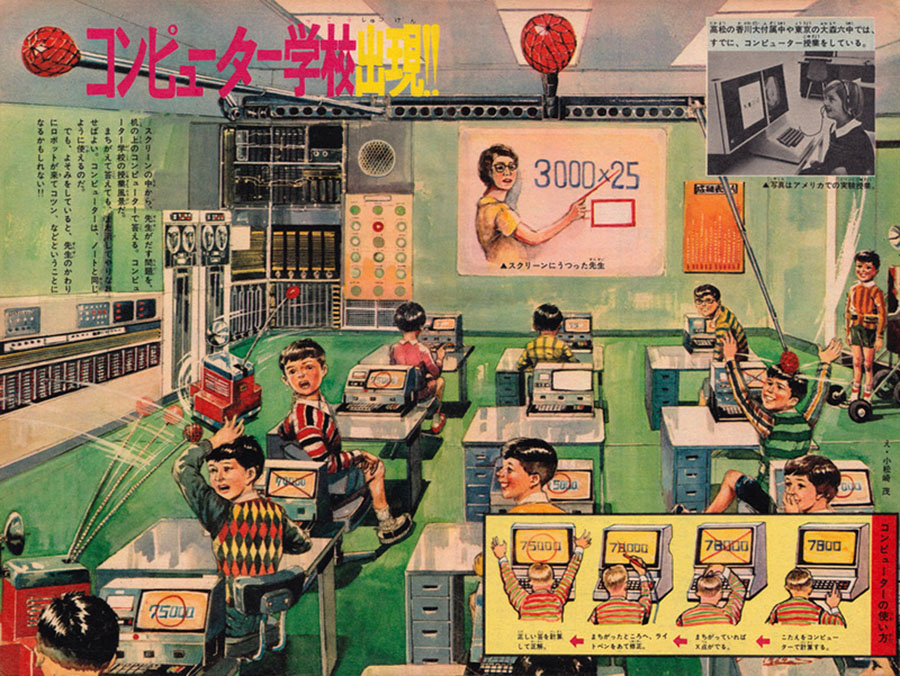
    Another paleo futuristic image, this one from Japan. This shows
    adaptive technology used for learning, no teacher in the room, and robot
    that doles out punishment.

    Futuristic art depiction of a classroom with a robot teacher.
    Source:  Shōnen Sunday, a Japanese Manga magazine, 1969.

    1972
    The first smartwatch, the Pulsar. I tried to find what definition
    ‘first smartwatch’ meant and I learned that it meant ‘you have to press a
    button in order for it to display the time’.

    Photo of The Pulsar, the original smart watch. Might not have been that smart, actually.
    The Pulsar, the first smart watch. Source: watchdepot.com.au

    1974 This
    video, One day, a computer will fit on a desk (1974) is excellent to watch. The world is predicted for
    2001.

    That’s
    Arthur C. Clarke. What is it about science fiction writers that have
    the ability to accurately predict the future? I think it’s first the
    broad spectrum of options that science fiction provides. Second, I think
    that they can also pick out design patterns that are viable. 

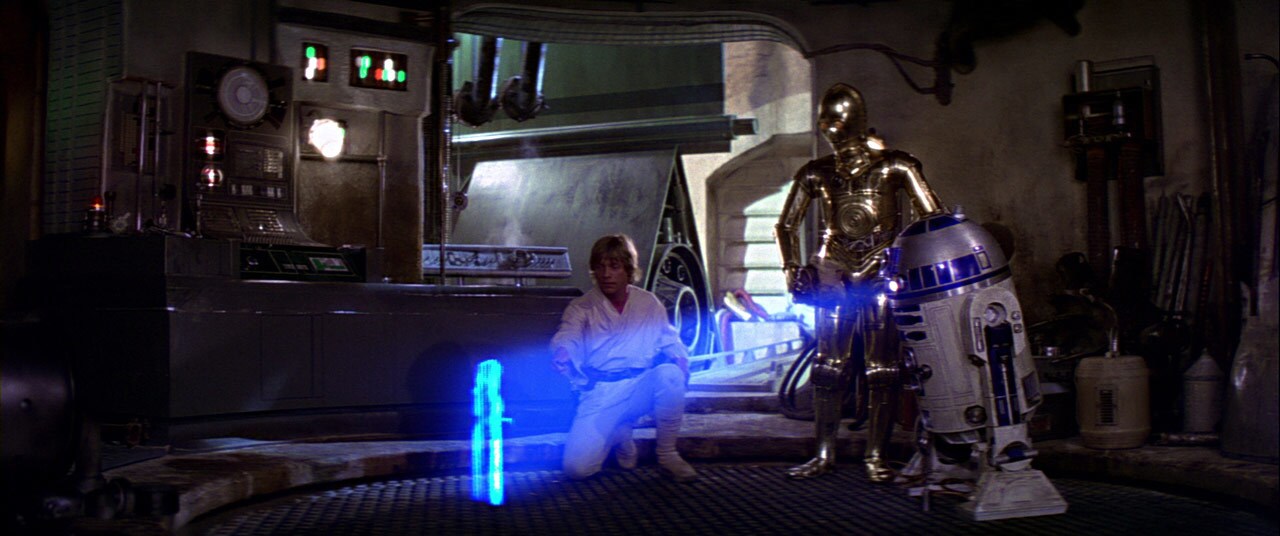
    1979 Star Wars – communication via recorded hologram.

    Capture of Star Wars scene where Princess Leia is relaying a message as a hologram.
    Star Wars, A New Hope, Leia as hologram scene.

    1982
    EPCOT opens. This is the now-closed Horizons pavilion which focused
    entirely on the future. I wanted to show this image because of the
    robots in the home. One robot in the kitchen is cooking and
    simultaneously cleaning. 

    Let’s zoom in on the “Butler” robot who is vacuuming.

    Photo of the Butler from the Horizons Epcot pavilion. He is vacuuming.
    The butler from the now-gone Horizons Epcot pavilion

    Notice
    how Disney has the Butler robot — who is capable of other
    duties–literally using a vacuum cleaner that would have been present in
    1960 or even 1982. So futurists often start by putting objects together to increase the functions. Need your floor vacuumed? No problem. Your robot will grab the vacuum and do it for you. One device will use another device.

    But
    today, we have Roomba vacuums. Disney was wrong. What happened? In the
    future that came to pass, the robot and the vacuum cleaner were put
    together into one device (and the butler’s duties are done by other
    robots in our homes, I’m looking at you Alexa). Take note of that
    pattern; what started as two devices actually became one.

    This is a fun image from 1982.

    Artwork by Alan Kay, Atari, depicting a future classroom with most students paying attention to their computer lessons. One is not paying attention.
    Credit: Alan Kay

    This
    was drawn by Alan Kay who was drafted to draw a vision of how Atari
    could be incorporated into the classroom. Bold moves for a game
    company– then.

    Note: “Here we see some of the earliest visions
    from Silicon Valley of the personal computer in the classroom. The
    future of education here is technological. It is branded. It is
    game-based. There are still desks in rows and clusters. And students
    still rebel.” (Watters, 2015)

    1992 Snow Crash novel by Neal Stephenson. 

    Snow Crash novel cover art with a man running down a blue digital hallway.
    Cover art for the Snow Crash novel by Neal Stephenson

    Stephenson
    writes of a virtual world, the impact of headsets, and a basic Sumerian
    language programming plot. Philip Rosedale credits his wife as handing
    him this novel to read that became the starting point for Linden Lab’s
    Second Life virtual world. 

    1995’s The Net with Sandra Bullock is a techno thriller of an isolated remote worker.

    Photo from The Net movie with Sandra Bullock. She is using a computer keyboard.
    Source: imdb.com

    Problems
    ensue when she discovers a tech problem and a large corporation goes
    after her via the only conduit in her life: everything digital. Without
    giving away the plot because I’ve heard some have never seen this movie (what?), there is a very interesting intersection with privacy, security, and medical records. Let’s just say that I’m very glad that this prediction of the future has not come true…yet.

    Part 1 380 B.C. to 1880 

    Part 2 1881 to 1909

    Part 3 1910 to 1965

    Part 4 1966 – 1998

    Part 5 1999 – 2013

    Part 6  2014 – Future

    #Reality
    #CrossReality #MixedReality #VirtualReality #AugmentedReality
    #VirtualWorlds #Design #Transmedia #XR #VR #AR #ARVRinEdu #EdTech
    #Innovation #StarTrek #Communicator #PaleoFuture #Pulsar #StarWars
    #Hologram #EPCOT #Horizons #Disney #Roomba #Atari #SnowCrash
    #NealStephenson #SecondLife #PhilipRosedale #LindenLab #TheNet
    #SandraBullock


    This article originally posted to LinkedIn on November 30, 2019. Updated on February 24, 2026 with better font and re-added images.

  • A History of XR Cross Reality Part 3 of 6

    A History of XR Cross Reality Part 3 of 6


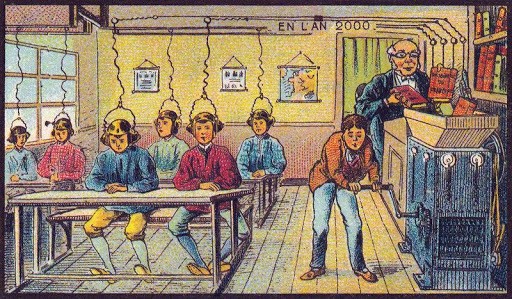
    Drawing by Villemard circa 1910 showing future schools where students learn via headphones as the teacher and assistant grind books into some kind of device connected to the headphones.
    France_in_XXI_Century._School.jpg: Jean Marc Cote (if 1901) or Villemard (if 1910)derivative work: TVJunkie, Public domain, via Wikimedia Commons

    1910 – 1965

    In 1910, the artist Jean
    Marc Cote, is commissioned to create artwork for cigar boxes showing
    humanity in the year 2000. Some of these predictions hit remarkably
    close the mark.

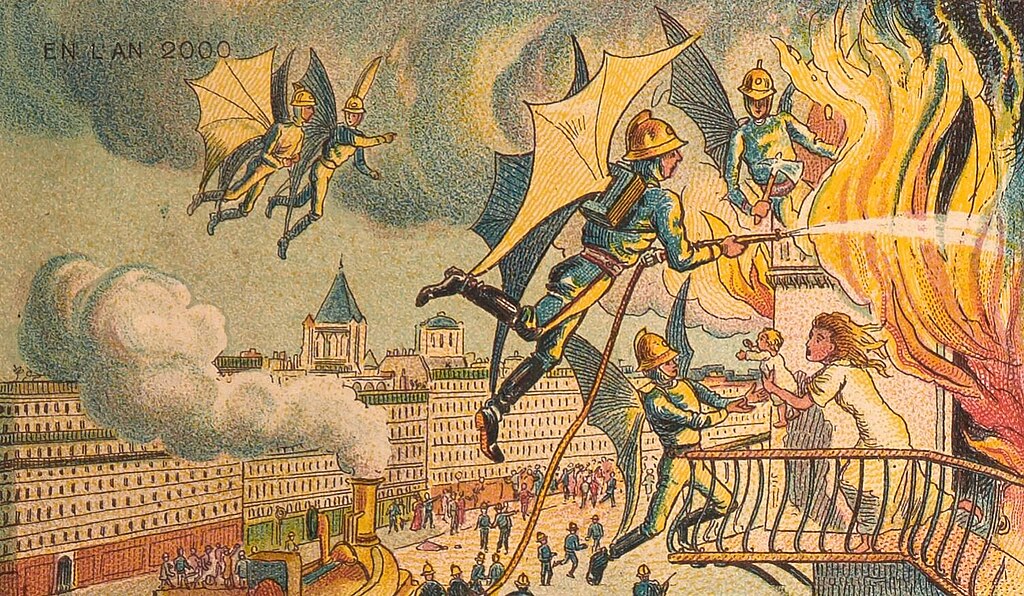
    Flying firefighters. No? You do know that departments are incorporating drones, right?

    Art drawing by Villemard circa 1910 showing fire fighters with wings fighting fires.
    Villemard, Public domain, via Wikimedia Commons

    Schools transformed by just listening-learning (blog banner image).

    Now educators and I can have a field day with just this image. I
    would ask a group of teachers-to-be to analyze what was correct in this
    prediction and what was incorrect. We could go on and on. The main idea
    here to get is that learning was going to transformed to occur only by listening. How ridiculous, right? And yet, three years later in real life…

    Photo of Thomas Edison examining a film strip.
    Thomas Edison examining some film. NPGallery, Public domain, via Wikimedia Commons

    “Thomas
    Edison famously predicted in 1913 that “Books will soon be obsolete in
    schools” – but not because books were to be ground up by a knowledge
    mill. Rather, Edison believed that one of the technological inventions
    he was involved with and invested in – the motion picture – would
    displace both textbooks and teachers alike.

    “I believe that the
    motion picture is destined to revolutionize our educational system and
    that in a few years it will supplant largely, if not entirely, the use
    of textbooks,” Edison asserted in 1922. “I should say that on the
    average we get about two percent efficiency out of schoolbooks as they
    are written today. The education of the future, as I see it, will be
    conducted through the medium of the motion picture… where it should be
    possible to obtain one hundred percent efficiency.” (Watters, 2015)

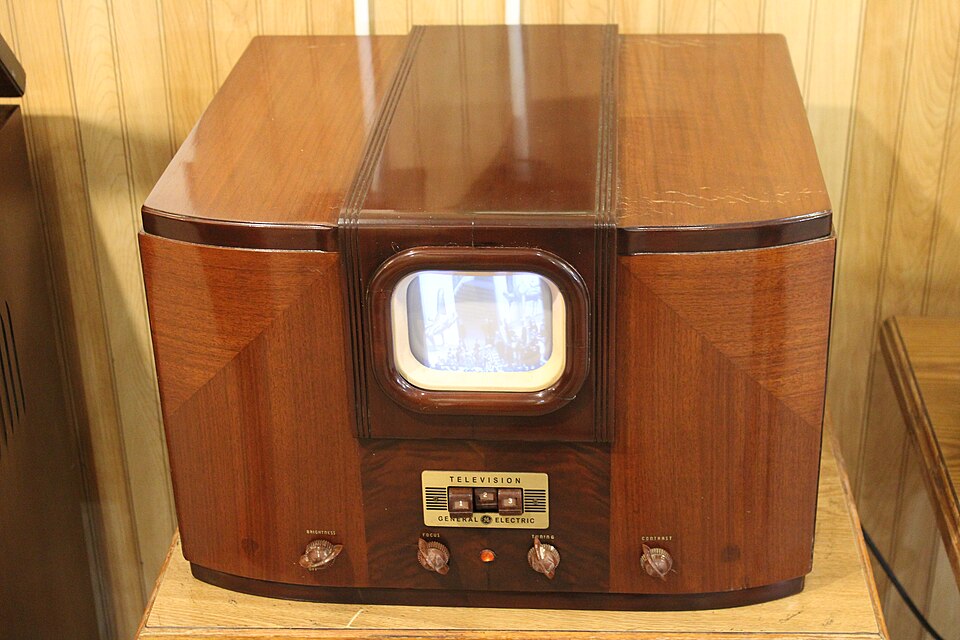
    From
    1913 to 1931, we have the age of radio. By 1931, television was
    demonstrated at the Iowa State Fair. Just two years after (so quick if
    you think about it) that the University of Iowa started to experiment
    with this medium. The first broadcasts were only video, no audio.
    Because televisions were scarcely available commercially and the signal
    was weak, users who could receive the signal tended to be with five
    miles of the campus and had built their own TVs from parts. If you
    wanted to hear sound along with the video, you had to tune in your radio
    at the same time. Descriptions of the image produced in these
    rudimentary TVs are actually scary (colors, shapes, very fuzzy). But it
    is a start!

    Photo of early television set. Large wooden-type box has a small, curved black and white screen.
    General Electric early television set. DogsRNice, CC BY-SA 4.0 <https://creativecommons.org/licenses/by-sa/4.0>, via Wikimedia Commons

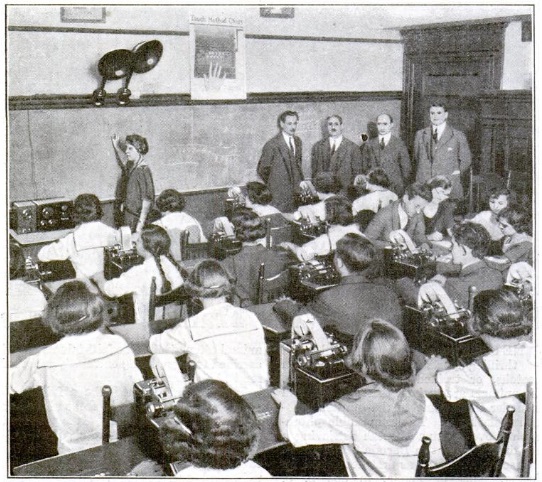
    Professors
    quickly figured out that they could broadcast radio from home and then
    did so. Students still had to travel to campus and sit in seats to
    listen. The next innovation was two way radio so students could ask
    questions of the professor.

    Photo of Haaren High School's radio-based accounting class. Circa 1923.
    Haaren High School, New York, accounting class, by radio. Source: https://onetuberadio.com/2023/07/10/1923-distance-learning/

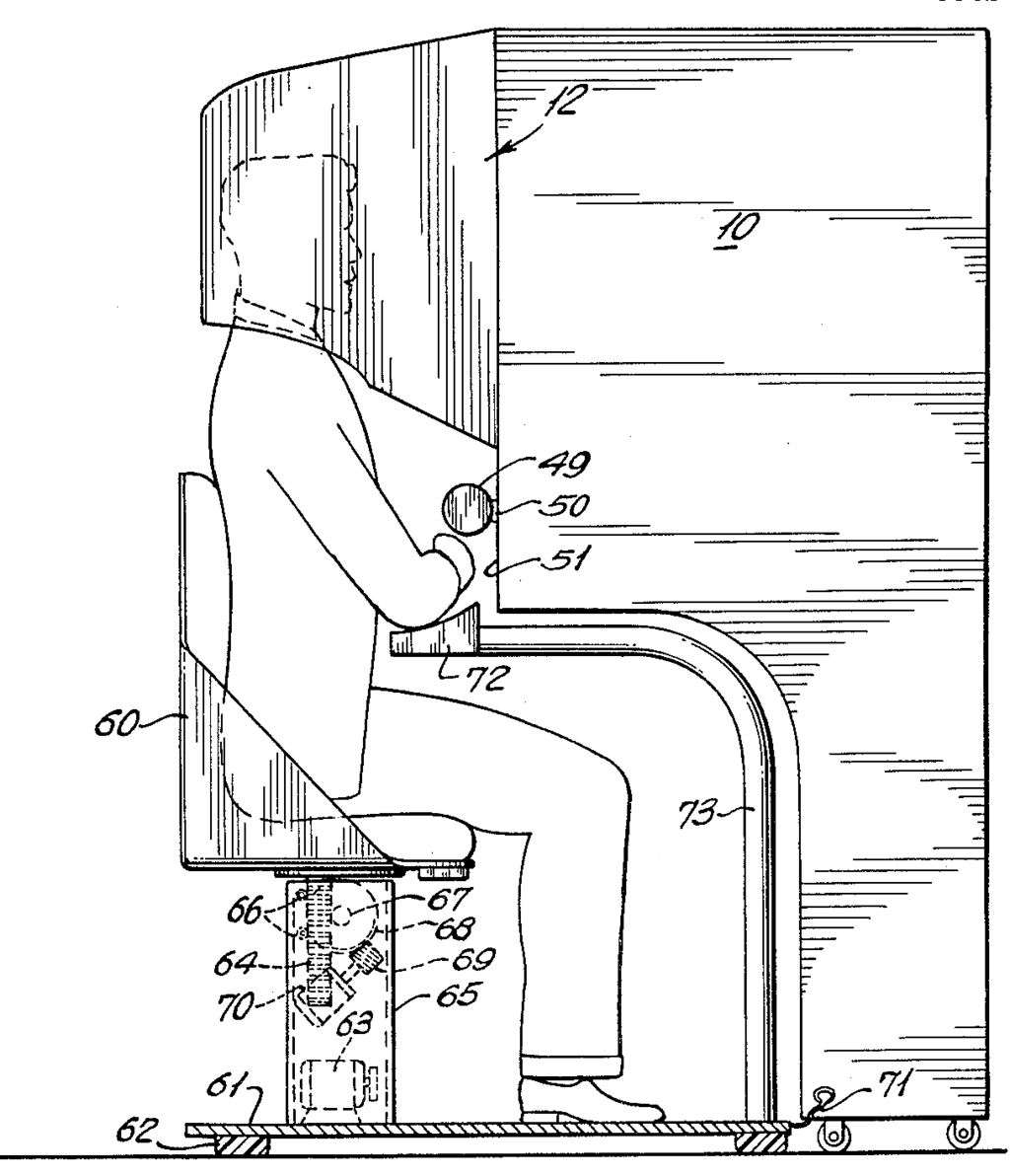
    1957
    The Sensorama by Morton Heilig is considered the first cross reality
    machine. It provided visuals, sounds, vibrations, and smells.

    Side view diagram of the Sensorama patent filing. Device surrounds the users head with images and sound.
    Sensorama patent filing diagram, side view.

    1958
    I cannot resist including this image of an electric typewriter because
    use of text is a common theme that carries through our history of XR and
    I do believe it will continue into the future. What is interesting is
    the boast that her grades will improve by 38% if you buy her an electric
    typewriter. Her grades will improve in what…typing class?

    Typewriter advertisement saying that a student's scores increase after using their typewriter.

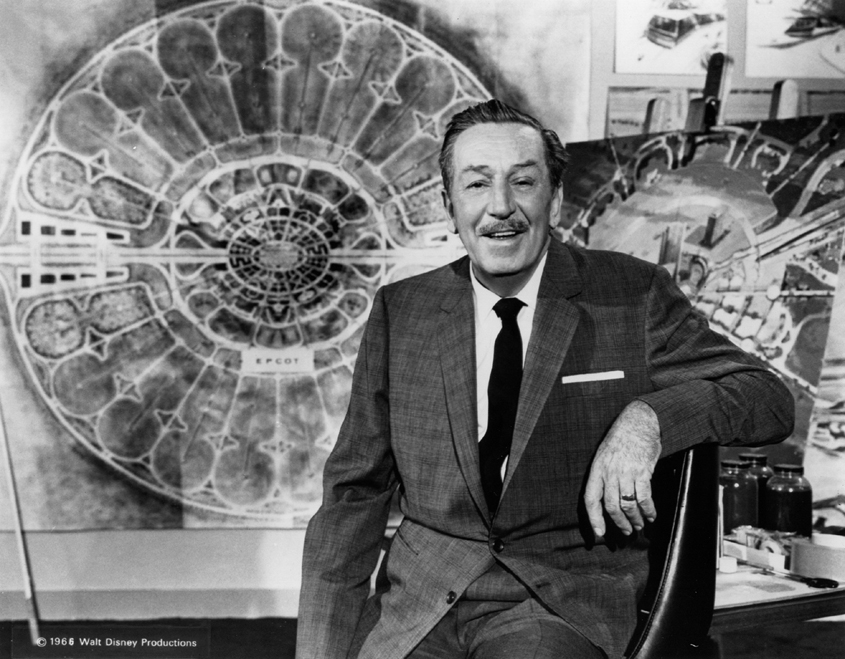
    1960 No history mentioning futurism would be complete without mentioning Walt Disney. 

    Photo of Walt Disney in front of a concept map for Epcot.
    Source: expolounge.blogspot.com

    In
    addition to his many other achievements, Walt Disney was a visionary
    futurist and he did not stop with just dreaming; he set in place plans
    to create the future. This particular image is associated with his plans
    for EPCOT, his Experimental Prototype Community Of Tomorrow. I’d like
    to point out that this image is from 1960 when Walt Disney was also
    planning his displays for the 1964 World’s Fair (what would become It’s A
    Small World and The Carousel of Progress). Walt never lived to see
    EPCOT open but his flair for looking into the future appeared in the
    rides as I will show in a future article. At this point, we note that he
    looked at the future with ideas about community, centralization of
    services, and the importance of neighborhoods.

    Also in 1960, the first videoconferencing was conducted. This gives us the sharing of live video and audio.

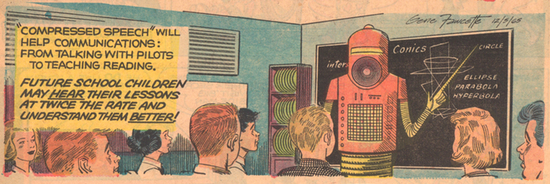
    1965 This paleo futuristic cartoon seems to predict a dire future of robots giving instruction. 

    Comic strip style art with a robot teacher in front of a class.
    “Robot teacher from the December 5, 1965 edition of the Sunday comic strip Our New Age” Source: Novak Archive.

    But
    look closely at the prediction: “Compressed speech will help
    communications. From talking with pilots, to teaching reading. Future
    school children may hear their lessons at twice the rate and understand
    them better!”

    Did they get that wrong? Ever noticed this choice at YouTube? [I’m not implying that learners can learn at a higher speed, I’m pointing to the availability of speeding up videos– a different thing altogether.]

    Capture of YouTube playback speed controls showing faster than 1.0 speed choices.
    YouTube playback speed choices

    1966 Have another cartoon prediction.

    Comic strip single panel with text
    Source: http://publicdomainreview.org/collections/france-in-the-year-2000-1899-1910/

    “By
    2016, man’s intelligence and intellect will be able to be increased by
    drugs and by linking human brains directly to computers.” 

    Well, my intellect is increased by coffee. I won’t speak for you.

    Part 1 380 B.C. to 1880 

    Part 2 1881 to 1909

    Part 3 1910 to 1965

    Part 4 1966 – 1998

    Part 5 1999 – 2013

    Part 6  2014 – Future

    #Reality
    #CrossReality #MixedReality #VirtualReality #AugmentedReality
    #VirtualWorlds #Design #Transmedia #XR #VR #AR #ARVRinEdu #EdTech
    #Innovation #Change #WaltDisney #Epcot #ProgressCity #JeanMarcCote
    #CigarBox #Year2000 #PaleoFuture #Sensorama #ThomasEdison


    This article originally posted on LinkedIn on November 29, 2021. Updated February 24, 2026 with a better font and re-added images.

  • A History of XR Cross Reality Part 2 of 6

    A History of XR Cross Reality Part 2 of 6


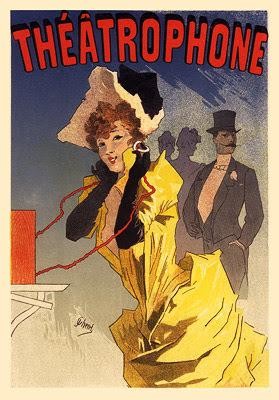
    Poster advertising the Theatrophone, a way to listen to a live theater show from another location.
    Jules Chéret, Public domain, via Wikimedia Commons

    As a reminder, we are using science fiction as our time
    machine vehicle to examine how good we are at predicting the future and
    our intention is to predict the future of cross realities (XR).

    1881 – 1909

    1881
    – The invention of the theater phone (theatrophone) allowed users to
    listen to the live opera from a location up to 1 mile away from the
    theater. So you do not have to be there to be there.

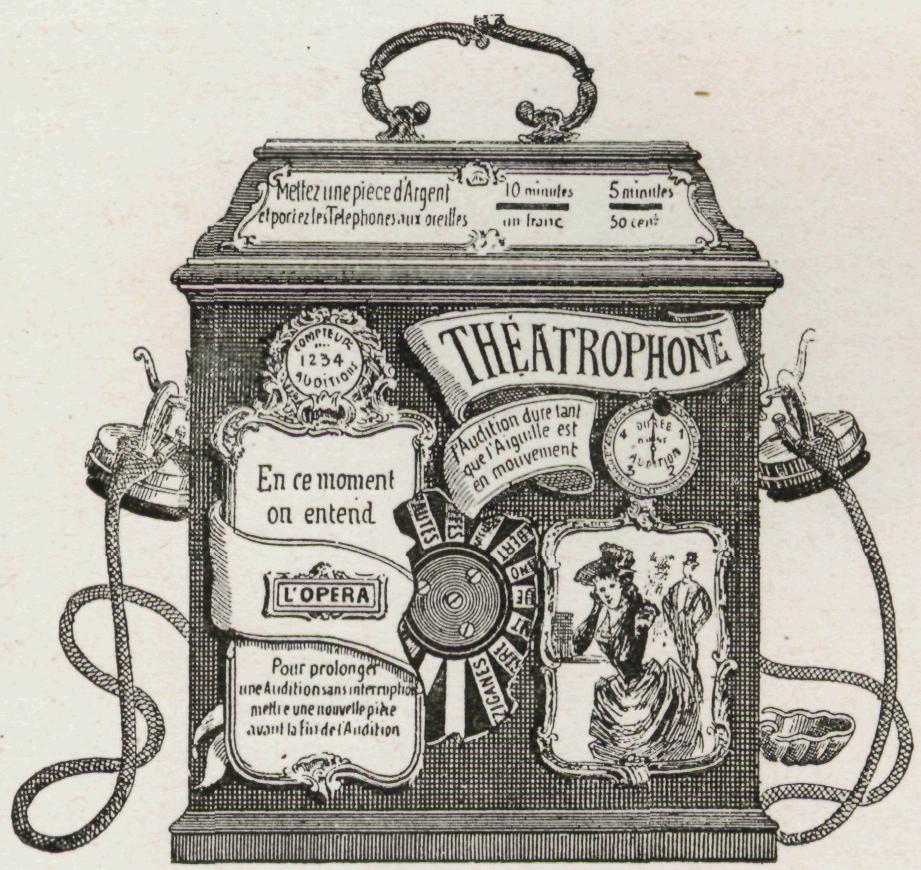
    Artwork by an unknown artist showing a mini theater inside of a phone to advertise the theater-phone concept.
    Münzbetriebenes Empfangsgerät des de:Theatrophons. Circa 1892. Work is considered to be in the public domain in the US.

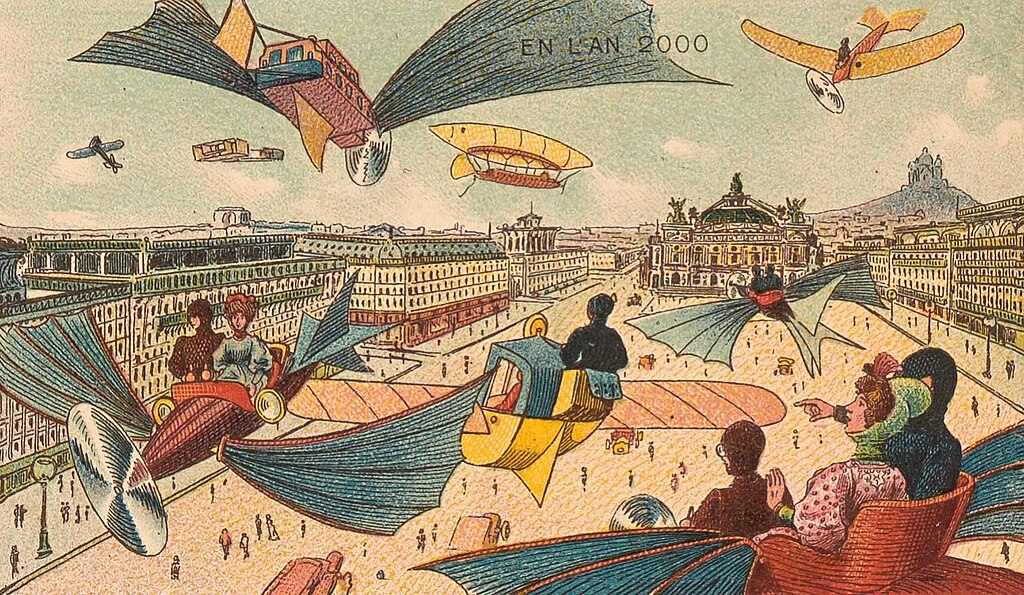
    1882 Paleo futuristic image showing opera attendees in the future year 2000.
    In case you are checking your watch, that’s 2 decades ago as of this
    writing. Did I miss fish cars? Lizard cars? Actually, never mind. I
    don’t think you’d find me going to the opera regardless of the kind of
    car.

    Art by Villemard, comissioned circa 1910 for cigar boxes, showing how people will attend the opera, in flying cars, in the year 2000.
    Villemard, Public domain, via Wikimedia Commons

    1895
    H.G. Wells published The Time Machine as a dystopian future view. Wells
    was living in rural England and was seeing the industrial revolution
    expand. He saw large factory cities swallow up young workers for long
    hours in dark conditions and producing to satisfy an seemingly
    insatiable consumer. He looked forward and saw a future where humanity
    would become split into two groups that would almost would never interact.

    Book cover for The Time Machine by HG Wells
    Author Herbert George WellsPublisher William Heinemann, Public domain, via Wikimedia Commons

    On
    the surface was a Greek god-like existence of Eloi. They all looked
    alike. (Shivers.) This group would be the consumers. They would benefit
    from this world order but simultaneously be oblivious to the price for
    their existence. They would be a small group, the 1%.

    The
    underground dwellers, the Morlocks, would run all of the machinery. They
    would be the producers, and the generations of being underground would
    allow for adaptations of evolution including large eyes, intolerance of
    sunlight, and flesh-eating.

    E.M. Forster read The Time Machine and rejected this future that H.G. Well foresaw.  

    However,
    before we get to Forster’s publication, we visit one other futurist. In
    1901, Frank Baum (of The Wizard of Oz) published The Master Key which
    contains the first known reference in writing to what we would recognize
    today as augmented reality:

    Book cover for The Wizard of Oz.
    William Wallace Denslow, Public domain, via Wikimedia Commons

     “On
    the other hand,” continued the Demon, “some people with fierce
    countenances are kindly by nature, and many who appear to be evil are in
    reality honorable and trustworthy. Therefore, that you may judge all
    your fellow-creatures truly, and know upon whom to depend, I give you
    the Character Marker. It consists of this pair of spectacles. While you
    wear them every one you meet will be marked upon the forehead with a
    letter indicating his or her character. The good will bear the letter
    ‘G,’ the evil the letter ‘E.’ The wise will be marked with a ‘W’ and the
    foolish with an ‘F.’ The kind will show a ‘K’ upon their foreheads and
    the cruel a letter ‘C.’ Thus you may determine by a single look the true
    natures of all those you encounter.”

    “And are these,
    also, electrical in their construction?” asked the boy, as he took the
    spectacles… All character sends out certain electrical vibrations, which
    these spectacles concentrate in their lenses and exhibit to the gaze of
    their wearer, as I have explained.”

    “It’s a fine idea,” said the boy; “who discovered it?”

    “It is a fact that has always existed, but is now utilized for the first time.”  [A wonderful Wizard of Oz-like sense of humor. Making fun of the fantastical, but obvious.]

    In December 1909, E.M. Forster publishes The Machine Stops. If
    you have a chance to read it, I encourage that. It is a remarkable
    story. If you substitute “the Internet” for “the Machine,” the story is
    eerily accurate in some predictions of humanity. There is also very
    interesting economy where humanity values the exchange of ideas above all other concepts (cough, Instagram, Twitter/X, Mastadon, Bluesky, etc.).

    Short summary:

    In
    the future, everyone lives underground in these large columns of cells
    because the surface is inhabitable. Each person lives in a cell that is
    of a small defined space, one person per cell. The collections of people
    are like bee hives. Everything a person needs to live is brought to
    them in their cell by the Machine. Food, air, water, and once a day the
    cell (and the person) are washed clean. The humans never meet or touch
    in any way. They listen to concerts, speeches, and read books.  

    The
    plot of the story unfolds with a son that yearns to escape to the
    surface world; he believes it might be inhabitable and as such, holds
    new promise for humanity. At first, he tells his mother about his desire
    to leave via the Machine (a progenitor to Skype?) but the Machine,
    intercepting the message, always fuzzes out when people express
    unhappiness with the current order of things (cough, Facebook experiment).
    Thus, the mother does not understand her son’s intent. She tries to
    dismiss her worries. The son becomes insistent and travels to visit his
    mother in person. When they meet, the mother is bothered by human touch.
    He insists that he’s been on an exploratory climb and that he knows
    other youth that are going to leave too. She will not leave the hive,
    she cannot understand why anyone would leave the Machine. He leaves and
    finds a livable world on the surface. The Machine, without humans to
    service it, eventually breaks down and everyone remaining underground
    dies; not because they are unable to leave, but because they lack the fortitude to do so

    Forster’s future vision does not have cannibalism but it highlights an amazing weakness; that the more humans depend on machines, the less human we will essentially become. Forster seems to argue that the human connection to the natural world is our salvation; a lesson not lost in 2019.

    You’ve
    finished a great deal of time travel but this was the slowest feeling
    part of our journey. We’ll start speeding up in Part 3 which will
    publish on November 29, 2019.

    Part 1 380 B.C. to 1880 

    Part 2 1881 to 1909

    Part 3 1910 to 1965

    Part 4 1966 – 1998

    Part 5 1999 – 2013

    Part 6  2014 – Future

    #Reality
    #CrossReality #MixedReality #VirtualReality #AugmentedReality
    #VirtualWorlds #Design #Transmedia #XR #VR #AR #ARVRinEdu #EdTech
    #Innovation #Change #HGWells #EMForster #TheMachineStops #TheTimeMachine
    #TheMasterKey #FrankBaum #TheaterPhone

    Originally posted in November 2019. Updated on February 24, 2026 with changed font and re-added images.

  • A History of XR Cross Reality Part 1 of 6

    A History of XR Cross Reality Part 1 of 6


    Decorative image showing scenes from the history of XR: Athens, The Aztec sun stone, and the Microsoft Hololens.

    “The longer you can look back, the farther you can look forward.” ~Winston Churchill.

    This
    the first of six articles describing a history of cross reality,
    otherwise known as mixed reality or XR, which encompasses the fields of
    virtual reality (VR), augmented reality (AR), and virtual worlds (VW). I
    have used the lens of science fiction as my time travel machine. This
    is not meant as an exhaustive history, as I purposely chose my timeline.
    Also in this effort, I engaged pattern-seeking from design research to
    sharpen my prediction skills.

    These articles started with two
    recent research efforts: 1) an invitation to present on any topic at a
    local university and 2) a project to forecast the future of XR
    technology. As a result, I decided to craft a story, the history of XR.

    Said another way, there is a reason this article series is called “A History…”. It is because it is one chosen history. 

    There are many possible others. For example, some will trace a purely technological history and start with Morton Heilig’s Sensorama device. Others will trace the use of alternative realities and perhaps start with flight simulators.

    When I went to find the origins of science fiction, my research indicated that I should start first with paleo futurism. Paleo futurism
    is the study of how, in the past, we envisioned the future. Said
    another way, we have guessed about the future before. How good are we at
    guessing? Once I did some research in paleo futurism, I found that I needed to look to utopian/dystopian literature as the origins of alternative realities in human thought.  

    Photo of Athens showing the Acropolis and surrounding trees on the hillside.
    Photo by Constantinos Kollias on Unsplash

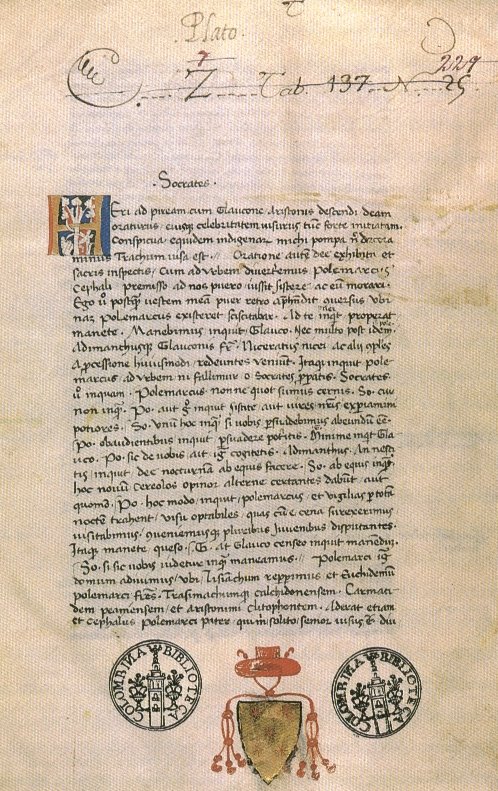
    That brings our time machine’s first stop back to 380 B.C. and Plato’s Republic.

    Photo of a page from Plato's Republic.
    Public Domain, https://commons.wikimedia.org/w/index.php?curid=1181161


    This
    is argued to be the first instance of humankind writing about an
    alternative reality for themselves. Plato focused this reality not on
    city planning or public education, but on the concept of justice. Plato
    pitted 4 different definitions of justice against each other to see how
    humanity fared. At least up until 1900, it is a very strong bet that
    the rest of our science fiction sources know of this foundation.

    (Note:
    there may be non-Western roots of alternative realities that go further
    back than 380 B.C. My choice to start with Plato simply reflects a place
    where I was comfortable starting.)

    Our next stop is the early 1500s A.D. What was happening on Earth?

    Columbus
    had made 2 journeys to the “New World” Undoubtedly, knowledge that new
    lands had been discovered was spreading across Europe. The slave trade
    had begun.

    Drawing by Theodor de Bry, dated 1594 of Columbus discovering the New World. It depicts a tonal drawing of a single armor-clad person looking out into a sea-serpent-filled ocean towards distant lands.
    Bry, Theodor de,, Public domain, via Wikimedia Commons

    The Pacific Ocean had just been discovered.

    Globalism is on the rise. Colonialism is not far behind.

    In
    1516, under King Henry the 8th, Brian Tuke was established as the first
    Master of the Posts, the progenitor of the Royal Mail.

    In Germany, a law established that only water, barley, and hops are the allowed ingredients to make beer.

    In
    China, the Nantan meteorite fell to Earth. The fall of this meteorite
    was eye-witnessed by a farmer in a field and it was a rare iron-nickel
    meteorite.

    One of the final battles for the Holy Land was won by the Ottomans, establishing the Ottoman empire.

    The
    Aztecs were in their post classical period. This image is from the
    Aztec sun stone, showing the belief in a cyclical calendar. We’ll see
    cycles later as a key to prediction.

    Photo of the Aztec Sun Stone, thought to have been carved around 1521.
    Gary Todd, CC0, via Wikimedia Commons

    The
    first social housing was established in Bavaria—which still exists
    today. Originally to live here, you had to have been a city resident for
    the two prior years, have no source of income, and be a
    Catholic. Widowed mothers were the primary residents.

    In Venice, the first Jewish ghetto was established by law.

    In
    Florence, the first uffizi (office) was established for workers to come
    to on a daily basis to do their work for the first “corporation.”

    Photo of the Firenze in Florence, Italy. The text argues that this was the first office.
    Txllxt TxllxT, CC BY-SA 4.0 <https://creativecommons.org/licenses/by-sa/4.0>, via Wikimedia Commons


    I’ve brought up all of these elements to show that humanity was in flux, in a period of change when new ideas were flooding many different cultures.

    Then, in 1516 Thomas More published Utopia, the progenitor of science fiction.

    Photo of an original version of Thomas More's Utopia book.
    The Folger Shakespeare Library, CC BY-SA 4.0 <https://creativecommons.org/licenses/by-sa/4.0>, via Wikimedia Commons

    As
    I researched, I learned that the definition of utopia was not our
    current meaning of perfection or “Eden.” Thomas More intended “Utopia”
    to mean “nowhere” or “a place that does not exist.” The book was a
    commentary that both supported and criticized socialism. Utopia had a
    ruler for life but after he died, there is an election for a new
    ruler. There was shared work, food, clothing, land, etc. Punishment for
    crime, however, was severe. We would not recognize More’s concept of
    justice today. Residents dug away at a peninsular to form the island of
    Utopia. Interestingly, Utopia is not isolated for there are still ships
    to other nations. 

    The very next year after Utopia was published,
    Martin Luther nailed his 95 theses to the cathedral door and Canada was
    discovered via the St. Lawrence River. This was a world deep in
    change: new worlds, new religions, globalization, and also segregation
    and slavery.

    So we have our foundation of humans engaging with alternative realities. On to Part 2.

    Part 1 380 B.C. to 1880 

    Part 2 1881 to 1909

    Part 3 1910 to 1965

    Part 4 1966 – 1998

    Part 5 1999 – 2013

    Part 6  2014 – Future

    #Quotes
    #WinstonChurchill #Reality #CrossReality #MixedReality #VirtualReality
    #AugmentedReality #VirtualWorlds #Design #Plato #Republic #Utopia
    #ThomasMore #1516 #Transmedia #XR #VR #AR #ARVRinEdu #EdTech #Innovation
    #Athens #Globalization #Change


    This article was originally posted to LinkedIn on November 17, 2019. Updated on February 24, 2026 with some slighted clarified writing, changed font, and re-added images.

    (more…)