Tag: Headset

  • 2021 Bests and Worsts

    2021 Bests and Worsts


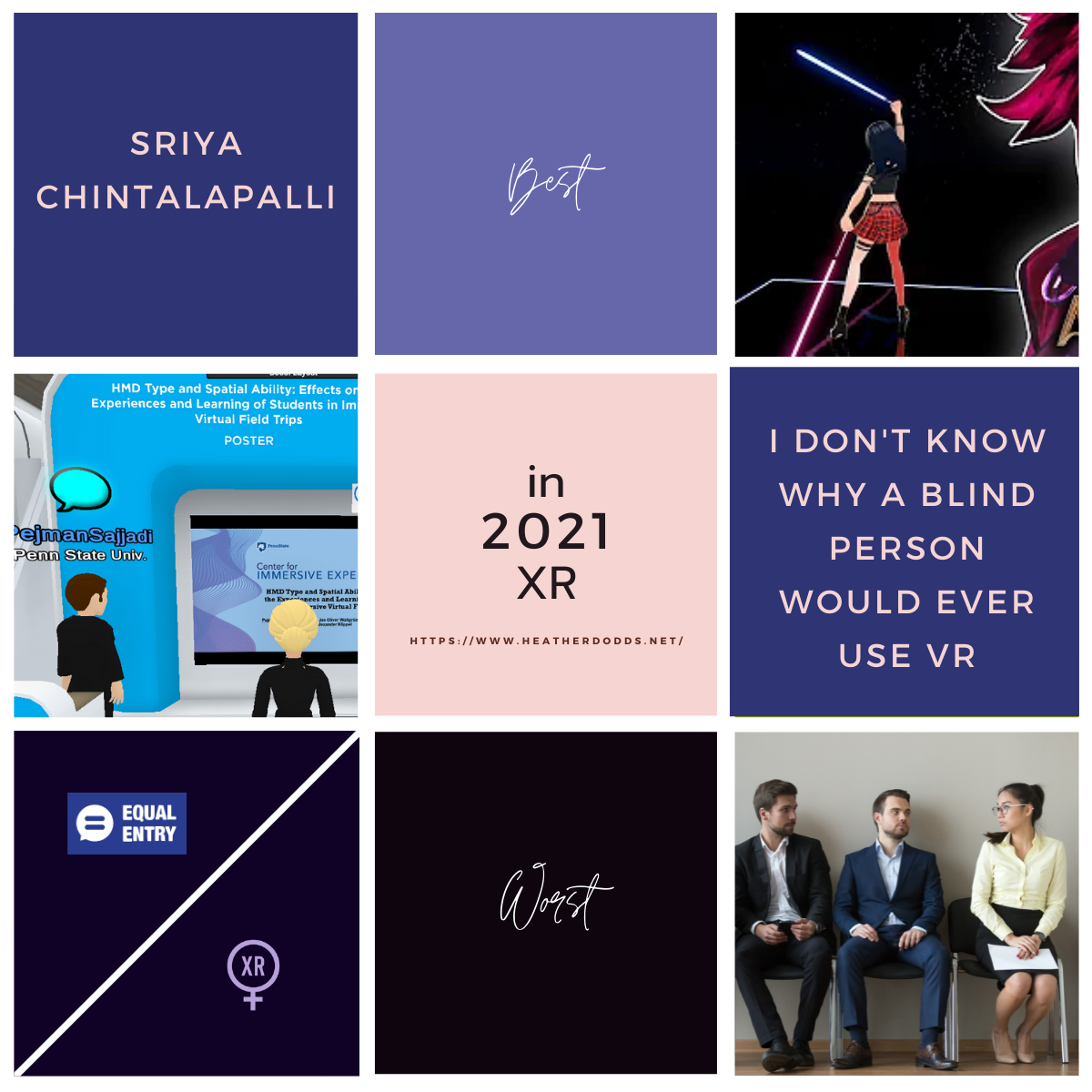
    I drew up my list of Best and Worst for 2021 and to make it balanced, it has 3 on each side. Here we go:

    Best

    1. Meeting Sriya Chintalapalli.

    I count meeting Sriya as a golden moment of 2021.  I actually haven’t had long chats with her. But I was given a small heads-up for a student XR conference that I was supporting that a speaker was coming that was going to be amazing. I think the ‘knock socks off‘ phrase might have been used. I was under FERPA regulations to know that she needed extra protection at the conference and I volunteered to give it. That means I stood on the virtual stage with her, playing the role of direct tech support but also crowd control if necessary.

    But what did happen meant something much more to me.

    Sriya gave her presentation. It was a great topic and very forward looking. Then, she took questions from the audience. Because the topic was on brain-computer interfaces (BCI), it didn’t take long before questions of invasion of privacy questions came from what were obviously professors in the audience.  

    I’ve seen these verbal examinations before. I’ve seen them break college seniors and Master’s Degree students. It’s just enough questioning to find where the student does not know the answer. That’s the push point. Several men in the audience were going right for her, directly and academically.

    Standing on stage with her, without her knowing it, I would have thrown up a shield if she needed it and blocked those men from getting to her/embarrass her/humiliate her by making some excuse that we’d run out of time, audio wasn’t working, etc.

    But, she held the stage. She held her ground. More than once she said “The data doesn’t say.”  

    Good line! Don’t let them pin you where you have not staked a claim.  She’d been trained well to enter an academic fight.

    When she was done, I let out my breath.

    Were those men plants in the audience? Not sure. Maybe. Either way, my hackles were real.

    And the lesson for me that day was: if I can do anything to help women like Sriya…even if it is only shouting “Make a path!“, I will.  It’s very hard to be a woman in the technological sciences. The road ahead will shape her in ways I’m sorry to contemplate. May she always find a woman like me standing by, ready to help.  

    Please follow her. Great things are ahead.

    2. A small unheralded research paper, HMD Type and Spatial Ability: Effects on the Experiences and Learning
    of Students in Immersive Virtual Field Trips.

    I was able to meet the first author, Pejman Sajjadi, at the IEEE VR conference in March/April 2021 in avatar form here. This small piece of research stayed in my mind all year as a great example of the piecemeal way that scientific research works its way slowly towards practitioners and teachers.
     

    The write up of this study is pay walled behind IEEE, I believe, and Pejman would be the first to point out the small sample size. Therefore, there was no fanfare and no social media on this paper. If you look at his research background, what you see is this paper is just one of several papers generated from one research event, so it’s pretty generic par-for-the-course research.
     
    Taking into account all those discount factors, this tiny study investigated something that teachers do really want to know:   
     
    Are expensive VR headsets worth it?
     
    The answer is no.
     
    There is much more to the no, of course, related to content, learning objectives, scalability, etc. But more so than ever in 2021, educators turned to VR as a more realistic mainstream learning choice. The price drop of the Oculus Quest 2 to $299 and further, the Facebook push for the work use of Workrooms to bring VR use directly into the workplace show that we are going to have to get more and more comfortable with VR headsets and quality will be a question.
     

     (Image source: https://about.fb.com/news/2021/08/introducing-horizon-workrooms-remote-collaboration-reimagined/)

    Quietly researched, small sample size, no social media presence.  
     
    But bit by bit, researchers are answering these questions. I hope teachers are listening to the work of Pejman.

    P. Sajjadi, J. Zhao, J. O. Wallgrün, P. C. La Femina and A. Klippel,
    “HMD Type and Spatial Ability: Effects on the Experiences and Learning
    of Students in Immersive Virtual Field Trips,” 2021 IEEE Conference on Virtual Reality and 3D User Interfaces Abstracts and Workshops (VRW), 2021, pp. 546-547, doi: 10.1109/VRW52623.2021.00155. https://ieeexplore.ieee.org/abstract/document/9419337


    3. Equal Entry and XR Women 

    It’s a tie! Both organizations work for similar goals: 
    • Equal Entry has a strong drive for accessibility and has a section of work dedicated just for VR, AR, and XR.
    • XR Women‘s mission is dedicated to getting women’s voices up on stage as part of the narrative about the ongoing and future directions of XR.  
    • Both organizations stay focused on their task and welcome listeners, newcomers, and allies.
    Both groups alike are working on accessibility into the coming metaverse for all.  I applaud their efforts.
    Now time for the worsts.  Is worsts a word?  You will notice a theme from the Bests that carries through.  Here it comes…

    Worst

    1. Not necessarily restricted to 2021 sadly, say the phrase “Women in XR” and you will likely get this image:

    Or this one.  That’s not even a woman on the right. #dehumanizing means you treat women like animals.

    Actually, as I prepped for this article, I went to find one screen capture of a woman in a short skirt playing Beat Saber so that I could use it as a example of a poor behavior.  I thought finding one image of a woman in a skirt would be hard. I had remembered seeing one.  
     
    Much to my shock and horror, it turns out….it was drop dead easy.  So easy, nearly EVERY image on YouTube for playing Beat Saber is of a young female scantily dressed.  Check it out:

    I counted ~9 images of women playing with either bare legs, bare midriffs, sports bras, etcs, for every 1 man.
    Think that’s a coincidence?  Oh no. It’s BY REQUEST.  Look video info at the bottom of this image I just posted above again.
     
     
    It says:
     
    “Song + Outfit per George T’s request! To request songs & outfits/costumes become a Patron at…”

    This woman is taking money to have herself videoed/green screened playing Beat Saber in a short skirt.  Don’t tell me that the Patron isn’t begging for that skirt to fly up at some point. I know what you can see through that black skirt by outline.  In these videos, women have not only lost body space control, they are selling it.

     
    It’s disgusting. And this is ALL OVER YouTube.  There’s a research project in there to count the views of Beat Saber videos without skirts versus those with.
    Remember that the Quest 2 was a major Christmas gift for 2021 and your daughters are now –January 2022– watching YouTube videos to learn how to get better at Beat Saber.  Is getting better at the game the only thing they are learning?
    Think that this is just about fun, though?  Really? Did you read what happened at late 2021 a technical conference ad?  Reminder: Major “Game” conference, no women speakers on the ad, and a sexbot prominently featured. This is what women in tech are facing when we “go to work.”

    Women have been getting groped at tech conferences during large standing-room only keynotes. It’s real that women feel less comfortable in HMDs because they give up body space control. 
     
    At any conference right now, by putting on a headset, women take a risk that men do not.

    2. Major immersive learning researcher responds to an accessibility question with “I don’t know why a blind person would ever use VR.”

    I was running tech support. I was on mute. I sputtered.  But the researcher’s mic was hot. The video caught that…I think. It’s out there.  
     
    But what does that matter if it’s on video or not, if the researcher truly thought that?
     
    I don’t even know what to do with that.
     
    Major. US. Immersive Learning Researcher.  
     
    😔
     
    By the way, for you, reader,  in answer to the question, contemplate this:

    Screenreader Experience of a Virtual Reality Conference by Rhea Althea Guntalili

    and  

    Virtual Reality in the Dark: VR Development for People Who Are Blind | Accessibility VR Meetup Recap by Aaron Gluck (YouTube link and transcript available at this link)

    3.  Microaggressions against women in the XR industry
     

    I left 3 organizations in 2021 and am no longer associated with them. It’s apparent now that I could not stand up for the rights of women and for accessibility in XR without being targeted myself.
     
    “A microaggression is a subtle behavior – verbal or non-verbal, conscious
    or unconscious – directed at a member of a marginalized group that has a
    derogatory, harmful effect. Chester Pierce, a psychiatrist at Harvard
    University, first introduced the term microaggression in the 1970s. ” https://www.thoughtco.com/microaggression-definition-examples-4171853
     

    The last organization I left questioned if I was a dues-paying member, so they used an institutional rule to execute an exclusionary move.

    We’ve heard about headset straps that do not adjust for varying hair styles. Women and people with disabilities that are not recruited into research studies so that research results are invalidated when applied to major populations, conferences that not only host but advertise manels with sexbots, and the list keeps going already 7 days in 2022…
    😔
     
  • The Future of XR Headsets

    The Future of XR Headsets


    Photo by Drew Graham on Unsplash


    I’ve been working on a project to predict the future of XR technology
    within a 5-10 year time frame. That means I’ve been reading research
    reports, digging through Twitter posts for conference photos, and
    reading thought pieces by some of the most valued opinions on XR in
    industry and education.  

    Simultaneous to this project, I’ve been brushing up my skills in User Experience (UX) and my most favorite, Design Thinking
    One of the most fun aspects of Design Thinking is that I’m allowed to
    let my inner empath run on full tilt. And it’s really great to let your
    emotions run through bunny-filled sunshine meadows and just see what
    she has to say about anything and everything.  Let me tell you: she has
    some real opinions on XR headsets. And almost ALL of those opinions
    come from the images being used to portray headsets. Come along on this
    mystical magical ride of the visuals of headsets.

    At the end of
    the journey, I will make a prediction about headsets.  And as with
    every project of mine, I’ve figured out how to work Disney into it (as much as possible).

    As our starting point, I’ll state something very strongly.   I’m sick of headsets where people are supposed to be wowed by XR.  To
    be realistic, 90% of XR headset images are these. I’ve gathered these
    images from across the internet and to preserve some degree of
    anonymity, I’m NOT providing the reference location.  I’m not trying to
    make fun of people. Please be clear on that. I’m commenting on *how we
    are portraying XR to others* to, supposedly, encourage others to join
    us in XR.

    Unknown person expressing surprise while wearing a VR headset and earphones. Her hands and fingers are spread wide, her mouth is agape.

    So
    we have the “Oh my I’m surprised!” look. I think that’s what this photo
    is trying to say. It’s possible she was frightened, but more on fear in
    a little bit.

    No alt text provided for this image

    Honorable
    mention in this category: hipster dude
    looking…uh…surprised. Actually, he looks ‘tired and being forced to
    look surprised’ but that could just be me overlaying college student
    thoughts onto this photo.

    The next one we have is the *very*
    ubiquitous “Hey, we’re trying out headsets…somewhere.”  I’ve got about
    10 of these photos collected.

    No alt text provided for this image

    So
    they are all smiling and facing the same direction.  We’re supposed to
    like that, right? Uh, remember that those headsets are designed to cut
    off all vision except that which the designer wants you to see and those
    are four women standing really close together in a public place.  Where
    is everyone’s hands? How did they know to stand that close together?
    They were probably prompted and stood close together and *then* put the
    headsets on. Yeah, that’s realistic. Is it any wonder that women, in
    particular, note less comfort with XR?

    Hey here’s a few more.  Do you want to try yet?

    No alt text provided for this image

    I’m
    solo and still comfortable standing here showing you this thing. 
    Wait…are you still there? Did walk away? Oo, a whole new way to
    indicate non-interest at vendor tables if every vendor wore one!  I
    might like this.

    No alt text provided for this image

    We are friends and happy even though we can’t see each other…and you!

    It’s a coincidence that those last two were Magic Leap.  I’ve got nothing against Magic Leap.

    Before we leave the emotional theme of happy, catch this image *from a real article*.

    Hello Clarice.

    I
    am so creeped out by this.  If you don’t see it, look closely at the
    mouth.  Where is the mouth???? Why is the mouth from someone else????
    Ah, the Hannibal Lecter of XR images.

    And finally, before things get better, just remember that your XR headset isn’t this.

    No alt text provided for this image

    I got nothing for this.  It’s so…nope…nothing.  Someone help her.

    So
    back to the topic of the future.  I’m asked occasionally which
    technologies to invest in over the 5-10 year time frame that are winning
    bets for XR.  I’ve got a multiple-part article series coming on how I
    arrived at my conclusions, so stay tuned for that. However, the more
    XR headset images I’ve seen (like all of those images above),
    the more I think we are doing a very poor job enticing new users into
    XR.  I feel like we are hitting all the wrong notes.

    The more and
    more I thought about what disturbs me about these headset images, the
    more I realized that I saw a theme to headsets where I’m like ‘Yes, I
    would try that,” and “Nope, I would not try that.”  And here is a hint
    to the theme:

    Graphic image of The Incredibles Family wearing masks over their eyes.

    Recall the custom that some fiction writers use to disguise some superheroes: they mask their eyes. 
    If the eyes are covered, we can’t completely know who it is. By day,
    it’s just mild mannered Clark Kent.  He can’t possibly be Superman.
    Think that premise is just in stories? We block off someone’s eyes when
    we want them to have anonymity in photos/video, etc.  It seems we humans use eyes as our ultimate identification card.

    While
    headsets in VR are designed to take the user to different places and
    times to experience the normal and phantasmagorical (<-love that
    word), they do so by cutting off all view of the current space the user
    is in.  That’s on purpose. I got no beef with that. We have data that
    these headsets *can* generate empathy. Great! I buy that too.

    My problem is what if empathy when involving headsets is a two-way street?
     What if I cannot believe that the user is truly impacted by an
    experience until I see their eyes?  Isn’t that the problem with all of
    the prior VR headset images? You cannot see the user’s eyes. Ooo, so I
    have hit on a real tech problem here.  If I want to see the user’s eyes
    and yet the user needs to see nothing of the real world in order to be
    immersed in virtuality, how do we solve that problem?  Right now,
    headsets cannot answer to both sets of demands. However, I have also
    never met a tech problem that hasn’t been able to be overcome.

    The short term solution is already at hand and I’ve been discussing it on LinkedIn:

    • The
      solution is that immersive headsets (mostly for VR, VW, and games) will
      do what they do best with full immersion.  Said another way, Magic Leap
      and Oculus Quest– if they pursue full immersion activities, will be
      fine. We hope that the users are in a safe space with assistance
      available in case they fall or need some body space security.
    • The
      solution is also that AR headsets (which are not designed for immersion
      but for information display) will focus on information display.  Since
      AR is not quite pulling on the emotions as VR, it’s not as important to
      see the user’s eyes but, bonus points, I can see them.

    My favorite headset therefore is…Microsoft Hololens
    It allows me to see the user’s eyes. It also has the body profile of
    safety glasses (a familiar pattern).  Also I believe that Microsoft is
    following their own playbook that worked for Office Suite and they are
    pumping the Hololens into the business market *first* and that will
    create back pressure through education. (i.e. we’ve got to get some
    Hololens headsets because our graduates will go out to work X job and
    will be expected to have experience in headsets as part of the job
    requirement.)

    Said another way, as of today, let AR headsets do AR and let VR headsets do VR.  Never the two shall meet. Until…

    The future can and will contain headsets that will do both.
     That’s my prediction.  A user wearing AR technology will find their
    way to their subway train, sit down, and switch over to a VR scene of
    the latest episode of the Mandalorian. 

    OK, I realize it won’t be
    *full* immersion but I think the tech is going to get better (refresh
    rates, etc.) and users will accept non-full immersion. What makes me
    predict that? I’ve been a glasses-wearer since kindergarten. Ask me if
    it bothers me that about 30% of my field of vision at any given moment
    is not in focus. Answer: Nope. Users will accommodate to non-immersive
    VR.

    Once at their destination, the headset will fade down the
    immersion and fade up to a map to a restaurant and some jazzy music (or
    what-have-you-AR-experience-on-demand).  

    How do I foresee that?  As a designer, I look for patterns in what has successfully worked in the past to predict what will successfully work in the future. 
    So what do we have in the past or present that predicts that AR/VR
    combined headsets will totally be a workable thing in the future?

    Two things:

    1. Sunglasses. 
      (Not just regular glasses as I mentioned earlier.)  I see a few
      commentators skeptical how comfortable users will be wearing glasses
      that they *don’t need to*, aka vanity glasses, aka AR glasses, just to
      get AR.  I think it will very much work! Because I don’t think of them
      like glasses…I think of them like sunglasses. Sunglasses are the
      harbinger of wearable tech because as we know, there are many examples
      of people wearing sunglasses for reasons that have nothing to do with
      sun protection.  If people are willing to wear sunglasses at night,
      wearing AR headsets whether or not one is using AR will be an easy idea
      (see: the wearable technology fashion industry).
    2. The ubiquity of
      the smartphone space-wise currently to users’ bodies. I don’t think I’m
      going out on a limb when I say that most users keep their smartphones
      with a meter’s radius of their bodies. As I’ve said on LinkedIn (and I
      should get this embroidered on a cushion), smartphones are the gateway drug for AR. 
      Users are getting very used to having customizable information at their
      fingertips (or voice, as it may be).  Switching from that smartphone
      interface to our vision or auditory range? Easy. Consider it done.

    Until we get to the future, a few recommendations:

    • The emotional nuance possible via XR is stunning.  Let’s stop using fear as our primary XR coinage. 
      (I’m looking at you, Plank.) Emotional reactions such as peace, wonder,
      laughter, curiosity, sadness, and honor all have a place in XR.  Those
      emotions are how you are going to get not just gamers into XR.
    • Stop it with the “I’ve put on a headset and I’m amazed” images. Just stop. I am looking for other
      emotions or events expressed with headsets…it’s just my hobby to
      collect these now. I’ve made my own “wearing a headset and barfing!”
      image. I’m not posting it here yet. You are welcome.
    • Debate
      me!  My opinion has been shaped and formed on this topic over years. 
      But I’m always open to new thoughts and different points of view!  

    What do you think?

    • Did I pick on Magic Leap too much? Maybe.
    • Am I paid to espouse Microsoft Hololens? I wish!
    • What comes after AR glasses? Implants? Already on the way. #omega opthamaltics

    I look forward to your comments.

    P.S.
    I totally held off picking on any LinkedIn personal account photos of
    people wearing headsets.  You are an interesting crowd. On one hand, I
    admire that you are *clearly* sending the message that you are pro-XR.
    Way to go!  On the other hand, you are going to regret that image in 20
    years. I’m just saying. And to the dude’s profile I saw last night
    where you are wearing 3 headsets at once: You, sir, are next level bananas. Carry on.

    #Transmedia
    #virtual reality #virtualworlds #crossreality #mixedreality
    #augmentedreality #design #AR #VR #XR #headsets #images #eyes #wearing
    #Immersion #Glasses #future #Users #Problem #Experience #Technology
    #Emotions #Empathy #Empath #UX #UXinXR #MicrosoftHololens #Disney
    #IllWearMySunglassesAtNight

    This article originally posted at LinkedIn on November 12, 2019

    https://www.linkedin.com/pulse/future-xr-headsets-heather-dodds