Tag: Getting Started

  • Getting Started in WebXR

    Getting Started in WebXR


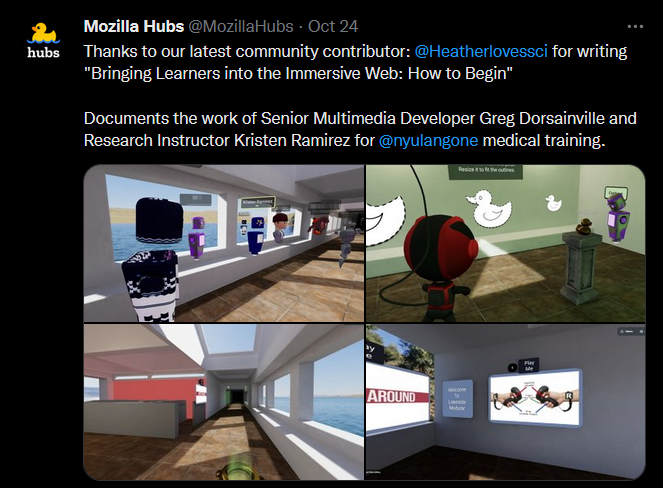
    Tweet from Mozilla Hubs announcing my Creator Labs article Bringing Learners into the Immersive Web; How to Begin"
    Mozilla Hubs put out their social media this week for the article I wrote “Bringing Learners into the Immersive Web: How to Begin” where I described the new user orientation space built by NYU Langone Medical School.
    It was a great example of helping users get started on the basics of entering and moving in WebXR. Their users were in VR headsets but the instructions also apply to WebXR users for the most part.
    The first draft of the article, however, had another focus that doesn’t show up in the final version: the tour that Greg and Kristen took us on and how that tour fit into the Friday Community Meetups hosted by Mozilla Hubs. Matt Cool and I decided that that focus could go into another future article.
    Looking back on the article now since it’s been a couple of weeks since the experience and writing the article, I find the topic very dry.

    Tweet capture of me trying to upspin a dry topic.

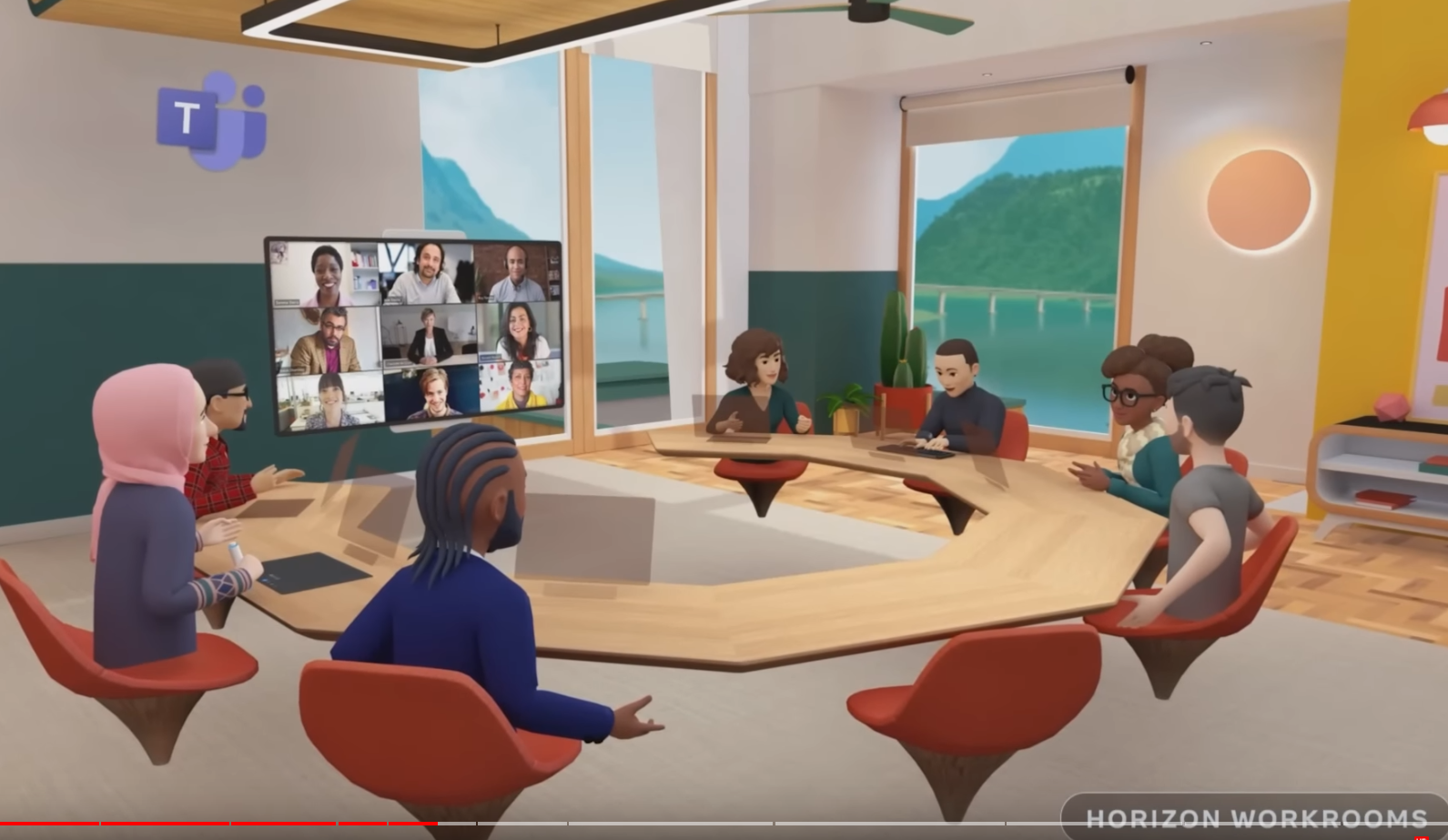
    I’ve engaged in a short conversation – that I’m writing up – about the use of virtual reality offices and what those will be in the future. A Facebook community member bemoaned that Meta showed work meetings happening in work meeting offices. 


    Meta VR Workrooms depiction as of October 2022

     
     She wanted meetings to be held in volcanoes– which brings up a regular decry when something in VR looks new– there will be those who say it’s NOT cool enough. So I went on to explain to her that starting in VR in known spaces like rooms with floors, ceilings, doors, and windows is, IMO, a better idea as it keeps apprehensive (or READ BUSINESS) users comfortable.  With the ‘replication of reality’ of those spaces, users just behave better, then tend to NOT walk into walls, etc. Believe me, that is very important – proper real world behaviors are expected in virtual reality-  because trying to go back in time and remind men that they should not speak openly and derogatorily about women’s avatar bodies is a really hard Pandora’s box to close.

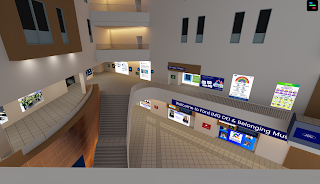
    Then this week, Ford Motor Company just opened their IMG DEI Museum in FrameVR and I took a quick tour. Here are some photos from the space:

    Video of the first few seconds being in the Ford IMG DEI space (no sound, 25 seconds)

    Right off the bat, I liked how they were taking care of what could be first-time-ever XR users.

    They had VERY simple instructions:
    1. Click this link.
    2. An image of the buttons and mouse to use.
    3. A first-person (first-avatar) point of view video of what looking at and entering the Museum looked like, including the ‘floating feeling’ of movement.

    *Note: there is NO acknowledgement or use of avatars in this experience.  So it’s a great example of #MetaverseWithNoAvatars.  You don’t (and can’t) look down at your avatar body.

    So two different WebXR experiences with two different orientations or Getting Started experiences.

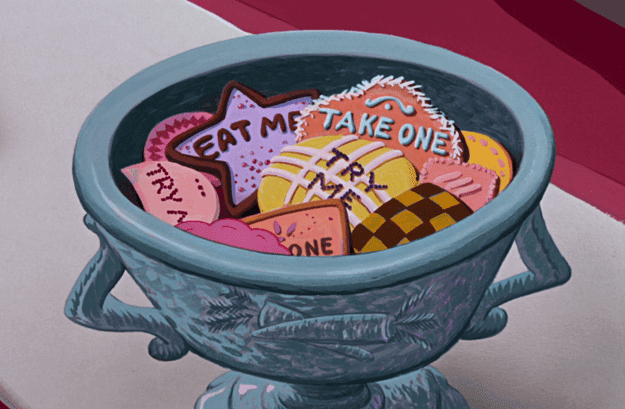
    Technically, I prefer the video approach from Ford over the how-to from NYU. Even though NYU did have this very cute Alice in Wonderland-style of instructions that SHOULD be emulated, (Click me, Watch me),
     
    Disney's Alice on Wonderland Eat Me Cookies

     
    the show ’em what you’ll show ’em style of a quick video (it was 21seconds and could have been shorter!) of Ford’s experience nails the quick intro experience WHILE still taking advantage of the XR space.  (READ: YOU SEE AND THEN YOU DO, there are no other choices.)

    It was nice to compare 2 entry experiences so closely together in time. I’m reminded of a recent quote:


    “Design as if it [the technology] were something speaking to the learner.”
    ~Donald Clark with John Helmer, The Learning Hack podcast, S1E5 Online Educators.

    The video – especially from the eye-viewpoint of the entering avatar nails the intro. Perfect.

  • Best Starting Place for Complete Novices to XR

    Best Starting Place for Complete Novices to XR


    When I’m introducing folks to XR as a designer, I often list the pros and cons of each platform, game, event, etc.  But those words are things I mention and then are lost.  My “Best Of…” post here will be an attempt to document and capture those points.  Mind you, the Best Of [Whatever] does change over time!


    Best first starting place for complete novices in XR

    WebXR, Mozilla Hubs, Apart Gallery by Paradowski Creative. 


    What is it? A art gallergy of 2D and 3D art related to the concept of social distancing during a pandemic. Art focuses on posters hanging on walls throughout multiple rooms (walls, floor, doors, ceiling), art is “propoganda” style related to public health.

    Where? https://apartposters.com/, Select “Visit Virtual Gallery”

    Pros:

    WebXR 

    • you can get there via a browser windo
    • 2D reduces the possibility of vertigo
    • No need to download an app
    • Can get their via mobile, web, or headset (aka no special equipment needed)

    Ease of entry

    • Users are handed a url or link and usually know to single click on that
    • Entering the first time is relatively fast (I think I counted 5 clicks for Hubs)
    • No need to necessarily know in advance who is attending
    • Avatar choices have always included non-binary and non-humanoid choices

    Ease of use

    • Can navigate by keyboard and mouse
    • Teleporting and flying are possible
    • Spaces can be realistic and simplistic
    • Sound works well (few errors)
    • Controls within spaces are intuitive 
    • Spaces can be saved or discarded.

    Best aspects overall

    • Preserves privacy – I would bring ages 5 -105 into these spaces
    • Entry requirements are really low.  Basically need electricity, web browser.
    • Can easily import from Sketchfab repository of 3D objects.


  • Getting Started in XR in Education

    Getting Started in XR in Education


    I’m frequently asked for what do you recommend for those interested in using XR in education?

    I thought I would start gathering resources because the use of XR in education in October 2021 is about where e-learning was in about 2005.  There were a few studies, tons of anecdotal stories, and some general scorn and nose wrinkling in the direction of e-learning at that time. It is just the same point in the adoption of XR, immersive learning, virtual reality, or the metaverse in education.

    We do have some good ideas how to use XR and I’ll boil down my 13 years of experience to two statements to make this REALLY simple.

    Rule #1: XR will, eventually, score equally as well as any other learning technology as measured by learning objectives.

    Rule #2: XR does excel when used in situations where one aims to reduce time, money, or danger.

    I’ll refer back to these 2 rules when I start talking about good and bad uses of XR in education.

    Theoretical background

    I am a Clarkist in the Clark versus Kozma debate.  Interestingly enough, I was a Kozma-ist all through my Master’s Degree and in getting my Ph.D.  It wasn’t until my Ph.D. was all done and buttoned up and I had a few years of recovery that I was able to look back at my own research and say “Harrumph.  I was a Clarkist all along.”

    This means that I do not believe that the technological medium makes a difference in the learning.  This debate is also known as the Grocery Store Truck debate. 

    Theory and approaches that support ID in XR

    Constructivist Learning Theory – this applies more so if one is using the XR as either part of the assessment or learners are tasked with building something within an XR platform.

    3D Learning Experience Theory (Kapp)

    further elaborated here: https://www.linkedin.com/feed/update/urn:li:ugcPost:6864927093248020480?updateEntityUrn=urn%3Ali%3Afs_updateV2%3A%28urn%3Ali%3AugcPost%3A6864927093248020480%2CFEED_DETAIL%2CEMPTY%2CDEFAULT%2Cfalse%29

    Narrative Plot from Pixar

    Experiential Approach to Instruction by Lindsey & Berger

    Lindsey, L., & Berger, N. (2009). Experiential approach to
    instruction. In C. M. Reigeluth & A. A. Carr-Chellman (Eds.),
    Instructional-design theories and models (Vol. 3, pp. 117-142).
    Routledge.

    All theories point to these characteristics if one is making high quality XR for education:

    • Be of high quality: XR experiences cannot be haphazard; the lesson must be pre-planned.
    • Expose the learner to something
      different, a variation in the user environment. It is not enough to
      replicate reality; XR experience should be different from the non-XR (as
      in manipulatable/changeable).
    • Include experimentation or manipulation of cause and effect. The user must be able to change something.
    • Include reflective components. All theories stress the inclusion of guided pondering and contemplation.
    • Have a direct tie to future action. XR experience should change or impact a future experience.

    (I wrote about this in my book chapter here:https://edtechbooks.org/id_highered/immersive_learning_e)

    Epic Rap Battle of Educational Technology History

    https://malat-webspace.royalroads.ca/rru0058/epic-rap-battle-of-educational-technology-history/


    I’ve asked around a bit on this debate and it seems that most IDs think that this topic is “ho-hum”, doesn’t really matter (as in, the answer is in the middle), and they really don’t understand what all the fuss is about.

    All right. Have it your way.  Don’t come asking to me for a theoretical foundation when you need one. Just kidding. Of course ask me.