
What fights won’t we fight? What is our secret weapon? And what lies ahead? It’s the final part of this series.
What fights won’t we fight? What is our secret weapon? And what lies ahead? It’s the final part of this series.
.png)
Heading out with purpose, emotion, and awareness of real world.
At this point, we have all of the building blocks ready to begin a design. We know what works from 2D learning and what to try with 3D learning. Beginning the steps to launch an XR experience can feel more like a User Experience (UX) project than an instructional design project, however. UX similarly uses storyboards, journey mapping, and personas which can be very helpful in designing emotion into the experience. Prototype versions can be ready for a few users to sample and give feedback. Overall, ID projects in the metaverse feel different because the designing and building phases blend together with test layouts requiring adjustment.
Even at the final project launch, instructional designers (IDs) should observe how the learners are experiencing the design. IDs should be at the forefront with the learners, constantly evaluating what is working and what is not. It can be very helpful for IDs to observe what learners try first or how they explore the experience. In this way, design with this media is less of a one-way instance and more of an ongoing process. Remember D. Clark’s ‘always beginning, never ending’ design advice? The following three sections represent lessons already learned in ID for XR designs.
Determining purpose at the earliest stage is critical because the purpose guides many of the upcoming ID decisions. Traditional ID projects begin with these questions that ask about the main learning objective or goal.
“What will students be able to do at the end of the course” (Stanford University, 2023).
“Focus on performance requirements” (Guy Wallace as quoted in Washburn, 2023).
“Identify desired results” (MIT Teaching and Learning Lab, 2023).
“Think about what people are truly trying to do and realize that’s a system” (Don Norman as quoted in Faller, 2017).
However, because the metaverse is an experience for the learners, it can be thought of as a place and time; it is like a field trip.
.jpg)
Here is an example: An art history instructor wants to recreate a visit to the Sistine Chapel. Rather than first creating an XR building or finding an XR recreated chapel, the ID can determine what is the most important experience for the learner. It could be:
Appreciating Michelangelo’s artistic style
Imagining how the artist would have painted in the space
Discussing the role of sponsors for art
Viewing the artwork like real life (looking up)
Each of those different purposes could generate a different learning design.
Let’s say the instructor wants to emphasize viewing the artwork within the chapel, on the curved ceiling and the soaring upper walls and how this viewing angle intersects with perspective. Noting prior experiences, learners might have only seen this art somewhat straight-on from photographs.

In real life, the art appears above the viewer. Thus, there are two different points to view from: in photographs, the view is from what would be mid-air. In real life, the view is from the ground.
_editted.png)
In XR, designers could use either or both. The learners might be able to first view the artwork from the floor and then fly and compare looking at the art from mid-air. In this way, the learners will have comparative viewing from different angles…something that the real life Chapel can not easily provide. This satisfies the instructor’s request to focus on the viewing experience by providing a standard replication and then a different angle as comparison.
.png)
Side by side photo comparison of the real Sistine Chapel and a virtual Sistine Chapel. Except for some light, nearly indistinguishable from each other.

By thinking about the learner’s experience, the designer can start to list which aspects of the real world need to be replicated (e.g., gravity, enclosed space) and which aspects will not be from reality (e.g. flying on demand). In summary, this adage fits: begin with the end in mind.
For XR designs, ask “what is the feeling that you want your learner to have?” That might come as a surprise– elevating feeling as a primary design priority. The next section will address why the feel of an XR design is more important than its content.
Pixar is a highly successful storytelling company. In the Pixar narrative model, the highest production emphasis is placed on the emotions within the story (Khan Academy Labs, 2017). Characters and setting are considered secondarily.
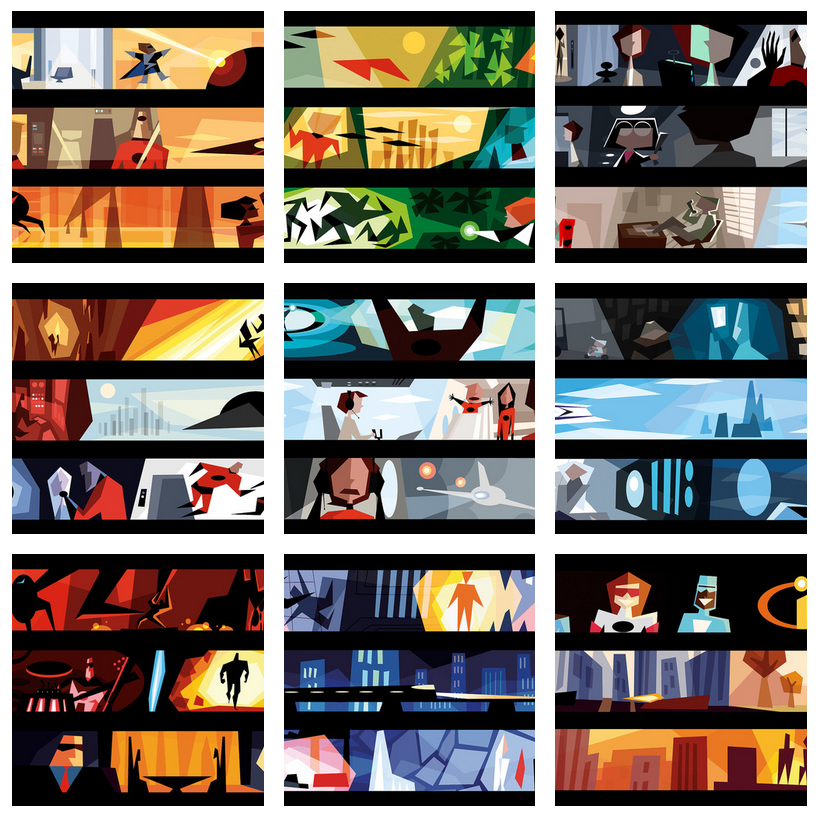
Emotional coinage works in XR storytelling because emotion transcends language; it does not need a text pop-up or an AI translator.
When an emotion can be relayed in some sort of visual or sound media, the designer can worry less about language translation or exactness in the metaverse. XR works naturally in this realm. Combining emotion with narrative plot creates designs where the learner is truly at the center because the learner becomes the lead character in the story. They are pulled along the learning journey because their character (their avatar) is experiencing the story.

Alger illustrated these atomic design elements used to relay emotion: line, color, motion, lighting, spatial arrangement, sound timbre, haptic sensations, user proprioception, or visual elements like iridescence and specularity (2020).

IDs might want to work with designers from industrial or interior design, architects, or public space planners. [Hot tip: want to read more? The Internet Library has The Pocket Universal Principles Of Design 150 Essential Tools.

In planning a design, IDs can ask the instructor what the main emotion is that they want their learners to feel within the space (curiosity, happiness, fear, proficiency, etc.).
The emotions can, of course, change as the story changes. In prototypes, IDs should ask learners what feelings they have in the XR space. Does the feeling match the purpose/goal? If not, the design needs to be changed to foster the emotion that is intended.
After the purpose is established and the central emotions are noted for a learning experience, the ID can determine how much of a real world correlation there is to the XR experience.
For instance, when coming up against a design challenge in XR, IDs should ask, “How is this done in the real world?”
The answer might be that the learner does a behavior (e.g. takes notes or alters a piece of equipment) or retrieves more information (e.g. looks at a reference source). With some consideration, the real world solution can be strategized together with the Multimedia Principles and created in XR. For example, if learners are struggling to remember a series of steps, do they need a nearby poster as a visual aid? If learners are getting something wrong with timing, do they need a stopwatch or clock? In XR, posters and clocks do not need to necessarily hang on walls.
Capture from a rabbit counting experience. The timer appears in the upper left corner indicating 33 seconds left. Timers and clocks can be placed anywhere in XR.

Combining what we already know from the Multimedia Principles will maximize the opportunity to learn by placing the relevant information when and where the learner will need it.
Starting with real world correlations is the healthy first step, but next, the IDs should consider what affordances XR can further provide. For example, do the learners need to fly or go inside an object? XR easily provides the ability to go through what would be solid objects like walls. Referring to a prior example, if a learner needs access to a clock, can a floating one be put into the learner’s field of view, but not necessarily on a wall or wrist? By imagining the experience in pieces or segments, an ID can deconstruct what is necessary to drive the experience along and then rebuild those segments with the added possibilities of 3D design.
Here is another example: an experience is replicating a spacewalk in outer space. The learning objective is to have the learner follow the correct procedure despite stressful conditions. The learner needs to put on a space suit following the correct procedure and check it for safety before leaving the spaceship. The emotional tone is to be calm and methodical even if the situation is urgent. What is the real world correlation to this experience? It might be donning protective equipment at a cold weather research station. This is a cognitively correlated event; the thought process is very similar. Thus, we can use this real world event to drive the design of the XR event. Items need to be put on in a certain order and checked for safety before going outside.

The XR design might want to include an alarm sound or flashing light to create urgency. Some sort of ‘buddy check’ system might stand by so that after the learner puts on the equipment, it is checked by another entity. Including alarms and safety checks are correlations to real world elements that can be built into the experience. The details of surrounding walls and floors or what is happening outside the spaceship do not influence this learning event. Mayer (2020) refers to these as seductive details – interesting, but they detract from the learning. Therefore, those details can be minimized in the surrounding design.
Part 8 is the last part!! It will acknowledge the limitations of what we know from research so far. But I’ve tucked one of my best tips into Part 8 before I conclude. Stay tuned, fellow babies*, for one last time.

Decorative image: Prompt: Wide angle shot from the side, in the style of full color charcoal and Legend of Zelda game cover art, a female profile in a hooded cloak climbing up a mountain towards light, she carries a flame in one hand, in the style of deep indigo, light silver, enchanting lighting, blue and green color scheme –ar 16:9
Part 1 was the Introduction.
Part 2 covered Theory and Scope.
Part 3 was Myths versus Reality.
Part 4 covered the Characteristics of Success.
Part 5 was What is the same between 2D and 3D design?
Part 6 was What is different between 2D and 3D design?
Want to see my full references? Have at it.
*Apologies if you don’t catch the reference to Johnny Fever from WKRP where groups of people were “fellow babies”.
##InstructionalDesign #XR #Multimedia #Principles #Mayer #LXD #ID #InstructionalDesigner #WebXR #3D #2D #Approach #LearnerCentric #NarrativePlot #Storytelling #Purpose #Design #Emotion #PrinciplesOfDesign #RealWorld #Correlation #edtech #DonNorman #GuyWallace
I’ve been thinking about applications of the metaverse and how those intersect with storytelling. One of the interesting characteristics of the metaverse is not just it as a place – with all the hardware and software trappings of avatar legs or not, realistic spaces or not, headset or not, basically what you can do and what you cannot do – but that it can impact your definition of self.
Premise: the metaverse is not just technology, the metaverse is how it makes you feel about yourself.
If you have Disney+, you may have seen Obi-Wan Kenobi: A Jedi’s Return, a documentary on the making of the Obi-Wan series.
I want to emphasize that this ‘original documentary special’ was directed by Deborah Chow, who also directed the series.
This isn’t just bits of archival footage patched together like how it was with the original Star Wars movies, although documentaries have now been re-made with a much greater story-telling focus. The same person who helped weave the story of Obi-Wan has also weaved the story of this documentary.
Storytelling: The Object Can Be Beyond A Place
This is a storytelling director telling a story.
Deborah Chow is in control and she knows what she wants you to see and feel. She plays up a visual theme that shows up over and over in this documentary:
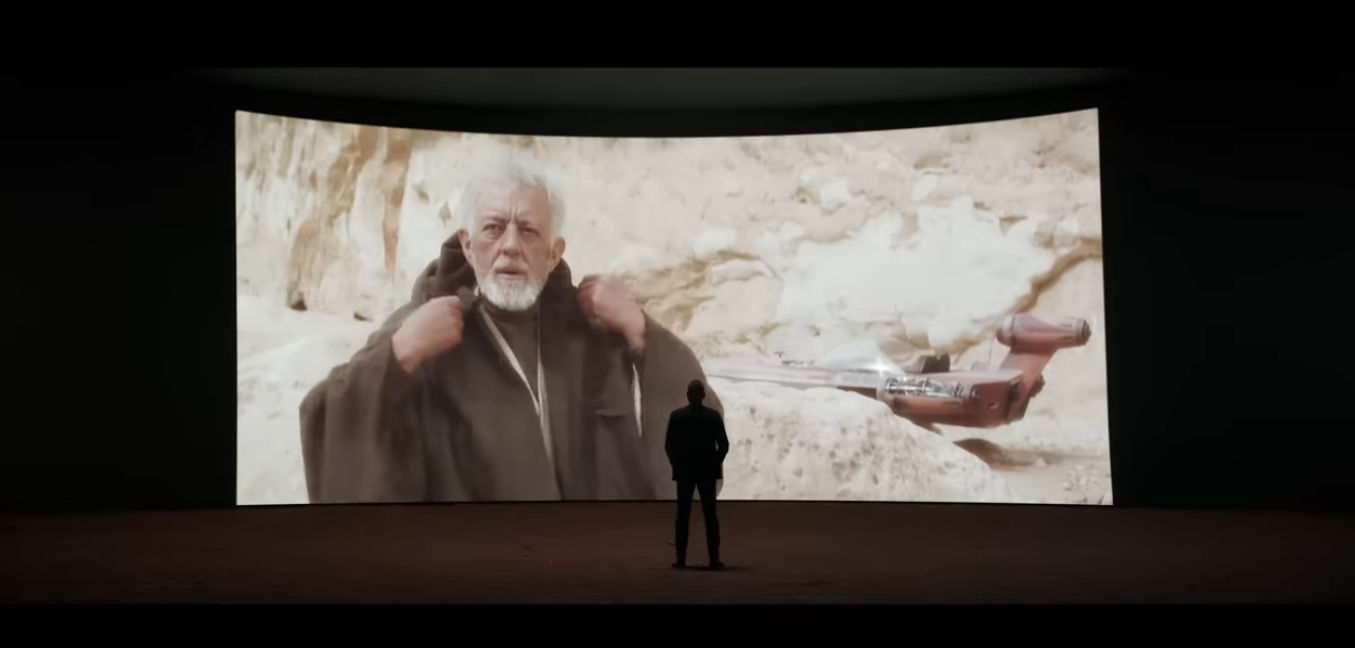
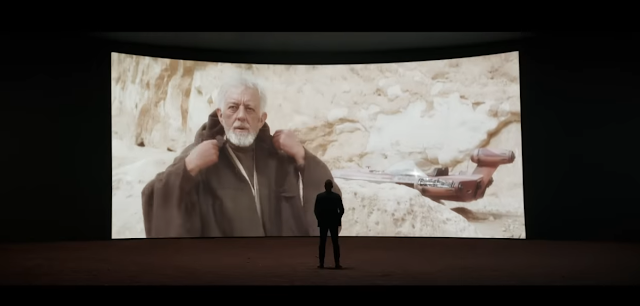
An actor standing in and being impacted by a screen similar to the virtual production set: a space 21 feet tall, 75 foot diameter, run by 7 machines by ILM and Epic Games, with a 270-degree semicircular LED video wall called StageCraft, the LED Stage, or The Wall.
Image: Capture of The Wall from The Virtual Production of The Mandalorian.
Image: Depiction of how a virtual game engine camera can create a scene on demand.
To be very specific, there are many shots of Ewan McGregor, Hayden Christensen, and Deborah Chow standing in front of a very large screen and another camera is capturing their own faces & bodies while they are watching clips either from the Star Wars movie series or from the Obi-wan series. The implied idea is:
their emotions are your emotions.
They are feeling it like you are feeling it. Permission granted to forget that they acted in these visuals. They are sitting next to you now, eating popcorn, laughing, and getting teary eyed just the same as you. This theme is repeated over and over through the one hour.
Deborah Chow is making the point, I believe, that the Obi-Wan series was born and crafted crafted from existing Star Wars film lore. She’s not striking out new. She is claiming the heritage directly from the original Star Wars family. Also, she knows her series is #2 at bat; The Mandalorian came first. So the technical innovation of The Wall isn’t hers to claim. But she can show that she’s learning and growing from it as younger siblings often learn lessons from older siblings.
As the phrase goes, the early bird might get the word, but the second mouse gets the cheese.
Her innovation? She lets a Wall-like experience impact her characters in this documentary. This video has scenes from the teaser.
It’s the Wall as an actor emotionally experiences it. She takes the time to show you an actor’s face, body, and location near the Wall and then shows what the actor was seeing in that same moment.
She plays up the idea that Ewan McGregor had to study and pattern after Alec Guinness as an actor. He had to visualize who the character would be 10 years before the original Star Wars movies began. He’s impacted by the Wall. But when he does it, it gives you permission to do it.
She also plays up the re-meet of Hayden Christensen after more than decade separation; a person that’s older, wiser, and re-meets a colleague. Ever been there yourself?
Image: Capture of Hayden Christensen views the very beginning of A New Hope.
Image of Deborah Chow viewing an intense Hoth battle.
She’s using the Wall as not just something used to create surrounding scenes,
she’s using it to say ‘it impacts you.’
Image: A touching moment as Deborah Chow looks at the first introduction of Princess Leia.
Deborah Chow pointed up to The Wall and showed us that the metaverse is not just technology.
You could be forgiven if you thought that she was only going for nostalgia. ‘Isn’t this just wispy looks up to a screen?’
Image: Photo collage of Deborah Chow, Ewan McGregor, and Hayden Christensen looking up at screens. There is a faint glow of golden light on their faces.
No, I don’t think she is letting you off easily.
I think she’s saying ‘Obi-Wan’s story isn’t over yet. There is more. Come on, let’s find out.’
Image: Poster for Obi-Wan Kenobi: A Jedi’s Return documentary. Obi-Wan with back to viewer looks over a desert scene production set. Note that: this is not a Star Wars poster. This is a production poster; the Obi-Wan character sees the production crew.
Deborah Chow used the Wall as not just a scene but as an impact device. Disney is late and slow on their metaverse path. But they’ve been on their way as I talked about here. This deliberate storytelling combined with innovative technology is not a misstep.
The metaverse is not just a place you visit, it can impact your definition of self.
#Disney #Metaverse #TheWall #StageCraft #VirtualProduction #3D #Storytelling #ObiWanKenobi #Self #Define #Impact
.png)
It’s a rare moment when I can bring 3 themes into 1 post:
leadership, XR, and design. Also, I’m going to be personal. Believe it
or not, I’m not really personal on LinkedIn. Enthusiastic, yes. Personal, hardly.
Over the weekend, I wrote a gushing sentence to a friend that I
realized I’d never written down before: I became a Biology major in
college because of Dr. Ellie Sattler.
A mentor of mine once said writing is thinking. Writing that
sentence lead me to do a lot of thinking and reading about her character
and on the impact of the Jurassic Park (JP) movie. I’m not alone as a
woman in deciding to go further in STEM because of the Dr. Ellie Sattler
character. So huzzah all the Paleobotanists out there!
We have to time travel to talk about JP. In 1993, we’ve just BARELY
broken out of the 1980s. For the first time in STEM history, scientific
breakthroughs are being accomplished by teams instead of white men. Think: AIDS breakthroughs & the Human Genome Project. Teams means women included. Prior to this point, women were the “also rans” in science. Sisters. Mentioned on the side. Or worse, they had their research stolen.
Strong women depicted in media? Disney’s top film of the 80s was The
Little Mermaid and Aladdin was just released in 1992. Strong women, not
so much. Video tapes existed; the Internet did not. If you wanted to see
a movie, you bought a movie theater ticket.
We arrive when the music was rises in cool, dark, air conditioned theaters. And then you see this:
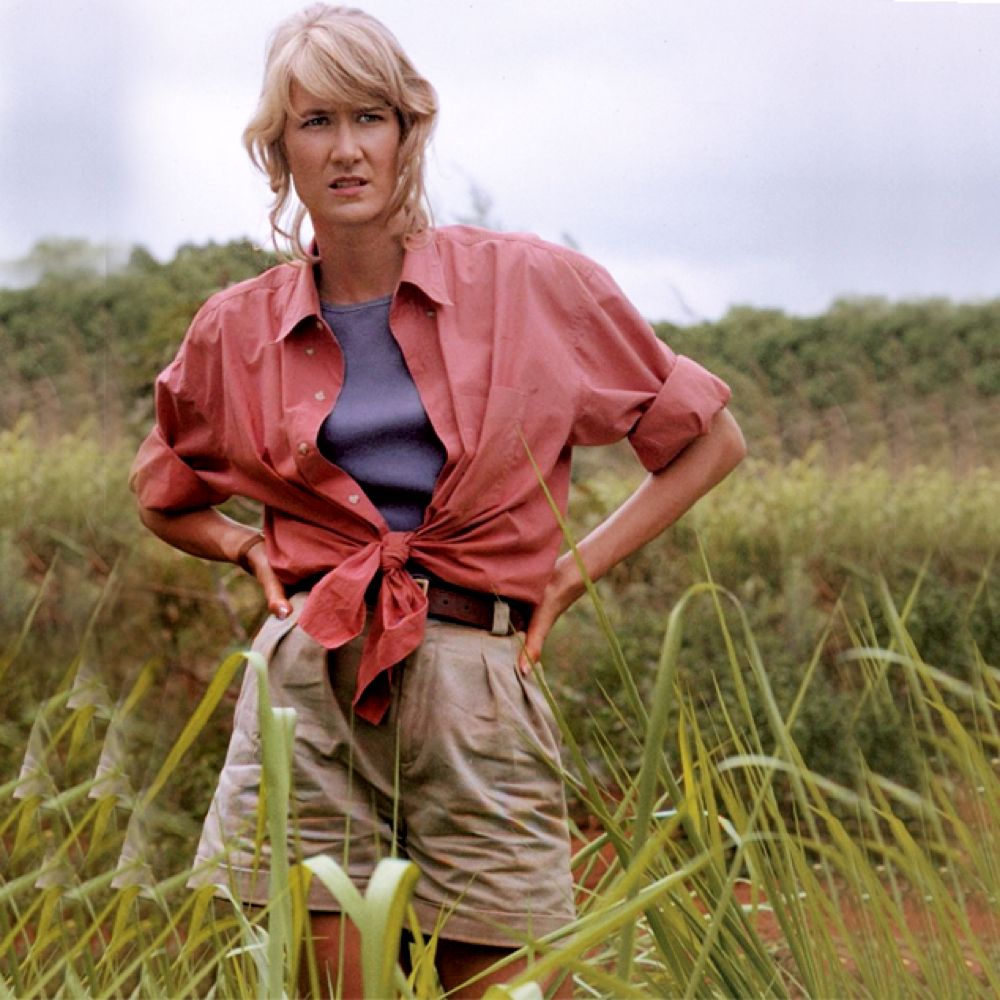
Caption: A character who does not care what you think because she’s solving a problem.
A character who lays out this line while she holds a stare on the richest daddy around:
“Look…we can discuss sexism in survival situations when I get back”
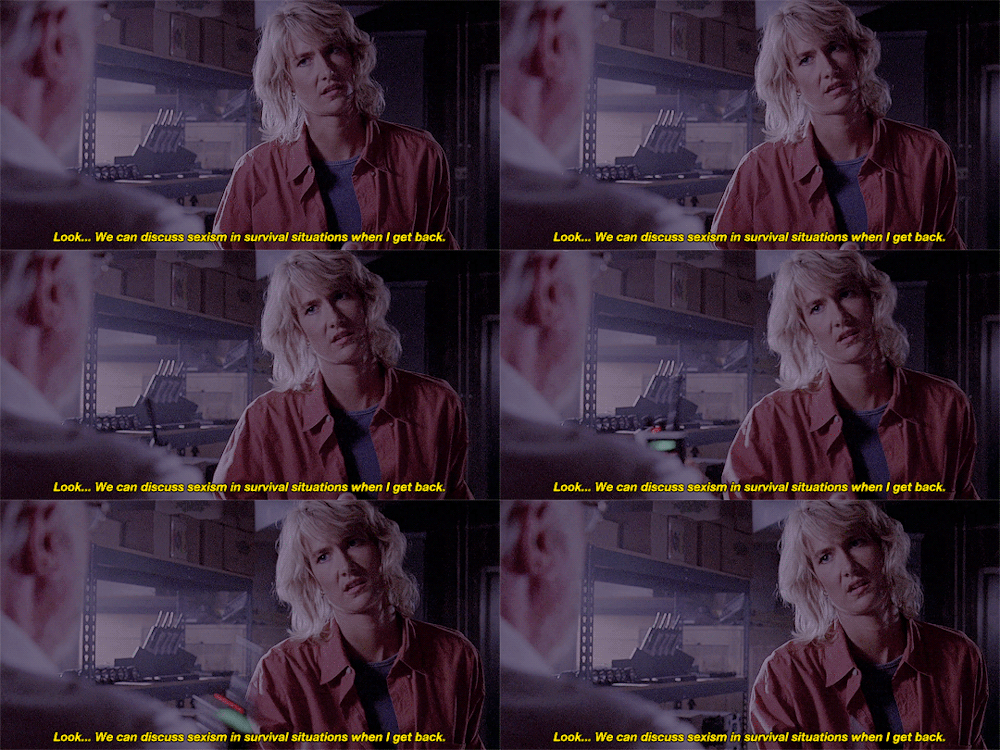
I took that to mean that women are better in survival situations (not equal, as others took it.) and my life was shaped for the better.
I bought a $5 ticket 3 times over the course of that 1993 summer. Now that’s saying something.
To this day, it’s the only movie I’ve bought multiple theater seats
for. But realize, I have older brothers that saw Star Wars, what, a
bazillion times?
Jurassic Park became the first movie to gross US$1billion.
Reading some commentaries and watching some videos over the past few
days, I picked up some tidbits below. Some I agree with, some not.
1. To this day, the scene of the T-Rex crossing the paddock fence
HAS NOT YET BEEN BEAT in movie history & you don’t need to try.
True disclosure: the raptor jumping up to the ceiling shot? I still
can’t *barely* watch that. I wince too hard.
2. There’s been some 2022 commentary on the age difference between
the Dr. Ellie Sattler (Laura Dern) and Dr. Alan Grant (Sam Neill)
characters. It’s been confusing and I’ve decided to weigh in.
In the book, Dr. Ellie Sattler was written as a grad student (Age
23, no advanced degree) but also no relationship. It was apparently
Laura Dern’s own idea to give the character a full doctoral degree and
in the movie the character holds her own against dinosaurs. In real
life, I’m disappointed to say, Laura treats Sam Neill patronizingly
and actually “left the party” of JP with Jeff Goldblum, which I find to
be a big mistake. (I said this article would be personal, yo.)

Caption: The look of faithfulness.
Don’t be like this guy and not see the sexual tension in JP: https://youtu.be/jSPxu3WprSs
As far as the age difference? The problem came in when, in the book,
the “relationship” was not there but in the movie it was. Laura was in her late 20s playing early 20s. Sam (then early 40s)
continues to feel the (physical) burden of the age difference. If you
need help to see what was happening, Deshi Basara has collected these gifs. Notice in gifs 2, 3, and 7 how his body immediately reacts to hers when she touches him. This is chemistry, folks.
I had to wade into all that because the point was that regardless of
an age difference (which, arguably could be *less* than 23 years),
there was a *quality difference* between Dr. Ian Malcolm and Dr. Alan
Grant.
I will concede this one point (I disagreed with so much here
that I couldn’t read more than 2 pages of this commentary) that Ellie
holds her ground just fine (and doesn’t move despite Alan’s come here
gesture) with a metamessage at the Raptor pit:

Vogue got an interview with Laura Dern
where she points out that the Dr. Ellie Sattler character went on to be
an activist and whistleblower. Interesting!! I’ll just leave that right there.

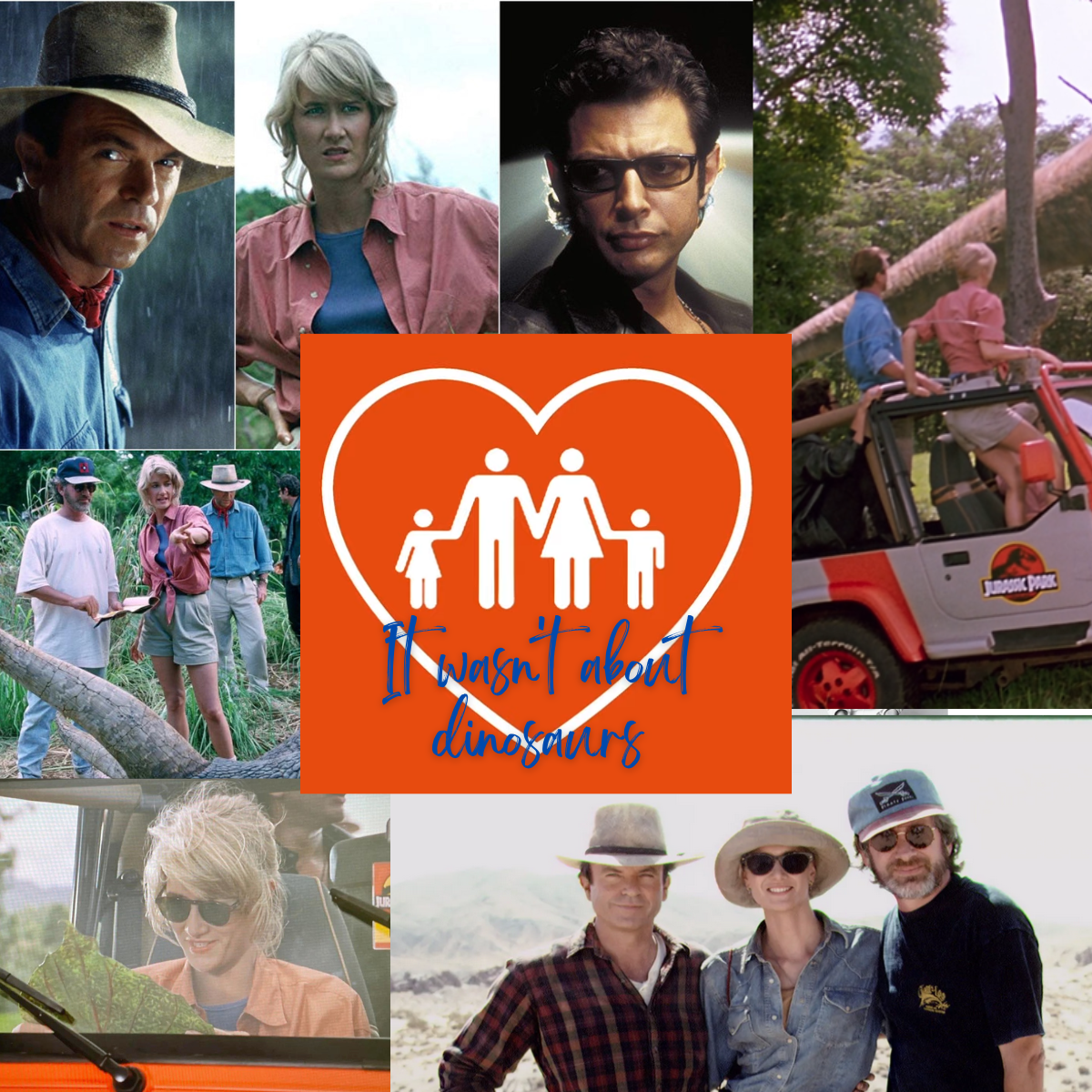
But most I really enjoyed watching these video analyses of the plot of Jurassic Park here and especially by Mike Hill here and why the movie worked when all subsequent versions of JP have not worked. The key was that Steven Spielberg worked in narrative plot. He carried a story all the way through that was human, basic, and emotional. Dinosaurs just happened to be there.
%20Spielberg's%20Subtext%20-%20Jurassic%20Park%20analysis%202.png)
But that shows up in my VR/XR consulting work to this day.
The famous quote about rushing into things by the Choatician character Dr. Ian Malcolm:
Ian Malcolm: Don’t you see the danger, John, uh,
inherent in what you’re doing here? Genetic power’s the most awesome
force this planet’s ever seen, but you wield it like a kid who’s found
his dad’s gun.
Donald Gennaro: It’s hardly appropriate to start hurling accusations–
Ian Malcolm: If I may, if I may. Uh, I’ll tell you
the problem with the scientific power that you’re, that you’re using
here. It didn’t require any discipline to attain it. You know, you read
what others had done, and you, and you took the next step. You didn’t
earn the knowledge for yourselves, so you don’t take any
responsibility… for it. You stood on the shoulders of geniuses, uh, to
accomplish something as fast as you could, and before you even knew it,
you had, you’ve patented it, and packaged it, and slapped it on a
plastic lunch box, and now (bangs the table) you’re selling it, you
wanna sell it, well.
John Hammond: I don’t think you’re giving us our due credit. Our scientists have done things which nobody has ever done before.
Ian Malcolm: Yeah, yeah, but your scientists were so preoccupied over whether or not they could, they didn’t stop to think if they should.
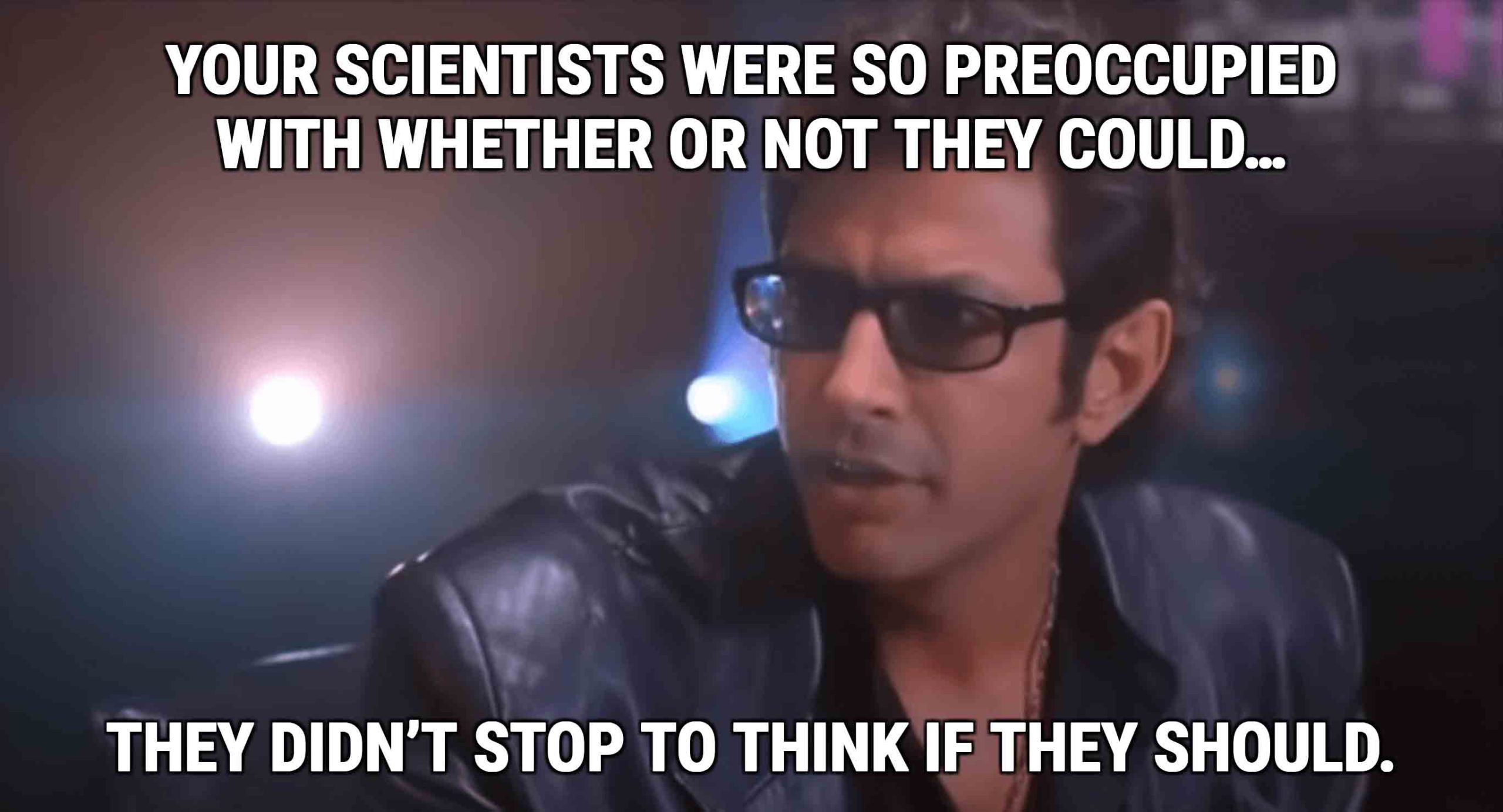
I fight this battle every day.
Industry and indeed some in academia want to use XR liberally in
education. Yet, the power of XR is still unknown. Our early research is
pointing to one thing that seems firm:
The mind believes what the eye sees.
That means that the XR experiences we put our children into will be real for them.
What power are we wielding in the classroom? Everywhere?
There are those that say “XR is the Empathy Machine! We can create empathy, soft skills in the workplace!”
Oh yeah?
The most recent research I saw (from 2018) says that empathy coming from XR is a 50/50 gambit. That does not mean that it causes empathy for whatever you want half the time.
It means it causes empathy half of the time and causes the opposite of empathy the other half of the time!
So, would you like your employees to don a headset to be more
empathetic towards race, age, body size? Oh really? How would you like
results that say that half of the time, those employees are going to
take off the headsets and quietly say to themselves “Thank God I’m not
black” 50% of the time? That’s one hell of a bet you are willing to take
with XR.
XR is dangerous.
People say “Look at how you can look all around you! 360 degrees! A
sphere! Isn’t this cool? Isn’t this new? Just think how this will reach new learners!”
I can take a learner into a new real physical space (for example on a field trip) and have them be overwhelmed. We’re all on the spectrum, remember? Was that cool? Were they reached
in a new way when they cried? Would you like for me to even mention
harassment events in VR that have already happened? We haven’t yet
arrived into market saturation of haptic bodysuits, but it’s coming.
XR is dangerous.
I’d rather have a low, slow, plodding walk into an XR for education
experience than every bell and whistle thrown at them the first day. The
line “spared no expense” gives me chills.
XR is dangerous and if we aren’t careful, we will damage learners
along the way. Jurassic Park should not have been built or opened. Dr.
Alan Grant refused to give his endorsement. That was the lesson of the
movie.
But the parallel lesson of JP was “Build for story. Because the dinosaurs are not real.”
When I encourage XR design, I build for narrative plot.
I build for emotions,
because those are real.
%20Spielberg's%20Subtext%20-%20Jurassic%20Park%20analysis%20-.png)
#XR #Design #JurassicPark #NarrativePlot #InstructionalDesign #DrEllieSattler #DrAlanGrant #DrIanMalcolm #Dinosaurs #VR #VirtualReality #EmpathyMachine #Leadership #WomenInMedia #FemTech #Sexism #BestMovieSceneEver #Whistleblower #Scientist #PreoccupiedWithCould #SparedNoExpense #Emotion #DesignForXR
Article originally posted same day to LinkedIn here: https://www.linkedin.com/pulse/dr-ellie-sattler-jurassic-park-narrative-plot-wasnt-dodds-ph-d-


