Tag: Embodiment

  • From Myths to Principles Part 6 Myth: Immersive learning is active learning

    From Myths to Principles Part 6 Myth: Immersive learning is active learning

    From Myths to Principles: Navigating Instructional Design in Immersive Environments

    Part 6 Myth: Immersive learning is active learning

    Photo by Blake Cheek on Unsplash

    The next myth is that learning in immersive experiences is active, kinesthetic, or like an internship, which is “the way most people learn best” (D’Agostino, 2022, para 17.)


    Active learning was first associated with immersive experiences because learners could observe or engage with or, more properly described, engage within simulations (Dede, 2009). The term active simply meant that the learner was present at a simulated place and time; the original use of the active learning phrase with reference to immersive experiences did not imply that a learner could do anything other than observe. The emphasis was much more on the time and space travel afforded by XR.

    This claim has been controversial (Khorasani et al., 2023), in part because of the differing degrees of activity that a learner can have – ranging from simply being inside an immersive environment and observing (e.g. historical re-enactment simulations) to taking actions that have non-trivial consequences (e.g. practicing a surgical technique).

    Active learning is a phrase on the move


    Dede (2009) referred to actional immersion as situations where learner actions have “novel, intriguing consequences” that are “highly motivating and sharply focus attention.” (p. 66). The active learning claim moved from a focus on the learner’s actions and instead focused on the learner’s body ownership illusion. Further, the relationship between user bodies and virtual depictions (avatars) was reformulated and later called implicit learning (Slater, 2017, p. 29).

    I want to pause here and really dissect the difference because in this area, there has definitely been vocabulary “drift”.  Learner’s actions focus on what the learner causes to happen.  Learner’s body ownership focuses on parts of the body that the learner uses to cause actions.

    For example, picture a chemistry lab simulation.

    Image: Labster

    Focusing on the learner’s actions means that we could use a 2D display screen and mouse and have the learner click on the pipette, click on a liquid to suck up with the pipette, and then click on a vial within which to dispense the liquid.  Those could be right to left actions, but the learner is causing the actions to happen on the screen. They are using a mouse and moving their hand generally right to left.  No hand needs to be visible to do these actions. Activities could be “ghost like” in that they could be caused by no visual physical object whatsoever.  In reality, the computer mouse is doing the most physical ‘work’.

    Focusing on the learner’s body ownership however, would have the learner reaching out (they need to be able to reach) to the pipette, to grab it (they need to be able to firmly grasp), to possible depress the button on the top to create the needed suction, to move the pipette, see the liquid and subsequent vial, and depress the button to dispense the liquid. The movements could be all right to left. Key in this visual depiction, however, is A HAND with workable fingers that is somehow connection via experience to a learner’s IRL hand.

    In the former example, the learner causes the actions to occur but we are not focused on their body parts doing the action. In the latter example, we are very interested in the body parts doing work that is replicate (in this case) to the real world work of operating a pipette. In the former, we could have confidence that a learner is exposed to the cause and effect of pipette work; it sucks up a reliable amount of liquid and can squirt it back out. In the latter, we could have confidence that a learner is exposed to how pipettes physically work (button press down equal prime for suck, release equals suck, button press down again equals squirt). 

    See that the focus is different?

    My point is that the FOCUS of what was coming to be called active learning with reference to XR was changing already between 2009 and 2017.


    Drawing from the educational history of the Montessori method and considering the interfaces available within immersive experiences, implicit bodily learning (from 2017) transformed to embodied learning (by 2018). Indeed, Johnson-Glenberg initially postulated that “doing actual physical gestures in a virtual environment should have positive, and lasting, effects on learning in the real world” (2018, p. 1). Movement became synonymous with active learning. “Active, motor-driven concepts may stimulate distributed semantic networks (meaning), as well as the associated motor cortices which would have been used to learn long ago, in childhood” (Johson Glenberg, 2018 p. 3). [Hat tip, by the way to all research into the mind-body connection within learning. This post throws no shade on the phenomena.] With specific, other than meaningful, actions now excluded, some researchers appeared to support the claim that all movement somehow begets learning. (That sentence is confusing, I wrote it and even I’m wondering what I meant. It’s this: Inside a XR-for-learning experience, a learner might be instructed to do something. Pick this up, move it there.  Because that learning is specific to the learning event, I’m setting it aside. It’s not part of this argument.  What I am referring to are the learner-instigated but non-instructed movements. Let’s say, a learner joins XR and wanders to the left for 2 minutes before a lesson begins. Or let’s say instead of looking to the “front” at the end of the experience, the learner is looking to the “back”. These random but learner-instigated actions are…wait for it…somehow the secret sauce of learning in XR.  I kid you not. I really try to pin down the meaning from educators that belief this myth and THIS is what they come up with; because you can move in XR, you are learning (more) in XR.


    The supporting hypothesis then became that immersive experiences are an inherently active learning method precisely because the learner can move. 

     I’m going to repeat that for emphasis:

    The supporting hypothesis then became
    that immersive experiences are an inherently active learning method
    precisely because the learner can move. 

    The Emperor’s New Clothes. Image by Helen Stratton, Public domain, via Wikimedia Commons

    Did you catch that? Are you catching on? Aren’t the emperor’s new clothes splendid?


    By incorporating the word “active” educators are reminded of the belief that active learning is better than passive learning (Slater, 2017). Ooo! Shade thrown there, for sure, because no teacher wants to be accused of being a passive educator.

    [BTW, there is reams of garbage research out there for anyone looking for a topic. Go ahead and dig into active versus passive in educational psychology papers. It’s almost as big of a research garbage dump as XR; teachers radically redefine and appeal to this topic. My point is that the appeal to “active learning” when coupled with XR provides scant evidence of such. To this day, I RARELY see active learning in XR.]


    Let’s bear down now. To be specific, the ‘active learning’ coupling with ‘XR’ claim is not about being fidgety, randomly moving about, or purely reacting as a user would in a game. It is movement, usually performed by the learner via an avatar or minimally via hand controllers where the learner is autonomously and purposely manipulating content.  This is known as embodiment or embodied learning (Johnson-Glenberg, 2018; Markowitz et al., 2018) although definitions of embodiment vary. The definitions vary including how much a learner is embodied. It should also be noted that the term embodiment is often used interchangeably with ‘embodied learning’, which is a theory that the meaningful gestures in and with the environment aid a learner’s cognitive processes (that’s the no shade thing I referred to earlier). But even ’embodiment’ and ’embodied learning’ are slightly different things. Whew! Keeping up?

    The Emperor’s clothes should be splendid


    In 2018, Johnson-Glenberg claimed that presence and embodiment were “profound affordances” of immersive environments and this embodiment affordance should facilitate learner control, also known as agency (p. 1). One further hat tip to Mina: she did actually use a somewhat scientific body action in her research –I believe it was catching butterflies with a butterfly net– something that biologists WOULD do with their bodies. So it’s a real world action.  I point this out because some XR actions are nonsensical. I’m looking at you people who change vocabulary words to bouncing balls or something.

    But aren’t


    A follow-up paper by Mina, however, found that while embodiment does have a connection to learning, it does not exclusively cause learning, or perhaps better said, it doesn’t interact with learning. Referring to high or low embodied VR and the connection to learning, “platform is not destiny” (Johnson‐Glenberg et al., 2021, p. 20). So in lay talk that means it had no effect.
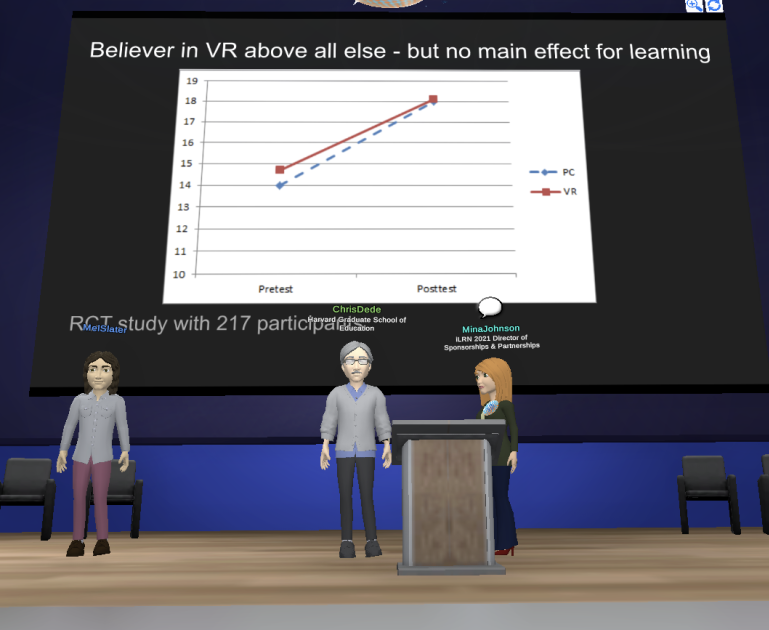
    A capture that fell flat with the audience: VR had no effect on learning, even when embodied.


    This confounding (confusing/muddling up/drift of vocabulary) of movement in immersive experiences with active learning forms the myth. Because active learning is considered better than passive learning, claims are made that immersive experiences must cause more learning due to the body-movement connection. The research, however, does not support that claim.

    The active learning myth appears to be referred to more often in academic literature than evidence to the contrary. It is true that immersive experiences can allow for more movement-based learning experiences than other forms of media, but it is not definitive that immersive experiences cause learning simply because they can contain learner movement or agency.

    Just because you can move in XR, doesn’t mean you do learn. Full stop.

    Part 7 will be our last myth for this series: Immersive learning causes empathy.

    References

    D’Agustino, S. (2022, August 3). College in the metaverse is here. Is higher ed ready? Inside Higher Ed. https://www.insidehighered.com/news/2022/08/03/college-metaverse-here-higher-ed-ready

    Dede, C. (2009). Immersive interfaces for engagement and learning. Science, 323(5910), 66–69. https://doi.org/10.1126/science.1167311

    Johnson-Glenberg, M. C. (2018). Immersive VR and education: Embodied design principles that include gesture and hand controls. Frontiers in Robotics and AI, 81.

    Johnson‐Glenberg, M. C., Bartolomea, H., & Kalina, E. (2021). Platform is not destiny: Embodied learning effects comparing 2D desktop to 3D virtual reality STEM experiences. Journal of Computer Assisted Learning, 37(5), 1263-1284.

    Khorasani, S., Syiem, B. V., Nawaz, S., Knibbe, J., & Velloso, E. (2023). Hands-on or hands-off: Deciphering the impact of interactivity on embodied learning in VR. Computers & Education: X Reality, 3, 100037.

    Markowitz, D. M., Laha, R., Perone, B. P., Pea, R. D., & Bailenson, J. N. (2018). Immersive virtual reality field trips facilitate learning about climate change. Frontiers in Psychology, 9, 2364.

    Slater, M. (2017). Implicit learning through embodiment in immersive virtual reality. Virtual, augmented, and mixed realities in education, 19-33.

    The content cannot be used to train or be reviewed by AI. All copyrights retained.

    Did you miss the other parts of this series? Here they are!

    Part 1: From Myths To Principles: Navigating Instructional Design in Immersive Environments

    Part 2: The Immersive Environment Delusion

    Part 3: The Case Against Virtual Campuses

    Part 4: Myth: Learners Learn Faster

    Part 5: Myth: Learners Learn More

    Part 6: Myth: Immersive learning is active learning

    Part 7: Myth: Immersion Creates Empathy
    Part 8: Ethical Labyrinths, Interpreting Research

    Did you miss the other parts of this series? Here they are!

    Part 1: From Myths To Principles: Navigating Instructional Design in Immersive Environments

    Part 2: The Immersive Environment Delusion

    Part 3: The Case Against Virtual Campuses

    Part 4: Myth: Learners Learn Faster

    Part 5: Myth: Learners Learn More

    Part 6: Myth: Immersive learning is active learning

    Part 7: Myth: Immersion Creates Empathy

    Part 8: Ethical Labyrinths, Interpreting Research

    Part 9: Ethical Labyrinths, Biased Content Creation

  • Instructional Design in the Metaverse Part 5 Building Blocks

    Instructional Design in the Metaverse Part 5 Building Blocks

    This conceptual series proposes instructional design principles for the metaverse. This is Part 5. Today we start the building blocks of design. And the best news for instructional designers? So much of what we already know from two-dimensional learning will work in three-dimensions. Grab your toolbox, IDs!

    2D to 3D: What Is the Same

    Technology can benefit learning when the affordances are leveraged towards effective and evidence-based learning principles (Yeung, Carpenter, & Corral, 2021). Instructional design already has a depth of theory and research that shows that a learning experience is a “systemic, complex design” (Honebein & Reigeluth, 2023. p. 14).

    Yet, instructional designers (IDs) interested in the metaverse in education can be at risk for two unhelpful mindsets: first, thinking that IDs must become developers or second, succumbing to a ‘buy first, find a use for it later’ mentality. The first creates a substantial learning curve with the end result mostly being scenes or environments and 3D objects. Currently, AI is able to create scenes and objects (Sahu, Young, & Rai, 2021). As a consequence, the need for programmers may decrease. The second mindset leads to IDs to search for educational resources to justify the expense and bother of entering the metaverse. 

    Capture of a post with text: With the world in such a virtual/hybrid state, I'm curious if any of you have explored using (REDACTED) VR to enhance virtual new hire onboarding experiences. My boss ordered myself and one of my peers our own (REDACTED) devices to explore as this an add on to our current onboarding program, so I'd love to hear from people with similar use cases.

    Buy first, find a use for it later. Technocentric-design.

    Both of these mindsets miss the main point of instructional design. They sacrifice the learner-centric stance for a technology-centric stance (Mayer, 2020). Many of the 2D-based instructional design models, structures, and principles apply towards 3D learning (Dodds, 2021).

    What we already know should inform us as we make future 3D designs because as Alger stated, “Principles and processes of design are pretty universal because we’re usually designing for humans (2020, 3:06).

    A further extension of this thought would be that IDs are not designing for technology. An ID focusing on 3D design for the first time can have an advantage because their experience will be from a novice’s viewpoint. Learners are novices. Thus, the ID experiences what the learners will later experience for the first time.

    Keeping the learner-centric point of view is key.

    This section emphasizes the use of Mayer’s Principles of Multimedia Design (Mayer, 2020, pp. 400-402, [Reminder, I covered the basics in Part 2]) because they are based on research. This list is not meant as a checklist. This is meant to remind IDs of what the correct design choice would be within a 3D experience.

    1 Reduce extraneous processing

    The Coherence, Signaling, Redundancy, Spatial Contiguity, and Temporal Contiguity Principles will assist in decisions about types of media (visual, text, audio) and where it will be placed or made available in XR experiences. Because of the enveloping nature of the 3D environment upon the learner, extra unnecessary material could interfere with the learning.

    1.1 Coherence

    Summary: “Weed out extraneous material”.

    ID: Minimize text, sounds, and movement that is not directly related to the learning goal.

    1.2 Signaling

    Summary: “Highlight important material.”

    ID: Use slow pulsating glows, arrows, or narrative prompts to focus the learner on the content.

    1.3 Redundancy

    Summary: “Do not add printed text that duplicates narration.”

    ID: Accessibility concerns dictate that information available via vision or sound should be made available in an alternate form. To follow the spirit of this principle, default settings can be set to include both alternates as activated, which could then be toggled off by the learner at will. XR accessibility research organizations such as XR Access or Virtual Ability should be consulted for further guidance.

    1.4 Spatial Contiguity

    Summary: “Place printed text near to the corresponding part of the graphic.”

    ID: There is more space to work with in 3D than 2D. The key with this principle will be to find just the right place to put the text. Some user experience (UX) testing in the form of A/B testing can help find the best placement.

    1.5 Temporal Contiguity

    Summary: “Present corresponding graphics and narration at the same time.”

    ID: Sound and action triggers can be timed within 3D programming.

    2 Managing essential processing

    The Segmenting, Pre-training, and Modality Principles help the designer place the necessary material in the right place and time for the learner to move the content into sensory memory, short-term memory, and into long-term memory.

    2.1 Segmenting

    Summary: “Break a lesson into learner-paced parts.”

    ID: Plan lessons with storyboards with scenes where the learner moves through the experience. Always provide an escape button that saves learner progress. If that is not possible, a confirmation dialog message can indicate that the learner upon re-entry will be returned to a certain spot.

    2.2 Pre-training

    Summary: “Provide pre-training in the names and characteristics of the key terms.”

    ID: Plan for pre- and post-experience briefing. Pre-training is analogous to reading the box when considering buying a game or reviewing choices in an online store. The learner experience starts there.

    2.3 Modality

    Summary: “Present words in spoken form.”

    ID: Especially for key vocabulary, provide sound files of pronunciation. This especially matters if the experience is designed for solo learner use.

    3 Fostering generative processing

    The Multimedia, Personalization, Voice, Image, Embodiment, Immersion and Generative Activity Principles help encourage learners to cognitively engage with the material and exert effort to make sense of it. It is this area of design where the ID is making sure that the learners are not passively accepting information but must do mental work with it.

    3.1 Multimedia

    Summary: “Use corresponding words and graphics to explain the material.”

    ID: XR is a natural fit for this principle because it nearly always contains simultaneous visuals and sounds. These can be timed together within 3D programming. An interesting design exercise for IDs, however, is to isolate certain aspects of a design and think through how it might work if only one channel of input was working. For example, in a tour of XR spaces, there might be a period of a few seconds of complete darkness between scenes. How are the learners guided by sound only during this time?

    3.2 Personalization

    Summary: “Put words in conversational language.”

    ID: Recorded audio should sound comfortably natural.

    3.3 Voice

    Summary: “Present spoken words in an appealing human voice.”

    ID: This applies most logically in XR to human sources of the spoken words. Poor sound can ruin an XR experience.

    3.4 Image

    Summary: “Do not put the instructor’s static image on the screen.”

    ID: The keyword in this principle is ‘static’. This would rarely be needed in XR. Exceptions might include biographies or eulogies.

    3.5 Embodiment

    Summary: “Have instructors display human-like gestures, eye contact, facial expressions, and body movements.”

    ID: The Proteus Effect shows that users change their behaviors depending on their avatars (Praetorius, & Görlich, 2020). Employers are becoming more interested in the use of the metaverse for meetings (Jaehnig, 2022). It is reasonable to predict that educators will be holding meetings that are now on-campus or in Zoom with their learners in the metaverse within five years. Due to the demand for these human-like behaviors, avatar creators and platforms are adding more movements like blinking, sitting, or gesturing.

    3.6 Generative Activity

    Summary: “Add prompts to engage in generative activities such as summarizing, mapping, drawing, imagining, self-testing, self-explaining, teaching, and enacting.”

    ID: Interestingly, here the research reaches a nexus; several different sources point in the same direction. Mayer called these generative activities and points to their use within the learning act, as a guided form of practice, “Insert prompts to engage in generative learning activities within the instructional episode” and “learners must use the material from the lesson rather than simply remember it” (2020, p. 371). From this, an activity within XR would be ideal. However, generative activities are not exclusive to happening within XR. Wallace stated in Washburn (2023) that all learning points to some place in the future where the results are played out–ideally in a workplace or high stakes setting; it is the final performance that counts. Dede (2021) pointed out the importance of onboarding and off-boarding as where the learning occurs primarily. Mayer conceded that generative activities likely need to be taught first as behaviors before asking a learner to perform them (2020). That is, learners need to be taught what summarizing is before being asked to summarize. This is a valid and somewhat overlooked point. D. Clark referred to these activities as “effortful learning” or “desirable difficulties” (2022, p. 3) and Thalheimer (2006) supported retrieval practice, spaced practice, or interleaving approaches. Each of these researchers has a slightly different view into the same problem.

    They seem to point to the need for a certain amount of learner effort (not just clicking), with guidance, that should occur within XR and then a follow-on amount of learner effort after leaving XR.

    What might this look like? Here, we reach the edges of known ID in the metaverse universe [Editor Heather here: fresh off the presses! This just hit ResearchGate last month: Collaborative generative learning activities in immersive virtual reality increase learning], but we can take with us what we already know.

    The key question to ask is: In real life, where do learners practice in place and later perform when the stakes really matter?  How something is done in real life should be the template that we use to start thinking of how the behavior should be prompted in the metaverse.

    Here is an example: Learners do science labs in real life. They practice doing a procedure under the watchful eye of an instructor. It is usually fine if they fail because they can start again but there is some risk and limitation of resources. In XR, the same lab can be set up as practice where learners can repeat interactions, control the speed, and engage in plausible manipulations of scientific equipment (Asare, Annan, & Ngman-Wara, 2022). The scripted practice available within XR should be added to other generative activities which could be inside and/or outside of XR such as learners self-explaining what is happening in the experiment during a video recording of the experience or learners teaching what would happen if the variables changed or if there was a chemical spill.

    3.7 Immersion

    Summary: “Do not convert lessons into 3D immersive virtual reality.”

    ID: At this point, this article series would appear to come to a stop.

    This last principle basically states do not use 3D. This article series posits, do use 3D, if it is the right thing to do. Returning to the beginning assumptions:

    1. Learners experience the virtual as real.

    2. Learning outcomes are expected to be equal to other media.

    It goes to follow, therefore, that if the designs will be accepted by the learners as real experiences and if the learning outcomes are the same as for other forms of media, the decision to go forward with the design should only occur if the lesson cannot reasonably be done in 2D and meets at least one of the conditions of saving time, money, or danger. Stepping outside of the learning objective decision, one could argue that 3D allows for added immersion and presence. But in that case, the ID should ask “Is immersion or presence critical to the learning objective?”

    Acknowledging the affordance of immersion, Mayer pointed out that the case for immersion is often wrapped into the learner’s feelings of interest and motivation (2020, p.361). The logic goes that if a learner is motivated, they will learn more. Research shows that interest and motivation wane and learning performance drains away with it.

    The case for presence can be tied with a personal feeling of being there. The more a learner takes on the experience as real and really happening to them, the more the learning should stick with them. Contrarily, research shows that distraction due to extraneous processing seems to cancel any benefit that might be gained (Mayer, 2020). In sum, the research does not predict at this time that presence will increase learning.

    Finally, this tidbit might tip the scales for a decision. Clark and Mayer recommended this strategy from e-learning: “Use facilitative techniques that support social presence” (2016, p. 313). This tips the balance of synchronous versus asynchronous learning towards synchronous and shows an affordance not before mentioned: the benefit of social learning in XR.

    Wise uses of XR seem to contain elements of bringing learners together.

    This should be leaned into in designs, if possible. Therefore, if learning designs can minimize extraneous processing and are best done in 3D, next we should ask what is different about designing for 3D.

    That will be Part 6. Stay tuned!


    Part 1 was the Introduction.

    Part 2 covered Theory and Scope.

    Part 3 was Myths versus Reality.

    Part 4 covered the Characteristics of Success.

    Want to see my full references? Have at it.


    Midjourney and Me. Prompt: Blend full color charcoal and game cover of Legends of Zelda, an attractive woman with short blonde hair and blue eyes wears hooded cloak, casting a glowing spell in a laboratory, cinematic lighting, fantasycore, blue and green color scheme


    #InstructionalDesign #XR #Multimedia #Principles #Mayer #LXD #ID #L&D #InstructionalDesigner #WebXR #3D #2D #ExtraneousProcessing #Coherence #Signaling #Redundancy #SpatialContiguity #TemporalContiguity #EssentialProcessing #Segmenting #PreTraining #Modality #GenerativeProcessing #Multimedia #Personalization #Voice #Image #Embodiment #GenerativeActivity #Immersion #Presence #EffortfulLearning #DesirableDifficulties #RetrievalPractice #SpacedPractice #Interleaving #LearnerCentric #edtech