Tag: Education

  • Happy Twelvetide! 12 of My Most Favorite XR for Education Examples

    Happy Twelvetide! 12 of My Most Favorite XR for Education Examples


    Happy Twelvetide or the name you might recognize, The 12 Days of Christmas!
    For
    you, I’ve arranged 12 of my most favorite XR-for-education examples.
    These are virtual sites, simulations, companies, or concepts.

    But what’s a good story without some twists?
    – Some of these no longer exist. Let that twist your noodle. šŸ˜•
    – Some are concepts.
    – These were originally posted to LinkedIn as separate posts. This blog posts represents all 12 in one place (so buckle up, this will be long).

    Day 1 Heritage Key

    Happy Twelvetide! Number 1 on my 12 favorite
    XR-for-education list is Heritage Key by Rezzable. It was in Second Life
    and then Open Sim ~2008-2010, but no longer exists. Visitors could
    visit recreations of Stonehenge or the Valley of the Kings.

    My fav parts?

    Users **participated** in the building of Stonehenge. (THINK: NPCs
    giving instructions to quests in games.) Did you know that there were
    different versions of Stonehenge over thousands of years, including a
    wooden one?


    Time travel – The Stonehenge location (if I’m remembering it correctly)
    had “time travel” for visitors to go to Stonehenge in different times
    by directing users BACK to an underground Visitors Center where
    (unbeknownst to the visitors) the overhead scene would change and go
    forward ~500 years or something. Nice time travel technique!


    Avatar clothing. Each location offered avatars garb to wear appropriate
    to the builds (all of them, at once). I remember the choices where:
    Druid-theme, Thebes-theme, or Indiana Jones-theme. All a super fun way
    for users to keep playing along with “we are participating with” these
    locations. THINK: DRESS FOR THE JOB YOU WANT.

    Will
    someone resurrect this concept fully, please? It was so cool despite
    being from more than 10 years ago. And it outperforms a lot of XR for
    education even today.

    YouTube video from Heritage Key: https://www.youtube.com/watch?v=_SqTwaa0HVg
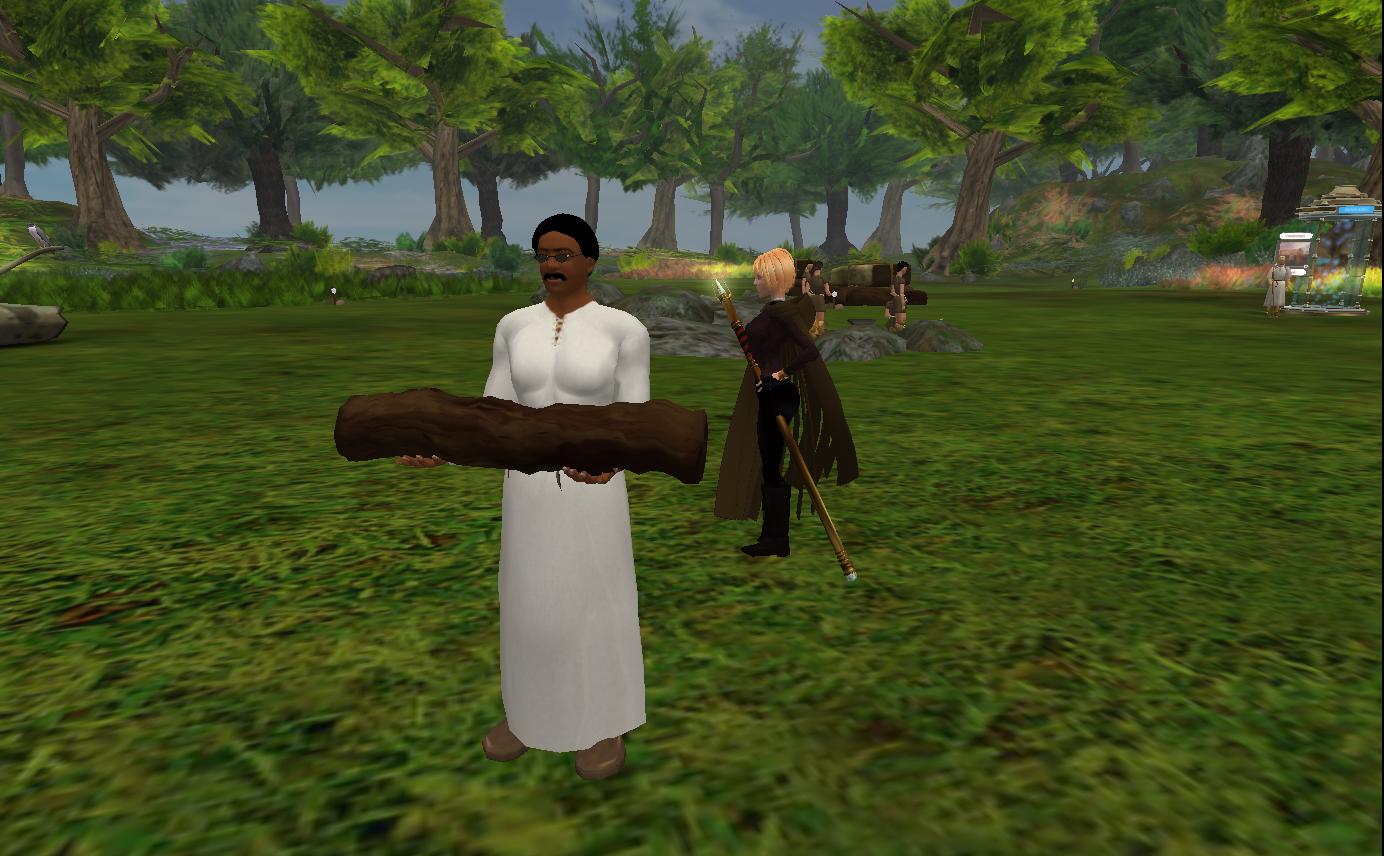
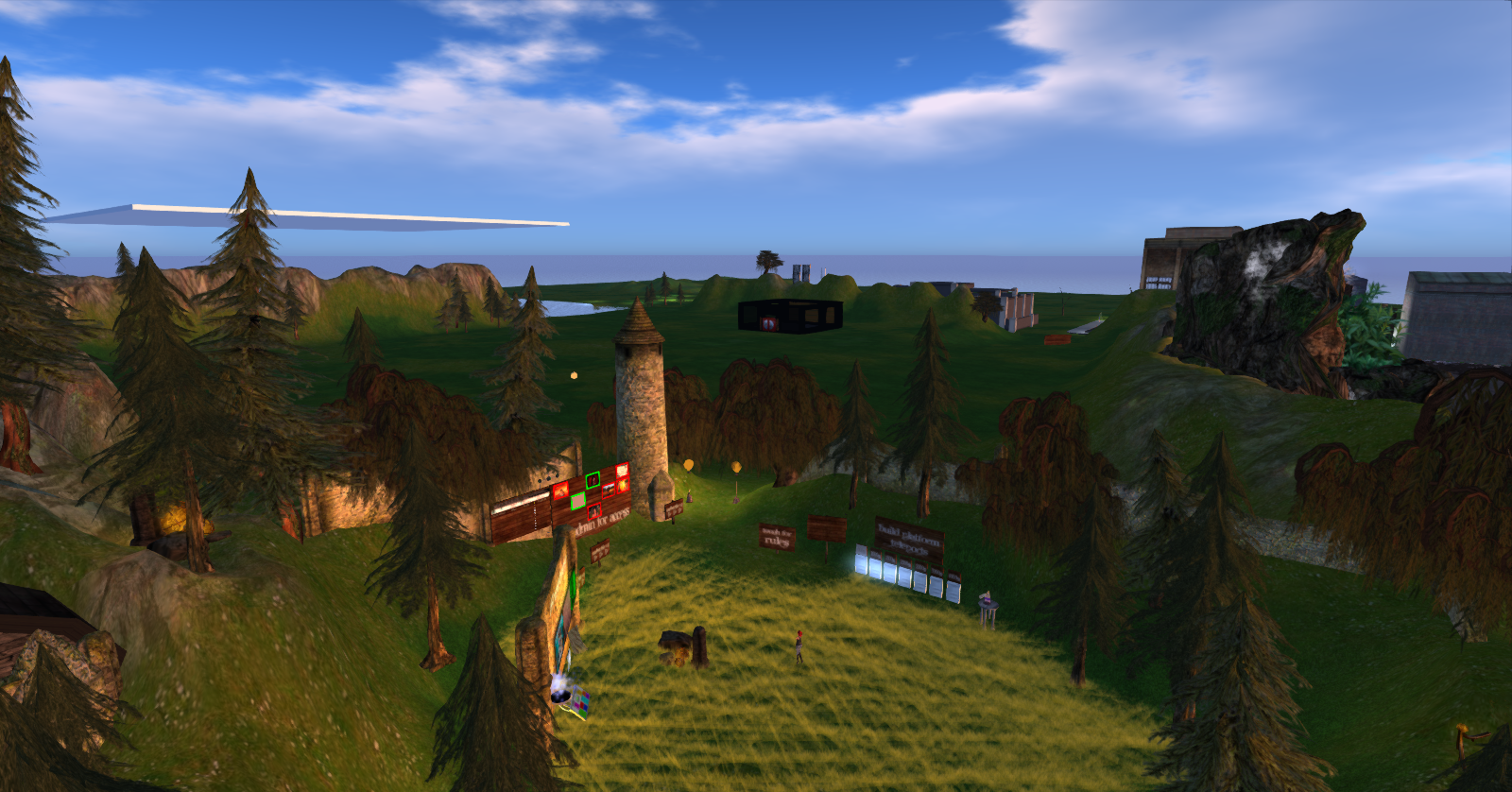
    IMAGE 1: Capture from Heritage Key of a clearing in a woods scene of a male avatar
    carrying a log to assist in the building of Stonehenge. A further
    female Indiana-Jone type character (that was me) is seen just behind.
    Circa 2010.
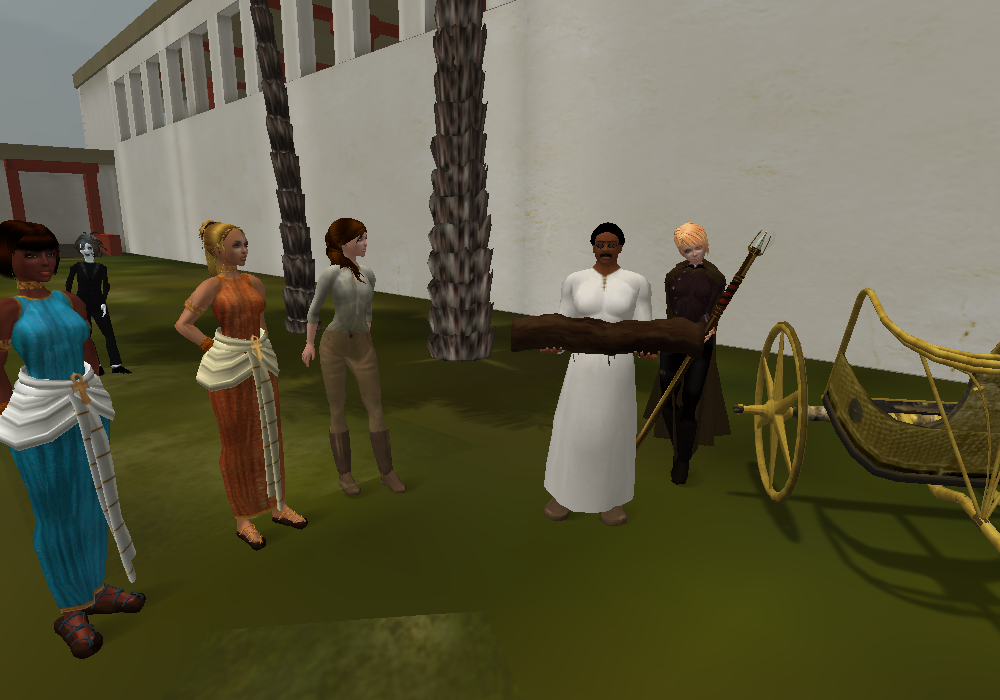


    IMAGE 2: Capture from
    Heritage Key tour that I believe Virtual Worlds Education Roundtable
    took back in 2010. Image shows a scene in Thebes between palaces and
    temples. Avatars are dressed in Egyptian, Druid, or Indiana Jones-like
    apparel.

    #VR #XR #vreducation #SecondLife #OpenSim #HeritageKey #Avatar #Stonghenge #ValleyOfTheKings #Participation #Best #Favorite #InstructionalDesign #Design #edtech

    Day 2 NASA goes to Mars


    Happy Twelvetide! Number 2 on my 12 favorite XR-for-education list is NASA goes to Mars!

    My fav parts?
    – Users had first person experiences walking around a Martian base in 2008.


    This kind of build checks every one of my ‘saves time, money, danger’
    boxes and as such, represents a great investment in XR. Experiences like
    this should be replicated.

    Yes, this
    is another defunct XR location, however there are still space clubs in
    Second Life and other platforms have picked up the gauntlet to recreate
    Mars, the Moon, and beyond.

    Is NASA
    done with virtual reality? Far from it. She’s just grown with the times.
    One of my favorite XR-for-education things that NASA has done recently
    is the First Woman graphic novel (comic book) demonstrating the
    diversity of thought that it will take to get successfully back to the
    moon. It’s XR-enabled and I’m happy to report that RT (the waving robot)
    has visited my living room.
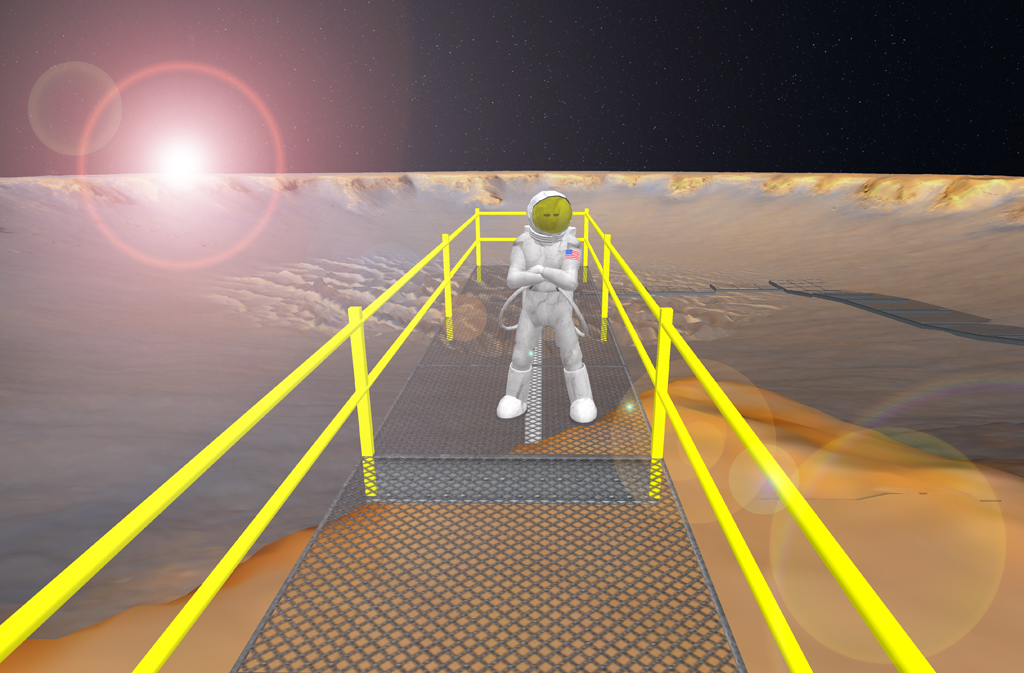


    IMAGE 1: Capture from NASA CoLab recreation of
    the Victoria Crater on Mars. Capture credit: Eric Hackathorn, NOAA,
    February 22 2008. Source: https://lnkd.in/gWFu7aKn Image is in the public domain.


    IMAGE
    2: Capture from NASA website about First Woman. Comic book style scene
    from the angle of moon boots shows a nearby moon rover with a robot
    waving in the back seat.


    IMAGE 3: Capture of cover of the First Woman, NASA’s Promise To Humanity, Issue Number 1 Dream to Reality graphic novel.

    #XR #VR #NASA #CommanderCallie #RT #VictoriaCrater #SecondLife #CoLab #SpaceEducation #edtech #InstructionalDesign

    Day 3 Dinosaur Track Lab


    Happy Day 3 of the 12 Days of Christmas! Today’s favorite XR-for-education example is for the curious InstructionalDesigners out there, wondering ā€œhow do you design instruction in VirtualReality?ā€

    I
    suggest this example from the Grand Cache Tourism and Interpretive
    Centre, that I saw demonstrated by Mike McCready of Lethbridge College,
    Alberta. This is the  best example of instructions given in a VR
    experience that I’ve seen!

    I
    should disclose my judging bias– I have taken many science labs in my
    time and a good set of lab instructions is a good set of instructions.
    Full stop. So these are good instructions. Direct, to the point, and
    helpful for completing the task at hand. Not too much detail in the
    objects presented to the learners and completing the lab *should* be
    within the physical capabilities of VR controllers (grabbing, placing,
    brushing, etc). Modification of target sizes could be done for Accessibility.
    I’m guessing that the VR artist and developer, Benjamin Blackwell,
    transposed real life lab instructions. I could be wrong, maybe someone
    wrote these instructions for the VR experience. But hey, either way, it
    works!

    The
    backstory of this VR experience isn’t bad either as it DOES tick
    Heather’s boxes of saving time, money, and danger. The real world
    dinosaur footprints are up on a sheer rock face at an angle in a
    preservation area. Getting there takes time, doing a dinosaur imprint
    IRL costs money (for supplies), and the location itself is dangerous to
    learners (and to environmental & historical damage). (Source: https://lnkd.in/gcWjFBXb)

    There’s
    a chance I would suggest adding an element that increases the stress
    level for learners (what??) but that’s just to add a narrative to the
    experience. I would throw in an approaching thunderstorm that the
    learners have to boogie and get out of the site ASAP.  But hey, I like
    narratives with my educational XR.

    I do not endorse any Lethbridge College program.


    IMAGE: Capture showing entry instructions for VR controllers.


    IMAGE
    3: Capture of prep table for taking a plaster cast of a dinosaur
    imprint. Equipment on the table includes a bag to carry the supplies up
    to the footprint location.


    IMAGE 4:
    Capture showing that learners have to use a spray (I think it was an
    adhesive) to position the frame in place to hold the plaster.


    IMAGE 5: Capture of the user grabbing the wooden frame to place over the footprint.


    IMAGE 6: Capture from a Lethbridge College site showing the angled sheer rock face with the dinosaur footprints.

    #InstructionalDesign #VR #XR #InstructionsMatter #ScienceLaboratory #Dinosaur #PlasterCast #VirtualInstruction #edtech

    Day 4 VR for Distraction/Pain Management

    Happy Day 4 of Twelvetide, where I’m sharing 12
    of my XR-for-education favorites! Today’s example is a concept– XR for
    distraction/pain management.


    I’ll admit
    that this example is tangentially associated with education. But two of
    the three examples I’m sharing are targeted for children. So in a way,
    VR is part of helping the children learn to live healthier lives!

    1.
    VR Vaccines – using VR to distract children during vaccine
    administration. Combine this with the “Buzzy” concept and I think the
    entire fear of needles (for anyone) could be eliminated! https://lnkd.in/gQsn39W9

    2.
    VR in a MRI – LOVE this but it’s still experimental. My favorite part
    of this design is that the clicks and whir sounds are incorporated INTO
    the VR experience. (Learning what the “sounds” mean is part of fear of
    flying courses so I think this could be incorporated into future virtual
    reality fear of flying experiences too.) https://lnkd.in/gZ6xnPEz

    3.
    VR for pain management. There are several companies working on this and
    kudos to ALL OF THEM! But I’ll shine a light on my friend Heather Bucalos, RN
    and her advocacy of using it for hospital patients (https://lnkd.in/g8s7q4_y ). It looks like Beth Savoldelli
    has a new initiative coming up in 2024, the XR Impact Network. Best wishes to all!


    IMAGE
    2: Capture from inside VR Vaccines where the user is about to have a
    special stone placed on their arm at the same timing as a vaccination.
    The user is presented with a story about how the stone ā€œprotectsā€ them.


    IMAGE
    3: VR use during an MRI. Experimental but includes the typical sounds
    of an MRI and particularly helpful for children to stay still and calm
    during the procedure.

    InstructionalDesign VR XR PainManagement Distraction Pediatric CancerTreatment edtech #XRImpactNetwork

     
    Day 5 National Geographic Explore VR
     
    Clip from inside of National Geographic Explore VR with a pelican flying past.


    For Day 5 of Twelvetide, where I’m sharing 12 of
    my XR-for-education favorites, I list National Geographic Explore VR,
    whose name, perhaps in a clever move, puts the ā€œVRā€ in the right
    place…last.  It just HAPPENS to occur inside the media of VR, but the
    star of the show IS the Nat Geo content.

    My favs of this?

    This puts the explore in Explore VR. Basically if you want to use VR to go places, this is your golden ticket.

    Plus,
    there is an impressive story line (I’m referring ONLY to the Antarctica
    experience here): going from a ship, via kayak, to an ice shelf,
    climbing it, and then waiting out an Antarctic storm in a camp. 
    (Playthrough video here: https://lnkd.in/ggMtNxy8 )

    When I taught an Introduction to XR (Design) course using the Quest 2s (https://lnkd.in/gYi9RWCU),
    I placed Nat Geo as the very first experience in the course after the
    Oculus First Steps primer. I also framed it within the design element of
    Function. That is, does the experience take advantage of VR
    affordances? If not, could it be done some other way just as well?  In
    the case of exploring, there is a long history of high quality National
    Geographic TV shows. Could doing something in VR measure up?

    In
    this case, the learner has to paddle their kayak, choose and take their
    own photos (they are on a mission from Nat Geo, of course, to get
    photographs), and climb an ice shelf. Either way, it’s arm work!

    So
    the user is not simply a viewer as would be for a TV show. There are a
    few folks right here that would like to pipe up and state that the
    movement *causes* learning or as I saw it phrased the other day:

    ā€œIt
    feels more like an earned learned experience than something you
    passively learned about or were informed about,ā€ Bill Briggs, Deloitte
    CTO, told VentureBeat. ā€œThe retention and recall is just higher. Your
    brain is storing it in a different place.ā€

    That’s a bunch of horse hockey.

    Your
    brain is storing it in a different place? Oh, like that prepper
    pantry?  Experiences ARE experiences. Full stop. The brain encodes them
    exactly the same, whether they are in VR or IRL. What this person was
    doing was a backhand slap at traditional instruction (code word:
    passive), which (according to them) has been dreadful for ages.  On
    behalf of all teachers…thanks? (not really, grr)

    But
    I digress. Back to enjoying Nat Geo because they did a good job. It’s a
    good starter experience if you can afford it for your learners. It’s
    listed at US$9.99 in the Meta Quest store.


    IMAGE: Capture from inside of Explore VR looking down to see some whales in a small bay dotted with icebergs.



    IMAGE: Capture from the Meta Quest store of the purchase page from National Geographic Explore VR. 

     
    InstructionalDesign VR XR NationalGeographic Explore Antarctica Kayak Penguin Whale IceClimb Photography
     

    Day 6 VR for Conflict-Related Sexual Violence

    Trigger warning: today’s entry refers to sexual violence.

    I went to an entrepreneurial conference last year to speak on the topic of the metaverse. I know my ad hoc speaking style (which I enjoy but I lose my train of thought), so in advance I scribbled up a list of truly GREAT applications of virtual reality so that I could glance at it.  Today’s entry made that list. 

    A VR for conflict-related sexual violence (CRSV) pilot study includes everything from seeing a courtroom in advance, seeing visual assurances of identity protection, reenactments, and post trauma healing and comfort. I see it is still in the experimental stage but the results are about to come in.

    https://lnkd.in/gG7knz4y

    In September 2019, I was sexually attacked. I had to describe the event to the State Police three times. A friend rushed to me, took one look at me, and said that I was in shock. The shock goes on for a long time. I can only imagine what circumstances are like when sexual attacks occur as part of conflict or war.  Therefore, I wish this pilot Godspeed. 

    Good on yer to the sponsors: The Royal College of Art, Immersonal, Frontier Tech Hub, UK International Development, and the Office of the Prosecutor of the International Criminal Court.

    #VR #XR #BestUseCase #CRSV #SexualViolence #Crime #VictimProtections #RoyalCollegeOfArt #TechHub #UK #InternationalCriminalCourt


    Day 7 Tsunami Simulation from NOAA


    Day 7 from my 12 Days of Christmas favorite VR-for-education examples is a multi-step process. We have to time travel back. I’m going to stop our time machine at 14 years ago, the year 2010. NOAA had built their 2nd iteration of a tsunami simulation on their Second Life island, Meteora, that my old friend and colleague AJ Kelton captured in video here: https://lnkd.in/dCNDXnAH. (To see an even OLDER version of the same simulation, see video here https://lnkd.in/d2csDTyA) On the timeline, 2004 the Indian Ocean earthquake and tsunami was just 6 years prior when an estimated 227,000 people died (https://lnkd.in/du6sTWGt)

    OK, Heather, this looks chunky and old. What’s the deal?

    The point is that NOAA only built 5 experiences in VR– and a tsunami remained one of them (https://lnkd.in/dGD62bv6). I’m going to go out on a limb and state that NOAA thought it was *important* that humanity learn what tsunamis are and why you just can’t ā€œoutrun themā€.

    Why was XR a good choice for this particular natural hazard?

    Because in XR, the viewer can stand still and let the tsunami wash over them and get a hint at it’s height, power, and devastation. (Hat tip to the movie, The Impossible for their depiction here https://lnkd.in/dSx-PHnv). READ: Avatar height actually means something here.

    Time machine forward to 2011, March 11 and the Great East Japan Earthquake. (https://lnkd.in/djjVKSsP ) For the first time, humanity would see in real terms the devastation of a tsunami.

    Fast forward one more time to 2016 and simulations advanced to this stage (see video clip below). By now, humanity had begun to take tsunamis MUCH more seriously with early warning buoys, escape routes, and *hopefully* people evacuating the coast when it could happen. 

    Do you see the connection between SEEING what a tsunami could do and future safety? Humans have a habit of clinging to ā€œseeing is believing.ā€

    It is areas like this that hit my 3-item (time, money, danger) checklist hard and for the good: XR for reducing danger.

    In a sad twist, I’m late getting this posted on January 3 and another earthquake and tsunami occurred in Japan on the day I should have posted this, January 1, 2024. Thankfully, it appears that warnings went up fast and folks did evacuate. (Edit: I’ve now heard that at least 200+ people have died.)

    In summary, we can’t look at this Day 7 example outside of its historical context. More emphasis on the real dangers of tsunamis can save lives.

    #VR #XR #InstructionalDesign #Tsunami #Earthquake #Preparedness #NaturalDisaster #Awareness #EscapeRoute #Practice

    Day 8 Apart Gallery

    Day 8 of my Twelvetide favorite examples of XR-for-education is a true favorite. If you’ve never been in the metaverse, I’ll take you here first: the Apart Gallery.

    1. Surf to https://apartposters.com/

    2. Click on Virtual Gallery.

    3. Click on Join Room.

    4. Click Accept to agree to your avatar. (Yup, you can change it here if you want or you can change it later, either way. Because metaverse!)

    5. Turning on mics is optional so you can skip that if you want. Click on Enter Room.

    See? 5 Clicks.  And if you’ve been in before, it’s actually 4 clicks b/c  your browser will remember you.

    This is WebXR, the spatial web, or the immersive web. Names are not yet nailed down because it’s still relatively new.  You entered the metaverse with your browser. That doesn’t sound like much, but to gamers, it’s a big deal.

    Gamers are used to:

    – Large downloads

    – Required log-ins

    – Running extra programs for sound or dialog.

    – Turning off other programs to preserve memory and increase speed.

    – All kinds of special doohickeys.

    In this example, hosted by Mozilla Hubs, you don’t need to do any of that. You are free as a bird!  (Movement is with your W,A,S,D keys and your mouse).

    This *particular* example is on my list of favorites because of this ease of entry.  It’s the comfortable on-ramp into the metaverse. šŸš—

    But there is one OTHER reason why I take newbies to the Apart Gallery. It’s an art gallery and it’s a time capsule of a sliver of American time. The original gallery artwork was produced between February and April 2020. Think back to what we were doing then:

    – Social distancing

    – Stay home

    – Wash your hands

    We were NOT talking about immunizations, unnecessary lock downs, and vulnerable populations. We didn’t even know COVID could be airborne. The artwork reflects the public health propaganda of those months. I use that word NEUTRALLY, not in a negative way. (I’m FOR public health!!)  The word propaganda to me means ā€œrelaying an idea that you want someone to agree withā€. Another word might be ā€œrhetoricā€.  It’s fascinating to look back on what we were telling each other might work.  Truly, we have our own stories now, just like the haunting stories from the 1918 flu.

    The great folks at Paradowski Creative have since expanded the build so if you have time, wander around a bit. Not every version of the coming metaverse will be Second Life 2.0 ( šŸ˜ ).

    #VR #XR #InstructionalDesign #ImmersiveWeb #SpatialWeb #WebXR #ApartGallery #ApartPosters #Propaganda #SocialDistancing #WashYourHands #StayHome #Immunizations #Art #VirtualReality


    Day 9  The Naturalist’s Workshop

    Today’s entry in my 12 Days of Christmas favorite XR-for-education examples is an odd one. For all those independent projects, developers, and small teams slogging away on tiny VR experiences and wondering…does anyone notice this?

    My answer is YES.

    I received exposure to the Naturalist’s Workshop (from North Carolina State University and the North Carolina Museum of Natural Sciences https://lnkd.in/duyS4xaW ) via a colleague. While I’m sure it’s great for learning some basic tree identification (yes!) I liked it for the basic design and how I could use THIS design to teach some elements of basic spatial design to others.  How do you situate a learner in a virtual space? How close is everything? How far away? Does the learner have to walk?

    I didn’t use this experience with any instructions. It was just headset on, app on, and go. So I didn’t even know it had a name or purpose. I was plopped in a small clearing in a forest on a slightly elevated concrete-looking platform with a desk and some stuff.

    I did some basic spatial awareness practice. I looked at my hands. I looked at my feet. I looked to the front, to the left, to the right, behind me, below me, and above me (oh! Nice opening the tree canopy). I looked at my stomach (missing. huh.) So users have no avatars. But they don’t need them to identify trees, do they? Even though the area is closed in, it did NOT feel claustrophobic at all…because trees just fade off into the distance. The color theme is a bright spring green. The platform had a low knee-level wall and 2 gaps for going out into the forest (cough, expansion plans please!)

    I bent down and looked under the desk and then discovered that the desk drawers do open! Hey there is stuff inside! So I started to pick those things up and when I placed them on the desk, something happened. Sometimes, I was temporarily transported to a 360 degree photo with one tree dominant in my view.  Oh! I had placed an object FROM the tree (a leaf or a seed) into a place and could learn more about it!  Level 1 tree identification unlocked.

    You can get this app via SideQuest.

    It’s paced at 5-15 minutes. I assume the 5 minute-rs would know what they are doing.  I’d say it’s nicely at the 20 minute mark if you want to fool around.

    It’s little projects like this (and the Dinosaur Track cast from Day 3) that are actually moving us forward in the XR for learning market.  It doesn’t escape me that both were built in partnership between a university and a museum.  Are you writing this down? You should be.

    #VR #XR #InstructionalDesign #NaturalistsWorkshop #VirtualReality #VirtualNature #TreeIdentification #NorthCarolina

    Day 10 Sandboxes


    Happy Day 10 of the 12 Days of Christmas! You’re
    probably getting tired of this by now, aren’t you?  But we are almost to
    the end!

    For today, my favorite
    example of XR-for-education is back to a concept– NOT a specific
    platform, app, or game. The concept is sandboxes.

    No,
    these are not virtual boxes on the ground filled with sand. These are
    locations in virtual reality where users are endowed as creators. 
    Virtual reality needs these spaces.  I’m reminded of the name of one of
    my favorite Facebook groups, I Require Art. I feel like that name needs a
    second clause ā€œlike I need air.ā€  Virtual reality needs places where
    users of any kind can experiment.

    I’m
    going to name 2 platforms because they meet this standard: Upon entry,
    users are endowed as creators. Of course, it often matters where you are
    standing.  You can’t just create anywhere and everywhere. You must have
    wisdom about this.

    When I first
    described Second Life to my best educational psychology friend and said
    ā€œAll users are endowed as creatorsā€, he quipped back ā€œOh, you all can
    have God complexes!ā€ God, I loved working with that guy. He both kept me
    grounded and pointed to the stars.

    But,
    yes, users can have God complexes. Or to put it more finely, users can
    explore their desires to create, to shape their world, to build, to
    paint, to sculpt, to cook, or do all kinds of creative things that
    humans have been doing for millennia.

    I
    used to have a tiny patch of ground in Second Life, thanks to a grant
    to educators via Montclair State University in New Jersey.  I could
    build whatever I wanted (that was free b/c I was cheap).  I set up a
    free pavilion, campfire, and space-pod office where-in I placed a
    Tiffany lamp and tiny velociraptor, as one would do.  It wasn’t much,
    but it was my space.

    I found that this location (https://lnkd.in/ek8h-22F) does
    a good job of explaining a virtual sandbox. I don’t know them, but they
    show the connection between space available, what you can do (rules),
    and technical specifications (prim/polygon or memory sizes).


    In
    the world of WebXR, Hubs allows for users to be creators from their
    first moment. As long as the space you are inside of standing allows it,
    you can bring in your own .glb files or surf over to Sketchfab.

    What’s my fav?

    Humans
    are creators. We bring order to chaos.  The freedom to create is
    important and yes, I think it is as important as air is to breathing.
    None of our other human endeavors would have value if we didn’t have art
    to express meaning.  Onward artists, onward!


    Post
    script: You might not know that most XR platforms do not endow users as
    creators.  There could be costs, permissions, or it is simply not
    available.  That’s why this feature is remarkable.

    (I actually do NOT know the platform Sandbox VR and this post does not constitute an endorsement.)

    #VR #XR #InstructionalDesign #Sandboxes #CreativeSpaces #CreativePlay #Expression #Art #Freedom #BringOrderToChaos

    Day 11 Action


    Day 11 of the 12 Days of Christmas of my favorite XR-for-education examples! Today is another ā€œconceptā€– it is action.  I have some colleagues in the XR industry that believe that movement in XR is the best possible affordance of XR. I have disagreed with them.

    See one example where a researcher hypothesized that movement in XR would cause more learning and then (gasp!) found that it made no difference: Johnson‐Glenberg, M. C., Bartolomea, H., & Kalina, E. (2021). Platform is not destiny: Embodied learning effects comparing 2D desktop to 3D virtual reality STEM experiences. Journal of Computer Assisted Learning, 37(5), 1263-1284.

    But today I’m splitting that action hair super fine. 

    I’m actually FOR movement in XR when it facilitates learning.  Said another way: when all other media choices would not allow for equivalent movement in a situation (or if movement in XR is a brand new thing under the sun), movement, then, in XR is, yes, helpful.  I would not say it is the end-all be-all of XR-for-learning but it can help (facilitate) learning. I’m hinting at neuroscience and body memory.

    For example, using XR before approaching a large, moving, and dangerous piece of equipment like a windmill to learn maintenance. YES. This is a good use of movement in XR because it makes something happen that no other form of media would easily do (not a drone or first person GoPro video). If it would be dangerous to approach with zero training, XR can provide action practice use of the equipment in a safe way.

    Want some sources to support that?

    Here you go:

    Students at the University of East London practice using PCR equipment in XR before using it in real life. https://lnkd.in/eKhkRWks

    Potential workers in windmill maintenance get exposed to the work conditions in XR to decide if they really want to pursue this career

    https://lnkd.in/eqbzqceX

    And the now somewhat buried Lowe’s Home Improvement Store use of VR to teach skills like bathroom tiling to customers https://lnkd.in/emJF7KRr

    Other versions of ā€œactionā€ include programs like Tiltbrush or possibly GravitySketch that allow users to move and create from inside of XR, not on the outside and bring art of object creations into XR like is the current method with programs like Unity, Unreal, and Blender.

    The key to remember here is: compare the XR experience to its closest cognitively competitor experience. (READ: if the experience is processed in the brain the same way). If XR is faster or cheaper or safer than that competitor choice, XR is the way to go.

    Video clip from Simulwind. Capture shows the user selecting and placing the correct size wrench to open an equipment panel.

    #XR #VR #InstructionalDesign #Action #BodyMemory #Safety #Movement #Art #Skills

    Day 12 Emergency Services


    Last but far from least, my 12th favorite XR-for-education example has, as far as I discern right now, the strongest connection between USE and LEARNING. (Translation: a safe bet!)

    It’s XR for the emergency and military services– fire, medical, police, and military. As the daughter of a fire instructor, this use just makes me smile. I’m sure my Dad would have LOVED this.  He loved teaching and learning via fire simulations– there was no time his skills shone brighter than helping trainee firefighters learn things like fire behavior, untapped rural water sources, and fire site safety. I’m sure I got my ā€œadult educatorā€ genes from him.

    By now, I don’t have to tell you how XR for training uses here ticks every box of saving time, saving money, and reducing danger.

    But I’ll spend this last moment on the list hinting – indeed – to the intriguing research connection here. What is it about emergency situations that makes XR work so well?  I don’t know!  The emotional hype? The practice-so-many-times-until-you-can-do-it-in-your-sleep-ness? The visual SEEING of emergency situations– and living thereafter?

    So much cool depth to explore here, but in the meantime, using XR for these uses has my endorsement.  May we never need these services, but I’m glad that our service people are getting well trained in the meantime.

    Ending my 12 Days of Christmas on Epiphany (whew!) I wish you the gifts of peace, happiness, and good health in the New Year!

    #XR #VR #InstructionalDesign #EmergencyServices #Police #Fire #EMS #Medical #Military #SaveTime #SaveMoney #ReduceDanger



  • Seeking Integrity in VR Educational Research

    Seeking Integrity in VR Educational Research


    Banner image of a woman in a hooded cloak looks out from a dark scene
    Credit: Midjourney and me

    I’m starting a new article series today, calling out ‘bad research’ or research that is quoted badly in virtual reality for educational use. I thought I would start with a whopper – a really egregious example to start this series with a bang. Then I checked my notes and realized that this example is from LAST MONTH, June 2023. I’m not even going into the vault for this. I’m barely picking myself up off the ground from the shock wave.

    So, like Mario says “Here we go!”

    What Is Said About The Research Versus What The Research Says

    June 2023, LinkedIn Post:

    “According to a study from the University of Maryland in 2018, learners remember an astounding 90% of what they experience in VR compared to merely 10% of what they read and 20% of what they hear.”

    LinkedIn post with quote and photo. Details blurred.

    I believe this is the research referred to:

    Krokos, E., Plaisant, C., & Varshney, A. (2019). Virtual memory palaces: immersion aids recall. Virtual reality, 23, 1-15. https://obj.umiacs.umd.edu/virtual_reality_study/10.1007-s10055-018-0346-3.pdf

    Hey, I’ll give you the abstract because I know you don’t like to read long papers:

    “Virtual reality displays, such as head-mounted displays (HMD), affords us a superior spatial awareness by leveraging our vestibular and proprioceptive senses, as compared to traditional desktop displays. Since classical times, people have used memory palaces as a spatial mnemonic to help remember information by organizing it spatially and associating it with saliļæ½ent features in that environment. In this paper, we explore whether using virtual memory palaces in a head-mounted display with head-tracking (HMD condition) would allow a user to better recall information than when using a traditional desktop display with a mouse-based interaction (desktop condition). [OK skip to here because this is the interesting part:] We found that virtual memory palaces in HMD condition provide a superior memory recall ability compared to the desktop condition. We believe this is a frst step in using virtual environments for creating more memorable experiences that enhance productivity through better recall of large amounts of information organized using the idea of virtual memory palaces.”
    Google Scholar tells me this study has been cited 461 times. That’s a low-medium citation number. Not bad, and remember that’s in ~3 years of time.

    Believe it or not, I’m walking RIGHT PAST that 90%, 10%, and 20% because it has already be debunked here and here. Also, to be fair to the research paper, it never quotes those 10 and 20% numbers.

    My Take on the Research

    Research found 90.48% recall in the headset condition, with a 78.57% score from the desktop display control group. So that’s ~10% higher with the headset. 

    From Section 4.1 “Using a paired t test with Bonferroni–Holm correction, we calculated p = 0.0017 < 0.05 which shows that our result was statistically significant.”

    Interesting. I’m not familiar with Bonferroni-Holm correction. Just looking at it, it appears to be a method of discarding some data. I wonder if NOT using it showed a not statistically significant difference between the 90 and 78. Their n was 40. Smaller group sizes means it can be harder to justify the data as fitting a normal bell curve.

    Figure 5 shows the data and just looking at it, you can see that the numbers landed in similar scores. The boxes overlap, so whatever the effect of VR is, it’s not that substantial in this study. Students were learning, regardless.

    But here comes the whopper. Check out this little detail in the Materials section:

    “For this study, we used a traditional desktop with a 30 inch (76.2) cm—diagonal monitor and an Oculus DK2 HMD. The rendering for the desktop was configured to match that of the Oculus with a resolution of 1920 Ɨ 1080 pixels (across the two eyes) with a rendering field of view (FOV) of 100ā—¦. In order to give the desktop display the same field of view as the HMD, the participants were positioned with their heads 10 inches (25.4 cm) away from the monitor.”

    10 inches away

    The “control group” sat 10 inches from their desktop monitor to use the desktop condition.

    WHO DOES THAT?

    You know, I was curious. I grabbed my ruler. 

    How far away are you sitting from YOUR monitor?

    I’m currently sitting 24 inches from my monitor. I leaned in to feel what 10 inches is like.

    At that point, it became no wonder to me that the control group scored about 10 points lower. It was maddening. Remember, the learners had to look all around themselves so completing learning at 10″ from the monitor would be…uh…weird?

    This is a great example of not seeing the forest for the trees in VR in education design. In order to match the field of view, they forced learners to unusually use their desktop monitors.

    There is too much. Let me sum up.

    The quote is from a keynote speaker at a research conference. I can’t believe anyone in the audience did not flag the play on the quote, the percentages, or the design setup of the U. of Maryland study. At the industry.

    • The difference between 90 and 78 *might* be too close to call a difference caused by VR.
    • Setting up learners to use a monitor from 10 inches away is unusual, to say the least.
    • When research sets up unfair comparison conditions, the results should be questioned.

    As Hill Street Blues would say, “Let’s be careful out there.”


    What do you think?

    #VirtualReality #VR #XR #VRForLearning #Technology #Future #edtech #learning #education #UserExperience #InstructionalDesign #research #ComparisonResearch #Media #MediaForLearning #BonferroniHolm #ImmersiveExperience #Desktop #Design #MemoryPalace #ResearchIntegrity


    This article is co-published to my LinkedIn account here: https://www.linkedin.com/pulse/seeking-integrity-vr-educational-research-heather-dodds-ph-d-


    Attribution-NonCommercial-ShareAlike

    CC BY-NC-SA

  • Happy 20th Birthday Second Life

    Happy 20th Birthday Second Life


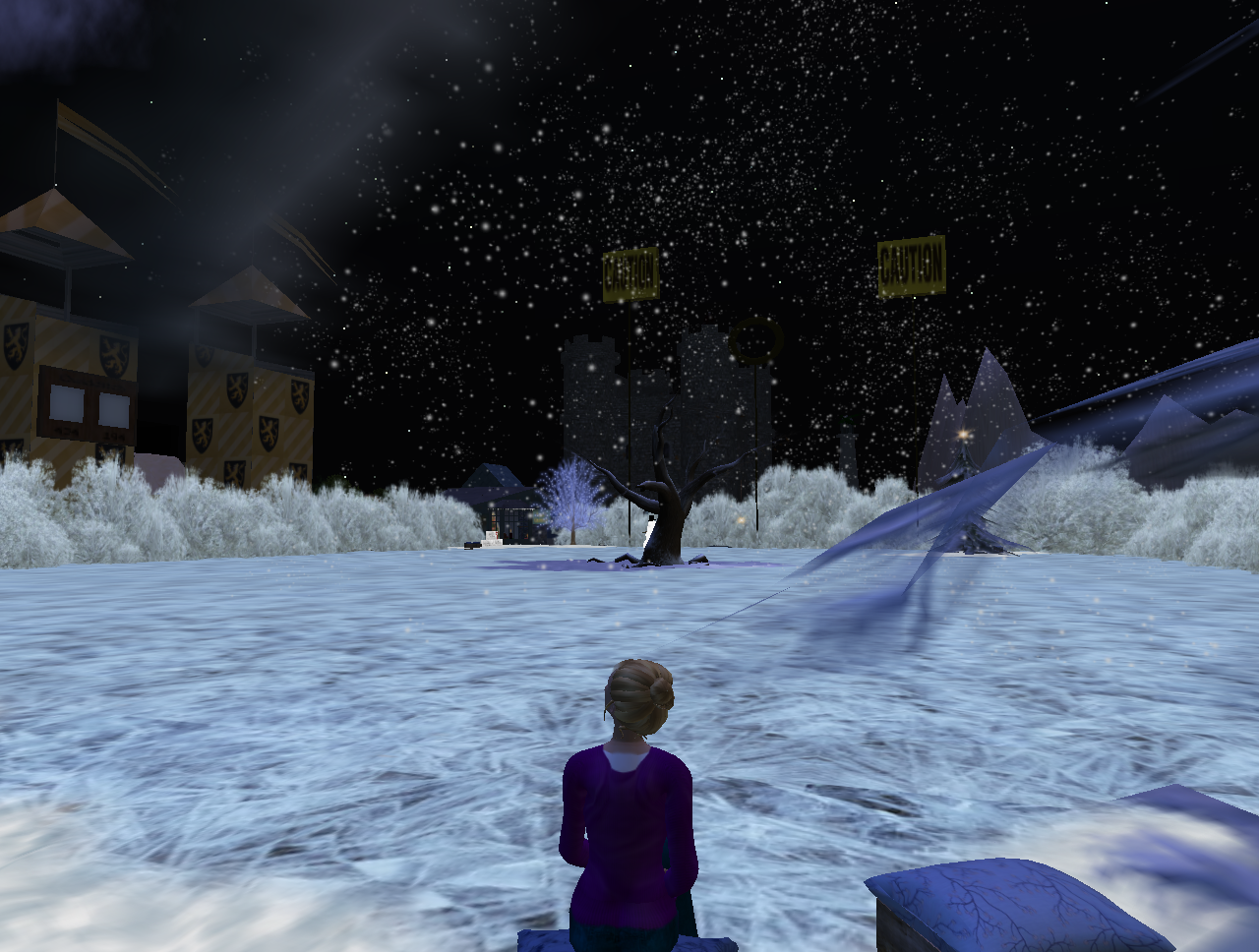
    Second Life resident looking at snow falling on the Quidditch pitch of the nighttime VWER Campus, 2010.

    IMAGE: Second Life resident looking at snow falling on the Quidditch pitch of the nighttime VWER Campus, 2010.


    This is some of what I call my “kick out writing” that I did not include in some recent published writing. It starts:

    The
    promise of the metaverse in education is like a mirage in the desert.
    Educators seem to be forever awaiting the arrival of the metaverse but
    still not yet embracing those technologies.

    In 2003, #SecondLife
    launched as an immersive persistent virtual world. Just three years
    later, educators were publishing about their pioneering efforts on the
    platform. Kemp & Daniel Livingstone (2006) suggested pairing Second Life with a learning management system (LMS), a suggestion familiar to #instructionaldesigners
    of the Internet age. In 2007, the word “metaverse” first appeared in
    educational publications (Tilili, 2022). The popularity of virtual
    worlds briefly increased between 2007 and 2010. As cited in Warburton
    (2009), Kirriemuir estimated that ā€œthree quarters of UK universities are
    estimated to be actively developing or using Second Life.” This
    adoption would wane by 2013 however after educational discounts were
    discontinued and the initial fervor of virtual spaces gave way to empty
    buildings and virtual ghost towns.

    The arrival of the metaverse would have to wait a little while longer.

    ~

    I just lean back in my chair and wax poetic sometimes. šŸ’ŗ āœ

    Happy 20th Birthday Second Life


  • Manifesto: XR will not cause lasting improvement in education

    Manifesto: XR will not cause lasting improvement in education


    Photo of clear glass sphere on a beach reflecting the sunny scene upside down. Keyword: Clarify.

    Photo by Dan DeAlmeida on Unsplash

    I’ve received some questions on my video and transcript posted here: https://heatheredodds.blogspot.com/2022/09/xr-will-not-cause-lasting-improvements.html

    So I’ll add some clarifications:

    1. There are weak points in my argument:

    A. I argue that the learner is the still as-yet undiscovered cause of the flat lining of learning objective results media to media.  I have NO data to back that up. That is a supposition by me. I suspect the data will have to come from brain studies.

    B. My argument that learners in previous generations were NOT dumb is a bit of low…err…high?…blow. Certainly, there were dumb learners in the past.

    However, I do not buy the modernist argument that when technology gets “better”, learning gets better.  Nope. No. As I mentioned in the video, humans appear to have a learning speed limit. Said another way, the neural pathways of learning in a human brain are set. (Yup, I’m referring to brain-based learning theory here. You might know it as neuroscience.) Short of something like “Lawnmower Man” or a “Flowers for Algernon” royal technology/drug-induced fuck up, I don’t see humans getting smarter.

    2. Let me be clear on my argument about results flat-lining and there being no “lasting improvement”. The “lasting improvement” that I’m mentioning are ONLY learning objectives. So said another way, if there was an exam covering X taught with media Y where students score Z right now….in 10 to 30 years, learners will still score Z even if XR is the media.  I’m sticking to apples to apples comparisons. I’m NOT talking about other things like XR affordances, which would introduce apples to kiwi to melon comparisons….which are not comparisons and are not fair.  

    So I’m not talking about XR doing things like increasing access to resources due to manipulations of time, space, geography, physics, etc. Those things are affordances, the characteristics that belong or sort-of stick to a media form.

    The conversation about affordances is fascinating and I’d love to have it! As a designer, knowing the positives and negatives about each media is my specialty! (See my XR platforms writing.) However, I’m also bound as designer to not force any decision about the “best” media upon a client. The clients decides what they will select, what they will pay for, what they will invest in long-term and thus the client accepts both the positive and negative consequences of their decision, their “opportunity cost”. So by default, I almost never like to say this is “the best” when it comes to an XR platform.

    3. Timeline = I used smartphones as an example in the video but I’m really brief about it.  But it is in somewhat recent memory that smartphones went from a new technology to everyone having one.  How long did that take?  Hmm… lemme check:

    First arguable smartphone: 1992.

    2022: as shown in the video there are enough smartphones in the US for every adult to have one. Translation = the US market is saturated. Smartphones are ubiquitous. 

    1992 to 2022. So that took 30 years.

    I’m fine with adding in Moore’s Law here.  So the adoption of XR until the point of it being ubiquitous and saturated– how long will that take?

    Hmm… I’m guessing but I’m more comfortable saying closer the 10 years from 2022 than 5 years.  That puts my guess at 2032.

    Now now, you pro-XR folks out there! I heard your cry! 10 years!!  Don’t be sad.  Remember what is between HERE and THERE: a great big increase, an expansion, a bubble, GROWTH.  It will be a good 10 years.  (Imagine what the first 10 years was like for smartphone manufacturers Nokia and Apple, whoohoo!)

    (more…)

  • XR Will Not Cause Lasting Improvements In Education

    XR Will Not Cause Lasting Improvements In Education


    This post accompanies my XR will not cause lasting improvement in education video and contains a few more details. I wrote this blog post first, then made and remade the video and I’ve come back to finish the blog post with the final script and my notes.

    XR will not cause lasting improvement in education.

    That’s an interesting statement to start a video

    when I’m known for being pro-XR.

    That’s right, I am pro-XR in education.

    But I have expectations that learners will not perform higher.

    With respect: Rephrased
    from the Cambridge Handbook of Multimedia, (2005, pp. 7-9) and Cuban’s
    1986 book: Teachers and machines: The classroom use of technology since
    1920 (pp. 9-26) and Mayer, R. (2020). Multimedia Learning (3rd ed.).
    Cambridge: Cambridge University Press. doi:10.1017/9781316941355.

    Generally, educators are on the lookout for what causes learning and we want to encourage more of it. We realize that content is hard to learn and we want as many learners as possible to successfully learn it. This is given– a belief in the general positive well-being of the learning process, the educators and not least, the learners. It IS important to say that because somewhere along the way, one of the counter arguments against that fact that we don’t find learning gains is “the technology was poorly implemented” or “the leaders don’t care for change” and I wanted to cut both of those excuses off right at the beginning. Nope! Educators IN GENERAL are implementing the technology well and leadership IN GENERAL is pro-change.

    Next we need to visit the scientific experimental model as it is the basis for the experimental models used in education. That means that we observe an effect, some data, some phenomena, and we ask “What caused this?”

    Remember, we are looking for cause and effect.

    This is the scientific experimental model.

    Controlled variables – things hold them constant so that they don’t change.

    Independent variable – what we purposely change to test cause and effect.

    Dependent variable – what we measure as the result.

    There are other models to gain information from; naturalistic…meaning anything outside of a lab

    Or cultural ways of knowing. This could be indigenous or religious knowledge.

    Regardless, the Experimental Model is one of our strongest logic systems and it comes through more times than not at finding cause and effect.

    We can isolate variables down to determining the cause (a deductive reasoning approach, a la Sherlock Holmes), or we can simply start with as few variables as possible to find the cause.

    This is the same experimental model as it appears in educational research.

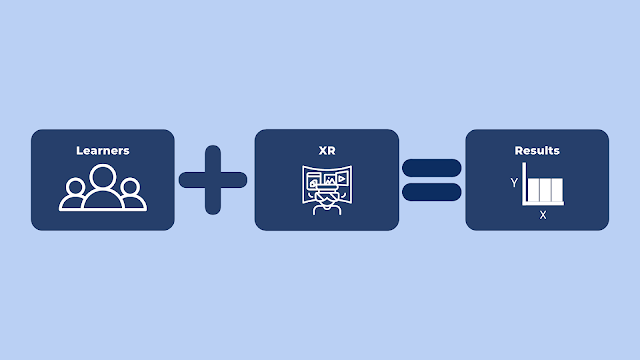
    We have our learners, we add a technology, and we measure the results.

    And it’s not like we just started this research.

    For the purposes of this video, I’ll go back just over 100 years and use the word technology to mean anything powered by electricity.

    For example, Radio

    And here are the results: no lasting improvement.

    Projectors – no lasting improvement

    Television – no lasting improvement

    Computers – no lasting improvement

    Internet – no lasting improvement

    and in the future, cloud-based learning by robots or whatever.

    But in all seriousness, this video is about XR, extended reality, cross-reality, mixed reality or whatever you want to call it.

    Graphic of learners plus XR equals results.

    Now RIGHT HERE, some will become upset. They say:

    But this is different!

    This is learning in 3D!

    No, you don’t understand, this is a computer stuck to your face!

    We need to implement it correctly and THEN we’ll see the results!

    I have a study right here that shows it better when putting VR up against a textbook or a human teacher!

    OK for that last one, I toss that right out as non-comparable methods, but that’s a topic for another day.

    So let’s look at the results, shall we?

    No improvement.

    Now for those that are hearing me right now having a really hard time taking this in, I understand that this is not fitting into your schema. What you are feeling is bias. You want the results to be a certain way, and even when the results are not turning out the way you want them to, you want to reject all of the previous results as not predicting what will happen next. Remember that bias, in research, is a bad thing. We don’t want it. So I need to ask you to check your bias and leave it behind.

    I’ll give you an example that should be in the recent memory of XR enthusiasts. I’ll use 2022 words to explain a 2022 real world example.

    How many studies do we hear of right now that show a spectacular increase in learning with a smartphone (mobile)?

    How many times do we hear from learners that they love learning on their smartphone? “Oh it’s so cool!” “Oh it’s the best!” Oh I love that I can learn from a computer in my pocket! Oh, I love that I can learn on this tiny screen!ā€
    ~ Oh I love that I’m
    being forced to do my workplace learning on my own device (that I paid
    for, pay for the internet subscription for, and pay the insurance on, to
    say nothing of being tracked by my workplace VIA my own phone!

    What’s that?

    No one says this?

    You’re right.

    Why?

    Said another way, smartphones are ubiquitous. Actually if you listen closely, there is a STRONG amount of conversation about how learning on the smartphone is boring, forced, poorly designed and/or at least equivalent to learning in the classroom—thanks to COVID and 2020.

    So learning on a smartphone is ubiquitous. The learning results have flat-lined.

    I’ve made my case that history predicts that XR will also flat-line after it has become ubiquitous.

    But….why?

    We still didn’t answer that.

    I have 2 reasons. One I’ll share, the other, not yet.

    Let’s go back and look at that experiment model again.

    We said that every technological improvement has proved to produce zero overall learning gains. Learners are simply NOT DOING BETTER.

    We can slip in and out all of these technologies and we keep getting goose egg results, nothing. But…look closely at the model. What other variables are there?

    We said that technology was a variable and our proposed independent variable– we are purposely changing it).

    The results are the dependent variable – they are the output, the effect, or the result of what we are changing and frustratingly, they are NOT CHANGING.

    So what else is there?

    Look. One more variable is present…

    The learners!

    Matching my technology examples: 1920s learners

    1940s learners

    1960s learners

    1980s learners

    Learners from the year 2000

    2010 learners

    I mean, everyone knows that 1920s learners were dumb, right? I mean…

    Oh, you mean the time when Einstein discovered his E = mc(squared) hypothesis? We were dumb?

    1940s? The start of the discovery of the polio vaccine? Saving thousands if not millions of future lives?

    We were dumb then?

    1960s? Early computers being built? Remember…going to the moon?

    1980s? Well no comment from me, I’m from there.

    Many smart well-respected people that I acknowledge, say it is a mistake to assume that older generations were not, at least, as smart as us, and in some ways, we can find evidence that they excelled (for example, try learning entirely by oral tradition, no shared writing, READ: no books).

    So we can’t say that those learners, educators, and leaders were dumb. They were trying to implement the latest, greatest technology in the best way and certainly there’s been plenty of time to try MANY iterations of the technology. For example, radio for adult learning, radio for kids,

    radio for cows. Heh heh, just kidding about the cows, let’s leave them out of this.

    ~I included cows because there is some research already about there about putting VR headsets on cows and I’m totally befuddled by that. I’m like “Why? Just stop it.”

    But the humans are there.

    The humans are the same.

    I’ll repeat that for emphasis.

    The humans are the same.

    So we have experiment after experiment; we change out the technology thinking THAT will cause changes in the learning. But the results come out the same.

    Could it be the OTHER variable– the humans – causing the non-increase in learning?

    I posit, yes it is.

    Brain-based learning science (OK, use the word neuroscience if that makes you more comfortable) gives this as it’s prediction.

    The humans are the cause of why the learning results are always turning out the same, flat-lining, goose egg in improvements. Humans seem to have a “speed limit” when it comes to learning. We all have it. We can’t break past it. (Why? that’s my second shhhhhhh reason.)

    So that’s why I’m so confident that XR will not cause lasting improvements in education.

    As long as we are using humans as our test subjects, the results will peg even.

    To be clear, I’m all for the improvements in AFFORDANCES that VR will bring; for example, safely learning inside a VR volcano, or added safety information with XR glasses. But those will not cause an overall lasting improvement because eventually everyone should be able to learn inside of a VR volcano or with XR glasses at work. Eventually, VR will be ubiquitous and not…

    not the domain of the rich kids.

    (more…)

  • I’m going camping! Part 3 of 5 Keeping work in its place

    I’m going camping! Part 3 of 5 Keeping work in its place


    This is the third article in a series about keeping work in its place. As a reminder: emails are equivalent to messaging and I’m specifically referring to work situations involving remote teachers and students in educational contexts.

    My first story about overworking starts with a colleague; she was not a direct report of mine when this story started.  She was a brand new employee and loved the idea of remote full time work! I was tasked with talking with her about her planned schedule.  What was she going to be her work schedule?

    ā€œI’m going camping!ā€ she said excitedly.  She proceeded to tell me her planned schedule.

    She was going to work Monday through Friday but leave by noon on Fridays.  It was going to be great because she loved to go camping with her husband. She was going to stop work at 12 p.m. (noon) on Friday, pack up the gear, and head out to the wilderness ahead of the Friday rush-hour traffic and be sitting at the campsite sipping a cold beer when the rest of the world was stuck in bumper to bumper traffic.

    ā€œOh, that does sound funā€ I said.

    Then she’s going to relax and probably hike on Saturdays, have another great big camping dinner. On Sunday morning, it will be a sleep-in and then slowly break camp for the afternoon drive back home, throw a load of laundry in the washing machine, and she’ll boot up her work laptop that evening ā€œJust to clear some emails.ā€

    Uh-oh. I could see it coming.

    I can do the math.  That was 6 days a week of work.  Well, 6 days of the week containing work. I knew that would not be enough time off.

    I tried to talk her out of the Sunday evening email check.  ā€œJust plan to spent an extra hour on Monday or Tuesday catching up…don’t open that laptop on Sunday.ā€ I advised as her teammate.

    ā€œNo,ā€ she said, ā€œI’ll be fine, this will be great!ā€

    She lasted 3 weeks.

    Then she burnt out.

    Tearfully, she told me she could not keep that schedule anymore.

    I asked her, ā€œWhat happened?ā€

    Well, it ended up that she’d work on Friday morning–all morning.  Then noon would come…and go…and she’s still be working because emails she was sending out or work she was getting done was coming back in to her in the form of counter-questions or just…more emails. It wouldn’t stop! She felt bad for not helping the next email…and the next…and the next. 1 p.m. would come and go. Then 2 p.m. Then at 3 p.m. her husband who had managed to get out of work early for a Friday walked in the door to her home office and said ā€œWhy isn’t the packing done?  We need to leave now or there will be traffic!ā€ and they wouldn’t leave because it was hard for her to shut that laptop down. Finally, in a fit, she’d slam the laptop lid shut and they’d get the campsite late, after having been stuck in traffic, have an unhappy dinner and try to ā€œrelax.ā€

    So much for leaving work early.

    By Sunday morning, she’d start thinking about those emails again. They were at home, waiting for her on that laptop. Even though the morning was supposed to be leisurely, she’d have that work in the back of her mind.  Gotta get home. Gotta get on the Internet. Gotta answer emails.


      She’d get home, open the laptop and sure enough, there was a bunch of emails and she’d work at them. 2 planned hours might creep up to 3 or 4 hours but finally at some point, her Inbox would grow quiet, she’d caught up on everything and she’d go to bed knowing that, at least, there would not be a mountain of emails on Monday morning.

      But then Monday morning would come.  And she was wrong.  This was the part of the story that I can personally attest to. Because, while she was working in Pacific time zone as my colleague, I was working in Eastern time zone and no matter how much she ā€œworked aheadā€ on Sunday night, I had a 3 hour head start on her on Monday and I’d start going through my emails –which meant I was pumping emails into her Inbox for 3 hours before she even booted up. That meant, she’d open her laptop at 8 a.m. Pacific and there would be more emails…piled up…demanding her attention. These emails didn’t exist until the east coast came online. But now they do.

      No such thing as “clear her emails.”

      Three straight weeks of this had pummeled her mental attention. She couldn’t keep up. She was getting no true rest and the work just kept coming.

      True story: I measured my own Inbox in this job. It averaged over 1 email per hour for every hour. EVERY HOUR. EVERY HOUR EVER.  So a weekend that is 64 hours of not working between 4 p.m. Friday and 8 a.m. Monday meant a normal inbox after a weekend of 100+ unread emails (adding in occasional replies, newsletters, and automated receipt emails).

      I became her boss later after this story.  I remembered her struggles. And as her boss, I worked on 3 things to help her:

      1) Turn on the Out of Office (OOO) Message the night before leaving work.  This made her planned 4 hours of work on Friday morning much easier on her because she knew that anyone emailing her after she went offline on Thursday evening was getting warned that she might not respond. So this trick looks like it helped her students, but truly, it helped her mindset. She had a backup plan now.  

      Later on, this would become a standing rule on my team: 

      • Turn on your Out of Office Message 4 working hours BEFORE you go out of the office.  
      • Vacation or Holiday Reminders (blurbs at the bottom of emails) go up as early as 2 weeks before the event.

      Let’s be real folks. Readers don’t read or necessarily follow these OOOs. These are tricks that help the sender, not the reader.

      2) I asked her to bundle up any remaining emails that she could not address by 11:45 a.m. on Friday morning and send them to me. I would answer them or re-allocate them. Period.  Said another way, I’d do her work to help get her out of the office.  Now this is not a ā€œI’ll fall on the sword for you!ā€ behavior. I was literally working LONGER on Friday than her with my Eastern US hours. If she had any, I was getting them at 2:45 p.m. Eastern. Easy peasy to incorporate into my remaining day. I could pick up the slack. I had the ability so it was easy for me to step in and take this.

      3) I begged her to NOT check those emails on Sunday night. I showed her my stats: the emails come in whether you read them or not. So don’t read them. Make all of Sunday a day off.  (It’s really hard for people to understand that true rest brings on GREATER productivity when at work. She could literally answer more emails and answer better on Monday if she didn’t read any emails on Sunday.) This took work for her to implement and I was never quite sure she engaged this tip. Later on, the team built a robust weekend coverage system and she shuttled her clients to the weekend coverage team rather than just pop in to check email.

      One more time for those in the back:

      You do better work at 40 hours per week than at 45, 50, 60, or 80 hours per week.

      Got a problem with that? Talk with your boss. They are responsible for you hitting 40 hours. If you can’t hit that, the boss needs to change things. If they can’t change things for you (and you’ve tried yourself), find another job.

      Lessons of this story:

      If you do work on a day, it’s a work day.

      Yes, I feel like this is a line from a children’s book. Why do I have to go back to children’s book language to make my point? Because we have bastardized work to the point that doing work from your smartphone is not only considered OK, it’s cool.

      I’m telling you, it’s not. To me, you look like a person with low self-control.

      Just yesterday, I heard an interviewee on a radio show encourage listeners to Keep the Sabbath, regardless of your faith or day of the week. The idea was take a day off. Even better take 2, they’re small.

      Email and messaging for work is work.

      Remote working blurs the lines between what and where messaging is “for work.” But just like drunk Facebooking is a thing that we discourage friends from doing, so is emailing or messaging for work purposes from a non-work-as-defined location/device/time.

      Remember that work messages sent via your smartphone gives your workplace the rights to examine, load apps on, and monitor your phone.

      Doubt me? Read your university’s tech policy. I used to edit these policies. I guarantee it has fine print that says that any device “accessing” educational systems is reached out and encompassed by the educational technology security policy.

      That means your smartphone.

      Load on a keylogger without your permission? Yup.

      Screen capture what you see? Yup.

      Search through your photos and files. Yup.

      Value your privacy? Don’t do work outside of work devices/locations/times. (P.S. Not to weird you out more, but the same policy exists at libraries and commercial locations that loan out “free wi-fi!”)

      Humans are not robots.

      We are not allocated a certain number of work hours and life and then we deserve retirement. Some of the most successful, happily retired CEOs report that they ‘figured out’ work once they knew how to hit 40 hours a week. That’s successful people. They don’t say “Hey, I worked 60 hours a week for a couple of decades and then I earned early retirement, wahoo!” Nope. They arrived at happiness when they knew how to keep work in its place.

      Keep work in its place.

      Since OOOs are for you and not for them, write one you like.

      This is Heather’s top favorite:

      I meant to do my work today—
         But a brown bird sang in the apple tree,
      And a butterfly flitted across the field,
         And all the leaves were calling me. 

      And the wind went sighing over the land,
         Tossing the grasses to and fro,
      And a rainbow held out its shining hand—
         So what could I do but laugh and go?


      ~
      Richard Le Gallienne

      Needs some creative OOOs? Try 18 Funny Out-of-Office Messages to Inspire Your Own [+ Templates] I like this one.

      This was the article that started this series: Defending a Teacher’s Right To Disconnect.

      Article 1 I am the woman who did not check her email and lived.

      Article 2: You replied too quickly!

      Article 4: 6 Days A Week

      Article 5: Measuring Remote Team Productivity or When It All Goes Wrong

      #KeepWorkInItsPlace #RemoteWork #TimeManagement #SelfControl #EducationIsAnInsatiableMonster #Working6DaysAWeek #Leadership #Success #Failure #Management #Email #OutOfOffice #LeavingWorkEarly


      This article originally posted on LinkedIn on October 6, 2021.

      https://www.linkedin.com/pulse/im-going-camping-heather-dodds/

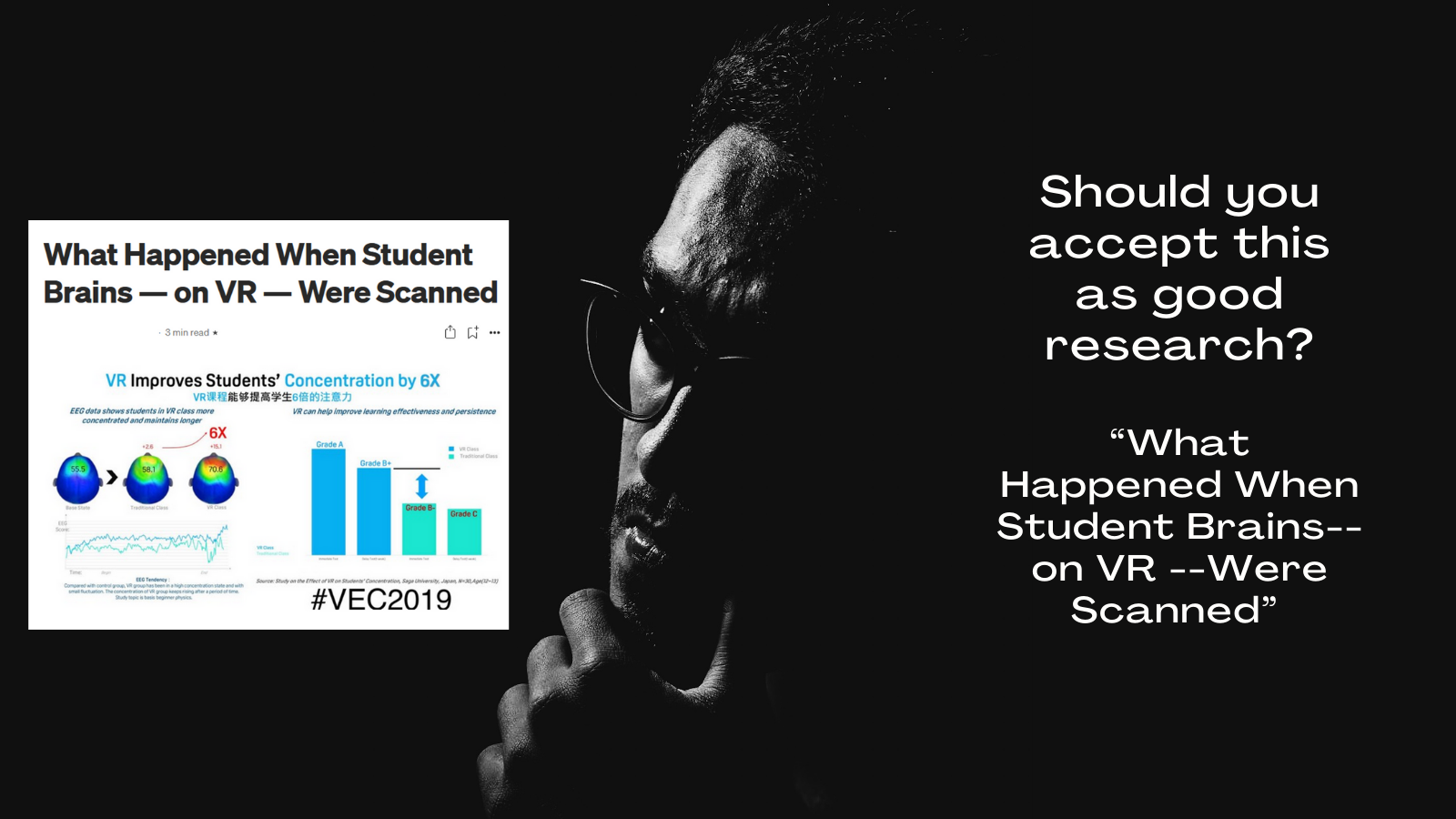
    • “What Happened When Student Brains — on VR — Were Scanned” is Analyzed.

      “What Happened When Student Brains — on VR — Were Scanned” is Analyzed.


      Should you accept this, What Happened When Student Brains – on VR – Were Scanned, as good research?

      I believe that VR has a place in education.  We’ll get there and it will be awesome.

      However,
      along the way, I will analyze and call out poor virtual reality and
      learning research EVERY CHANCE I GET.  Poor research helps no one.

      I’ll be writing about several poor VR studies soon. I’m writing just like I did for my ā€œSurvey does NOT show that instructional designers drive better student outcomes.ā€ 
      Even though poor research should be called out (yes!) I am NOT in the
      business of embarrassing or humiliating a person nor damaging or ending
      someone’s business.  Therefore, I will block out names as much as
      possible.  If the source blatantly has names within it though (for
      example, if someone names a company), I’ll keep that in the screen
      capture.  Note however, the minute time traveling teenagers arrive in my
      home office asking me to truly name names related to this, I AM SO
      TELLING THEM.

      Seat belt sign on.

      Image of airplane seatbelt on sign
      Seat belts on. It’s a bumpy ride ahead.

      On July 25, 2021, an author that I’ll call Author A posted this story to Medium: What Happened when student brains on VR were scanned
      Before you click on that link, remember that Medium is a site where
      authors are paid for article reads.  Now I post to Medium too (as a
      matter of fact, I’m posting this article there as a sort of rock’em
      sock’em method of seeing my article go head to head against his) but
      [EDIT: I no longer post to Medium] just bear in mind that the more you click, the more the author is paid.
      Author A appears to have posted 6 articles to Medium and 4 of them are
      about VR. (Update: during publication, this has increased, I’ll pick
      this point up again at the end of this article).

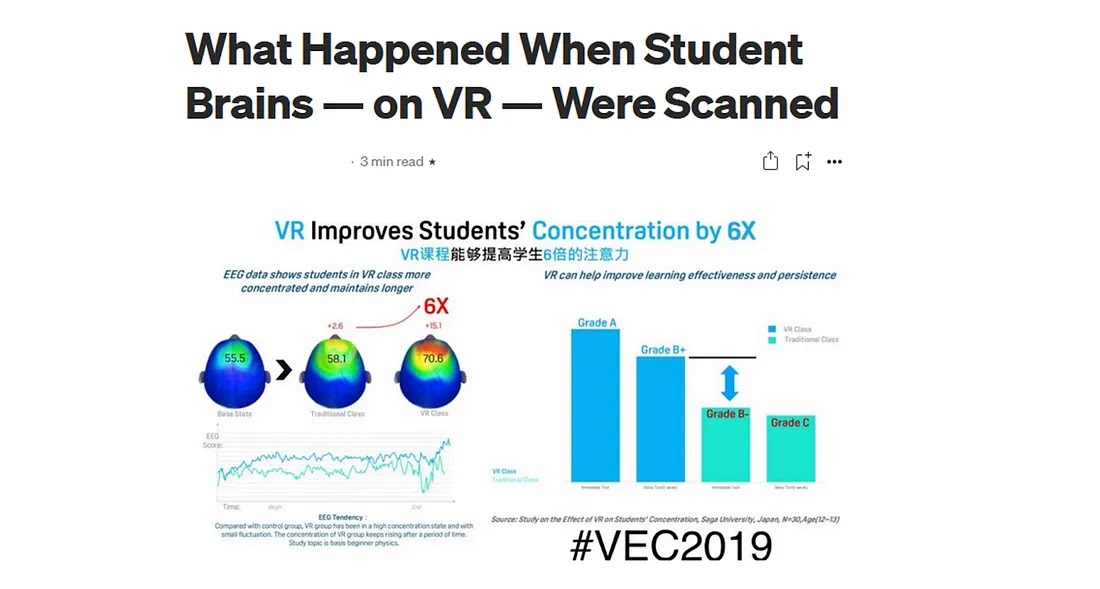
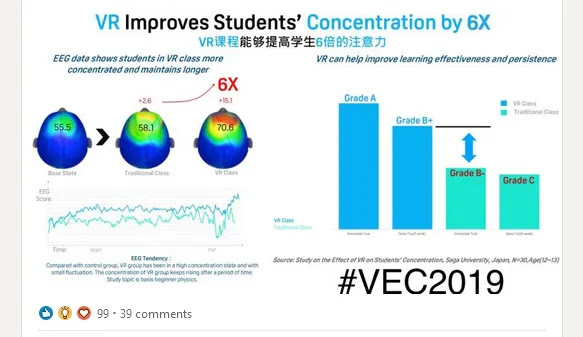
      Screen capture of Medium article from July 25, 2021 headline.  Article is titled "What Happened When Student Brains -- on VR -- Were Scanned"


      (July
      2021 version of this image, I’ve blocked the author’s account. Note the
      added #VEC2019.  I think it’s very obvious that the #VEC2019 was
      overlaid.

      VEC2019 is the VIVE Ecosystem Conference held in 2019.

      Inside the article, I did hope to find sources.

      Here is what I found (names blocked):


      Screen capture of a Medium article from  July 25, 2021

      In July 2021, Author A posted to their own LinkedIn account

      Partial capture of post here (blocked out the link and a name):

      Screen capture of a LinkedIn Post from July 30.

      While you are looking at this though, does anything stand out yet?

      Already for me:

      • The writing style feels like it’s pulling me along (FIRST, SECOND, THIRD) but I tend to like my separate points to be actually separate and new points
        If you look at what’s written for each item, the points are more
        chronological as if someone was talking than factual as if someone was
        listing.
      • I’m zinged by that ā€œ [read the rest of the story here:  
        link    ]  That was actually written by the author, NOT hard coded in
        by LinkedIn. Bummer. I wish I had NOT clicked on the link but I
        sincerely thought that there was ā€œthe rest of the storyā€ at the link. It
        was the Medium article link so by clicking on it, I ā€œpaidā€ this Author A
        some money.  This means something.  Stay tuned.
      • I do a quick
        mental check of the numbers in the post versus the image. As your math
        teachers always said ā€œStand back and look at the numbers. Do they make
        sense?ā€  The 4th bullet just further describes (aka says the same thing
        but with DIFFERENT numbers as the 3rd bullet so… is 15 roughly 6 times 
        2.5?  Yes. 
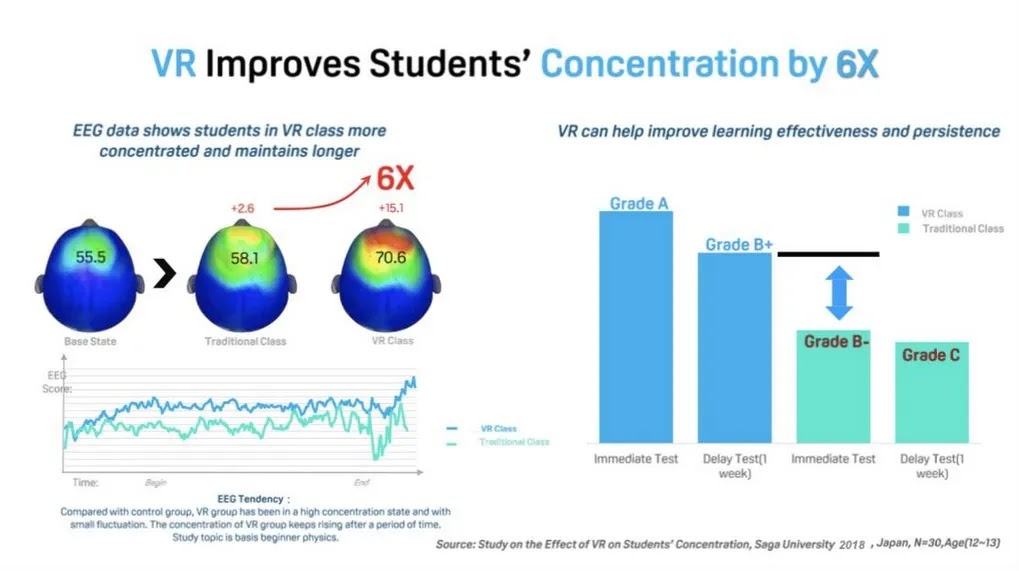
      • OK, the number ā€œ6Xā€ checks out within the diagram
        (meaning that the data I’m provided with so far does align with the
        head/images).  However, your hackles should be going up because you
        should be asking yourself ā€œWhy was the image of the heads not enough? 
        Why do I need to be told– in red font with a drawn line– ā€œsix timesā€? 
        Answer: because the phrase ā€œSix timesā€ will stick in my head and slow
        down my reading and I will — as I’m sure MANY have done– quickly
        breeze over the ā€œsix times WHATā€ part and read this to say:

      Six times more brain activity on VR

      Rather than what it says, which is

      The difference between the brain states is 6 times traditional.

      • See? 
        Didn’t you read this as ā€œWow, the brain is 6 times more active on VR,
        that’s got to be good!ā€  (VR and autism researchers right here are
        roiling; I can feel you. They are saying ā€œAn active brain isn’t
        necessarily a learning brain.”  Right on.  You get your chance coming up
        later.)
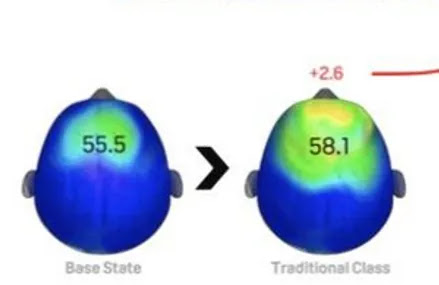
      • One further point I noticed later.  The ā€œTraditional
        Classā€ is pulling a 58.1 (unitless) over a Base State of 55.5. That’s a
        2.6 difference. The image says 2.6, the writing says 2.5.  I’m willing
        to overlook this; that’s minor.  But think about it for a second. 
        Traditional class work is pulling nearly the same brain activity as
        ā€œbase stateā€.  So bad news teachers: your students in class are one tick over coma.  (I HOPE NOT!)


      In all my years of research, I NEVER found the original source of this image.

      I’m linked with Author A and that’s how I saw that this image was circulating again. 

      Author
      A linked to the Medium article within their post but they added this
      image to their LinkedIn post. Therefore, the image appears prominently
      like this:

      LinkedIn post with image “VR Improves Students’ Concentration by 6X”. Image includes some Chinese characters and #VEC2019.

      Here is a version of the same image from 2020.


      LinkedIn post with image “VR Improves Students’ Concentration by 6X”. Image does not include some Chinese characters and #VEC2019.

      So
      the Chinese line under the title is present in the newer version but I
      don’t see any other changes. I did a Google image search and this
      appears often on LinkedIn, but it’s not coming up linked directly to
      another source (so far).

      The images seem to have a ā€œsourceā€ credited in the lower right corner.

      Retyped here with kept capitalization but not formatting:

      Study on the Effect of VR on Students Concentration, Saga University, Japan, N = 30, Age (12~13).

      Capitalization
      matters because it can indicate how much the author is following a
      particular reference style (APA, MLA, IEEE, etc.) Also some statistical
      and mathematical symbols change meaning if they are capitalized or not.

      So six times the improvement of concentration on VR!  That is an attention grabbing number!

      I’m not the first person to report that FINDING that article by that name or some derivative appears to be impossible. However, looking at that citation, a few thoughts pop up:

      • There
        is a formatting change in the line that looks like text has been added
        or overlaid. In particular, the age information is odd.  Researchers
        don’t usually add the sample groups’ age in a citation particularly when
        everyone in the research study (supposedly) was of the same age.  Ages
        didn’t vary within the study.  The N info can be properly included in a
        figure caption, which is different from a citation. So this info looks
        like a blend of an attempt to give a citation and more information…for
        perhaps ā€œpeople who were askingā€? (I BET.)
      • It is entirely
        possible that this source was published in a language other than
        English. The title is academic-looking but academics are also sticklers
        for choosing the exact words to reflect what we mean and this title is
        actually a little wordy.  That tips me off that it might be a
        translation.  For example, tight academic English would have been ā€œThe
        effect of VR on students’ concentration.ā€  All through some of the
        sources I go through next, I have the feeling that I’m dealing with a
        good-hearted translation.  Good intentions, yes, but not the original
        author’s thoughts. Hmm.


      In 2020, a few other images and a link circulated associated with this research.

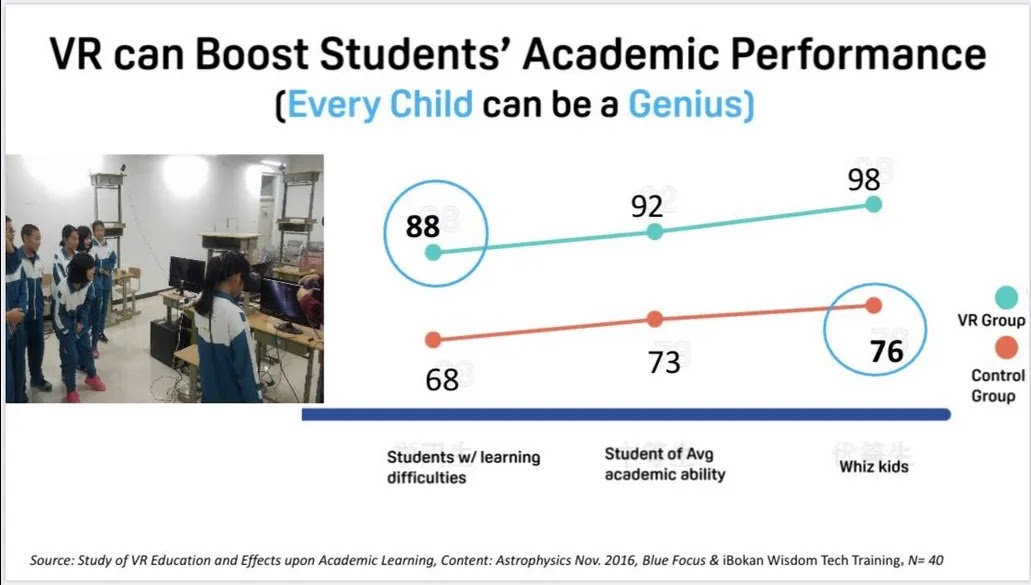
      Shared on Facebook as ā€œslidesā€ from a conference talk:

      Take note of the learner’s clothing and the Source.


      This version has the “6X” in big red font with an arrow.

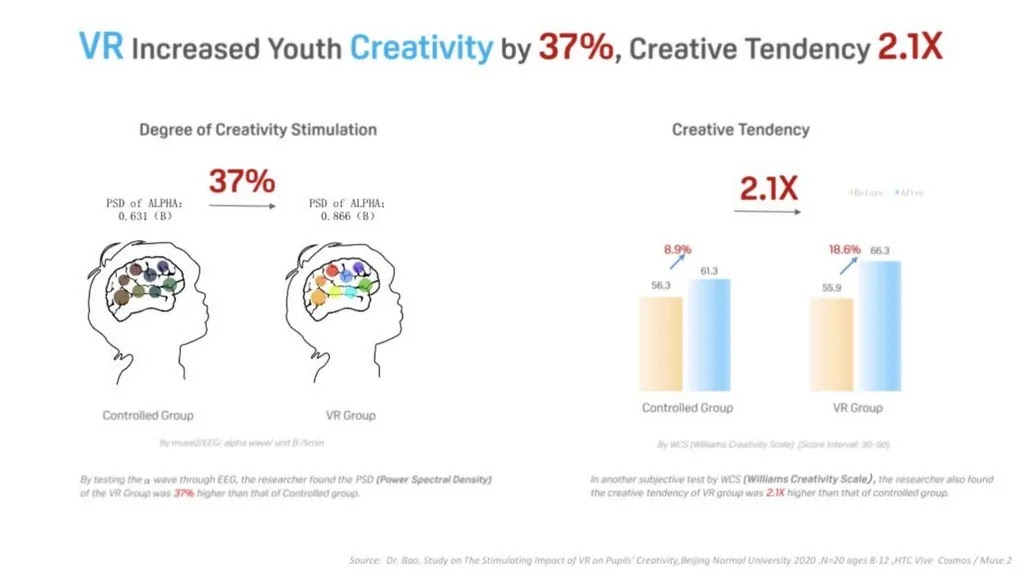
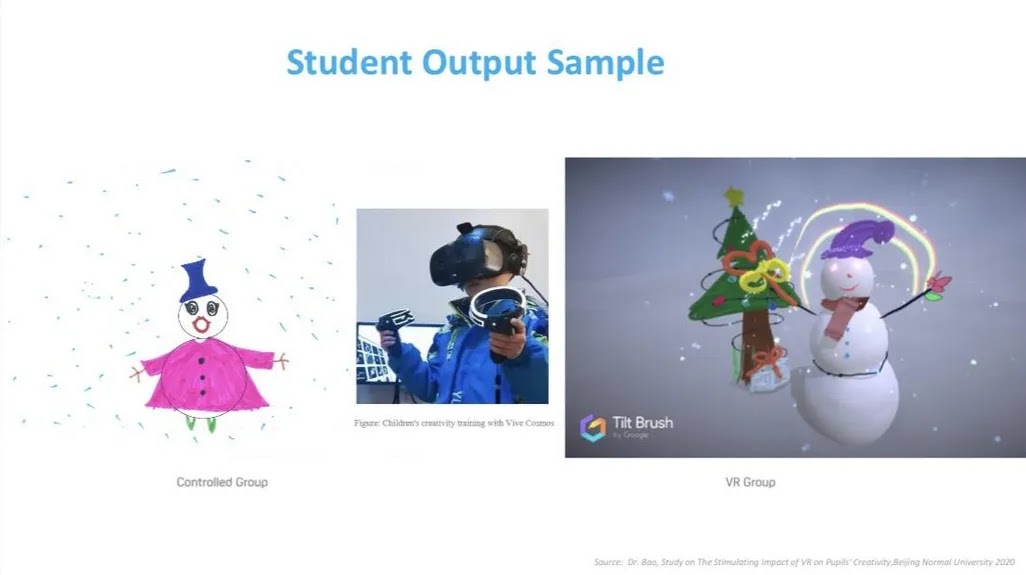
      “VR Increased Youth Creativity by 37%, Creative Tendency 2.1X”

      “Student Output Sample” Personal comment: I find this comparison disgusting, laughable, and then disgusting again.

      There was a suggestion that THIS is the actual study here: A Case Study – The Impact of VR on Academic Performance

      https://mk0uploadvrcom4bcwhj.kinstacdn.com/wp-content/uploads/2016/11/A-Case-Study-The-Impact-of-VR-on-Academic-Performance_20161125.pdf

      For the next part of this article, I’m really getting in the weeds of the research.  Get a cup of coffee and keep up.

      As
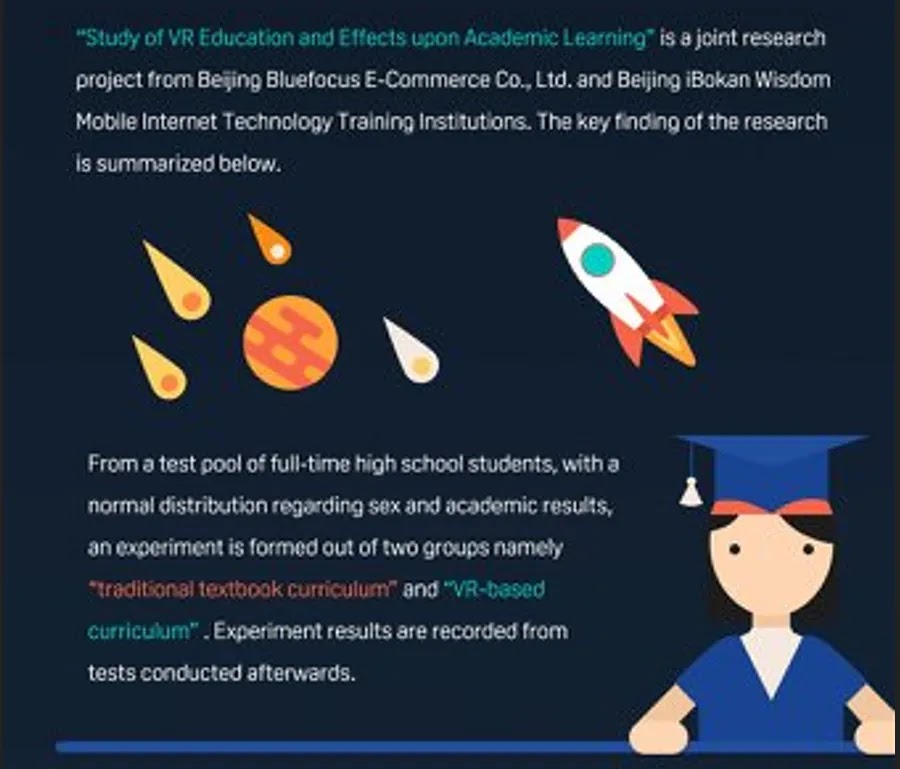
      a summary of the research a teacher separated students into a control
      group and a VR group. Then each of those groups was measured for
      learning either in the same class period or two weeks later.  The VR
      group was compared to the control group.

      Note that the control group is the ā€œTraditionalā€ is a teacher talking with a PowerPoint for 30 minutes.

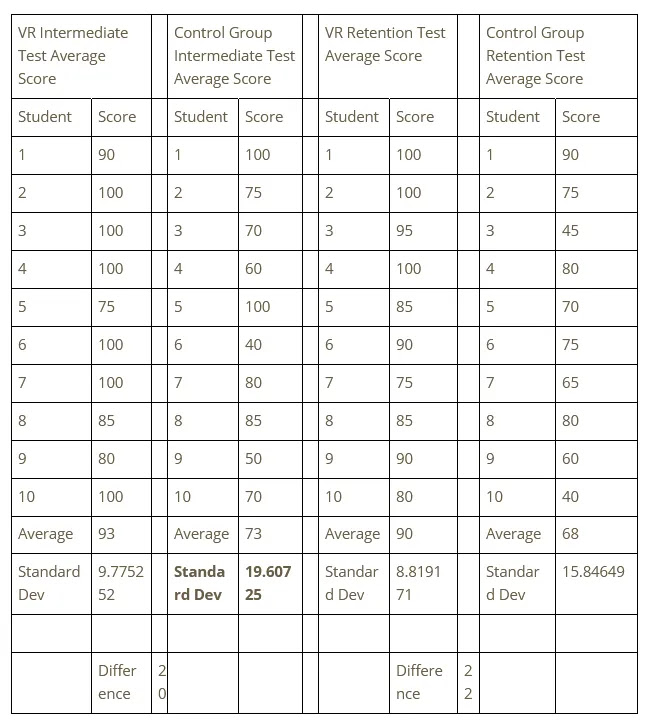
      Remember that Intermediate refers to the ā€˜same day’ test and Retention refers to the test 2 weeks later.

      Before I get into some problems, I’d like to say a couple of items in this teacher’s defense:

      • First, it is clear that the teacher means well and is supportive about the use of VR in the classroom.  
      • Second, the teacher taught an astrophysics lesson. Physics content is an area of ideal use for VR because
        of the conceptual and sometimes ā€œhard to seeā€ type of content (hard to
        see atoms, hard to conceive of galaxies, etc.). There is always a direct
        relationship between ā€œseeingā€ and understanding when trying to use VR.
      • Technically,
        self-publishing isn’t awful.  I do that myself. I think more publishing
        will be self-publishing in the future.  But I’m also NOT SELLING
        SOMETHING and not dangling the data behind paid links (cough, Medium) or
        concealing references to support eye-popping results.  Don’t forget, it
        said SIX TIMES.

      Inside this paper, there are some concerning misfires.

      The
      first would be the experiment design.  It is poor ground to stand on to
      compare not cognitively equivalent experiences.  PowerPoint versus VR
      is not a fair fight and just with that item, that research shouldn’t be
      published.

      Second, as I read through to get my bearings, the
      author seems to put some of the wrong data in the wrong places through
      the paper (they talk about the Intermediate data last and the Retention
      data first when those were administered in the opposite order) and then
      they attribute the averages backwards. It’s like the paper had a cut
      & paste festival run through it.

      Example page 9, in a section talking about the Intermediate test, subtitled ā€œVR Improves Test Scoresā€

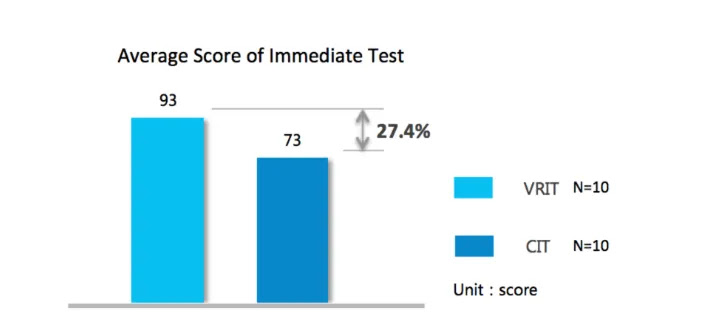
      ā€œThe
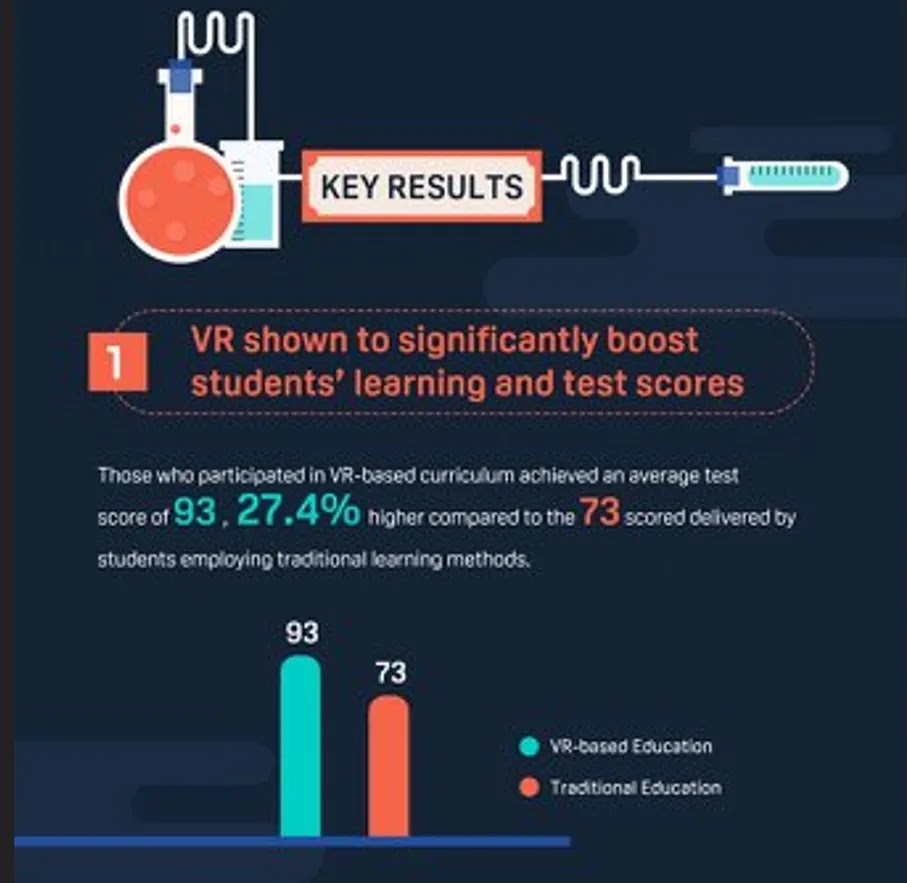
      average score of the VRIT group is 93, CIT, 73. On average, VRIT group
      has registered a 27.4% growth in terms of score, indicating the great
      advantage of VR in the teaching of astrophysics.ā€

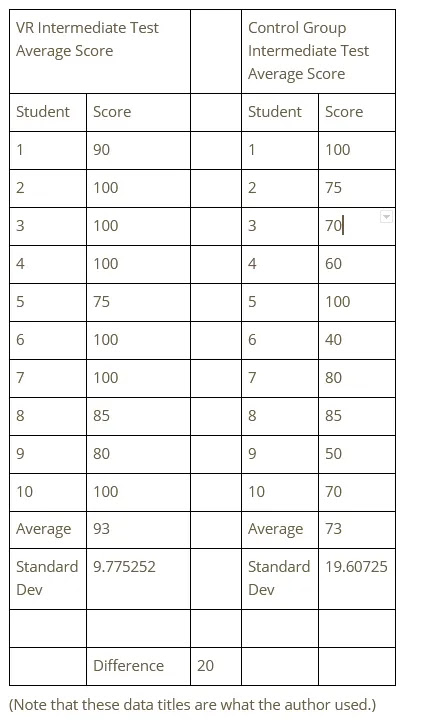
      OK, that first sentence is true.  Here’s my data check:

      I also get averages 93 and 73.  But the difference between 93 and 73 is 20, not 27.4.

      Then on page 10, there is a graph that immediately followed this text: 

      Both
      the text here and the graph indicated that the gap between 93 and 73 is
      27.4%.  It is not. It is 20.  But I’m trained to look for ā€œaccuracyā€
      that suddenly arrives that wasn’t present before.  Where did that 0.4
      accuracy come from?. And how did the percent symbol sneak in? The
      percent symbol isn’t anywhere else in this image (red flag). Does that
      27.4% look pasted on?  Why? I’d cry ā€œSignificant Figures!ā€ here but the
      27. 4% does show up on Page 14:


      “4.2.1. VR Improves knowledge Retention 

      In
      Retention Test, the average score of VR group is 90, while that of the
      traditional teaching group is 68. The gap between the two average scores
      is 32.4%, higher than that in the Immediate Test 27.4% (# 4.1.1-1),
      suggesting that knowledge taught in traditional mode is more inclined to
      be forgotten, while VR-based teaching could help students get a deeper
      impression and maintain long-term memory because it creates a quosi-real
      environment, interacts with students and make students more involved in
      the teaching.” [spelling in context

      OK, so now the text says that the difference between 90 and 68 , which is 22 points, is 32.4%!
      OK, so they are not trying to communicate the point difference (a
      number), they are communicating, on purpose, a percent difference. Ah! 
      OK. Points and percentages are different, and they know that. Now I feel
      better.

      But notice, why would you convert one set of numbers like this:

      • Hey the difference was 20 points!

      To another set of numbers like this:

      • Hey the difference was 27.4%!

      Answer:
      27.4 is interpreted as ā€œbiggerā€ than 20 even though, in this case, they
      are the same (percentage and points, respectively).  Sigh. It’ another
      instance of the SIX TIMES difference.  If I make the number appear more
      impressive, I have more of your attention.

      Folks, this is exactly
      what peeves me here.  Remember that I WANT this research to be positive
      and true.  But when you manipulate the numbers just to get me to go wow,
      I’m on to you. I get extra angry when you are making money off of this
      manipulation.

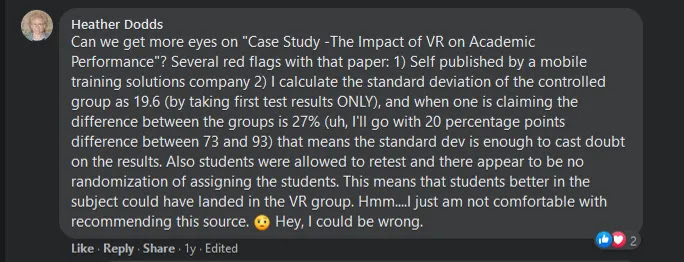
      In 2020, I commented:

      “Can we get more eyes on ā€œCase Study – The Impact of VR on Academic Performanceā€  Several red flags with that paper:

      1) Self-published by a mobile training solutions company.

      2)
      I calculate the standard deviation of the controlled group as 19.6 (by
      taking the first test results ONLY) and when one is claiming the
      difference between the groups is 27% (uh, I’ll go with 20 percentage
      points difference between 73 and 93) that means the standard deviation
      is enough to cast doubt on the results. 

      Also students were
      allowed to retest and there appear to be no randomization of assigning
      the students. This means that students better in the subject could have
      landed in the VR group.  

      Hmm….I am just not comfortable with recommending this source. Hey, I could be wrong.”


      I
      want to spend just a little more time on the stats.  First, standard
      deviation.  Refresher!  Standard deviation is a descriptive number that
      describes how well the average describes the group.  Quick example:


      One
      class: 2 students. Students score 45 and 55 on an exam. The average is
      50. The standard deviation is 5.  That means that a random student, if I
      could mix all the students up and just pick one student out, differs
      from the average score by 5 points.  Said another way: most students are
      scoring with 5 points of 50. And this is true. In one case, if I picked
      out a student, they’d be scoring 45, which is 5 points off the average.
      In another case, the student would be scoring 55, which is 5 points off
      the average. Five points off and five points off. That’s good, that’s
      ā€˜tightā€. Therefore the average of ā€œ50ā€ is a nice tight description of
      how the class is scoring.

      One class: 2 students. Students score 0
      and 100 on an exam. The average is 50. The standard deviation is 50. 
      That means that a random student differs from the average by 50 points.  
      Said another way: most students are nowhere near the average score. 
      They are missing it hugely. Both students are off by 50 points.  The
      average of ā€œ50ā€ does NOT describe this class scores very well at all. 
      It’s junk.

      So you generally want small standard deviation numbers if you want to believe that your average number is a good descriptor.

      Let’s go look at those standard deviations (I calculated) again.

      So
      I calculated the standard deviation in 2020 of the Control Group
      Intermediate Test Average Score to be 19.6. Same result by recalculating
      that in 2021 (so I’m using myself as my own data checker by inserting
      time between the 2 calculations).

      That is troublesome.  A standard
      dev of 19.6 when the difference between the 2 groups was 20 means that
      the control group could, reasonably, waver from ~53 to ~93 on their
      score and still be considered ā€œOKā€ and reasonably near the group
      average.  But that means that the control **could have scored** near the
      VR group.  93 is quite near 93. (#fact)

      So, a statistical flag on
      that play.  When you have reason to think that your experimental group
      and control group **could have* scored the same, you do not have reason
      to think that cause and effect has happened in your experiment, you
      should doubt that your independent variable caused your dependent
      variable’s results.

      In plain language, VR could not be causing higher scores.  Higher scores could have happened by chance.

      This
      is what I meant when I said that this data does hint that ā€œstudents
      good at VRā€ could have simply been sorted into the VR group
      unintentionally and thus, voila, do great at the content. (The photos of
      the students admittedly look like they are ā€˜having a good time.’)
      Statistics is meant to help us  know how much to believe in some numbers
      and doubt other numbers. (Remember the line: Lies, Damn Lies, and
      Statistics?) I know this is deep math for some, but it’s just saying
      that these numbers are not believable as they stand.

      Also, I want
      to point out that I’m NOT strong in ā€œpowerā€ talk in stats, but this is
      the field of being able to know how many individual data points you need
      before you can trust a whole set of data points. Data points are known
      as ā€œNā€s.  An N of 10 is quite ridiculously low for a sample size.  10
      students are nice but no one should be spending thousands of dollars
      buying headsets or software because of data from 10 students.  And
      remember, when you are seeing these numbers, you are being convinced to
      buy.  You are NOT being convinced to research deeper. More on this is
      coming after some more scrolling down.

      Finally, one last big item that you might have forgotten down in these weeds:

      After all that searching, where is the EEG data?

      Where’s the EEG data?

      Well,
      not in this paper, that’s for sure.  But the image you are looking at
      has only ONLY half-hearted reference on it (lower right).  Where does
      the EEG data come from?  I tried to find it both by topic and image
      search.  Maybe that’s where ā€œSaga Universityā€ comes in?  I don’t know.
      Word on the street is that that EEG data is made up.  I really don’t
      know. I can tell you that I’m suspicious because I’m not sure why one
      would research on VR with EEG (a reasonably expensive test), publish
      your results in color, find six times more activity and then bury your
      published paper about it?  Seems fishy to me.  Again, though, this could
      have happened all in another language and me and Google are failing to
      find it.

      There’s possible other stats problems in the paper but I’ll let it rest.

      Also
      circulating from 2020 was this one long infographic that I screen
      captured into slices.  The images are grainy, I know. (sad face)

      Presentation slide: “VR-based Education Shown to Enhance Academic Performance, November 2016”

      Slide from presentation.

      Slide from presentation with text “VR shown to significantly boost students’ learning and test scores”
      Slide from presentation with text: VR enhanced curriculum improves learning comprehension and retention

      Slide from presentation emphasizing that the control and experimental groups had the same instructor

      Slide from presentation emphasizing that the VR was additional to the traditional instruction.

      Slide from presentation with QR code. Note prominent VIVE logo.

      This
      infographic appears to be supporting this image. The ā€œEvery child can
      be a geniusā€ phrase and the numbers appear to be the same.  I have only
      one item to say about these slides: cute UFO theme.

      Note that the student clothes looks similar:


      I tried to find ā€œStudy of VR Education and Effects upon Academic Learningā€  Google Scholar and Google can’t seem to find it.

      Searching on iBokan Wisdom Tech Training instead, it seems to be used as a reference from here: https://www.degruyter.com/document/doi/10.1515/phys-2017-0114/html

      To: here:

      [5]
      Beijing Bluefocus E-Commerce Co., Ltd. and Beijing iBokan Wisdom Mobile
      Internet Technology Training Institutions, A Case Study – The Impact of
      VR on Academic Performance, 2016. Search in Google Scholar

      That is a dead end, as in, dead link:


      Back
      to the August 2021 comments.  Notice how even if this data cannot be
      substantiated, folks are still eating it up! 99 reactions last I
      checked:

      Who needs sources?


      (Blocking all these names is making me crazy!)

      Or at least, they are eating it up if they work at that same company as Author A.


      But there are a few of us VR Research Jedi’s prowling that send up warnings.  


      My
      colleague is much more even in tone than I am but they do strike the
      right balance with saying that we ARE hoping to find positive learning
      research as it relates to VR.  

      But this isn’t it.

      P.S. I don’t know why Author A posted twice.  Zealous much?

      I’m coming in here.  This is the link I share: https://www.analyticsinsight.net/extended-reality-enhancing-healthcare-industry/


      Uh. 
      I didn’t respond after this.  Author A apparently didn’t realize that I
      was questioning the research in HIS OWN reply immediately above about
      the ā€œMiami Children’s Hospital CEOā€.  Perhaps he thought I was so
      excited about his first graphic.

      If you cannot properly mansplain to me, I just don’t know what else to say.


      Note:
      side fight broke out! Although, I’m not sure what they are fighting
      about…  I suspect autocorrect did it because that’s one perky
      disagreement.  Tee hee hee…


      There
      is one honorable mention of a person that asked for ā€œwe need a
      concerted effort to also communicate the methodology and external
      validity for such research. For industry adoption, particularly
      healthcare, the core elements of research must be extracted and
      communicated alongside the highlightsā€

      Hey, nice try buddy!


      Note that all of the positive supportive comments came from people working in the VR industry.  That’s not bad, it should just be noted.

      If you are selling me something, don’t I have a right to doubt the research you hand me?


      FYI,
      during the writing of this article, this same Author A continues with
      the ā€œI’ll tell you something tantalizing about VR!ā€ and then makes you
      click on a link where:

      He makes money.

      He doesn’t have to give you more information or sources.


      That LinkedIn link right there? Goes to Medium, for a ā€œ2 minuteā€ article. I didn’t click on this.

      Why does all of this matter?

      Because
      media will never influence learning.  Yup. I’m a Clarkist.  Studies
      that say that VR makes eye-popping differences in learning is not
      supported by every media study we’ve ever done as humanity since the beginning of time.  

      If
      we go around telling everyone that all students will be geniuses and
      that VR will cause six fold increase in grades, those of us that DO
      support VR for education are going to be out of jobs pretty quickly as
      that bubble will pop.

      ~~

      I recently watched Exodus: Gods and
      Kings and I love this exchange between Moses and Malak (who is the
      messenger of God).  Moses is fed up with Egypt/slavery and is being told
      to cool his jets by God.

      Moses: So what do I do, nothing?

      Malak/God: For now, you can watch.

      ~~

      You can watch. 

      You can watch as I tear this research up.


      Clark, R.E. Media will never influence learning. ETR&D 42, 21–29 (1994). https://doi.org/10.1007/BF02299088

      #edtech #research #VR #VReducation #VRResearch #TooGoodToBeTrue #MediaWillNeverInfluenceLearning #InstructionalDesign


      This is a copy of the article I published on Linked In on August 17, 2021

      This post was edited on April 11, 2026. The font was improved and the images re-placed. Slight editing of content.