I
launched this build to celebrate Halloween. Not because it is in any
way scary, but because it is dark.
Hey, that’s as far as I go with
Halloween. 😑
But I did add a twist for my planned live tour of 3 scenes. The story line for the experience would have a beginning, middle, and end. It was not just about visiting and looking around.
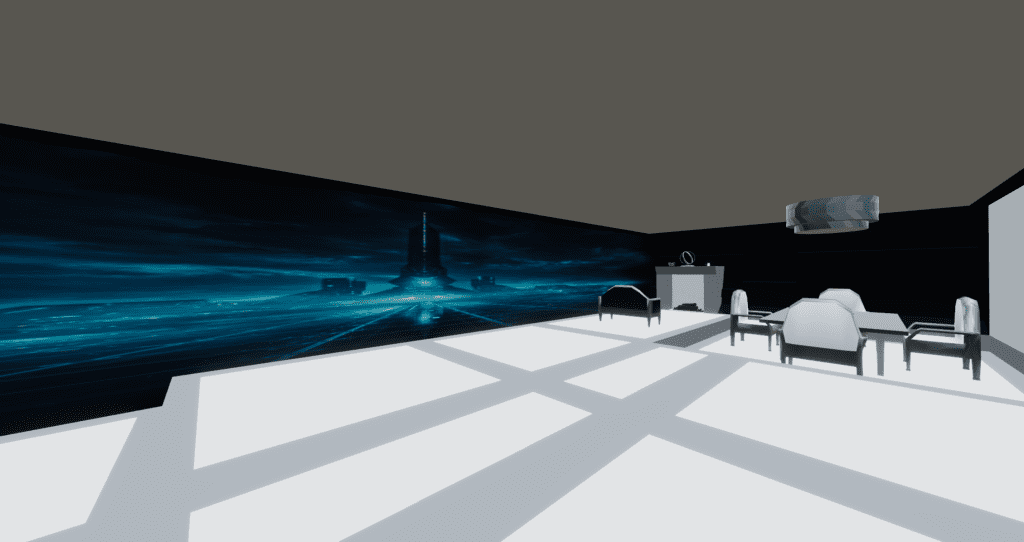
Scene 1: Start in Flynn’s Hideout. A wall is hiding the full city. I will
play the music because without Behavior Graphs at this time, I did not
know how to otherwise time the wall to descend at the same time as the
“Tron” aspect of the song arrives. I invited folks to look at the
fireplace for something to do.
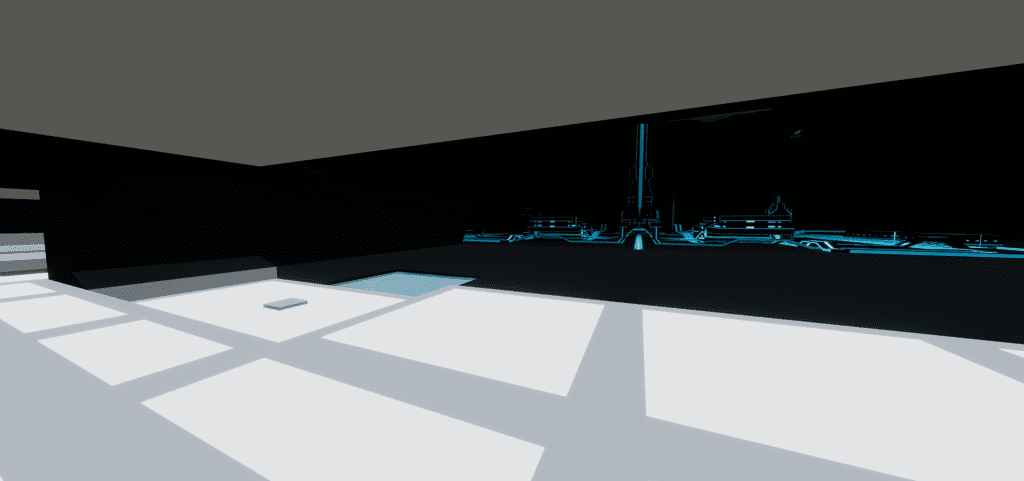
Tron arrival view. Notice the “Tron City” is an image on the wall.
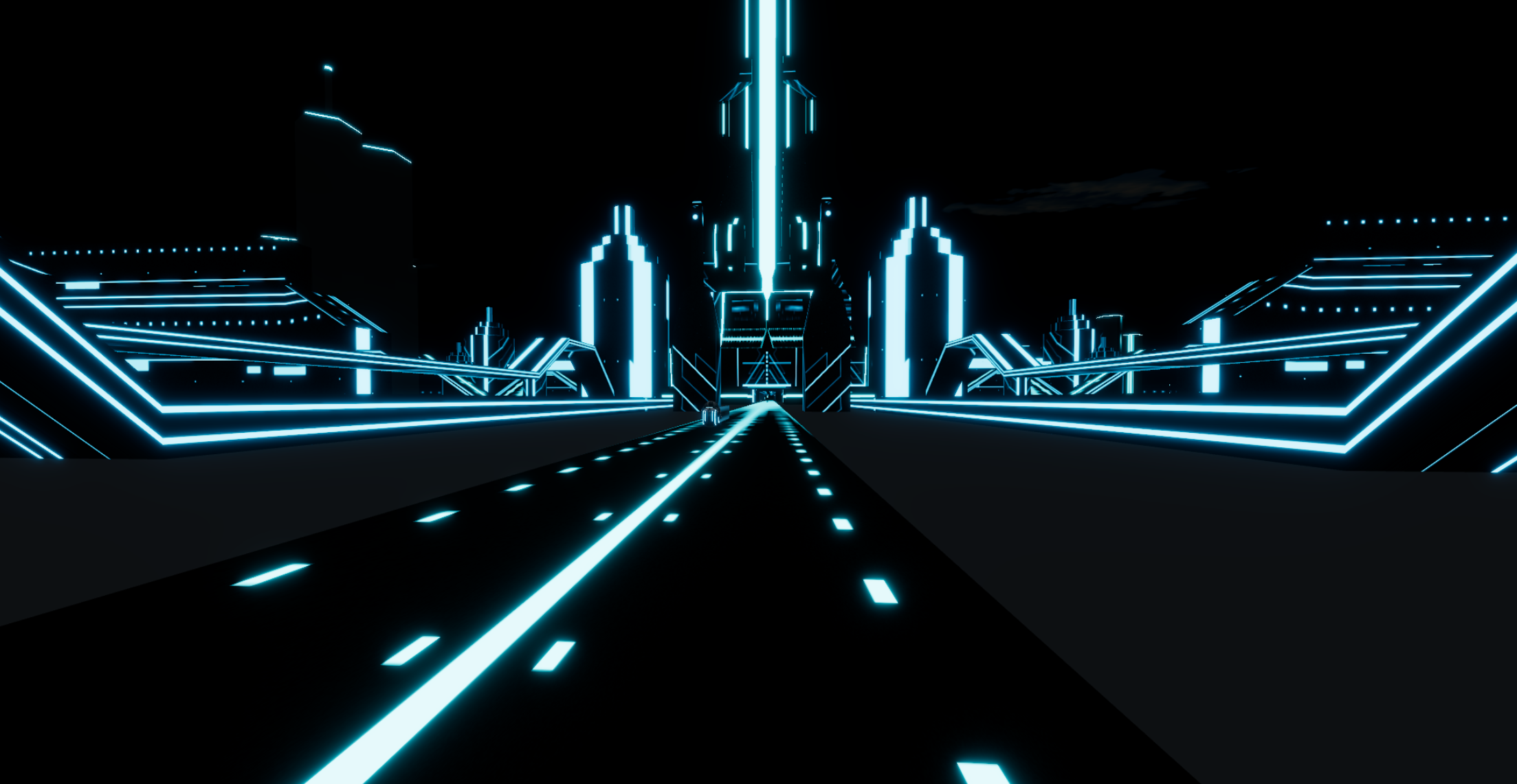
Scene 2: Explore Tron city (The
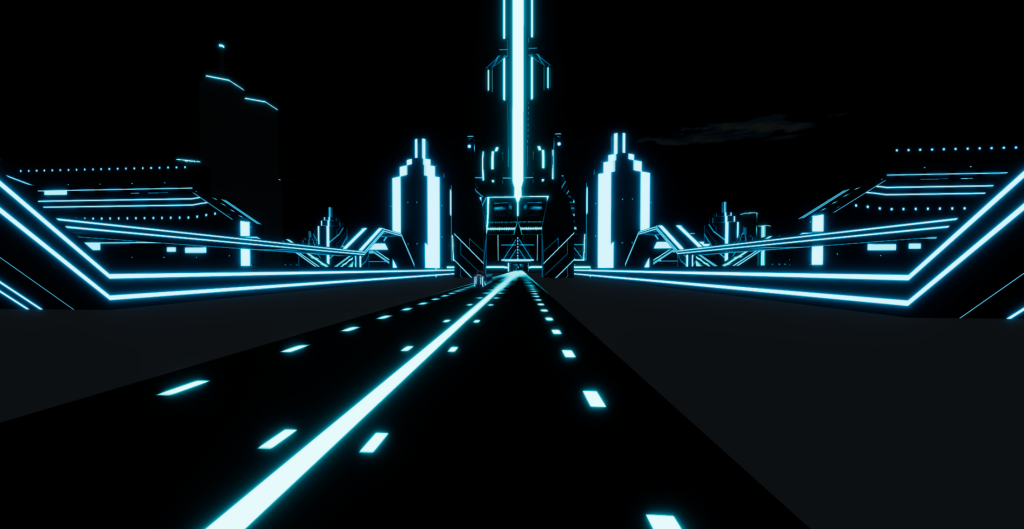
Grid). It’s really fun to turn your movement speed up to 2.0 and zoom
down the main entry road. I did it nearly every time I visited the
build while working on it.
Scene 3 (an actual other whole Hubs scene): I switched scenes once everyone was comfortable.
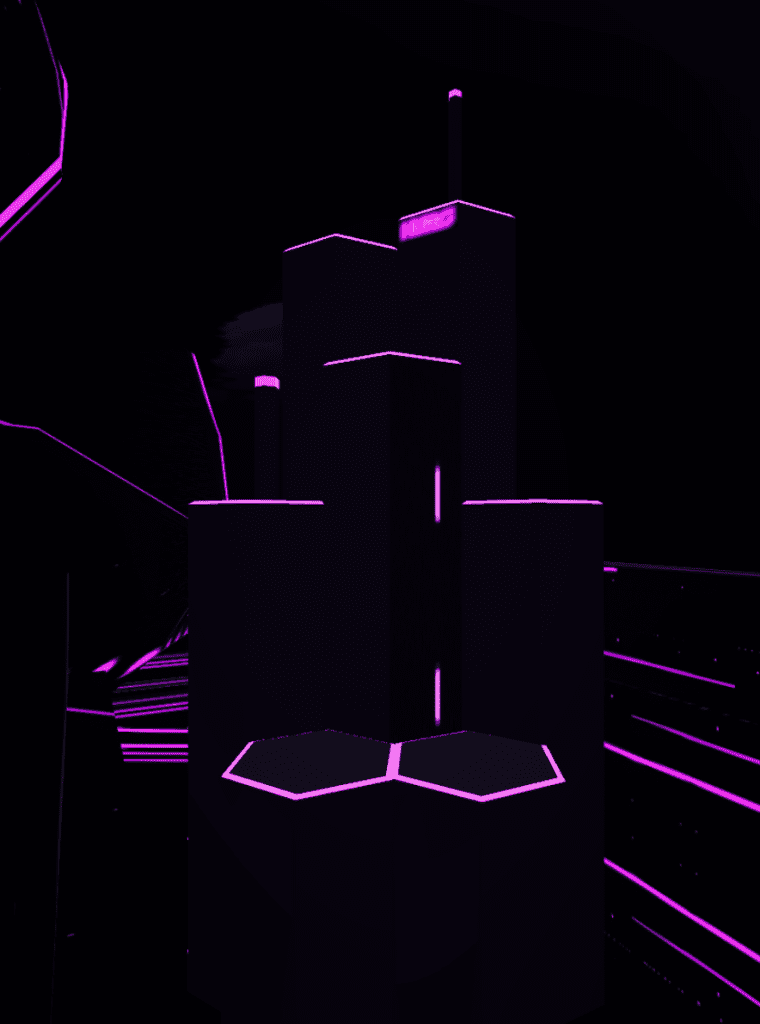
The center building was replaced with a “5th Element” style duck (IYKYK),
everything now purple monotone for Halloween, and eliminated Flynn’s Hideout. The sky
changed from black to a purple/orange gradient. Inadvertently, the navigation mesh which I only flirted with in Blender, worked.
The Bummer
Unfortunately,
no one who showed up for the Halloween event knew the Tron movies. So
all of my work adding in references and allusions was for naught at the time.
😔 Hopefully I’ll be able to show this build live to a real Tron fan someday!
The Video
Because
I knew I was launching this space on October 31 at ~3:00 p.m., I
prepared all of my social media in advance of the event to be able to submit it to the show-and-tell Hubs Discord channel for October.
Other inspirations
I would like to point out some other inspirations that I used because this build took me about 8 weeks.
The Tron font generator was brilliant! Another happy accident was getting the purple neon Hubs in Tron font work well in the Hubs space.
Combination neon from the Tron font generator with Hubs bloom.
I did not know that Disney was releasing Tron: Ares
but I did notice that Tron red clips started showing up in my YouTube
searches. Tron: Ares released on October 10, 2025 and did very
poorly. My build released on October 31, 2025 and was completely unrelated!! Cringe!
I did attempt some UV scrolling but in the end, I didn’t like the effect inside of the build; it was too flashy against all the black. The neon bloom was already enough.
Early
on, I collected a few Sleeping Beauty images because I’ve been
intrigued by the angular branches on the trees in the background. These
didn’t show up in the build but I’m keeping those ideas for the future.
I did not make a Recombinant. Thought about it, because it is very basic geometry (it makes the Solar Sailer look very complex). But decided not because in the Tron lore, it is sorta a bad guy.
Easter egg hidden: I made a back door and garage where the Light Cycle starts it’s straight line run across the city. The door does not open until the wall opens, but I figured that I could direct everyone to look towards the city and NOT see the door opening behind them at the same time. That way, that Easter egg would stay mostly hidden until I pointed it out.
Lessons Learned
Keep Blender source files for everything.
Keep a Project folder in my browser for images, fonts, music, anything.
Plan the experience – I liked my 3 scene narrative plot.
Make the social media early. It is stressful but it did work.
There are MANY fan art pieces for the Tron Light Cycle (Sketchfab Tron Light Cycle search results, ArtStation search results) showing many styles, emphasizing different elements. I did giggle at a model out there that used a human with bare feet. There is even a significant difference between the Light Cycles shown at Comic Con (green and blue) and in the Tron 2 movie (orange and blue). I picked the features that I wanted to for my 3D Light Cycle object which I made in blue and purple.
The Light Cycle was a two day build and I completely restarted it once. Relatively, this was a fast build but I had a lot of fun making it. It’s too bad that it does whiz past in the actual scene, but I know it’s cool. 😎
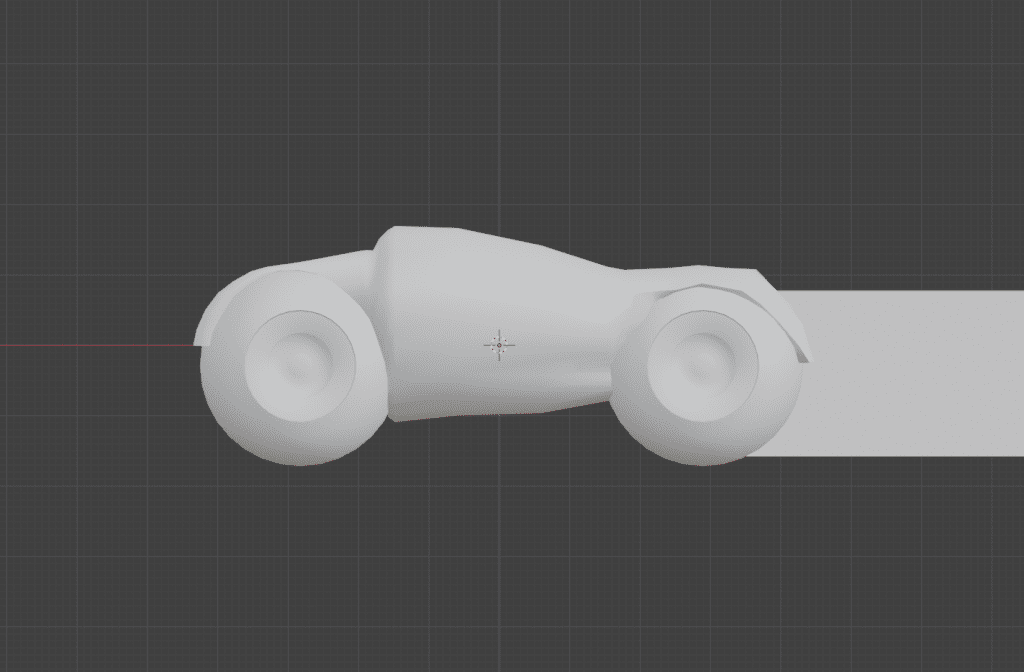
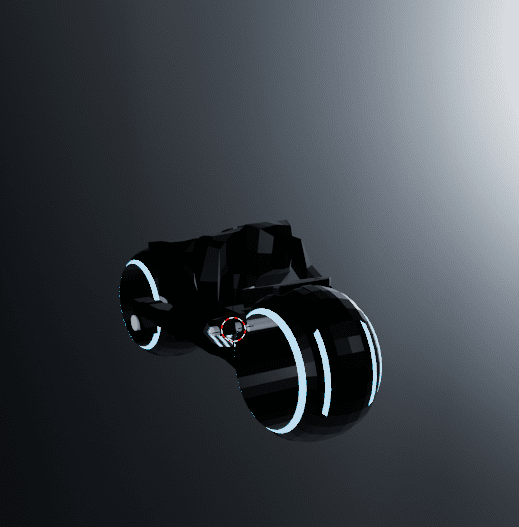
Light cycle version 1
In my first attempt, I started with the wheels which turned out pretty good. But I was primed by this video of a Light Cycle remake. But I didn’t like that core which was a mesh cylinder.
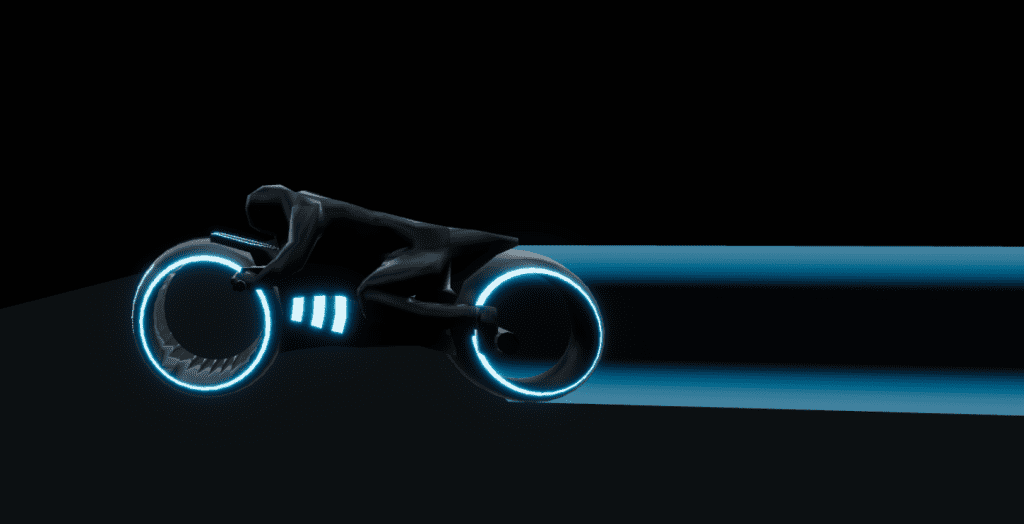
In my second attempt, I just used a mesh cube because that was easier to use loop cuts to get faces that I could pull the arms, legs, and head from. I did add in a mesh cylinder, however, for the light “engine”. I knew that it needed an added glowing tail, but I made the texture for the Solar Sailer and reused it for what Tron lore calls the Light Cycle Ghost Tail.
Light cycle, version 2Light Cycle, with glowing transparent tail (made in GIMP).
Similar but different
POST SCRIPT: This section added
I realized after I pressed Publish (the world’s greatest proofreader) that I had not fully explained what I meant by this build utilizing negative space. Also, I need to properly give credit for the light cycle animation, which goes to Hubs community member, Theanine. I did look at his Synthcity Blender file to find out how he animated his spaceships. I was wondering: did he use a generator of some kind or did he use animation. The answer was animation.
However, while I was there looking at his blend file, I realize that there was a some common “look” from his Synthcity build and my Tron build– both used glowing colors. However, I used a negative space idea and depended on my textures to carry the work and he actually HAS the heavy work in his build.
Here is an example. In Synthcity, windows are added planes that have their own glowing material shading. In Tron, any windows are created as a result of rectangular shapes in the texture. So I didn’t build windows into my buildings. I left my buildings (all of them) as plain shapes. But when I applied the texture, I saw how Blender applied the 2D texture to a 3D shape and with little editing, I went with the results. The straight lines and dashes on the textures became apparent as windows and road paint. So I didn’t bother with the details that Theanine had, but I got a very similar result! Synthcity is going for a video game city look and Tron is going for a city as circuit board look. But Theanine was gracious to comment favorably on my Tron build and that should make all artists happy.
In the Tron 2 movie (TRON: Legacy), it is implied that Sam and Quorra fall in love on the Solar Sailer– which I find a bit rich. 😕 But the scene of them on the Solar Sailer sailing into Tron city is beautiful and I wanted to replicate that.
I used Blender make the shape of the solar sailer (easy, one day). I made the sail texture in Blender as well, which turned into what I call a happy accident when I’m making my art. I made a cylinder, shaped as a six-sided hexagon, made glowing beveled edges, duplicated it, snuggled them up to each other to fill the camera view with a good scale. I did a bit of tweaking to try to make the texture seamless but alas, no one really notices it so far into the sky. But when I went to render a 2D image out of this 3D object set, you guessed it – completely black. I had not put ANY light into the scene so Blender was like “Nope, you get completely black as a result.” So I threw a “light” source haphazardly over the scene while saying something like “Give me SOMETHING lit” and Blender rendered the texture I show in the Inspiration image—it’s a lit just a bit of left-center. And I realized— YES! That’s how I see my Solar Sailer moving through the scene! It will float through on the right side of the city so it will be “lit” from the left.
What a cool, happy accident! I ran with that texture. It’s actually one of my proudest accomplishments because instead of a flat texture, I had a texture that meant something real inside the scene (and I simply changed the color for a purple equivalent Solar Sailer).
One Hubs note here: I thought about trying to put a waypoint on the Solar Sailer so that visitors could go up and sit on it (ride it?) just like the Inspiration image above. But I did remember that Hubs doesn’t do moving objects to ride on. Later, I asked a Hubs expert about it and he said that a visitor could go to the waypoint (utilize it) but then they’ll stay on one place in space as the object the waypoint is attached to moves on. Oh well, a future version of the software will accommodate moving waypoints, I’m sure.
My Tron Solar Sailer
Tron Avatar
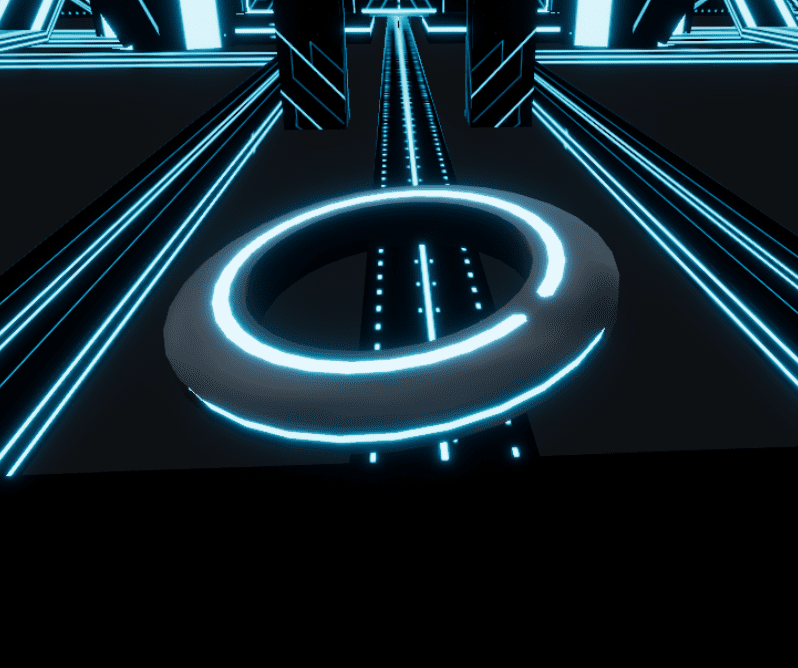
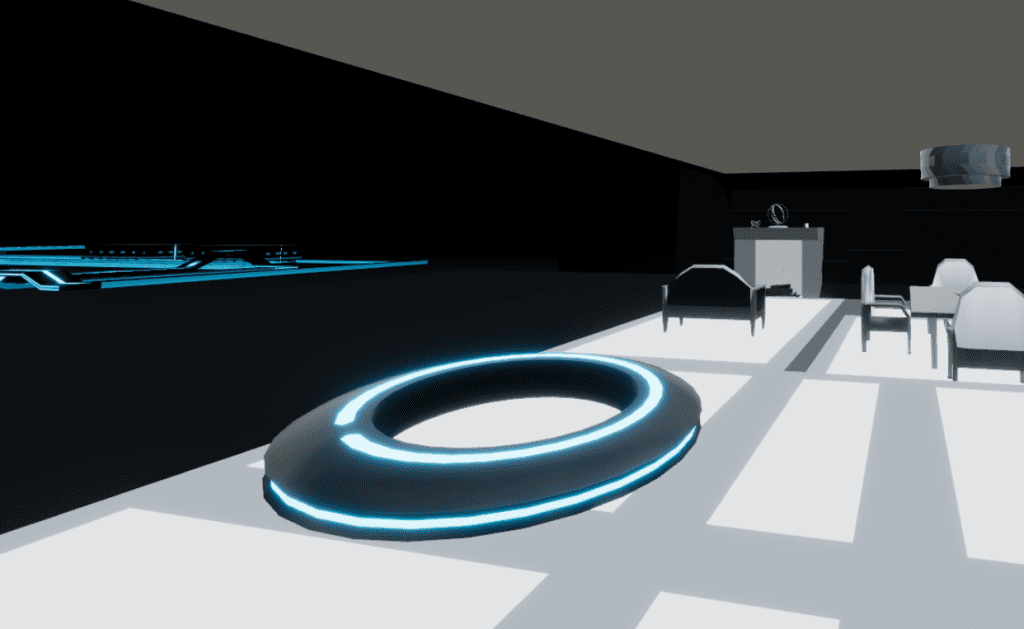
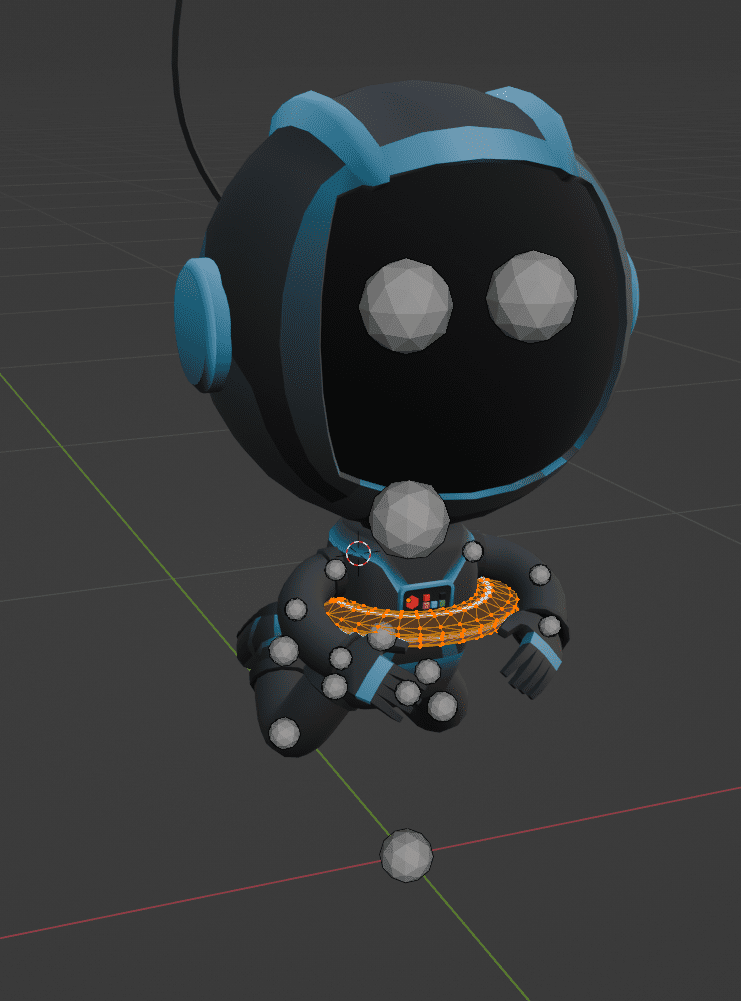
No Tron avatar is complete without an identity disk so I attempted that first.
Sketchfab models in wireframe mode are very helpful for buildingMy Identity Disk in blue
I customized an already available orange and white “Spaceman” avatar from Hubs, created by Jim Conrad.
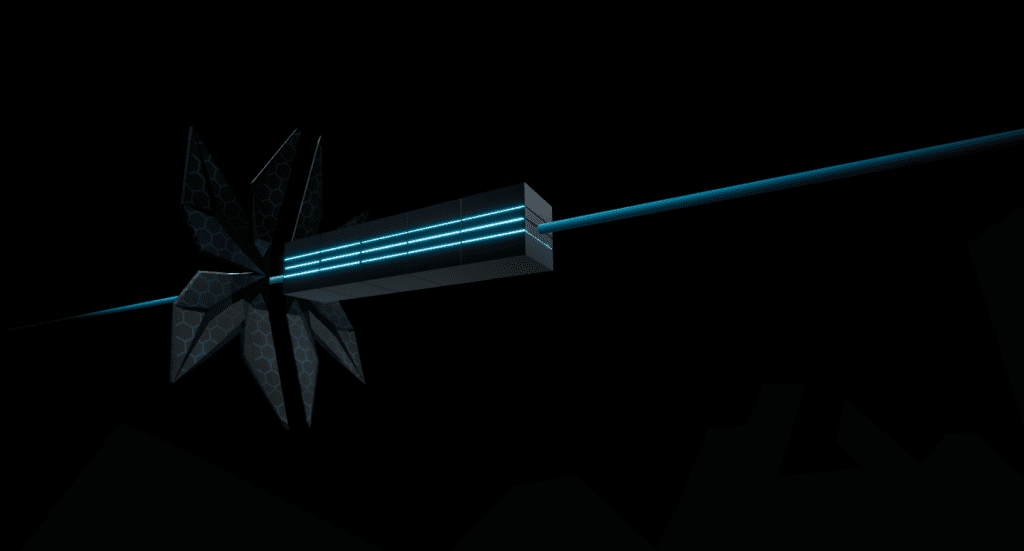
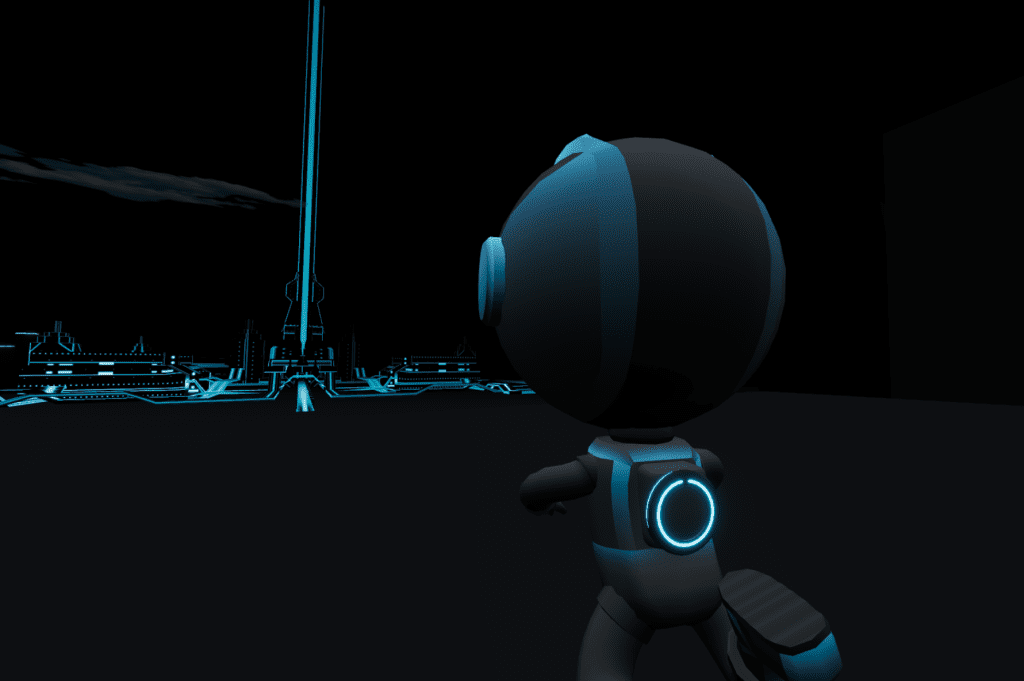
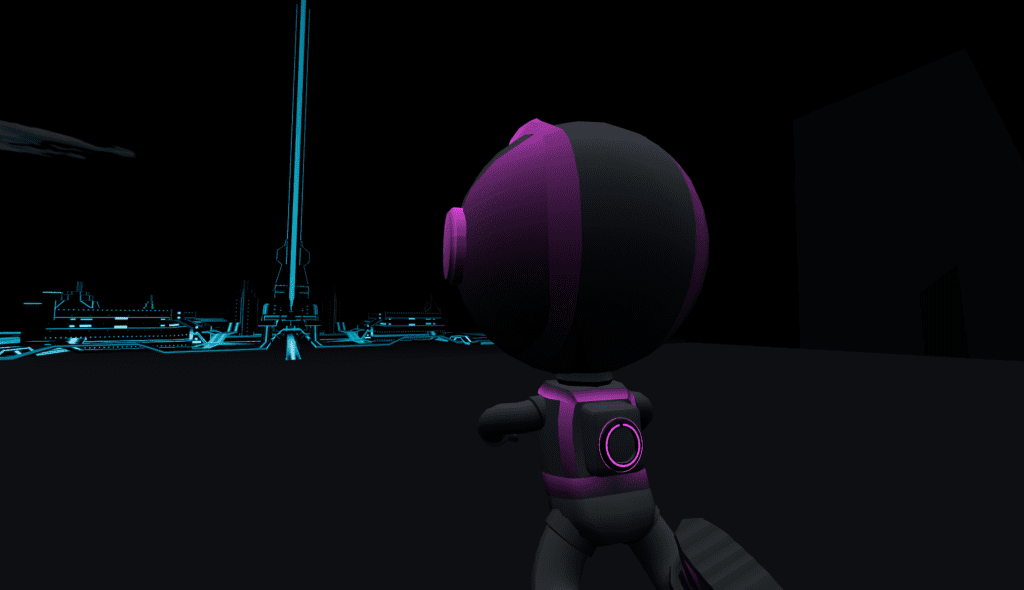
I changed the base texture using GIMP and removed the air supply hose. I added a Tron Identity Disk on the back
Work in progress: Adding my Identity Disk in BlenderTron avatar blueTron avatar purple
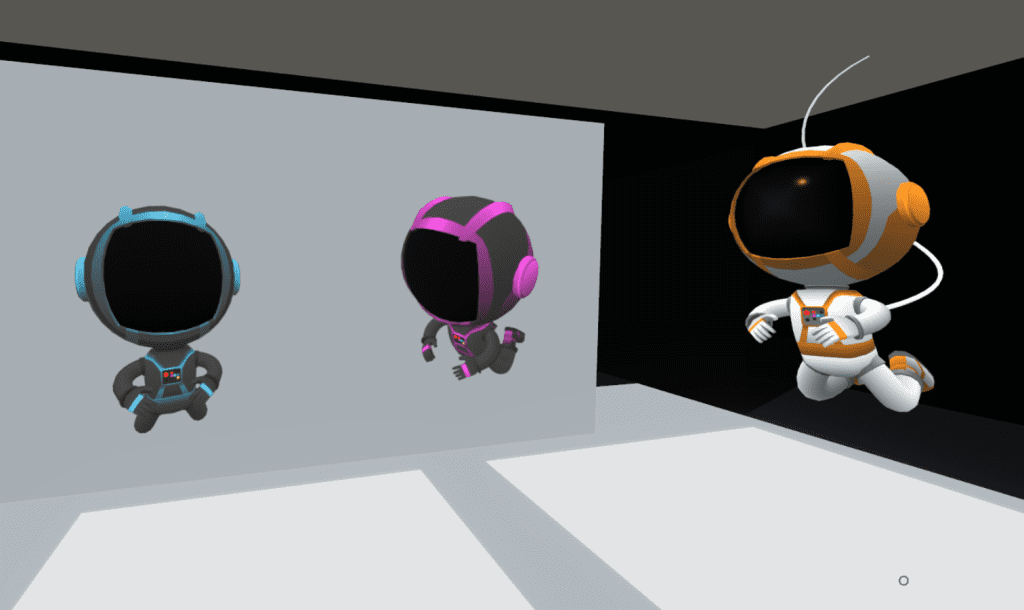
I made a blue avatar for all of my attendees by placing it up on my Hubs instance and taking all other avatars offline for guests via the Hubs Admin Panel. Then I made a purple avatar for me to wear as host (and it was a hint that a purple Grid was coming).
In Part 3, I’ll cover the big reveal as this build was not even leaked to the public before the opening day, Halloween 2025.
As promised, I’m starting blog posts about my Hubs/Blender builds. This will be a bit like stepping into a running stream as I’m over 2 years into my learning journey. I’m not that far in, still working primarily in modeling and I’ve done a little animation and I’m currently learning Grease Pencil (2D). Plus, I hope that some of my writing will help others.
What I do in Hubs and with Blender, for now, is pure art.
And that’s a good starting point for this blog because My Tron build, The Grid, was a really fun art study in negative space. In other words, this build had me work on what was not there just as much as what was there.
Tron
I don’t remember how me and YouTube started cross-pollinating on Tron. Truly, I’m not that into the movie (you will not believe that by the time this post is done because now, my Tron lore cup runneth over). It might have been this video, Sweet Dreams are Made of These, Epic Tron Version. I just find this song mesmerizing.
At some point, probably when searching out YouTube Blender tutorials, I ran across this video, Make Tron City in Blender, Real Time Render.
I watched this, it’s only 39 minutes and the creator is true to his word (mostly) that the build can be made in a short period of time. (There is little sped up footage.) That means a lot when evaluating a Blender tutorial. Many creators speed up time and give building ‘the hand wave’ approach. However, a close watch will show that this creator, Daniel Grove, made the Tron city three times as there are two different showcased cities (the center building changes) and then the one he builds as his how-to in real time.
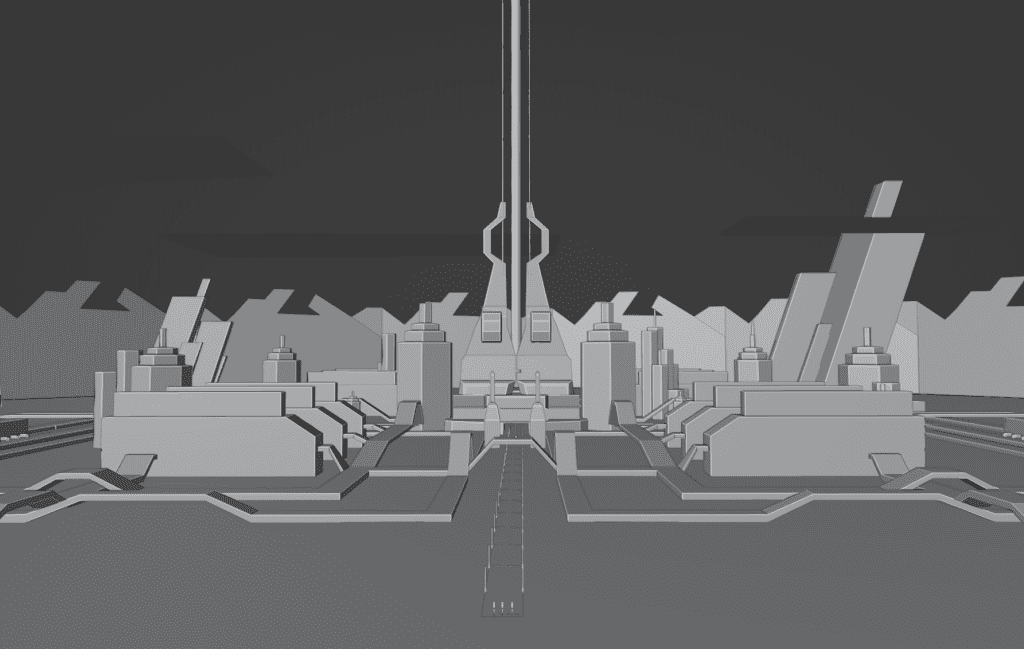
Nonetheless, it looked very simple. I was intrigued to play with bloom. Making my own textures with Blender was something I had just learned to do. I started.
Textures
This video and I think perhaps one by Grant Abbitt on using Grease Pencil Drawing in Blender got me going with using the Drawing tools in Blender and practicing something relatively easy, straight lines. I input a few circles but most of the textures are straight lines with a few angles.
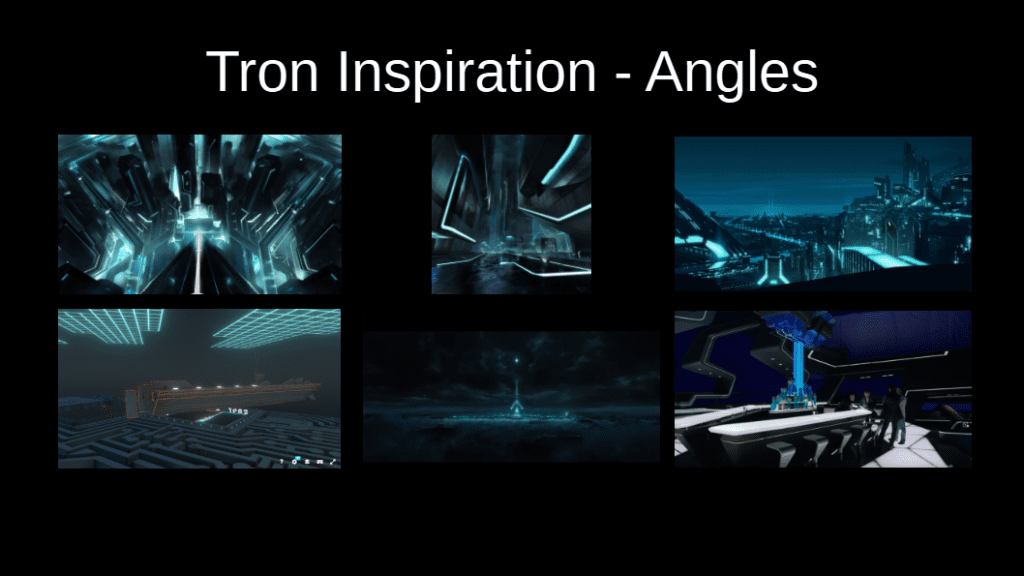
In my “lit review” of Tron art, angles are a cool element. They are not quite 45 degrees, but they play near there.
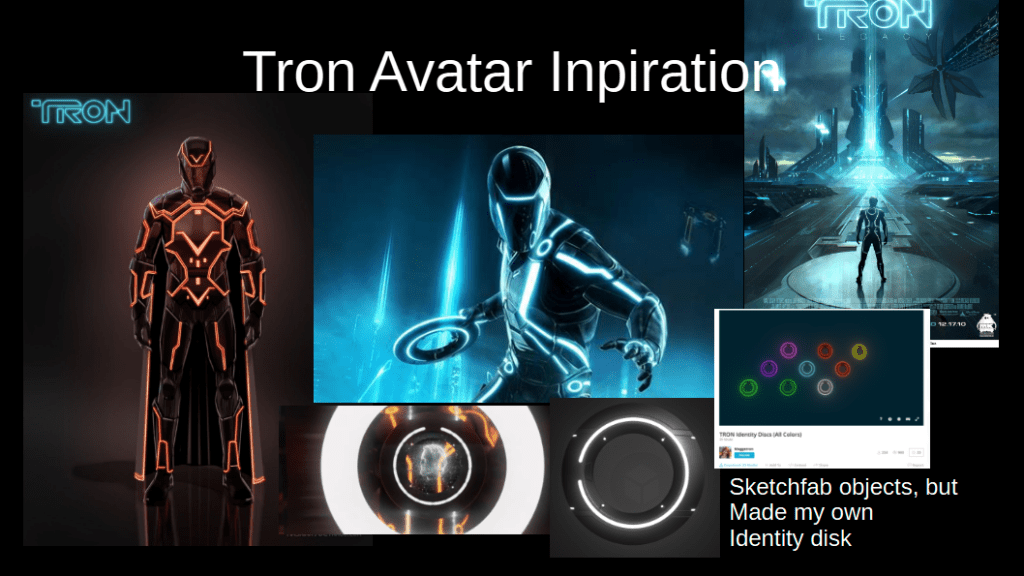
Inspiration images – note some of these are directly from the Tron movies/books but some are fan art.
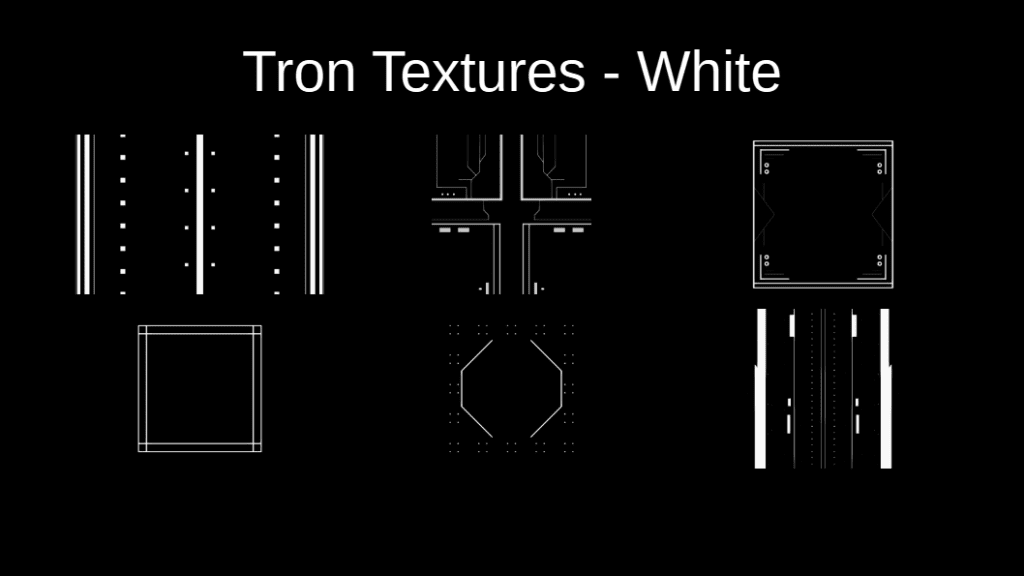
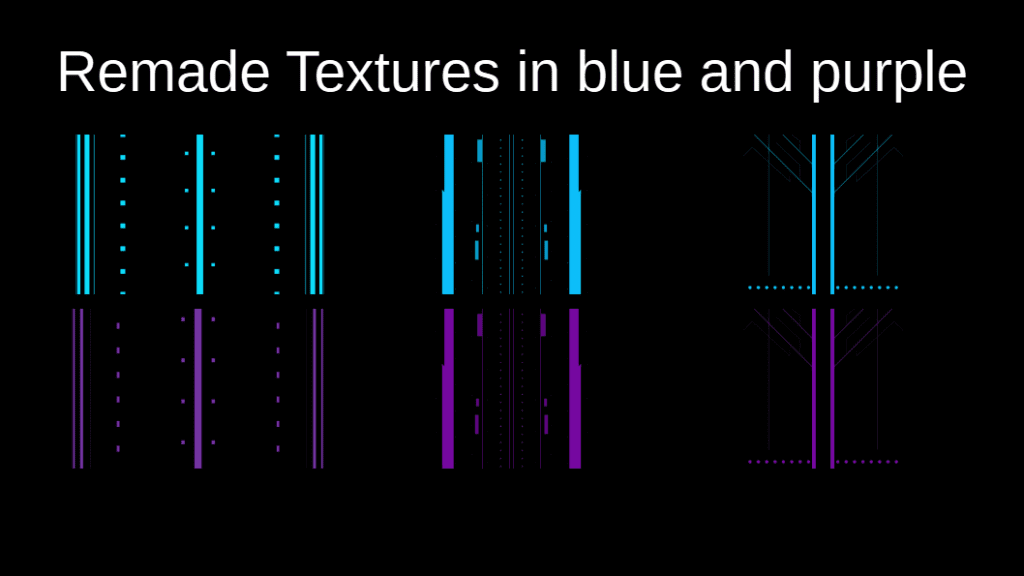
So I had my first bunch of textures, these were all made in Blender. Note that they are white on black.
None of these show up in the final build
I got the rest of the buildings made (and conceived of my “Halloween twist”), put the textures on and ramped up the bloom. The tutorial has you build a Color Ramp to turn the white to blue. In Blender, it looked fabulous! Essentially, I’m done! No, I’m not. I make immersive art.
I put the build up into Hubs to get inside it for the first time.
Nothing. Blackness. But that’s because my build was unlit– as in completely unlit; no light source. I had to play with some HDRIs to get the lighting I wanted.
And, I had bloom off on my own browser. That’s the problem that you can partially see below. It’s not glowing.
Work in progress. Note that the blue color is working but nothing is glowing.
So starts the work of translating what is a great scene in Blender to work in the WebXR platform, Hubs. There are LOT more settings to be worked on. In total, lighting took me ~3 days, slowing tweaking each setting and using the Hubs Blender Add-On after every tweak to see if was working towards the effect I wanted. Plus I had to turn bloom on.
Problem
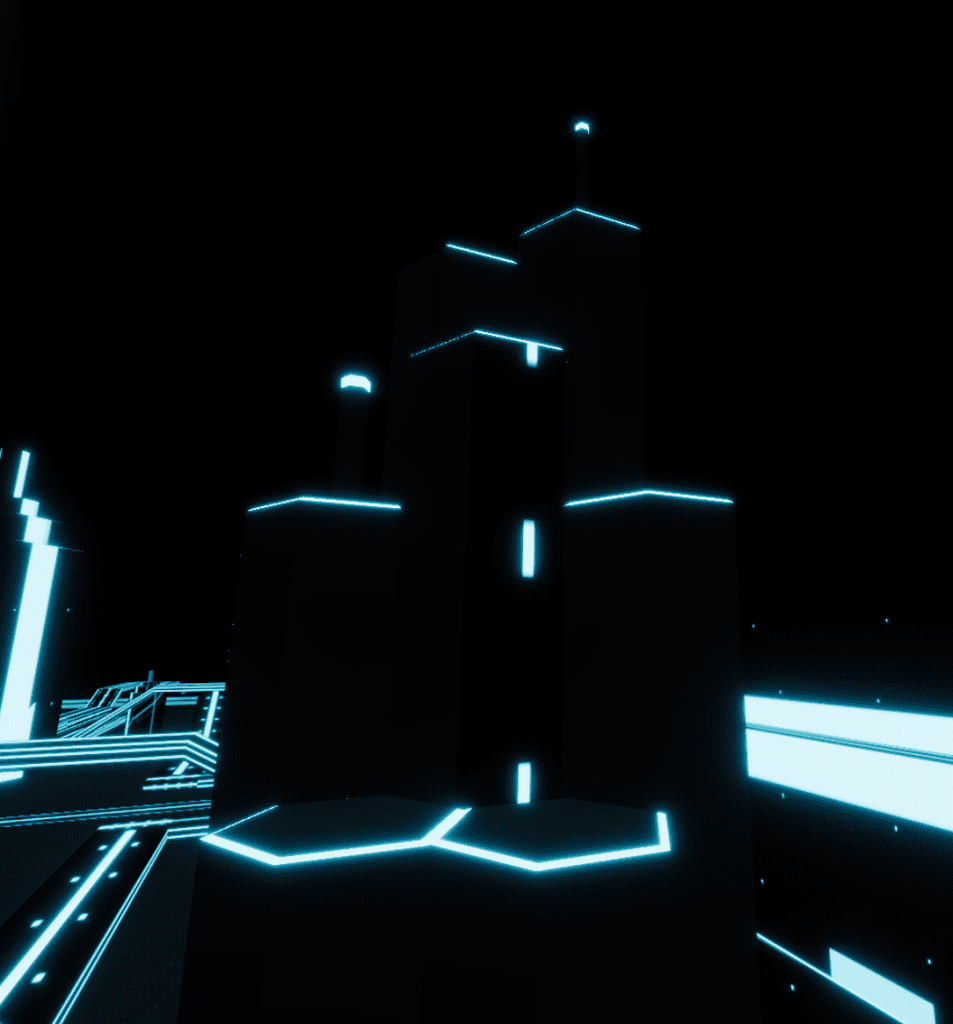
But of course, Hubs cannot understand the color ramp taught in the tutorial. So now I had to rebuild my entire set of textures in blue on black. Plus by now I know I want a set of purple on black for Halloween. I didn’t quite keep a set of Blender files for each texture, so I had t remake most of them from scratch. Bummer. That was another two days work. Plus I had to check for just the right “blue” (HEX 0DC2FF) and “purple” (HEX 7809A4) inside of Hubs. I would reference those 2 HEX codes frequently. In hindsight, the blue worked great. But the purple– even though I tried 3 different purples (a dark, a mid, and a light) was still too dark; it didn’t glow much in general. I’d pick a lighter purple if I did this again.
Notice how the purple just seems darker.
At this point I have one of the textures in blue (the road) but I’m still tweaking the bloom. Notice the white in most of the textures. The street lights are glowing from a blue material with emission, not a texture.
Only the blue is emissive at this point. I haven’t replaced all of the textures yet.
In addition to re-texturing, I was adding Flynn’s Hideout (aka apartment or safehouse) and heavily researching Tron lore to determine the purposes for things. I learned a LOT more about Tron that I ever wanted but it was cool to explore a world that was a computer simulation.
For example, there is a fireplace with a mantel in the hideout. I had to ask “what is fire in the Tron world?” and found that it appears to be blue transparent cubes (Tron Wiki, Flynn’s Safehouse, Trivia). Blue transparent cubes coming up! First, actually made in 3D in Blender. Then I picked a camera viewpoint and rendered one in 2D to be used with Hubs spawner. The result? Close enough. I’m still hesitant with transparency in Blender and Gimp. If I were to make these again, I would not have as many lines.
My Tron fire cube
Design Elements for Flynn’s Hideout
Should be spawn location
Can see Tron city (The Grid) from an outer deck
Includes water or meditation pool
Has angled black shiny walls (entire Tron world is black angled shiny rock)
There needs to be a book shelf in the back. Books appear to be significant in Tron lore. Books containing “text” might be the only part of the real world that computer programs can attempt to understand. The poorly done ‘do you know Jules Verne’ joke implies that programs struggle with fiction/nonfiction text.
No real food, but Flynn does eat. Note: humans are users. Users are self-powered in the Tron world. They are the only entity that is self-powered. That self-empowerment grants them somewhat of a god status in the Grid. It also allows Flynn to live separate, off the Grid, and beyond the reach of Clu.
There should be a bedroom to the side.
The fireplace has objects that seem to bemuse and simultaneously confuse Clu. I recreated this scene in my video. #CluDoesNotGetTchotchkes
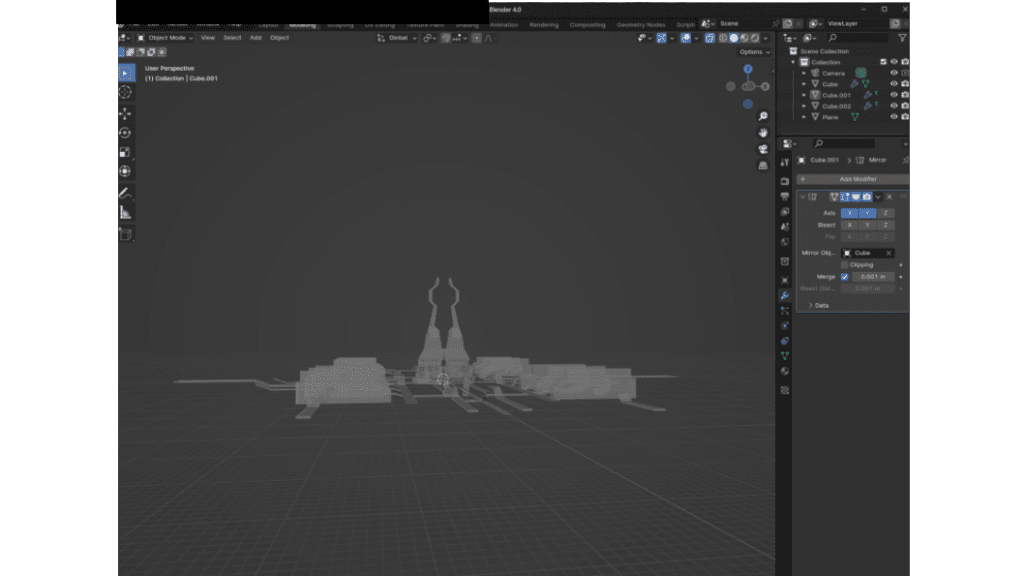
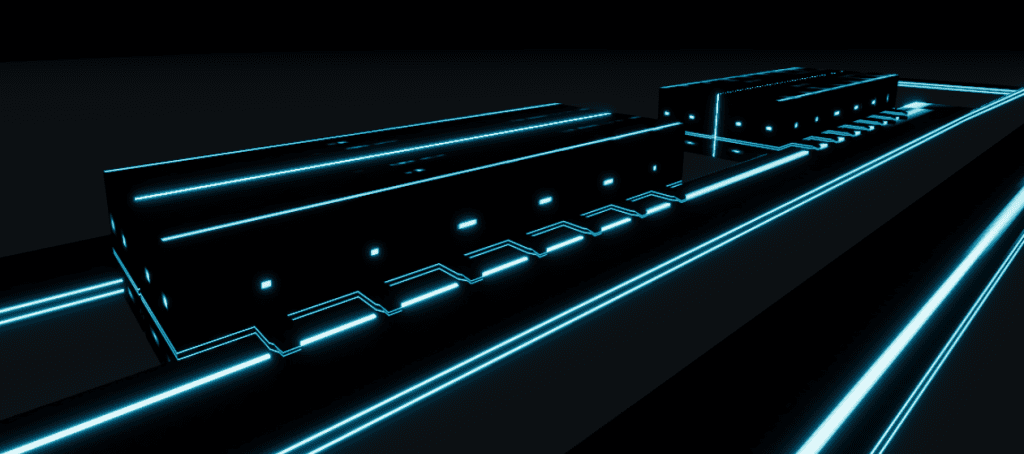
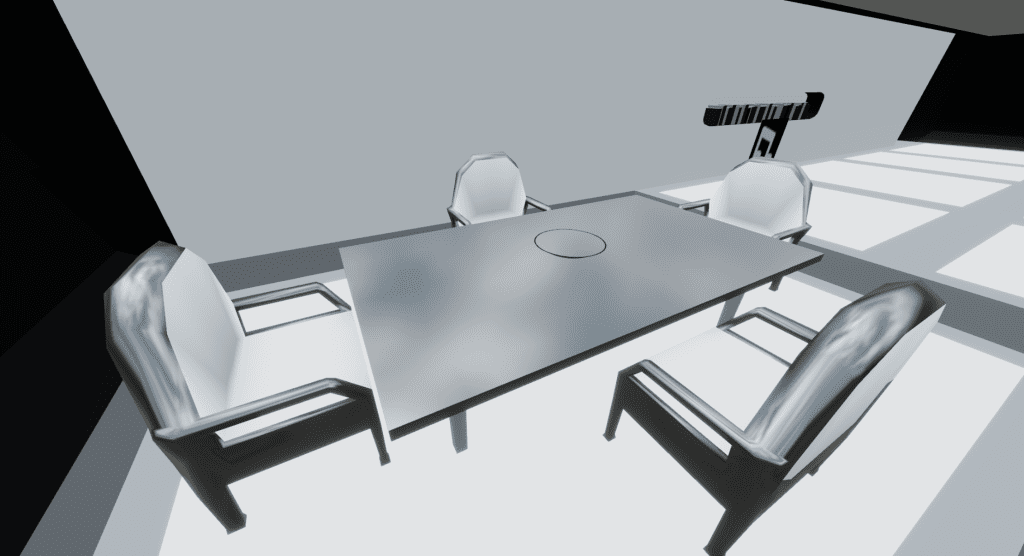
Work in progress: Blender screen showing that the basic city is only 3 cubes
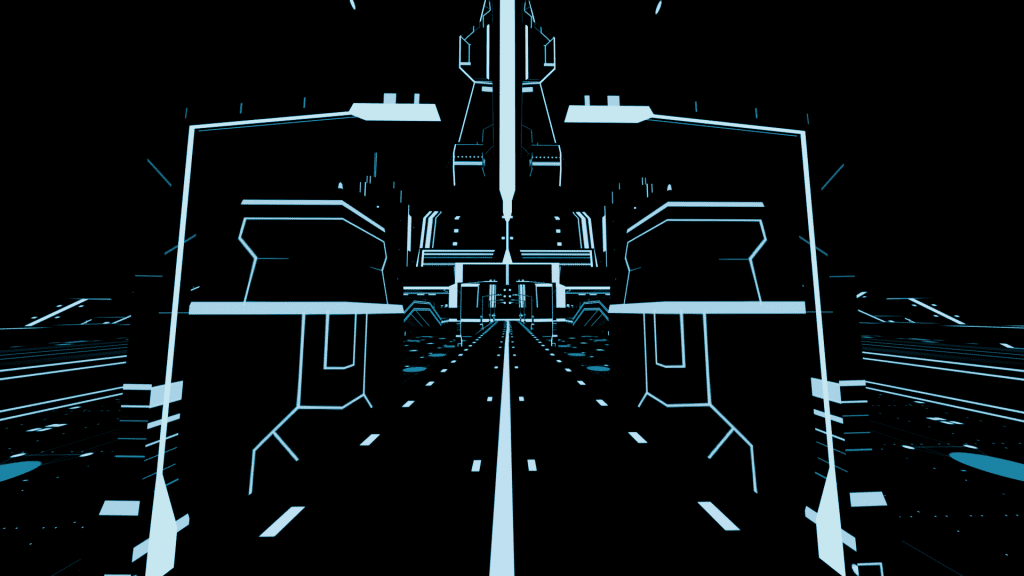
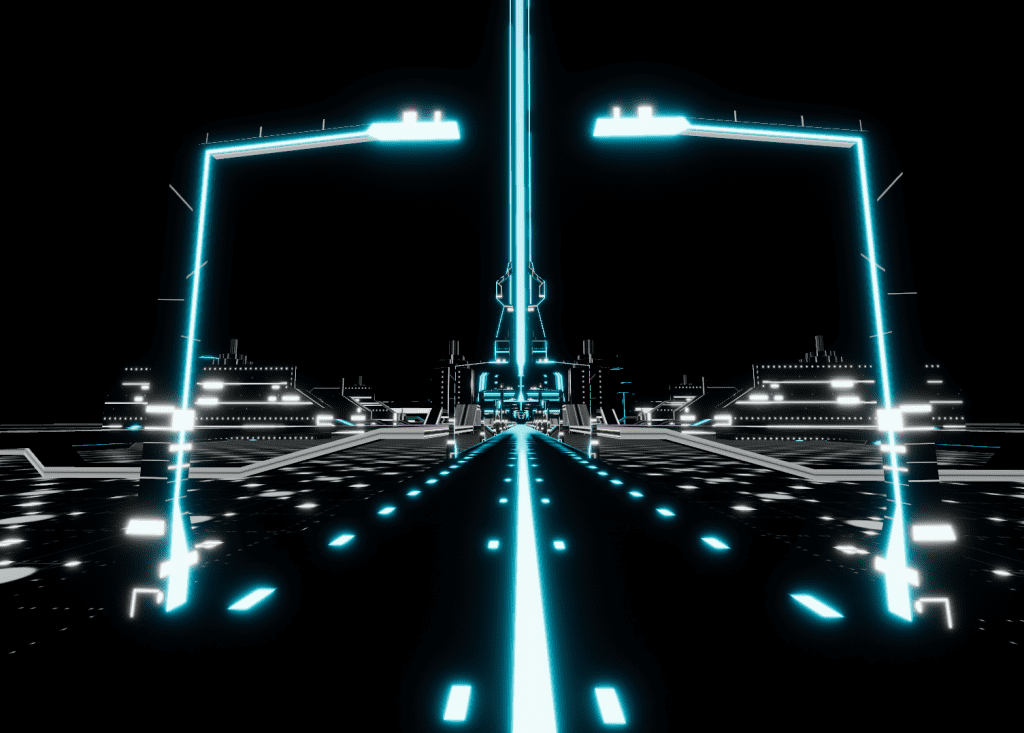
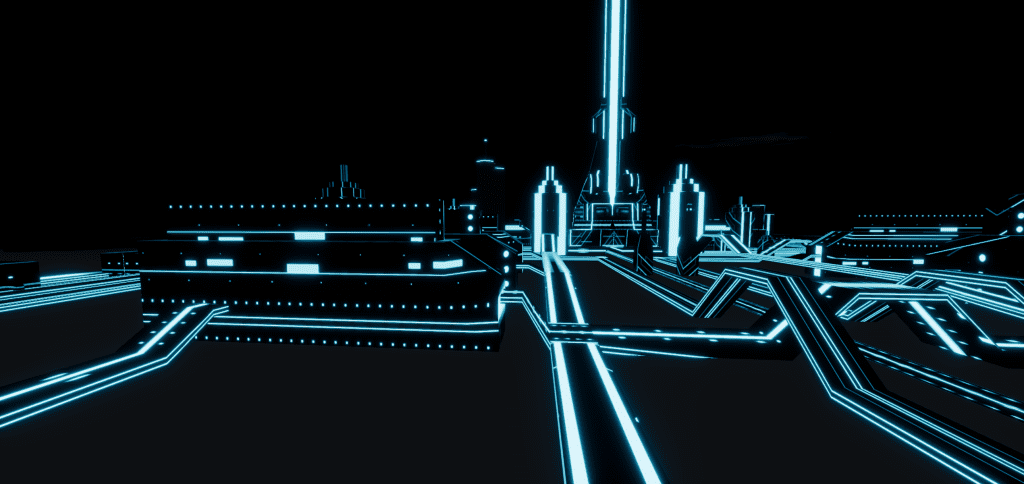
This series of images shows what I mean by “the textures carry the weight” and the use of negative space is compelling. The textures add what could be windows, doors, or programming through the scene. On the “roads” the textures give a sense of movement. It’s wild that all that busy city is from a few cubes, with the Mirror Modifier and some linear textures.
Tron City Elements
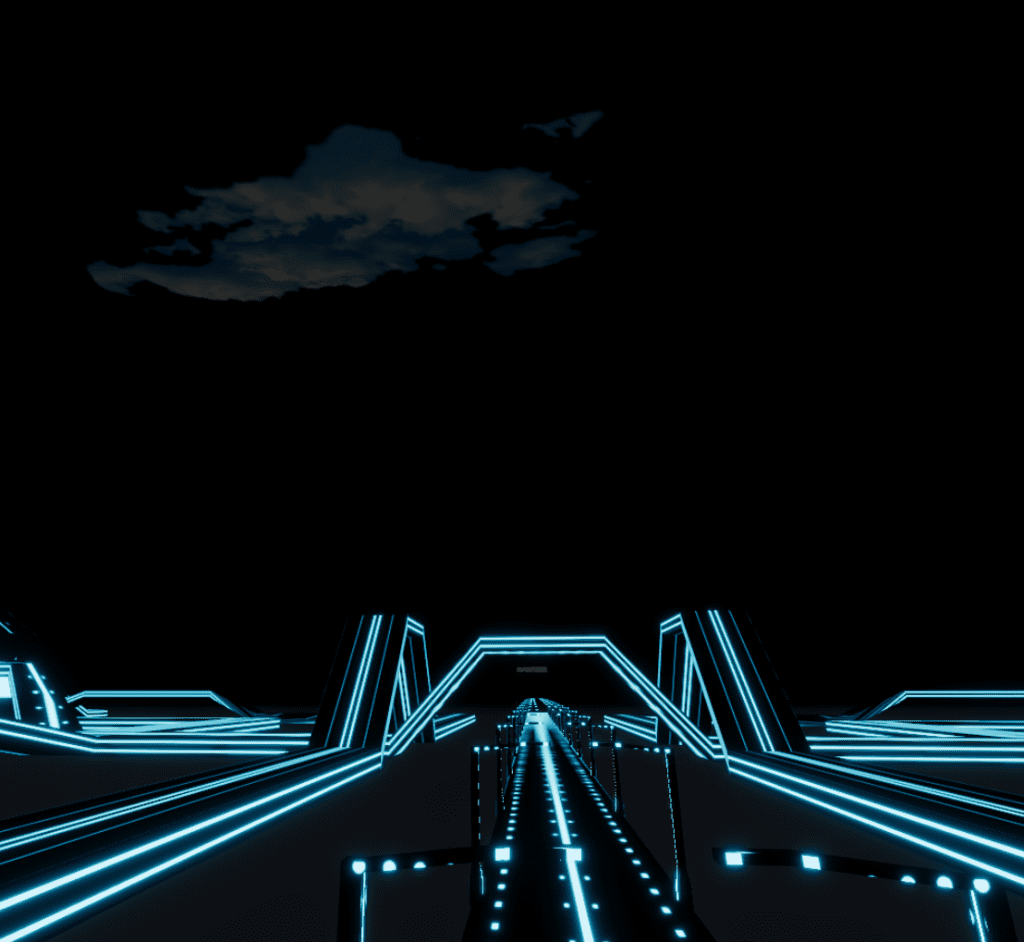
Apparently, it’s always dark and stormy in the Grid. Technically, it can rain and the Grid is rather proud that it can simulate rain. I did not make rain. I added some blue-tinted clouds that float across the scene via my animation. The black rock everywhere is shiny. Perhaps it is a break in the rain.
It’s always stormy in the Grid
I became much more comfortable with the Mirror Modifier in Blender in this build because the tutorial has you create the city with one mirror (i.e. X axis) but I simply added the other horizontal mirror (i.e. Y axis) for things like the roads and you quickly get a much larger symmetrical city!
The city is NOT fully symmetrical. I created some extra buildings that I manually placed into the scene.
By Nehrams2020, CC BY-SA 3.0, https://commons.wikimedia.org/w/index.php?curid=6637555
My purple socket set with a neon Hubs sign
I chose not to make the Games stadium. It’s already a big build and I didn’t need another building complex for my story line.
I thought about having the Solar Sailer arrive at some sort of tethered location at an antennae. I built the building for it to arrive at (per the Tron plot). But I decided that I liked the look of it just sailing through and past better.
About that center power beam
The tutorial doesn’t care how high the beam goes up as you just get it going up out of the animation render camera shot. But since my city is immersive, I had to think about how high of a beam I wanted. The beam IS part of Tron lore and it represents communicating back with reality so I thought it should go up forever! I really thought I had a perfect application for Fading Assets Gracefully with Vertex Alpha. But with Blender 4.0 (or some version near there), alpha has changed and changed how it is done. Thus, I’m lost and could NOT get it to work. I’m sure the problem is with me and I just need to adjust to the new system, but still I’m floundering.
Still, a mantra that I keep repeating did work: There is more than one way to do things in Blender.
So I tried Hubs black fog instead. Plus, since I already knew by that time that that beam was about 500m from the spawn point, if I set the fog to 500m it should just about perfectly hide the beam until a visitor goes out to the cliff edge.
View of Tron city after just stepping outside of the HideoutView of Tron City further out on the cliff edgeWIP image: Note the elements: the cushion, the water pool, the bedroom, and the far off city.
By The Numbers
The final build of Tron City with Flynn’s Hideout: ~18MB. I’m very sure most of that were my textures. But all things considered, that’s a tiny number for a build 1 kilometer in size.
Credit: Midjourney and me. Prompt:film still, wide shot moon base, glowing moon bases are separated across the surface, mysterious, nighttime, blue and green color scheme. –style raw
It’s a rare moment when I can bring 3 themes into 1 post:
leadership, XR, and design. Also, I’m going to be personal. Believe it
or not, I’m not really personal on LinkedIn. Enthusiastic, yes. Personal, hardly.
Over the weekend, I wrote a gushing sentence to a friend that I
realized I’d never written down before: I became a Biology major in
college because of Dr. Ellie Sattler.
A mentor of mine once said writing is thinking. Writing that
sentence lead me to do a lot of thinking and reading about her character
and on the impact of the Jurassic Park (JP) movie. I’m not alone as a
woman in deciding to go further in STEM because of the Dr. Ellie Sattler
character. So huzzah all the Paleobotanists out there!
We have to time travel to talk about JP. In 1993, we’ve just BARELY
broken out of the 1980s. For the first time in STEM history, scientific
breakthroughs are being accomplished by teams instead of white men. Think: AIDS breakthroughs & the Human Genome Project. Teams means women included. Prior to this point, women were the “also rans” in science. Sisters. Mentioned on the side. Or worse, they had their research stolen.
Strong women depicted in media? Disney’s top film of the 80s was The
Little Mermaid and Aladdin was just released in 1992. Strong women, not
so much. Video tapes existed; the Internet did not. If you wanted to see
a movie, you bought a movie theater ticket.
We arrive when the music was rises in cool, dark, air conditioned theaters. And then you see this:
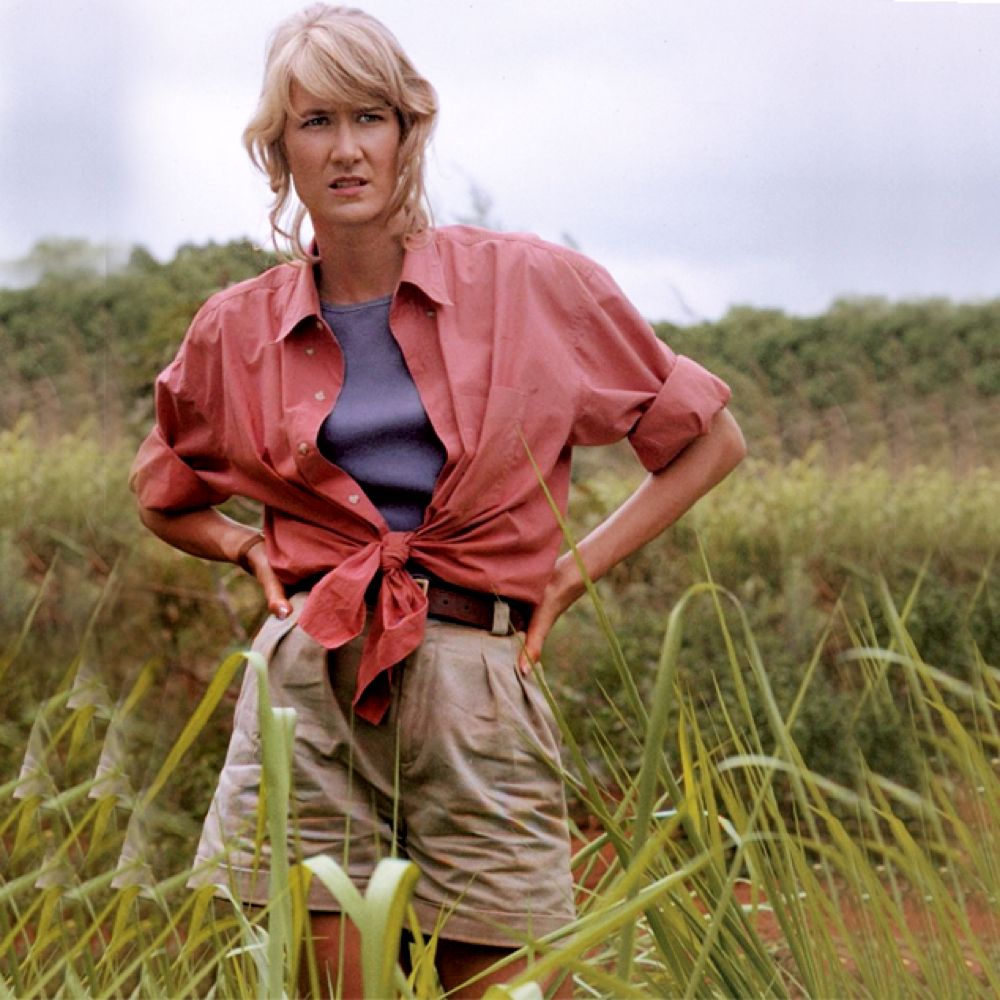
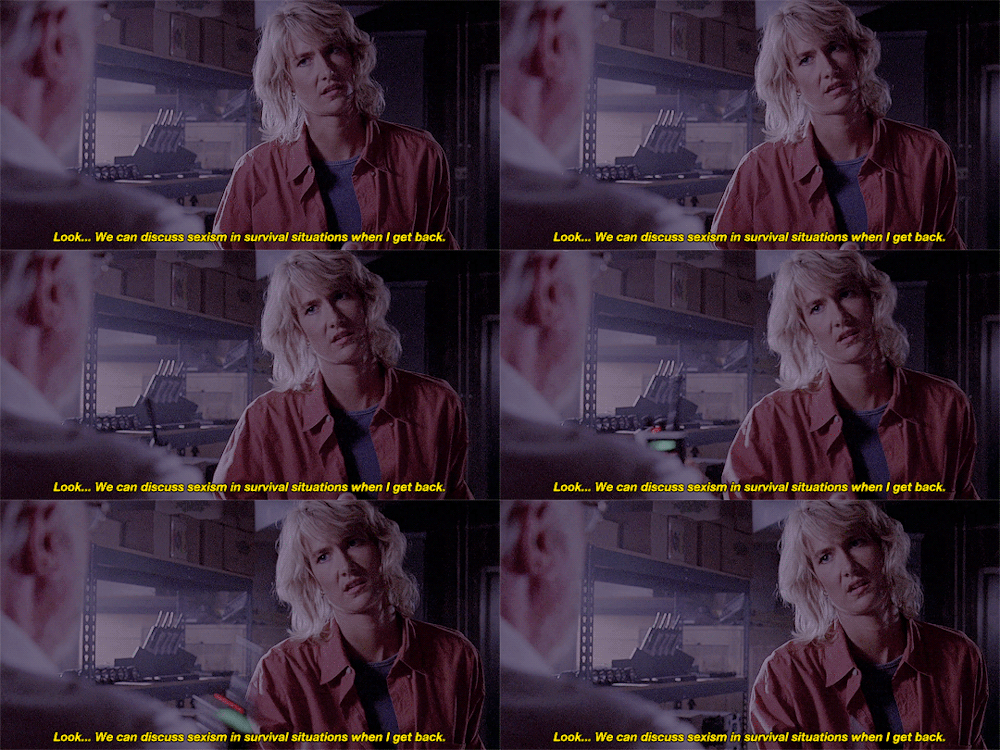
Caption: A character who does not care what you think because she’s solving a problem.
A character who lays out this line while she holds a stare on the richest daddy around:
“Look…we can discuss sexism in survival situations when I get back”
I took that to mean that women are better in survival situations (not equal, as others took it.) and my life was shaped for the better.
I bought a $5 ticket 3 times over the course of that 1993 summer. Now that’s saying something.
To this day, it’s the only movie I’ve bought multiple theater seats
for. But realize, I have older brothers that saw Star Wars, what, a
bazillion times?
Jurassic Park became the first movie to gross US$1billion.
Reading some commentaries and watching some videos over the past few
days, I picked up some tidbits below. Some I agree with, some not.
1. To this day, the scene of the T-Rex crossing the paddock fence
HAS NOT YET BEEN BEAT in movie history & you don’t need to try.
True disclosure: the raptor jumping up to the ceiling shot? I still
can’t *barely* watch that. I wince too hard.
2. There’s been some 2022 commentary on the age difference between
the Dr. Ellie Sattler (Laura Dern) and Dr. Alan Grant (Sam Neill)
characters. It’s been confusing and I’ve decided to weigh in.
In the book, Dr. Ellie Sattler was written as a grad student (Age
23, no advanced degree) but also no relationship. It was apparently
Laura Dern’s own idea to give the character a full doctoral degree and
in the movie the character holds her own against dinosaurs. In real
life, I’m disappointed to say, Laura treats Sam Neill patronizingly
and actually “left the party” of JP with Jeff Goldblum, which I find to
be a big mistake. (I said this article would be personal, yo.)
Caption: The look of faithfulness.
Don’t be like this guy and not see the sexual tension in JP: https://youtu.be/jSPxu3WprSs
As far as the age difference? The problem came in when, in the book,
the “relationship” was not there but in the movie it was. Laura was in her late 20s playing early 20s. Sam (then early 40s)
continues to feel the (physical) burden of the age difference. If you
need help to see what was happening, Deshi Basara has collected these gifs. Notice in gifs 2, 3, and 7 how his body immediately reacts to hers when she touches him. This is chemistry, folks.
I had to wade into all that because the point was that regardless of
an age difference (which, arguably could be *less* than 23 years),
there was a *quality difference* between Dr. Ian Malcolm and Dr. Alan
Grant.
I will concede this one point (I disagreed with so much here
that I couldn’t read more than 2 pages of this commentary) that Ellie
holds her ground just fine (and doesn’t move despite Alan’s come here
gesture) with a metamessage at the Raptor pit:
Vogue got an interview with Laura Dern
where she points out that the Dr. Ellie Sattler character went on to be
an activist and whistleblower. Interesting!! I’ll just leave that right there.
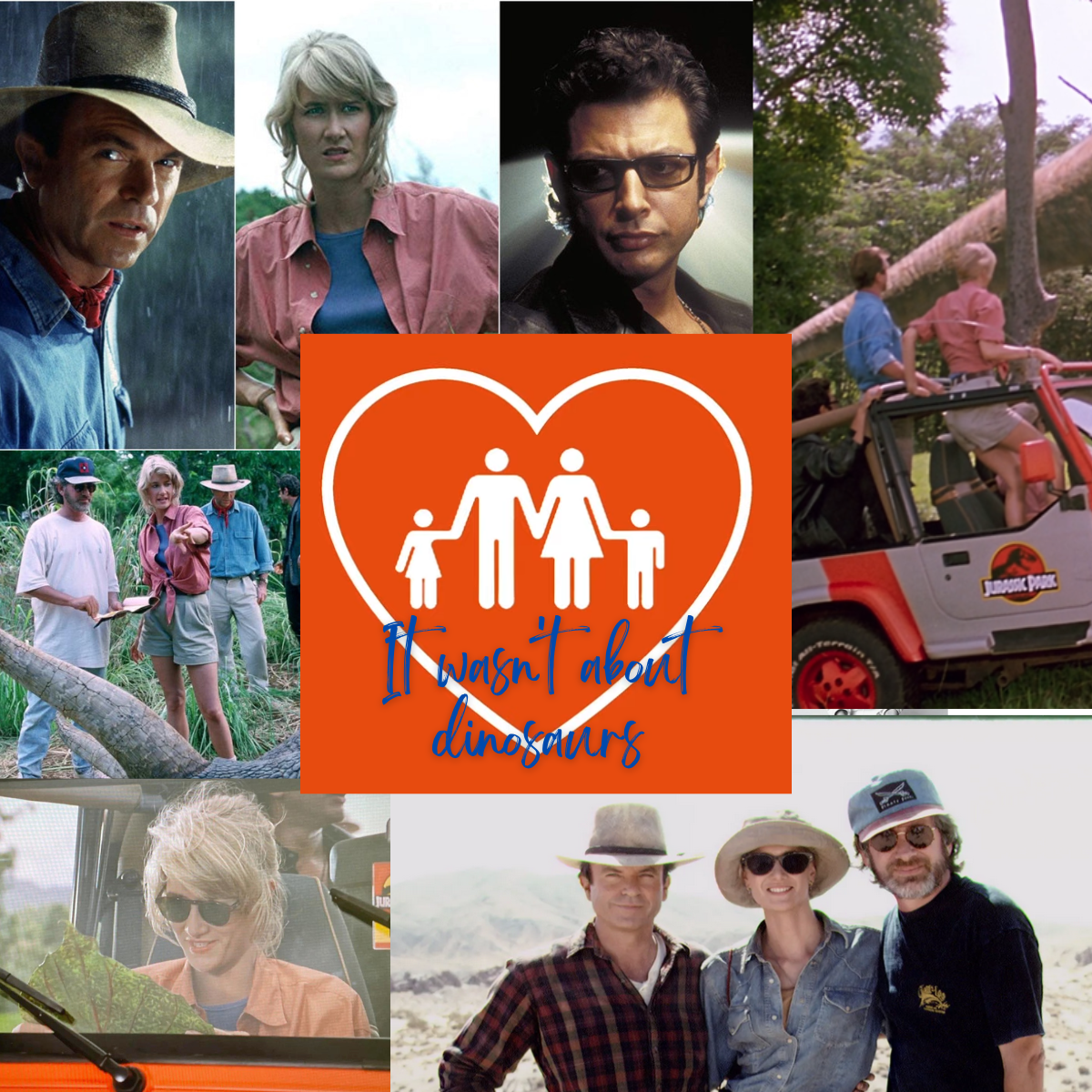
But most I really enjoyed watching these video analyses of the plot of Jurassic Park here and especially by Mike Hill here and why the movie worked when all subsequent versions of JP have not worked. The key was that Steven Spielberg worked in narrative plot. He carried a story all the way through that was human, basic, and emotional. Dinosaurs just happened to be there.
But that shows up in my VR/XR consulting work to this day.
The famous quote about rushing into things by the Choatician character Dr. Ian Malcolm:
Ian Malcolm: Don’t you see the danger, John, uh,
inherent in what you’re doing here? Genetic power’s the most awesome
force this planet’s ever seen, but you wield it like a kid who’s found
his dad’s gun.
Donald Gennaro: It’s hardly appropriate to start hurling accusations–
Ian Malcolm: If I may, if I may. Uh, I’ll tell you
the problem with the scientific power that you’re, that you’re using
here. It didn’t require any discipline to attain it. You know, you read
what others had done, and you, and you took the next step. You didn’t
earn the knowledge for yourselves, so you don’t take any
responsibility… for it. You stood on the shoulders of geniuses, uh, to
accomplish something as fast as you could, and before you even knew it,
you had, you’ve patented it, and packaged it, and slapped it on a
plastic lunch box, and now (bangs the table) you’re selling it, you
wanna sell it, well.
John Hammond: I don’t think you’re giving us our due credit. Our scientists have done things which nobody has ever done before.
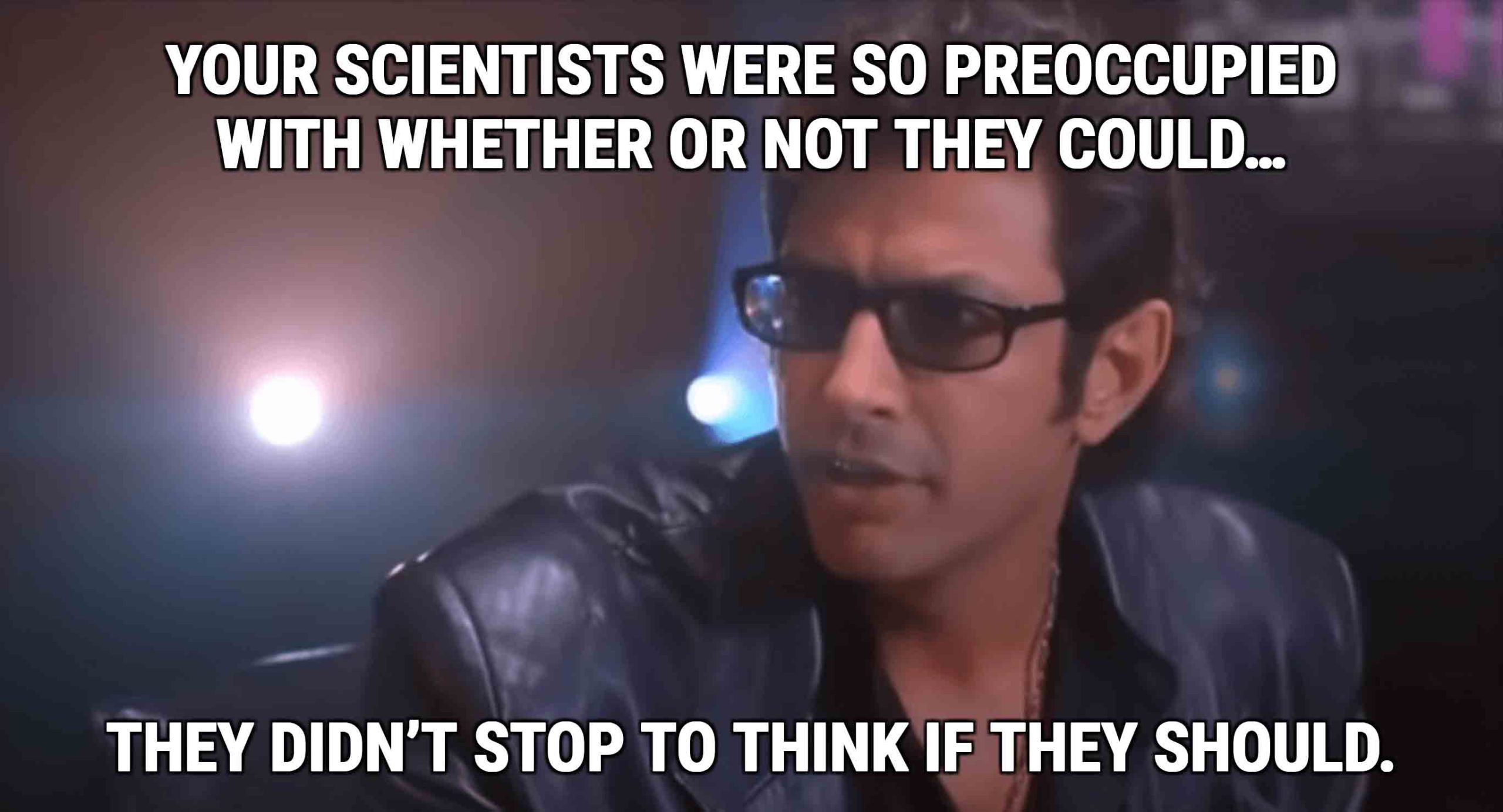
Ian Malcolm: Yeah, yeah, but your scientists were so preoccupied over whether or not they could, they didn’t stop to think if they should.
I fight this battle every day.
Industry and indeed some in academia want to use XR liberally in
education. Yet, the power of XR is still unknown. Our early research is
pointing to one thing that seems firm:
The mind believes what the eye sees.
That means that the XR experiences we put our children into will be real for them.
What power are we wielding in the classroom? Everywhere?
There are those that say “XR is the Empathy Machine! We can create empathy, soft skills in the workplace!”
Oh yeah?
The most recent research I saw (from 2018) says that empathy coming from XR is a 50/50 gambit. That does not mean that it causes empathy for whatever you want half the time.
It means it causes empathy half of the time and causes the opposite of empathy the other half of the time!
So, would you like your employees to don a headset to be more
empathetic towards race, age, body size? Oh really? How would you like
results that say that half of the time, those employees are going to
take off the headsets and quietly say to themselves “Thank God I’m not
black” 50% of the time? That’s one hell of a bet you are willing to take
with XR.
XR is dangerous.
People say “Look at how you can look all around you! 360 degrees! A
sphere! Isn’t this cool? Isn’t this new? Just think how this will reach new learners!”
I can take a learner into a new real physical space (for example on a field trip) and have them be overwhelmed. We’re all on the spectrum, remember? Was that cool? Were they reached
in a new way when they cried? Would you like for me to even mention
harassment events in VR that have already happened? We haven’t yet
arrived into market saturation of haptic bodysuits, but it’s coming.
XR is dangerous.
I’d rather have a low, slow, plodding walk into an XR for education
experience than every bell and whistle thrown at them the first day. The
line “spared no expense” gives me chills.
XR is dangerous and if we aren’t careful, we will damage learners
along the way. Jurassic Park should not have been built or opened. Dr.
Alan Grant refused to give his endorsement. That was the lesson of the
movie.
I’m proud that I don’t endorse some forms of XR (Dr. Alan Grant)
I’m proud that I throw water on some XR ideas (Dr. Ian Malcolm)
I’m proud that I tackle problems that no one else can survive. (Dr. Ellie Sattler)
But the parallel lesson of JP was “Build for story. Because the dinosaurs are not real.”
When I encourage XR design, I build for narrative plot.
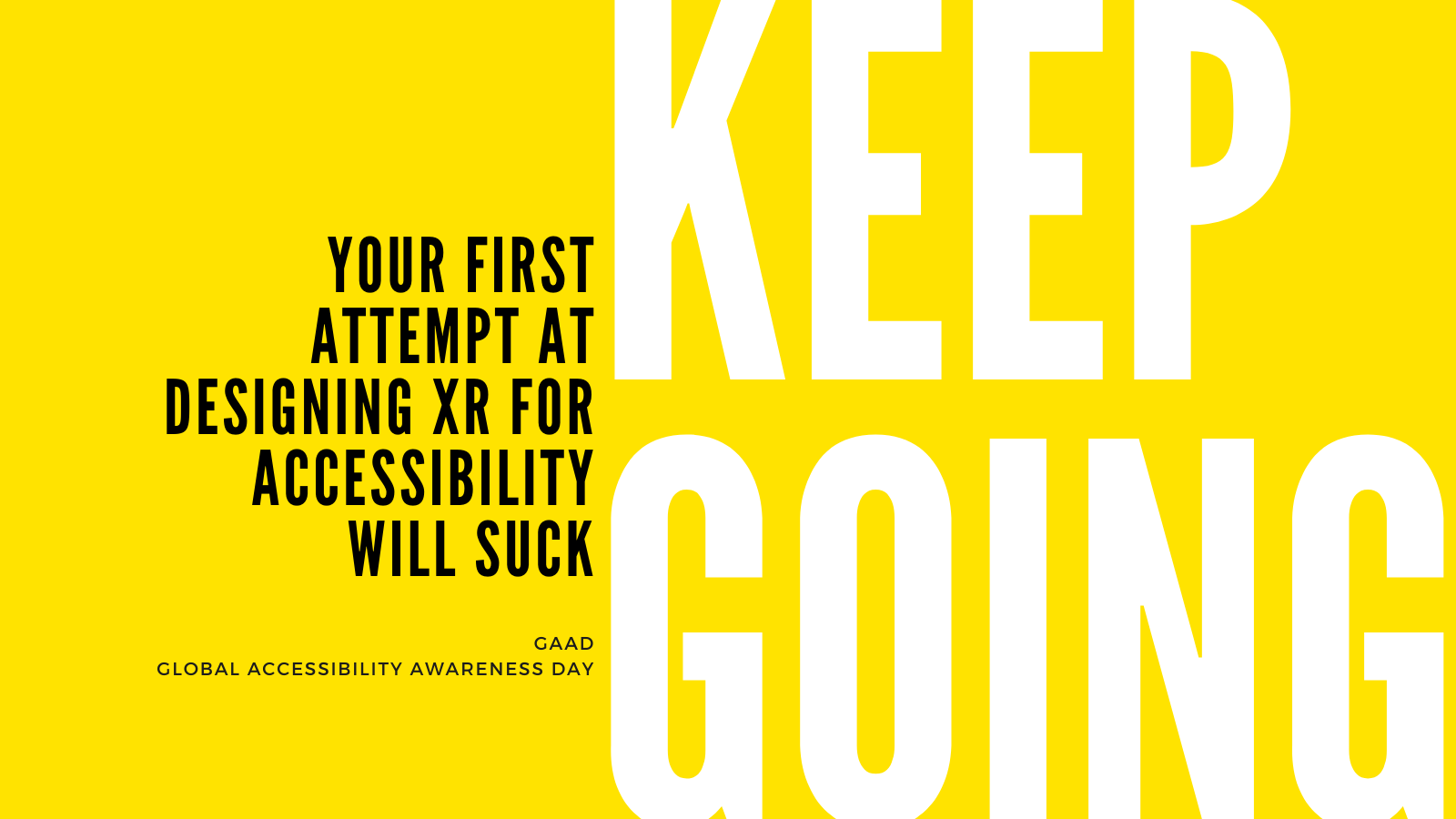
Looking for tips on how to design #XR
for accessibility? You could follow me, but I’m just learning this
stuff myself. Search. Learn. Ask. Network. Try. Then try again. Cry
some. Then try 1 MORE DAMN TIME. Because XR can be for everyone.
Curious? Good. I’m putting some links here. They are all click worthy.
XR for the Deaf: I read everything my link Meryl puts out. I would encourage you to follow her: https://www.linkedin.com/in/meryl/ She publishes on topics beyond deaf accessibility.
I just found this golden tidbit TODAY for #gaad2022
, check it out! Audio descriptions in games – something of particular
interest to my Instructional Designer friends as we are always keeping
an eye on conflicting text, sound, and narration. This is something to
learn about here! https://youtu.be/W2B3jBu0ZqY
I’m knee deep in an XR implementation project. It’s going forward by
inches; each step aches with how small it is. If I measured it, it feels
like it would barely tick one mark on a stick. However, like a gardener
that makes one small snip here, one pull of a weed there, there is no
overnight transformation. But still– in the messy work of
IMPLEMENTATION, I’m making a garden that turns heads and makes people
think “I want to be there.”
Seriously, here is the garden:
Today is one of those days where it feels like we are going 2 steps backwards with no step forward. When you hear it mentioned quietly, but over and over and over, that one of the biggest implementation problems we have in XR for education is “sound” — WE ARE NOT KIDDING.
We have more problems with sound that with any other aspect of an experience. It is the TOP problem source.
Virbela had this problem in buckets. My hosts cringed every time I estimated that 20% of incoming users had sound problems. 20%! If YouTube had a 20% failure rate that they presented to users, they would far, far out of business by now.
I watched this video dated November 5, 2021 put out by Stanford University touting the first course taught in XR with Jeremy Bailenson where he claims it will be “an incredible journey for about half of this class”
Here is the video promo text:
“263 students, all with their own VR headsets, across 20 weeks and two courses, spent over 200,000 shared minutes together in the Metaverse. They engaged in large group field trips, small group discussions, performed live music and skits, and worked both alone and together to build their own virtual worlds.”
First: posed shot OR photoshopped image. Notice: no Zoom markings at all. It’s not “live”, people are not moving.
For someone like me with enough live event logistics and tech support experience, watching this video shows me that I suspected the course was riddled with sound problems.
The background music starts at 0:18, so “hearing” the students will be hard.
Watch for how much students were cordoned off into small groups (that’s not just a teaching method, that’s to put them soundwise AWAY from each other and minimize disruption) and then just listen to what you CAN hear of the sound provided in the video, you will get snippets and what you will hear will be blurbs of users acting more awkward and users waiting around on another user.
The “you made it” comment is somewhat telling. It is HARD to get users into XR. Admittedly, it might easier if you are at Stanford and everyone has an Oculus Quest 2 (Meta Quest). (smirk)
Privilege much?
At 1:14 there is a LOT of talk over and by 1:18 the video has been sped up to just overwhelm with ADDING models or processing to VR on the ENGAGE platform.
I’m not trying to douse flames of innovation here. But I’m trying to point out that implementation, as the Atlantic article points out, is a much messier, day-by-day process than the glitz and glamour of a moment.
The video shows THIS as what appears to be a class highlight moment.
The sound is a man speaking saying “Nice work everyone!”
Just let that sink in while looking at that image.
2021. Stanford University. That is one of our very best learning instituations, folks.
Ironically, all of the avatars with awkward arms ARE the users actually using headsets. That one avatar in the middle in the gray shirt with this hands at his sides? He is the one user in 2D, not a headset.
Snicker now, because he is the only one looking normal in this bunch.
With the dramatic shift to online learning with the arrival of the
COVID-19 pandemic, faculty, staff, and students within higher education
worldwide have made the sudden but necessary initial steps to
incorporate technology into the learning environment in ways never
imagined. However, forward-thinking administrators are wondering, “what
comes next?” Immersive learning and XR answer this call.
Created with care in Canva.
Sources:
Definitions come from my own writing here:
Ziker C., Truman B., Dodds H. (2021) Cross Reality (XR): Challenges and
Opportunities Across the Spectrum. In: Ryoo J., Winkelmann K. (eds)
Innovative Learning Environments in STEM Higher Education.
SpringerBriefs in Statistics. Springer, Cham. https://doi.org/10.1007/978-3-030-58948-6_4
Dodds, H. (2021). Immersive Learning Environments: Designing XR into
Higher Education. In J. E. Stefaniak, S. Conklin, B. Oyarzun, &
R. M. Reese (Eds.), A Practitioner’s Guide to Instructional Design in
Higher Education. EdTech Books. https://edtechbooks.org/id_highered/immersive_learning_e
Slide 8 does not have one source but over 20 years research (including
my dissertation study) with technology-facilitated immersive learning
has yet to show a significant improvement other any other learning
media. This aligns with this important article in the history of
instructional design: Clark, R. E. (1994). Media will never influence
learning. Educational technology research and development, 42(2), 21-29.
Slides 9, 10, 11 “XR reduces Time, Money, Danger” (similarly expressed
in my dissertation). There are parallel comments made by Jeremy
Bailenson documented here as his “DICE” advice. https://stanfordvr.com/video/2019/transformative-experiences-vr-for-good/
It should be noted that the DICE advice are the 4 occasions for which
to NOT use VR (against) where my 3 are 3 occasions TO use VR (for).
The combination of 4 different models is my own published creation:
ADDIE (traditional ID model), Design Thinking (from UX), 3DLED (from
Karl Kapp), and narrative plot (loosely credited to Pixar). They are
displayed here to show the remarkable similarity of steps/pathway across
each model, thus supporting the validity of the proposed path.
I was recently asked if I have service design experience and I realized that I have more service design
experience than product design experience in VR. Truly, my focus has
been on bringing new clients into VR experiences, explaining the
benefits and challenges, and customizing a solution for their own needs.
I love doing this work!
So here is an example of service design experience that I did for the IEEE VR Conference in 2021.
First, as I stated my remarks at the Opening Ceremony
(held at 3:30 a.m. my time, 8:30 a.m. Lisbon, Portugal time), the
institution that I worked for pursued getting this particular client
because they were an ideal fit with similar mission and demographics.
Additionally, both organizations had switched on online conferences in
2020 (IEEE VR to Mozilla Hubs and iLRN to Virbela)
and so we shared the common ground of bringing large amounts of users
into new virtual spaces. We won the contract to host their posters,
doctoral consortium, demo, 3DUI contest, and video presentations on the iLRN Virtual Campus
powered by Virbela. (The rest of their program was handled on Zoom,
YouTube, and Twitch.) We had approximately 2 months prep time and worked
directly with organizers from Portugal, New Zealand, and the US –
drawing together meetings, tours, and set up times across multiple time
zones.
My support was being online to help with registrations,
account access with translation to virtual access, technical support
inside the virtual reality spaces, and providing options when the
organizers wanted to dream up something new on the spot.
And did they dream! Out of this one 7 day event, 3 brand new in-VR conference events started and I was part of all of them.
All
of these events had a theme to them: they used the basic affordances of
the platform and put those pieces together in a new way.
Said another way, these events were not pushing the VR boundary. They used the VR platform in ways it could perfectly perform and thus the execution was great! Think: using basic legos, not a kit, to build something like the Millennium Falcon.
Treasure Hunt Ready Player 21
Just
a few weeks before the conference opened, our island gained the ability
to passcode spaces. This meant that users needed to enter a code into a
pop-up box in order to teleport or arrive in a specific space (usually a
meeting room). One of the conference organizers, Rob Lindeman,
listened as we described the basic features of the passcode system and
he realized that he could create a treasure hunt game. He called it Ready Player 21.
http://www.lindeman.com/vr2021/live.shtml
(This landing page has 1,211 hits as of October 13, 2021. Rob documents
that it had over 900 hits just during the treasure hunt game.)
“If you are seeing or reading this, it means I am dead…I mean I am an avatar, and so are you. My name is James HOLIDAY.
I
have created a set of puzzles for you to solve. Each puzzle results in a
key that you can use to unlock a secret room within the campus, where
you will find clues to finding the next key. There are four keys in all,
and the first person to find all four of them and reach the final room
will receive an extra special prize.
Half a billion…No, wait…I mean an NVIDIA GeForce RTX 3090 graphics card!
There
are leader boards displayed around the campus, and each time someone
finds a key, their name will be added to the leaderboard, along with the
time of earning the key.
If you would like to take part in this adventure, please use the QR code that you find below.
Good luck!*”
As
I was part of the support crew, I could not participate to win the
prize but I had fun visiting the first 2 rooms to check out their
function and I actually solved the puzzles! (I’m good at lateral
thinking.)
When the treasure hunt game opened, there were QR
codes placed around the Campus inside of images and participants ran
around collecting them– mistakenly thinking that just collecting QR
codes would win the game. The QR codes, however, were only the START of
the game. The actual puzzles were inside the passcoded rooms.
The hunt ran about 4 days.
I was proud to witness that a woman, Xioadan Hu,
won the game and this screenshot shows us in the winning puzzle room as
we were taking her celebrating photo, with a research colleague. I
asked her how she completed all of the puzzles and she said “you just
have to be very detail-oriented!” I’m sure she’s going on to great
things. There was great envy for the graphics card that she won because the COVID-19 pandemic had curtailed graphic card production.
Speed Networking
The next experience was dreamed up and put into action in just a few hours. One of the organizers, Francisco Simoes,
had realized that we could make for them a large office space of 36
offices that each had private sound (sound restricted to inside that
space). So with some added Portugal theming and a few ground rules, we
instituted “Scientific Speed Dating” when networkers could just show up
and meet new people every few minutes. Everyone at the conference was
invited so this was a great time for students to meet potential
colleagues or new research contacts!
The VR affordances that we used were:
Sound isolated rooms connected by open office spaces.
“Flat sound” or sound all of the same volume transmitted through the entire space
The ability to send a “room notification” to every avatar in the space notifying them of time remaining or time to switch rooms.
So remember those spaces:
An office is a sound isolated space with walls, ceiling, floors, and a door. You could see into the office from outside.
A
team suite is a group of offices bound together by a common floor.
Sound is NOT spatial or isolated, sound is flat so therefore “traffic
control” could be done by voice by being in one spot and describing or
saying a number and you could be heard a hallway away.
The ground rules were very easy and I was drafted to be the Master of Ceremonies so I kept repeating these rules all through the hour.
Rule 1: Find an office.
Rule 2:
If there is no one in it, go in it!
If there is one person in it, go in it!
If there are 2 people in, don’t go in it! (Find another office.)
Networking was for 5 total minutes: 4 minutes to meet/greet, then a 1 minute warning to exchange contact info.
At
the 5 minute point, the person who was first into that office stayed
and the person who arrived 2nd stood up and walked to a new office.
Given that this was an international conference, instructions had to be as simple as possible.
We had “Hall Monitors” of sorts, really just roving volunteers, who would call out
if an office had only one person waiting to network. We discovered that
numbered offices, therefore, were better than named offices because
folks could navigate by looking for a increasing or decreasing number.
In all, the event was a great success!
We actually ran it twice with 36 available offices. That meant capacity
of 72 attendees and we pulled in ~50 for the first session and ~35 for
the second (including some repeat attendees!)
Kent Bye commented that it was “One of the best virtual conf activities I’ve seen”
Flash Mob
The
final event took advantage of the VR affordance that Virbela empowers
every avatar to dance. From the F7 dance command to longer robot
dancing, it didn’t take long for the IEEE VR organizers to realize that
if everyone synchronized their dancing, it would look like a flash mob.
We put a flash mob on the agenda and LOTS of folks showed up! I took a video and Kent Bye led the instructions.
Working
with the volunteers and conference committee was great! We often worked
simultaneously in multiple systems: Discord, Virbela, etc. In a classy
maneuver, the conference chair, Joaquim Jorge, also made sure that he treated his volunteers with the utmost respect, dancing with them,
inviting them to virtual drinks at the rooftop bar, and trusting them
completely with projects like organizing volunteer coverage.
The combined effort led to the LARGEST IEEE VR conference ever!
In
summary, the design experience used the basic affordances of the
platform, passcoded rooms, sound-isolated rooms, and dancing avatars,
and created unique and successful VR events. It was not the case that we
imported unique objects or transported the users to phantasmagorical
locations. The entire Virbela platform is a software download that looks
very traditionally like conference and meeting rooms. But it was taking
the basic building blocks and imagining them in new ways that was the
key to this success.
A good design lesson for me and I hope, for you!
Check out IEEE VR 2022 set for Christchurch, New Zealand!
I’ve been working on a project to predict the future of XR technology
within a 5-10 year time frame. That means I’ve been reading research
reports, digging through Twitter posts for conference photos, and
reading thought pieces by some of the most valued opinions on XR in
industry and education.
Simultaneous to this project, I’ve been brushing up my skills in User Experience (UX) and my most favorite, Design Thinking.
One of the most fun aspects of Design Thinking is that I’m allowed to
let my inner empath run on full tilt. And it’s really great to let your
emotions run through bunny-filled sunshine meadows and just see what
she has to say about anything and everything. Let me tell you: she has
some real opinions on XR headsets. And almost ALL of those opinions
come from the images being used to portray headsets. Come along on this
mystical magical ride of the visuals of headsets.
At the end of
the journey, I will make a prediction about headsets. And as with
every project of mine, I’ve figured out how to work Disney into it (as much as possible).
As our starting point, I’ll state something very strongly. I’m sick of headsets where people are supposed to be wowed by XR. To
be realistic, 90% of XR headset images are these. I’ve gathered these
images from across the internet and to preserve some degree of
anonymity, I’m NOT providing the reference location. I’m not trying to
make fun of people. Please be clear on that. I’m commenting on *how we
are portraying XR to others* to, supposedly, encourage others to join
us in XR.
So
we have the “Oh my I’m surprised!” look. I think that’s what this photo
is trying to say. It’s possible she was frightened, but more on fear in
a little bit.
Honorable
mention in this category: hipster dude
looking…uh…surprised. Actually, he looks ‘tired and being forced to
look surprised’ but that could just be me overlaying college student
thoughts onto this photo.
The next one we have is the *very*
ubiquitous “Hey, we’re trying out headsets…somewhere.” I’ve got about
10 of these photos collected.
So
they are all smiling and facing the same direction. We’re supposed to
like that, right? Uh, remember that those headsets are designed to cut
off all vision except that which the designer wants you to see and those
are four women standing really close together in a public place. Where
is everyone’s hands? How did they know to stand that close together?
They were probably prompted and stood close together and *then* put the
headsets on. Yeah, that’s realistic. Is it any wonder that women, in
particular, note less comfort with XR?
Hey here’s a few more. Do you want to try yet?
I’m
solo and still comfortable standing here showing you this thing.
Wait…are you still there? Did walk away? Oo, a whole new way to
indicate non-interest at vendor tables if every vendor wore one! I
might like this.
We are friends and happy even though we can’t see each other…and you!
It’s a coincidence that those last two were Magic Leap. I’ve got nothing against Magic Leap.
Before we leave the emotional theme of happy, catch this image *from a real article*.
I
am so creeped out by this. If you don’t see it, look closely at the
mouth. Where is the mouth???? Why is the mouth from someone else????
Ah, the Hannibal Lecter of XR images.
And finally, before things get better, just remember that your XR headset isn’t this.
I got nothing for this. It’s so…nope…nothing. Someone help her.
So
back to the topic of the future. I’m asked occasionally which
technologies to invest in over the 5-10 year time frame that are winning
bets for XR. I’ve got a multiple-part article series coming on how I
arrived at my conclusions, so stay tuned for that. However, the more
XR headset images I’ve seen (like all of those images above),
the more I think we are doing a very poor job enticing new users into
XR. I feel like we are hitting all the wrong notes.
The more and
more I thought about what disturbs me about these headset images, the
more I realized that I saw a theme to headsets where I’m like ‘Yes, I
would try that,” and “Nope, I would not try that.” And here is a hint
to the theme:
Recall the custom that some fiction writers use to disguise some superheroes: they mask their eyes.
If the eyes are covered, we can’t completely know who it is. By day,
it’s just mild mannered Clark Kent. He can’t possibly be Superman.
Think that premise is just in stories? We block off someone’s eyes when
we want them to have anonymity in photos/video, etc. It seems we humans use eyes as our ultimate identification card.
While
headsets in VR are designed to take the user to different places and
times to experience the normal and phantasmagorical (<-love that
word), they do so by cutting off all view of the current space the user
is in. That’s on purpose. I got no beef with that. We have data that
these headsets *can* generate empathy. Great! I buy that too.
My problem is what if empathy when involving headsets is a two-way street?
What if I cannot believe that the user is truly impacted by an
experience until I see their eyes? Isn’t that the problem with all of
the prior VR headset images? You cannot see the user’s eyes. Ooo, so I
have hit on a real tech problem here. If I want to see the user’s eyes
and yet the user needs to see nothing of the real world in order to be
immersed in virtuality, how do we solve that problem? Right now,
headsets cannot answer to both sets of demands. However, I have also
never met a tech problem that hasn’t been able to be overcome.
The short term solution is already at hand and I’ve been discussing it on LinkedIn:
The
solution is that immersive headsets (mostly for VR, VW, and games) will
do what they do best with full immersion. Said another way, Magic Leap
and Oculus Quest– if they pursue full immersion activities, will be
fine. We hope that the users are in a safe space with assistance
available in case they fall or need some body space security.
The
solution is also that AR headsets (which are not designed for immersion
but for information display) will focus on information display. Since
AR is not quite pulling on the emotions as VR, it’s not as important to
see the user’s eyes but, bonus points, I can see them.
My favorite headset therefore is…Microsoft Hololens.
It allows me to see the user’s eyes. It also has the body profile of
safety glasses (a familiar pattern). Also I believe that Microsoft is
following their own playbook that worked for Office Suite and they are
pumping the Hololens into the business market *first* and that will
create back pressure through education. (i.e. we’ve got to get some
Hololens headsets because our graduates will go out to work X job and
will be expected to have experience in headsets as part of the job
requirement.)
Said another way, as of today, let AR headsets do AR and let VR headsets do VR. Never the two shall meet. Until…
The future can and will contain headsets that will do both.
That’s my prediction. A user wearing AR technology will find their
way to their subway train, sit down, and switch over to a VR scene of
the latest episode of the Mandalorian.
OK, I realize it won’t be
*full* immersion but I think the tech is going to get better (refresh
rates, etc.) and users will accept non-full immersion. What makes me
predict that? I’ve been a glasses-wearer since kindergarten. Ask me if
it bothers me that about 30% of my field of vision at any given moment
is not in focus. Answer: Nope. Users will accommodate to non-immersive
VR.
Once at their destination, the headset will fade down the
immersion and fade up to a map to a restaurant and some jazzy music (or
what-have-you-AR-experience-on-demand).
How do I foresee that? As a designer, I look for patterns in what has successfully worked in the past to predict what will successfully work in the future.
So what do we have in the past or present that predicts that AR/VR
combined headsets will totally be a workable thing in the future?
Two things:
Sunglasses.
(Not just regular glasses as I mentioned earlier.) I see a few
commentators skeptical how comfortable users will be wearing glasses
that they *don’t need to*, aka vanity glasses, aka AR glasses, just to
get AR. I think it will very much work! Because I don’t think of them
like glasses…I think of them like sunglasses. Sunglasses are the
harbinger of wearable tech because as we know, there are many examples
of people wearing sunglasses for reasons that have nothing to do with
sun protection. If people are willing to wear sunglasses at night,
wearing AR headsets whether or not one is using AR will be an easy idea
(see: the wearable technology fashion industry).
The ubiquity of
the smartphone space-wise currently to users’ bodies. I don’t think I’m
going out on a limb when I say that most users keep their smartphones
with a meter’s radius of their bodies. As I’ve said on LinkedIn (and I
should get this embroidered on a cushion), smartphones are the gateway drug for AR.
Users are getting very used to having customizable information at their
fingertips (or voice, as it may be). Switching from that smartphone
interface to our vision or auditory range? Easy. Consider it done.
Until we get to the future, a few recommendations:
The emotional nuance possible via XR is stunning. Let’s stop using fear as our primary XR coinage.
(I’m looking at you, Plank.) Emotional reactions such as peace, wonder,
laughter, curiosity, sadness, and honor all have a place in XR. Those
emotions are how you are going to get not just gamers into XR.
Stop it with the “I’ve put on a headset and I’m amazed” images. Just stop. I am looking for other
emotions or events expressed with headsets…it’s just my hobby to
collect these now. I’ve made my own “wearing a headset and barfing!”
image. I’m not posting it here yet. You are welcome.
Debate
me! My opinion has been shaped and formed on this topic over years.
But I’m always open to new thoughts and different points of view!
What do you think?
Did I pick on Magic Leap too much? Maybe.
Am I paid to espouse Microsoft Hololens? I wish!
What comes after AR glasses? Implants? Already on the way. #omega opthamaltics
I look forward to your comments.
P.S.
I totally held off picking on any LinkedIn personal account photos of
people wearing headsets. You are an interesting crowd. On one hand, I
admire that you are *clearly* sending the message that you are pro-XR.
Way to go! On the other hand, you are going to regret that image in 20
years. I’m just saying. And to the dude’s profile I saw last night
where you are wearing 3 headsets at once: You, sir, are next level bananas. Carry on.













.png)
.png)


%20Spielberg's%20Subtext%20-%20Jurassic%20Park%20analysis%202.png)
%20Spielberg's%20Subtext%20-%20Jurassic%20Park%20analysis%20-.png)
.png)






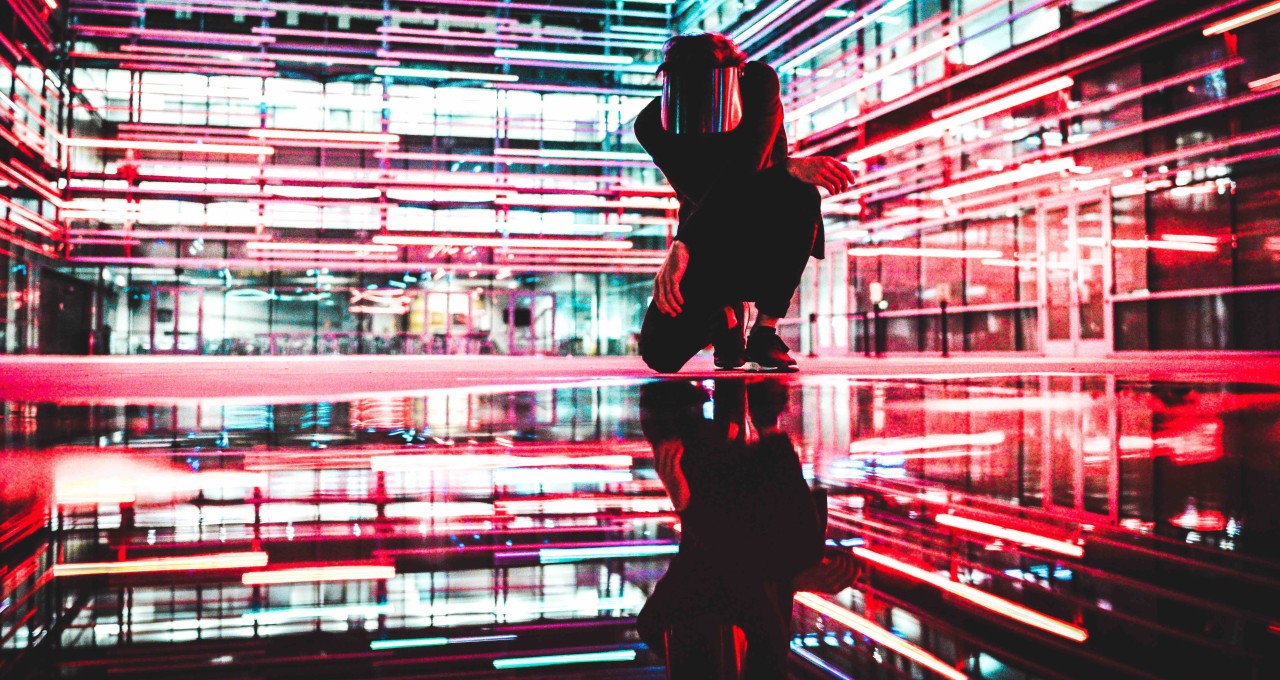


would want to access VR”. I’m so over that. I’m SOOO over that comment.
👿 Let’s make one thing clear: if you make a human “sub-human” in
front of me, there will be angry eyes. Start here: https://equalentry.com/virtual-reality-development-for-blind/ and then here: https://equalentry.com/how-can-a-blind-person-use-virtual-reality/ and for a video, see here (seriously, WATCH the very beginning): https://youtu.be/rvsZ1ssyom8
Sound