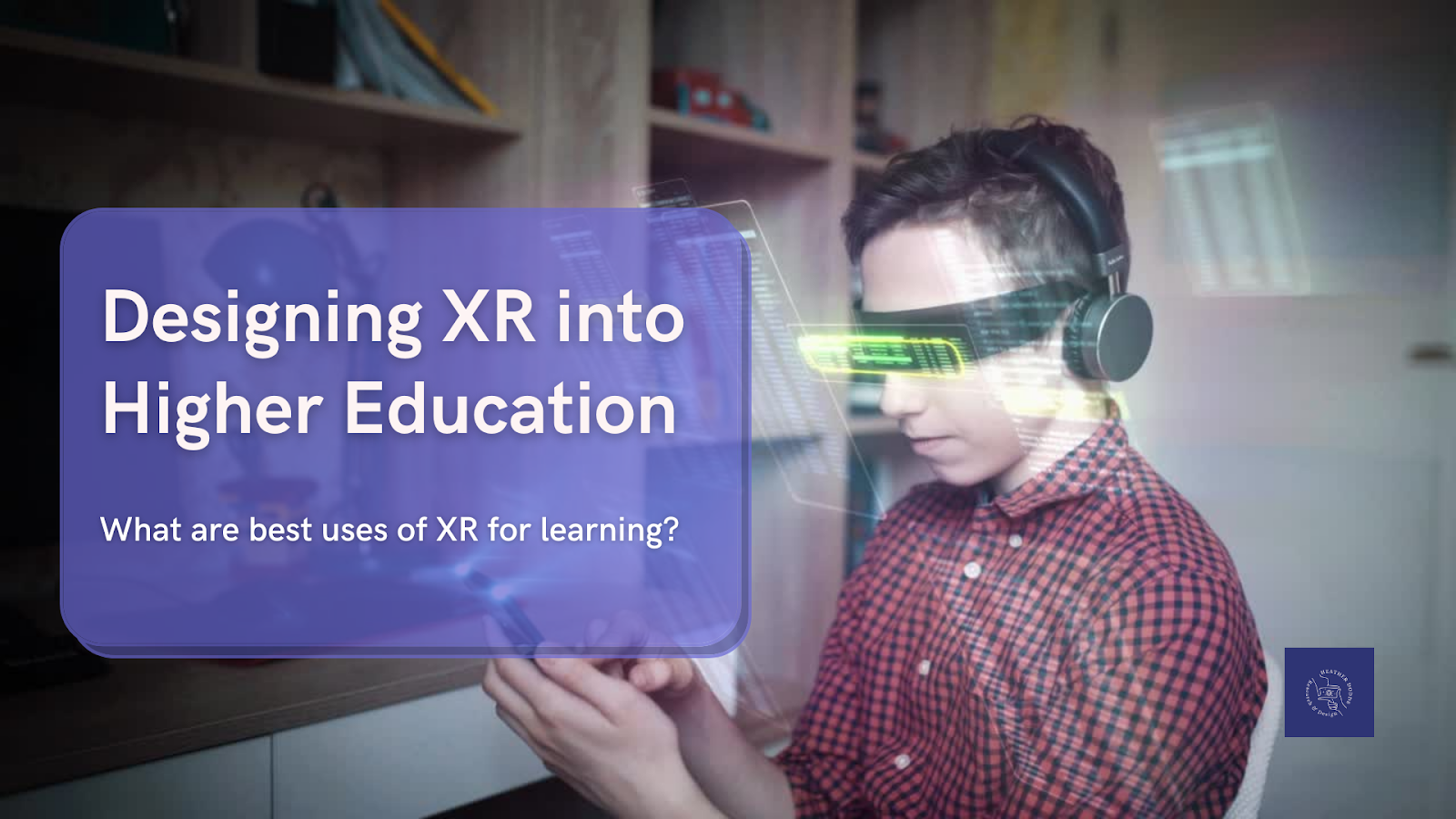

With the dramatic shift to online learning with the arrival of the
COVID-19 pandemic, faculty, staff, and students within higher education
worldwide have made the sudden but necessary initial steps to
incorporate technology into the learning environment in ways never
imagined. However, forward-thinking administrators are wondering, “what
comes next?” Immersive learning and XR answer this call.
Created with care in Canva.
Sources:
Definitions come from my own writing here:
Ziker C., Truman B., Dodds H. (2021) Cross Reality (XR): Challenges and
Opportunities Across the Spectrum. In: Ryoo J., Winkelmann K. (eds)
Innovative Learning Environments in STEM Higher Education.
SpringerBriefs in Statistics. Springer, Cham. https://doi.org/10.1007/978-3-030-58948-6_4
Dodds, H. (2021). Immersive Learning Environments: Designing XR into
Higher Education. In J. E. Stefaniak, S. Conklin, B. Oyarzun, &
R. M. Reese (Eds.), A Practitioner’s Guide to Instructional Design in
Higher Education. EdTech Books. https://edtechbooks.org/id_highered/immersive_learning_e
Slide 6:
Mordor Intelligence. (2021). Extended Reality (XR) Market –
Growth, Trends, COVID-19 Impact, and Forecasts (2021 – 2026) https://www.mordorintelligence.com/industry-reports/extended-reality-xr-market
Slide 8 does not have one source but over 20 years research (including
my dissertation study) with technology-facilitated immersive learning
has yet to show a significant improvement other any other learning
media. This aligns with this important article in the history of
instructional design: Clark, R. E. (1994). Media will never influence
learning. Educational technology research and development, 42(2), 21-29.
Slides 9, 10, 11 “XR reduces Time, Money, Danger” (similarly expressed
in my dissertation). There are parallel comments made by Jeremy
Bailenson documented here as his “DICE” advice. https://stanfordvr.com/video/2019/transformative-experiences-vr-for-good/
It should be noted that the DICE advice are the 4 occasions for which
to NOT use VR (against) where my 3 are 3 occasions TO use VR (for).
The combination of 4 different models is my own published creation:
ADDIE (traditional ID model), Design Thinking (from UX), 3DLED (from
Karl Kapp), and narrative plot (loosely credited to Pixar). They are
displayed here to show the remarkable similarity of steps/pathway across
each model, thus supporting the validity of the proposed path.